"I am not one who was born in the custody of wisdom. I am one who is fond of olden times and intense in quest of the sacred knowing of the ancients." Gustave Courbet
Showing posts with label storytelling. Show all posts

01 November 2026

Spattered.

Kelley, The Schoolhouse, Being Deserted, Soon Fell to Decay, and Was Reported to be Haunted by the Ghost of the Unfortunate Pedagogue, 1991


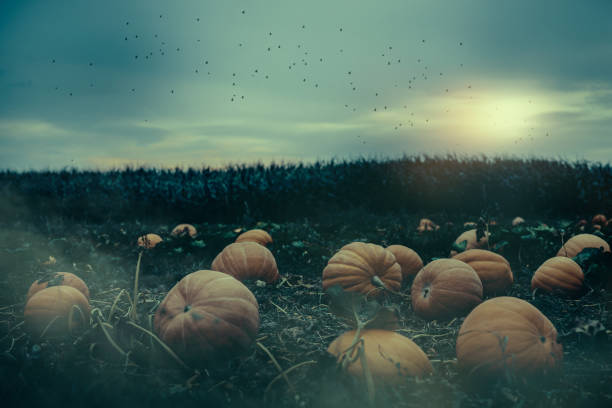
The next morning the old horse was found, without his saddle and with the bridle under his feet, soberly cropping the grass at his master’s gate. Ichabod did not make his appearance at breakfast; dinner-hour came, but no Ichabod. The boys assembled at the school-house and strolled idly about the banks of the brook but no schoolmaster. Hans Van Ripper now began to feel some uneasiness about the fate of poor Ichabod and his saddle. An inquiry was set on foot, and after diligent investigation they came upon his traces. In one part of the road leading to the church was found the saddle trampled in the dirt; the tracks of horses’ hoofs, deeply dented in the road and evidently at furious speed, were traced to the bridge, beyond which, on the bank of a broad part of the brook, where the water ran deep and black, was found the hat of the unfortunate Ichabod, and close beside it a spattered pumpkin.

Washington Irving, from "The Legend of Sleepy Hollow"

31 October 2026

Tremendous.

Kelley, Just Then He Saw the Goblin Rising in His Stirrups, and in the Very Act of Hurling his Head at Him, 1991


The hair of the affrighted pedagogue rose upon his head with terror. What was to be done? To turn and fly was now too late; and besides, what chance was there of escaping ghost or goblin, if such it was, which could ride upon the wings of the wind? Summoning up, therefore, a show of courage, he demanded in stammering accents, “Who are you?” He received no reply. He repeated his demand in a still more agitated voice. Still there was no answer. Once more he cudgelled the sides of the inflexible Gunpowder, and, shutting his eyes, broke forth with involuntary fervor into a psalm tune. Just then the shadowy object of alarm put itself in motion, and with a scramble and a bound stood at once in the middle of the road. Though the night was dark and dismal, yet the form of the unknown might now in some degree be ascertained. He appeared to be a horseman of large dimensions and mounted on a black horse of powerful frame. He made no offer of molestation or sociability, but kept aloof on one side of the road, jogging along on the blind side of old Gunpowder, who had now got over his fright and waywardness.

Ichabod, who had no relish for this strange midnight companion, and bethought himself of the adventure of Brom Bones with the Galloping Hessian, now quickened his steed in hopes of leaving him behind. The stranger, however, quickened his horse to an equal pace. Ichabod pulled up, and fell into a walk, thinking to lag behind; the other did the same. His heart began to sink within him; he endeavored to resume his psalm tune, but his parched tongue clove to the roof of his mouth and he could not utter a stave. There was something in the moody and dogged silence of this pertinacious companion that was mysterious and appalling. It was soon fearfully accounted for. On mounting a rising ground, which brought the figure of his fellow-traveller in relief against the sky, gigantic in height and muffled in a cloak, Ichabod was horror-struck on perceiving that he was headless! but his horror was still more increased on observing that the head, which should have rested on his shoulders, was carried before him on the pommel of the saddle. His terror rose to desperation, he rained a shower of kicks and blows upon Gunpowder, hoping by a sudden movement to give his companion the slip; but the spectre started full jump with him. Away, then, they dashed through thick and thin, stones flying and sparks flashing at every bound. Ichabod’s flimsy garments fluttered in the air as he stretched his long lank body away over his horse’s head in the eagerness of his flight.

They had now reached the road which turns off to Sleepy Hollow; but Gunpowder, who seemed possessed with a demon, instead of keeping up it, made an opposite turn and plunged headlong down hill to the left. This road leads through a sandy hollow shaded by trees for about a quarter of a mile, where it crosses the bridge famous in goblin story, and just beyond swells the green knoll on which stands the whitewashed church.

As yet the panic of the steed had given his unskillful rider an apparent advantage in the chase; but just as he had got halfway through the hollow the girths of the saddle gave away and he felt it slipping from under him. He seized it by the pommel and endeavored to hold it firm, but in vain, and had just time to save himself by clasping old Gunpowder round the neck, when the saddle fell to the earth, and he heard it trampled under foot by his pursuer. For a moment the terror of Hans Van Ripper’s wrath passed across his mind, for it was his Sunday saddle; but this was no time for petty fears; the goblin was hard on his haunches, and (unskilled rider that he was) he had much ado to maintain his seat, sometimes slipping on one side, sometimes on another, and sometimes jolted on the high ridge of his horse’s back-bone with a violence that he verily feared would cleave him asunder.

An opening in the trees now cheered him with the hopes that the church bridge was at hand. The wavering reflection of a silver star in the bosom of the brook told him that he was not mistaken. He saw the walls of the church dimly glaring under the trees beyond. He recollected the place where Brom Bones’ ghostly competitor had disappeared. “If I can but reach that bridge,” thought Ichabod, “I am safe.” Just then he heard the black steed panting and blowing close behind him; he even fancied that he felt his hot breath. Another convulsive kick in the ribs, and old Gunpowder sprang upon the bridge; he thundered over the resounding planks; he gained the opposite side; and now Ichabod cast a look behind to see if his pursuer should vanish, according to rule, in a flash of fire and brimstone. Just then he saw the goblin rising in his stirrups, and in the very act of hurling his head at him. Ichabod endeavored to dodge the horrible missile, but too late. It encountered his cranium with a tremendous crash; he was tumbled headlong into the dust, and Gunpowder, the black steed, and the goblin rider passed by like a whirlwind.

Washington Irving, from "The Legend of Sleepy Hollow"

30 October 2026

Scourings.

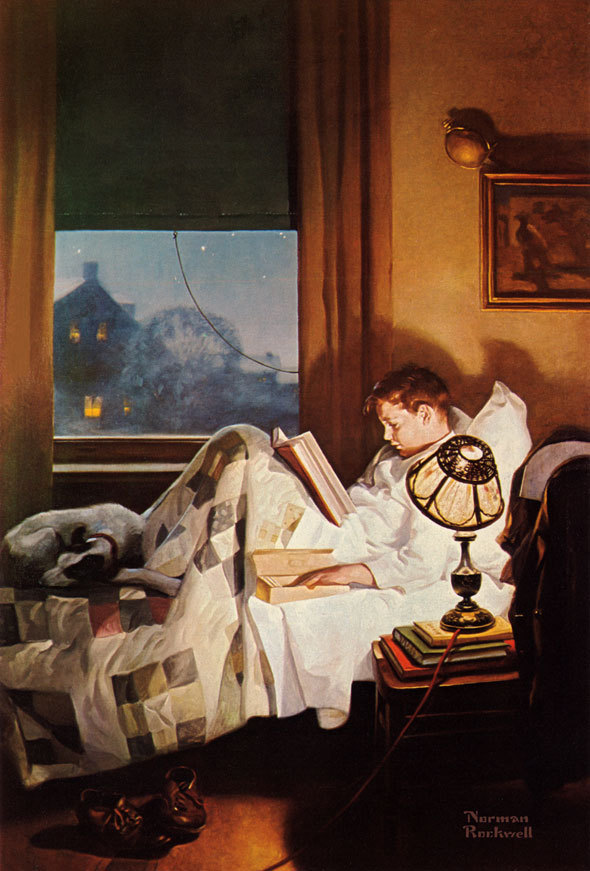
Rockwell, Ichabod Crane, 1937


The schoolmaster is generally a man of some importance in the female circle of a rural neighborhood; being considered a kind of idle, gentlemanlike personage, of vastly superior taste and accomplishments to the rough country swains, and, indeed, inferior in learning only to the parson. His appearance, therefore, is apt to occasion some little stir at the tea-table of a farmhouse, and the addition of a supernumerary dish of cakes or sweetmeats, or, peradventure, the parade of a silver teapot. Our man of letters, therefore, was peculiarly happy in the smiles of all the country damsels. How he would figure among them in the churchyard, between services on Sundays; gathering grapes for them from the wild vines that overran the surrounding trees; reciting for their amusement all the epitaphs on the tombstones; or sauntering, with a whole bevy of them, along the banks of the adjacent millpond; while the more bashful country bumpkins hung sheepishly back, envying his superior elegance and address.

From his half-itinerant life, also, he was a kind of travelling gazette, carrying the whole budget of local gossip from house to house, so that his appearance was always greeted with satisfaction. He was, moreover, esteemed by the women as a man of great erudition, for he had read several books quite through, and was a perfect master of Cotton Mather’s History of New England Witchcraft, in which, by the way, he most firmly and potently believed.

He was, in fact, an odd mixture of small shrewdness and simple credulity. His appetite for the marvellous, and his powers of digesting it, were equally extraordinary; and both had been increased by his residence in this spell-bound region. No tale was too gross or monstrous for his capacious swallow. It was often his delight, after his school was dismissed in the afternoon, to stretch himself on the rich bed of clover bordering the little brook that whimpered by his schoolhouse, and there con over old Mather’s direful tales, until the gathering dusk of evening made the printed page a mere mist before his eyes. Then, as he wended his way by swamp and stream and awful woodland, to the farmhouse where he happened to be quartered, every sound of nature, at that witching hour, fluttered his excited imagination,—the moan of the whip-poor-will from the hillside, the boding cry of the tree toad, that harbinger of storm, the dreary hooting of the screech owl, or the sudden rustling in the thicket of birds frightened from their roost. The fireflies, too, which sparkled most vividly in the darkest places, now and then startled him, as one of uncommon brightness would stream across his path; and if, by chance, a huge blockhead of a beetle came winging his blundering flight against him, the poor varlet was ready to give up the ghost, with the idea that he was struck with a witch’s token. His only resource on such occasions, either to drown thought or drive away evil spirits, was to sing psalm tunes and the good people of Sleepy Hollow, as they sat by their doors of an evening, were often filled with awe at hearing his nasal melody, “in linked sweetness long drawn out,” floating from the distant hill, or along the dusky road.

Another of his sources of fearful pleasure was to pass long winter evenings with the old Dutch wives, as they sat spinning by the fire, with a row of apples roasting and spluttering along the hearth, and listen to their marvellous tales of ghosts and goblins, and haunted fields, and haunted brooks, and haunted bridges, and haunted houses, and particularly of the headless horseman, or Galloping Hessian of the Hollow, as they sometimes called him. He would delight them equally by his anecdotes of witchcraft, and of the direful omens and portentous sights and sounds in the air, which prevailed in the earlier times of Connecticut; and would frighten them woefully with speculations upon comets and shooting stars; and with the alarming fact that the world did absolutely turn round, and that they were half the time topsy-turvy!

But if there was a pleasure in all this, while snugly cuddling in the chimney corner of a chamber that was all of a ruddy glow from the crackling wood fire, and where, of course, no spectre dared to show its face, it was dearly purchased by the terrors of his subsequent walk homewards. What fearful shapes and shadows beset his path, amidst the dim and ghastly glare of a snowy night! With what wistful look did he eye every trembling ray of light streaming across the waste fields from some distant window! How often was he appalled by some shrub covered with snow, which, like a sheeted spectre, beset his very path! How often did he shrink with curdling awe at the sound of his own steps on the frosty crust beneath his feet; and dread to look over his shoulder, lest he should behold some uncouth being tramping close behind him! And how often was he thrown into complete dismay by some rushing blast, howling among the trees, in the idea that it was the Galloping Hessian on one of his nightly scourings!

Washington Irving, from "The Legend of Sleepy Hollow", found among the papers of the late Dietrich Knickerbocker in Geoffrey Crayon's Sketchbook

29 October 2026

Legendary.

Kelley, A Fine Autumnal Day, 1990


From the listless repose of the place, and the peculiar character of its inhabitants, who are descendants from the original Dutch settlers, this sequestered glen has long been known by the name of SLEEPY HOLLOW, and its rustic lads are called the Sleepy Hollow Boys throughout all the neighboring country. A drowsy, dreamy influence seems to hang over the land, and to pervade the very atmosphere. Some say that the place was bewitched by a High German doctor, during the early days of the settlement; others, that an old Indian chief, the prophet or wizard of his tribe, held his powwows there before the country was discovered by Master Hendrick Hudson. Certain it is, the place still continues under the sway of some witching power, that holds a spell over the minds of the good people, causing them to walk in a continual reverie. They are given to all kinds of marvellous beliefs, are subject to trances and visions, and frequently see strange sights, and hear music and voices in the air. The whole neighborhood abounds with local tales, haunted spots, and twilight superstitions; stars shoot and meteors glare oftener across the valley than in any other part of the country, and the nightmare, with her whole ninefold, seems to make it the favorite scene of her gambols.

The dominant spirit, however, that haunts this enchanted region, and seems to be commander-in-chief of all the powers of the air, is the apparition of a figure on horseback, without a head. It is said by some to be the ghost of a Hessian trooper, whose head had been carried away by a cannon-ball, in some nameless battle during the Revolutionary War, and who is ever and anon seen by the country folk hurrying along in the gloom of night, as if on the wings of the wind. His haunts are not confined to the valley, but extend at times to the adjacent roads, and especially to the vicinity of a church at no great distance. Indeed, certain of the most authentic historians of those parts, who have been careful in collecting and collating the floating facts concerning this spectre, allege that the body of the trooper having been buried in the churchyard, the ghost rides forth to the scene of battle in nightly quest of his head, and that the rushing speed with which he sometimes passes along the Hollow, like a midnight blast, is owing to his being belated, and in a hurry to get back to the churchyard before daybreak.

Such is the general purport of this legendary superstition, which has furnished materials for many a wild story in that region of shadows; and the spectre is known at all the country firesides, by the name of the Headless Horseman of Sleepy Hollow.

Washington Irving, from The Legend of Sleepy Hollow

24 October 2026

Early.


But you take October, now. School’s been on a month and you’re riding easier in the reins, jogging along. You got time to think of the garbage you’ll dump on old man Prickett’s porch, or the hairy-ape costume you’ll wear to the YMCA the last night of the month. And if it’s around October twentieth and everything smoky-smelling and the sky orange and ash grey at twilight, it seems Hallowe’en will never come in a fall of broomsticks and a soft flap of bedsheets around corners.

But one strange wild dark long year, Hallowe’en came early.

One year Hallowe’en came on October 24, three hours after midnight.


Thanks, Kurt.

23 October 2026

Wish.


“There goes the Todd woman,” I said.

Homer Buckland watched the little Jaguar go by and nodded. The woman raised her hand to Homer. Homer nodded his big, shaggy head to her but didn’t raise his own hand in return. The Todd family had a big summer home on Castle Lake, and Homer had been their caretaker since time out of mind. I had an idea that he disliked Worth Todd’s second wife every bit as much as he’d liked ’Phelia Todd, the first one.

This was just about two years ago and we were sitting on a bench in front of Bell’s Market, me with an orange soda-pop, Homer with a glass of mineral water. It was October, which is a peaceful time in Castle Rock. Lots of the lake places still get used on the weekends, but the aggressive, boozy summer socializing is over by then and the hunters with their big guns and their expensive nonresident permits pinned to their orange caps haven’t started to come into town yet. Crops have been mostly laid by. Nights are cool, good for sleeping, and old joints like mine haven’t yet started to complain. In October the sky over the lake is passing fair, with those big white clouds that move so slow; I like how they seem so flat on the bottoms, and how they are a little gray there, like with a shadow of sundown foretold, and I can watch the sun sparkle on the water and not be bored for some space of minutes. It’s in October, sitting on the bench in front of Bell’s and watching the lake from afar off, that I still wish I was a smoking man.

Stephen King, from "Mrs Todd's Shortcut"

Thanks to Kurtastrophe for introducing me to this way, way back in those heady days.

17 August 2026

Too.


When someone doesn't show up, the people who wait sometimes tell stories about what might have happened and come to half believe the desertion, the abduction, the accident. Worry is a way to pretend that you have knowledge or control over what you don't--and it surprises me, even in myself, how much we prefer ugly scenarios to the pure unknown. Perhaps fantasy is what you fill up maps with rather than saying that they too contain the unknown.

Rebecca Solnit, from A Field Guide to Getting Lost

13 August 2026

Murmuring.


Until then I had thought each book spoke of the things, human or divine, that lie outside books. Now I realized that not infrequently books speak of books: it is as if they spoke among themselves. In the light of this reflection, the library seemed all the more disturbing to me. It was then the place of a long, centuries-old murmuring, an imperceptible dialogue between one parchment and another.

Thus I rediscovered what writers have always known (and have told us again and again): books always speak of other books, and every story tells a story that has already been told.

Umberto Eco, from the postscript to The Name of the Rose

04 August 2026

Emptiness.


In the living room the voice-clock sang, Tick-tock, seven o'clock, time to get up, time to get up, seven o'clock! as if it were afraid that nobody would. The morning house lay empty. The clock ticked on, repeating and repeating its sounds into the emptiness. Seven-nine, breakfast time, seven-nine!

In the kitchen the breakfast stove gave a hissing sigh and ejected from its warm interior eight pieces of perfectly browned toast, eight eggs sunny side up, sixteen slices of bacon, two coffees, and two cool glasses of milk.

"Today is August 4, 2026," said a second voice from the kitchen ceiling, "in the city of Allendale, California." It repeated the date three times for memory's sake. "Today is Mr. Featherstone's birthday. Today is the anniversary of Tilita's marriage. Insurance is payable, as are the water, gas, and light bills."

Somewhere in the walls, relays clicked, memory tapes glided under electric eyes ...

Ray Bradbury, from "There Will Come Soft Rains"

23 July 2026

Satisfactory.


He watched them holding themselves with their noses into the current, many trout in deep, fast moving water, slightly distorted as he watched far down through the glassy convex surface of the pool, its surface pushing and swelling smooth against the resistance of the log-driven piles of the bridge. At the bottom of the pool were the big trout. Nick did not see them at first. Then he saw them at the bottom of the pool, big trout looking to hold themselves on the gravel bottom in a varying mist of gravel and sand, raised in spurts by the current.

Nick looked down into the pool from the bridge. It was a hot day. A kingfisher flew up the stream. It was a long time since Nick had looked into a stream and seen trout. They were very satisfactory. As the shadow of the kingfisher moved up the stream, a big trout shot upstream in a long angle, only his shadow marking the angle, then lost his shadow as he came through the surface of the water, caught the sun, and then, as he went back into the stream under the surface, his shadow seemed to float down the stream with the current, unresisting, to his post under the bridge where he tightened facing up into the current.

Nick's heart tightened as the trout moved. He felt all the old feeling.

He turned and looked down the stream. It stretched away, pebbly-bottomed with shallows and big boulders and a deep pool as it curved away around the foot of a bluff.

Nick walked back up the ties to where his pack lay in the cinders beside the railway track. He was happy. He adjusted the pack harness around the bundle, pulling straps tight, slung the pack on his back, got his arms through the shoulder straps and took some of the pull off his shoulders by leaning his forehead against the wide band of the tump-line. Still, it was too heavy. It was much too heavy. He had his leather rod-case in his hand and leaning forward to keep the weight of the pack high on his shoulders he walked along the road that paralleled the railway track, leaving the burned town behind in the heat, and then turned off around a hill with a high, fire-scarred hill on either side onto a road that went back into the country. He walked along the road feeling the ache from the pull of the heavy pack. The road climbed steadily. It was hard work walking up-hill. His muscles ached and the day was hot, but Nick felt happy. He felt he had left everything behind, the need for thinking, the need to write, other needs. It was all back of him.


Ernest Hemingway, from "Big Two-Hearted River, Part One"

13 June 2026

Fascinating.


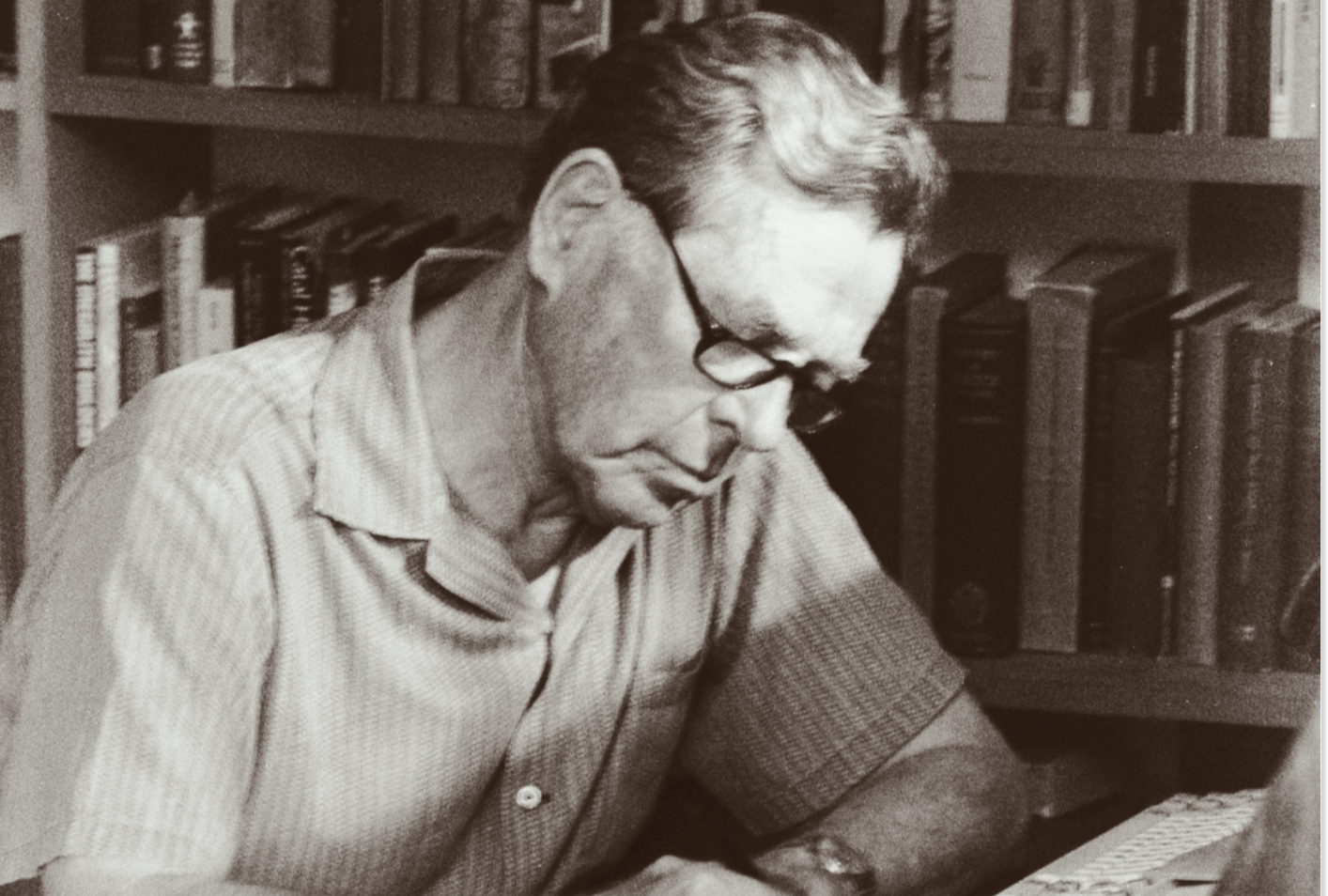
Roosevelt Junior High School was fortunate enough to have Bob Stevens as an 8th grade history teacher. Mr. Stevens would spend each history period walking between the desks of students bringing to life the history of this country. Hands behind his back he would walk and tell the stories of the country.

Occasionally, he would grab the chalk and draw out a battle scheme on the chalkboard, supplementing the drawing with gory and fascinating details.

Several friends and I even decided to bring our own history books into class to “check” Mr. Stevens on his facts. No way could he just roll these details out without at least some exaggeration.

Imagine an 8th grade class with at least four young students feverishly flipping through a stack of books as the teacher told the lesson from memory.

My family moved to Ohio from Michigan in 1977.  On my first day of school at Roosevelt, I had the bright idea to wear a Michigan jersey to school. Coach Stevens noticed it within minutes. He picked me up (in my chair), carried me to his room, placed me in my chair atop his desk and proclaimed to his class, “Look what I found!”

Thirty years later, after a pretty drastic career change, I was blessed to spend time with him in his third-floor classroom as he mentored me through my student-teaching experience.

Through those Roosevelt years, Coach Stevens told amazing stories to engage his students, he maintained the highest standards to set an example for his students, and he carried himself in a way that I still remember today.  I knew he believed in me and all his students.  He was a model of what it was to be not just a good teacher, but a great man.  His sincerity and authenticity were such that you didn't want to let him down.  That responsibility was transformative to a young punk like me.

I’m beginning my twenty-second year as a teacher and there isn’t a day that goes by that doesn’t catch me feeling grateful that I was his student. What a fine teacher. What a great man.

21 April 2026

Happy Birthday, John Muir


I kept my lofty perch for hours, frequently closing my eyes to enjoy the music by itself, or to feast quietly on the delicious fragrance that was streaming past. The fragrance of the woods was less marked than that produced during warm rain, when so many balsamic buds and leaves are steeped like tea; but, from the chafing of resiny branches against each other, and the incessant attrition of myriads of needles, the gale was spiced to a very tonic degree. And besides the fragrance from these local sources there were traces of scents brought from afar. For this wind came first from the sea, rubbing against its fresh, briny waves, then distilled through the redwoods, threading rich ferny gulches, and spreading itself in broad undulating currents over many a flower-enameled ridge of the coast mountains, then across the golden plains, up the purple foot-hills, and into these piney woods with the varied incense gathered by the way.

John Muir, born on this day in 1838, from "A Wind-Storm in the Forest"

29 March 2026

Treasures.

Hamilton of Finnart, Stirling Castle, 1496


On the following morning, the sun darted his beams from over the hills through the low lattice window. I rose at an early hour, and looked out between the branches of eglantine which overhung the casement. To my surprise Scott was already up and forth, seated on a fragment of stone, and chatting with the workmen employed on the new building. I had supposed, after the time he had wasted upon me yesterday, he would be closely occupied this morning, but he appeared like a man of leisure, who had nothing to do but bask in the sunshine and amuse himself.

I soon dressed myself and joined him. He talked about his proposed plans of Abbotsford; happy would it have been for him could he have contented himself with his delightful little vine-covered cottage, and the simple, yet hearty and hospitable style, in which he lived at the time of my visit. The great pile of Abbotsford, with the huge expense it entailed upon him, of servants, retainers, guests, and baronial style, was a drain upon his purse, a tax upon his exertions, and a weight upon his mind, that finally crushed him.

As yet, however, all was in embryo and perspective, and Scott pleased himself with picturing out his future residence, as he would one of the fanciful creations of his own romances. "It was one of his air castles," he said, "which he was reducing to solid stone and mortar." About the place were strewed various morsels from the ruins of Melrose Abbey, which were to be incorporated in his mansion. He had already constructed out of similar materials a kind of Gothic shrine over a spring, and had surmounted it by a small stone cross.

Among the relics from the Abbey which lay scattered before us, was a most quaint and antique little lion, either of red stone, or painted red, which hit my fancy. I forgot whose cognizance it was; but I shall never forget the delightful observations concerning old Melrose to which it accidentally gave rise. The Abbey was evidently a pile that called up all Scott's poetic and romantic feelings; and one to which he was enthusiastically attached by the most fanciful and delightful of his early associations. He spoke of it, I may say, with affection. "There is no telling," said he, "what treasures are hid in that glorious old pile. It is a famous place for antiquarian plunder; there are such rich bits of old time sculpture for the architect, and old time story for the poet. There is as rare picking in it as a Stilton cheese, and in the same taste—the mouldier the better."

Washington Irving, from "Abbotsford and Newstead Abbey"

22 March 2026

Sprang.


Uncle Thomas was the first to draw my attention to the possibilities of the old bureau.  He was pottering about the house one afternoon, having ordered me to keep at his heels for company—he was a man who hated to be left one minute alone,—when his eye fell on it. "H'm! Sheraton!" he remarked. (He had a smattering of most things, this uncle, especially the vocabularies.) Then he let down the flap, and examined the empty pigeon-holes and dusty paneling. "Fine bit of inlay," he went on: "good work, all of it. I know the sort. There's a secret drawer in there somewhere." Then as I breathlessly drew near, he suddenly exclaimed: "By Jove, I do want to smoke!" And, wheeling round, he abruptly fled for the garden, leaving me with the cup dashed from my lips. What a strange thing, I mused, was this smoking, that takes a man suddenly, be he in the court, the camp, or the grove, grips him like an Afreet, and whirls him off to do its imperious behests! Would it be even so with myself, I wondered, in those unknown grown-up years to come?

But I had no time to waste in vain speculations. My whole being was still vibrating to those magic syllables 'secret drawer'; and that particular chord had been touched that never fails to thrill responsive to such words as cave, trap-door, sliding-panel, bullion, ingots, or Spanish dollars. For, besides its own special bliss, who ever heard of a secret drawer with nothing in it? And O I did want money so badly! I mentally ran over the list of demands which were pressing me the most imperiously.

First, there was the pipe I wanted to give George Jannaway. George, who was Martha's young man, was a shepherd, and a great ally of mine; and the last fair he was at, when he bought his sweetheart fairings, as a right-minded shepherd should, he had purchased a lovely snake expressly for me; one of the wooden sort, with joints, waggling deliciously in the hand; with yellow spots on a green ground, sticky and strong-smelling, as a fresh-painted snake ought to be; and with a red-flannel tongue pasted cunningly into its jaws. I loved it much, and took it to bed with me every night, till what time its spinal cord was loosed and it fell apart, and went the way of all mortal joys. I thought it very nice of George to think of me at the fair, and that's why I wanted to give him a pipe. When the young year was chill and lambing-time was on, George inhabited a little wooden house on wheels, far out on the wintry downs, and saw no faces but such as were sheepish and woolly and mute; and when he and Martha were married, she was going to carry his dinner out to him every day, two miles; and after it, perhaps he would smoke my pipe. It seemed an idyllic sort of existence, for both the parties concerned; but a pipe of quality, a pipe fitted to be part of a life such as this, could not be procured (so Martha informed me) for a smaller sum than eighteenpence. And meantime——!

Then there was the fourpence I owed Edward; not that he was bothering me for it, but I knew he was in need of it himself, to pay back Selina, who wanted it to make up a sum of two shillings, to buy Harold an ironclad for his approaching birthday,—H.M.S. Majestic, now lying uselessly careened in the toyshop window, just when her country had such sore need of her. And then there was that boy in the village who had caught a young squirrel, and I had never yet possessed one, and he wanted a shilling for it, but I knew that for ninepence in cash—but what was the good of these sorry threadbare reflections? I had wants enough to exhaust any possible find of bullion, even if it amounted to half a sovereign. My only hope now lay in the magic drawer, and here I was, standing and letting the precious minutes slip by! Whether 'findings' of this sort could, morally speaking, be considered 'keepings,' was a point that did not occur to me.

The room was very still as I approached the bureau; possessed, it seemed to be, by a sort of hush of expectation. The faint odour of orris-root that floated forth as I let down the flap, seemed to identify itself with the yellows and browns of the old wood, till hue and scent were of one quality and interchangeable. Even so, ere this, the pot-pourri had mixed itself with the tints of the old brocade, and brocade and pot-pourri had long been one. With expectant fingers I explored the empty pigeon-holes and sounded the depths of the softly-sliding drawers. No books that I knew of gave any general recipe for a quest like this; but the glory, should I succeed unaided, would be all the greater.

To him who is destined to arrive, the fates never fail to afford, on the way, their small encouragements. In less than two minutes, I had come across a rusty button-hook. This was truly magnificent. In the nursery there existed, indeed, a general button-hook, common to either sex; but none of us possessed a private and special button-hook, to lend or to refuse as suited the high humour of the moment. I pocketed the treasure carefully, and proceeded. At the back of another drawer, three old foreign stamps told me I was surely on the highroad to fortune.

Following on these bracing incentives, came a dull blank period of unrewarded search. In vain I removed all the drawers and felt over every inch of the smooth surfaces, from front to back. Never a knob, spring or projection met the thrilling finger-tips; unyielding the old bureau stood, stoutly guarding its secret, if secret it really had. I began to grow weary and disheartened. This was not the first time that Uncle Thomas had proved shallow, uninformed, a guide into blind alleys where the echoes mocked you. Was it any good persisting longer? Was anything any good whatever? In my mind I began to review past disappointments, and life seemed one long record of failure and of non-arrival. Disillusioned and depressed, I left my work and went to the window. The light was ebbing from the room, and seemed outside to be collecting itself on the horizon for its concentrated effort of sunset. Far down the garden, Uncle Thomas was holding Edward in the air reversed, and smacking him. Edward, gurgling hysterically, was striking blind fists in the direction where he judged his uncle's stomach should rightly be; the contents of his pockets—a motley show—were strewing the lawn. Somehow, though I had been put through a similar performance myself an hour or two ago, it all seemed very far away and cut off from me.

Westwards the clouds were massing themselves in a low violet bank; below them, to north and south, as far round as eye could reach, a narrow streak of gold ran out and stretched away, straight along the horizon. Somewhere very far off, a horn was blowing, clear and thin; it sounded like the golden streak grown audible, while the gold seemed the visible sound. It pricked my ebbing courage, this blended strain of music and colour. I turned for a last effort; and Fortune thereupon, as if half-ashamed of the unworthy game she had been playing with me, relented, opening her clenched fist. Hardly had I put my hand once more to the obdurate wood, when with a sort of small sigh, almost a sob—as it were—of relief, the secret drawer sprang open.

Kenneth Grahame, from The Golden Age

Transcendent.


I think of mythology as the homeland of the muses, the inspirers of art, the inspirers of poetry. To see life as a poem and yourself participating in a poem is what mythology does for you.

I mean a vocabulary in the form of not words but acts and adventures, which connotes something transcendent of the action here so that you always feel in accord with the universal being.

Joseph Campbell, from The Power of Myth

08 March 2026

Unsuspected.

Keen, The Old Manse, Concord, Massachusetts, 1900
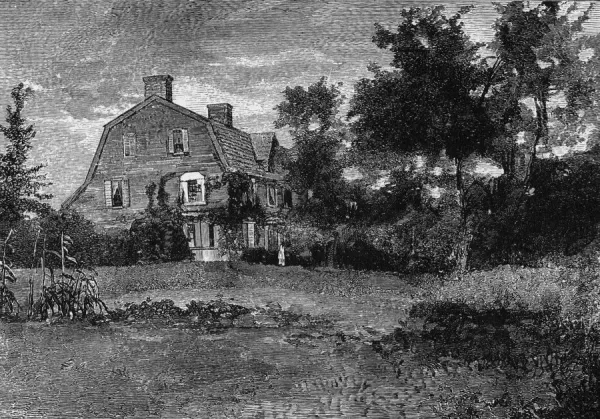

Happy the man who in a rainy day can betake himself to a huge garret, stored, like that of the Manse, with lumber that each generation has left behind it from a period before the Revolution. Our garret was an arched hall, dimly illuminated through small and dusty windows; it was but a twilight at the best; and there were nooks, or rather caverns, of deep obscurity, the secrets of which I never learned, being too reverent of their dust and cobwebs. The beams and rafters, roughly hewn and with strips of bark still on them, and the rude masonry of the chimneys, made the garret look wild and uncivilized, an aspect unlike what was seen elsewhere in the quiet and decorous old house. But on one side there was a little whitewashed apartment, which bore the traditionary title of the Saint’s Chamber, because holy men in their youth had slept, and studied, and prayed there. With its elevated retirement, its one window, its small fireplace, and its closet convenient for an oratory, it was the very spot where a young man might inspire himself with solemn enthusiasm and cherish saintly dreams. The occupants, at various epochs, had left brief records and ejaculations inscribed upon the walls. There, too, hung a tattered and shrivelled roll of canvas, which on inspection proved to be the forcibly wrought picture of a clergyman, in wig, band, and gown, holding a Bible in his hand. As I turned his face towards the light, he eyed me with an air of authority such as men of his profession seldom assume in our days. The original had been pastor of the parish more than a century ago, a friend of Whitefield, and almost his equal in fervid eloquence. I bowed before the effigy of the dignified divine, and felt as if I had now met face to face with the ghost by whom, as there was reason to apprehend, the Manse was haunted.

Houses of any antiquity in New England are so invariably possessed with spirits that the matter seems hardly worth alluding to. Our ghost used to heave deep sighs in a particular corner of the parlor, and sometimes rustled paper, as if he were turning over a sermon in the long upper entry,—where nevertheless he was invisible, in spite of the bright moonshine that fell through the eastern window. Not improbably he wished me to edit and publish a selection from a chest full of manuscript discourses that stood in the garret. Once, while Hillard and other friends sat talking with us in the twilight, there came a rustling noise as of a minister’s silk gown, sweeping through the very midst of the company, so closely as almost to brush against the chairs. Still there was nothing visible. A yet stranger business was that of a ghostly servant-maid, who used to be heard in the kitchen at deepest midnight, grinding coffee, cooking, ironing,—performing, in short, all kinds of domestic labor,—although no traces of anything accomplished could be detected the next morning. Some neglected duty of her servitude, some ill-starched ministerial band, disturbed the poor damsel in her grave and kept her at work without any wages.

But to return from this digression. A part of my predecessor’s library was stored in the garret,—no unfit receptacle indeed for such dreary trash as comprised the greater number of volumes. The old books would have been worth nothing at an auction. In this venerable garret, however, they possessed an interest, quite apart from their literary value, as heirlooms, many of which had been transmitted down through a series of consecrated hands from the days of the mighty Puritan divines. Autographs of famous names were to be seen in faded ink on some of their fly-leaves; and there were marginal observations or interpolated pages closely covered with manuscript in illegible shorthand, perhaps concealing matter of profound truth and wisdom. The world will never be the better for it. A few of the books were Latin folios, written by Catholic authors; others demolished Papistry, as with a sledge-hammer, in plain English. A dissertation on the Book of Job—which only Job himself could have had patience to read—filled at least a score of small, thick-set quartos, at the rate of two or three volumes to a chapter. Then there was a vast folio body of divinity,—too corpulent a body, it might be feared, to comprehend the spiritual element of religion. Volumes of this form dated back two hundred years or more, and were generally bound in black leather, exhibiting precisely such an appearance as we should attribute to books of enchantment. Others equally antique were of a size proper to be carried in the large waistcoat pockets of old times,—diminutive, but as black as their bulkier brethren, and abundantly interfused with Greek and Latin quotations. These little old volumes impressed me as if they had been intended for very large ones, but had been unfortunately blighted at an early stage of their growth.

The rain pattered upon the roof and the sky gloomed through the dusty garret-windows while I burrowed among these venerable books in search of any living thought which should burn like a coal of fire or glow like an inextinguishable gem beneath the dead trumpery that had long hidden it. But I found no such treasure; all was dead alike; and I could not but muse deeply and wonderingly upon the humiliating fact that the works of man’s intellect decay like those of his hands. Thought grows mouldy. What was good and nourishing food for the spirits of one generation affords no sustenance for the next. Books of religion, however, cannot be considered a fair test of the enduring and vivacious properties of human thought, because such books so seldom really touch upon their ostensible subject, and have, therefore, so little business to be written at all. So long as an unlettered soul can attain to saving grace there would seem to be no deadly error in holding theological libraries to be accumulations of, for the most part, stupendous impertinence.

Many of the books had accrued in the latter years of the last clergyman’s lifetime. These threatened to be of even less interest than the elder works a century hence to any curious inquirer who should then rummage then as I was doing now. Volumes of the Liberal Preacher and Christian Examiner, occasional sermons, controversial pamphlets, tracts, and other productions of a like fugitive nature, took the place of the thick and heavy volumes of past time. In a physical point of view, there was much the same difference as between a feather and a lump of lead; but, intellectually regarded, the specific gravity of old and new was about upon a par. Both also were alike frigid. The elder books nevertheless seemed to have been earnestly written, and might be conceived to have possessed warmth at some former period; although, with the lapse of time, the heated masses had cooled down even to the freezing-point. The frigidity of the modern productions, on the other hand, was characteristic and inherent, and evidently had little to do with the writer’s qualities of mind and heart. In fine, of this whole dusty heap of literature I tossed aside all the sacred part, and felt myself none the less a Christian for eschewing it. There appeared no hope of either mounting to the better world on a Gothic staircase of ancient folios or of flying thither on the wings of a modern tract.

Nothing, strange to say, retained any sap except what had been written for the passing day and year, without the remotest pretension or idea of permanence. There were a few old newspapers, and still older almanacs, which reproduced to my mental eye the epochs when they had issued from the press with a distinctness that was altogether unaccountable. It was as if I had found bits of magic looking-glass among the books with the images of a vanished century in them. I turned my eyes towards the tattered picture above mentioned, and asked of the austere divine wherefore it was that he and his brethren, after the most painful rummaging and groping into their minds, had been able to produce nothing half so real as these newspaper scribblers and almanac-makers had thrown off in the effervescence of a moment. The portrait responded not; so I sought an answer for myself. It is the age itself that writes newspapers and almanacs, which therefore have a distinct purpose and meaning at the time, and a kind of intelligible truth for all times; whereas most other works—being written by men who, in the very act, set themselves apart from their age—are likely to possess little significance when new, and none at all when old. Genius, indeed, melts many ages into one, and thus effects something permanent, yet still with a similarity of office to that of the more ephemeral writer. A work of genius is but the newspaper of a century, or perchance of a hundred centuries.

Lightly as I have spoken of these old books, there yet lingers with me a superstitious reverence for literature of all kinds. A bound volume has a charm in my eyes similar to what scraps of manuscript possess for the good Mussulman. He imagines that those wind-wafted records are perhaps hallowed by some sacred verse; and I, that every new book or antique one may contain the “open sesame,”—the spell to disclose treasures hidden in some unsuspected cave of Truth. Thus it was not without sadness that I turned away from the library of the Old Manse.

Nathaniel Hawthorne, from "The Old Manse"

Outliers.


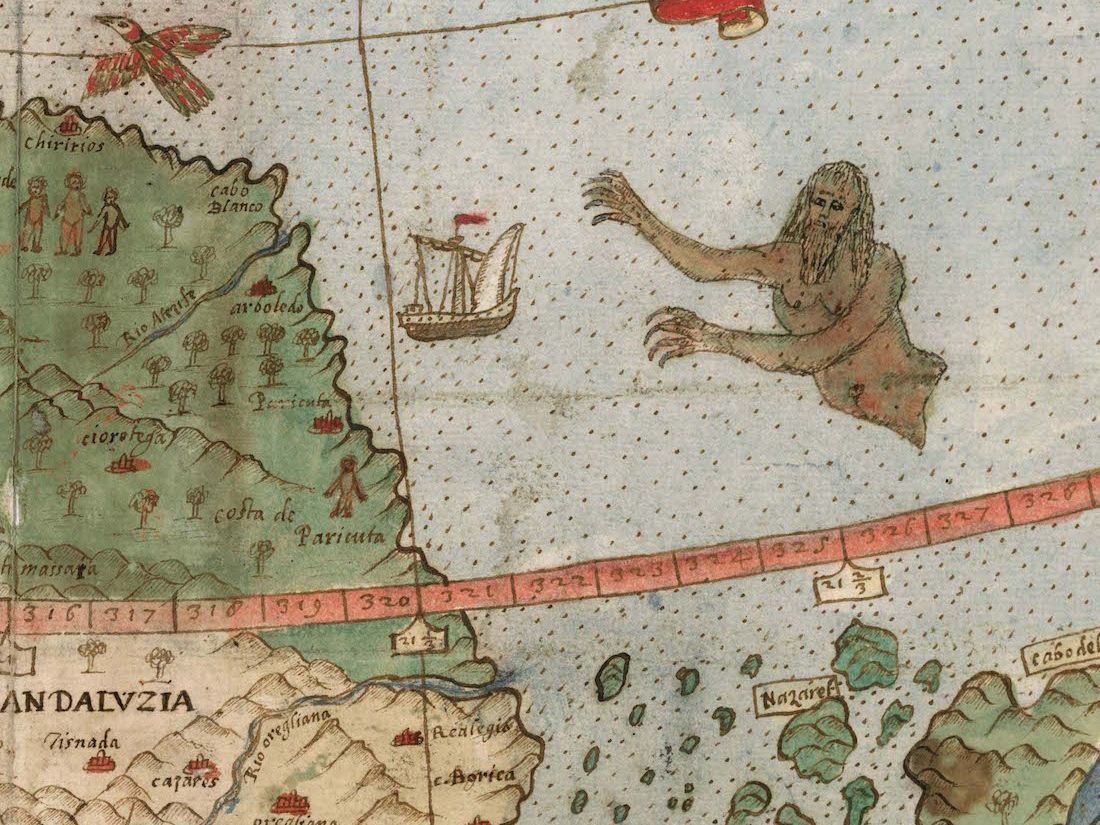
The Bodleian Map Room reminds us that when mapping imaginary lands, normal rules don't apply ...
This description, from the Oxford English Dictionary, is what we all imagine when we think of a map, and when we look at that map we expect to see a location, whether a detailed town plan or country, continent or world, somewhere that exists both in reality and on paper.

Despite all this there are some outliers in the map world, maps of places that only exist in the mind, maps of imaginary lands. 

07 March 2026

Inexhaustible.

Sargent, Robert Louis Stevenson, 1887


I am told there are people who do not care for maps, and I find it hard to believe.  The names, the shapes of the woodlands, the courses of the roads and rivers, the prehistoric footsteps of man still distinctly traceable up hill and down dale, the mills and the ruins, the ponds and the ferries, perhaps the standing tone or the Druidic Circle on the heath; here is an inexhaustible fund of interest for any man with eyes to see or twopence-worth of imagination to understand with!  No child but must remember laying his head in the grass, staring into the infinitesimal forest and seeing it grow populous with fairy armies.

Somewhat in this way, as I paused upon my map of Treasure Island, the future character of the book began to appear there visibly among imaginary woods; and their brown faces and bright weapons peeped out upon me from unexpected quarters, as they passed to and fro, fighting and hunting treasure, on these few square inches of a flat projection.  The next thing I knew I had some papers before me and was writing out a list of chapters.  How often have I done so, and the thing gone no further! But there seemed elements of success about this enterprise. 

Robert Louis Stevenson, from "My First Book, Treasure Island"

31 January 2026

Dared.


In January, Lake Erie froze nearly to Canada. One evening, standing before its ominous expanse in my ice skates, with a wool cap pulled over my ears and a long scarf wound around my neck and crisscrossed over my chest beneath my blue Navy-surplus pea jacket, I left the shore. I planned to face down the spectre of my fear by going as far as I dared toward Canada, or the Livingston ship channel if the icebreaker had been through. 
I hoped that my love of skating would propel me through the worst of my worries ...

Tom McGuane, from "Ice"