"I am not one who was born in the custody of wisdom. I am one who is fond of olden times and intense in quest of the sacred knowing of the ancients." Gustave Courbet
Showing posts with label libraries. Show all posts

20 July 2026

Kindled.

It so many fires in my imagination were kindled inside this glorious building ...

IN the LIBRARY 

There’s a book called
A Dictionary of Angels.
No one had opened it in fifty years,
I know, because when I did,
The covers creaked, the pages
Crumbled. There I discovered

The angels were once as plentiful
As species of flies.
The sky at dusk
Used to be thick with them.
You had to wave both arms
Just to keep them away.

Now the sun is shining
Through the tall windows.
The library is a quiet place.
Angels and gods huddled
In dark unopened books.
The great secret lies
On some shelf Miss Jones
Passes every day on her rounds.

She’s very tall, so she keeps
Her head tipped as if listening.
The books are whispering.
I hear nothing, but she does.

Charles Simic

24 January 2026

Know.

Hollis/Buckler, Bodleian Library, Oxford, n/d


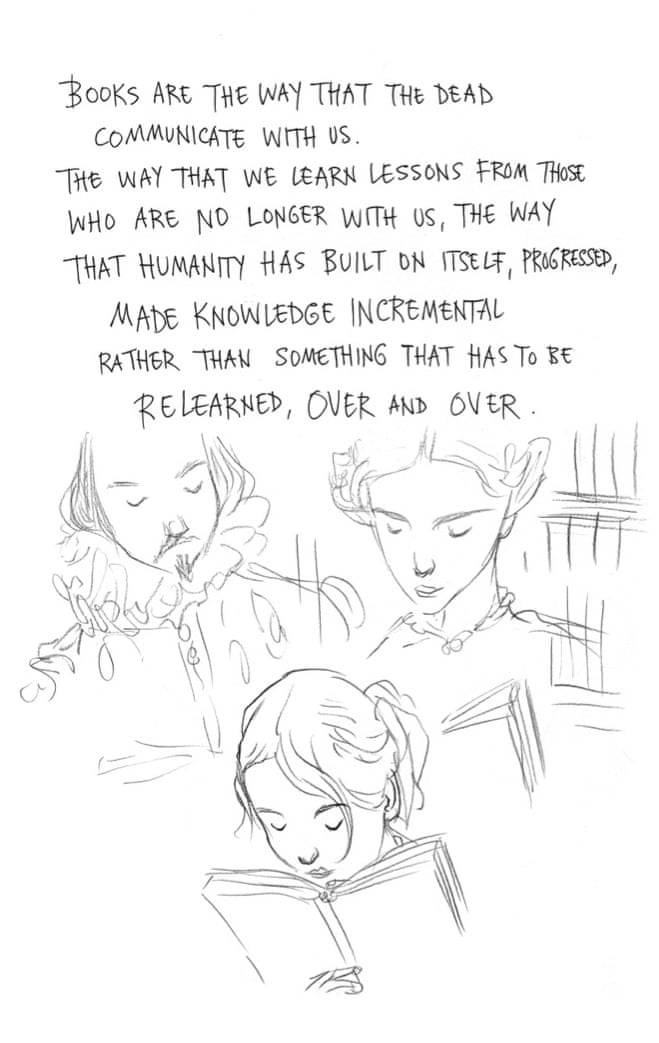
It hardly matters why a library is destroyed: every banning, curtailment, shredding, plunder or loot gives rise (at least as a ghostly presence) to a louder, clearer, more durable library of the banned, looted, plundered, shredded or curtailed.

Readers, censors know, are defined by the books they read.

Alberto Manguel, from The Library at Night

26 June 2025

Paradise.

Gibbs, Radcliffe Camera, University of Oxford, England, 1749


I have always imagined that Paradise will be a kind of library.

Jorge Luis Borges

11 January 2025

Exists.


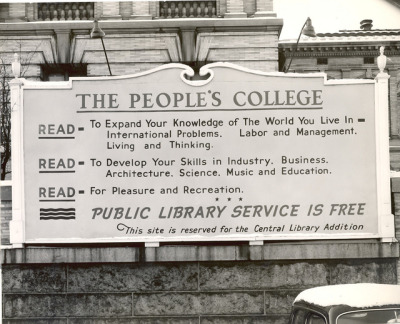
I want to congratulate librarians, not famous for their physical strength or their powerful political connections or their great wealth, who, all over this country, have staunchly resisted anti-democratic bullies who have tried to remove certain books from their shelves, and have refused to reveal to thought police the names of persons who have checked out those titles.

So the America I loved still exists, if not in the White House or the Supreme Court or the Senate or the House of Representatives or the media. The America I love still exists at the front desks of our public libraries.

Kurt Vonnegut, from A Man Without a Country

31 December 2024

Danger.


At what point then is the approach of danger to be expected? I answer, if it ever reach us, it must spring up amongst us. It cannot come from abroad. If destruction be our lot, we must ourselves be its author and finisher. As a nation of freemen, we must live through all time, or die by suicide.

January 27, 1838

06 October 2024

Mozart, Serenate ex C, "Ganz kleine Nachtmusik," K. 648


Classic FM reports on newly discovered Mozart compositions ...
The music was found in the collection of the Leipzig Municipal Library while researchers were completing a new edition of the Köchel catalogue of Mozart’s works.

Composed for string trio, the seven-movement piece is believed to have been written in the mid to late 1760s, when Mozart was a teenager. The manuscript features dark brown ink on off-white laid paper, with the title Serenate ex C.
Elisabeth Zimmermann, Vincent Geer, and David Geer of the youth symphony orchestra of the Leipzig School of Music "Johann Sebastian Bach" perform the piece ...

18 June 2024

Among.


Libraries are not childcare facilities but sometimes feral children raise themselves among the stacks.

25 March 2024

Happy Birthday, O'Connor


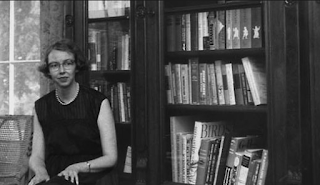
I suppose I read Aristotle in college but not to know I was doing it; the same with Plato. I don’t have the kind of mind that can carry such beyond the actual reading, i.e., total non-retention has kept my education from being a burden to me. So I couldn’t make any judgment on the Summa, except to say this: I read it for about twenty minutes every night before I go to bed. If my mother were to come in during the process and say, "Turn off that light. It’s late," I with lifted finger and broad bland beatific expression, would reply, "On the contrary, I answer that the light, being eternal and limitless, cannot be turned off. Shut your eyes," or some such thing.”

I too am blessedly unburdened by my education. The university was no more than an intellectual match-making service, an instrument of exposure – to writers and a large library that permitted me to read them. I remember the reassuring thrill of knowing the campus library was open twenty-four hours a day. If I needed Tertullian, Hobbes or George Herbert at 3 a.m., they were a short walk away.

For the purposes of education, I found most fellow students an irritation to be endured, which I suppose taught me something. Even with several excellent teachers I remained, for good and ill, an autodidact but not always, I hope, a know-it-all. I was acutely aware of my ignorance but resented most intermediaries – critics, interpreters, systematizers – and felt only aversion for grand theories. To this day I like to meet a book on my terms, without a middle-man, because most of the best books teach me how to read them. My request is simple: Don’t tell me what to think; show me what you know.

Flannery O’Connor, born on this day in 1925, from a letter to “A.”, August 9, 1955

15 January 2024

Only.

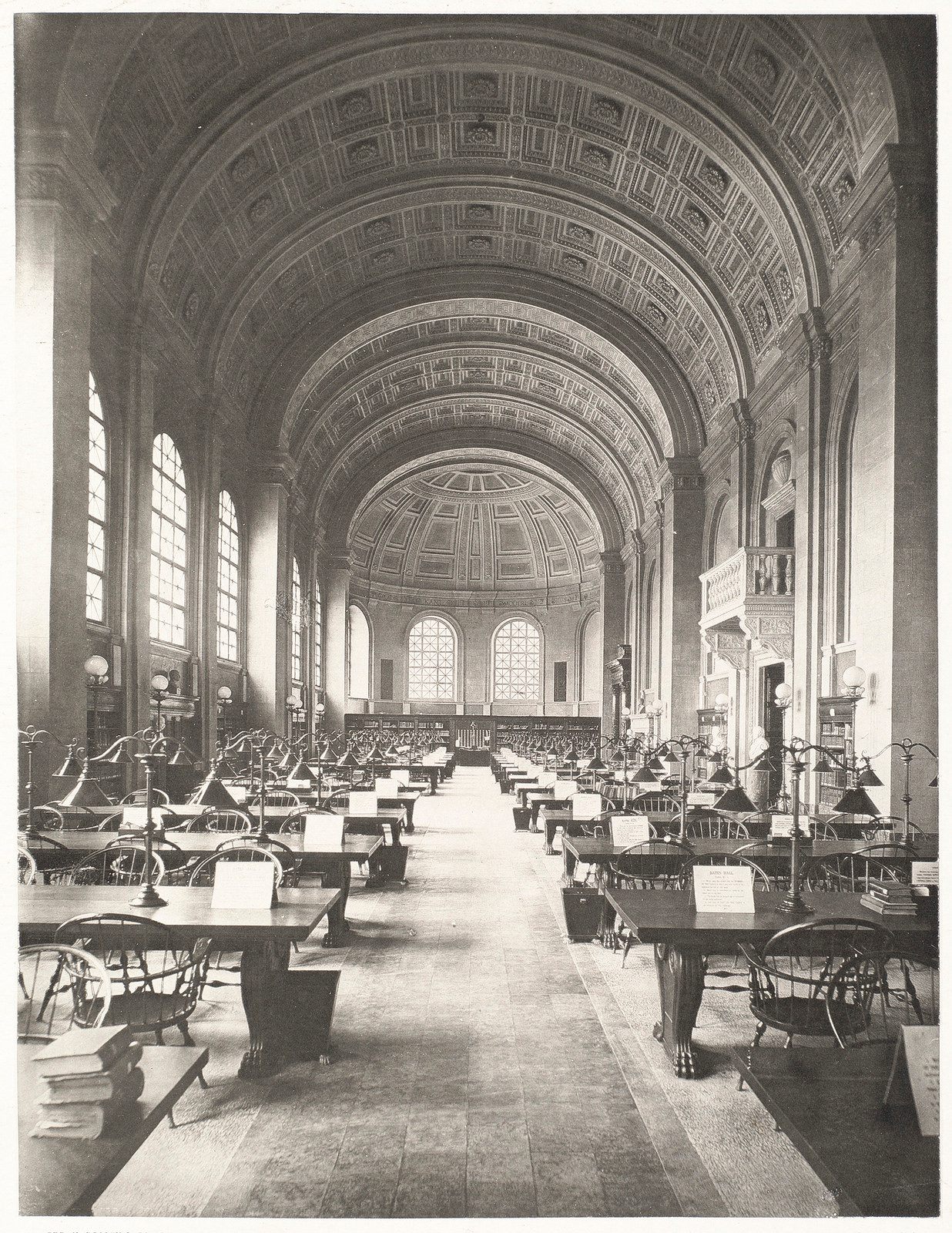
McKim, Bates Hall, Boston Public Library, 1896 


Peek into these historic hushed rooms where knowledge was shared, and remember Albert Einstein’s words: “The only thing you absolutely have to know is the location of the library.

23 December 2023

05 December 2022

Full-Throated.


James Panero on the politicization of the American library ...
In 2006 the American Library Association issued a button to its members. It read, “radical, militant librarian.” We should have taken the message at its word. The American library, until recently a refuge of neutral quietude, has become a booming battleground in the culture wars.

In 2018 the ala dropped the name of Laura Ingalls Wilder from its annual children’s literature award. The reason? The supposed “culturally insensitive portrayals” in her landmark Little House on the Prairie series. Three years later, the organization published its “Resolution to Condemn White Supremacy and Fascism as Antithetical to Library Work.” The edict claimed that “libraries have upheld and encouraged white supremacy both actively through discriminatory practices and passively through a misplaced emphasis on neutrality.” The proclamation charged the ala’s “Working Group on Intellectual Freedom and Social Justice” to “review neutrality rhetoric and identify alternatives.”
 
The quiet, neutral library was out. Full-throated progressive politics were in. As Emily Drabinski, a self-described “Marxist lesbian” who was recently elected president of the ala, stated on her campaign website: “So many of us find ourselves at the ends of our worlds. The consequences of decades of unchecked climate change, class war, white supremacy, and imperialism have led us here.”
These edicts contradict every tenet for which the American Library Association stands (their Library Bill of Rights is HERE).

Dive.


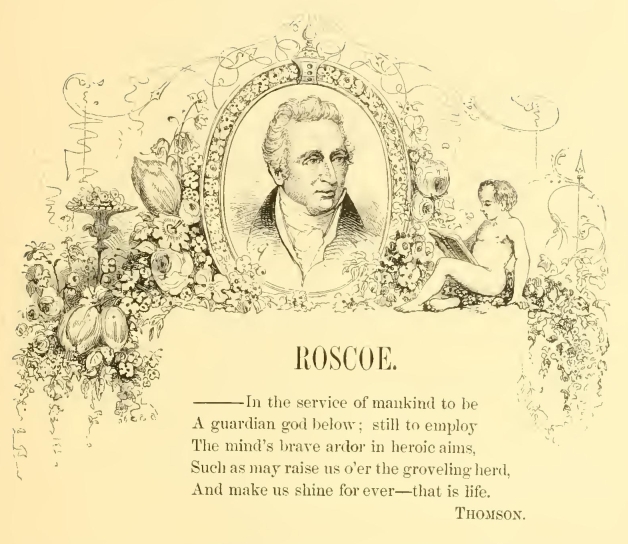
From "Roscoe," an essay found in The Sketchbook of Geoffrey Crayon, Esq., by Washington Irving
While my feelings were yet alive on the subject, it was my fortune to light on further traces of Mr. Roscoe. I was riding out with a gentleman, to view the environs of Liverpool, when he turned off, through a gate, into some ornamented grounds. After riding a short distance, we came to a spacious mansion of freestone, built in the Grecian style. It was not in the purest style, yet it had an air of elegance, and the situation was delightful. A fine lawn sloped away from it, studded with clumps of trees, so disposed as to break a soft fertile country into a variety of landscapes. The Mersey was seen winding a broad quiet sheet of water through an expanse of green meadow land, while the Welsh mountains, blended with clouds, and melting into distance, bordered the horizon.

This was Roscoe’s favorite residence during the days of his prosperity. It had been the seat of elegant hospitality and literary retirement. The house was now silent and deserted. I saw the windows of the study, which looked out upon the soft scenery I have mentioned. The windows were closed—the library was gone. Two or three ill-favored beings were loitering about the place, whom my fancy pictured into retainers of the law. It was like visiting some classic fountain, that had once welled its pure waters in a sacred shade, but finding it dry and dusty, with the lizard and the toad brooding over the shattered marbles.

I inquired after the fate of Mr. Roscoe’s library, which had consisted of scarce and foreign books, from many of which he had drawn the materials for his Italian histories. It had passed under the hammer of the auctioneer, and was dispersed about the country. The good people of the vicinity thronged liked wreckers to get some part of the noble vessel that had been driven on shore. Did such a scene admit of ludicrous associations, we might imagine something whimsical in this strange irruption in the regions of learning. Pigmies rummaging the armory of a giant, and contending for the possession of weapons which they could not wield. We might picture to ourselves some knot of speculators, debating with calculating brow over the quaint binding and illuminated margin of an obsolete author; of the air of intense, but baffled sagacity, with which some successful purchaser attempted to dive into the black-letter bargain he had secured.

13 July 2021

Toiled.


"Life in the Stacks: A Love Letter to Browsing" ...
But speed of scrolling, algorithmic assistance, and instant access weren’t what my friends and I needed, even if we might’ve welcomed them as conveniences. We needed that long subway trip downtown. (We were the farthest stop west.) We needed the sobering disappointments and sporadic victories. We needed the longueurs that new technology seeks to close, as if abolishing boredom ever does anyone a favour. Mostly, we needed wind resistance. It took effort to cultivate our enthusiasms in a desert, but it’s clear now that we took the desert’s role for granted. Knowledge tends to stick when you’ve toiled for it.

29 November 2020

Atmosphere.

von Alt, The Library in the Apartment of Count Lanckoronski in Vienna, 1881


Night which Pagan Theology could make the daughter of Chaos, affords no advantage to the description of order. The library in which I have at long last collected my books began life as a barn sometime in the fifteenth century, perched on a small hill south of the Loire. Here, in the last years before the Christian era, the Romans erected a temple to Dionysus to honour the god of this wine--producing area; twelve centuries later, a Christian church replaced the god of drunken ecstasy with the god who turned his blood into wine. (I have a picture of a stained--glass window showing a Dionysian grapevine growing out of the wound in Christ's right side.) Still later, the villagers attached to the church a house to lodge their priest, and eventually added to this presbytery a couple of pigeon towers, a small orchard and a barn. In the fall of 2000, when I first saw these buildings which are now my home, all that was left of the barn was a single stone wall that separated my property from a chicken run and the neighbour's field. According to village legend, before belonging to the barn, the wall was part of one of the two castles that Tristan L'Hermite, minister of Louis xi of France and notorious for his cruelty, built for his sons around 1433. The first of these castles still stands, much altered during the eighteenth century. The second burnt down three or four centuries ago, and the only wall left standing, with a pigeon tower attached to its far end, became the property of the church, bordering one side of the presbytery garden. In 1693, after a new cemetery was opened to house the increasing number of dead, the inhabitants of the village ("gathered outside the church doors," says the deed) granted the incumbent priest permission to incorporate the old cemetery and to plant fruit trees over the emptied tombs. At the same time, the castle wall was used to enclose a new barn. After the French Revolution, war, storms and neglect caused the barn to crumble, and even after services resumed in the church in 1837 and a new priest came to live in the presbytery, the barn was not rebuilt. The ancient wall continued to serve as a property divider, looking onto a farmer's field on one side and shading the presbytery's magnolia tree and bushes of hydrangea on the other. 

As soon as I saw the wall and the scattered stones around it, I knew that here was where I would build the room to house my books. I had in mind a distinct picture of a library, something of a cross between the long hall at Sissinghurst (Vita Sackville-West's house in Kent, which I had recently visited) and the library of my old high school, the Colegio Nacional de Buenos Aires. I wanted a room panelled in dark wood, with soft pools of light and comfortable chairs, and an adjacent, smaller space in which I'd set up my writing desk and reference books. I imagined shelves that began at my waist and went up only as high as the fingertips of my stretched--out arm, since, in my experience, the books condemned to heights that require ladders, or to depths that force the reader to crawl on his stomach on the floor, receive far less attention than their middle--ground fellows, no matter their subject or merit. But these ideal arrangements would have required a library three or four times the size of the vanished barn and, as Stevenson so mournfully put it, "that is the bitterness of art: you see a good effect, and some nonsense about sense continually intervenes." Out of necessity, my library has shelves that begin just above the baseboards and end an octavo away from the beams of the watershed ceiling. 

While the library was being built, the masons discovered two windows in the old wall that had been bricked up long ago. One is a slim embrasure from which archers perhaps defended Tristan l'Hermite's son when his angry peasants revolted; the other is a low square window protected by medieval iron bars cut roughly into stems with drooping leaves. From these windows, during the day, I can see my neighbour's chickens hurry from one corner of the compound to another, pecking at this spot and at that, driven frantic by too many offerings, like demented scholars in a library; from the windows on the new wall opposite, I look out onto the presbytery itself and the two ancient sophora trees in my garden. But at night, when the library lamps are lit, the outside world disappears and nothing but this space of books remains in existence. To someone standing outside, in the garden, the library at night appears like a vast vessel of some sort, like that strange Chinese villa that, in 1888, the capricious Empress Cixi caused to be built in the shape of a ship marooned in the garden lake of her Summer Palace. In the dark, with the windows lit and the rows of books glittering, the library is a closed space, a universe of self--serving rules that pretend to replace or translate those of the shapeless universe beyond. During the day, the library is a realm of order. Down and across the lettered passages I move with visible purpose, in search of a name or a voice, summoning books to my attention according to their allotted rank and file. The structure of the place is visible: a maze of straight lines, not to become lost in but for finding; a divided room that follows an apparently logical sequence of classification; a geography obedient to a predetermined table of contents and a memorable hierarchy of alphabets and numbers. But at night the atmosphere changes. Sounds become muffled, thoughts grow louder. "Only when it is dark does the owl of Minerva take flight," noted Walter Benjamin, quoting Hegel. Time seems closer to that moment halfway between wakefulness and sleep in which the world can be comfortably reimagined. My movements feel unwittingly furtive, my activity secret. I turn into something of a ghost. The books are now the real presence and it is I, their reader, who, through cabbalistic rituals of half-glimpsed letters, am summoned up and lured to a certain volume and a certain page. The order decreed by library catalogues is, at night, merely conventional; it holds no prestige in the shadows.

Alberto Manguel, from The Library at Night
10 January 2020