Showing posts with label Foote. Show all posts
Showing posts with label Foote. Show all posts
07 July 2026


03 July 2026
Moments.
Gardner, Gettysburg, Interior View of Breastworks on Extreme Left of the Federal Line, 1863

Lee rose by starlight, as he had done the previous morning, with equally fervent hopes of bringing this bloodiest of all his battles to a victorious conclusion before sunset. Two months ago today, Chancellorsville had thundered to its climax, fulfilling just such hopes against longer odds, and one month ago today, hard on the heels of a top-to-bottom reorganization occasioned by the death of Stonewall Jackson, the Army of Northern Virginia had begun its movement from the Rappahannock, northward to where an even greater triumph had seemed to be within its reach throughout the past 40-odd hours of savage fighting. Today would settle the outcome, he believed, not only of the battle — that went without saying; flesh and blood, bone and sinew and nerve could only stand so much — but also, perhaps, of the war; which, after all, was why he had come up here to Pennsylvania in the first place.
Lee's reply to this was an order for Pickett to be summoned... The objective was clearly defined against the skyline: a little clump of umbrella shaped trees, four-fifths of a mile away on Cemetery Ridge, just opposite the Confederate command post... By way of softening up the objective, the assault would be preceded by a brief but furious bombardment from than 140 guns of various calibers — this would be the greatest concentration of artillery ever assembled for a single purpose on the continent, and Lee appeared to have no doubt that it would pave the way for the infantry by pulverizing or driving off the batteries posted in support of the Union center.
Pickett's men were unaware of what awaited them beyond the screening ridge... The sun had burned the early morning clouds away, and though the lack of breeze gave promise of a sultry afternoon, the impression here in this unscarred valley behind Seminary Ridge was of an ideal summer day, no different from any other except in its perfection. "Never was sky or earth more serene, more harmonious, more aglow with light and life," one among the marchers afterwards wrote.
By now it was noon, and a great stillness came down over the field and over the two armies on their ridges. Between them, the burning house and barn loosed a long plume of smoke that stood upright in the hot and windless air. From time to time some itchy-fingered picket would fire a shot, distinct as a single hand-clap, but for the most part the silence was profound. For the 11,000 Confederates maintaining their mile-wide formation along the wooded slope and in the swale, the heat was oppressive. They sweated and waited, knowing that they were about to be launched on a desperate undertaking from which many of them would not be coming back, and since it had to be, they were of one accord in wanting to get it over with as soon as possible. "It is said, that to the condemned, in going to execution, the moments fly," a member of Pickett's staff wrote some years later, recalling the strain of the long wait. "To the good soldier, about to go into action, I am sure the moments linger. It is the nervous anxiety to solve the great issue as speedily as possible, without stopping to count the cost. The Macbeth principle — 'Twere well it were done quickly — holds quite as good in heroic action as in crime."
Shelby Foote, from "Stars in Their Courses: The Gettysburg Campaign"
The Maestro of Memphis details Gettysburg ...
17 November 2025
Happy Birthday, Shelby Foote
Shelby Foote was born on this day in 1916.
Brian Lamb's three-hour In Depth interview, filmed with Foote in his home in 2001 ..
I wonder who will emerge from The American Revolution as its "Shelby Foote." I was excited to hear Nathaniel Philbrick commenting last night.
27 December 2024
Preserved.

The point I would make is that the novelist and the historian are seeking the same thing: the truth – not a different truth: the same truth – only they reach it, or try to reach it, by different routes. Whether the event took place in a world now gone to dust, preserved by documents and evaluated by scholarship, or in the imagination, preserved by memory and distilled by the creative process, they both want to tell us how it was: to re-create it, by their separate methods, and make it live again in the world around them.
Shelby Foote, from The Civil War, Vol. 1: Fort Sumter to Perryville
23 September 2023
Spirit.
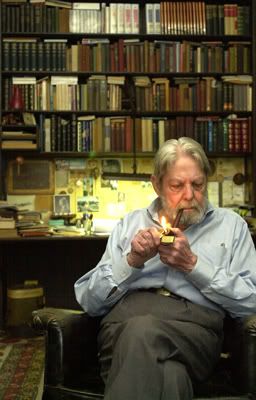
Kurt points to an excellent article exploring Shelby Foote's "aristocracy of spirit" ...
The vocation of the artist, the soldier and the statesman are accessible only to those who can honor and hunger after honor, who, drawn backward into the past and forward into posterity, disjoint themselves from our flat present and its imperatives to egalitarian political correctness or “aesthetic” harmlessness. Perhaps we would be better off without such human types. Certainly we may not want to become them ourselves. It may be too that we ought to speak candidly about them and what their fulfillment requires only in private, and in public to let them assume such guises as, for example, the gentlemanly, avuncular Southerner with a gift for stories about old times—entertaining, interesting tales that can go unnoticed as incitations to honor the teller and those about whom they are told.
03 July 2023
Heroic.
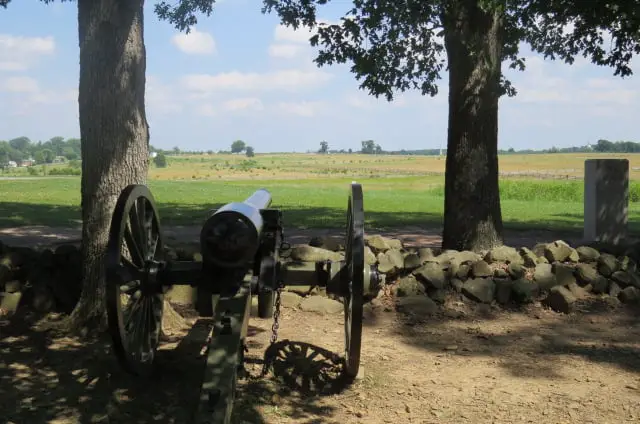
JULY 3, 1863
Lee rose by starlight, as he had done the previous morning, with equally fervent hopes of bringing this bloodiest of all his battles to a victorious conclusion before sunset. Two months ago today, Chancellorsville had thundered to its climax, fulfilling just such hopes against longer odds, and one month ago today, hard on the heels of a top-to-bottom reorganization occasioned by the death of Stonewall Jackson, the Army of Northern Virginia had begun its movement from the Rappahannock, northward to where an even greater triumph had seemed to be within its reach throughout the past 40-odd hours of savage fighting. Today would settle the outcome, he believed, not only of the battle — that went without saying; flesh and blood, bone and sinew and nerve could only stand so much — but also, perhaps, of the war; which, after all, was why he had come up here to Pennsylvania in the first place.
Lee's reply to this was an order for Pickett to be summoned... The objective was clearly defined against the skyline: a little clump of umbrella shaped trees, four-fifths of a mile away on Cemetery Ridge, just opposite the Confederate command post... By way of softening up the objective, the assault would be preceded by a brief but furious bombardment from than 140 guns of various calibers — this would be the greatest concentration of artillery ever assembled for a single purpose on the continent, and Lee appeared to have no doubt that it would pave the way for the infantry by pulverizing or driving off the batteries posted in support of the Union center.
Pickett's men were unaware of what awaited them beyond the screening ridge... The sun had burned the early morning clouds away, and though the lack of breeze gave promise of a sultry afternoon, the impression here in this unscarred valley behind Seminary Ridge was of an ideal summer day, no different from any other except in its perfection. "Never was sky or earth more serene, more harmonious, more aglow with light and life," one among the marchers afterwards wrote.
By now it was noon, and a great stillness came down over the field and over the two armies on their ridges. Between them, the burning house and barn loosed a long plume of smoke that stood upright in the hot and windless air. From time to time some itchy-fingered picket would fire a shot, distinct as a single hand-clap, but for the most part the silence was profound. For the 11,000 Confederates maintaining their mile-wide formation along the wooded slope and in the swale, the heat was oppressive. They sweated and waited, knowing that they were about to be launched on a desperate undertaking from which many of them would not be coming back, and since it had to be, they were of one accord in wanting to get it over with as soon as possible. "It is said, that to the condemned, in going to execution, the moments fly," a member of Pickett's staff wrote some years later, recalling the strain of the long wait. "To the good soldier, about to go into action, I am sure the moments linger. It is the nervous anxiety to solve the great issue as speedily as possible, without stopping to count the cost. The Macbeth principle — 'Twere well it were done quickly — holds quite as good in heroic action as in crime."
Shelby Foote, from "Stars in Their Courses: The Gettysburg Campaign"
02 July 2023
Gettysburg.
A 1994 C-SPAN production in which Shelby Foote discusses the Gettysburg Campaign and his book, Stars in Their Courses ...
01 July 2023
Trouble.
Pierce, Stevens' Knoll, Gettysburg, Pennsylvania, 1 July 1863, 1863

The Battle of Gettysburg began on this date in 1865.
Shelby Foote's thoughts on the battle ...
The Battle of Gettysburg began on this date in 1865.
Longstreet considered Chancellorsville the kind of flashy spectacle the South could ill afford. Facing what Lincoln called 'the arithmetic', he perceived that four more such battles, in which the Confederates were outnumbered two to one and inflicted casualties at a rate of three for four, would reduce Lee's army to a handful, while Hooker would be left with the number Lee had had at the outset. The style he preferred had the Confederates taking up a strong defensive position against which the superior blue forces were shattered, like waves against a rock. Longstreet listened with disapproval as Lee announced his intention to launch an offensive in the East. He protested but Lee's mind was made up. So Longstreet contented himself with his theory that the proposed invasion be conducted in accordance with his preference for receiving rather than delivering attack when the two armies came to grips, wherever that might be. As he put it later, quite as if he and Lee had been joint commanders of the army, "I then accepted his proposition to make a campaign into Pennsylvania, provided it should be offensive in strategy but defensive in tactics, forcing the Federals to give us battle when we were in strong position and ready to receive them."The American Battlefield Trust's exceptional animated map of Gettysburg ...
Lee heard him out with the courtesy which he was accustomed to extend to all subordinates, but which in this case was mistaken for a commitment. He intended no such thing, of course... trouble was stored up for all involved.
Shelby Foote, from Stars in Their Courses: The Gettysburg Campaign
Shelby Foote's thoughts on the battle ...
10 June 2023
Obsessive.
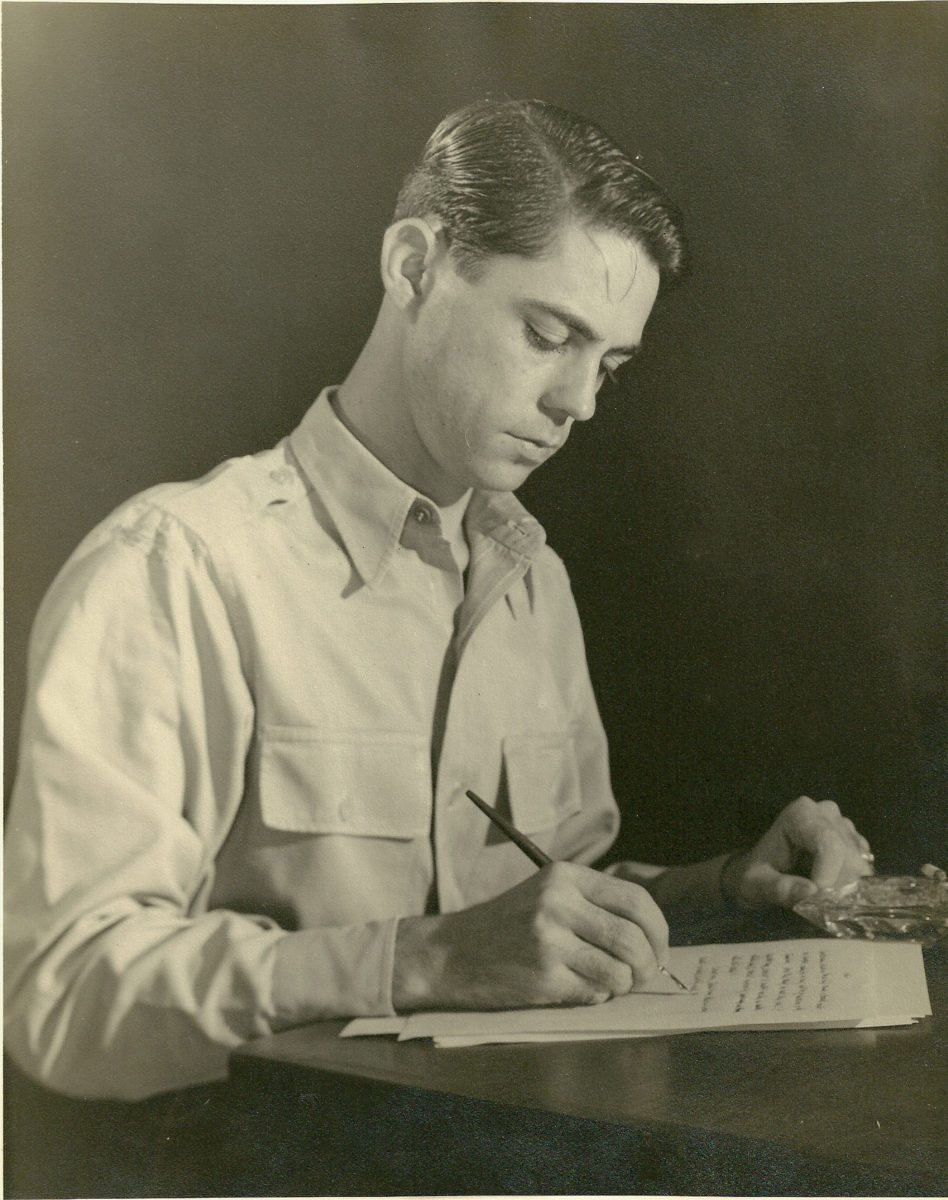
Garden & Gun on the enduring quality of Shelby Foote's Civil War ...
Like Homer, Foote focused on two things: the clash of arms and the lives of the warriors. The grand issues of politics and diplomacy, of economics and culture, mattered less to Foote than re-creating the reality of battle. “The idea is to strike fire,” he wrote, “prodding the reader much as combat quickened the pulses of the people at the time.” Critics took Foote to task for this single-minded focus, but he believed in his approach, and stuck to it. “I think the superiority of Southern writers lies in our driving interest in just…two things, the story and the people.” In a way, Foote is one of the little-noted pioneers of the New Journalism, the movement to bring fictional technique to nonfiction subjects, elevating journalism, history, and biography to the level of literature.He also saw himself working in a broader tradition than that of many mainstream historians. “My hope was that if I wrote well enough about what you would have seen with your own eyes, you yourself would see how those things, the politics and economics, entered in,” he said. “I quite deliberately left those things out. My job was to put it all in perspective, to give it shape. Look at Flaubert: He didn’t criticize Emma Bovary as a terrible woman; he didn’t judge her; he just put down what happened.”Time has vindicated his view. There are other books about other parts of the war—great books. No other volumes, however, put the reader in the horror and the haze so effectively and so memorably. It was hard but rewarding work. “The battle scenes are lit by a strange, lurid light…. I have never enjoyed writing so much as I do this writing,” he wrote. “It goes dreadful slow; sometimes I feel like I’m trying to bail out the Mississippi with a teacup; but I like it, I like it.” He grew obsessive in his study in Memphis: “All I want is to work at my book, a great wide sea of words.”He visited the battlefields in season, walking them at the same time of year as the soldiers had walked them. “For one thing, it’s teaching me to love my country—especially the South, but all the rest as well. I’m learning so many things: geography, for instance. I never saw this country before now—the rivers and mountains, the watersheds and valleys.” The books are as much a biography of the land and the elements as they are of the men who fought the war: It is the accumulation of such atmospheric detail that lends the trilogy much of its vivid novelistic feel.
I read somewhere that when Foote shipped off to Europe for to serve in World War Two, he took only one book, G.F.R. Henderson's, Stonewall Jackson and the American Civil War.
01 July 2022
Trouble.
Pierce, Stevens' Knoll, Gettysburg, Pennsylvania, 1 July 1863, 1863
The Battle of Gettysburg began on this date in 1865.
Longstreet considered Chancellorsville the kind of flashy spectacle the South could ill afford. Facing what Lincoln called 'the arithmetic', he perceived that four more such battles, in which the Confederates were outnumbered two to one and inflicted casualties at a rate of three for four, would reduce Lee's army to a handful, while Hooker would be left with the number Lee had had at the outset. The style he preferred had the Confederates taking up a strong defensive position against which the superior blue forces were shattered, like waves against a rock. Longstreet listened with disapproval as Lee announced his intention to launch an offensive in the East. He protested but Lee's mind was made up. So Longstreet contented himself with his theory that the proposed invasion be conducted in accordance with his preference for receiving rather than delivering attack when the two armies came to grips, wherever that might be. As he put it later, quite as if he and Lee had been joint commanders of the army, "I then accepted his proposition to make a campaign into Pennsylvania, provided it should be offensive in strategy but defensive in tactics, forcing the Federals to give us battle when we were in strong position and ready to receive them."
Lee heard him out with the courtesy which he was accustomed to extend to all subordinates, but which in this case was mistaken for a commitment. He intended no such thing, of course... trouble was stored up for all involved.
Shelby Foote, from Stars in Their Courses: The Gettysburg Campaign
The American Battlefield Trust's exceptional animated map of Gettysburg ...
Shelby Foote's thoughts on the battle ...
The Battle of Gettysburg began on this date in 1865.
Longstreet considered Chancellorsville the kind of flashy spectacle the South could ill afford. Facing what Lincoln called 'the arithmetic', he perceived that four more such battles, in which the Confederates were outnumbered two to one and inflicted casualties at a rate of three for four, would reduce Lee's army to a handful, while Hooker would be left with the number Lee had had at the outset. The style he preferred had the Confederates taking up a strong defensive position against which the superior blue forces were shattered, like waves against a rock. Longstreet listened with disapproval as Lee announced his intention to launch an offensive in the East. He protested but Lee's mind was made up. So Longstreet contented himself with his theory that the proposed invasion be conducted in accordance with his preference for receiving rather than delivering attack when the two armies came to grips, wherever that might be. As he put it later, quite as if he and Lee had been joint commanders of the army, "I then accepted his proposition to make a campaign into Pennsylvania, provided it should be offensive in strategy but defensive in tactics, forcing the Federals to give us battle when we were in strong position and ready to receive them."
Lee heard him out with the courtesy which he was accustomed to extend to all subordinates, but which in this case was mistaken for a commitment. He intended no such thing, of course... trouble was stored up for all involved.
Shelby Foote, from Stars in Their Courses: The Gettysburg Campaign
The American Battlefield Trust's exceptional animated map of Gettysburg ...
Shelby Foote's thoughts on the battle ...
16 April 2022
Memory.

All things end, and by ending not only find continuance in the whole, but also assure continuance by contributing their droplets, clear or murky, to the stream of history. So it was for the Confederacy, and so one day will it be for the other nations of earth, if not for earth itself. Appomattox was one of several endings. But at what cost — if not in suffering, which was immeasurable, then at any rate in blood — had the war been won and lost?
In round numbers, two million blue-clad soldiers and sailors were diminished by 640,000 casualties — more than a fourth — while the 750,000 in gray, all told, lost 450,000 — well over half. Of the former, 111,000 had been killed in battle, as compared to 94,000 of the latter... The butcher's bill thus came to no less than 1,094,453 for both sides, in and out of more than 10,000 military actions, including 76 full-scale battles, 310 engagements, 6337 skirmishes, and numerous sieges, raids, expeditions, and the like.
Out of 583 Union generals, 47 were killed in action, whereas of the 425 Confederate generals, 77 fell — roughly one in twelve as opposed to one in five. Approximately one out of ten able-bodied Northerners were dead or incapacitated, while for the South it was one out of four, including her noncombatant Negroes.
Not secession but the war itself, and above all the memories recurrent through the peace that followed — such as it was — created a Solid South, more firmly united in defeat than it had been during the brief span when it claimed independence. Voided, the claim was abandoned, but the pride remained: pride in the segment reabsorbed, as well as in the whole, which now for the first time was truly indivisible.
No wonder then, if they looked back on that four-year holocaust — which in a sense was begun by one madman, John Brown, and ended by another, John Wilkes Booth — with something of the feeling shared by men who have gone through, and survived, some cataclysmic phenomenon; a hurricane or an earthquake say, or a horrendous railway accident. Memory smoothed the crumpled scroll, abolished fear, leached pain and grief, and removed the sting from death.
Shelby Foote, from "Lucifer in Starlight"
24 October 2021
Uncut.
Nearly two hours of raw, uncut interviews that Ken Burns did with Shelby Foote for The Civil War ...
12 July 2021
Effort.
Shelby Foote on the misidentification of the Confederate flag ...
Dean Knight of the Museum of the Confederacy explains some relics of the Civil War on C-SPAN's American Artifacts ...
If you have free speech but you don't [make] any effort to be sensitive and respect people, then free speech becomes associated with just a weapon to hit people upside the head [with]. When you enter the public square, you're going to have such a distrust and suspicion that somebody can use their free speech and say something that appears to you to be disrespectful. And you think it's a direct attack on you. Because now there's no trust.
Reverend Dr. Cornell West, in dialogue with Dr. Robert George from "Honesty and Courage, Humility and Hope"
He who is unaware of his ignorance will only be misled by his knowledge.
Richard Whately
03 July 2021
Quickly.
JULY 3, 1863
Lee rose by starlight, as he had done the previous morning, with equally fervent hopes of bringing this bloodiest of all his battles to a victorious conclusion before sunset. Two months ago today, Chancellorsville had thundered to its climax, fulfilling just such hopes against longer odds, and one month ago today, hard on the heels of a top-to-bottom reorganization occasioned by the death of Stonewall Jackson, the Army of Northern Virginia had begun its movement from the Rappahannock, northward to where an even greater triumph had seemed to be within its reach throughout the past 40-odd hours of savage fighting. Today would settle the outcome, he believed, not only of the battle — that went without saying; flesh and blood, bone and sinew and nerve could only stand so much — but also, perhaps, of the war; which, after all, was why he had come up here to Pennsylvania in the first place.
Lee's reply to this was an order for Pickett to be summoned... The objective was clearly defined against the skyline: a little clump of umbrella shaped trees, four-fifths of a mile away on Cemetery Ridge, just opposite the Confederate command post... By way of softening up the objective, the assault would be preceded by a brief but furious bombardment from than 140 guns of various calibers — this would be the greatest concentration of artillery ever assembled for a single purpose on the continent, and Lee appeared to have no doubt that it would pave the way for the infantry by pulverizing or driving off the batteries posted in support of the Union center.
Pickett's men were unaware of what awaited them beyond the screening ridge... The sun had burned the early morning clouds away, and though the lack of breeze gave promise of a sultry afternoon, the impression here in this unscarred valley behind Seminary Ridge was of an ideal summer day, no different from any other except in its perfection. "Never was sky or earth more serene, more harmonious, more aglow with light and life," one among the marchers afterwards wrote.
By now it was noon, and a great stillness came down over the field and over the two armies on their ridges. Between them, the burning house and barn loosed a long plume of smoke that stood upright in the hot and windless air. From time to time some itchy-fingered picket would fire a shot, distinct as a single hand-clap, but for the most part the silence was profound. For the 11,000 Confederates maintaining their mile-wide formation along the wooded slope and in the swale, the heat was oppressive. They sweated and waited, knowing that they were about to be launched on a desperate undertaking from which many of them would not be coming back, and since it had to be, they were of one accord in wanting to get it over with as soon as possible. "It is said, that to the condemned, in going to execution, the moments fly," a member of Pickett's staff wrote some years later, recalling the strain of the long wait. "To the good soldier, about to go into action, I am sure the moments linger. It is the nervous anxiety to solve the great issue as speedily as possible, without stopping to count the cost. The Macbeth principle — 'Twere well it were done quickly — holds quite as good in heroic action as in crime."
Shelby Foote, from "Stars in Their Courses: The Gettysburg Campaign"
The Maestro of Memphis details Gettysburg ...
23 August 2020
World-class.
If history were taught in the form of stories, it would never be forgotten.
Rudyard Kipling
C-SPAN's masterful In-Depth series has yielded unforgettable stories from these world-class historians ...


Rudyard Kipling
C-SPAN's masterful In-Depth series has yielded unforgettable stories from these world-class historians ...
01 July 2020
Trouble.
Pierce, Stevens' Knoll, Gettysburg, Pennsylvania, 1 July 1863, 1863
The Battle of Gettysburg began on this date in 1865.
Longstreet considered Chancellorsville the kind of flashy spectacle the South could ill afford. Facing what Lincoln called 'the arithmetic', he perceived that four more such battles, in which the Confederates were outnumbered two to one and inflicted casualties at a rate of three for four, would reduce Lee's army to a handful, while Hooker would be left with the number Lee had had at the outset. The style he preferred had the Confederates taking up a strong defensive position against which the superior blue forces were shattered, like waves against a rock. Longstreet listened with disapproval as Lee announced his intention to launch an offensive in the East. He protested but Lee's mind was made up. So Longstreet contented himself with his theory that the proposed invasion be conducted in accordance with his preference for receiving rather than delivering attack when the two armies came to grips, wherever that might be. As he put it later, quite as if he and Lee had been joint commanders of the army, "I then accepted his proposition to make a campaign into Pennsylvania, provided it should be offensive in strategy but defensive in tactics, forcing the Federals to give us battle when we were in strong position and ready to receive them."
Lee heard him out with the courtesy which he was accustomed to extend to all subordinates, but which in this case was mistaken for a commitment. He intended no such thing, of course... trouble was stored up for all involved.
Shelby Foote, from Stars in Their Courses: The Gettysburg Campaign
The American Battlefield Trust's exceptional animated map of Gettysburg ...
Shelby Foote's thoughts on the battle ...
The Battle of Gettysburg began on this date in 1865.
Longstreet considered Chancellorsville the kind of flashy spectacle the South could ill afford. Facing what Lincoln called 'the arithmetic', he perceived that four more such battles, in which the Confederates were outnumbered two to one and inflicted casualties at a rate of three for four, would reduce Lee's army to a handful, while Hooker would be left with the number Lee had had at the outset. The style he preferred had the Confederates taking up a strong defensive position against which the superior blue forces were shattered, like waves against a rock. Longstreet listened with disapproval as Lee announced his intention to launch an offensive in the East. He protested but Lee's mind was made up. So Longstreet contented himself with his theory that the proposed invasion be conducted in accordance with his preference for receiving rather than delivering attack when the two armies came to grips, wherever that might be. As he put it later, quite as if he and Lee had been joint commanders of the army, "I then accepted his proposition to make a campaign into Pennsylvania, provided it should be offensive in strategy but defensive in tactics, forcing the Federals to give us battle when we were in strong position and ready to receive them."
Lee heard him out with the courtesy which he was accustomed to extend to all subordinates, but which in this case was mistaken for a commitment. He intended no such thing, of course... trouble was stored up for all involved.
Shelby Foote, from Stars in Their Courses: The Gettysburg Campaign
The American Battlefield Trust's exceptional animated map of Gettysburg ...
Shelby Foote's thoughts on the battle ...
13 July 2019
Happy Birthday, Forrest
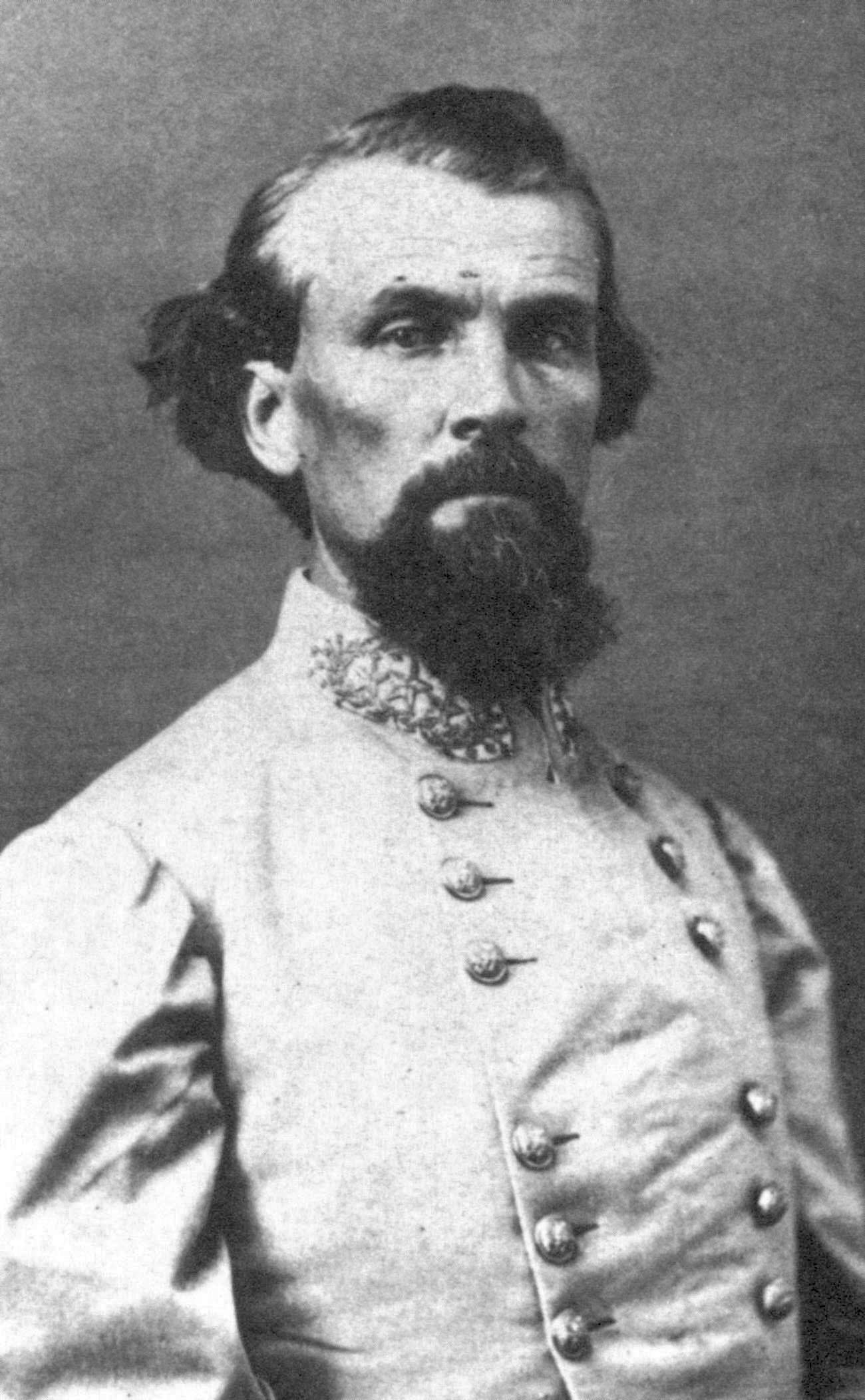
Nathan Bedford Forrest was born on this date in 1821.
These were no mere bushwhackers, like those who operated along the Kansas-Missouri border. From the beginning Forrest recognized the importance of discipline—an attribute learned in part from his own experiences as custodian of a fierce temper.
Forrest did not rise from frontier hayseed to millionaire plantation owner and businessman without learning self-control. In a hard-drinking age he was abstemious. He was neither hothead nor brawler. His outbursts were fewer than legend allows, usually brief and often followed by apologies. His wartime lapses in self-control were nonetheless spectacular—he brandished his sword at one fellow general during a blowup over regulations and reportedly drew a pistol on another who disputed his troopers’ right of way. In a time and place when one was expected to defend his honor personally and immediately, Forrest’s behavior did not put him beyond the pale, as it might have in the Army of Northern Virginia.
Even when conscription agents resorted to scraping the bottom of the Confederacy’s barrel, Forrest could always raise men. Enlisting as a private and soon commissioned a lieutenant colonel, he successively recruited a battalion, then a regiment and ultimately an entire corps. While convalescing from his injuries at Shiloh, Forrest ran a recruiting advertisement in the Memphis Daily Appeal with the stirring phrase, “Come on, boys, if you want a heap of fun and to kill some Yankees.”
While the training his men received was often marginal and occasionally nonexistent, Forrest compensated for it by his strict insistence on camp discipline. Leaves and passes were restricted. “Hoorahing”—the frontier practice of galloping about on horses and firing guns indiscriminately— was a court-martial offense. Forrest sentenced his own son and fellow transgressors to several hours of carrying fence rails on their shoulders for breaking camp discipline. In the field the commander strictly forbade straggling and looting.
The key to Forrest’s skill as a tactician was his innate ability to read a fight. He understood how best to balance mounted and dismounted action, defense and attack, commitment and pursuit. Whatever his issues of self-control behind the lines or in personal combat, Forrest never let emotion overcome him in conducting a battle.
His defining approach involved maintaining pressure, harassing enemy forces before an engagement, engaging them at all points during a fight and giving them no time to rally. “Whenever you see anything blue, shoot at it and do all you can to keep up the scare,” was his injunction during one skirmish.
He was born to be a soldier the way John Keats was born to be a poet.
Shelby Foote, from The Civil War ...
31 May 2018
Discovered.

I can’t begin to tell you the things I discovered while I was looking for something else.
Shelby Foote
15 August 2017

01 July 2017
Gettyburg.
On this, the anniversary of the beginning of the Battle of Gettysburg, Shelby Foote discusses Stars in Their Courses, his narrative of the campaign ...
Subscribe to:
Posts (Atom)