"I am not one who was born in the custody of wisdom. I am one who is fond of olden times and intense in quest of the sacred knowing of the ancients." Gustave Courbet
Showing posts with label teaching. Show all posts

13 June 2026

Fascinating.


Roosevelt Junior High School was fortunate enough to have Bob Stevens as an 8th grade history teacher. Mr. Stevens would spend each history period walking between the desks of students bringing to life the history of this country. Hands behind his back he would walk and tell the stories of the country.

Occasionally, he would grab the chalk and draw out a battle scheme on the chalkboard, supplementing the drawing with gory and fascinating details.

Several friends and I even decided to bring our own history books into class to “check” Mr. Stevens on his facts. No way could he just roll these details out without at least some exaggeration.

Imagine an 8th grade class with at least four young students feverishly flipping through a stack of books as the teacher told the lesson from memory.

My family moved to Ohio from Michigan in 1977.  On my first day of school at Roosevelt, I had the bright idea to wear a Michigan jersey to school. Coach Stevens noticed it within minutes. He picked me up (in my chair), carried me to his room, placed me in my chair atop his desk and proclaimed to his class, “Look what I found!”

Thirty years later, after a pretty drastic career change, I was blessed to spend time with him in his third-floor classroom as he mentored me through my student-teaching experience.

Through those Roosevelt years, Coach Stevens told amazing stories to engage his students, he maintained the highest standards to set an example for his students, and he carried himself in a way that I still remember today.  I knew he believed in me and all his students.  He was a model of what it was to be not just a good teacher, but a great man.  His sincerity and authenticity were such that you didn't want to let him down.  That responsibility was transformative to a young punk like me.

I’m beginning my twenty-second year as a teacher and there isn’t a day that goes by that doesn’t catch me feeling grateful that I was his student. What a fine teacher. What a great man.

30 April 2025

Prevent.


How can I number the worlds to which the eye gives me entry? - the world of light, of colour, of shape, of shadow: of mathematical precision in the snowflake, the ice formation, the quartz crystal, the patterns of stamen and petal: of rhythm in the fluid curve and plunging line of the mountain faces. Why some blocks of stone, hacked into violent and tortured shapes, should so profoundly tranquillise the mind I do not know.

Perhaps the eye imposes its own rhythm on what is only a confusion: one has to look creatively to see this mass of rock as more than jag and pinnacle - as beauty. Else why did men for so many centuries think mountains repulsive? A certain kind of consciousness interacts with the mountain-forms to create this sense of beauty. Yet the forms must be there for the eye to see. And forms of a certain distinction: mere dollops won't do it.

It is, as with all creation, matter impregnated with mind: but the resultant issue is a living spirit, a glow in the consciousness, that perishes when the glow is dead. It is something snatched from non-being, that shadow which creeps in on us continuously and can be held off by continuous creative act. So, simply to look on anything, such as a mountain, with the love that penetrates to its essence, is to widen the domain of being in the vastness of non-being. Man has no other reason for his existence.

Nan Shepherd, who described her role at the Aberdeen College of Education as having the “heaven-appointed task of trying to prevent a few of the students who pass through our Institution from conforming altogether to the approved pattern," from The Living Mountain

Thank you, Rachel.

26 March 2025

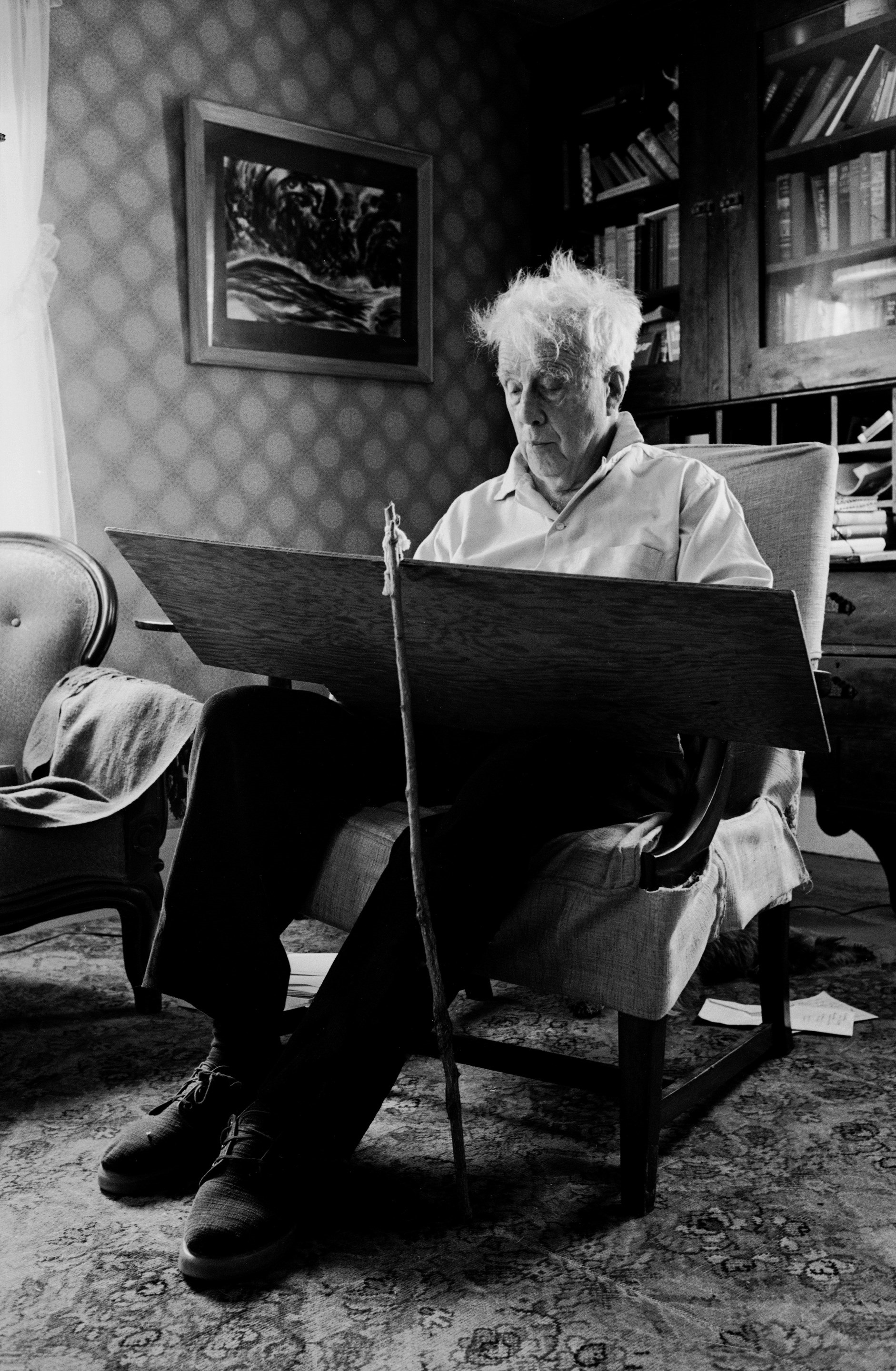
Happy Birthday, Frost


There are two kinds of teachers: the kind that fill you with so much quail shot that you can’t move, and the kind that just give you a little prod behind and you jump to the skies.

Robert Frost, born on this day in 1874

04 January 2025

Formative.


Harvard Magazine on the power of patience ...
In the thousands of years of human history that predated our current moment of instantaneous communication, the very fabric of human understanding was woven to some extent out of delay, belatedness, waiting. All objects were made of slow time in the way that Copley’s painting concretizes its own situation of delay. I think that if we want to teach history responsibly, we need to give students an opportunity to understand the formative values of time and delay. The teaching of history has long been understood as teaching students to imagine other times; now, it also requires that they understand different temporalities. So time is not just a negative space, a passive intermission to be overcome. It is a productive or formative force in itself.

25 July 2024

Happy Birthday, Eakins

Eakins, Mending the Net, 1881


A teacher can do very little for a pupil and should only be thankful not to hinder him.  The greater the master, mostly the less he can say.

Thomas Eakins, born on this day in 1844

29 October 2023

Difference.


Instead of becoming a devotee of popular culture, expose students to what they are not familiar with, in particular, high art and music.   Students inhabit popular culture.  Treat them to High Culture, even to "high seriousness." "Mr. Pickering," a student said to me last year, don't you realize there is a generation gap, maybe two gaps, between you and our class?" "Oh, no," I said, widening my eyes.  "I can't believe that."  The truth is that in addition to teaching writing and reading, math and science, you should expose students to difference.  Children grow by comparing the familiar with the unfamiliar.  Be what you are rather than what you think students want you to be.  As you age, you will discover that you will believe less and marvel more, something that will separate you from your students. 

Sam Pickering, from Letters From a Teacher

06 July 2023

Better.

From TEDxEastsidePrep ...
Dr. Tae is a skateboarder, videographer, physicist, and teacher. Contrasting his observations of his own learning while skateboarding with the reality that is the current education system, Dr. Tae provides some insight as to how we might better educate in the future ...

Are schools designed to help people learn? Are colleges and universities really institutions of higher education? Do students actually learn any science in science classes? Can skateboarding give us a better model for teaching and learning?


12 June 2023

Alfred Brendel & Kit Armstrong: Set the Piano Stool on Fire

An document of the relationship between young composer and pianist Kit Armstrong and the world renowned Alfred Brendel ...

20 April 2023

Aggressively.


Wynton Marsalis on the importance of aggressive inspiration in education ...
In the past thirty years, I have had the good fortune to teach thousands of bands and an incalculable number of students in diverse settings. Though each situation is unique, students share many of the same concerns in pursuit of a more profound relationship with music and with life through music. Every style of music presents distinct challenges which demand the development of different skills. Jazz requires creativity, communication and community.

Through improvising we learn to value our own creativity; through swing we coordinate our communication with others; and through the blues we learn to find and celebrate ‘meaning’ in the tragic and absurd parts of life that afflict every community. Certainly three things worth learning. I believe jazz revolutionized the art of music by vesting the individual musician with the authority to ‘tell their story’ and by positing that an even larger ‘story’ could be told, by choice, by a group of equally empowered musicians. Our educational system has yet to be retooled to accommodate that revolution. Of course there are some educators pointing the way, but many still view this music as exotic, mysterious and unteachable. Some jazz lovers believe the music can’t be taught in schools when, truth is, it can’t be taught THE WAY we are teaching it.

How many decades must we watch these faulty methods fail? It’s time to begin an earnest national effort to teach our kids the glories of jazz. Not a way to play scales on harmonies, or some jazzy misrepresentation of rock tunes, but an engagement with the stories, songs, rhythms, and the lives of those who made this music so vital— from the inspired dancers who blanketed this country in the 1930’s to the many earnest and eager kids now in jazz programs all over the world, to the local musicians playing their hearts out in small clubs everywhere.

Jazz is life music and education is not anti-life.

To achieve greater success in producing students who play inside the reality of this music, the modern teacher should consider combining various methods of instruction:

1) The gradual, graded, literature-based method employed in most traditional music education. Students should perform music of the great composers and arrangers, from Bill Challis to Don Redman, Duke Ellington to Gil Evans and Charles Mingus and so on. A selected and graded canon makes the compositional victories of the music obvious and provides a practical way to assess progress; performing the "best of" of all eras creates a more informed, sophisticated, and technically proficient musician who is better equipped to influence the tastes of listeners as well as develop and defend a comprehensive art.

2) A method that focuses on the substance of all periods of jazz instead of segregating them by decade and arbitrarily assigning greater value to later styles. In this way, free expression (which encourages experimentation and the focusing of personal intentions) and early New Orleans music (which is rich in melody, danceable groove, and triadic harmonies) is taught concurrently to beginners. More structured and/or rigorous harmonic and thematic material is covered later. The initial instruction should be entirely aural in imitation of how we learn to speak our mother tongue. (By the time we study the mechanics of English we have employed them for years). Teaching jazz is sometimes confused with teaching theory. Instead of learning what scales to play on which chords, we should be thinking about HEARING ideas in the context of harmonic progressions and understanding what those ideas mean.

3) A method that teaches vernacular grooves and dance as integral to jazz. For example: a New Orleans two groove is different from a Texas two, or the Kansas City two or a Nashville two. The 12/8 blues-rock shuffle is different from the Afro- American church 12/8…. on and on. Each groove has its own characteristic, meaning, and dance. I call this ‘root groove’ teaching. Many of these grooves were achieved after years of distillation. It’s a shame to discard cultural victories in lieu of grooves that machines can play, or old-timely, corny reductions of the actual groove, or no groove at all. A jazz musician should be able to convincingly play a wide cross section of American vernacular music. Let’s teach our kids how to play the most essential part of our music—-the rhythm—-with authority and feeling and lets encourage all kids to improvise. Of course most are shy at first because it sounds so bad, but any activity (playing ball or singing or doing almost anything) takes time for little ones to develop. The seeds are always there. It’s up to us to tend to them with love, concern and intelligence.
In all of my years of teaching, I have encountered all types of directors. Regardless of philosophical differences, I have found them to be principally concerned about the education of their students. They often ask me to comment on the most common problems confronting the modern jazz ensemble (after improvisation). These are a few suggested solutions to issues I have encountered with bands throughout the world:

1) Implement good listening habits. If students don’t listen to the type of music they play in band, there is no way they will sound good playing it. You want your students to develop their musical taste as well as their playing. At the beginning of each rehearsal have the students listen to a great piece of music. Assign weekly listening and put aside time to discuss what was heard.

2) The band is just too loud! The median volume of a jazz band today is a soft. It should be an intense mp, with a powerful and dramatic f. Rehearse the band at pp so they become accustom to hearing each other while playing. Also, the acoustic bass and rhythm guitar are a great check to balance the power of drums. Checks and balances in the rhythm section were developed over decades of playing. Why should they be discarded so easily for a less favorable result? Jazz is constant communication. Above a certain volume communication becomes very difficult.

3) TEACH a piece of music when rehearsing. Students should know how we get from one theme to the other and what musical devices are used for what effect. Knowledge of form and function lead to a much more listenable performance. Furthermore, improvised solos require detailed listening because you are required to respond with some degree of appropriateness to music as it’s being invented. After playing a piece, ask members of the band to recall what the soloists played, then have the soloists explain what they were doing.

4) Embrace the dance beat orientation of jazz. There is such a proliferation of non-swinging styles bearing the name of jazz; it’s hard to know what to teach. Samba has a principal rhythm, mambo has a rhythm, rock has a rhythm, Jazz has one too: Swing! It is such an elegant, supple, and dynamic rhythm constantly evolving; it must be tended to with care in the same way the most serious Latin musicians tend to the clave.

5) How to make students want to learn … hmmm …. My father used to say, :You can bring a horse to water but you can’t make him thirsty." The best way I’ve found to combat the haze of uninspired participation that engulfs some of our young is for the director to be aggressively inspired. Yeah, that’s what we need to do out here: stay inspired no matter what.

And encouraged that we are not alone.

19 April 2023

Invite.


Professor Kevin Gannon on the impossibilities of objective histories ...
Some of the most valuable conversations I’ve had with my students about history are when we talk about how do we as people, as complicated and full human beings, engage with history?

This idea in my writing—to say, “Here, I’m going to lay all my cards on the table”—has come out of classroom discussions that I’ve had with students, where we talk about these intensely personal, as well as political, issues like abolitionism, racism, mass incarceration.

Objectivity cannot be a clinical detachment. And we need to own the fact that we’re coming into this as people; we don’t come out of vacuums. Those powerful classroom conversations convinced me that opening a textbook with such honestly can be a really powerful way to invite readers in, to invite students in.

From his blog ...

[W]hether one is writing, teaching, or contemplating History, it comes down to a question of what “matters.” But the mistake so many make is to assume there is one unchanging answer to that question. We fail our discipline and our students if we claim that what has traditionally been deemed historically significant–has mattered–achieved that status by any sort of “objective” standard. We are better served to emancipate ourselves from the iron cage of Objectivity and see Historical Facts for what they really are. Rather than create some sort of postmodern relativist hellscape where anything goes, embracing this “truth”* about History lets us acknowledge the nature of our epistemology. Freed from having to hew to some arbitrary standard that has somehow been elevated above all the other arbitrary standards, we can study, teach, and interpret History in ways which–paradoxically–might just be the most objective that we can achieve.

Teachers must remember that it's not about them.  It's about exposing students to ideas and perspectives, challenging a student to think about the world beyond the end of his or her nose.

26 March 2023

Evidence.

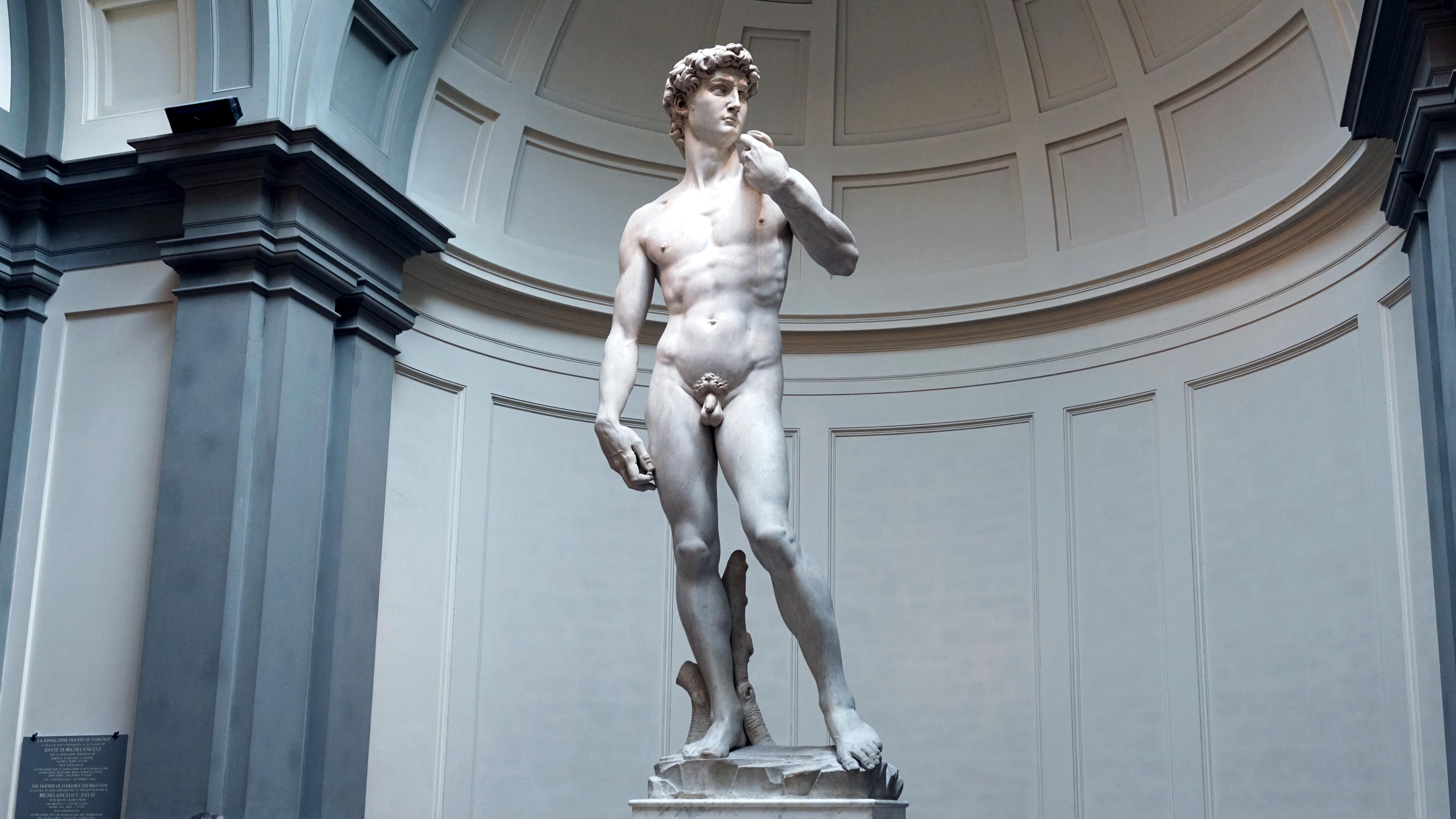
Michelangelo, David, 1504


The truest evidence that any civilization ever leaves behind about itself is its art. Art never lies.

Waldemar Januszczak

Teachers ...
  1. Know your students.  Go the extra mile to understand them (you'll get older; they'll stay the same age).
  2. Understand your craft (it's not a science).
  3. Understand your subject (this never ends).
  4. Understand the stories (be a master storyteller).
  5. Don't lecture; it's not about you (ever).
  6. Provide means of inspiration (see number 1).
  7. Nurture investigation (control is an illusion; the best lessons are the unplanned ones)
  8. Ask more questions (of everything and everyone).
  9. Declare less (see number 5).
  10. Be transparent.

03 August 2022

Individual.


Professor Bloom on preposterous "-isms" (from 2015) ...
Our burden as teachers now, even someone as old as I am, is in a sense something beyond our ability to teach.  There is a vast change in the cultural climate, which has devalued the very difficult act of solitary deep reading. 

Whether you call it feminism, which is not really feminism, has nothing to do with equal rights for women, or whether you call it transgenderism, or ethnicity, or Marxism, or any of these French manifestations, be it deconstruction or one mode of differential linguistics or another, or whether you call it -- what I think is mislabeled -- the new historicism, because it's neither new nor historicism, but simply a dilution of Foucault, a man whom I knew and liked personally, but whose influence I think has been pernicious, just as Derida's, with whom I also shared a friendship until eventually we broke with each other. All these "isms" are preposterous of course; they have nothing to do with the study of literature or with its originality. As I've said before, the aesthetic is an individual and not a social concern.

17 June 2022

12 February 2022

Excellent.

An excellent book ...


Daniel Pennac on instilling a joy of reading ...
Read, read, it’s your duty to read …

But what if, instead of demanding that students read, the teacher decided to share the joy of reading?

The joy of reading?  Whatever could that mean?

The question demands no small amount of self-knowledge.

Let’s begin with a truth that’s diametrically opposed to the dogma.  When a book changed our lives, we didn’t read it for, but against, something.  We read and continue to read as an act of withdrawal, of rejection and defiance.  If that makes us fugitives, if reality has little hope of prying us loose from the enchantment of our reading, then so be it, let’s be fugitives building a new life, escape artists in search of rebirth.

Every act of reading is an act of resistance.  Resistance to what?  To the world of random demands.

Social.
Professional.
Psychological.
Sentimental.
Climatic.
Familial.
Domestic.
Fraternal.
Pathological.
Pecuniary.
Ideological.
Cultural.
Or self-conscious

The act of reading, when well-done, preserves us from everything, including ourselves.

Most of all, we read to defeat death.

07 September 2021

Crave.

Chef Gabriel Kreuther teaching ...
Asking questions can be a treasure for you guys because you have a lot of knowledge around you.  Use it to your advantage.  Nobody is going to knock on your door and say, 'Hey!  I'm going to teach you something.'  You actually have to knock on the door and say, 'Show me something today.'  When you crave for learning, you learn.  That's really what it is ... get the knowledge and then have fun."

Thank you, Jessica.

21 July 2021

Learn.


EIGHT VERSES of TRAINING the MIND

By thinking of all sentient beings
As more precious than a wish-fulfilling jewel
For accomplishing the highest aim,
I will always hold them dear.

Whenever I’m in the company of others,
I will regard myself as the lowest among all,
And from the depths of my heart
Cherish others as supreme.

In my every action, I will watch my mind,
And the moment destructive emotions arise,
I will confront them strongly and avert them,
Since they will hurt both me and others.

Whenever I see ill-natured beings,
Or those overwhelmed by heavy misdeeds or suffering,
I will cherish them as something rare,
As though I’d found a priceless treasure.

Whenever someone out of envy
Does me wrong by attacking or belittling me,
I will take defeat upon myself,
And give the victory to others.

Even when someone I have helped,
Or in whom I have placed great hopes
Mistreats me very unjustly,
I will view that person as a true spiritual teacher.

In brief, directly or indirectly,
I will offer help and happiness to all my mothers,
And secretly take upon myself
All their hurt and suffering.

I will learn to keep all these practices
Untainted by thoughts of the eight worldly concerns.
May I recognize all things as like illusions,
And, without attachment, gain freedom from bondage.

Geshe Langri Thangpa

20 December 2020

Satisfying.


In my poetry class, I’ve always had students memorize something, a few things. I feel that if they’ve forgotten everything I’ve said, if they haven’t written anything down all semester and just stared out the window, at least they’ll come away with a poem memorized.

So one day, years ago, I was on the subway in New York, and a guy across the aisle kept kind of looking at me and finally he came over and said he recognized me as his teacher. I’d taught him about 10 years before that, or more. He’d since become an oncologist, and I congratulated him on his success. Then he said, “You made us memorize a poem.” And I said, “Yes.” And he said, “I’d like to say that poem for you.”

And it was a little poem by Emily Dickinson that he’d carried in his head, and maybe in his heart, for all those years. Over the roar of the six train, he yelled that poem in my ear, and I think it was probably the most satisfying pedagogical experience I’ve ever had.

Billy Collins

27 May 2020

Attention.


I don't know which is worse—to have a bad teacher or no teacher at all. In any case, I believe the teacher's work should be largely negative. He can't put the gift into you, but if he finds it there, he can try to keep it from going in an obviously wrong direction. We can learn how not to write, but this is a discipline that does not simply concern writing itself but concerns the whole intellectual life. A mind cleared of false emotion and false sentiment and egocentricity is going to have at least those roadblocks removed from its path. If you don't think cheaply, then there at least won't be the quality of cheapness in your writing, even though you may not be able to write well. The teacher can try to weed out what is positively bad, and this should be the aim of the whole college. Any discipline can help your writing: logic, mathematics, theology, and of course and particularly drawing. Anything that helps you to see, anything that makes you look. The writer should never be ashamed of staring. There is nothing that doesn't require his attention.

Flannery O'Connor

31 December 2019

Value.

An intimate account of the relationship between young composer and pianist Kit Armstrong and the world renowned Alfred Brendel, Set the Piano Stool on Fire captures both the creative process and champions the value of teaching and collaboration and features the only filmed footage of Brendel during his farewell tour ...