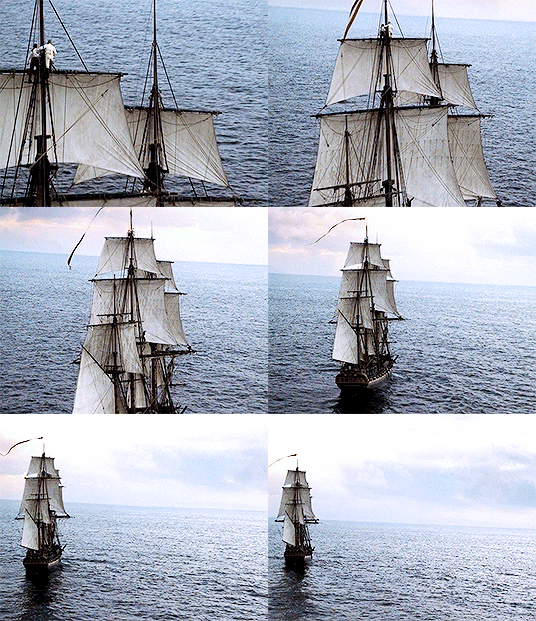
"I am not one who was born in the custody of wisdom. I am one who is fond of olden times and intense in quest of the sacred knowing of the ancients." Gustave Courbet
Showing posts with label Bradbury. Show all posts

27 July 2026

Learned.


When I was three my mother snuck me in and out of movies two or three times a week. My first film was Lon Chaney in The Hunchback of Notre Dame. I suffered permanent curvature of the spine and of my imagination that day a long time ago in 1923. From that hour on, I knew a kindred and wonderfully grotesque compatriot of the dark when I saw one. I ran off to see all the Chaney films again and again to be deliciously frightened. The Phantom of the Opera stood astride my life with his scarlet cape. And when it wasn't the Phantom it was the terrible hand that gestured from behind the bookcase in The Cat and the Canary, bidding me to come find more darkness hid in books. 

I was in love, then, with monsters and skeletons and circuses and carnivals and dinosaurs and, at last, the red planet, Mars. 

From these primitive bricks I have built a life and a career. By my staying in love with all of these amazing things, all of the good things in my existence have come about. 

In other words, I was not embarrassed at circuses. Some people are. Circuses are loud, vulgar, and smell in the sun. By the time many people are fourteen or fifteen, they have been divested of their loves, their ancient and intuitive tastes, one by one, until when they reach maturity there is no fun left, no zest, no gusto, no flavor. Others have criticized, and they have criticized themselves, into embarrassment. When the circus pulls in at five of a dark cold summer morn, and the calliope sounds, they do not rise and run, they turn in their sleep, and life passes by.

I did rise and run. I learned that I was right and everyone else wrong when I was nine. Buck Rogers arrived on scene that year, and it was instant love. I collected the daily strips, and was madness maddened by them. Friends criticized. Friends made fun. I tore up the Buck Rogers strips. For a month I walked through my fourth-grade classes, stunned and empty. One day I burst into tears, wondering what devastation had happened to me. The answer was: Buck Rogers. He was gone, and life simply wasn't worth living. The next thought was: Those are not my friends, the ones who got me to tear the strips apart and so tear my own life down the middle; they are my enemies.

25 July 2026

Alive.


How is it that the boy I was in October, 1929, could, because of the criticism of his fourth grade schoolmates, tear up his Buck Rogers comic strips and a month later judge all of his friends idiots and rush back to collecting?

Where did that judgment and strength come from? What sort of process did I experience to enable me to say: I am as good as dead. Who is killing me? What do I suffer from? What's the cure?

I was able, obviously, to answer all of the above. I named the sickness: my tearing up the strips. I found the cure: go back to collecting, no matter what.

I did. And was made well.

But still. At that age? When we are accustomed to responding to peer pressure?

Where did I find the courage to rebel, change my life, live alone?

I don't want to over-estimate all this, but damn it, I love that nine-year-old, whoever in hell he was. 

Part of the answer, of course, is in the fact that I was so madly in love with Buck Rogers, I could not see my love, my hero, my life, destroyed. It is almost that simple. It was like having your best allround greatest-loving-buddy, pal, center-of-life drown or get shotgun killed. Friends, so killed, cannot be saved from funerals. Buck Rogers, I realized, might know a second life, if I gave it to him. So I breathed in his mouth and, lo !, he sat up and talked and said, what?

Yell. Jump. Play. Out-run those sons-of-bitches. They'll never live the way you live. Go do it.  

Except I never used the S.O.B. words. They were not allowed.  Heck! was about the size and strength of my outcry. 

Stay alive!

21 July 2026

Use.

Raverat, The Magician’s Chariot, 1939


Collecting facts is important. Knowledge is important. But if you don’t have an imagination to use the knowledge, civilization is nowhere.

Ray Bradbury, from an interview with the Chicago Sun Times, August 24, 2003

30 June 2026

If.


When I was a boy in the midwest I used to go out and look at the stars at night and wonder about them.

I guess every boy does that.

When I wasn't looking at the stars, I was running in the my old or my brand-new tennis shoes, on my way to swing in a tree, swim in a lake, or delve in the town library to read about dinosaurs or time machines.

I guess every boy has done that, too.

This is a book about those stars and those tennis shoes. Mainly about the stars, beacuse that is the way I grew up, getting more and more involved with rockets and space as I moved toward my twelfth, thirteenth, and fourteenth years.

Not that I have forgotten the tennis shoes and their powerful magic, as you will see in the last story here, which I have included not because it concerns the future, but because it gives you some sort of idea of the kind of boy I was when I was looking at the stars and thinking of the years ahead.

Nor have I forgetten the dinosaurs that all boys love; they are here, too, along with a machine that travels back in time to step on a butterfly.

This is a book then by a boy who grew up in a small illinois town and lived to see the space age arrive, as he hoped and dreamt it would.

I dedicate these stories to all boys who wonder about the past, run swiftly in the present, and have high hopes for our future.

The stars are yours, if you have the head, the hands, and the heart for them.

Ray Bradbury, from R is for Rocket

21 June 2026

Summer.


As Summer is beginning right about ... now, here's the introduction to Dandelion Wine, by Ray Bradbury ...
JUST THIS SIDE OF BYZANTIUM: an introduction

This book, like most of my books and stories, was a surprise. I began to learn the nature of such surprises, thank God, when I was fairly young as a writer. Before that, like every beginner, I thought you could beat, pummel, and thrash an idea into existence. Under such treatment, of course, any decent idea folds up its paws, turns on its back, fixes its eyes on eternity, and dies.

It was with great relief, then, that in my early twenties I floundered into a word-association process in which I simply got out of bed each morning, walked to my desk, and put down any word or series of words that happened along in my head.

I would then take arms against the word, or for it, and bring on an assortment of characters to weigh the word and show me its meaning in my own life. An hour or two hours later, to my amazement, a new story would be finished and done. The surprise was total and lovely. I soon found that I would have to work this way for the rest of my life.

First I rummaged my mind for words that could describe my personal nightmares, fears of night and time from my childhood, and shaped stories from these.

Then I took a long look at the green apple trees and the old house I was born in and the house next door where lived my grandparents, and all the lawns of the summers I grew up in, and I began to try words for all that.

What you have here in this book then is a gathering of dandelions from all those years. The wine metaphor which appears again and again in these pages is wonderfully apt. I was gathering images all of my life, storing them away, and forgetting them. Somehow I had to send myself back, with words as catalysts, to open the memories out and see what they had to offer.

So from the age of twenty-four to thirty-six hardly a day passed when I didn’t stroll myself across a recollection of my grandparents’ northern Illinois grass, hoping to come across some old half-burnt firecracker, a rusted toy, or a fragment of letter written to myself in some young year hoping to contact the older person I became to remind him of his past, his life, his people, his joys, and his drenching sorrows.

It became a game that I took to with immense gusto: to see how much I could remember about dandelions themselves, or picking wild grapes with my father and brother, rediscovering the mosquito-breeding ground rain barrel by the side bay window, or searching out the smell of the gold-fuzzed bees that hung around our back porch grape arbor. Bees do have a smell, you know, and if they don’t they should, for their feet are dusted with spices from a million flowers.

An then I wanted to call back what the ravine was like, especially on those nights when walking home late across town, after seeing Lon Chaney’s delicious fright The Phantom of the Opera, my brother Skip would run ahead and hide under the ravine-creek bridge like the Lonely One and leap out and grab me, shrieking, so I ran, fell, and ran again, gibbering all the way home. That was great stuff.

Along the way I came upon and collided, through word-association, with old and true friendships. I borrowed my friend John Huff from my childhood in Arizona and shipped him East to Green Town so that I could say good-bye to him properly.

Along the way I sat me down to breakfasts, lunches, and dinners with the long dead and much loved. For I was a boy who did indeed love his parents and grandparents and his brother, even when that brother “ditched” him.

Along the way, I found myself in the basement working the wine-press for my father, or on the front porch Independence night helping my Uncle Bion load and fire his home-made brass cannon.

Thus I fell into surprise. No one told me to surprise myself, I might add. I came on the old and best ways of writing through ignorance and experiment and was startled when truths leaped out of bushes like quail before gunshot. I blunwas somehow true.

So I turned myself into a boy running to bring a dipper of clear rainwater out of that barrel by the side of the house. And, of course, the more water you dip out the more flows in. The flow has never ceased. Once I learned to keep going back and back again to those times, I had plenty of memories and sense impressions to play with, not work with, no, play with. Dandelion Wine is nothing if it is not the boy-hid-in-the-man playing in the fields of the Lord on the green grass of other Augusts in the midst of starting to grow up, grow old, and sense darkness waiting under the trees to seed the blood.

I was amused and somewhat astonished at a critic a few years back who wrote an article analyzing Dandelion Wine plus the more realistic work of Sinclair Lewis, wondering how I could have been born and raised in Waukegan, which I renamed Green Town for my novel, and not noticed how ugly the harbor was and how depressing the coal docks and railyards down below the town.

But, of course, I had noticed them and, genetic enchanter that I was, was fascinated by their beauty. Trains and boxcars and the smell of coal and fire are not ugly to children. Ugliness is a concept that we happen on later and become self-conscious about. Counting boxcars is a prime activity of boys. Their elders fret and fume and jeer at the train that holds them up, but boys happily count and cry the names of the cars as they pass from far places.

And again, that supposedly ugly railyard was where carnivals and circuses arrived with elephants who washed the brick pavements with mighty streaming acid waters at five in the dark morning.

As for the coal from the docks, I went down in my basement every autumn to await the arrival of the truck and its metal chute, which clanged down and released a ton of beauteous meteors that fell out of far space into my cellar and threatened to bury me beneath dark treasures.

In other words, if your boy is a poet, horse manure can only mean flowers to him; which is, of course, what horse manure has always been about.

Perhaps a new poem of mine will explain more than this introduction about the germination of all the summers of my life into one book.

Here’s the start of the poem:
Byzantium, I come not from,
But from another time and place
Whose race was simple, tried and true;
As boy
I dropped me forth in Illinois.
A name with neither love nor grace
Was Waukegan, there I came from
And not, good friends, Byzantium.
The poem continues, describing my lifelong relationship to my birthplace:
And yet in looking back I see
From topmost part of farthest tree
A land as bright, beloved and blue
As any Yeats found to be true.
Waukegan, visited by me often since, is neither homelier nor more beautiful than any other small Midwestern town. Much of it is green. The trees do touch in the middle of streets. The street in front of my old home is still paved with red bricks. In what way then was the town special? Why, I was born there. It was my life. I had to write of it as I saw fit:
So we grew up with mythic dead
To spoon upon midwestern bread
And spread old gods’ bright marmalade
To slake in peanut-butter shade,
Pretending there beneath our sky
That it was Aphrodite’s thigh…
While by the porch-rail calm and bold
His words pure wisdom, stare pure gold
My grandfather, a myth indeed,
Did all of Plato supercede
While Grandmama in rockingchair
Sewed up the raveled sleeve of care
Crocheted cool snowflakes rare and bright
To winter us on summer night.
And uncles, gathered with their smokes
Emitted wisdoms masked as jokes,
And aunts as wise as Delphic maids
Dispensed prophetic lemonades
To boys knelt there as acolytes
To Grecian porch on summer nights;
Then went to bed, there to repent
The evils of the innocent;
The gnat-sins sizzling in their ears
Said, through the nights and through the years
Not Illinois nor Waukegan
But blither sky and blither sun.
Though mediocre all our Fates
And Mayor not as bright as Yeats
Yet still we knew ourselves. The sum?
Byzantium.
Byzantuim.
Waukegan/ Green Town/ Byzantium.
Green Town did exist, then?
Yes, and again, yes.

Was there a real boy named John Huff? There was. And that was truly his name. But he didn’t go away from me, I went away from him. But, happy ending, he is still alive, forty-two years later, and remembers our love.

Was there a Lonely One? There was, and that was his name. And he moved around at night in my home town when I was six years old and he frightened everyone and was never captured.

Most importantly, did the big house itself, with Grandpa and Grandma and the boarders and uncles and aunts in it exist? I have answered that.

Is the ravine real and deep and dark at night? It was, it is. I took my daughters there a few years back, fearful that the ravine might have gone shallow with time. I am relieved and happy to report that the ravine is deeper, darker, and more mysterious than ever. I would not, even now, go home through there after seeing The Phantom of the Opera.

So there you have it. Waukegan was Green Town was Byzantium, with all the happiness that that means, with all the sadness that these names imply. The people there were gods and midgets and knew themselves mortal and so the midgets walked tall so as not to embarrass the gods and the gods crouched so as to make the small ones feel at home. And, after all, isn’t that what life is all about, the ability to go around back and come up inside other people’s heads to look out at the damned fool miracle and say: oh, so that’s how you see it!? Well, now, I must remember that.

Here is my celebration, then, of death as well as life, dark as well as light, old as well as young, smart and dumb combined, sheer joy as well as complete terror written by a boy who once hung upside down in trees, dressed in his bat costume with candy fangs in his mouth, who finally fell out of the trees when he was twelve and went and found a toy-dial typewriter and wrote his first “novel.”

A final memory.

Fire balloons.

You rarely see them these days, though in some countries, I hear, they are still filled with warm breath from a small straw fire hung beneath.

But in 1925 Illinois, we still had them, and one of the last memories I have of my grandfather is the last hour of a Fourth of July night forty-eight years ago when Grandpa and I walked out on the lawn and lit a small fire and filled the pear-shaped red-white-and-blue-striped paper balloon with hot air, and held the flickering bright-angel presence in our hands a final moment in front of a porch lined with uncles and aunts and cousins and mothers and fathers, and then, very softly, let the thing that was life and light and mystery go out of our fingers up on the summer night air and away over the beginning-to-sleep houses, among the stars, as fragile, as wondrous, as vulnerable, as lovely as life itself.

I see my grandfather there looking up at that strange drifting light, thinking his own still thoughts. I see me, my eyes filled with tears, because it was all over, the night was done, I knew there would never be another night like this.

No one said anything. We all just looked up at the sky and we breathed out and in and we all thought the same things, but nobody said. Someone finally had to say, though, didn’t they? And that one is me.

The wine still waits in the cellars below.

My beloved family still sits on the porch in the dark.

The fire balloon still drifts and burns in the night sky of an as yet unburied summer.

Why and how?

Because I say it is so.


Ray Bradbury
Summer, 1974
Your hymnal is here.

Fire balloons afloft in Thailand ...


Basic fire balloon how-to is here.

19 June 2026

Purify.

Ray Bradbury on life and love ...
We keep cleansing the stream just as any impurity running downhill in a river by the time it travels nine miles is purified.   So the life of a man traveling to the sea, which is our inevitable death someday, purifies itself.  It must, because if you do not purify, these tensions remain in and turn in on yourself and destroy you.  The man who cannot laugh freely is a sick man.  The man who cannot cry and release tears in that direction, there's a sick man.  The man who cannot be violent through exercise, through sports, through acting out his violence in paper or painting or acting on a stage, is a sick man.

15 June 2026

Miracle.


“What are we?” he asked. 

“Why, we are the miracle of force and matter making itself over into imagination and will. Incredible. The Life Force experimenting with forms. You for one. Me for another. The Universe has shouted itself alive. We are one of the shouts. Creation turns in its abyss. We have bothered it, dreaming ourselves to shapes. The void is filled with slumbers; ten billion on a billion on a billion bombardments of light and material that know not themselves, that sleep moving and move but finally to make an eye and waken on themselves. Among so much that is flight and ignorance, we are the blind force that gropes like Lazarus from a billion-light-year tomb. We summon ourselves. We say, O Lazarus Life Force, truly come ye forth. So the Universe, a motion of deaths, fumbles to reach across Time to feel its own flesh and know it to be ours.”

Ray Bradbury, from The Halloween Tree

14 June 2026

Make-Up.


Zest. Gusto. How rarely one hears these words used. How rarely do we see people living, or for that matter, creating by them. Yet if I were asked to name the most important items in a writer’s make-up, the things that shape his material and rush him along the road to where he wants to go, I could only warn him to look to his zest, see to his gusto.

Ray Bradbury, from Zen in the Art of Writing

02 May 2026

Ray Bradbury, "If Only We Had Taller Been"

Short man, large dream, I send my rockets forth between my ears,
Hoping an inch of good is worth a pound of years ...

28 March 2026

Be.


WHAT I DO IS ME —FOR THAT I CAME

for Gerard Manley Hopkins

What I do is me—for that I came.
What I do is me!
For that I came into the world!
So said Gerard;
So said that gentle Manley Hopkins.
In his poetry and prose he saw the Fates that chose
Him in genetics, then set him free to find his way
Among the sly electric printings in his blood.
God thumbprints thee! he said.
Within your hour of birth
He touches hand to brow, He whorls and softly stamps
The ridges and the symbols of His soul above your eyes!
But in that selfsame hour, full born and shouting
Shocked pronouncements of one's birth,
In mirrored gaze of midwife, mother, doctor
See that Thumbprint fade and fall away in flesh
So, lost, erased, you seek a lifetime's days for it
And dig deep to find the sweet instructions there.

Put by when God first circuited and printed thee to
life:
"Go hence! do this! do that! do yet another thing!
This self is yours! Be it!"
And what is that?! you cry at hearthing breast,
Is there no rest? No, only journeying to be yourself.
And even as the Birthmark vanishes, in seashell ear
Now fading to a sigh, His last words send you in the
world:
"Not mother, father, grandfather are you.
Be not another. Be the self I signed you in your blood.
I swarm your flesh with you. Seek that.
And, finding, be what no one else can be.
I leave you gifts of Fate most secret; find no other's Fate,
For if you do, no grave is deep enough for your despair
No country far enough to hide your loss.
I circumnavigate each cell in you
Your merest molecule is right and true.
Look there for destinies indelible and fine
And rare.
Ten thousand futures share your blood each instant;
Each drop of blood a cloned electric twin of you.

In merest wound on hand read replicas of what I
planned
and knew
Before your birth, then hid it in your heart.
No part of you that does not snug and hold and hide
The self that you will be if faith abide.
What you do is thee. For that I gave you birth.
Be that. So be the only you that's truly you on Earth."
Dear Hopkins. Gentle Manley. Rare Gerard. Fine
name.
What we do is us. Because of you. For that we came.

Ray Bradbury

16 March 2026

Everywhere.


Read poetry every day of your life. Poetry is good because it flexes muscles you don't use often enough. Poetry expands the senses and keeps them in prime condition. It keeps you aware of your nose, your eye, your ear, your tongue, your hand. And, above all, poetry is compacted metaphor or simile. Such metaphors, like Japanese paper flowers, may expand outward into gigantic shapes. Ideas lie everywhere through the poetry books, yet how rarely have I heard short story teachers recommending them for browsing.

19 December 2025

Truly.


Through neglect, ignorance, or inability, the new intellectual Borgias cram hairballs down our throats and refuse us the convulsion that could make us well. They have forgotten, if they ever knew, the ancient knowledge that only by being truly sick can one regain health. Even beasts know when it is good and proper to throw up. Teach me how to be sick then, in the right time and place, so that I may again walk in the fields and with the wise and smiling dogs know enough to chew sweet grass.


Revolt against the modern world.

27 October 2025

Spread.


It was a small town by a small river and a small lake in a small northern part of a Midwest state. There wasn't so much wilderness around you couldn't see the town. But on the other hand there wasn't so much town you couldn't see and feel and touch and smell the wilderness. The town was full of trees. And dry grass and dead flowers now that autumn was here. And full of fences to walk on and sidewalks to skate on and a large ravine to tumble in and yell across. And the town was full of...

Boys.

And it was the afternoon of Halloween.

And all the houses shut against a cool wind.

And the town was full of cold sunlight.

But suddenly, the day was gone.
Night came out from under each tree and spread.

Ray Bradbury, from The Halloween Tree

25 October 2025

Unless.


Have I said anything I started out to say about being good? God, I don't know. A stranger is shot in the street, you hardly move to help. But if, half an hour before, you spent just ten minutes with the fellow and knew a little about him and his family, you might just jump in front of his killer and try to stop it. Really knowing is good. Not knowing, or refusing to know, is bad, or amoral, at least. You can't act if you don't know. Acting without knowing takes you right off the cliff. God, God, you must think I'm crazy, this talk. Probably think we should be out duck-shooting, elephant-gunning balloons, like you did, Will, but we got to know all there is to know about those freaks and that man heading them up. We can't be good unless we know what bad is, and it's a shame we're working against time.

20 October 2025

Smoky-Smelling.


But you take October, now. School's been on a month and you're riding easier in the reins, jogging along.You got time to think of the garbage you'll dump on old man Prickett's porch, or the hairy-ape costume you'll wear to the YMCA the last night of the month.  And if it's around October twentieth and everything smoky-smelling and the sky orange and ash grey at twilight, it seems Hallowe'en will never come in a fall of broomsticks and a soft flap of bedsheets around corners.

19 October 2025

Around.


And then there is that day when all around, all around you hear the dropping of the apples, one by one, from the trees. At first it is one here and one there, and then it is three and then it is four and then nine and twenty, until the apples plummet like rain, fall like horse hoofs in the soft, darkening grass, and you are the last apple on the tree; and you wait for the wind to work you slowly free from your hold upon the sky, and drop you down and down. Long before you hit the grass you will have forgotten there ever was a tree, or other apples, or a summer, or green grass below. 

Ray Bradbury, from Dandelion Wine

02 October 2025

Read.


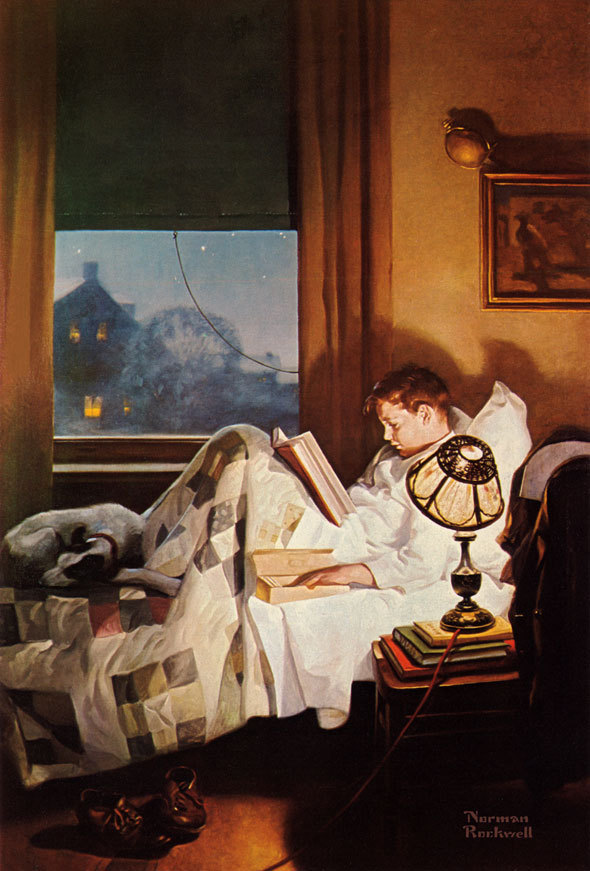
Martin knew it was autumn again, for Dog ran into the house bringing wind and frost and a smell of apples turned to cider under trees. In dark clock-springs of hair, Dog fetched goldenrod, dust of farewell-summer, acorn-husk, hair of squirrel, feather of departed robin, sawdust from fresh-cut cordwood, and leaves like charcoals shaken from a blaze of maple trees. Dog jumped. Showers of brittle fern, blackberry vine, marsh-grass sprang over the bed where Martin shouted.  No doubt, no doubt of it at all, this incredible beast was October!

“Here, boy, here!”

And Dog settled to warm Martin’s body with all the bonfires and subtle burnings of the season, to fill the room with soft or heavy, wet or dry odors of far-traveling. In spring, he smelled of lilac, iris, lawn-mowered grass; in summer, ice cream-mustached, he came pungent with firecracker, Roman candle, pinwheel, baked by the sun. But autumn! Autumn!

“Dog, what’s it like outside?”

And lying there, Dog told as he always told. Lying there, Martin found autumn as in the old days before sickness bleached him white on his bed. Here was his contact, his carry-all, the quick-moving part of himself he sent with a yell to run and return, circle and scent, collect and deliver the time and texture of worlds in town, country, by creek, river, lake, down-cellar, up-attic, in closet or coal-bin. Ten dozen times a day he was gifted with sunflower seed, cinder-path, milkweed, horse-chestnut, or full flame-smell of pumpkin. Through the loomings of the universe Dog shuttled; the design was hid in his pelt. Put out your hand, it was there. . . .

“And where did you go this morning?”

But he knew without hearing where Dog had rattled down hills where autumn lay in cereal crispness, where children lay in funeral pyres, in rustling heaps, the leaf-buried but watchful dead, as Dog and the world blew by. Martin trembled his fingers, searched the thick fur, read the long journey. Through stubbled fields, over glitters of ravine creek, down marbled spread of cemetery yard, into woods. In the great season of spices and rare incense, now Martin ran through his emissary, around, about, and home!

The bedroom door opened ...

Ray Bradbury, from "The Emissary"

01 October 2025

Smoky-Smelling.

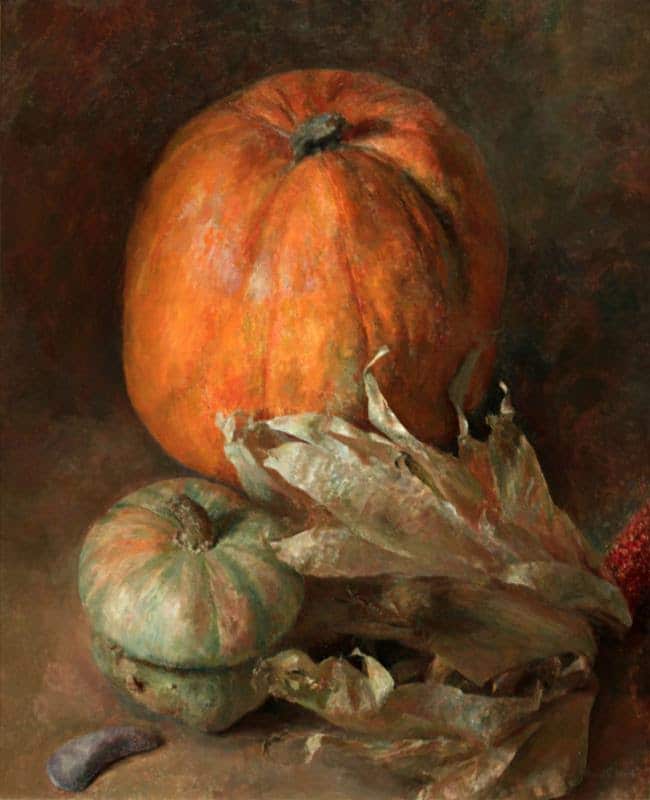
Wyeth, Henriette, Jamie’s Pumpkins, 1968


First of all, it was October, a rare month for boys. Not that all months aren’t rare. But there be bad and good, as the pirates say. Take September, a bad month: school begins. Consider August, a good month: school hasn’t begun yet. July, well, July’s really fine: there’s no chance in the world for school. June, no doubting it, June’s best of all, for the school doors spring wide and September’s a billion years away.

But you take October, now. School’s been on a month and you’re riding easier in the reins, jogging along. You got time to think of the garbage you’ll dump on old man Prickett’s porch, or the hairy-ape costume you’ll wear to the YMCA the last night of the month. And if it’s around October twentieth and everything smoky-smelling and the sky orange and ash gray at twilight, it seems Halloween will never come in a fall of broomsticks and a soft flap of bedsheets around corners.


Thank you, Kurt, for introducing me to Bradbury all those years ago.  Autumn wouldn't be the same without him.  I remember.

22 September 2025

Reminded.


Ray Bradbury, from "The Pumpernickel" ...
What was the special quality of that day that it should focus like a stereoscopic image, fresh and clear, forty- years later? Perhaps each of them had had an experience like his own. A few days before the picnic, he had found a photograph of his father twenty-five years younger, standing with a group of friends at college. The photograph had disturbed him, made him aware as he had not been before of the passing of time, the swift flow of the years away from youth. A picture taken of him as he was now would, in twenty-five years, look as strange to his own children as his father's picture did to him - unbelievably young, a stranger out of a strange, never-returning time.

Was that how the final picnic had come about - with each of them knowing that in a few short years they would be crossing streets to avoid one another, or, if they met, saying, "We've got to have lunch sometime!" but never doing it? Whatever the reason, Mr. Welles could still hear the splashes as they'd plunged off the pier under a yellow sun. And then the beer and sandwiches underneath the shady trees.

We never ate that pumpernickel, Mr. Welles thought. Funny, if we'd been a bit hungrier, we'd have cut it up, and I wouldn't have been reminded of it by the loaf there on the counter.

Lying under the trees in a golden peace that came from beer and sun and male companionship, they promised that in ten years they would meet at the courthouse on New Year's Day, 1920, to see what they had done with their lives. Talking their rough easy talk, they carved their names in the pumpernickel.

"Driving home," Mr. Welles said, "we sang 'Moonlight Bay'."

He remembered motoring along in the hot, dry night with their swimsuits damp on the jolting floorboards. It was a ride of many detours taken just for the hell of it, which was the best reason in the world.