"I am not one who was born in the custody of wisdom. I am one who is fond of olden times and intense in quest of the sacred knowing of the ancients." Gustave Courbet
Showing posts with label Rockwell. Show all posts

30 October 2026

Scourings.

Rockwell, Ichabod Crane, 1937


The schoolmaster is generally a man of some importance in the female circle of a rural neighborhood; being considered a kind of idle, gentlemanlike personage, of vastly superior taste and accomplishments to the rough country swains, and, indeed, inferior in learning only to the parson. His appearance, therefore, is apt to occasion some little stir at the tea-table of a farmhouse, and the addition of a supernumerary dish of cakes or sweetmeats, or, peradventure, the parade of a silver teapot. Our man of letters, therefore, was peculiarly happy in the smiles of all the country damsels. How he would figure among them in the churchyard, between services on Sundays; gathering grapes for them from the wild vines that overran the surrounding trees; reciting for their amusement all the epitaphs on the tombstones; or sauntering, with a whole bevy of them, along the banks of the adjacent millpond; while the more bashful country bumpkins hung sheepishly back, envying his superior elegance and address.

From his half-itinerant life, also, he was a kind of travelling gazette, carrying the whole budget of local gossip from house to house, so that his appearance was always greeted with satisfaction. He was, moreover, esteemed by the women as a man of great erudition, for he had read several books quite through, and was a perfect master of Cotton Mather’s History of New England Witchcraft, in which, by the way, he most firmly and potently believed.

He was, in fact, an odd mixture of small shrewdness and simple credulity. His appetite for the marvellous, and his powers of digesting it, were equally extraordinary; and both had been increased by his residence in this spell-bound region. No tale was too gross or monstrous for his capacious swallow. It was often his delight, after his school was dismissed in the afternoon, to stretch himself on the rich bed of clover bordering the little brook that whimpered by his schoolhouse, and there con over old Mather’s direful tales, until the gathering dusk of evening made the printed page a mere mist before his eyes. Then, as he wended his way by swamp and stream and awful woodland, to the farmhouse where he happened to be quartered, every sound of nature, at that witching hour, fluttered his excited imagination,—the moan of the whip-poor-will from the hillside, the boding cry of the tree toad, that harbinger of storm, the dreary hooting of the screech owl, or the sudden rustling in the thicket of birds frightened from their roost. The fireflies, too, which sparkled most vividly in the darkest places, now and then startled him, as one of uncommon brightness would stream across his path; and if, by chance, a huge blockhead of a beetle came winging his blundering flight against him, the poor varlet was ready to give up the ghost, with the idea that he was struck with a witch’s token. His only resource on such occasions, either to drown thought or drive away evil spirits, was to sing psalm tunes and the good people of Sleepy Hollow, as they sat by their doors of an evening, were often filled with awe at hearing his nasal melody, “in linked sweetness long drawn out,” floating from the distant hill, or along the dusky road.

Another of his sources of fearful pleasure was to pass long winter evenings with the old Dutch wives, as they sat spinning by the fire, with a row of apples roasting and spluttering along the hearth, and listen to their marvellous tales of ghosts and goblins, and haunted fields, and haunted brooks, and haunted bridges, and haunted houses, and particularly of the headless horseman, or Galloping Hessian of the Hollow, as they sometimes called him. He would delight them equally by his anecdotes of witchcraft, and of the direful omens and portentous sights and sounds in the air, which prevailed in the earlier times of Connecticut; and would frighten them woefully with speculations upon comets and shooting stars; and with the alarming fact that the world did absolutely turn round, and that they were half the time topsy-turvy!

But if there was a pleasure in all this, while snugly cuddling in the chimney corner of a chamber that was all of a ruddy glow from the crackling wood fire, and where, of course, no spectre dared to show its face, it was dearly purchased by the terrors of his subsequent walk homewards. What fearful shapes and shadows beset his path, amidst the dim and ghastly glare of a snowy night! With what wistful look did he eye every trembling ray of light streaming across the waste fields from some distant window! How often was he appalled by some shrub covered with snow, which, like a sheeted spectre, beset his very path! How often did he shrink with curdling awe at the sound of his own steps on the frosty crust beneath his feet; and dread to look over his shoulder, lest he should behold some uncouth being tramping close behind him! And how often was he thrown into complete dismay by some rushing blast, howling among the trees, in the idea that it was the Galloping Hessian on one of his nightly scourings!

Washington Irving, from "The Legend of Sleepy Hollow", found among the papers of the late Dietrich Knickerbocker in Geoffrey Crayon's Sketchbook

19 July 2026

Rewarded.

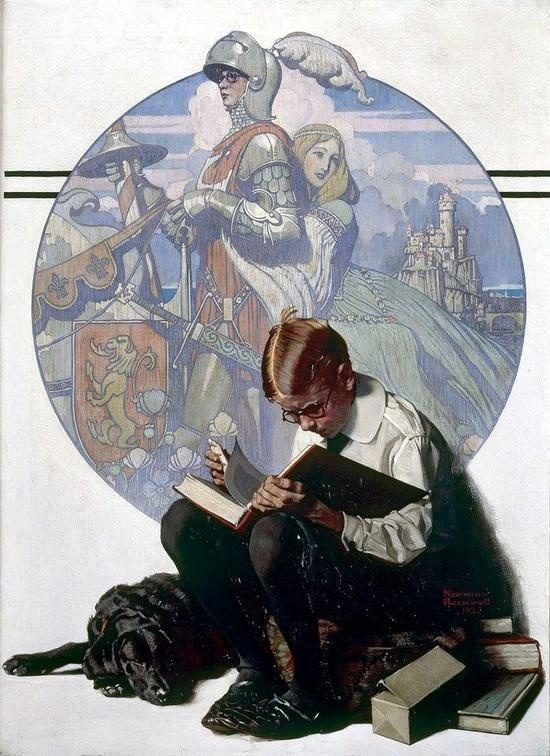
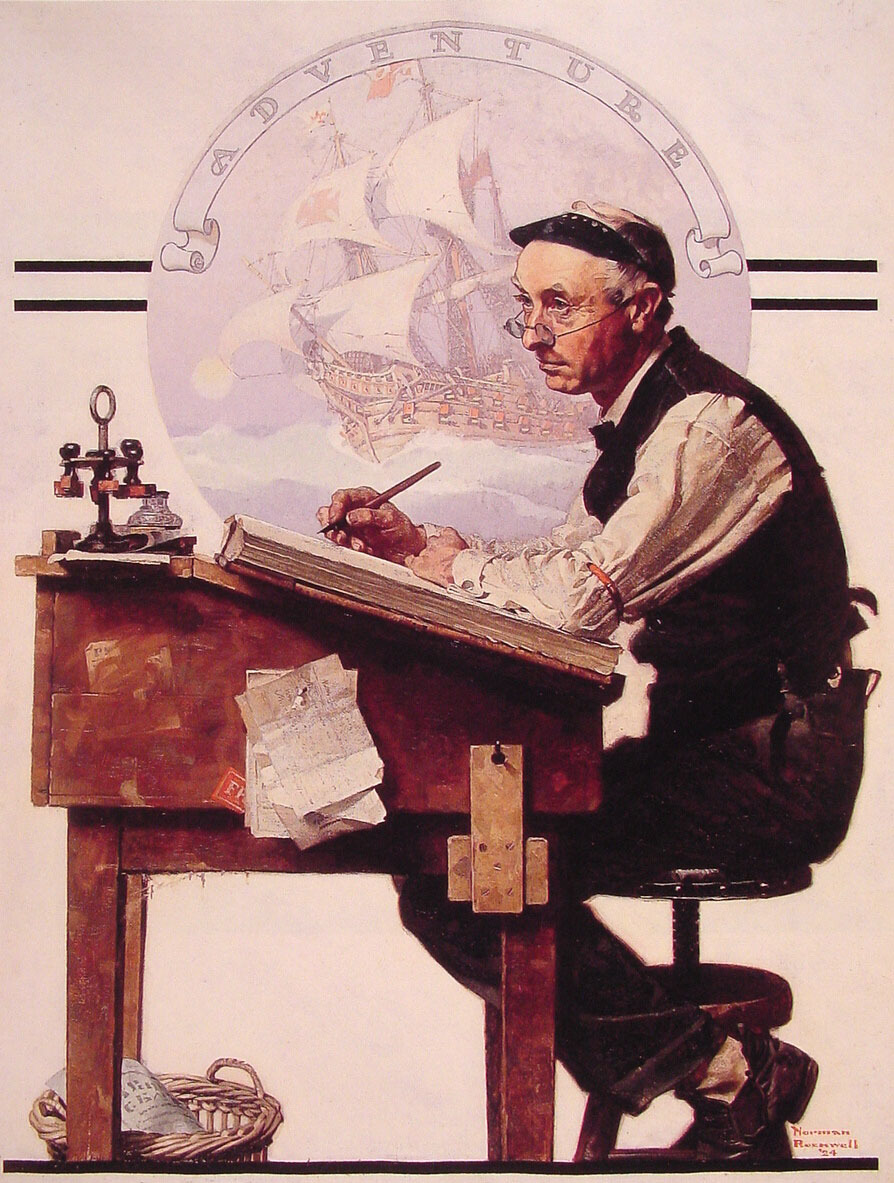
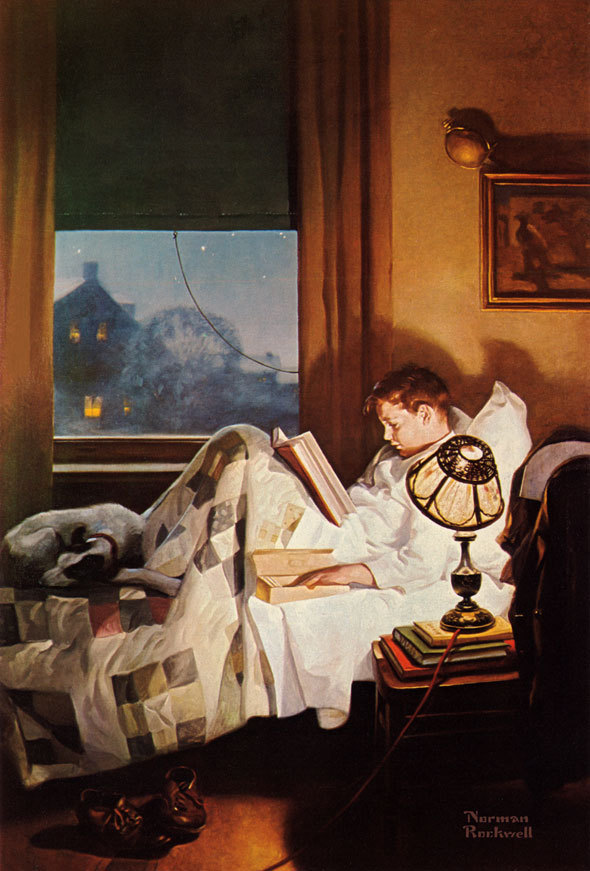
Rockwell, Boy Reading of Adventure, 1920


The Atlantic says the end of reading is here ...
Rennix told me that some students now view reading as an unnecessarily burdensome way of acquiring knowledge. “By asking them to read,” she said, “professors are arbitrarily withholding information from students by forcing them to get it through this more difficult medium.”

Later ...

If we fill our time with short-form videos instead of books, our reading skills atrophy. We have less background knowledge to aid comprehension. There’s no danger of spontaneous mass illiteracy, but the complex cognitive skills that reading fosters start to degrade. The library of the mind falls into disrepair.

Reading books is a workout for the attention span. The more you read, the easier it is to read, and the more you’re rewarded with new understanding. Eventually the process is more pleasurable than it is challenging. But as with physical exercise, the converse is true as well: The less you read, the more difficult it is to read, and the rockier the path to acquiring knowledge.

My students hear this from me every single day:  "Psst!  Hey all you readers!  Keep at it!  The habits of those around you are making it easier and easier for you to succeed!

Twain tried to warn us: The man who does not read has no advantage over the man who cannot.

22 May 2026

Happy Birthday, Sir Arthur Conan Doyle

Rockwell, Boy Reading an Adventure Story, 1923


I do not think that life has any joy to offer so complete, so soul- filling as that which comes upon the imaginative lad, whose spare time is limited, but who is able to snuggle down into a corner with his book knowing that the next hour is all his own. And how vivid and fresh it all is! Your very heart and soul are out on the prairies and the oceans with your hero. It is you who act and suffer and enjoy. You carry the long small-bore Kentucky rifle with which such egregious things are done, and you lie out upon the topsail yard, and get jerked by the flap of the sail into the Pacific, where you cling on to the leg of an albatross, and so keep afloat until the comic boatswain turns up with his crew of volunteers to handspike you into safety. What a magic it is, this stirring of the boyish heart and mind! Long ere I came to my teens I had traversed every sea and knew the Rockies like my own back garden. How often had I sprung upon the back of the charging buffalo and so escaped him! It was an everyday emergency to have to set the prairie on fire in front of me in order to escape from the fire behind, or to run a mile down a brook to throw the bloodhounds off my trail. I had creased horses, I had shot down rapids, I had strapped on my moccasins hindforemost to conceal my tracks, I had lain under water with a reed in my mouth, and I had feigned madness to escape the torture. As to the Indian braves whom I slew in single combats, I could have stocked a large graveyard, and, fortunately enough, though I was a good deal chipped about in these affairs, no real harm ever came of it and I was always nursed back into health by a very fascinating young squaw. It was all more real than the reality. Since those days I have in very truth both shot bears and harpooned whales, but the performance was flat compared with the first time that I did it with Mr. Ballantyne or Captain Mayne Reid at my elbow.

Sir Arthur Conan Doyle, born on this day in 1859, from "Juvenilia"

06 December 2025

Privilege.

Rockwell, Mistletoe, 1937


The Druids started it. Mistletoe, a hemi-parasitic plant that grows on trees, has long been considered a cure-all with special properties: In the Aeneid, the hero brings a bough thought to be mistletoe—a symbol of vitality that remains green even in winter—to the underworld. But the earliest mention of mistletoe's romantic powers was by Roman natural historian Pliny the Elder, who scoffed at the Druids of the 1st Century A.D. for believing that "mistletoe, taken in drink, will impart fecundity to all animals that are barren." That romantic association was later expanded by the Norse myth about Baldur and his mother, Frigga, the goddess of love and marriage. According to legend, Frigga got all the plants and animals of the Earth to promise not to harm her son—except mistletoe. Loki, the god of mischief, took that opportunity to kill Baldur with a spear made of mistletoe. In some versions of the tale, Frigga's tears then turned into mistletoe berries, which brought Baldur back to life, prompting Frigga to declare mistletoe a symbol of love.
In his essay on Christmas Eve, Washington Irving vividly describes the proper setting ...
As we approached the house we heard the sound of music, and now and then a burst of laughter from one end of the building. This, Bracebridge said, must proceed from the servants' hall, where a great deal of revelry was permitted, and even encouraged, by the squire throughout the twelve days of Christmas, provided everything was done conformably to ancient usage. Here were kept up the old games of hoodman blind, shoe the wild mare, hot cockles, steal the white loaf, bob apple, and snap dragon; the Yule-clog and Christmas candle were regularly burnt, and the mistletoe with its white berries hung up, to the imminent peril of all the pretty housemaids.  The mistletoe is still hung up in farm-houses and kitchens at Christmas, and the young men have the privilege of kissing the girls under it, plucking each time a berry from the bush. When the berries are all plucked the privilege ceases.

28 October 2025

Scourings.

Rockwell, Ichabod Crane, 1937


The schoolmaster is generally a man of some importance in the female circle of a rural neighborhood; being considered a kind of idle, gentlemanlike personage, of vastly superior taste and accomplishments to the rough country swains, and, indeed, inferior in learning only to the parson. His appearance, therefore, is apt to occasion some little stir at the tea-table of a farmhouse, and the addition of a supernumerary dish of cakes or sweetmeats, or, peradventure, the parade of a silver teapot. Our man of letters, therefore, was peculiarly happy in the smiles of all the country damsels. How he would figure among them in the churchyard, between services on Sundays; gathering grapes for them from the wild vines that overran the surrounding trees; reciting for their amusement all the epitaphs on the tombstones; or sauntering, with a whole bevy of them, along the banks of the adjacent millpond; while the more bashful country bumpkins hung sheepishly back, envying his superior elegance and address.

From his half-itinerant life, also, he was a kind of travelling gazette, carrying the whole budget of local gossip from house to house, so that his appearance was always greeted with satisfaction. He was, moreover, esteemed by the women as a man of great erudition, for he had read several books quite through, and was a perfect master of Cotton Mather’s History of New England Witchcraft, in which, by the way, he most firmly and potently believed.

He was, in fact, an odd mixture of small shrewdness and simple credulity. His appetite for the marvellous, and his powers of digesting it, were equally extraordinary; and both had been increased by his residence in this spell-bound region. No tale was too gross or monstrous for his capacious swallow. It was often his delight, after his school was dismissed in the afternoon, to stretch himself on the rich bed of clover bordering the little brook that whimpered by his schoolhouse, and there con over old Mather’s direful tales, until the gathering dusk of evening made the printed page a mere mist before his eyes. Then, as he wended his way by swamp and stream and awful woodland, to the farmhouse where he happened to be quartered, every sound of nature, at that witching hour, fluttered his excited imagination,—the moan of the whip-poor-will from the hillside, the boding cry of the tree toad, that harbinger of storm, the dreary hooting of the screech owl, or the sudden rustling in the thicket of birds frightened from their roost. The fireflies, too, which sparkled most vividly in the darkest places, now and then startled him, as one of uncommon brightness would stream across his path; and if, by chance, a huge blockhead of a beetle came winging his blundering flight against him, the poor varlet was ready to give up the ghost, with the idea that he was struck with a witch’s token. His only resource on such occasions, either to drown thought or drive away evil spirits, was to sing psalm tunes and the good people of Sleepy Hollow, as they sat by their doors of an evening, were often filled with awe at hearing his nasal melody, “in linked sweetness long drawn out,” floating from the distant hill, or along the dusky road.

Another of his sources of fearful pleasure was to pass long winter evenings with the old Dutch wives, as they sat spinning by the fire, with a row of apples roasting and spluttering along the hearth, and listen to their marvellous tales of ghosts and goblins, and haunted fields, and haunted brooks, and haunted bridges, and haunted houses, and particularly of the headless horseman, or Galloping Hessian of the Hollow, as they sometimes called him. He would delight them equally by his anecdotes of witchcraft, and of the direful omens and portentous sights and sounds in the air, which prevailed in the earlier times of Connecticut; and would frighten them woefully with speculations upon comets and shooting stars; and with the alarming fact that the world did absolutely turn round, and that they were half the time topsy-turvy!

But if there was a pleasure in all this, while snugly cuddling in the chimney corner of a chamber that was all of a ruddy glow from the crackling wood fire, and where, of course, no spectre dared to show its face, it was dearly purchased by the terrors of his subsequent walk homewards. What fearful shapes and shadows beset his path, amidst the dim and ghastly glare of a snowy night! With what wistful look did he eye every trembling ray of light streaming across the waste fields from some distant window! How often was he appalled by some shrub covered with snow, which, like a sheeted spectre, beset his very path! How often did he shrink with curdling awe at the sound of his own steps on the frosty crust beneath his feet; and dread to look over his shoulder, lest he should behold some uncouth being tramping close behind him! And how often was he thrown into complete dismay by some rushing blast, howling among the trees, in the idea that it was the Galloping Hessian on one of his nightly scourings!

Washington Irving, from "The Legend of Sleepy Hollow", found among the papers of the late Dietrich Knickerbocker in Geoffrey Crayon's Sketchbook

26 October 2025

Glaring.

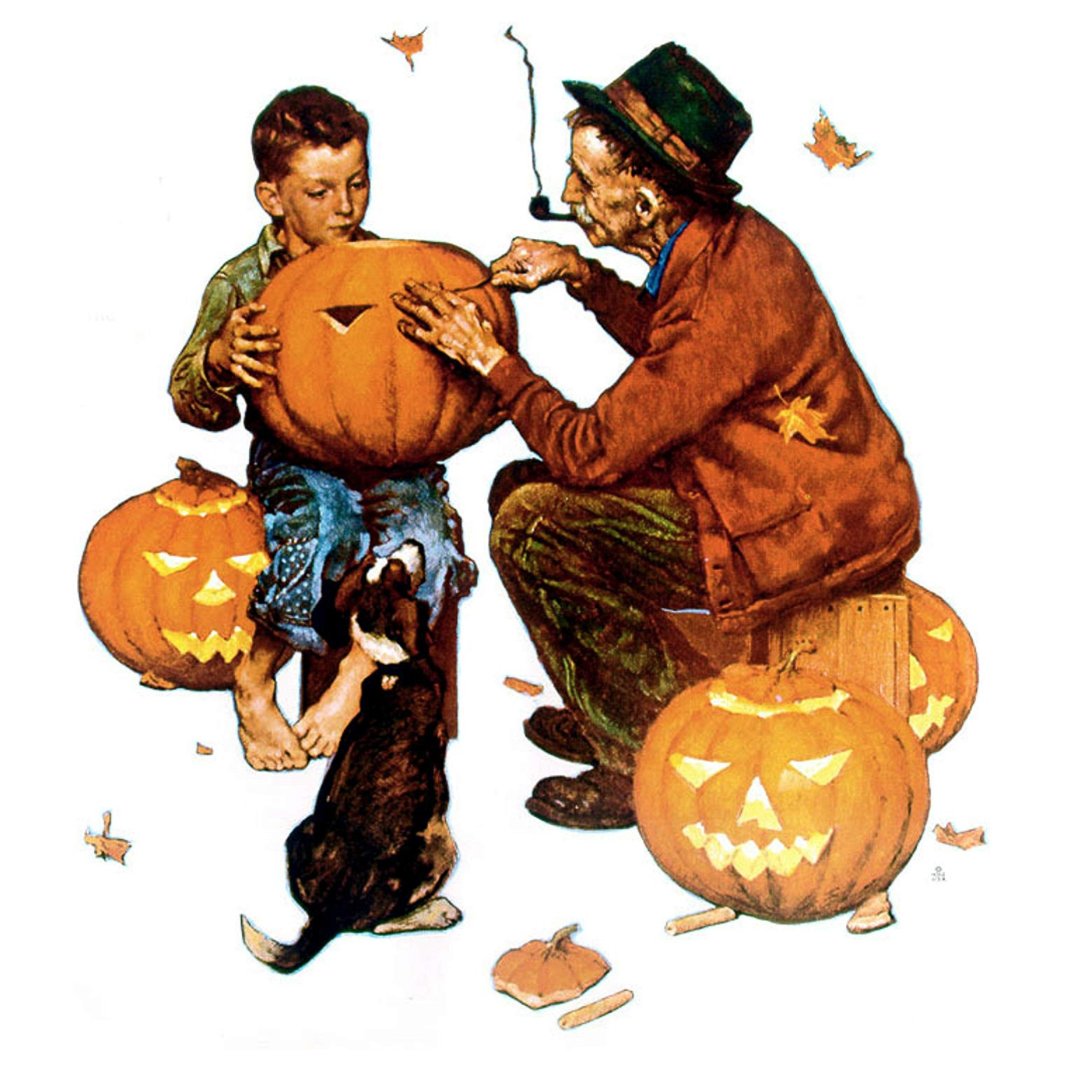
Rockwell, Ghostly Gourds, 1969


The PUMPKIN

Oh, greenly and fair in the lands of the sun, 
The vines of the gourd and the rich melon run, 
And the rock and the tree and the cottage enfold, 
With broad leaves all greenness and blossoms all gold, 
Like that which o'er Nineveh's prophet once grew, 
While he waited to know that his warning was true, 
And longed for the storm-cloud, and listened in vain 
For the rush of the whirlwind and red fire-rain. 

On the banks of the Xenil the dark Spanish maiden 
Comes up with the fruit of the tangled vine laden; 
And the Creole of Cuba laughs out to behold 
Through orange-leaves shining the broad spheres of gold; 
Yet with dearer delight from his home in the North, 
On the fields of his harvest the Yankee looks forth, 
Where crook-necks are coiling and yellow fruit shines, 
And the sun of September melts down on his vines. 

Ah! on Thanksgiving day, when from East and from West, 
From North and from South comes the pilgrim and guest; 
When the gray-haired New Englander sees round his board 
The old broken links of affection restored, 
When the care-wearied man seeks his mother once more, 
And the worn matron smiles where the girl smiled before, 
What moistens the lip and what brightens the eye? 
What calls back the past, like the rich Pumpkin pie? 

Oh, fruit loved of boyhood! the old days recalling, 
When wood-grapes were purpling and brown nuts were falling! 
When wild, ugly faces we carved in its skin, 
Glaring out through the dark with a candle within! 
When we laughed round the corn-heap, with hearts all in tune, 
Our chair a broad pumpkin,—our lantern the moon, 
Telling tales of the fairy who travelled like steam 
In a pumpkin-shell coach, with two rats for her team! 

Then thanks for thy present! none sweeter or better 
E'er smoked from an oven or circled a platter! 
Fairer hands never wrought at a pastry more fine, 
Brighter eyes never watched o'er its baking, than thine! 
And the prayer, which my mouth is too full to express, 
Swells my heart that thy shadow may never be less, 
That the days of thy lot may be lengthened below, 
And the fame of thy worth like a pumpkin-vine grow, 
And thy life be as sweet, and its last sunset sky 
Golden-tinted and fair as thy own Pumpkin pie! 

John Greenleaf Whittier

27 October 2024

Gentleman-Like.

Rockwell, Ichabod Crane, 1937


The schoolmaster is generally a man of some importance in the female circle of a rural neighborhood, being considered a kind of idle, gentleman-like personage of vastly superior taste and accomplishments to the rough country swains, and, indeed, inferior in learning only to the parson. His appearance, therefore, is apt to occasion some little stir at the tea-table of a farmhouse and the addition of a supernumerary dish of cakes or sweetmeats, or, peradventure, the parade of a silver tea-pot. Our man of letters, therefore, was peculiarly happy in the smiles of all the country damsels. How he would figure among them in the churchyard between services on Sundays, gathering grapes for them from the wild vines that overrun the surrounding trees; reciting for their amusement all the epitaphs on the tombstones; or sauntering, with a whole bevy of them, along the banks of the adjacent mill-pond, while the more bashful country bumpkins hung sheepishly back, envying his superior elegance and address.

From his half-itinerant life, also, he was a kind of travelling gazette, carrying the whole budget of local gossip from house to house, so that his appearance was always greeted with satisfaction. He was, moreover, esteemed by the women as a man of great erudition, for he had read several books quite through, and was a perfect master of Cotton Mather’s History of New England Witchcraft, in which, by the way, he most firmly and potently believed.

He was, in fact, an odd mixture of small shrewdness and simple credulity. His appetite for the marvellous and his powers of digesting it were equally extraordinary, and both had been increased by his residence in this spellbound region. No tale was too gross or monstrous for his capacious swallow. It was often his delight, after his school was dismissed in the afternoon, to stretch himself on the rich bed of clover bordering the little brook that whimpered by his school-house, and there con over old Mather’s direful tales until the gathering dusk of the evening made the printed page a mere mist before his eyes. Then, as he wended his way by swamp and stream and awful woodland to the farmhouse where he happened to be quartered, every sound of Nature at that witching hour fluttered his excited imagination—the moan of the whip-poor-will from the hillside; the boding cry of the tree-toad, that harbinger of storm; the dreary hooting of the screech-owl, or the sudden rustling in the thicket of birds frightened from their roost. The fire-flies, too, which sparkled most vividly in the darkest places, now and then startled him as one of uncommon brightness would stream across his path; and if, by chance, a huge blockhead of a beetle came winging his blundering flight against him, the poor varlet was ready to give up the ghost, with the idea that he was struck with a witch’s token. His only resource on such occasions, either to drown thought or drive away evil spirits, was to sing psalm tunes; and the good people of Sleepy Hollow, as they sat by their doors of an evening, were often filled with awe at hearing his nasal melody, “in linked sweetness long drawn out,” floating from the distant hill or along the dusky road.

Another of his sources of fearful pleasure was to pass long winter evenings with the old Dutch wives as they sat spinning by the fire, with a row of apples roasting and spluttering along the hearth, and listen to their marvellous tales of ghosts and goblins, and haunted fields, and haunted brooks, and haunted bridges, and haunted houses, and particularly of the headless horseman, or Galloping Hessian of the Hollow, as they sometimes called him. He would delight them equally by his anecdotes of witchcraft and of the direful omens and portentous sights and sounds in the air which prevailed in the earlier times of Connecticut, and would frighten them woefully with speculations upon comets and shooting stars, and with the alarming fact that the world did absolutely turn round and that they were half the time topsy-turvy.

But if there was a pleasure in all this while snugly cuddling in the chimney-corner of a chamber that was all of a ruddy glow from the crackling wood-fire, and where, of course, no spectre dared to show its face, it was dearly purchased by the terrors of his subsequent walk homewards. What fearful shapes and shadows beset his path amidst the dim and ghastly glare of a snowy night! With what wistful look did be eye every trembling ray of light streaming across the waste fields from some distant window! How often was he appalled by some shrub covered with snow, which, like a sheeted spectre, beset his very path! How often did he shrink with curdling awe at the sound of his own steps on the frosty crust beneath his feet, and dread to look over his shoulder, lest he should behold some uncouth being tramping close behind him! And how often was he thrown into complete dismay by some rushing blast howling among the trees, in the idea that it was the Galloping Hessian on one of his nightly scourings!

Washington Irving, from "The Legend of Sleepy Hollow"

05 October 2024

Rustling.

Rockwell, Grandpa and Me Raking Leaves, 1948


GATHERING LEAVES

Spades take up leaves
No better than spoons,
And bags full of leaves
Are light as balloons.

I make a great noise
Of rustling all day
Like rabbit and deer
Running away.

But the mountains I raise
Elude my embrace,
Flowing over my arms
And into my face.

I may load and unload
Again and again
Till I fill the whole shed,
And what have I then?

Next to nothing for weight,
And since they grew duller
From contact with earth,
Next to nothing for color.

Next to nothing for use.
But a crop is a crop,
And who's to say where
The harvest shall stop?

Norman Rockwell

14 October 2023

Wading.

Rockwell, Grandpa and Me, Fall, 1948


BURNING LEAVES

Autumn leaves are raked into piles
Unceremoniously packed into
Plastic or paper bags
Carted from curbside
By city workers driving big city trucks.

Years ago
We burned Autumn.

Our neighborhood smelled of smoking sycamore
As my father and I swept flakes
Of wind-whipped fall.

As he cradled his pipe on his lip
He puffed on it,
Sending skyward the
Wiggling waves of smoldering tobacco.

The smoke wafted through the forest of
Emptied branches of our stand of trees.

The same matches he struck to
Kindle his pipe
Also fired the sycamore leaves
Making two smoky streams
Which spiraled upward
Into the late October air.

As he pulled on his pipe
Dad heaped our burning leaves
Carefully checking their fiery crackle.

Lightheartedly, I leap-frogged outside fire’s lick
Skimming its top,
Playing catch-me-if-you can
With the flames singeing fingers.

As Dad chuckled
I chased wind-blown runaway leaves
As if they were horses needing
To lassoed, herded back, and corralled
To our burning pile.

In my memory
Are visions of my father in the prime of his life
And I in the schooldays years of mine.

Working together
We raked our yard of its Autumn offerings.

We stepped beneath the stretching sycamore trees
Which surrendered
Brown dried leaves
Marking the season’s change.

Under the tree limbs vacant of their leafy vestments
Were conversations
Between my father and me.

In the chill of the breeze, we chatted.

Through the smoke in the air, we spoke.

As we warmed ourselves by the fire
We tended at curbside.

Sharing the moments
We were two generations
Connected by blood
And surrounded by piles of autumn
Which had fallen on our green lawn.

It has been many years since those days
But I miss the times of autumn burnings
And conversations in the smoke-filled air.

But memories of them
Are as secure as those of my
Father and me
Wading through waves of October crunch,
Smelling our sycamore aflame.

Leon Douglass Bibb

04 March 2023

Devoted.

Rockwell, The Law Student, 1927


The freedom to read is essential to our democracy. It is continuously under attack. Private groups and public authorities in various parts of the country are working to remove or limit access to reading materials, to censor content in schools, to label “controversial” views, to distribute lists of “objectionable” books or authors, and to purge libraries. These actions apparently rise from a view that our national tradition of free expression is no longer valid; that censorship and suppression are needed to avoid the subversion of politics and the corruption of morals. We, as citizens devoted to reading and as librarians and publishers responsible for disseminating ideas, wish to assert the public interest in the preservation of the freedom to read.

American Library Association, from "The Freedom to Read Statement"

27 December 2021

Life.

Rockwell, Child Reading by Lamp Light, 1926


Life is two things. Life is morality – life is adventure. Squire and master. Adventure rules, and morality looks up the trains in the Bradshaw. Morality tells you what is right, and adventure moves you. If morality means anything it means keeping bounds, respecting implications, respecting implicit bounds. If individuality means anything it means breaking bounds – adventure.

H.G. Wells

24 October 2021

Scourings.

Rockwell, Ichabod Crane, 1937


The schoolmaster is generally a man of some importance in the female circle of a rural neighborhood; being considered a kind of idle, gentlemanlike personage, of vastly superior taste and accomplishments to the rough country swains, and, indeed, inferior in learning only to the parson. His appearance, therefore, is apt to occasion some little stir at the tea-table of a farmhouse, and the addition of a supernumerary dish of cakes or sweetmeats, or, peradventure, the parade of a silver teapot. Our man of letters, therefore, was peculiarly happy in the smiles of all the country damsels. How he would figure among them in the churchyard, between services on Sundays; gathering grapes for them from the wild vines that overran the surrounding trees; reciting for their amusement all the epitaphs on the tombstones; or sauntering, with a whole bevy of them, along the banks of the adjacent millpond; while the more bashful country bumpkins hung sheepishly back, envying his superior elegance and address.

From his half-itinerant life, also, he was a kind of travelling gazette, carrying the whole budget of local gossip from house to house, so that his appearance was always greeted with satisfaction. He was, moreover, esteemed by the women as a man of great erudition, for he had read several books quite through, and was a perfect master of Cotton Mather’s History of New England Witchcraft, in which, by the way, he most firmly and potently believed.

He was, in fact, an odd mixture of small shrewdness and simple credulity. His appetite for the marvellous, and his powers of digesting it, were equally extraordinary; and both had been increased by his residence in this spell-bound region. No tale was too gross or monstrous for his capacious swallow. It was often his delight, after his school was dismissed in the afternoon, to stretch himself on the rich bed of clover bordering the little brook that whimpered by his schoolhouse, and there con over old Mather’s direful tales, until the gathering dusk of evening made the printed page a mere mist before his eyes. Then, as he wended his way by swamp and stream and awful woodland, to the farmhouse where he happened to be quartered, every sound of nature, at that witching hour, fluttered his excited imagination,—the moan of the whip-poor-will from the hillside, the boding cry of the tree toad, that harbinger of storm, the dreary hooting of the screech owl, or the sudden rustling in the thicket of birds frightened from their roost. The fireflies, too, which sparkled most vividly in the darkest places, now and then startled him, as one of uncommon brightness would stream across his path; and if, by chance, a huge blockhead of a beetle came winging his blundering flight against him, the poor varlet was ready to give up the ghost, with the idea that he was struck with a witch’s token. His only resource on such occasions, either to drown thought or drive away evil spirits, was to sing psalm tunes and the good people of Sleepy Hollow, as they sat by their doors of an evening, were often filled with awe at hearing his nasal melody, “in linked sweetness long drawn out,” floating from the distant hill, or along the dusky road.

Another of his sources of fearful pleasure was to pass long winter evenings with the old Dutch wives, as they sat spinning by the fire, with a row of apples roasting and spluttering along the hearth, and listen to their marvellous tales of ghosts and goblins, and haunted fields, and haunted brooks, and haunted bridges, and haunted houses, and particularly of the headless horseman, or Galloping Hessian of the Hollow, as they sometimes called him. He would delight them equally by his anecdotes of witchcraft, and of the direful omens and portentous sights and sounds in the air, which prevailed in the earlier times of Connecticut; and would frighten them woefully with speculations upon comets and shooting stars; and with the alarming fact that the world did absolutely turn round, and that they were half the time topsy-turvy!

But if there was a pleasure in all this, while snugly cuddling in the chimney corner of a chamber that was all of a ruddy glow from the crackling wood fire, and where, of course, no spectre dared to show its face, it was dearly purchased by the terrors of his subsequent walk homewards. What fearful shapes and shadows beset his path, amidst the dim and ghastly glare of a snowy night! With what wistful look did he eye every trembling ray of light streaming across the waste fields from some distant window! How often was he appalled by some shrub covered with snow, which, like a sheeted spectre, beset his very path! How often did he shrink with curdling awe at the sound of his own steps on the frosty crust beneath his feet; and dread to look over his shoulder, lest he should behold some uncouth being tramping close behind him! And how often was he thrown into complete dismay by some rushing blast, howling among the trees, in the idea that it was the Galloping Hessian on one of his nightly scourings!

Washington Irving, from "The Legend of Sleepy Hollow", found among the papers of the late Dietrich Knickerbocker in Geoffrey Crayon's Sketchbook

29 February 2020

Rising.

Rockwell, Willy Gillis in College, 1946


The LADDER of ST. AUGUSTINE

Saint Augustine! well hast thou said,
      That of our vices we can frame
A ladder, if we will but tread
      Beneath our feet each deed of shame!

All common things, each day's events,
      That with the hour begin and end,
Our pleasures and our discontents,
      Are rounds by which we may ascend.

The low desire, the base design,
      That makes another's virtues less;
The revel of the ruddy wine,
      And all occasions of excess;

The longing for ignoble things;
      The strife for triumph more than truth;
The hardening of the heart, that brings
      Irreverence for the dreams of youth;

All thoughts of ill; all evil deeds,
      That have their root in thoughts of ill;
Whatever hinders or impedes
      The action of the nobler will; —

All these must first be trampled down
      Beneath our feet, if we would gain
In the bright fields of fair renown
      The right of eminent domain.

We have not wings, we cannot soar;
      But we have feet to scale and climb
By slow degrees, by more and more,
      The cloudy summits of our time.

The mighty pyramids of stone
      That wedge-like cleave the desert airs,
When nearer seen, and better known,
      Are but gigantic flights of stairs.

The distant mountains, that uprear
      Their solid bastions to the skies,
Are crossed by pathways, that appear
      As we to higher levels rise.

The heights by great men reached and kept
      Were not attained by sudden flight,
But they, while their companions slept,
      Were toiling upward in the night.

Standing on what too long we bore
      With shoulders bent and downcast eyes,
We may discern — unseen before —
      A path to higher destinies,

Nor deem the irrevocable Past
      As wholly wasted, wholly vain,
If, rising on its wrecks, at last
      To something nobler we attain.

Henry Wadsworth Longfellow

03 February 2020

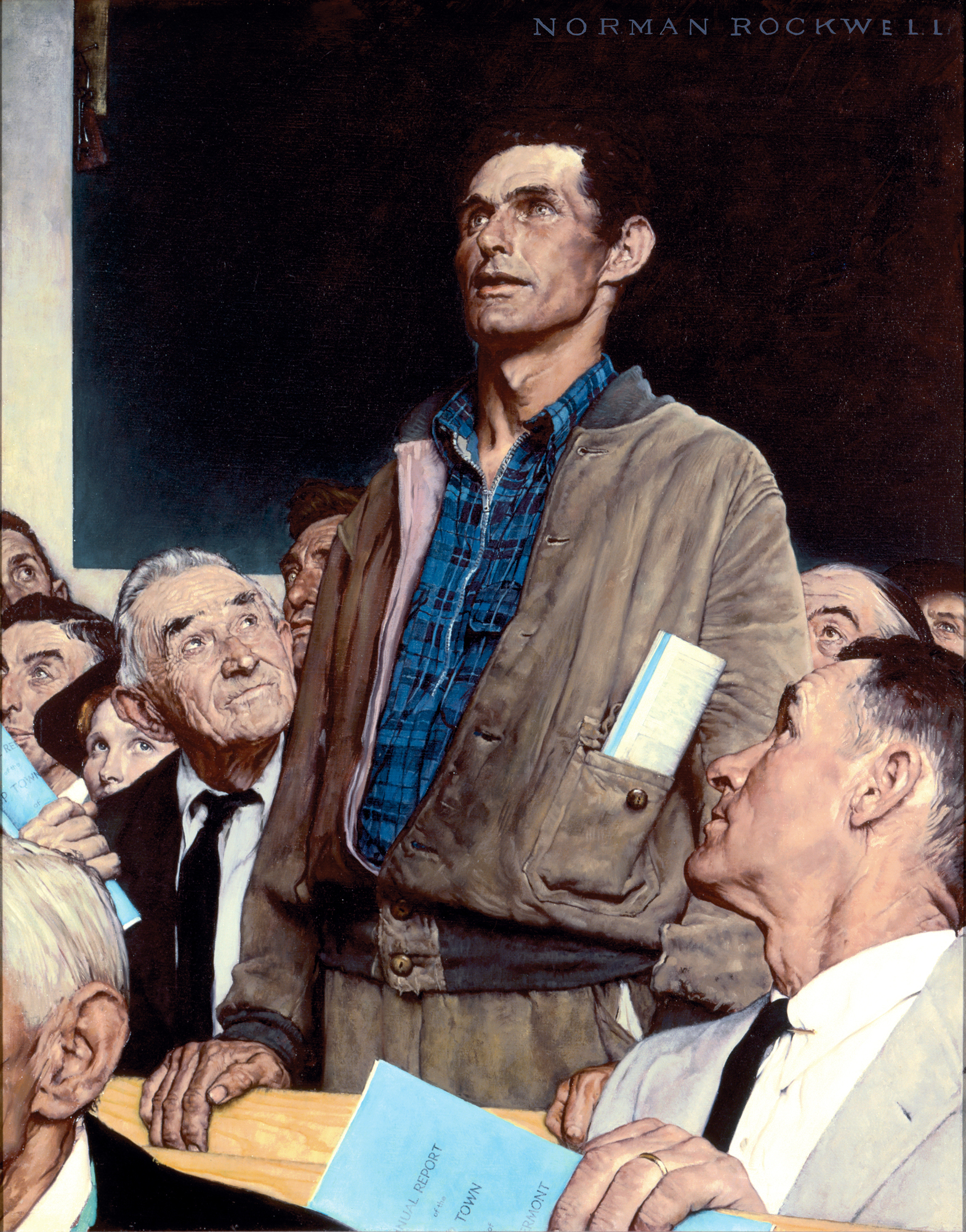
Happy Birthday, Rockwell.

Rockwell, Freedom of Speech, 1943


Norman Rockwell was born on this date in 1894.

Commonplaces never become tiresome. It is we who become tired when we cease to be curious and appreciative.

Norman Rockwell