"I am not one who was born in the custody of wisdom. I am one who is fond of olden times and intense in quest of the sacred knowing of the ancients." Gustave Courbet
Showing posts with label The Sketchbook of Geoffrey Crayon. Show all posts

24 December 2025

Listened.

Alden, "They Went Around the House, Playing Under the Windows", 1908


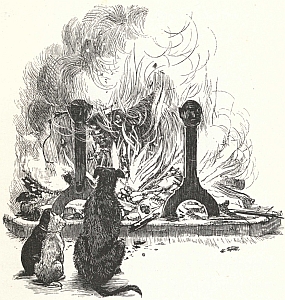
The party now broke up for the night with the kind-hearted old custom of shaking hands. As I passed through the hall, on the way to my chamber, the dying embers of the Yule-clog still sent forth a dusky glow; and had it not been the season when "no spirit dares stir abroad," I should have been half tempted to steal from my room at midnight, and peep whether the fairies might not be at their revels about the hearth.

My chamber was in the old part of the mansion, the ponderous furniture of which might have been fabricated in the days of the giants. The room was panelled with cornices of heavy carved-work, in which flowers and grotesque faces were strangely intermingled; and a row of black-looking portraits stared mournfully at me from the walls. The bed was of rich though faded damask, with a lofty tester, and stood in a niche opposite a bow-window. I had scarcely got into bed when a strain of music seemed to break forth in the air just below the window. I listened, and found it proceeded from a band, which I concluded to be the waits from some neighbouring village. They went round the house, playing under the windows. I drew aside the curtains, to hear them more distinctly. The moonbeams fell through the upper part of the casement, partially lighting up the antiquated apartment. The sounds, as they receded, became more soft and aĆ«rial, and seemed to accord with quiet and moonlight. I listened and listened—they became more and more tender and remote, and, as they gradually died away, my head sank upon the pillow and I fell asleep.

Washington Irving, from the "Christmas Eve" entry in Old Christmas

20 December 2025

Comforts.


In the evening we reached a village where I had determined to pass the night. As we drove into the great gateway of the inn, I saw on one side the light of a rousing kitchen fire, beaming through a window. I entered, and admired, for the hundredth time, that picture of convenience, neatness, and broad honest enjoyment, the kitchen of an English inn. It was of spacious dimensions, hung round with copper and tin vessels highly polished, and decorated here and there with a Christmas green. Hams, tongues, and flitches of bacon, were suspended from the ceiling; a smoke-jack made its ceaseless clanking beside the fireplace, and a clock ticked in one corner. A well-scoured deal table extended along one side of the kitchen, with a cold round of beef, and other hearty viands upon it, over which two foaming tankards of ale seemed mounting guard. Travellers of inferior order were preparing to attack this stout repast, while others sat smoking and gossiping over their ale on two high-backed oaken seats beside the fire. Trim housemaids were hurrying backwards and forwards under the directions of a fresh, bustling landlady; but still seizing an occasional moment to exchange a flippant word, and have a rallying laugh, with the group round the fire. The scene completely realised Poor Robin's humble idea of the comforts of mid-winter.

Washington Irving, from "The Stage Coach," found in Old Christmas

06 December 2025

Preserve.


We had now come in full view of the old family mansion, partly thrown in deep shadow, and partly lit up by the cold moonshine. It was an irregular building of some magnitude, and seemed to be of the architecture of different periods. One wing was evidently very ancient, with heavy stone-shafted bow windows jutting out and overrun with ivy, from among the foliage of which the small diamond-shaped panes of glass glittered with the moonbeams. The rest of the house was in the French taste of Charles the Second's time, having been repaired and altered, as my friend told me, by one of his ancestors, who returned with that monarch at the Restoration. The grounds about the house were laid out in the old formal manner of artificial flower-beds, clipped shrubberies, raised terraces, and heavy stone balustrades, ornamented with urns, a leaden statue or two, and a jet of water. The old gentleman, I was told, was extremely careful to preserve this obsolete finery in all its original state. He admired this fashion in gardening; it had an air of magnificence, was courtly and noble, and befitting good old family style. The boasted imitation of nature in modern gardening had sprung up with modern republican notions, but did not suit a monarchical government; it smacked of the levelling system.—I could not help smiling at this introduction of politics into gardening, though I expressed some apprehension that I should find the old gentleman rather intolerant in his creed.—Frank assured me, however, that it was almost the only instance in which he had ever heard his father meddle with politics; and he believed that he had got this notion from a member of parliament who once passed a few weeks with him. The Squire was glad of any argument to defend his clipped yew-trees and formal terraces, which had been occasionally attacked by modern landscape-gardeners.

As we approached the house, we heard the sound of music, and now and then a burst of laughter from one end of the building. This, Bracebridge said, must proceed from the servants' hall, where a great deal of revelry was permitted, and even encouraged, by the Squire throughout the twelve days of Christmas, provided everything was done conformably to ancient usage. Here were kept up the old games of hoodman blind, shoe the wild mare, hot cockles, steal the white loaf, bob apple, and snapdragon: the Yule log and Christmas candle were regularly burnt, and the mistletoe, with its white berries, hung up, to the imminent peril of all the pretty housemaids.

Washington Irving, from "Old Christmas"

01 November 2025

Spattered.

Kelley, The Schoolhouse, Being Deserted, Soon Fell to Decay, and Was Reported to be Haunted by the Ghost of the Unfortunate Pedagogue, 1991


The next morning the old horse was found, without his saddle and with the bridle under his feet, soberly cropping the grass at his master’s gate. Ichabod did not make his appearance at breakfast; dinner-hour came, but no Ichabod. The boys assembled at the school-house and strolled idly about the banks of the brook but no schoolmaster. Hans Van Ripper now began to feel some uneasiness about the fate of poor Ichabod and his saddle. An inquiry was set on foot, and after diligent investigation they came upon his traces. In one part of the road leading to the church was found the saddle trampled in the dirt; the tracks of horses’ hoofs, deeply dented in the road and evidently at furious speed, were traced to the bridge, beyond which, on the bank of a broad part of the brook, where the water ran deep and black, was found the hat of the unfortunate Ichabod, and close beside it a spattered pumpkin.

Washington Irving, from "The Legend of Sleepy Hollow"

31 October 2025

Horror-Struck.

Kelley, Just Then He Saw the Goblin Rising in His Stirrups, and in the Very Act of Hurling his Head at Him, 1991


The hair of the affrighted pedagogue rose upon his head with terror. What was to be done? To turn and fly was now too late; and besides, what chance was there of escaping ghost or goblin, if such it was, which could ride upon the wings of the wind? Summoning up, therefore, a show of courage, he demanded in stammering accents, “Who are you?” He received no reply. He repeated his demand in a still more agitated voice. Still there was no answer. Once more he cudgelled the sides of the inflexible Gunpowder, and, shutting his eyes, broke forth with involuntary fervor into a psalm tune. Just then the shadowy object of alarm put itself in motion, and with a scramble and a bound stood at once in the middle of the road. Though the night was dark and dismal, yet the form of the unknown might now in some degree be ascertained. He appeared to be a horseman of large dimensions and mounted on a black horse of powerful frame. He made no offer of molestation or sociability, but kept aloof on one side of the road, jogging along on the blind side of old Gunpowder, who had now got over his fright and waywardness.

Ichabod, who had no relish for this strange midnight companion, and bethought himself of the adventure of Brom Bones with the Galloping Hessian, now quickened his steed in hopes of leaving him behind. The stranger, however, quickened his horse to an equal pace. Ichabod pulled up, and fell into a walk, thinking to lag behind; the other did the same. His heart began to sink within him; he endeavored to resume his psalm tune, but his parched tongue clove to the roof of his mouth and he could not utter a stave. There was something in the moody and dogged silence of this pertinacious companion that was mysterious and appalling. It was soon fearfully accounted for. On mounting a rising ground, which brought the figure of his fellow-traveller in relief against the sky, gigantic in height and muffled in a cloak, Ichabod was horror-struck on perceiving that he was headless! but his horror was still more increased on observing that the head, which should have rested on his shoulders, was carried before him on the pommel of the saddle. His terror rose to desperation, he rained a shower of kicks and blows upon Gunpowder, hoping by a sudden movement to give his companion the slip; but the spectre started full jump with him. Away, then, they dashed through thick and thin, stones flying and sparks flashing at every bound. Ichabod’s flimsy garments fluttered in the air as he stretched his long lank body away over his horse’s head in the eagerness of his flight.

They had now reached the road which turns off to Sleepy Hollow; but Gunpowder, who seemed possessed with a demon, instead of keeping up it, made an opposite turn and plunged headlong down hill to the left. This road leads through a sandy hollow shaded by trees for about a quarter of a mile, where it crosses the bridge famous in goblin story, and just beyond swells the green knoll on which stands the whitewashed church.

As yet the panic of the steed had given his unskillful rider an apparent advantage in the chase; but just as he had got halfway through the hollow the girths of the saddle gave away and he felt it slipping from under him. He seized it by the pommel and endeavored to hold it firm, but in vain, and had just time to save himself by clasping old Gunpowder round the neck, when the saddle fell to the earth, and he heard it trampled under foot by his pursuer. For a moment the terror of Hans Van Ripper’s wrath passed across his mind, for it was his Sunday saddle; but this was no time for petty fears; the goblin was hard on his haunches, and (unskilled rider that he was) he had much ado to maintain his seat, sometimes slipping on one side, sometimes on another, and sometimes jolted on the high ridge of his horse’s back-bone with a violence that he verily feared would cleave him asunder.

An opening in the trees now cheered him with the hopes that the church bridge was at hand. The wavering reflection of a silver star in the bosom of the brook told him that he was not mistaken. He saw the walls of the church dimly glaring under the trees beyond. He recollected the place where Brom Bones’ ghostly competitor had disappeared. “If I can but reach that bridge,” thought Ichabod, “I am safe.” Just then he heard the black steed panting and blowing close behind him; he even fancied that he felt his hot breath. Another convulsive kick in the ribs, and old Gunpowder sprang upon the bridge; he thundered over the resounding planks; he gained the opposite side; and now Ichabod cast a look behind to see if his pursuer should vanish, according to rule, in a flash of fire and brimstone. Just then he saw the goblin rising in his stirrups, and in the very act of hurling his head at him. Ichabod endeavored to dodge the horrible missile, but too late. It encountered his cranium with a tremendous crash; he was tumbled headlong into the dust, and Gunpowder, the black steed, and the goblin rider passed by like a whirlwind.

Washington Irving, from "The Legend of Sleepy Hollow"

28 October 2025

Scourings.

Rockwell, Ichabod Crane, 1937


The schoolmaster is generally a man of some importance in the female circle of a rural neighborhood; being considered a kind of idle, gentlemanlike personage, of vastly superior taste and accomplishments to the rough country swains, and, indeed, inferior in learning only to the parson. His appearance, therefore, is apt to occasion some little stir at the tea-table of a farmhouse, and the addition of a supernumerary dish of cakes or sweetmeats, or, peradventure, the parade of a silver teapot. Our man of letters, therefore, was peculiarly happy in the smiles of all the country damsels. How he would figure among them in the churchyard, between services on Sundays; gathering grapes for them from the wild vines that overran the surrounding trees; reciting for their amusement all the epitaphs on the tombstones; or sauntering, with a whole bevy of them, along the banks of the adjacent millpond; while the more bashful country bumpkins hung sheepishly back, envying his superior elegance and address.

From his half-itinerant life, also, he was a kind of travelling gazette, carrying the whole budget of local gossip from house to house, so that his appearance was always greeted with satisfaction. He was, moreover, esteemed by the women as a man of great erudition, for he had read several books quite through, and was a perfect master of Cotton Mather’s History of New England Witchcraft, in which, by the way, he most firmly and potently believed.

He was, in fact, an odd mixture of small shrewdness and simple credulity. His appetite for the marvellous, and his powers of digesting it, were equally extraordinary; and both had been increased by his residence in this spell-bound region. No tale was too gross or monstrous for his capacious swallow. It was often his delight, after his school was dismissed in the afternoon, to stretch himself on the rich bed of clover bordering the little brook that whimpered by his schoolhouse, and there con over old Mather’s direful tales, until the gathering dusk of evening made the printed page a mere mist before his eyes. Then, as he wended his way by swamp and stream and awful woodland, to the farmhouse where he happened to be quartered, every sound of nature, at that witching hour, fluttered his excited imagination,—the moan of the whip-poor-will from the hillside, the boding cry of the tree toad, that harbinger of storm, the dreary hooting of the screech owl, or the sudden rustling in the thicket of birds frightened from their roost. The fireflies, too, which sparkled most vividly in the darkest places, now and then startled him, as one of uncommon brightness would stream across his path; and if, by chance, a huge blockhead of a beetle came winging his blundering flight against him, the poor varlet was ready to give up the ghost, with the idea that he was struck with a witch’s token. His only resource on such occasions, either to drown thought or drive away evil spirits, was to sing psalm tunes and the good people of Sleepy Hollow, as they sat by their doors of an evening, were often filled with awe at hearing his nasal melody, “in linked sweetness long drawn out,” floating from the distant hill, or along the dusky road.

Another of his sources of fearful pleasure was to pass long winter evenings with the old Dutch wives, as they sat spinning by the fire, with a row of apples roasting and spluttering along the hearth, and listen to their marvellous tales of ghosts and goblins, and haunted fields, and haunted brooks, and haunted bridges, and haunted houses, and particularly of the headless horseman, or Galloping Hessian of the Hollow, as they sometimes called him. He would delight them equally by his anecdotes of witchcraft, and of the direful omens and portentous sights and sounds in the air, which prevailed in the earlier times of Connecticut; and would frighten them woefully with speculations upon comets and shooting stars; and with the alarming fact that the world did absolutely turn round, and that they were half the time topsy-turvy!

But if there was a pleasure in all this, while snugly cuddling in the chimney corner of a chamber that was all of a ruddy glow from the crackling wood fire, and where, of course, no spectre dared to show its face, it was dearly purchased by the terrors of his subsequent walk homewards. What fearful shapes and shadows beset his path, amidst the dim and ghastly glare of a snowy night! With what wistful look did he eye every trembling ray of light streaming across the waste fields from some distant window! How often was he appalled by some shrub covered with snow, which, like a sheeted spectre, beset his very path! How often did he shrink with curdling awe at the sound of his own steps on the frosty crust beneath his feet; and dread to look over his shoulder, lest he should behold some uncouth being tramping close behind him! And how often was he thrown into complete dismay by some rushing blast, howling among the trees, in the idea that it was the Galloping Hessian on one of his nightly scourings!

Washington Irving, from "The Legend of Sleepy Hollow", found among the papers of the late Dietrich Knickerbocker in Geoffrey Crayon's Sketchbook

25 December 2024

Old-Fashioned.

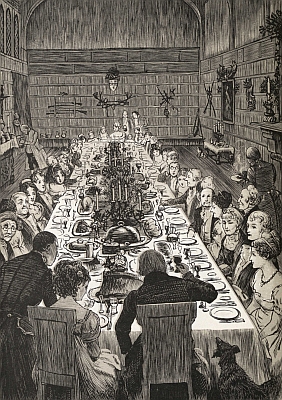
Aldin, The Joyful Feast, 1910


The table was literally loaded with good cheer, and presented an epitome of country abundance, in this season of overflowing larders. A distinguished post was allotted to "ancient sirloin," as mine host termed it; being, as he added, "the standard of old English hospitality, and a joint of goodly presence, and full of expectation." There were several dishes quaintly decorated, and which had evidently something traditionary in their embellishments; but about which, as I did not like to appear over-curious, I asked no questions.

I could not, however, but notice a pie, magnificently decorated with peacocks' feathers, in imitation of the tail of that bird, which over shadowed a considerable tract of the table. This the Squire confessed, with some little hesitation, was a pheasant-pie, though a peacock-pie was certainly the most authentical; but there had been such a mortality among the peacocks this season, that he could not prevail upon himself to have one killed.

It would be tedious, perhaps, to my wiser readers, who may not have that foolish fondness for odd and obsolete things to which I am a little given, were I to mention the other makeshifts of this worthy old humorist, by which he was endeavouring to follow up, though at humble distance, the quaint customs of antiquity. I was pleased, however, to see the respect shown to his whims by his children and relatives; who, indeed, entered readily into the full spirit of them, and seemed all well versed in their parts; having doubtless been present at many a rehearsal. I was amused, too, at the air of profound gravity with which the butler and other servants executed the duties assigned them, however eccentric. They had an old-fashioned look; having, for the most part, been brought up in the household, and grown into keeping with the antiquated mansion, and the humours of its lord; and most probably looked upon all his whimsical regulations as the established laws of honourable housekeeping.

Washington Irving, from "Christmas Dinner"

Welcome.


On our way homeward his heart seemed overflowing with generous and happy feelings. As we passed over a rising ground which commanded something of a prospect, the sounds of rustic merriment now and then reached our ears; the Squire paused for a few moments, and looked around with an air of inexpressible benignity. The beauty of the day was of itself sufficient to inspire philanthropy. Notwithstanding the frostiness of the morning, the sun in his cloudless journey had acquired sufficient power to melt away the thin covering of snow from every southern declivity, and to bring out the living green which adorns an English landscape even in mid-winter. Large tracts of smiling verdure contrasted with the dazzling whiteness of the shaded slopes and hollows. Every sheltered bank, on which the broad rays rested, yielded its silver rill of cold and limpid water, glittering through the dripping grass; and sent up slight exhalations to contribute to the thin haze that hung just above the surface of the earth. There was something truly cheering in this triumph of warmth and verdure over the frosty thraldom of winter; it was, as the Squire observed, an emblem of Christmas hospitality, breaking through the chills of ceremony and selfishness, and thawing every heart into a flow. He pointed with pleasure to the indications of good cheer reeking from the chimneys of the comfortable farm-houses and low thatched cottages. "I love," said he, "to see this day well kept by rich and poor; it is a great thing to have one day in the year, at least, when you are sure of being welcome wherever you go, and of having, as it were, the world all thrown open to you; and I am almost disposed to join with Poor Robin, in his malediction of every churlish enemy to this honest festival:—
"Those who at Christmas do repine,
And would fain hence despatch him,
May they with old Duke Humphry dine,
Or else may Squire Ketch catch 'em."
The Squire went on to lament the deplorable decay of the games and amusements which were once prevalent at this season among the lower orders, and countenanced by the higher: when the old halls of castles and manor-houses were thrown open at daylight; when the tables were covered with brawn, and beef, and humming ale; when the harp and the carol resounded all day long, and when rich and poor were alike welcome to enter and make merry. "Our old games and local customs," said he, "had a great effect in making the peasant fond of his home, and the promotion of them by the gentry made him fond of his lord. They made the times merrier, and kinder, and better; and I can truly say, with one of our old poets,—
"I like them well—the curious preciseness
And all-pretended gravity of those
That seek to banish hence these harmless sports,
Have thrust away much ancient honesty.

Washington Irving, from "Christmas Day" 

24 December 2024

Listened.

Alden, "They Went Around the House, Playing Under the Windows", 1908


The party now broke up for the night with the kind-hearted old custom of shaking hands. As I passed through the hall, on the way to my chamber, the dying embers of the Yule-clog still sent forth a dusky glow; and had it not been the season when "no spirit dares stir abroad," I should have been half tempted to steal from my room at midnight, and peep whether the fairies might not be at their revels about the hearth.

My chamber was in the old part of the mansion, the ponderous furniture of which might have been fabricated in the days of the giants. The room was panelled with cornices of heavy carved-work, in which flowers and grotesque faces were strangely intermingled; and a row of black-looking portraits stared mournfully at me from the walls. The bed was of rich though faded damask, with a lofty tester, and stood in a niche opposite a bow-window. I had scarcely got into bed when a strain of music seemed to break forth in the air just below the window. I listened, and found it proceeded from a band, which I concluded to be the waits from some neighbouring village. They went round the house, playing under the windows. I drew aside the curtains, to hear them more distinctly. The moonbeams fell through the upper part of the casement, partially lighting up the antiquated apartment. The sounds, as they receded, became more soft and aĆ«rial, and seemed to accord with quiet and moonlight. I listened and listened—they became more and more tender and remote, and, as they gradually died away, my head sank upon the pillow and I fell asleep.

Washington Irving, from the "Christmas Eve" entry in Old Christmas

07 December 2024

Impending.

Aldin, The Stage-Coachman, 1908


Perhaps it might be owing to the pleasing serenity that reigned in my own mind that I fancied I saw cheerfulness in every countenance throughout the journey. A stage-coach, however, carries animation always with it, and puts the world in motion as it whirls along. The horn, sounded at the entrance of the village, produces a general bustle. Some hasten forth to meet friends; some with bundles and bandboxes to secure places, and in the hurry of the moment can hardly take leave of the group that accompanies them. In the meantime the coachman has a world of small commissions to execute. Sometimes he delivers a hare or pheasant; sometimes jerks a small parcel or newspaper to the door of a public house; and sometimes, with knowing leer and words of sly import, hands to some half-blushing, half-laughing house-maid an odd-shaped billet-doux from some rustic admirer. As the coach rattles through the village every one runs to the window, and you have glances on every side of fresh country faces and blooming giggling girls. At the corners are assembled juntos of village idlers and wise men, who take their stations there for the important purpose of seeing company pass; but the sagest knot is generally at the blacksmith’s, to whom the passing of the coach is an event fruitful of much speculation. The smith, with the horse’s heel in his lap, pauses as the vehicle whirls by; the cyclops round the anvil suspend their ringing hammers and suffer the iron to grow cool; and the sooty spectre in brown paper cap laboring at the bellows leans on the handle for a moment, and permits the asthmatic engine to heave a long-drawn sigh, while he glares through the murky smoke and sulphurous gleams of the smithy.

Perhaps the impending holiday might have given a more than usual animation to the country, for it seemed to me as if everybody was in good looks and good spirits. Game, poultry, and other luxuries of the table were in brisk circulation in the villages; the grocers’, butchers’, and fruiterers’ shops were thronged with customers. The housewives were stirring briskly about, putting their dwellings in order, and the glossy branches of holly with their bright-red berries began to appear at the windows. The scene brought to mind an old writer’s account of Christmas preparation: “Now capons and hens, besides turkeys, geese, and ducks, with beef and mutton, must all die, for in twelve days a multitude of people will not be fed with a little. Now plums and spice, sugar and honey, square it among pies and broth. Now or never must music be in tune, for the youth must dance and sing to get them a heat, while the aged sit by the fire. The country maid leaves half her market, and must be sent again if she forgets a pack of cards on Christmas Eve. Great is the contention of holly and ivy whether master or dame wears the breeches. Dice and cards benefit the butler; and if the cook do not lack wit, he will sweetly lick his fingers.”

I was roused from this fit of luxurious meditation by a shout from my little travelling companions. They had been looking out of the coach-windows for the last few miles, recognizing every tree and cottage as they approached home, and now there was a general burst of joy. “There’s John! and there’s old Carlo! and there’s Bantam!” cried the happy little rogues, clapping their hands.

At the end of a lane there was an old sober-looking servant in livery waiting for them; he was accompanied by a superannuated pointer and by the redoubtable Bantam, a little old rat of a pony with a shaggy mane and long rusty tail, who stood dozing quietly by the roadside, little dreaming of the bustling times that awaited him.

I was pleased to see the fondness with which the little fellows leaped about the steady old footman and hugged the pointer, who wriggled his whole body for joy. But Bantam was the great object of interest; all wanted to mount at once, and it was with some difficulty that John arranged that they should ride by turns and the eldest should ride first.

Washington Irving, from "The Stagecoach"

01 November 2024

Spattered.

Kelley, The Schoolhouse, Being Deserted, Soon Fell to Decay, and Was Reported to be Haunted by the Ghost of the Unfortunate Pedagogue, 1991


The next morning the old horse was found, without his saddle and with the bridle under his feet, soberly cropping the grass at his master’s gate. Ichabod did not make his appearance at breakfast; dinner-hour came, but no Ichabod. The boys assembled at the school-house and strolled idly about the banks of the brook but no schoolmaster. Hans Van Ripper now began to feel some uneasiness about the fate of poor Ichabod and his saddle. An inquiry was set on foot, and after diligent investigation they came upon his traces. In one part of the road leading to the church was found the saddle trampled in the dirt; the tracks of horses’ hoofs, deeply dented in the road and evidently at furious speed, were traced to the bridge, beyond which, on the bank of a broad part of the brook, where the water ran deep and black, was found the hat of the unfortunate Ichabod, and close beside it a spattered pumpkin.

Washington Irving, from "The Legend of Sleepy Hollow"

31 October 2024

Horror-Struck.

Kelley, Just Then He Saw the Goblin Rising in His Stirrups, and in the Very Act of Hurling his Head at Him, 1991


The hair of the affrighted pedagogue rose upon his head with terror. What was to be done? To turn and fly was now too late; and besides, what chance was there of escaping ghost or goblin, if such it was, which could ride upon the wings of the wind? Summoning up, therefore, a show of courage, he demanded in stammering accents, “Who are you?” He received no reply. He repeated his demand in a still more agitated voice. Still there was no answer. Once more he cudgelled the sides of the inflexible Gunpowder, and, shutting his eyes, broke forth with involuntary fervor into a psalm tune. Just then the shadowy object of alarm put itself in motion, and with a scramble and a bound stood at once in the middle of the road. Though the night was dark and dismal, yet the form of the unknown might now in some degree be ascertained. He appeared to be a horseman of large dimensions and mounted on a black horse of powerful frame. He made no offer of molestation or sociability, but kept aloof on one side of the road, jogging along on the blind side of old Gunpowder, who had now got over his fright and waywardness.

Ichabod, who had no relish for this strange midnight companion, and bethought himself of the adventure of Brom Bones with the Galloping Hessian, now quickened his steed in hopes of leaving him behind. The stranger, however, quickened his horse to an equal pace. Ichabod pulled up, and fell into a walk, thinking to lag behind; the other did the same. His heart began to sink within him; he endeavored to resume his psalm tune, but his parched tongue clove to the roof of his mouth and he could not utter a stave. There was something in the moody and dogged silence of this pertinacious companion that was mysterious and appalling. It was soon fearfully accounted for. On mounting a rising ground, which brought the figure of his fellow-traveller in relief against the sky, gigantic in height and muffled in a cloak, Ichabod was horror-struck on perceiving that he was headless! but his horror was still more increased on observing that the head, which should have rested on his shoulders, was carried before him on the pommel of the saddle. His terror rose to desperation, he rained a shower of kicks and blows upon Gunpowder, hoping by a sudden movement to give his companion the slip; but the spectre started full jump with him. Away, then, they dashed through thick and thin, stones flying and sparks flashing at every bound. Ichabod’s flimsy garments fluttered in the air as he stretched his long lank body away over his horse’s head in the eagerness of his flight.

They had now reached the road which turns off to Sleepy Hollow; but Gunpowder, who seemed possessed with a demon, instead of keeping up it, made an opposite turn and plunged headlong down hill to the left. This road leads through a sandy hollow shaded by trees for about a quarter of a mile, where it crosses the bridge famous in goblin story, and just beyond swells the green knoll on which stands the whitewashed church.

As yet the panic of the steed had given his unskillful rider an apparent advantage in the chase; but just as he had got halfway through the hollow the girths of the saddle gave away and he felt it slipping from under him. He seized it by the pommel and endeavored to hold it firm, but in vain, and had just time to save himself by clasping old Gunpowder round the neck, when the saddle fell to the earth, and he heard it trampled under foot by his pursuer. For a moment the terror of Hans Van Ripper’s wrath passed across his mind, for it was his Sunday saddle; but this was no time for petty fears; the goblin was hard on his haunches, and (unskilled rider that he was) he had much ado to maintain his seat, sometimes slipping on one side, sometimes on another, and sometimes jolted on the high ridge of his horse’s back-bone with a violence that he verily feared would cleave him asunder.
An opening in the trees now cheered him with the hopes that the church bridge was at hand. The wavering reflection of a silver star in the bosom of the brook told him that he was not mistaken. He saw the walls of the church dimly glaring under the trees beyond. He recollected the place where Brom Bones’ ghostly competitor had disappeared. “If I can but reach that bridge,” thought Ichabod, “I am safe.” Just then he heard the black steed panting and blowing close behind him; he even fancied that he felt his hot breath. Another convulsive kick in the ribs, and old Gunpowder sprang upon the bridge; he thundered over the resounding planks; he gained the opposite side; and now Ichabod cast a look behind to see if his pursuer should vanish, according to rule, in a flash of fire and brimstone. Just then he saw the goblin rising in his stirrups, and in the very act of hurling his head at him. Ichabod endeavored to dodge the horrible missile, but too late. It encountered his cranium with a tremendous crash; he was tumbled headlong into the dust, and Gunpowder, the black steed, and the goblin rider passed by like a whirlwind.

Washington Irving, from "The Legend of Sleepy Hollow"

19 October 2024

Marvellous.

Kelley, The Sequestered Situation of This Church Seems Always to Have Made It a Favorite Haunt of Troubled Spirits, 1991


When the dance was at an end, Ichabod was attracted to a knot of the sager folks, who, with Old Van Tassel, sat smoking at one end of the piazza, gossiping over former times, and drawing out long stories about the war.

This neighborhood, at the time of which I am speaking, was one of those highly favored places which abound with chronicle and great men. The British and American line had run near it during the war; it had, therefore, been the scene of marauding and infested with refugees, cowboys, and all kinds of border chivalry. Just sufficient time had elapsed to enable each storyteller to dress up his tale with a little becoming fiction, and, in the indistinctness of his recollection, to make himself the hero of every exploit.

There was the story of Doffue Martling, a large blue-bearded Dutchman, who had nearly taken a British frigate with an old iron nine-pounder from a mud breastwork, only that his gun burst at the sixth discharge. And there was an old gentleman who shall be nameless, being too rich a mynheer to be lightly mentioned, who, in the battle of White Plains, being an excellent master of defence, parried a musket-ball with a small sword, insomuch that he absolutely felt it whiz round the blade, and glance off at the hilt; in proof of which he was ready at any time to show the sword, with the hilt a little bent. There were several more that had been equally great in the field, not one of whom but was persuaded that he had a considerable hand in bringing the war to a happy termination.

But all these were nothing to the tales of ghosts and apparitions that succeeded. The neighborhood is rich in legendary treasures of the kind. Local tales and superstitions thrive best in these sheltered, long-settled retreats; but are trampled under foot by the shifting throng that forms the population of most of our country places. Besides, there is no encouragement for ghosts in most of our villages, for they have scarcely had time to finish their first nap and turn themselves in their graves, before their surviving friends have travelled away from the neighborhood; so that when they turn out at night to walk their rounds, they have no acquaintance left to call upon. This is perhaps the reason why we so seldom hear of ghosts except in our long-established Dutch communities.

The immediate cause, however, of the prevalence of supernatural stories in these parts, was doubtless owing to the vicinity of Sleepy Hollow. There was a contagion in the very air that blew from that haunted region; it breathed forth an atmosphere of dreams and fancies infecting all the land. Several of the Sleepy Hollow people were present at Van Tassel’s, and, as usual, were doling out their wild and wonderful legends. Many dismal tales were told about funeral trains, and mourning cries and wailings heard and seen about the great tree where the unfortunate Major AndrĆ© was taken, and which stood in the neighborhood. Some mention was made also of the woman in white, that haunted the dark glen at Raven Rock, and was often heard to shriek on winter nights before a storm, having perished there in the snow. The chief part of the stories, however, turned upon the favorite spectre of Sleepy Hollow, the Headless Horseman, who had been heard several times of late, patrolling the country; and, it was said, tethered his horse nightly among the graves in the churchyard.

The sequestered situation of this church seems always to have made it a favorite haunt of troubled spirits. It stands on a knoll, surrounded by locust-trees and lofty elms, from among which its decent, whitewashed walls shine modestly forth, like Christian purity beaming through the shades of retirement. A gentle slope descends from it to a silver sheet of water, bordered by high trees, between which, peeps may be caught at the blue hills of the Hudson. To look upon its grass-grown yard, where the sunbeams seem to sleep so quietly, one would think that there at least the dead might rest in peace. On one side of the church extends a wide woody dell, along which raves a large brook among broken rocks and trunks of fallen trees. Over a deep black part of the stream, not far from the church, was formerly thrown a wooden bridge; the road that led to it, and the bridge itself, were thickly shaded by overhanging trees, which cast a gloom about it, even in the daytime; but occasioned a fearful darkness at night. Such was one of the favorite haunts of the Headless Horseman, and the place where he was most frequently encountered. The tale was told of old Brouwer, a most heretical disbeliever in ghosts, how he met the Horseman returning from his foray into Sleepy Hollow, and was obliged to get up behind him; how they galloped over bush and brake, over hill and swamp, until they reached the bridge; when the Horseman suddenly turned into a skeleton, threw old Brouwer into the brook, and sprang away over the tree-tops with a clap of thunder.

This story was immediately matched by a thrice marvellous adventure of Brom Bones, who made light of the Galloping Hessian as an arrant jockey. He affirmed that on returning one night from the neighboring village of Sing Sing, he had been overtaken by this midnight trooper; that he had offered to race with him for a bowl of punch, and should have won it too, for Daredevil beat the goblin horse all hollow, but just as they came to the church bridge, the Hessian bolted, and vanished in a flash of fire.

All these tales, told in that drowsy undertone with which men talk in the dark, the countenances of the listeners only now and then receiving a casual gleam from the glare of a pipe, sank deep in the mind of Ichabod. He repaid them in kind with large extracts from his invaluable author, Cotton Mather, and added many marvellous events that had taken place in his native State of Connecticut, and fearful sights which he had seen in his nightly walks about Sleepy Hollow.

Washington Irving, from "The Legend of Sleepy Hollow"

12 October 2024

Howling.

Kelley, Untitled, 1990


He was, in fact, an odd mixture of small shrewdness and simple credulity. His appetite for the marvellous, and his powers of digesting it, were equally extraordinary; and both had been increased by his residence in this spell-bound region. No tale was too gross or monstrous for his capacious swallow. It was often his delight, after his school was dismissed in the afternoon, to stretch himself on the rich bed of clover bordering the little brook that whimpered by his schoolhouse, and there con over old Mather’s direful tales, until the gathering dusk of evening made the printed page a mere mist before his eyes. Then, as he wended his way by swamp and stream and awful woodland, to the farmhouse where he happened to be quartered, every sound of nature, at that witching hour, fluttered his excited imagination,—the moan of the whip-poor-will from the hillside, the boding cry of the tree toad, that harbinger of storm, the dreary hooting of the screech owl, or the sudden rustling in the thicket of birds frightened from their roost. The fireflies, too, which sparkled most vividly in the darkest places, now and then startled him, as one of uncommon brightness would stream across his path; and if, by chance, a huge blockhead of a beetle came winging his blundering flight against him, the poor varlet was ready to give up the ghost, with the idea that he was struck with a witch’s token. His only resource on such occasions, either to drown thought or drive away evil spirits, was to sing psalm tunes and the good people of Sleepy Hollow, as they sat by their doors of an evening, were often filled with awe at hearing his nasal melody, “in linked sweetness long drawn out,” floating from the distant hill, or along the dusky road.

Another of his sources of fearful pleasure was to pass long winter evenings with the old Dutch wives, as they sat spinning by the fire, with a row of apples roasting and spluttering along the hearth, and listen to their marvellous tales of ghosts and goblins, and haunted fields, and haunted brooks, and haunted bridges, and haunted houses, and particularly of the headless horseman, or Galloping Hessian of the Hollow, as they sometimes called him. He would delight them equally by his anecdotes of witchcraft, and of the direful omens and portentous sights and sounds in the air, which prevailed in the earlier times of Connecticut; and would frighten them woefully with speculations upon comets and shooting stars; and with the alarming fact that the world did absolutely turn round, and that they were half the time topsy-turvy!

But if there was a pleasure in all this, while snugly cuddling in the chimney corner of a chamber that was all of a ruddy glow from the crackling wood fire, and where, of course, no spectre dared to show its face, it was dearly purchased by the terrors of his subsequent walk homewards. What fearful shapes and shadows beset his path, amidst the dim and ghastly glare of a snowy night! With what wistful look did he eye every trembling ray of light streaming across the waste fields from some distant window! How often was he appalled by some shrub covered with snow, which, like a sheeted spectre, beset his very path! How often did he shrink with curdling awe at the sound of his own steps on the frosty crust beneath his feet; and dread to look over his shoulder, lest he should behold some uncouth being tramping close behind him! And how often was he thrown into complete dismay by some rushing blast, howling among the trees, in the idea that it was the Galloping Hessian on one of his nightly scourings!

Washington Irving, from "The Legend of Sleepy Hollow"

05 October 2024

Fine.

Kelley, A Fine Autumnal Day, 1990


It was, as I have said, a fine autumnal day; the sky was clear and serene, and nature wore that rich and golden livery which we always associate with the idea of abundance. The forests had put on their sober brown and yellow, while some trees of the tenderer kind had been nipped by the frosts into brilliant dyes of orange, purple, and scarlet. Streaming files of wild ducks began to make their appearance high in the air; the bark of the squirrel might be heard from the groves of beech and hickory-nuts, and the pensive whistle of the quail at intervals from the neighboring stubble field. 

As Ichabod jogged slowly on his way, his eye, ever open to every symptom of culinary abundance, ranged with delight over the treasures of jolly autumn. On all sides he beheld vast store of apples; some hanging in oppressive opulence on the trees; some gathered into baskets and barrels for the market; others heaped up in rich piles for the cider-press. Farther on he beheld great fields of Indian corn, with its golden ears peeping from their leafy coverts, and holding out the promise of cakes and hasty-pudding; and the yellow pumpkins lying beneath them, turning up their fair round bellies to the sun, and giving ample prospects of the most luxurious of pies; and anon he passed the fragrant buckwheat fields breathing the odor of the beehive, and as he beheld them, soft anticipations stole over his mind of dainty slapjacks, well buttered, and garnished with honey or treacle, by the delicate little dimpled hand of Katrina Van Tassel.

Washington Irving, from "The Legend of Sleepy Hollow"

25 December 2023

Haunted.


From Washington Irving's "Old Christmas" installment of Geoffrey Crayon's Sketchbook, here's "Christmas Day" ...
On our way homeward his heart seemed overflowing with generous and happy feelings. As we passed over a rising ground which commanded something of a prospect, the sounds of rustic merriment now and then reached our ears; the Squire paused for a few moments, and looked around with an air of inexpressible benignity. The beauty of the day was of itself sufficient to inspire philanthropy. 

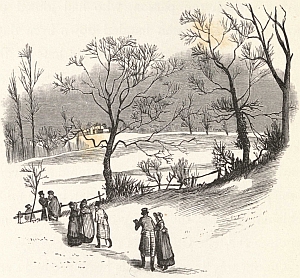
Notwithstanding the frostiness of the morning, the sun in his cloudless journey had acquired sufficient power to melt away the thin covering of snow from every southern declivity, and to bring out the living green which adorns an English landscape even in mid-winter. Large tracts of smiling verdure contrasted with the dazzling whiteness of the shaded slopes and hollows. Every sheltered bank, on which the broad rays rested, yielded its silver rill of cold and limpid water, glittering through the dripping grass; and sent up slight exhalations to contribute to the thin haze that hung just above the surface of the earth. There was something truly cheering in this triumph of warmth and verdure over the frosty thraldom of winter; it was, as the Squire observed, an emblem of Christmas hospitality, breaking through the chills of ceremony and selfishness, and thawing every heart into a flow. He pointed with pleasure to the indications of good cheer reeking from the chimneys of the comfortable farm-houses and low thatched cottages. "I love," said he, "to see this day well kept by rich and poor; it is a great thing to have one day in the year, at least, when you are sure of being welcome wherever you go, and of having, as it were, the world all thrown open to you; and I am almost disposed to join with Poor Robin, in his malediction of every churlish enemy to this honest festival:—
"Those who at Christmas do repine,
And would fain hence despatch him,
May they with old Duke Humphry dine,
Or else may Squire Ketch catch 'em."
The Squire went on to lament the deplorable decay of the games and amusements which were once prevalent at this season among the lower orders, and countenanced by the higher: when the old halls of castles and manor-houses were thrown open at daylight; when the tables were covered with brawn, and beef, and humming ale; when the harp and the carol resounded all day long, and when rich and poor were alike welcome to enter and make merry. "Our old games and local customs," said he, "had a great effect in making the peasant fond of his home, and the promotion of them by the gentry made him fond of his lord. They made the times merrier, and kinder, and better; and I can truly say, with one of our old poets,—
"I like them well—the curious preciseness
And all-pretended gravity of those
That seek to banish hence these harmless sports,
Have thrust away much ancient honesty.
"The nation," continued he, "is altered; we have almost lost our simple true-hearted peasantry. They have broken asunder from the higher classes, and seem to think their interests are separate. They have become too knowing, and begin to read newspapers, listen to alehouse politicians, and talk of reform. I think one mode to keep them in good humour in these hard times would be for the nobility and gentry to pass more time on their estates, mingle more among the country people, and set the merry old English games going again."

Such was the good Squire's project for mitigating public discontent; and, indeed, he had once attempted to put his doctrine in practice, and a few years before had kept open house during the holidays in the old style. The country people, however, did not understand how to play their parts in the scene of hospitality; many uncouth circumstances occurred; the manor was overrun by all the vagrants of the country, and more beggars drawn into the neighbourhood in one week than the parish officers could get rid of in a year. Since then he had contented himself with inviting the decent part of the neighbouring peasantry to call at the hall on Christmas day, and distributing beef, and bread, and ale, among the poor, that they might make merry in their own dwellings.
The dinner was served up in the great hall, where the Squire always held his Christmas banquet. A blazing crackling fire of logs had been heaped on to warm the spacious apartment, and the flame went sparkling and wreathing up the wide-mouthed chimney. The great picture of the crusader and his white horse had been profusely decorated with greens for the occasion; and holly and ivy had likewise been wreathed round the helmet and weapons on the opposite wall, which I understood were the arms of the same warrior. I must own, by the by, I had strong doubts about the authenticity of the painting and armour as having belonged to the crusader, they certainly having the stamp of more recent days; but I was told that the painting had been so considered time out of mind; and that as to the armour, it had been found in a lumber room, and elevated to its present situation by the Squire, who at once determined it to be the armour of the family hero; and as he was absolute authority on all such subjects in his own household, the matter had passed into current acceptation. A sideboard was set out just under this chivalric trophy, on which was a display of plate that might have vied (at least in variety) with Belshazzar's parade of the vessels of the temple; "flagons, cans, cups, beakers, goblets, basins, and ewers;" the gorgeous utensils of good companionship, that had gradually accumulated through many generations of jovial housekeepers. Before these stood the two Yule candles beaming like two stars of the first magnitude; other lights were distributed in branches, and the whole array glittered like a firmament of silver.

We were ushered into this banqueting scene with the sound of minstrelsy, the old harper being seated on a stool beside the fireplace, and twanging his instrument with a vast deal more power than melody. Never did Christmas board display a more goodly and gracious assemblage of countenances: those who were not handsome were, at least, happy; and happiness is a rare improver of your hard-favoured visage. I always consider an old English family as well worth studying as a collection of Holbein's portraits or Albert Durer's prints. There is much antiquarian lore to be acquired; much knowledge of the physiognomies of former times. Perhaps it may be from having continually before their eyes those rows of old family portraits, with which the mansions of this country are stocked; certain it is, that the quaint features of antiquity are often most faithfully perpetuated in these ancient lines; and I have traced an old family nose through a whole picture gallery, legitimately handed down from generation to generation, almost from the time of the Conquest. Something of the kind was to be observed in the worthy company around me. Many of their faces had evidently originated in a Gothic age, and been merely copied by succeeding generations; and there was one little girl, in particular, of staid demeanour, with a high Roman nose, and an antique vinegar aspect, who was a great favourite of the Squire's, being, as he said, a Bracebridge all over, and the very counterpart of one of his ancestors who figured in the court of Henry VIII.

The parson said grace, which was not a short familiar one, such as is commonly addressed to the Deity, in these unceremonious days; but a long, courtly, well-worded one of the ancient school. There was now a pause, as if something was expected; when suddenly the butler entered the hall with some degree of bustle: he was attended by a servant on each side with a large wax-light, and bore a silver dish, on which was an enormous pig's head decorated with rosemary, with a lemon in its mouth, which was placed with great formality at the head of the table. The moment this pageant made its appearance, the harper struck up a flourish; at the conclusion of which the young Oxonian, on receiving a hint from the Squire, gave, with an air of the most comic gravity, an old carol, the first verse of which was as follows:—
Caput apri defero
Reddens laudes Domino.
The boar's head in hand bring I,
With garlands gay and rosemary.
I pray you all synge merily
Qui estis in convivio.
Though prepared to witness many of these little eccentricities, from being apprised of the peculiar hobby of mine host; yet, I confess, the parade with which so odd a dish was introduced somewhat perplexed me, until I gathered from the conversation of the Squire and the parson that it was meant to represent the bringing in of the boar's head: a dish formerly served up with much ceremony, and the sound of minstrelsy and song, at great tables on Christmas day. "I like the old custom," said the Squire, "not merely because it is stately and pleasing in itself, but because it was observed at the College of Oxford, at which I was educated. When I hear the old song chanted, it brings to mind the time when I was young and gamesome—and the noble old college-hall—and my fellow-students loitering about in their black gowns; many of whom, poor lads, are now in their graves!"

The parson, however, whose mind was not haunted by such associations, and who was always more taken up with the text than the sentiment, objected to the Oxonian's version of the carol; which he affirmed was different from that sung at college. He went on, with the dry perseverance of a commentator, to give the college reading, accompanied by sundry annotations: addressing himself at first to the company at large; but finding their attention gradually diverted to other talk, and other objects, he lowered his tone as his number of auditors diminished, until he concluded his remarks, in an under voice, to a fat-headed old gentleman next him, who was silently engaged in the discussion of a huge plateful of turkey

24 December 2023

Revels.


The party now broke up for the night with the kind-hearted old custom of shaking hands. As I passed through the hall, on the way to my chamber, the dying embers of the Yule-clog still sent forth a dusky glow; and had it not been the season when "no spirit dares stir abroad," I should have been half tempted to steal from my room at midnight, and peep whether the fairies might not be at their revels about the hearth.

My chamber was in the old part of the mansion, the ponderous furniture of which might have been fabricated in the days of the giants. The room was panelled with cornices of heavy carved-work, in which flowers and grotesque faces were strangely intermingled; and a row of black-looking portraits stared mournfully at me from the walls. The bed was of rich though faded damask, with a lofty tester, and stood in a niche opposite a bow-window. I had scarcely got into bed when a strain of music seemed to break forth in the air just below the window. I listened, and found it proceeded from a band, which I concluded to be the waits from some neighbouring village. They went round the house, playing under the windows. I drew aside the curtains, to hear them more distinctly. The moonbeams fell through the upper part of the casement, partially lighting up the antiquated apartment. The sounds, as they receded, became more soft and aerial, and seemed to accord with quiet and moonlight. I listened and listened—they became more and more tender and remote, and, as they gradually died away, my head sank upon the pillow and I fell asleep.

Washington Irving, from "Christmas Eve," found in Geoffrey Crayon's Sketchbook

16 December 2023

Preparations.

Aldin, Snowed Up on Christmas Eve, 1910


Perhaps it might be owing to the pleasing serenity that reigned in my own mind, that I fancied I saw cheerfulness in every countenance throughout the journey. A stage coach, however, carries animation always with it, and puts the world in motion as it whirls along. The horn sounded at the entrance of a village, produces a general bustle. Some hasten forth to meet friends; some with bundles and bandboxes to secure places, and in the hurry of the moment can hardly take leave of the group that accompanies them. In the meantime, the coachman has a world of small commissions to execute. Sometimes he delivers a hare or pheasant; sometimes jerks a small parcel or newspaper to the door of a public-house; and sometimes, with knowing leer and words of sly import, hands to some half-blushing, half-laughing housemaid an odd-shaped billet-doux from some rustic admirer. As the coach rattles through the village, every one runs to the window, and you have glances on every side of fresh country faces, and blooming giggling girls. At the corners are assembled juntas of village idlers and wise men, who take their stations there for the important purpose of seeing company pass; but the sagest knot is generally at the blacksmith's, to whom the passing of the coach is an event fruitful of much speculation. The smith, with the horse's heel in his lap, pauses as the vehicle whirls by; the Cyclops round the anvil suspend their ringing hammers, and suffer the iron to grow cool; and the sooty spectre in brown paper cap, labouring at the bellows, leans on the handle for a moment, and permits the asthmatic engine to heave a long-drawn sigh, while he glares through the murky smoke and sulphureous gleams of the smithy.

Perhaps the impending holiday might have given a more than usual animation to the country, for it seemed to me as if everybody was in good looks and good spirits. Game, poultry, and other luxuries of the table, were in brisk circulation in the villages; the grocers', butchers', and fruiterers' shops were thronged with customers. The housewives were stirring briskly about, putting their dwellings in order; and the glossy branches of holly, with their bright red berries, began to appear at the windows. The scene brought to mind an old writer's account of Christmas preparations:—"Now capons and hens, besides turkeys, geese, and ducks, with beef and mutton—must all die; for in twelve days a multitude of people will not be fed with a little. Now plums and spice, sugar and honey, square it among pies and broth. Now or never must music be in tune, for the youth must dance and sing to get them a heat, while the aged sit by the fire. The country maid leaves half her market, and must be sent again, if she forgets a pack of cards on Christmas eve. Great is the contention of Holly and Ivy, whether master or dame wears the breeches. Dice and cards benefit the butler; and if the cook do not lack wit, he will sweetly lick his fingers."

Washington Irving, from The Sketch Book of Geoffrey Crayon, Gent., within "The Stage Coach"

18 November 2023

Splendor.


Washington Irving explores "Westminster Abbey" ...
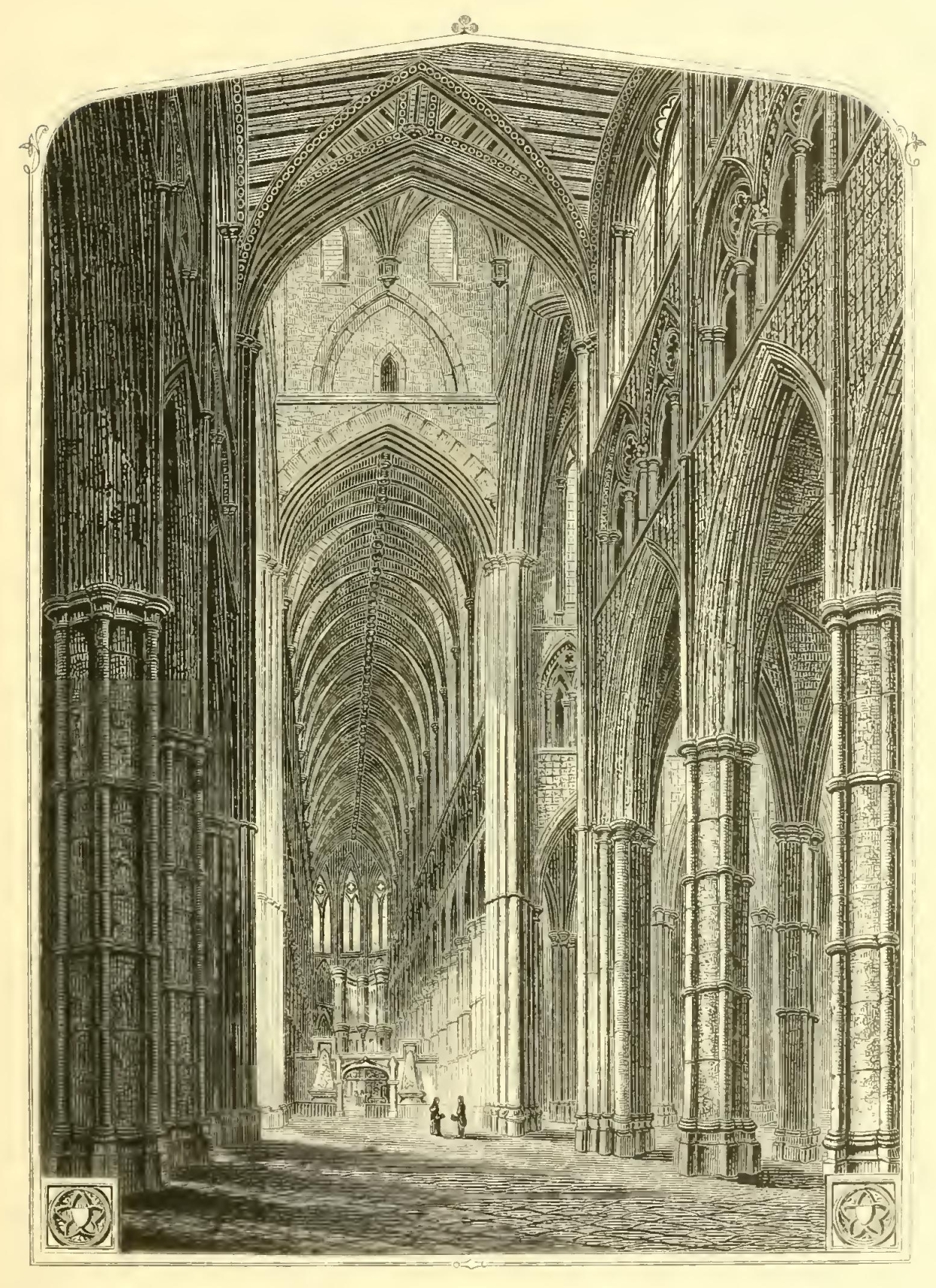
On one of those sober and rather melancholy days in the latter part of autumn when the shadows of morning and evening almost mingle together, and throw a gloom over the decline of the year, I passed several hours in rambling about Westminster Abbey. There was something congenial to the season in the mournful magnificence of the old pile, and as I passed its threshold it seemed like stepping back into the regions of antiquity and losing myself among the shades of former ages.

I entered from the inner court of Westminster School, through a long, low, vaulted passage that had an almost subterranean look, being dimly lighted in one part by circular perforations in the massive walls. Through this dark avenue I had a distant view of the cloisters, with the figure of an old verger in his black gown moving along their shadowy vaults, and seeming like a spectre from one of the neighboring tombs. The approach to the abbey through these gloomy monastic remains prepares the mind for its solemn contemplation. The cloisters still retain something of the quiet and seclusion of former days. The gray walls are discolored by damps and crumbling with age; a coat of hoary moss has gathered over the inscriptions of the mural monuments, and obscured the death’s heads and other funeral emblems. The sharp touches of the chisel are gone from the rich tracery of the arches; the roses which adorned the keystones have lost their leafy beauty; everything bears marks of the gradual dilapidations of time, which yet has something touching and pleasing in its very decay.

The sun was pouring down a yellow autumnal ray into the square of the cloisters, beaming upon a scanty plot of grass in the centre, and lighting up an angle of the vaulted passage with a kind of dusky splendor. From between the arcades the eye glanced up to a bit of blue sky or a passing cloud, and beheld the sun-gilt pinnacles of the abbey towering into the azure heaven.

21 October 2023

Inhale.


I recollect that, when a stripling, my first exploit in squirrel-shooting was in a grove of tall walnut-trees that shades one side of the valley. I had wandered into it at noontime, when all nature is peculiarly quiet, and was startled by the roar of my own gun, as it broke the Sabbath stillness around and was prolonged and reverberated by the angry echoes. If ever I should wish for a retreat whither I might steal from the world and its distractions, and dream quietly away the remnant of a troubled life, I know of none more promising than this little valley.

From the listless repose of the place, and the peculiar character of its inhabitants, who are descendants from the original Dutch settlers, this sequestered glen has long been known by the name of SLEEPY HOLLOW, and its rustic lads are called the Sleepy Hollow Boys throughout all the neighboring country. A drowsy, dreamy influence seems to hang over the land, and to pervade the very atmosphere. Some say that the place was bewitched by a High German doctor, during the early days of the settlement; others, that an old Indian chief, the prophet or wizard of his tribe, held his powwows there before the country was discovered by Master Hendrick Hudson. Certain it is, the place still continues under the sway of some witching power, that holds a spell over the minds of the good people, causing them to walk in a continual reverie. They are given to all kinds of marvellous beliefs, are subject to trances and visions, and frequently see strange sights, and hear music and voices in the air. The whole neighborhood abounds with local tales, haunted spots, and twilight superstitions; stars shoot and meteors glare oftener across the valley than in any other part of the country, and the nightmare, with her whole ninefold, seems to make it the favorite scene of her gambols.

The dominant spirit, however, that haunts this enchanted region, and seems to be commander-in-chief of all the powers of the air, is the apparition of a figure on horseback, without a head. It is said by some to be the ghost of a Hessian trooper, whose head had been carried away by a cannon-ball, in some nameless battle during the Revolutionary War, and who is ever and anon seen by the country folk hurrying along in the gloom of night, as if on the wings of the wind. His haunts are not confined to the valley, but extend at times to the adjacent roads, and especially to the vicinity of a church at no great distance. Indeed, certain of the most authentic historians of those parts, who have been careful in collecting and collating the floating facts concerning this spectre, allege that the body of the trooper having been buried in the churchyard, the ghost rides forth to the scene of battle in nightly quest of his head, and that the rushing speed with which he sometimes passes along the Hollow, like a midnight blast, is owing to his being belated, and in a hurry to get back to the churchyard before daybreak.

Such is the general purport of this legendary superstition, which has furnished materials for many a wild story in that region of shadows; and the spectre is known at all the country firesides, by the name of the Headless Horseman of Sleepy Hollow.

It is remarkable that the visionary propensity I have mentioned is not confined to the native inhabitants of the valley, but is unconsciously imbibed by every one who resides there for a time. However wide awake they may have been before they entered that sleepy region, they are sure, in a little time, to inhale the witching influence of the air, and begin to grow imaginative, to dream dreams, and see apparitions.

From "The Legend of Sleepy Hollow" by Washington Irving, found among the papers of the late Diedrich Knickerbocker