"I am not one who was born in the custody of wisdom. I am one who is fond of olden times and intense in quest of the sacred knowing of the ancients." Gustave Courbet
Showing posts with label sargent. Show all posts

02 May 2026

Ever-Continuous.

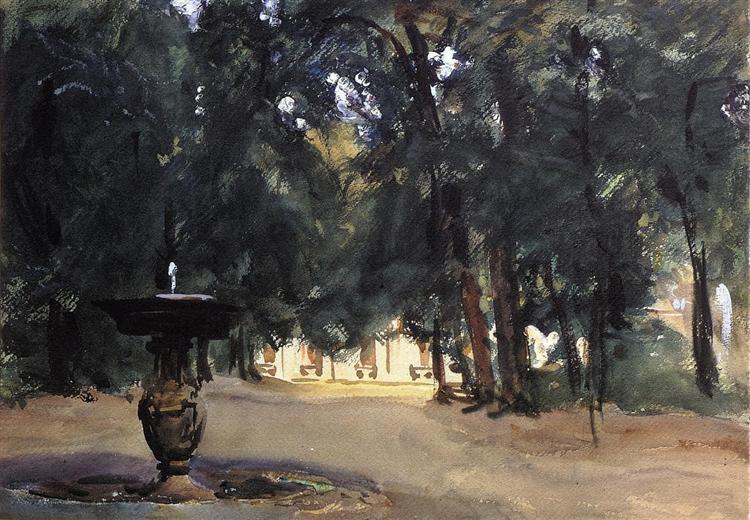
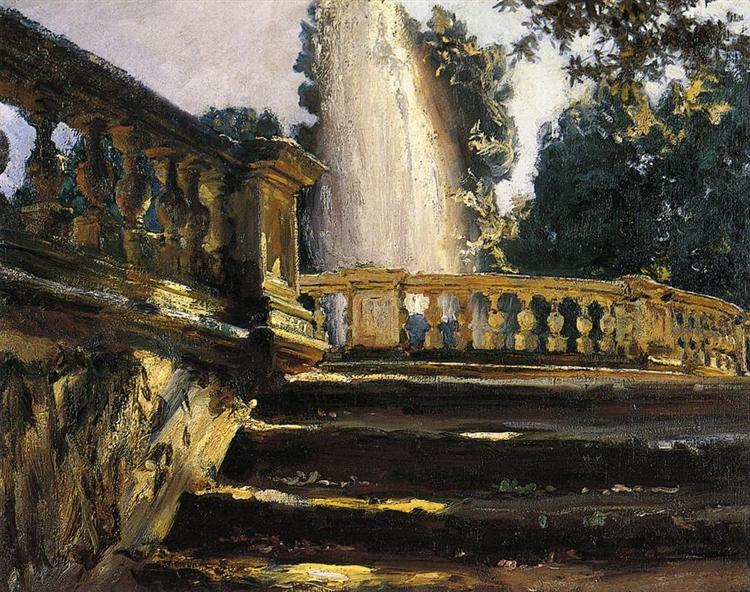
Sargent, Villa Torina Fountain, 1907


Cultivate an ever-continuous power of observation. Wherever you are, be always ready to make slight notes of postures, groups and incidents. Store up in the mind without ceasing a continuous stream of observations from which to make selections later. Above all things get abroad, see the sunlight, and everything that is to be seen, the power of selection will follow. Be continually making mental notes, make them again and again, test what you remember by sketches until you have got them fixed. Do not be backward at using every device and making every experiment that ingenuity can devise, in order to attain that sense of completeness which nature so beautifully provides, always bearing in mind the limitations of the materials in which you work.

John Singer Sargent, from a letter to J.B. Manson in 1901

07 March 2026

Inexhaustible.

Sargent, Robert Louis Stevenson, 1887


I am told there are people who do not care for maps, and I find it hard to believe.  The names, the shapes of the woodlands, the courses of the roads and rivers, the prehistoric footsteps of man still distinctly traceable up hill and down dale, the mills and the ruins, the ponds and the ferries, perhaps the standing tone or the Druidic Circle on the heath; here is an inexhaustible fund of interest for any man with eyes to see or twopence-worth of imagination to understand with!  No child but must remember laying his head in the grass, staring into the infinitesimal forest and seeing it grow populous with fairy armies.

Somewhat in this way, as I paused upon my map of Treasure Island, the future character of the book began to appear there visibly among imaginary woods; and their brown faces and bright weapons peeped out upon me from unexpected quarters, as they passed to and fro, fighting and hunting treasure, on these few square inches of a flat projection.  The next thing I knew I had some papers before me and was writing out a list of chapters.  How often have I done so, and the thing gone no further! But there seemed elements of success about this enterprise. 

Robert Louis Stevenson, from "My First Book, Treasure Island"

13 June 2025

Away.

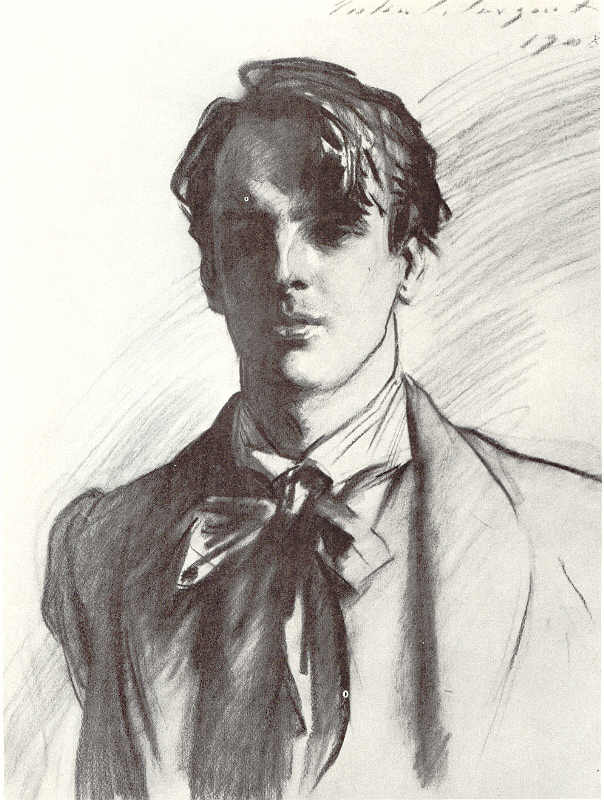
Sargent, William Butler Yeats, 1908


THE LAND of HEART'S DESIRE

God spreads the heavens above us like great wings
And gives a little round of deeds and days,
And then come the wrecked angels and set snares,
And bait them with light hopes and heavy dreams,
Until the heart is puffed with pride and goes
Half shuddering and half joyous from God's peace;
And it was some wrecked angel, blind with tears,
Who flattered Edane's heart with merry words.

Come, faeries, take me out of this dull house!
Let me have all the freedom I have lost;
Work when I will and idle when I will!
Faeries, come take me out of this dull world,
For I would ride with you upon the wind,
Run on the top of the dishevelled tide,
And dance upon the mountains like a flame.

I would take the world
And break it into pieces in my hands
To see you smile watching it crumble away.

Once a fly dancing in a beam of the sun,
Or the light wind blowing out of the dawn,
Could fill your heart with dreams none other knew,
But now the indissoluble sacrament
Has mixed your heart that was most proud and cold
With my warm heart for ever; the sun and moon
Must fade and heaven be rolled up like a scroll
But your white spirit still walk by my spirit.

When winter sleep is abroad my hair grows thin,
My feet unsteady. When the leaves awaken
My mother carries me in her golden arms;
I'll soon put on my womanhood and marry
The spirits of wood and water, but who can tell
When I was born for the first time?

The wind blows out of the gates of the day,
The wind blows over the lonely of heart,
And the lonely of heart is withered away;
While the faeries dance in a place apart,
Shaking their milk-white feet in a ring,
Tossing their milk-white arms in the air;
For they hear the wind laugh and murmur and sing
Of a land where even the old are fair,
And even the wise are merry of tongue;
But I heard a reed of Coolaney say--
When the wind has laughed and murmured and sung,
The lonely of heart is withered away.

W.B. Yeats

27 March 2024

Travel'd.

Sargent, Staircase in Capri, 1878


The man who never in his mind and thoughts travel'd to heaven is no artist.

William Blake

19 March 2024

Vanishing.

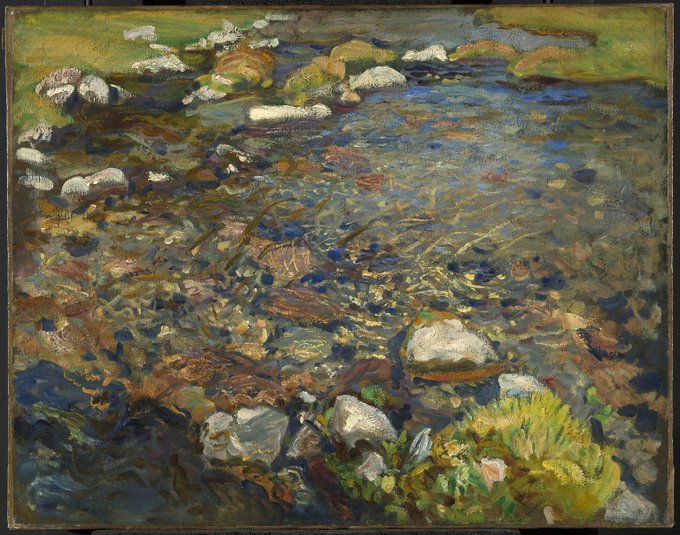
Sargent, Val d'Aosta (A Stream over Rocks), 1909 


THE NIGHT, THE PORCH

To stare at nothing is to learn by heart
What all of us will be swept into, and baring oneself
To the wind is feeling the ungraspable somewhere close by.
Trees can sway or be still. Day or night can be what they wish.
What we desire, more than a season or weather, is the comfort
Of being strangers, at least to ourselves. This is the crux
Of the matter, which is why even now we seem to be waiting
For something whose appearance would be its vanishing —
The sound, say, of a few leaves falling, or just one leaf,
Or less. There is no end to what we can learn. The book out there
Tells us as much, and was never written with us in mind.

Mark Strand

12 January 2024

13 November 2023

Happy Birthday, Stevenson

Sargent, Robert Louis Stevenson, 1887


To know what you prefer instead of humbly saying Amen to what the world tells you you ought to prefer, is to have kept your soul alive.

Robert Louis Stevenson, born on this day in 1850, from An Inland Voyage

16 May 2023

True.


Yale Daily News asks, "Could AI elevate human creativity?"
Buck thinks that AI is changing how artists imagine what can be made, but would not replace the entirety of the design process. 

Rather than “replacing” human creativity, Buck views AI as “displacing” it. The architect described AI as a form of “mediation,” similar to other technologies like a pencil or paint, and software like Photoshop and 3D modeling. AI serves as a filter which humans “look through” and “create through,” Buck explained, and is already a part of cameras, software for editing photos, Google search and a variety of other platforms that affect how humans see the world.

“It’s not that it is or will replace human creativity but that it will change how humans are creative and how art is produced,” Buck said. “[AI is] another way in which what we make is filtered through all the different technologies we use.”

Nisheeth Vishnoi, A. Bartlett Giamatti professor of computer science and co-founder of the Computation and Society Initiative, thinks that AI could add to the creativity of human artists, “perhaps indirectly.” 

“It is likely that AI will discover new types of art forms which are visually appealing,” Vishnoi said. “However, the popularity of art, the price of art and artistic styles is a very human-driven process. And I’m not sure how AI itself is going to enter and capture that.”
Persuasion says, "Never."
Experience: not just the source of art but its very substance—what it’s made from, what it refers to, what it is tested against. It might be possible to code for low-probability choices, I guess, but how would the computer know if the results are worth a damn? Art is good insofar as we recognize it as true, as corresponding to our experience of the world, both inner and outer. But for AIs, there is neither experience nor world. No sights or sounds, no joys or pains, and also no awareness—no idea whether what they make is true, and therefore whether it is good.

29 January 2023

Where's.

Sargent, Cottage at Fairford, Gloucestershire, 1892


The VILLAGE INN

"The village inn, the dear old inn,
So ancient, clean and free from sin,
True centre of our rural life
Where Hodge sits down beside his wife
And talks of Marx and nuclear fission
With all a rustic's intuition.
Ah, more than church or school or hall,
The village inn's the heart of all."
So spake the brewer's P. R. O.,
A man who really ought to know,
For he is paid for saying so.
And then he kindly gave to me
A lovely coloured booklet free.
'Twas full of prose that sang the praise
Of coaching inns in Georgian days,
Showing how public-houses are
More modern than the motor-car,
More English than the weald or wold
And almost equally as old,
And run for love and not for gold
Until I felt a filthy swine
For loathing beer and liking wine,
And rotten to the very core
For thinking village inns a bore,
And village bores more sure to roam
To village inns than stay at home.
And then I thought I must be wrong,

So up I rose and went along
To that old village alehouse where
In neon lights is written "Bear".

Ah, where's the inn that once I knew
With brick and chalky wall
Up which the knobbly pear-tree grew
For fear the place would fall?

Oh, that old pot-house isn't there,
It wasn't worth our while;
You'll find we have rebuilt "Bear"
In Early Georgian style.

But winter jasmine used to cling
With golden stars a-shine
Where rain and wind would wash and swing
The crudely painted sign.

And where's the roof of golden thatch?
The chimney-stack of stone?
The crown-glass panes that used to match
Each sunset with their own?

Oh now the walls are red and smart,
The roof has emerald tiles.
The neon sign's a work of art
And visible for miles.

The bar inside was papered green,
The settles grained like oak,
The only light was paraffin,
The woodfire used to smoke.

And photographs from far and wide
Were hung around the room
The hunt, the church, the football side,
And Kitchener of Khartoum.

Our air-conditioned bars are lined
With washable material,
The stools are steel, the taste refined,
Hygienic and ethereal.

Hurrah, hurrah, for hearts of oak!
Away with inhibitions!
For here's a place to sit and soak
In sanit'ry conditions.

John Betjeman
13 November 2022

Happy Birthday, Stevenson

Sargent, Portrait of Robert Louis Stevenson, 1887


WINDY NIGHTS

Whenever the moon and stars are set,
Whenever the wind is high,
All night long in the dark and wet,
A man goes riding by.
Late in the night when the fires are out,
Why does he gallop and gallop about?

Whenever the trees are crying aloud,
And ships are tossed at sea,
By, on the highway, low and loud,
By at the gallop goes he.
By at the gallop he goes, and then
By he comes back at the gallop again.

Robert Louis Stevenson, born on this day in 1850.

05 February 2022

Alive.

Sargent, A Capriote, 1878


crepuscule

i will wade out
                        till my thighs are steeped in burning flowers
I will take the sun in my mouth
and leap into the ripe air
                                       Alive
                                                 with closed eyes
to dash against darkness
                                       in the sleeping curves of my body
Shall enter fingers of smooth mastery
with chasteness of sea-girls
                                            Will i complete the mystery
                                            of my flesh
I will rise
               After a thousand years
lipping
flowers
             And set my teeth in the silver of the moon

e.e. cummings

14 August 2021

Reconnoitering.

Sargent, Reconnoitering, 1910


Now, my co-mates and brothers in exile,
Hath not old custom made this life more sweet
Than that of painted pomp? Are not these woods
More free from peril than the envious court?
Here feel we not the penalty of Adam,
The seasons’ difference, as the icy fang
And churlish chiding of the winter’s wind,
Which when it bites and blows upon my body
Even till I shrink with cold, I smile, and say
’This is no flattery. These are counsellors
That feelingly persuade me what I am.’
Sweet are the uses of adversity
Which, like the toad, ugly and venomous,
Wears yet a precious jewel in his head;
And this our life, exempt from public haunt,
Finds tongues in trees, books in the running brooks,
Sermons in stones, and good in everything.

William Shakespeare, from As You Like It

23 May 2021

Cultivate.

Sargent, Venetian Doorway, 1902

Cultivate an ever continuous power of observation. Wherever you are, be always ready to make slight notes of postures, groups and incidents. Store up in the mind a continuous stream of observations from which to make selections later. Above all things get abroad, see the sunlight and everything that is to be seen. 

John Singer Sargent

24 January 2021

Continuous.

Sargent, Elizabeth Winthrop Chanler (detail), 1893


Cultivate an ever continuous power of observation. Wherever you are, be always ready to make slight notes of postures, groups and incidents. Store up in the mind a continuous stream of observations.

John Singer Sargent

12 January 2021

Happy Birthday, Sargent

Sargent, Atlantic Storm, 1876


John Singer Sargent was on this day in 1856.

28 July 2020

Flashes.

Sargent, Olive Trees, 1878


Grown about by fragrant bushes,
Sunken in a winding valley,
Where the clear winds blow
And the shadows come and go,
And the cattle stand and low
And the sheep bells and the linnets
Sing and tinkle musically.
Between the past and the future,
Those two black infinities
Between which our brief life
Flashes a moment and goes out.

Robert Louis Stevenson

28 April 2020

Spoke.

Sargent, Kenneth Grahame, 1922


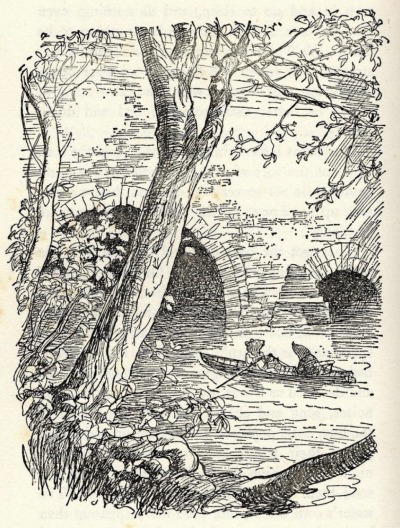
The smell of that buttered toast simply spoke to Toad, and with no uncertain voice; talked of warm kitchens, of breakfasts on bright frosty mornings, of cosy parlour firesides on winter evenings, when one’s ramble was over and slippered feet were propped on the fender; of the purring of contented cats, and the twitter of sleepy canaries.

Kenneth Grahame, from the Wind in the Willows

12 January 2020

Happy Birthday, Sargent

Sargent, Villa Torlonia Fountain, 1907


John Singer Sargent was born on this date in 1856.

Cultivate an ever continuous power of observation. Wherever you are, be always ready. Store up in the mind a continuous stream of observations from which to make selections later. Above all things get abroad, see the sunlight and everything that is to be seen.

John Singer Sargent

John Singer Sargent: Outside the Frame ...

06 July 2019

Judgment.

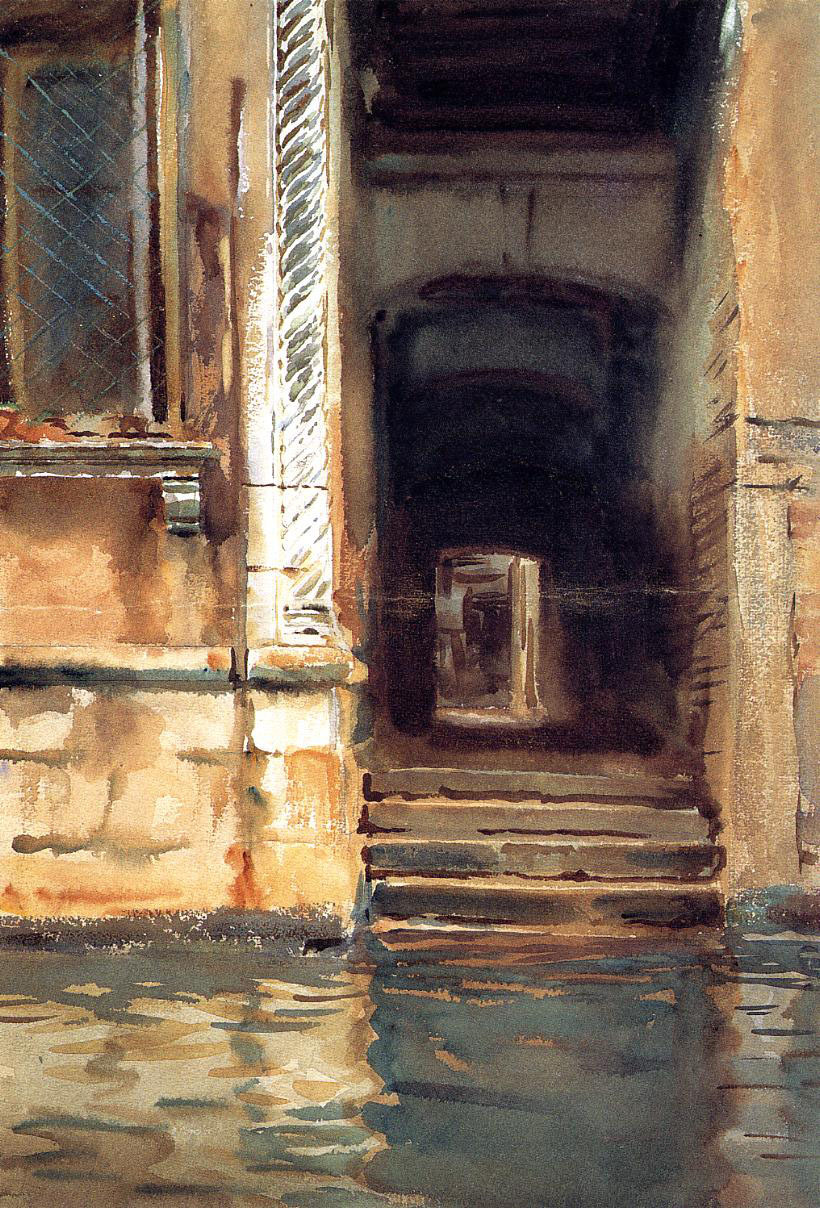
Sargent, Venetian Passageway, 1905


Beauty is the subject-matter of a judgment, a judgment of taste.

The judgment of taste referred to above is about the beautiful object, not about the subject’s state of mind. In describing an object as beautiful, I am describing it, not me (or my reaction to it).

Despite this, there are no second-hand judgments of beauty. There is no way that you can argue me into a judgment that I have not made for myself, nor can I become an expert in beauty, simply by studying what others have said about beautiful objects, and without experiencing and judging for myself.

Roger Scruton