"I am not one who was born in the custody of wisdom. I am one who is fond of olden times and intense in quest of the sacred knowing of the ancients." Gustave Courbet
Showing posts with label wind. Show all posts

21 April 2026

Happy Birthday, John Muir


I kept my lofty perch for hours, frequently closing my eyes to enjoy the music by itself, or to feast quietly on the delicious fragrance that was streaming past. The fragrance of the woods was less marked than that produced during warm rain, when so many balsamic buds and leaves are steeped like tea; but, from the chafing of resiny branches against each other, and the incessant attrition of myriads of needles, the gale was spiced to a very tonic degree. And besides the fragrance from these local sources there were traces of scents brought from afar. For this wind came first from the sea, rubbing against its fresh, briny waves, then distilled through the redwoods, threading rich ferny gulches, and spreading itself in broad undulating currents over many a flower-enameled ridge of the coast mountains, then across the golden plains, up the purple foot-hills, and into these piney woods with the varied incense gathered by the way.

John Muir, born on this day in 1838, from "A Wind-Storm in the Forest"

14 November 2025

Heart.


A WANDER'S SONG

A winds in the heart of me, a fire's in my heels,
I am tired of brick and stone and rumbling wagon-wheels;
I hunger for the sea’s edge, the limits of the land,
Where the wild winds old Atlantic is shouting on the sand.

Oh I’ll be going, leaving the noise of the street,
To where a lifting foresail-foot is yanking at the sheet;
To a windy, tossing anchorage where yawls and ketches ride,
Oh I’ll be going, going, until I meet the tide.

And first I’ll hear the sea-wind, the mewing of the gulls,
The clucking sucking of the sea about the rusty hulls,
The songs at the capstan at the hooker warping out,
And then the heart of me’ll know I’m there or thereabout.

Oh I am sick of brick and stone, the heart of me is sick,
For windy green unquiet sea, the realm of Moby Dick;
And I’ll be going going, form the roaring of the wheels,
For a wind’s in the heart of me, a fire’s in my heel’s.

John Masefield

03 November 2025

Wind.

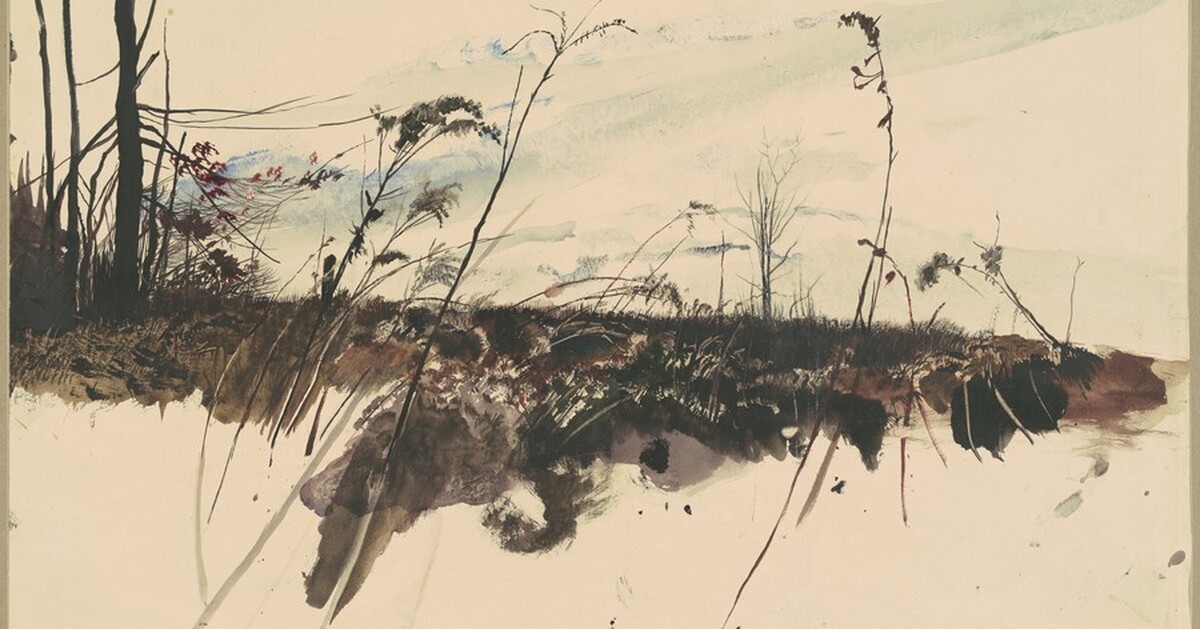
Wyeth, November Fields, Chadds Ford, Pennsylvania, 1945


KINTYRE

I wake when the wind changes.
Beyond the dark Firth far,
Where the waves clap and the tides rustle and the herring are,
At the far side of the great Clyde the wind ranges.
I wake as it changes.

If snow flew or mist blew
East on the hills of Renfrew,
Here, Arran shltered, we might never know,
Get no breath of sleet or hard snow,
Until across the mountain ranges
The wind backs and changes.

Clear starlight as sleep takes me,
But a cloud creeps from the side.
My dream no more ranges
Through a universe at rest,
But quick through the window wide,
From Atlantic on the west
Or from east beyond Clyde,
Leaps anxious into my breast.
I wake when the wind changes.

Naomi Mitchison

11 July 2024

Everything.


When we hear the sound of the pine trees on a windy day, perhaps the wind is just blowing, and the pine tree is just standing in the wind. That is all they are doing. But the people who will listen to the wind in the tree will write a poem, or will feel something unusual. That is, I think, the way everything is.

Shunryu Suzuki

08 February 2024

Hark!

Turner, Storm at Sea Study, n/d


What way does the wind come? What way does he go?
He rides over the water, and over the snow,
Through wood, and through vale; and o’er rocky height,
Which the goat cannot climb, takes his sounding flight;
He tosses about in every bare tree,
As, if you look up, you plainly may see;
But how he will come, and whither he goes,
There’s never a scholar in England knows.

He will suddenly stop in a cunning nook,
And ring a sharp ’larum; but, if you should look,
There’s nothing to see but a cushion of snow,
Round as a pillow, and whiter than milk,
And softer than if it were covered with silk.
Sometimes he’ll hide in the cave of a rock,
Then whistle as shrill as the buzzard cock;
— Yet seek him, and what shall you find in the place?
Nothing but silence and empty space;
Save, in a corner, a heap of dry leaves,
That he’s left, for a bed, to beggars or thieves!

As soon as ’tis daylight tomorrow, with me
You shall go to the orchard, and then you will see
That he has been there, and made a great rout,
And cracked the branches, and strewn them about;
Heaven grant that he spare but that one upright twig
That looked up at the sky so proud and big
All last summer, as well you know,
Studded with apples, a beautiful show!

Hark! over the roof he makes a pause,
And growls as if he would fix his claws
Right in the slates, and with a huge rattle
Drive them down, like men in a battle:
– But let him range round; he does us no harm,
We build up the fire, we’re snug and warm;
Untouched by his breath see the candle shines bright,
And burns with a clear and steady light.

Books have we to read, but that half-stifled knell,
Alas! ’tis the sound of the eight o’clock bell.
— Come, now we’ll to bed! and when we are there
He may work his own will, and what shall we care?
He may knock at the door — we’ll not let him in;
May drive at the windows — we’ll laugh at his din;
Let him seek his own home wherever it be;
Here’s a cozie warm house for Edward and me.

Dorothy Wordsworth

31 May 2023

Uncertain.

Stevenson, Georgia O’Keeffe, Dungeon Canyon, 1961


The wind is careless — uncertain — I like the wind — it seems more like me than anything else — I like the way it blows things around roughly — even meanly — then the next minute seems to love everything.

Georgia O'Keeffe

13 November 2022

Happy Birthday, Stevenson

Sargent, Portrait of Robert Louis Stevenson, 1887


WINDY NIGHTS

Whenever the moon and stars are set,
Whenever the wind is high,
All night long in the dark and wet,
A man goes riding by.
Late in the night when the fires are out,
Why does he gallop and gallop about?

Whenever the trees are crying aloud,
And ships are tossed at sea,
By, on the highway, low and loud,
By at the gallop goes he.
By at the gallop he goes, and then
By he comes back at the gallop again.

Robert Louis Stevenson, born on this day in 1850.

05 January 2022

Wind.

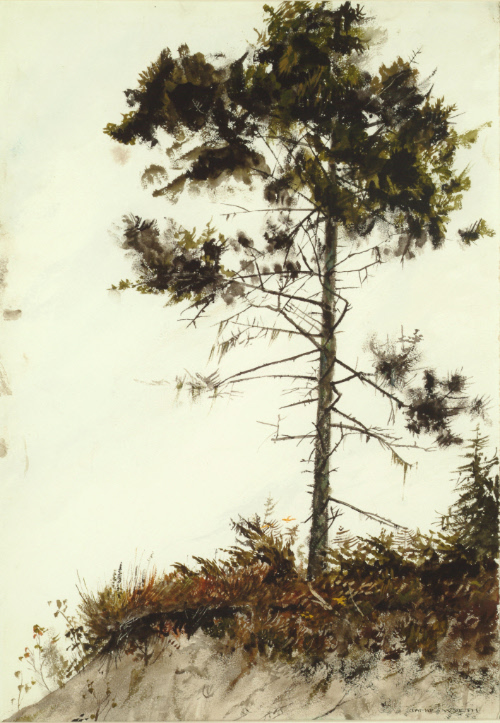
Wyeth, Jamie, Pine Study, 1960


this ink painting of wind
blowing through pines
who hears it?

Ikkyu

10 December 2021

Lashing.

Waterhouse, Boreas, 1903


WHITE HORSES 

Far out at sea
There are horses to ride,
Little white horses
That race with the tide.

Their tossing manes
Are the white sea-foam,
And the lashing winds
Are driving them home-

To shadowy stables
Fast they must flee,
To the great green caverns
Down under the sea.

Irene F. Pawsey

18 January 2021

Difference.


During the nights I listened to the ice booming on the lake.  During the day when I used to fetch water from the hole in the lake, I began to see how subtle changes in the temperature and the wind affected the thickness of the ice.  I heard a lot of wind and came to like the difference between wind through spruce, wind through balsam, wind through bare poplar, wind through red oak, wind through marsh grass, and wind through dead cattails.  I saw what wind and sun did to old moose tracks and deer tracks and squirrel tracks and rabbit tracks and fisher tracks and marten tracks and fox tracks.  I once crossed a pond to check my traps, and when I crossed back ten minutes later, seven sets of timber wolf tracks had crossed over mine.

David Treuer, from Trapline: An Ojibwe Man’s Search for Identity on the Canadian Taiga

When ice settles and cracks on the Great Lakes, it sounds like a distant cannon going off.

27 October 2020

Wind.

Wyeth, Apples, Study before Picking, 1942


To appreciate the wild and sharp flavors of these October fruits, it is necessary that you be breathing the sharp October or November air.  What is sour in the house a bracing walk makes sweet.  Some of these apples might be labeled, “To be eaten in the wind.” It takes a savage or wild taste to appreciate a wild fruit.  The era of the Wild Apple will soon be past.  It is a fruit which will probably become extinct in New England.  I fear that he who walks over these fields a century hence will not know the pleasure of knocking off wild apples.  Ah, poor soul, there are many pleasures which you will not know!  The end of it all will be that we shall be compelled to look for our apples in a barrel.

Henry David Thoreau

21 April 2019

Happy Birthday, Muir


John Muir was born on this date in 1838.

Toward midday, after a long, tingling scramble through copses of hazel and ceanothus, I gained the summit of the highest ridge in the neighborhood; and then it occurred to me that it would be a fine thing to climb one of the trees to obtain a wider outlook and get my ear close to the Æolian music of its topmost needles. But under the circumstances the choice of a tree was a serious matter. One whose instep was not very strong seemed in danger of being blown down, or of being struck by others in case they should fall; another was branchless to a considerable height above the ground, and at the same time too large to be grasped with arms and legs in climbing; while others were not favorably situated for clear views. After cautiously casting about, I made choice of the tallest of a group of Douglas Spruces that were growing close together like a tuft of grass, no one of which seemed likely to fall unless all the rest fell with it. Though comparatively young, they were about 100 feet high, and their lithe, brushy tops were rocking and swirling in wild ecstasy. Being accustomed to climb trees in making botanical studies, I experienced no difficulty in reaching the top of this one, and never before did I enjoy so noble an exhilaration of motion. The slender tops fairly flapped and swished in the passionate torrent, bending and swirling backward and forward, round and round, tracing indescribable combinations of vertical and horizontal curves, while I clung with muscles firm braced, like a bobo-link on a reed.

In its widest sweeps my tree-top described an arc of from twenty to thirty degrees, but I felt sure of its elastic temper, having seen others of the same species still more severely tried--bent almost to the ground indeed, in heavy snows--without breaking a fiber. I was therefore safe, and free to take the wind into my pulses and enjoy the excited forest from my superb outlook. The view from here must be extremely beautiful in any weather. Now my eye roved over the piny hills and dales as over fields of waving grain, and felt the light running in ripples and broad swelling undulations across the valleys from ridge to ridge, as the shining foliage was stirred by corresponding waves of air. Oftentimes these waves of reflected light would break up suddenly into a kind of beaten foam, and again, after chasing one another in regular order, they would seem to bend forward in concentric curves, and disappear on some hillside, like sea-waves on a shelving shore. The quantity of light reflected from the bent needles was so great as to make whole groves appear as if covered with snow, while the black shadows beneath the trees greatly enhanced the effect of the silvery splendor.

Excepting only the shadows there was nothing somber in all this wild sea of pines. On the contrary, notwithstanding this was the winter season, the colors were remarkably beautiful. The shafts of the pine and libocedrus were brown and purple, and most of the foliage was well tinged with yellow; the laurel groves, with the pale undersides of their leaves turned upward, made masses of gray; and then there was many a dash of chocolate color from clumps of manzanita, and jet of vivid crimson from the bark of the madroños, while the ground on the hillsides, appearing here and there through openings between the groves, displayed masses of pale purple and brown.

The sounds of the storm corresponded gloriously with this wild exuberance of light and motion. The profound bass of the naked branches and boles booming like waterfalls; the quick, tense vibrations of the pine-needles, now rising to a shrill, whistling hiss, now falling to a silky murmur; the rustling of laurel groves in the dells, and the keen metallic click of leaf on leaf--all this was heard in easy analysis when the attention was calmly bent.

The varied gestures of the multitude were seen to fine advantage, so that one could recognize the different species at a distance of several miles by this means alone, as well as by their forms and colors, and the way they reflected the light. All seemed strong and comfortable, as if really enjoying the storm, while responding to its most enthusiastic greetings. We hear much nowadays concerning the universal struggle for existence, but no struggle in the common meaning of the word was manifest here; no recognition of danger by any tree; no deprecation; but rather an invincible gladness as remote from exultation as from fear.

I kept my lofty perch for hours, frequently closing my eyes to enjoy the music by itself, or to feast quietly on the delicious fragrance that was streaming past. The fragrance of the woods was less marked than that produced during warm rain, when so many balsamic buds and leaves are steeped like tea; but, from the chafing of resiny branches against each other, and the incessant attrition of myriads of needles, the gale was spiced to a very tonic degree. And besides the fragrance from these local sources there were traces of scents brought from afar. For this wind came first from the sea, rubbing against its fresh, briny waves, then distilled through the redwoods, threading rich ferny gulches, and spreading itself in broad undulating currents over many a flower-enameled ridge of the coast mountains, then across the golden plains, up the purple foot-hills, and into these piny woods with the varied incense gathered by the way.

John Muir, from "A Wind-Storm in the Forests"

30 July 2018

On.

Botticelli, The Birth of Venus (detail), 1486


KING WIND

Of all the weathers wind is king.

Snow would not blow, rain would not beat,
Nor green grasses ripple, nor trees break, 
Except for the will of this blind thing
That neither is seen nor sees, but anyway
Comes, and anyway goes -- from where
To where?  Nobody knows.

I never am tired of thinking of him.
Even in sleep -- but where is his bed? --
He dreams of filling the world again
With waves of water and walls of air
That neither can stop nor stand, but anyway
Rise, and anyway, fall.  So on
Forever.  Motion is all.

Mark Van Doren

24 November 2017

Music.


The wind that makes music in November corn is in a hurry.  The stalks hum, the loose husks whisk skyward in half-playing swirls, and the wind hurries on. A tree tries to argue, bare limbs waving, but there is no detaining the wind.

Aldo Leopold

26 April 2017

Unusual.


When we hear the sound of the pine trees on a windy day, perhaps the wind is just blowing, and the pine tree is just standing in the wind. That is all that they are doing. But the people who listen to the wind in the tree will write a poem, or will feel something unusual. That is, I think, the way everything is.

Shunryu Suzuki

CONNECT

17 October 2016

Wild.


ODE TO THE WEST WIND

I
O wild West Wind, thou breath of Autumn's being, 
Thou, from whose unseen presence the leaves dead 
Are driven, like ghosts from an enchanter fleeing, 

Yellow, and black, and pale, and hectic red, 
Pestilence-stricken multitudes: O thou, 
Who chariotest to their dark wintry bed 

The winged seeds, where they lie cold and low, 
Each like a corpse within its grave, until 
Thine azure sister of the Spring shall blow 

Her clarion o'er the dreaming earth, and fill 
(Driving sweet buds like flocks to feed in air) 
With living hues and odours plain and hill: 

Wild Spirit, which art moving everywhere; 
Destroyer and preserver; hear, oh hear! 

II
Thou on whose stream, mid the steep sky's commotion, 
Loose clouds like earth's decaying leaves are shed, 
Shook from the tangled boughs of Heaven and Ocean, 

Angels of rain and lightning: there are spread 
On the blue surface of thine aëry surge, 
Like the bright hair uplifted from the head 

Of some fierce Maenad, even from the dim verge 
Of the horizon to the zenith's height, 
The locks of the approaching storm. Thou dirge 

Of the dying year, to which this closing night 
Will be the dome of a vast sepulchre, 
Vaulted with all thy congregated might 

Of vapours, from whose solid atmosphere 
Black rain, and fire, and hail will burst: oh hear! 

III
Thou who didst waken from his summer dreams 
The blue Mediterranean, where he lay, 
Lull'd by the coil of his crystalline streams, 

Beside a pumice isle in Baiae's bay, 
And saw in sleep old palaces and towers 
Quivering within the wave's intenser day, 

All overgrown with azure moss and flowers 
So sweet, the sense faints picturing them! Thou 
For whose path the Atlantic's level powers 

Cleave themselves into chasms, while far below 
The sea-blooms and the oozy woods which wear 
The sapless foliage of the ocean, know 

Thy voice, and suddenly grow gray with fear, 
And tremble and despoil themselves: oh hear! 

IV
If I were a dead leaf thou mightest bear; 
If I were a swift cloud to fly with thee; 
A wave to pant beneath thy power, and share 

The impulse of thy strength, only less free 
Than thou, O uncontrollable! If even 
I were as in my boyhood, and could be 

The comrade of thy wanderings over Heaven, 
As then, when to outstrip thy skiey speed 
Scarce seem'd a vision; I would ne'er have striven 

As thus with thee in prayer in my sore need. 
Oh, lift me as a wave, a leaf, a cloud! 
I fall upon the thorns of life! I bleed! 

A heavy weight of hours has chain'd and bow'd 
One too like thee: tameless, and swift, and proud. 

V
Make me thy lyre, even as the forest is: 
What if my leaves are falling like its own! 
The tumult of thy mighty harmonies 

Will take from both a deep, autumnal tone, 
Sweet though in sadness. Be thou, Spirit fierce, 
My spirit! Be thou me, impetuous one! 

Drive my dead thoughts over the universe 
Like wither'd leaves to quicken a new birth! 
And, by the incantation of this verse, 

Scatter, as from an unextinguish'd hearth 
Ashes and sparks, my words among mankind! 
Be through my lips to unawaken'd earth 

The trumpet of a prophecy! O Wind, 
If Winter comes, can Spring be far behind?

Percey Bysshe Shelley

11 October 2016

Matthew.

Hurricane Matthew from Frying Pan Tower, thirty-four miles off the coast of North Carolina  (33°29′N 77°35′W), 8 October 2016, 9:00 am (EDT) ...


CONNECT