"I am not one who was born in the custody of wisdom. I am one who is fond of olden times and intense in quest of the sacred knowing of the ancients." Gustave Courbet

07 January 2018

Mingling.

Boubat, Parc de Saint-Cloud, 1981


Some Claims About Poetry and Consciousness
Fana and Baqa: Two Streamings Across the Doorsill of Rumi’s Poetry

No one can say what the inner life is, but poetry tries to, and no one can say what poetry is, but let’s be bold and claim that there are two major streamings in consciousness, particularly in the ecstatic life, and in Rumi’s poetry: call the fana and baqa, Arabic words that refer to the play and intersection of human with devine.

Rumi’s poetry occurs in that opening, a dervish doorway these energies move through in either direction.  A movement out, a movement in.  Fana is the streaming that moves from the human out into mystery -- the annihilation, the orgasmic expansion, the dissolving swoon in the the all.  The gnat becomes buttermilk; a chickpea disappears into the flavor of the soup; a dead mule decays into salt flat, the infant turns to the breast.  These wild and boundaryless absorptions are the images and the kind poem Rumi is most well known for, a drunken clairvoyant tavern voice that announces, “Whoever brought me here will have to take me home.”

“What was in that candle’s light that opened and consumed me so quickly!”  That is the moth’s question after fana, after it becomes flame.  The king’s falcon circles in the empty sky.  There is an extravagance in the magnificent disintegration of fana.  In one wheat grain a thousand sheaf stacks.  Which is literally true: a single wheat seed can, after a few years, become thousands of stacks and sheaves.  But it’s that special praise for the natural abundance of existence that identifies this state.  Three hundred billion galaxies might seem a bit gaudy to some, but not to this awareness; in fana what is here can never be said extravagantly enough.

Fana is what opens our wings, what makes boredom and hurt disappear.  We break to pieces inside it, dancing and perfectly free.  We are the dreamer streaming into the loving nowhere of night.  Rapt, we are the devouring worm who, through grace becomes an entire orchard, the wholeness of the trunks, the leaves, the fruit, and the growing.  Fana is the dissolution just before our commotion and mad night prayers become silence.  Rumi often associates surrender with the joy of falling into the freedom of sleep.  It’s human-becoming-God, the Ana ‘l-Haqq (“I am the truth”) of Al-Hallaj Mansour.  The arms open outward.  This is the ocean with no shore into which the dewdrop falls.
My friend, the poet Daniel Abdal-Hayy Moore, scolds me for not saying outright that fana is annihilation in Allah.  I avoid God-words, not altogether, but whenever I can, because they seem to take away the freshness of experience and put it inside a specific system.  Rumi’s poetry belongs to everyone, and his impulse toward experience rather than any language or doctrine about it: our lives as text, rather than any book, be it Qur’an, Gospel, upanishad, or sutra.

There is a fierce desolation in fana, though, that I may not be communicating.  Abdal-Hayy is right.  The absence experienced in fana is complete.  There is no soft focus around anything.  It’s the hard-edged jelal (“majesty”) desert words of Shams.  I have much to learn in these matters.

Baqa goes the other way across the doorsill.  The Arabic word means “a living within:” it is the walk back down the Qaf Mountain, where the vision came; life lived with clarity and reason; the turning again toward what somehow always was.  The concentration of a night of stars into one needle’s eye.  A refinement, companionship, two people walking along some particular county road.  The absorbing work of this day.  The precise painting of a piece of trim.  The arms folding inward across the chest and the bow to one another.  Courtesy and craftsmanship. God-becoming-human.  The qualities associated with this motion are honesty, sobriety, carefulness, a clarity Rumi sometimes calls “reason,” compassion, and work within a community.  Baqa is also a return from expansion into each’s unique individuation work, into pain and effort, confusion and dark comedy: the end of a frayed rope, the deep knowing of absence.

Baqa is where animal and angel meet in an awkward but truly human dance.  It’s a breathtaking birth, the dying and then being born again that all religions know is the essence of soul growth.  It can be overheard in the poetry as a conversation between Julaluddin and the mystery.

Baqa might say:

Friend, our closeness is this:
Anywhere you put your foot feel me
In the firmness under you

while fana asks, in the same quatrain:

How is it with this love,
I see your world, but not you?

Baqa is felt in Rumi’s spring-morning poems, very present, green and alive with camaraderie of a picnic by the water.

Stay together, friends.
Don’t scatter and sleep.

Our friendship is made
Of being awake.

The waterwheel accepts water
And turns and gives it away, weeping.

That way it stays in the garden …
Stay here, quivering with each moment
Like a drop of mercury.

You feel a tremulous intensity within limits.  Bodhisattval service walking to the well.  The common joy of ducks riding a flooded river.  Kindness and acts of anonymous helping.  Baqa brings the next stage in the process of prayer: there’s the opening into annihilation, then the coming back to tend specific people.  A melody, the little German band coming up through Beethoven’s Ninth.  This is the ocean come to court the drop!  A fall to the knees, the frustrating satisfaction of the spoken word.

By letting these two conditions, fana and baqa, flow and exist simultaneously in his poetry, Rumi is saying that they are one thing, the core of one true human being, which he was and out of which these poems are spoken.  This is how alive his model of the human psyche is, where the secular and the sacred are always mingling, the mythic and the ordinary, dream vision and ordinary street life.

Coleman Barks, from the Preface to The Soul of Rumi

Study.


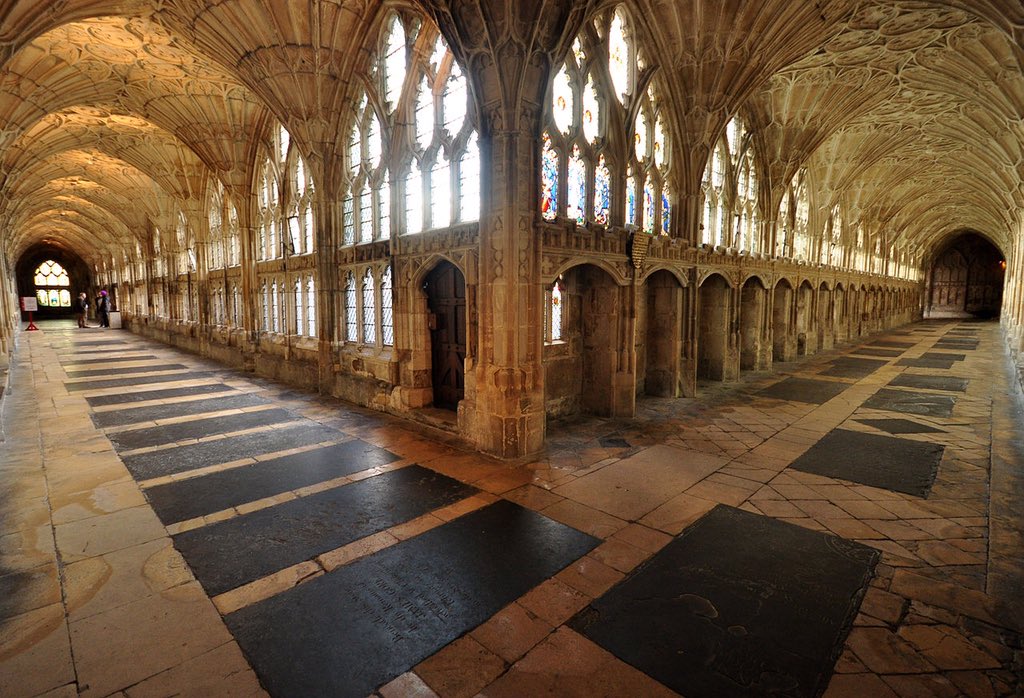
Carrel (noun)

  a small cubicle with a desk for the use of a reader or student in a library.

  a small enclosure or study in a cloister.

Row of the 20 carrels in Abbey of St. Peter (now Gloucester Cathedral), built in 1381-1412.

Thank you, Wrath of Gnon.

Higher.

Signac, The Bonaventure Pine, 1893


Art is a creation of a higher order than a copy of nature which is governed by chance.

Paul Signac


Thank You, Jess.

Traditions.


Thank you, Wrath of Gnon.

06 January 2018

The Cure, "The Blood"

Invigorates.


Drink deep or be careful how you taste this winter vintage. The first sip may chill, but a full draught warms and invigorates.

John Burroughs

Rollicking.


Buccaneers aboard the flagship of notorious 18th-century pirate Blackbeard apparently enjoyed a rollicking read, according to an unlikely discovery in a cannon chamber.

A handful of paper scraps recovered from the wreck of Queen Anne's Revenge have been identified as fragments of the 1712 book A Voyage to the South Sea, and Round the World, Perform’d in the Years 1708, 1709, 1710 and 1711, by Captain Edward Cooke.

The discovery was announced Thursday during a presentation by conservators from the Queen Anne’s Revenge (QAR) Conservation Lab at the annual meeting of the Society of Historical Archaeology held in New Orleans.

Irony.


Thank you, Wrath of Gnon.

05 January 2018

Bryan Ferry, "Just Like Tom Thumb's Blues"

Mind.

Hennings, The Nightwatchman, 1884


The SNOW MAN

One must have a mind of winter
To regard the frost and the boughs
Of the pine-trees crusted with snow;

And have been cold a long time
To behold the junipers shagged with ice,
The spruces rough in the distant glitter

Of the January sun; and not to think
Of any misery in the sound of the wind,
In the sound of a few leaves,

Which is the sound of the land
Full of the same wind
That is blowing in the same bare place

For the listener, who listens in the snow,
And, nothing himself, beholds
Nothing that is not there and the nothing that is.

Wallace Stevens

Obsession.

Delacroix, Study of Sky, Setting Sun, 1849


What moves men of genius, or rather what inspires their work, is not new ideas, but their obsession with the idea that what has already been said is still not enough.

Eugene Delacroix

Alan Jackson, "Just Playin' Possum"

HAPPY FRIDAY!

Invigorates.


Drink deep or be careful how you taste this winter vintage. The first sip may chill, but a full draught warms and invigorates.

John Burroughs

Free.

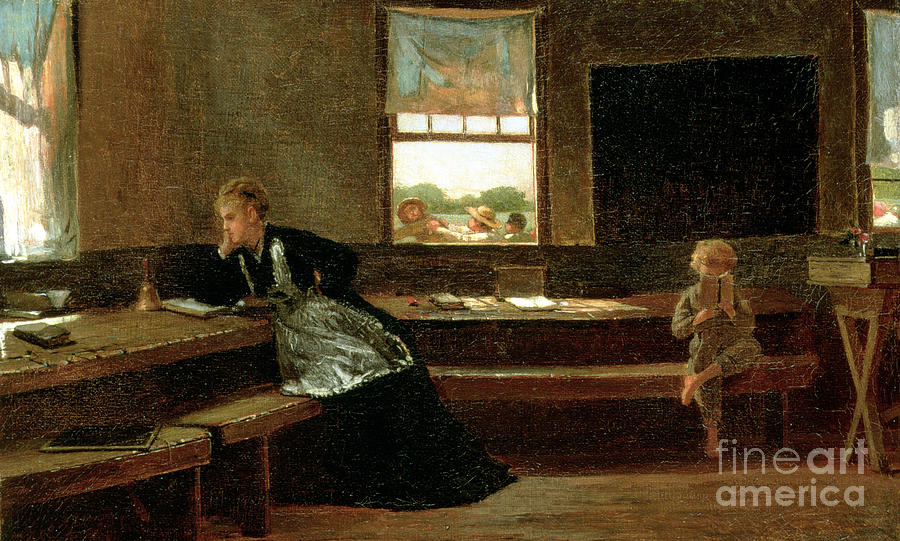
Homer, Noon Recess, 1873


I've noticed a fascinating phenomenon in my thirty years of teaching: schools and schooling are increasingly irrelevant to the great enterprises of the planet. No one believes anymore that scientists are trained in science classes or politicians in civics classes or poets in English classes. The truth is that schools don't really teach anything except how to obey orders. This is a great mystery to me because thousands of humane, caring people work in schools as teachers and aides and administrators, but the abstract logic of the institution overwhelms their individual contributions. Although teachers to care and do work very, very hard, the institution is psychopathic -- it has no conscience. It rings a bell and the young man in the middle of writing a poem must close his notebook and move to a different cell where he must memorize that humans and monkeys derive from a common ancestor.

Whatever an education is, it should make you a unique individual, not a conformist; it should furnish you with an original spirit with which to tackle the big challenges; it should allow you to find values which will be your roadmap through life; it should make you spiritually rich, a person who loves whatever you are doing, wherever you are, whomever you are with; it should teach you what is important, how to live and how to die.

Children learn what they live. Put kids in a class and they will live out their lives in an invisible cage, isolated from their chance at community; interrupt kids with bells and horns all the time and they will learn that nothing is important or worth finishing; ridicule them and they will retreat from human association; shame them and they will find a hundred ways to get even. The habits taught in large-scale organizations are deadly.

I feel ashamed that so many of us cannot imagine a better way to do things than locking children up all day in cells instead of letting them grow up knowing their families, mingling with the world, assuming real obligations, striving to be independent and self-reliant and free.

John Taylor Gatto, from Dumbing Us Down

The Tallest Man On Earth, "Thrown Right at Me"

Seeks.


The torpid artist seeks inspiration at any cost, by virtue or by vice, by friend or by fiend, by prayer or by wine.

Ralph Waldo Emerson

Servant.

Technique.


Technique is the proof of your seriousness.

Wallace Stevens

Ludovico Einaudi, "I Giorni"

Sally Maer, cello, and Sally Whitwell, piano ...

04 January 2018

Preservation.

Already.


Time --
In idleness,
So easily spent;
For seeking the Way,
It has already vanished.

Dogen

Barcelona Gipsy Klezmer Orchestra, "Djelem Djelem"

Gathering.


The small wind whispers through the leafless hedge
Most sharp and chill, where the light snowy flakes
Rest on each twig and spike of wither'd sedge,
Resembling scatter'd feathers;--vainly breaks
The pale split sunbeam through the frowning cloud,
On Winter's frowns below--from day to day
Unmelted still he spreads his hoary shroud,
In dithering pride on the pale traveller's way,
Who, croodling, hastens from the storm behind
Fast gathering deep and black, again to find
His cottage-fire and corner's sheltering bounds;
Where, haply, such uncomfortable days
Make musical the wood-sap's frizzling sounds,
And hoarse loud bellows puffing up the blaze.

John Clare

Eric Clapton, "Driftin' Blues"

Beauty.

van Baburen, The Procuress (detail), 1622


The first beautiful songs you hear tend to stay beautiful because better than beauty, which is everywhere, is the memory of first discovering beauty. 

Sarah Manguso

More.


We are alive within mystery, by miracle. "Life," wrote Erwin Chargaff, "is the continual intervention of the inexplicable." We have more than we can know. We know more than we can say. The constructions of language (which is to say the constructions of thought) are formed within experience, not the other way around. Finally we live beyond words, as also we live beyond computation and beyond theory. There is no reason whatever to assume that the languages of science are less limited than other languages. Perhaps we should wish that after the processes of reduction, scientists would return, not to the processes of synthesis and integration, but to the world of our creatureliness and affection, our joy and grief, that precedes and (so far) survives all of our processes.

Wendell Berry

Be.


To know nothing about yourself is to live.
To know yourself badly is to think.
To have opinions is to sell out to yourself.
To have no opinions is to exist.
To have every opinion is to be a poet.

Fernando Passoa

The Police, "Wrapped Around Your Finger"

Stewart Copeland, percussion ...

Breathe.


There is some kiss we want
with our whole lives, the touch

of spirit on the body. Seawater
begs the pearl to break its shell.

And the lily, how passionately
it needs some wild darling!

At night, I open the window and ask
the moon to come and press its
face against mine.

Breathe into me. Close
the language-door and open the love-window
The moon won’t use the door,
only the window.

Rumi

Wynton Marsalis, "Cherokee"

Why.


In the month of May when all leaves open,
I see when I walk how well all things
lean on each other, how the bees work,
the fish make their living the first day.
Monarchs fly high; then I understand
I love you with what in me is unfinished.

I love you with what in me is still
changing, what has no head or arms
or legs, what has not found its body.
And why shouldn't the miraculous,
caught on this earth, visit
the old man alone in his hut?

And why shouldn't Gabriel, who loves honey,
be fed with our own radishes and walnuts?
And lovers, tough ones, how many there are
whose holy bodies are not yet born.
Along the roads, I see so many places
I would like us to spend the night.

Robert Bly

Cream, "I'm So Glad"

Plan.

Rocque, A Plan of the Cities London and Westminster, and Borough of Southwark, with the Contiguous Buildings, 1746


Van Morrison, "On Hyndford Street"

Happy birthday, Pergolesi.


Giovanni Battista Pergolesi was born on this day in 1710.

Pergolesi's Stabat Mater featuring Céline Scheen and Damien Guillon performing with Le Banquet Céleste ...

Seems.

Chatham, Study, 1996


How many more times will you remember a certain afternoon of your childhood, some afternoon that's so deeply a part of your being that you can't even conceive of your life without it? Perhaps four or five times more. Perhaps not even that. How many more times will you watch the full moon rise? Perhaps twenty. And yet it all seems limitless.

Paul Bowles

Murmurous.


In January, Lake Erie froze nearly to Canada. One evening, standing before its ominous expanse in my ice skates, with a wool cap pulled over my ears and a long scarf wound around my neck and crisscrossed over my chest beneath my blue Navy-surplus pea jacket, I left the shore. I planned to face down the spectre of my fear by going as far as I dared toward Canada, or the Livingston ship channel if the icebreaker had been through. I hoped that my love of skating would propel me through the worst of my worries.

I struggled over the corrugations of the shore ice, and then ventured onto smoother, glassier terrain that rewarded me with long glides. I could see bubbles below me, and the white bellies of upended perch and rock bass. I began to dream of landing in Canada, on that foreign shore from whence, according to Mrs. Andrews, the redcoats had once launched sorties against our Colonial heroes. I began to imagine a visit to the old British fort at Amherstburg. I would skate home with tales of imperial ghosts and whatever other secret existences I might discover in those places where only the most courageous ventured. I would tell Mrs. Andrews what I had done. These dreams enlivened my skating, and I raced on, stroke after stroke. One day, years afterward, I would come to view this night as the template for the many disasters I later created for myself, but, at the time, risking my life in the gathering darkness on a day when I had cowered at the thought of a paper cut or an infected pimple produced no awareness of contradiction. I felt only the allure of the hard, perfect ice, cold-snap ice unblemished by wind during its formation. It was impossible for me to imagine the drum major out here in his shako like an animated Q-tip—there would be no prancing among the crows and ice-killed fish for him, I gloated.

I kept going. If I turned back, I told myself, if I let the falling dark turn me back, I would never be any good and the fog of cowardice would envelop me forever.

The ice seemed to rise before me and disappear into the twilit sky, as though they were one and the same. The lights that had shone briefly on the shore were gone now, and I had yet to see my first Canadian light or the outlines of the fort. I reached for the old compass in my pocket.

When I stopped to reconnoitre, I felt the cold penetrate and I adjusted my scarf. It was time to go home, and I knew it, but I couldn’t leave at the first wave of panic. I would press on into the blackness just long enough to prove that it was I who had elected to return and not those forces which were always rendering me worthless in my own eyes. Such thoughts produced an oddly inflexible gait in my skating; I reached my feet stiffly through a space that I couldn’t confirm with my eyes. Suddenly, the sound of my blades, which had seemed to fill the air around me, was replaced by another, more murmurous tone, like a church congregation heard from afar. I was gliding toward the sound when a vast aggravation of noise and physical turbulence erupted and a storm of ducks took flight in front of me: it was water. The lake heaved a gloomy sigh, and I found myself, after some minutes of agitated effort, almost at the edge of the ice.

Tom McGuane, from "Ice"