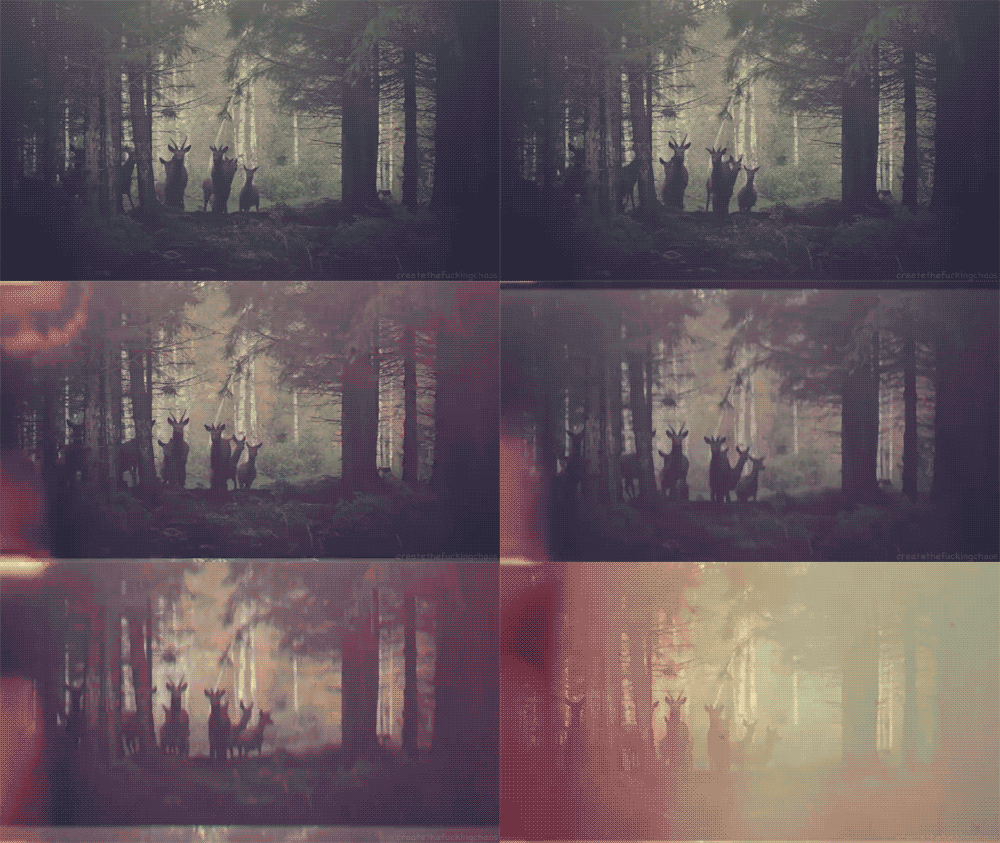
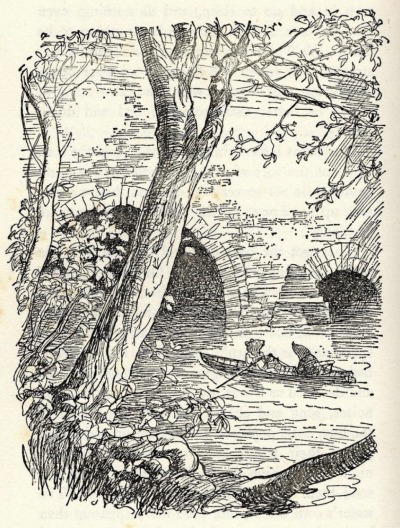
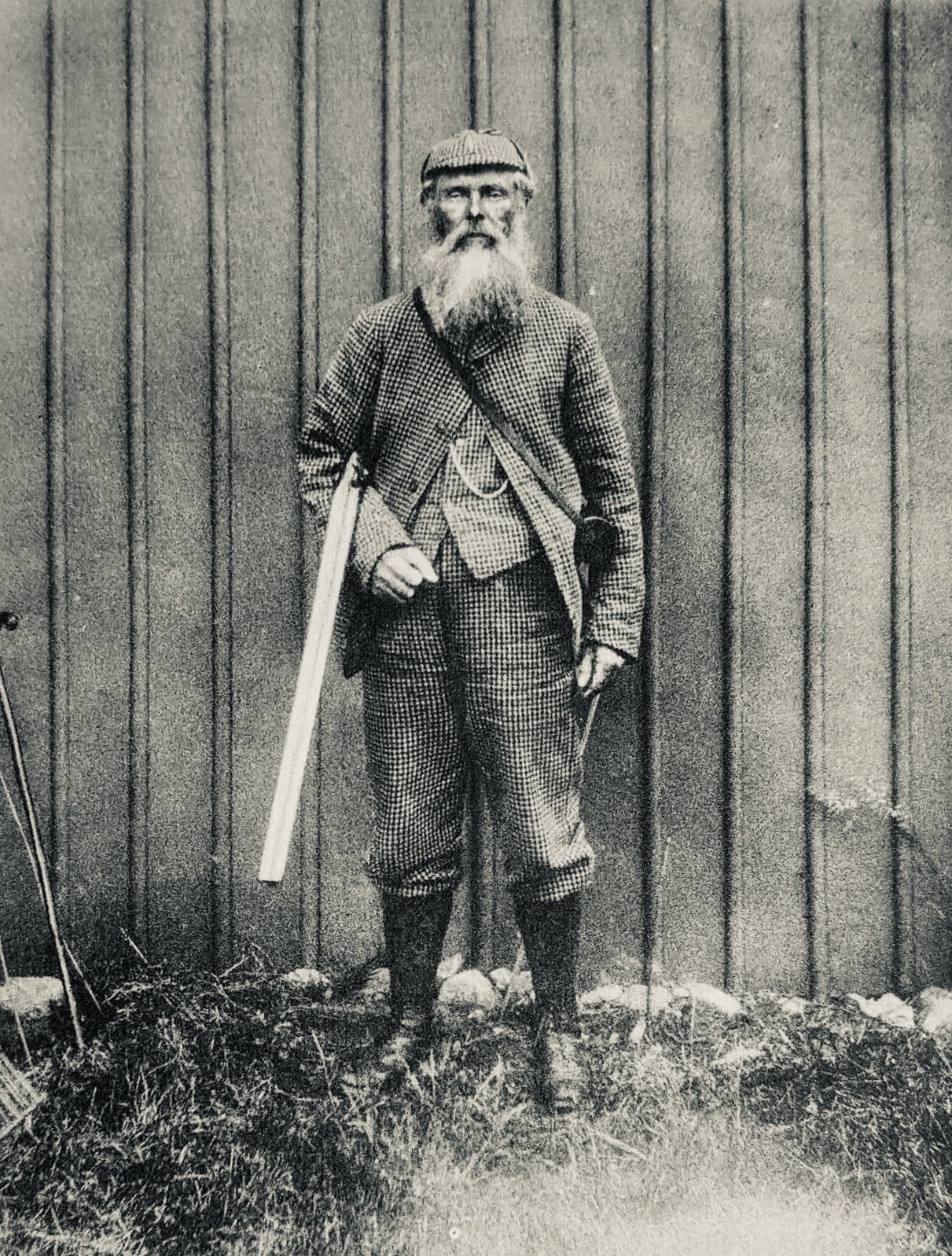
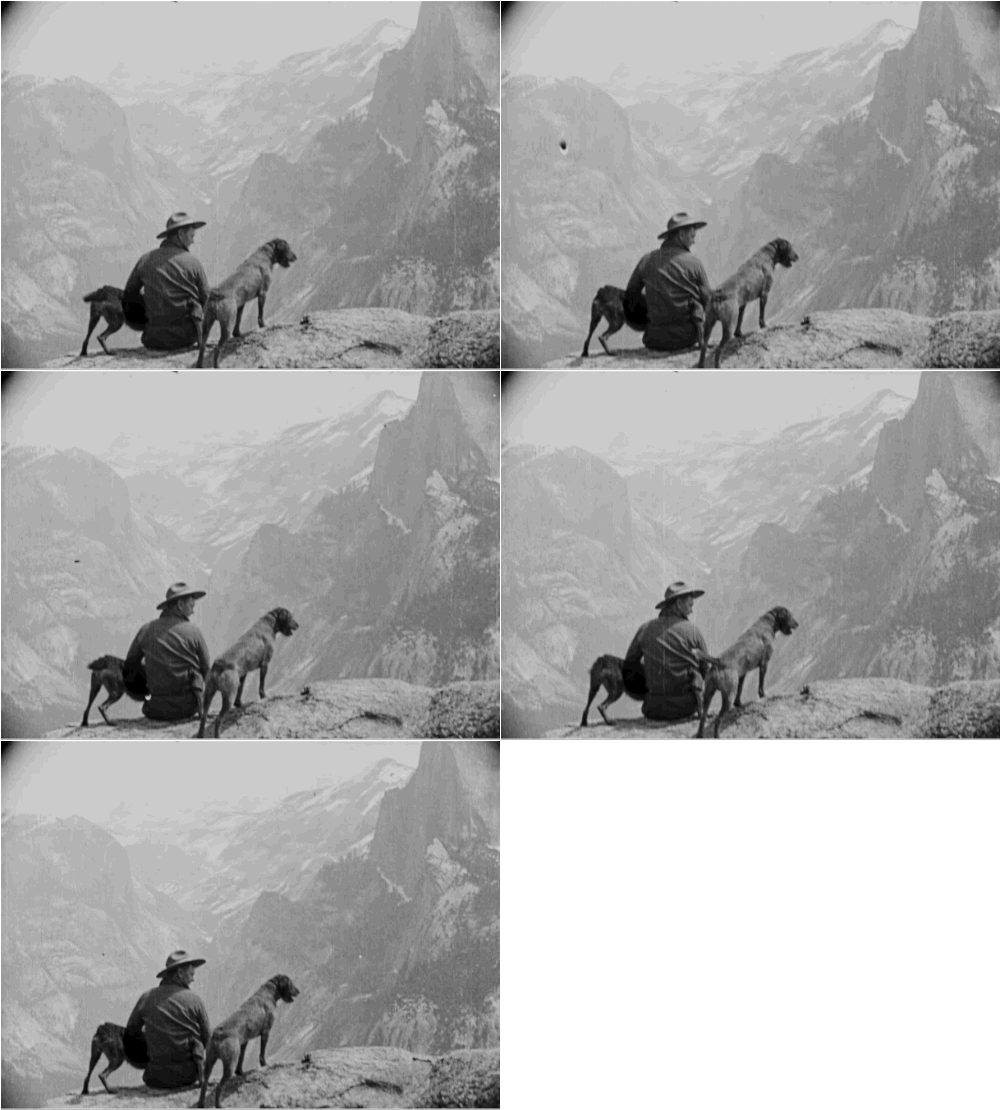
"I am not one who was born in the custody of wisdom. I am one who is fond of olden times and intense in quest of the sacred knowing of the ancients." Gustave Courbet
Showing posts with label Emerson. Show all posts

19 April 2026

Spirit.


The American Revolution began on this day, at this hour, in 1775.

CONCORD HYMN

By the rude bridge that arched the flood, 
   Their flag to April’s breeze unfurled, 
Here once the embattled farmers stood 
   And fired the shot heard round the world. 

The foe long since in silence slept; 
   Alike the conqueror silent sleeps; 
And Time the ruined bridge has swept 
   Down the dark stream which seaward creeps. 

On this green bank, by this soft stream, 
   We set today a votive stone; 
That memory may their deed redeem, 
   When, like our sires, our sons are gone. 

Spirit, that made those heroes dare 
   To die, and leave their children free, 
Bid Time and Nature gently spare 
   The shaft we raise to them and thee.

Ralph Waldo Emerson

21 February 2026

Non-Conformist.

Homer, The Woodsman, 1889


There is a time in every man's education when he arrives at the conviction that envy is ignorance; that imitation is suicide; that he must take himself for better, for worse, as his portion; that though the wide universe is full of good, no kernel of nourishing corn can come to him but through his toil bestowed on that plot of ground which is given to him to till. The power which resides in him is new in nature, and none but he knows what that is which he can do, nor does he know until he has tried. Not for nothing one face, one character, one fact, makes much impression on him, and another none. It is not without pre-established harmony, this sculpture in the memory.

The eye was placed where one ray should fall, that it might testify of that particular ray. Bravely let him speak the utmost syllable of his confession. We but half express ourselves, and are ashamed of that divine idea which each of us represents. It may be safely trusted as proportionate and of good issues, so it be faithfully imparted, but God will not have his work made manifest by cowards.

It needs a divine man to exhibit anything divine. A man is relieved and gay when he has put his heart into his work and done his best; but what he has said or done otherwise shall give him no peace. It is a deliverance which does not deliver. In the attempt his genius deserts him; no muse befriends; no invention, no hope.

Trust thyself: every heart vibrates to that iron string. Accept the place the divine providence has found for you, the society of your contemporaries, the connection of events. Great men have always done so, and confided themselves childlike to the genius of their age, betraying their perception that the Eternal was stirring at their heart, working through their hands, predominating in all their being. And we are now men, and must accept in the highest mind the same transcendent destiny.

Whoso would be a man, must be a non-conformist. He who would gather immortal palms must not be hindered by the name of goodness, but must explore if it be goodness. Nothing is at last sacred but the integrity of your own mind. Absolve you to yourself, and you shall have the suffrage of the world.

A foolish consistency is the hobgoblin of little minds, adored by little statesmen and philosophers and divines. With consistency a great soul has simply nothing to do. He may as well concern himself with his shadow on the wall!

Ah, then, exclaim the aged ladies, you shall be sure to be misunderstood! Misunderstood! It is a right fool's word. Is it so bad then to be misunderstood? Pythagoras was misunderstood, and Socrates and Jesus, and Luther, and Copernicus, and Galileo, and Newton, and every pure and wise spirit that ever took flesh. To be great is to be misunderstood.

Ralph Waldo Emerson, from Self-Reliance

25 January 2026

Arrives.


Announced by all the trumpets of the sky,
Arrives the snow, and, driving o'er the fields,
Seems nowhere to alight: the whited air
Hides hill and woods, the river, and the heaven,
And veils the farmhouse at the garden's end.
The sled and traveller stopped, the courier's feet
Delated, all friends shut out, the housemates sit
Around the radiant fireplace, enclosed
In a tumultuous privacy of storm.
Come see the north wind's masonry.
Out of an unseen quarry evermore
Furnished with tile, the fierce artificer
Curves his white bastions with projected roof
Round every windward stake, or tree, or door.
Speeding, the myriad-handed, his wild work
So fanciful, so savage, nought cares he
For number or proportion. Mockingly,
On coop or kennel he hangs Parian wreaths;
A swan-like form invests the hiddden thorn;
Fills up the famer's lane from wall to wall,
Maugre the farmer's sighs; and at the gate
A tapering turret overtops the work.
And when his hours are numbered, and the world
Is all his own, retiring, as he were not,
Leaves, when the sun appears, astonished Art
To mimic in slow structures, stone by stone,
Built in an age, the mad wind's night-work,
The frolic architecture of the snow.

Ralph Waldo Emerson

18 December 2025

Blessed.


In 1635, when the Massachusetts General Court authorized the founding of the town, it possessed a natural setting with distinct advantages replicated nowhere else in New England. Over millennia, the forces of geology had fashioned a physical landscape that the Native inhabitants had improved to sustain their way of life, and had unwittingly made ready for appropriation by the newcomers from across the sea. These resources drew pioneers into the interior, well beyond the seaboard, for the first time, and enabled the creation of new social and intellectual landscapes. Nature blessed Concord from the start. 

02 December 2025

Arrives.

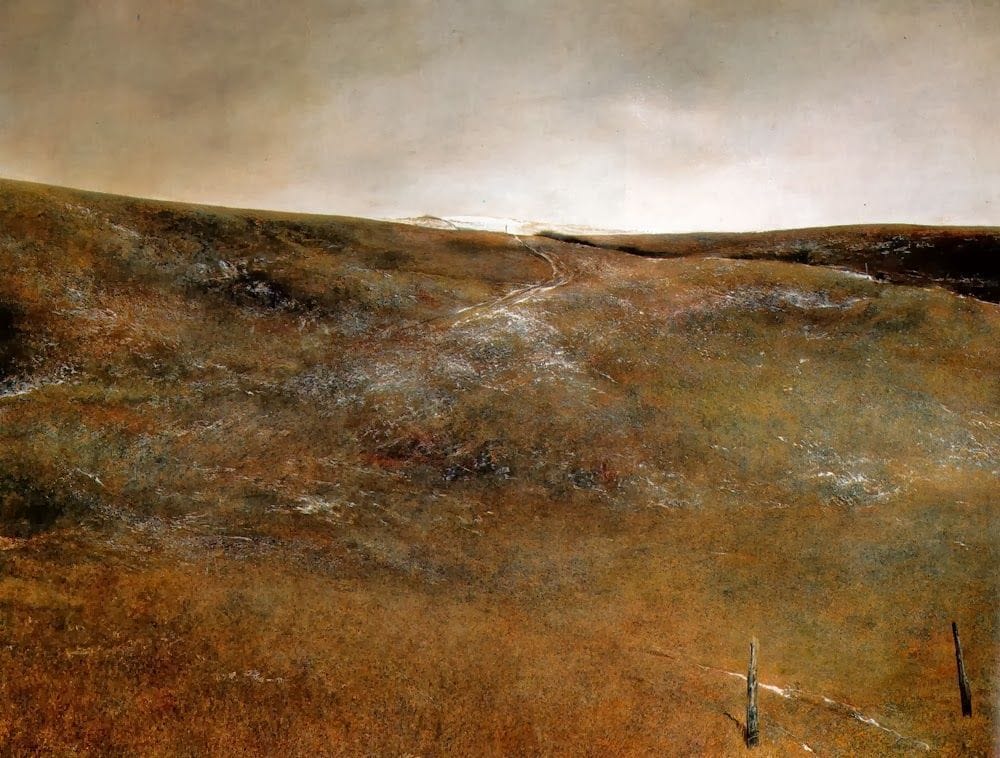
Wyeth, Over the Hill, 1953


Announced by all the trumpets of the sky,
Arrives the snow, and, driving o'er the fields,
Seems nowhere to alight: the whited air
Hides hill and woods, the river, and the heaven,
And veils the farmhouse at the garden's end.

The sled and traveller stopped, the courier's feet
Delated, all friends shut out, the housemates sit
Around the radiant fireplace, enclosed
In a tumultuous privacy of storm.

Come see the north wind's masonry.

Out of an unseen quarry evermore
Furnished with tile, the fierce artificer
Curves his white bastions with projected roof
Round every windward stake, or tree, or door.

Speeding, the myriad-handed, his wild work
So fanciful, so savage, nought cares he
For number or proportion. Mockingly,
On coop or kennel he hangs Parian wreaths;
A swan-like form invests the hiddden thorn;
Fills up the famer's lane from wall to wall,
Maugre the farmer's sighs; and at the gate
A tapering turret overtops the work.

And when his hours are numbered, and the world
Is all his own, retiring, as he were not,
Leaves, when the sun appears, astonished Art
To mimic in slow structures, stone by stone,
Built in an age, the mad wind's night-work,
The frolic architecture of the snow.

Ralph Waldo Emerson

18 November 2025

Propagate.

Bodley, Bodleian Library, 1602


Who looks upon a river in a meditative hour, and is not reminded of the flux of all things? Throw a stone into the stream, and the circles that propagate themselves are the beautiful type of all influence.

Ralph Waldo Emerson, from Nature

01 July 2025

Every.


Shall I tell you a secret of a true scholar? It is this: every man I meet is my master in some point and in that I learn from him.

Ralph Waldo Emerson

23 April 2025

Slights.


To the poet, to the philosopher, to the saint, all things are friendly and sacred, all events profitable, all days holy, all men divine. For the eye is fastened on the life, and slights the circumstance. Every chemical substance, every plant, every animal in its growth, teaches the unity of cause, the variety of appearance.

19 April 2025

Spirit.


The American Revolution began on this day, at this hour, in 1775.

CONCORD HYMN

By the rude bridge that arched the flood, 
   Their flag to April’s breeze unfurled, 
Here once the embattled farmers stood 
   And fired the shot heard round the world. 

The foe long since in silence slept; 
   Alike the conqueror silent sleeps; 
And Time the ruined bridge has swept 
   Down the dark stream which seaward creeps. 

On this green bank, by this soft stream, 
   We set today a votive stone; 
That memory may their deed redeem, 
   When, like our sires, our sons are gone. 

Spirit, that made those heroes dare 
   To die, and leave their children free, 
Bid Time and Nature gently spare 
   The shaft we raise to them and thee.

Ralph Waldo Emerson

27 March 2025

Sing.


Steve points to Emerson's "The Poet" ...
The poet is the sayer, the namer, and represents beauty. He is a sovereign, and stands on the centre. For the world is not painted or adorned, but is from the beginning beautiful; and God has not made some beautiful things, but Beauty is the creator of the universe. Therefore the poet is not any permissive potentate, but is emperor in his own right. Criticism is infested with a cant of materialism, which assumes that manual skill and activity is the first merit of all men, and disparages such as say and do not, overlooking the fact that some men, namely poets, are natural sayers, sent into the world to the end of expression, and confounds them with those whose province is action but who quit it to imitate the sayers. But Homer's words are as costly and admirable to Homer as Agamemnon's victories are to Agamemnon. The poet does not wait for the hero or the sage, but, as they act and think primarily, so he writes primarily what will and must be spoken, reckoning the others, though primaries also, yet, in respect to him, secondaries and servants; as sitters or models in the studio of a painter, or as assistants who bring building materials to an architect.

For poetry was all written before time was, and whenever we are so finely organized that we can penetrate into that region where the air is music, we hear those primal warblings and attempt to write them down, but we lose ever and anon a word or a verse and substitute something of our own, and thus miswrite the poem. The men of more delicate ear write down these cadences more faithfully, and these transcripts, though imperfect, become the songs of the nations. For nature is as truly beautiful as it is good, or as it is reasonable, and must as much appear as it must be done, or be known. Words and deeds are quite indifferent modes of the divine energy. Words are also actions, and actions are a kind of words.

The sign and credentials of the poet are that he announces that which no man foretold. He is the true and only doctor; he knows and tells; he is the only teller of news, for he was present and privy to the appearance which he describes. He is a beholder of ideas and an utterer of the necessary and causal. For we do not speak now of men of poetical talents, or of industry and skill in metre, but of the true poet. I took part in a conversation the other day concerning a recent writer of lyrics, a man of subtle mind, whose head appeared to be a music-box of delicate tunes and rhythms, and whose skill and command of language, we could not sufficiently praise. But when the question arose whether he was not only a lyrist but a poet, we were obliged to confess that he is plainly a contemporary, not an eternal man. He does not stand out of our low limitations, like a Chimborazo under the line, running up from the torrid Base through all the climates of the globe, with belts of the herbage of every latitude on its high and mottled sides; but this genius is the landscape-garden of a modern house, adorned with fountains and statues, with well-bred men and women standing and sitting in the walks and terraces. We hear, through all the varied music, the ground-tone of conventional life. Our poets are men of talents who sing, and not the children of music. The argument is secondary, the finish of the verses is primary.

20 February 2025

Timely.


There was this perception in him, which makes the poet or seer, an object of awe and terror, namely, that the same man, or society of men, may wear one aspect to themselves and their companions, and a different aspect to higher intelligences. Certain priests, whom he describes as conversing very learnedly together, appeared to the children, who were at some distance, like dead horses: and many the like misappearances. And instantly the mind inquires, whether these fishes under the bridge, yonder oxen in the pasture, those dogs in the yard, are immutably fishes, oxen, and dogs, or only so appear to me, and perchance to themselves appear upright men; and whether I appear as a man to all eyes. The Brahmins and Pythagoras propounded the same question, and if any poet has witnessed the transformation, he doubtless found it in harmony with various experiences. We have all seen changes as considerable in wheat and caterpillars. He is the poet, and shall draw us with love and terror, who sees, through the flowing vest, the firm nature, and can declare it.

I look in vain for the poet whom I describe. We do not, with sufficient plainness, or sufficient profoundness, address ourselves to life, nor dare we chant our own times and social circumstance. If we filled the day with bravery, we should not shrink from celebrating it. Time and nature yield us many gifts, but not yet the timely man, the new religion, the reconciler, whom all things await. 

Ralph Waldo Emerson, from "The Poet"

21 November 2024

Arrives.

Wyeth, Snow Flurries, 1953


Announced by all the trumpets of the sky,
Arrives the snow, and, driving o'er the fields,
Seems nowhere to alight: the whited air
Hides hill and woods, the river, and the heaven,
And veils the farmhouse at the garden's end.
The sled and traveller stopped, the courier's feet
Delated, all friends shut out, the housemates sit
Around the radiant fireplace, enclosed
In a tumultuous privacy of storm.
Come see the north wind's masonry.
Out of an unseen quarry evermore
Furnished with tile, the fierce artificer
Curves his white bastions with projected roof
Round every windward stake, or tree, or door.
Speeding, the myriad-handed, his wild work
So fanciful, so savage, nought cares he
For number or proportion. Mockingly,
On coop or kennel he hangs Parian wreaths;
A swan-like form invests the hiddden thorn;
Fills up the famer's lane from wall to wall,
Maugre the farmer's sighs; and at the gate
A tapering turret overtops the work.
And when his hours are numbered, and the world
Is all his own, retiring, as he were not,
Leaves, when the sun appears, astonished Art
To mimic in slow structures, stone by stone,
Built in an age, the mad wind's night-work,
The frolic architecture of the snow.

Ralph Waldo Emerson

09 November 2024

New.


Be not the slave of your own past - plunge into the sublime seas, dive deep, and swim far, so you shall come back with new self-respect, with new power, and with an advanced experience that shall explain and overlook the old.

Ralph Waldo Emerson

30 May 2024

Good.

Hyde, The Four Voices of the Wind, n/d


SONG of NATURE

Mine are the night and morning,
The pits of air, the gulf of space,
The sportive sun, the gibbous moon,
The innumerable days.

I hid in the solar glory,
I am dumb in the pealing song,
I rest on the pitch of the torrent,
In slumber I am strong.

No numbers have counted my tallies,
No tribes my house can fill,
I sit by the shining Fount of Life,
And pour the deluge still;

And ever by delicate powers
Gathering along the centuries
From race on race the rarest flowers,
My wreath shall nothing miss.

And many a thousand summers
My apples ripened well,
And light from meliorating stars
With firmer glory fell.

I wrote the past in characters
Of rock and fire the scroll,
The building in the coral sea,
The planting of the coal.

And thefts from satellites and rings
And broken stars I drew,
And out of spent and aged things
I formed the world anew;

What time the gods kept carnival,
Tricked out in star and flower,
And in cramp elf and saurian forms
They swathed their too much power.

Time and Thought were my surveyors,
They laid their courses well,
They boiled the sea, and baked the layers
Or granite, marl, and shell.

But he, the man-child glorious,—
Where tarries he the while?
The rainbow shines his harbinger,
The sunset gleams his smile.

My boreal lights leap upward,
Forthright my planets roll,
And still the man-child is not born,
The summit of the whole.

Must time and tide forever run?
Will never my winds go sleep in the west?
Will never my wheels which whirl the sun
And satellites have rest?

Too much of donning and doffing,
Too slow the rainbow fades,
I weary of my robe of snow,
My leaves and my cascades;

I tire of globes and races,
Too long the game is played;
What without him is summer's pomp,
Or winter’s frozen shade?

I travail in pain for him,
My creatures travail and wait;
His couriers come by squadrons,
He comes not to the gate.

Twice I have moulded an image,
And thrice outstretched my hand,
Made one of day, and one of night,
And one of the salt sea-sand.

One in a Judaean manger,
And one by Avon stream,
One over against the mouths of Nile,
And one in the Academe.

I moulded kings and saviours,
And bards o’er kings to rule;—
But fell the starry influence short,
The cup was never full.

Yet whirl the glowing wheels once more,
And mix the bowl again;
Seethe, fate! the ancient elements,
Heat, cold, wet, dry, and peace, and pain.

Let war and trade and creeds and song
Blend, ripen race on race,
The sunburnt world a man shall breed
Of all the zones, and countless days.

No ray is dimmed, no atom worn,
My oldest force is good as new,
And the fresh rose on yonder thorn
Gives back the bending heavens in dew.

Ralph Waldo Emerson
25 May 2024

Where'er.

Muncha, Morning Star, 1902


The moonlight fades from flower and rose 
And the stars dim one by one; 
The tale is told, the song is sung, 
And the Fairy feast is done.
 
The night-wind rocks the sleeping flowers, 
And sings to them, soft and low.
 
The early birds erelong will wake: 
'T is time for the Elves to go.
 
O'er the sleeping earth we silently pass, 
Unseen by mortal eye, 
And send sweet dreams, as we lightly float 
Through the quiet moonlit sky;-- 
For the stars' soft eyes alone may see, 
And the flowers alone may know, 
The feasts we hold, the tales we tell; 
So't is time for the Elves to go.
 
From bird, and blossom, and bee, 
We learn the lessons they teach; 
And seek, by kindly deeds, to win 
A loving friend in each.
 
And though unseen on earth we dwell, 
Sweet voices whisper low, 
And gentle hearts most joyously greet 
The Elves where'er they go.
 
When next we meet in the Fairy dell, 
May the silver moon's soft light 
Shine then on faces gay as now, 
And Elfin hearts as light.
 
Now spread each wing, for the eastern sky 
With sunlight soon shall glow.
 
The morning star shall light us home: 
Farewell! for the Elves must go.

Louisa May Alcott

Happy Birthday, Emerson


Mine are the night and morning,
The pits of air, the gulf of space,
The sportive sun, the gibbous moon,
The innumerable days.

I hid in the solar glory,
I am dumb in the pealing song,
I rest on the pitch of the torrent,
In slumber I am strong.

No numbers have counted my tallies,
No tribes my house can fill,
I sit by the shining Fount of Life,
And pour the deluge still;

And ever by delicate powers
Gathering along the centuries
From race on race the rarest flowers,
My wreath shall nothing miss.

And many a thousand summers
My apples ripened well,
And light from meliorating stars
With firmer glory fell.

I wrote the past in characters
Of rock and fire the scroll,
The building in the coral sea,
The planting of the coal.

And thefts from satellites and rings
And broken stars I drew,
And out of spent and aged things
I formed the world anew;

What time the gods kept carnival,
Tricked out in star and flower,
And in cramp elf and saurian forms
They swathed their too much power.

Time and Thought were my surveyors,
They laid their courses well,
They boiled the sea, and baked the layers
Or granite, marl, and shell.

But he, the man-child glorious,—
Where tarries he the while?
The rainbow shines his harbinger,
The sunset gleams his smile.

My boreal lights leap upward,
Forthright my planets roll,
And still the man-child is not born,
The summit of the whole.

Must time and tide forever run?
Will never my winds go sleep in the west?
Will never my wheels which whirl the sun
And satellites have rest?

Too much of donning and doffing,
Too slow the rainbow fades,
I weary of my robe of snow,
My leaves and my cascades;

I tire of globes and races,
Too long the game is played;
What without him is summer's pomp,
Or winter’s frozen shade?

I travail in pain for him,
My creatures travail and wait;
His couriers come by squadrons,
He comes not to the gate.

Twice I have moulded an image,
And thrice outstretched my hand,
Made one of day, and one of night,
And one of the salt sea-sand.

One in a Judaean manger,
And one by Avon stream,
One over against the mouths of Nile,
And one in the Academe.

I moulded kings and saviours,
And bards o’er kings to rule;—
But fell the starry influence short,
The cup was never full.

Yet whirl the glowing wheels once more,
And mix the bowl again;
Seethe, fate! the ancient elements,
Heat, cold, wet, dry, and peace, and pain.

Let war and trade and creeds and song
Blend, ripen race on race,
The sunburnt world a man shall breed
Of all the zones, and countless days.

No ray is dimmed, no atom worn,
My oldest force is good as new,
And the fresh rose on yonder thorn
Gives back the bending heavens in dew.

Ralph Waldo Emerson, born on this day in 1803

24 February 2024

Well.

Dore, Merlin, The Enchanter, 1888


MERLIN'S SONG

I
Or Merlin wise I learned a song,—
Sing it low or sing it loud,
It is mightier than the strong,
And punishes the proud.
I sing it to the surging crowd,—
Good men it will calm and cheer,
Bad men it will chain and cage—
In the heart of the music peals a strain
Which only angels hear;
Whether it waken joy or rage
Hushed myriads hark in vain,
Yet they who hear it shed their age,
And take their youth again.

II
Hear what British Merlin sung,
Of keenest eye and truest tongue.
Say not, the chiefs who first arrive
Usurp the seats for which all strive;
The forefathers this land who found
Failed to plant the vantage-ground;
Ever from one who comes to-morrow
Men wait their good and truth to borrow.
But wilt thou measure all thy road,
See thou lift the lightest load.
Who has little, to him who has less, can spare,
And thou, Cyndyllan's son! beware
Ponderous gold and stuffs to bear,
To falter ere thou thy task fulfil,—
Only the light-armed climb the hill.
The richest of all lords is Use,
And ruddy Health the loftiest Muse.
Live in the sunshine, swim the sea,
Drink the wild air's salubrity:
When the star Canope shines in May,
Shepherds are thankful and nations gay.
The music that can deepest reach,
And cure all ill, is cordial speech:
Mask thy wisdom with delight,
Toy with the bow, yet hit the white.
Of all wit's uses, the main one
Is to live well with who has none.

Ralph Waldo Emerson

03 December 2023

Preparation.


“Think on living.” That inscription describes a progress in opinion. Cease from this antedating of your experience. Sufficient to to-day are the duties of to-day. Don’t waste life in doubts and fears; spend yourself on the work before you, well assured that the right performance of this hour’s duties will be the best preparation for the hours or ages that follow it.

Ralph Waldo Emerson, from "Immortality"

03 August 2023

Infinite.


A little consideration of what takes place around us every day would show us that a higher law than that of our will regulates events; that our painful labors are unnecessary and fruitless; that only in our easy, simple, spontaneous action are we strong, and by contenting ourselves with obedience we become divine. Belief and love,--a believing love will relieve us of a vast load of care. O my brothers, God exists. There is a soul at the center of nature and over the will of every man, so that none of us can wrong the universe. It has so infused its strong enchantment into nature that we prosper when we accept its advice, and when we struggle to wound its creatures our hands are glued to our sides, or they beat our own breasts. The whole course of things goes to teach us faith. We need only obey. There is guidance for each of us, and by lowly listening we shall hear the right word. Why need you choose so painfully your place and occupation and associates and modes of action and of entertainment? Certainly there is a possible right for you that precludes the need of balance and willful election. For you there is a reality, a fit place and congenial duties. Place yourself in the middle of the stream of power and wisdom which animates all whom it floats, and you are without effort impelled to truth, to right and a perfect contentment. Then you put all gainsayers in the wrong. Then you are the world, the measure of right, of truth, of beauty. If we will not be mar-plots with our miserable interferences, the work, the society, letters, arts, science, religion of men would go on far better than now, and the heaven predicted from the beginning of the world, and still predicted from the bottom of the heart, would organize itself, as do now the rose and the air and the sun.

I say, do not choose; but that is a figure of speech by which I would distinguish what is commonly called choice among men, and which is a partial act, the choice of the hands, of the eyes, of the appetites, and not a whole act of the man. But that which I call right or goodness, is the choice of my constitution; and that which I call heaven, and inwardly aspire after, is the state or circumstance desirable to my constitution; and the action which I in all my years tend to do, is the work for my faculties. We must hold a man amenable to reason for the choice of his daily craft or profession. It is not an excuse any longer for his deeds that they are the custom of his trade. What business has he with an evil trade? Has he not a calling in his character?

Each man has his own vocation. The talent is the call. There is one direction in which all space is open to him. He has faculties silently inviting him thither to endless exertion. He is like a ship in a river; he runs against obstructions on every side but one, on that side all obstruction is taken away and he sweeps serenely over a deepening channel into an infinite sea. This talent and this call depend on his organization, or the mode in which the general soul incarnates itself in him. He inclines to do something which is easy to him and good when it is done, but which no other man can do. He has no rival. For the more truly he consults his own powers, the more difference will his work exhibit from the work of any other. His ambition is exactly proportioned to his powers. The height of the pinnacle is determined by the breadth of the base. Every man has this call of the power to do somewhat unique, and no man has any other call. The pretense that he has another call, a summons by name and personal election and outward "signs that mark him extraordinary, and not in the roll of common men," is fanaticism, and betrays obtuseness to perceive that there is one mind in all the individuals, and no respect of persons therein.

By doing his work he makes the need felt which he can supply, and creates the taste by which he is enjoyed. By doing his own work he unfolds himself. It is the vice of our public speaking that it has not abandonment. Somewhere, not only every orator but every man should let out all the length of all the reins; should find or make a frank and hearty expression of what force and meaning is in him. 

Ralph Waldo Emerson, from "Spiritual Laws"