"I am not one who was born in the custody of wisdom. I am one who is fond of olden times and intense in quest of the sacred knowing of the ancients." Gustave Courbet

17 September 2021

Chains.


If ye love wealth greater than liberty, the tranquility of servitude greater than the animating contest for freedom, go home from us in peace. We seek not your counsel, nor your arms. Crouch down and lick the hand that feeds you; May your chains set lightly upon you, and may posterity forget that ye were our countrymen.

Samuel Adams

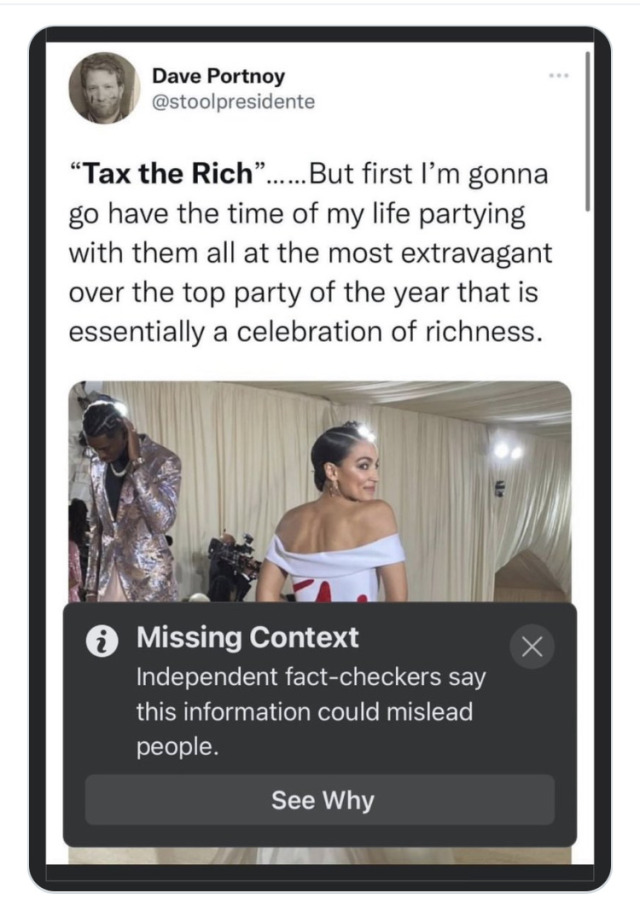
Mislead.


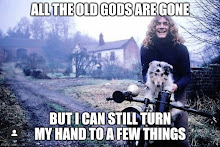
Look at ME, everybody!

Thanks, Kurt.

People.


On this day in 1787, the United States Constitution was completed and signed by the delegates of the Continental Congress.
We the People of the United States, in Order to form a more perfect Union, establish Justice, insure domestic Tranquility, provide for the common defense, promote the general Welfare, and secure the Blessings of Liberty to ourselves and our Posterity, do ordain and establish this Constitution for the United States of America.

Given.


It is the Soldier, not the minister
Who has given us freedom of religion.

It is the Soldier, not the reporter
Who has given us freedom of press.

It is the Soldier, not the poet
Who has given us freedom of speech.

It is the Soldier, not the campus organizer
Who has given us freedom to protest.

It is the Soldier, not the lawyer
Who has given us the right to a fair trial.

It is the Soldier, not the politician
Who has given us the right to vote.

It is the Soldier who salutes the flag,
Who serves beneath the flag,
And whose coffin is draped by the flag,
Who allows the protester to burn the flag.

Charles M. Province

15 September 2021

Translated.


But the quality of the imagination is to flow, and not to freeze. 


The poet did not stop at the color, or the form, but read their meaning; neither may he rest in this meaning, but he makes the same objects exponents of his new thought.  


For all symbols are fluxional; all language is vehicular and transitive, and is good, as ferries and horses are, for conveyance, not as farms and houses are, for homestead.  

The morning-redness happens to be the favorite meteor to the eyes of Jacob Behmen, and comes to stand to him for truth and faith; and he believes should stand for the same realities to every reader. But the first reader prefers as naturally the symbol of a mother and child, or a gardener and his bulb, or a jeweller polishing a gem. Either of these, or of a myriad more, are equally good to the person to whom they are significant. Only they must be held lightly, and be very willingly translated into the equivalent terms which others use… 


Let us have a little algebra, instead of this trite rhetoric, – universal signs, instead of these village symbols, – and we shall both be gainers. The history of hierarchies seems to show, that all religious error consisted in making the symbol too stark and solid, and, at last, nothing but an excess of the organ of language.

Ralph Waldo Emerson, “The Poet” 

14 September 2021

Done.


Done and done.

Medical.

Released.


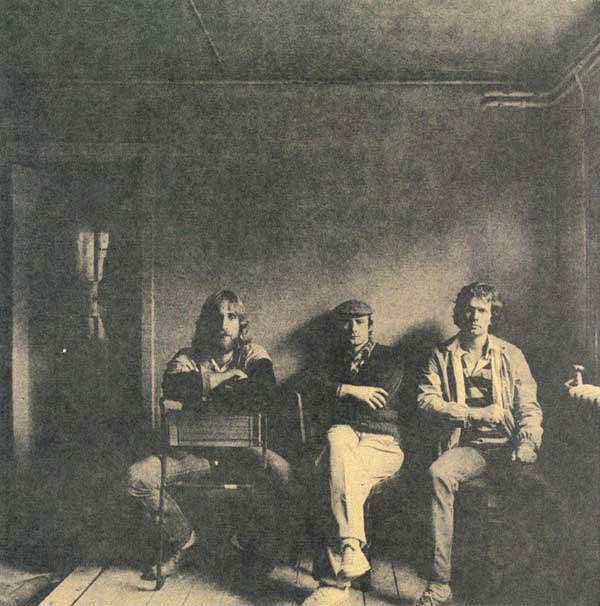
Genesis released Abacab in this day in 1981.
Words lost in the wind.
The tide was rising,
But there we stayed,
We had no fear of dying
We weren't afraid.

Anthony Banks, from "Me and Sarah Jane"

Not-Quite-Weightless.


A secret came a week ago though I already
knew it just beyond the bruised lips of consciousness.
The very alive souls of thirty-five hundred dead birds
are harbored in my body. It’s not uncomfortable.
I’m only temporary habitat for these not-quite-
weightless creatures. I offered a wordless invitation
and now they’re roosting within me, recalling
how I had watched them at night
in fall and spring passing across earth moons,
little clouds of black confetti, chattering and singing
on their way north or south. Now in my dreams
I see from the air the rumpled green and beige,
the watery face of earth as if they’re carrying
me rather than me carrying them. Next winter
I’ll release them near the estuary west of Alvarado
and south of Veracruz. I can see them perching
on undiscovered Olmec heads. We’ll say goodbye
and I’ll return my dreams to earth.

Jim Harrison

Barbarians, "Shirley"

Contention.


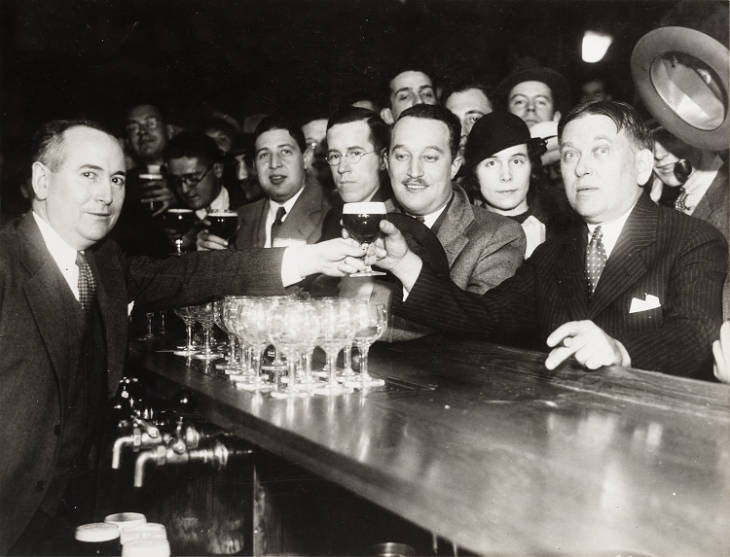
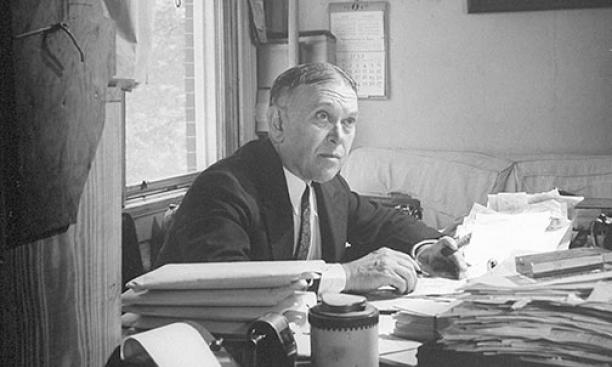
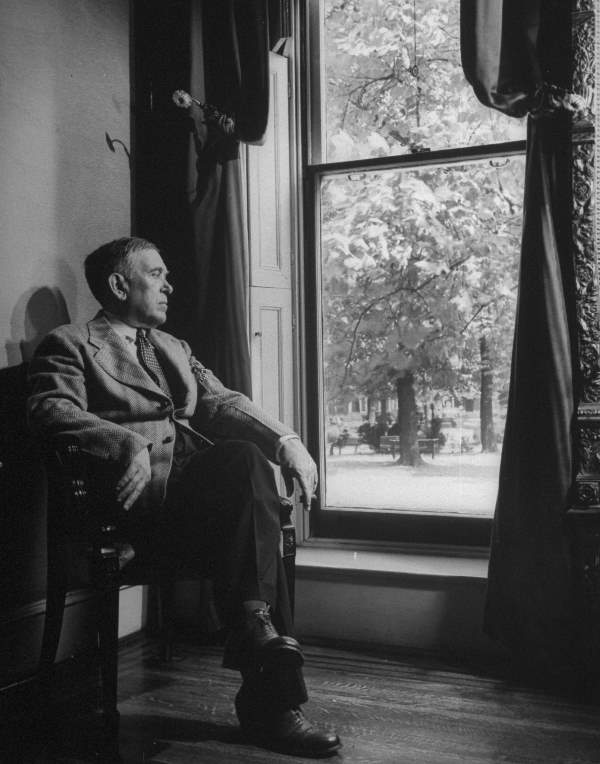
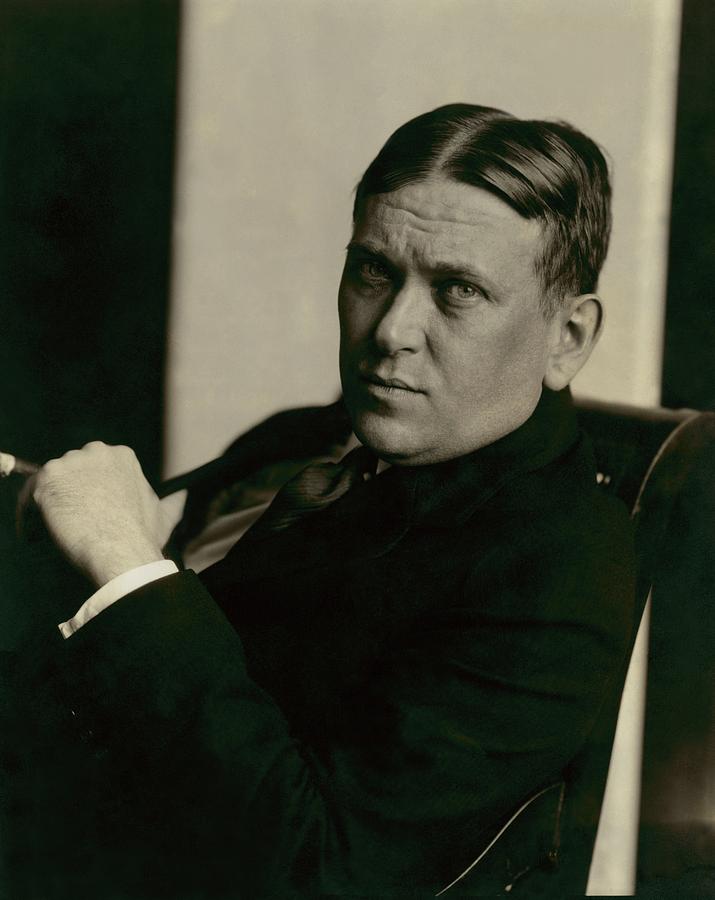
Mencken on "Giants at the Bar" ...
In the year 1904, when the Herald office was destroyed in the great Baltimore fire and we had to print the paper for five weeks in Philadelphia, I was sent ahead to look for accommodations for the printers. I found them in one of those old-fashioned dollar-a-day hotels that were all bar on the first floor. The proprietor, a German with goat whiskers, was somewhat reluctant to come to terms, for he had heard that printers were wild fellows who might be expected to break up his furniture and rough his chambermaids, but when I told him that a beer champion was among them he showed a friendly interest, and when I began to brag about Bill’s extraordinary talents he proposed amiably that some Philadelphia foam jumpers be invited in to make it a race.

The first heat was run the very next night, and Bill won hands down. In fact, he won so easily that he offered grandly to go on until he had drunk twice as much as the next-best entry. We restrained him and got him to bed, for there had been some ominous whispering among the other starters and it was plain that they were planning to call in help.

The next night it appeared in the shape of a tall, thin man from Allentown, Pennsylvania, who was introduced as the champion of the Lehigh Valley. He claimed to be not only a beer-drinker of high gifts but also a member of the Bach Choir at Bethlehem, and when he got down his first dozen mugs—the boys were drinking from the wood—he cut loose with an exultant yodel that he said was one of Bach’s forgotten minor works. But he might very well have saved his wind, for Bill soon had him, and at the end of the setting he was four or five mugs behind and in a state resembling suffocation. The next afternoon I saw his fans taking him home, a sadder and a much less melodious man.

On the first two nights there were only slim galleries, but on the third the bar was jammed, and anyone could see that something desperate was afoot. It turned out to be the introduction of two super-champions, the one a short, saturnine Welshman from Wilkes-Barre and the other a hearty, blond young fellow from one of the Philadelphia suburbs, who said that he was half German and half Irish. The Welshman was presented as the man who had twice drunk Otto the Brewery Horse under the table, and we were supposed to know who Otto was, though we didn’t. The Celto-Teutonic mongrel had a committee with him, and the chairman thereof offered to lay twenty-five dollars on him at even money. The printers in Bill’s corner made up the money at once, and it had grown to fifty dollars in forty minutes by the clock, for the hybrid took only that long to blow up. The Welshman lasted much better, and there were some uneasy moments when he seemed destined to make history again by adding Bill to Otto, but in the end he succumbed so suddenly that it seemed like a bang, and his friends laid him out on the floor and began fanning him with bar towels.

Bill was very cocky after that and talked grandiosely of taking on two champions at a time, in a marathon series. There were no takers for several nights, but then they began to filter in from the remotest wilds of the Pennsylvania-Dutch country, and the whole Herald staff was kept busy guarding Bill by day, to make sure that he did not waste any energy on malt liquor in the afternoons. He knocked off twenty or thirty challengers during the ensuing month, including another alleged member of the Bach Choir, two more Welshmen from the hard-coal country, a Scotsman with an ear missing, and a bearded Dunkard from Lancaster County. They were mainly pushovers, but now and then there was a tough one. Bill did not let this heavy going interfere with the practice of his profession. He set type every night from 6 p.m. to midnight in the office of the Evening Telegraph, where we were printing the Herald, and never began his combats until twelve-thirty. By two o’clock he was commonly in bed, with another wreath of laurels hanging on the gas jet.

To ease your suspense, I’ll tell you at once that he was never beaten. Germans, Irishmen, Welshmen, and Scotsmen went down before him like so many Sunday-school superintendents, and he bowled over everyday Americans with such facility that only two of them ever lasted more than half an hour. But I should in candor add that he was out of service during the last week of our stay in Philadelphia. What fetched him is still a bone of contention among the pathologists at the Johns Hopkins Medical School, to whom the facts were presented officially on our return to our rehabilitated printing plant in Baltimore ...

Sing.


In the middle of this century we turned to each other
With half faces and full eyes
like an ancient Egyptian picture
And for a short while.

I stroked your hair
In the opposite direction to your journey,
We called to each other,
Like calling out the names of towns
Where nobody stops
Along the route.

Lovely is the world rising early to evil,
Lovely is the world falling asleep to sin and pity,
In the mingling of ourselves, you and I,
Lovely is the world.

The earth drinks men and their loves
Like wine,
To forget.
It can’t.
And like the contours of the Judean hills,
We shall never find peace.

In the middle of this century we turned to each other,
I saw your body, throwing shade, waiting for me,
The leather straps for a long journey
Already tightening across my chest.
I spoke in praise of your mortal hips,
You spoke in praise of my passing face,
I stroked your hair in the direction of your journey,
I touched your flesh, prophet of your end,
I touched your hand which has never slept,
I touched your mouth which may yet sing.

Dust from the desert covered the table
At which we did not eat
But with my finger I wrote on it
The letters of your name.

Yehuda Amichai

Thank you, Veerle.

Abnormal.

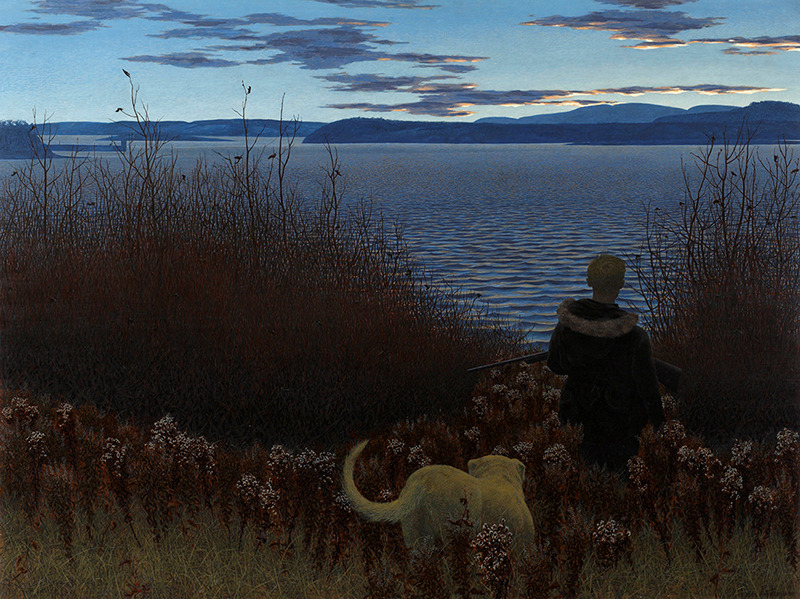
Colville, Dog, Boy, and St. John River, 1958 


"Why aren't you in school? I see you every day wandering around."

"Oh, they don't miss me," she said. "I'm antisocial, they say. I don't mix. It's so strange. I'm very social indeed. It all depends on what you mean by social, doesn't it? Social to me means talking to you about things like this." She rattled some chestnuts that had fallen off the tree in the front yard. "Or talking about how strange the world is. Being with people is nice. But I don't think it's social to get a bunch of people together and then not let them talk, do you? An hour of TV class, an hour of basketball or baseball or running, another hour of transcription history or painting pictures, and more sports, but do you know, we never ask questions, or at least most don't; they just run the answers at you, bing, bing, bing, and us sitting there for four more hours of film-teacher. That's not social to me at all. It's a lot of funnels and lot of water poured down the spout and out the bottom, and them telling us it's wine when it's not. They run us so ragged by the end of the day we can't do anything but go to bed or head for a Fun Park to bully people around, break windowpanes in the Window Smasher place or wreck cars in the Car Wrecker place with the big steel ball. Or go out in the cars and race on the streets, trying to see how close you can get to lampposts, playing 'chicken' and 'knock hubcaps.' I guess I'm everything they say I am, all right. I haven't any friends. That's supposed to prove I'm abnormal. But everyone I know is either shouting or dancing around like wild or beating up one another. Do you notice how people hurt each other nowadays?”

Ray Bradbury, from Fahrenheit 451

Thank you, Violet.

Remember.

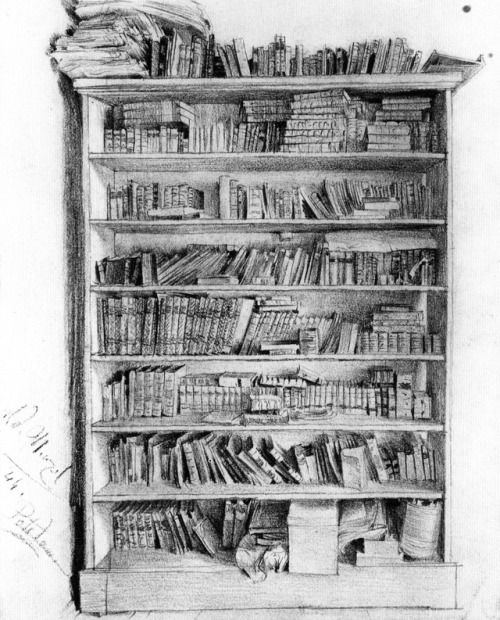
von Menzel, Dr. Puhlmann’s Bookcase, 1844


Our daily life has fallen among prosaic things and ignoble things, but our dreams remember the enchanted valleys.

W.B Yeats

Wisely.

Tiepolo, Armida and Rinaldo, 1753


LOVE'S PROGRESS

Who ever loves, if he do not propose
The right true end of love, he's one that goes
To sea for nothing but to make him sick.
Love is a bear-whelp born: if we o'erlick
Our love, and force it new strange shapes to take,
We err, and of a lump a monster make.
Were not a calf a monster that were grown
Faced like a man, though better than his own?
Perfection is in unity: prefer
One woman first, and then one thing in her.
I, when I value gold, may think upon
The ductileness, the application,
The wholsomeness, the ingenuity,
From rust, from soil, from fire ever free;
But if I love it, 'tis because 'tis made
By our new nature (Use) the soul of trade.
All these in women we might think upon
(If women had them) and yet love but one.
Can men more injure women than to say
They love them for that by which they're not they?
Makes virtue woman? Must I cool my blood
Till I both be, and find one, wise and good?
May barren angels love so! But if we
Make love to woman, virtue is not she,
As beauty's not, nor wealth. He that strays thus
From her to hers is more adulterous
Than if he took her maid. Search every sphere
And firmament, our Cupid is not there;
He's an infernal god, and under ground
With Pluto dwells, where gold and fire abound:
Men to such gods their sacrificing coals
Did not in altars lay, but pits and holes.
Although we see celestial bodies move
Above the earth, the earth we till and love:
So we her airs contemplate, words and heart
And virtues, but we love the centric part.
Nor is the soul more worthy, or more fit,
For love than this, as infinite is it.
But in attaining this desired place
How much they err that set out at the face.
The hair a forest is of ambushes,
Of springs, snares, fetters and manacles;
The brow becalms us when 'tis smooth and plain,
And when 'tis wrinkled shipwrecks us again—
Smooth, 'tis a paradise where we would have
Immortal stay, and wrinkled 'tis our grave.
The nose (like to the first meridian) runs
Not ‘twixt an East and West, but ‘twixt two suns;
It leaves a cheek, a rosy hemisphere,
On either side, and then directs us where
Upon the Islands Fortunate we fall,
(Not faint Canaries, but Ambrosial)
Her swelling lips; to which when we are come,
We anchor there, and think ourselves at home,
For they seem all: there Sirens' songs, and there
Wise Delphic oracles do fill the ear;
There in a creek where chosen pearls do swell,
The remora, her cleaving tongue doth dwell.
These, and the glorious promontory, her chin,
O'erpassed, and the straight Hellespont between
The Sestos and Abydos of her breasts,
(Not of two lovers, but two loves the nests)
Succeeds a boundless sea, but yet thine eye
Some island moles may scattered there descry;
And sailing towards her India, in that way
Shall at her fair Atlantic navel stay;
Though thence the current be thy pilot made,
Yet ere thou be where thou wouldst be embayed
Thou shalt upon another forest set,
Where many shipwreck and no further get.
When thou art there, consider what this chase
Misspent by thy beginning at the face.
Rather set out below; practise my art.
Some symetry the foot hath with that part
Which thou dost seek, and is thy map for that,
Lovely enough to stop, but not stay at;
Least subject to disguise and change it is—
Men say the devil never can change his.
It is the emblem that hath figured
Firmness; 'tis the first part that comes to bed.
Civility we see refined; the kiss
Which at the face began, transplanted is,
Since to the hand, since to the imperial knee,
Now at the papal foot delights to be:
If kings think that the nearer way, and do
Rise from the foot, lovers may do so too;
For as free spheres move faster far than can
Birds, whom the air resists, so may that man
Which goes this empty and ethereal way,
Than if at beauty's elements he stay.
Rich nature hath in women wisely made
Two purses, and their mouths aversely laid:
They then which to the lower tribute owe
That way which that exchequer looks must go:
He which doth not, his error is as great
As who by clyster gave the stomach meat.

John Donne

Limit.


The aim of science is not to open the door to infinite wisdom, but to set a limit to infinite error.

Bertolt Brecht

Announcing.


Smithsonian tells the story of how the flag that flew proudly over Fort McHenry inspired an anthem and made its way to the museum ...
On a rainy September 13, 1814, British warships sent a downpour of shells and rockets onto Fort McHenry in Baltimore Harbor, relentlessly pounding the American fort for 25 hours. The bombardment, known as the Battle of Baltimore, came only weeks after the British had attacked Washington, D.C., burning the Capitol, the Treasury and the President's house. It was another chapter in the ongoing War of 1812.

A week earlier, Francis Scott Key, a 35-year-old American lawyer, had boarded the flagship of the British fleet on the Chesapeake Bay in hopes of persuading the British to release a friend who had recently been arrested. Key's tactics were successful, but because he and his companions had gained knowledge of the impending attack on Baltimore, the British did not let them go. They allowed the Americans to return to their own vessel but continued guarding them. Under their scrutiny, Key watched on September 13 as the barrage of Fort McHenry began eight miles away.

"It seemed as though mother earth had opened and was vomiting shot and shell in a sheet of fire and brimstone," Key wrote later. But when darkness arrived, Key saw only red erupting in the night sky. Given the scale of the attack, he was certain the British would win. The hours passed slowly, but in the clearing smoke of "the dawn's early light" on September 14, he saw the American flag—not the British Union Jack—flying over the fort, announcing an American victory.

Undissected.


It is precisely the colouring, the atmosphere, the unclassifiable individual details of a story, and above all the general purport that informs with life the undissected bones of the plot, that really count.

J.R.R. Tolkien

Released.


Jethro Tull released Stormwatch on this day in 1979.
I'll be coming again like an old dog in pain
Blown through the eye of the hurricane
Down to the stones where old ghosts play.

Ian Anderson, from "Old Ghosts"

Black.

13 September 2021

Released.


Ronnie Wood released I've Got My Own Album to Do on this day in 1974.
I can hear you calling me
Prettiest girl that I've ever seen

Ronald David Wood, from "I Can Feel the Fire"

Released.


Supertramp released Crime of the Century on this day in 1974.
So you think your schooling is phoney
I guess it's hard not to agree

Richard Davies, from "Bloody Well Right"

Happy Birthday, Dahl


Roal Dahl was born on this day in 1916.

I began to realize how important it was to be an enthusiast in life. He taught me that if you are interested in something, no matter what it is, go at it at full speed ahead. Embrace it with both arms, hug it, love it and above all become passionate about it. Lukewarm is no good. Hot is no good either. White hot and passionate is the only thing to be.

Roald Dahl

As near as you will find to a twentieth-century renaissance man -- and inside that head there's a controlled kaleidoscope of riotous imagination, immense literary skill, and, most important of all to him, the sheer enjoyment of living ...

Released.


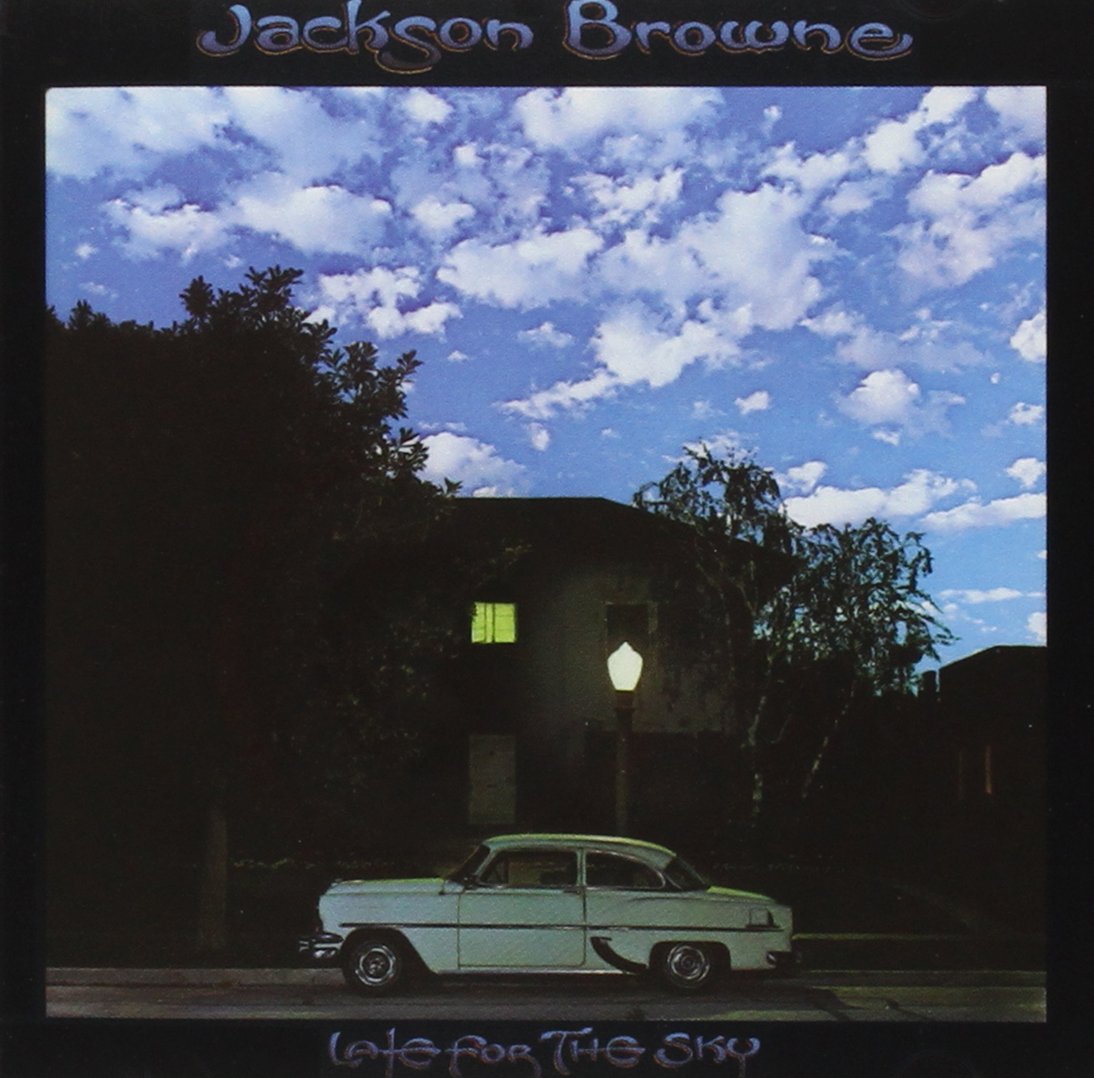
Jackson Browne release Late for the Sky on this day in 1974.
Some of them were dreamers
And some of them were fools
Who were making plans and thinking of the future

Jackson Browne, from "Before the Deluge" 

12 September 2021

Happy Birthday, Professor


Neil Peart was born on this day in 1952.

Neil-cam version of RUSH's "Digital Man" ...

Standardized.


That erroneous assumption is to the effect that the aim of public education is to fill the young of the species with knowledge and awaken their intelligence, and so make them fit to discharge the duties of citizenship in an enlightened and independent manner. Nothing could be further from the truth. The aim of public education is not to spread enlightenment at all, it is simply to reduce as many individuals as possible to the same safe level, to breed and train a standardized citizenry, to put down dissent and originality. That is its aim in the United States, whatever the pretensions of politicians, pedagogues and other such mountebanks, and that is its aim everywhere else.  The plain fact is that education is itself a form of propaganda - a deliberate scheme to outfit the pupil, not with the capacity to weigh ideas, but with a simple appetite for gulping ideas ready-made. The aim is to make "good" citizens, which is to say, docile and uninquisitive citizens.

H.L. Mencken

Transcendental.

Tiepolo, The Wind Gods (detail), 1770


Art, as we have known it, stands on the threshold of the transcendental. It points beyond this world of accidental and disconnected things to another realm, in which human life is endowed with an emotional logic that makes suffering noble and love worthwhile. Nobody who is alert to beauty, therefore, is without the concept of redemption – of a final transcendence of mortal disorder into a "kingdom of ends."

It is present in our experience of human beauty. And it is equally present in an experience that anthropologists have puzzled over for two centuries or more, and which appears to be a human universal: the experience of the sacred. In every civilization at every period of history people have devoted time and energy to sacred things. The sacred, like the beautiful, includes every category of object. There are sacred words, sacred gestures, sacred rites, sacred clothes, sacred places, sacred times. Sacred things are not of this world: they are set apart from ordinary reality and cannot be touched or uttered without rites of initiation or the privilege of religious office. To meddle with them without some purifying preparation is to run the risk of sacrilege. It is to desecrate and pollute what is holy, by dragging it down into the sphere of everyday events.

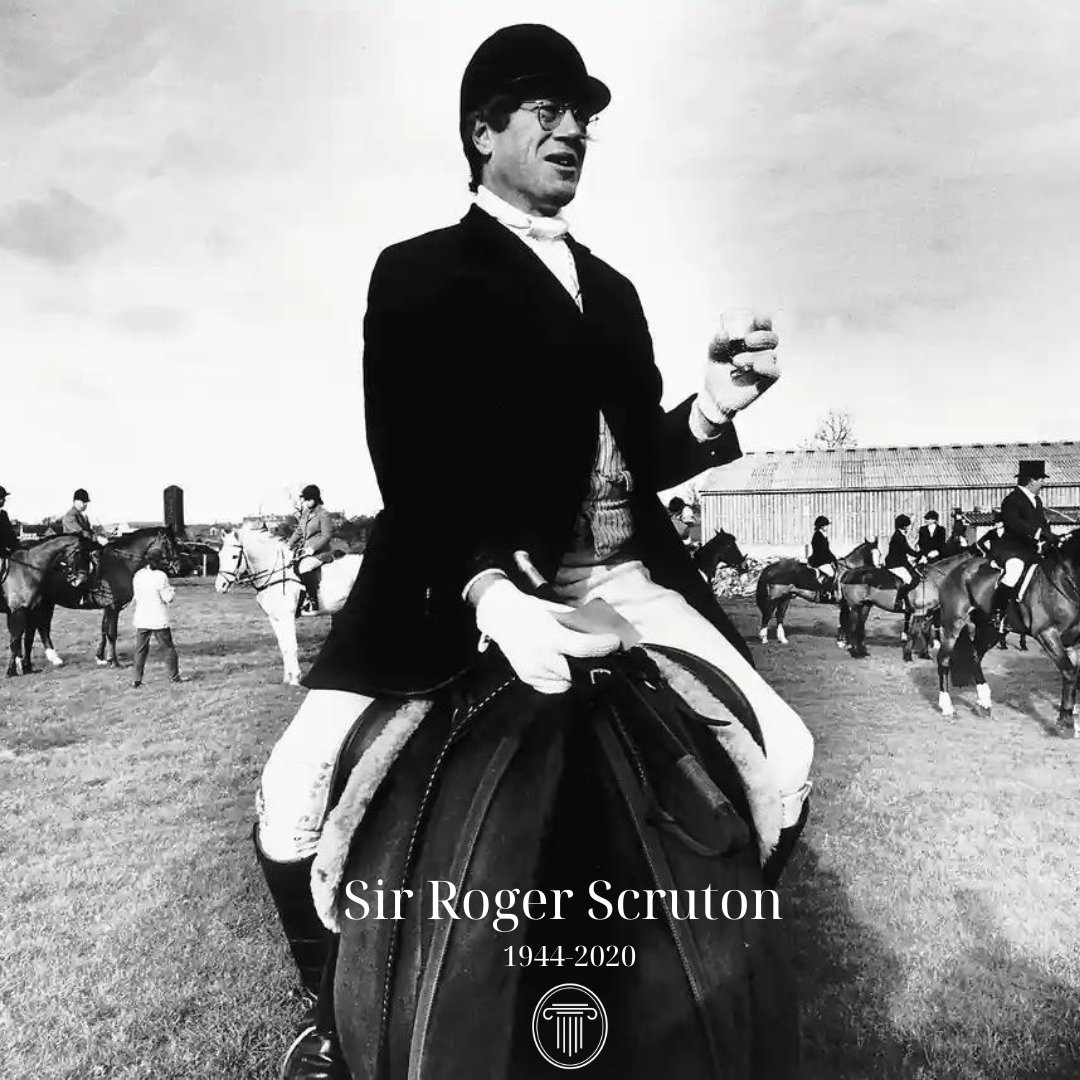
Sir Roger Scruton, from Beauty: A Very Short Introduction

Endless.


Civilization, in fact, grows more maudlin and hysterical; especially under democracy it tends to degenerate into a mere combat of crazes; the whole aim of practical politics is to keep the populace alarmed (and hence clamorous to be led to safety) by an endless series of hobgoblins, most of them imaginary. Wars are no longer waged by the will of superior men, capable of judging dispassionately and intelligently the causes behind them and the effects flowing out of them. The are now begun by first throwing a mob into a panic; they are ended only when it has spent its ferine fury.

H.L. Mencken

Haydn, Quartet in C Major, Op. 20, No. 2

The Danish String Quartet performs ...

Happy Birthday, Mencken


H. L. Mencken was born on this day in 1880.

Truth would quickly cease to be stranger than fiction, once we got as used to it.

H. L. Mencken

11 September 2021

Remember.

Never.

No day shall erase you from the memory of time.

Virgil


A PASS (Personal Alert Safety System) device alarm can be activated if a first-responder realizes that he or she is in trouble and needs assistance, or, it will activate automatically if the device is armed and the individual does not move for a predetermined period, usually about 30 seconds.

PASS devices activated at Ground Zero ...


No matter how convincingly the short-memory apologists in our government and the mainstream media are in attempting to legitimize these groups, let us ...

NEVER FORGET.

Gratitude.


FDNY Engine 28 Firefighter Mike Kehoe headed up on September 11, 2001.

In normal life we hardly realize how much more we receive than we give, and life cannot be rich without such gratitude. It is so easy to overestimate the importance of our own achievements compared with what we owe to the help of others.

Dietrich Bonhoeffer

10 September 2021

Happy Birthday, Soane

Lawrence, Portrait of Sir John Sloane, 1829


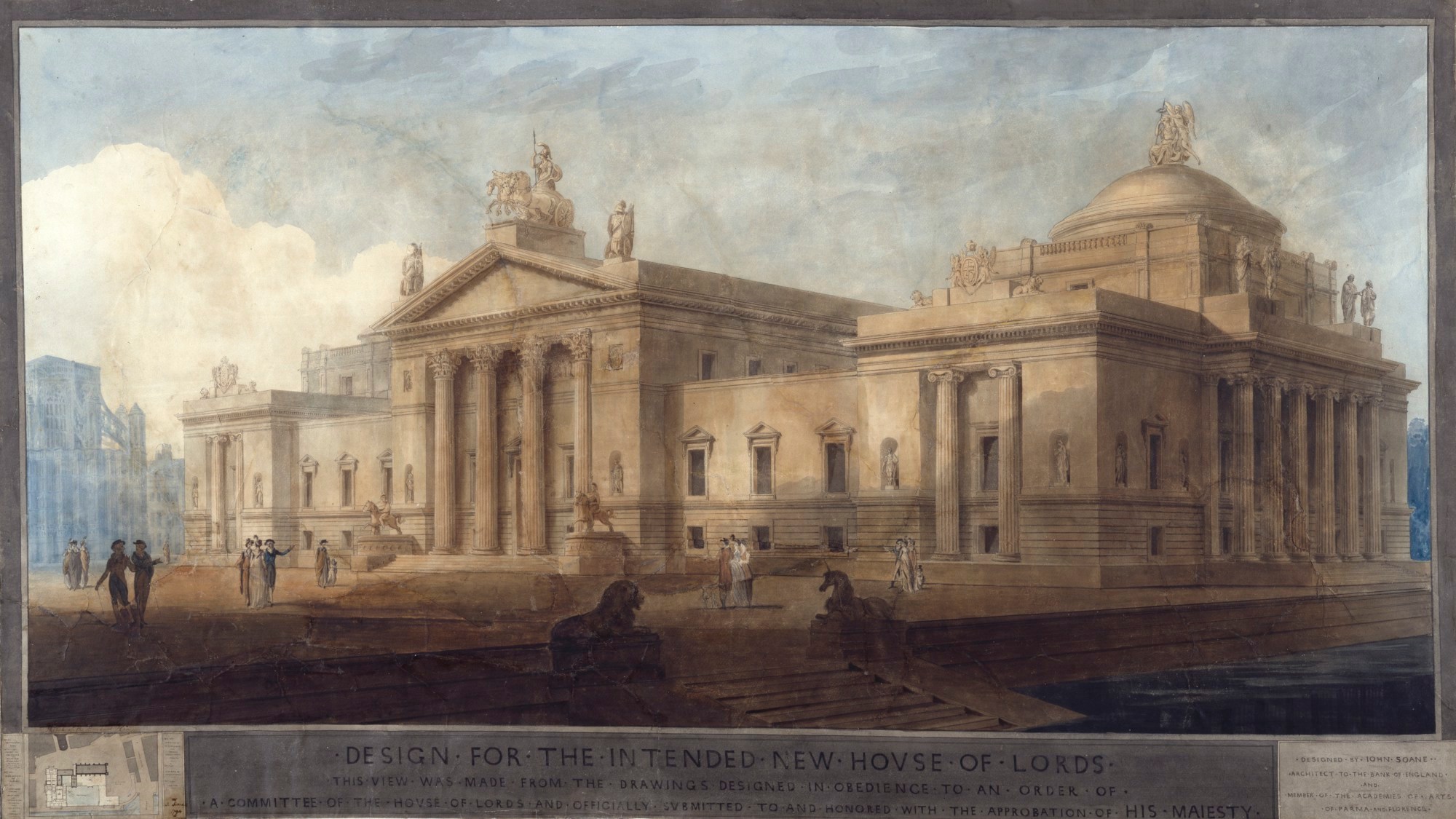
Soane, Design for a New House of Lords, 1794

Ready.


Poet Warrior reached for a gun. She was given a paintbrush, a saxophone, a pen. These will be your instruments of power, the old one said. Though the gun gleamed and pranced as a tool of takeover by governments, even as it danced through the imaginations of revolutionaries as the perfect tool for social change. Do not be fooled, they told her. Violence might be louder, tougher and is often good looking. The power of insight and compassion is fiercely humble and helpful. Be ready for what the story of your age demands. You will be tested. There will be jealousy, envy. But the most difficult enemies will be from your closest circle, even your family. You must act in a manner that will cause no harm to anyone, seven generations back or forward.

Joy Harjo, from Poet Warrior

Happy Birthday, Perry


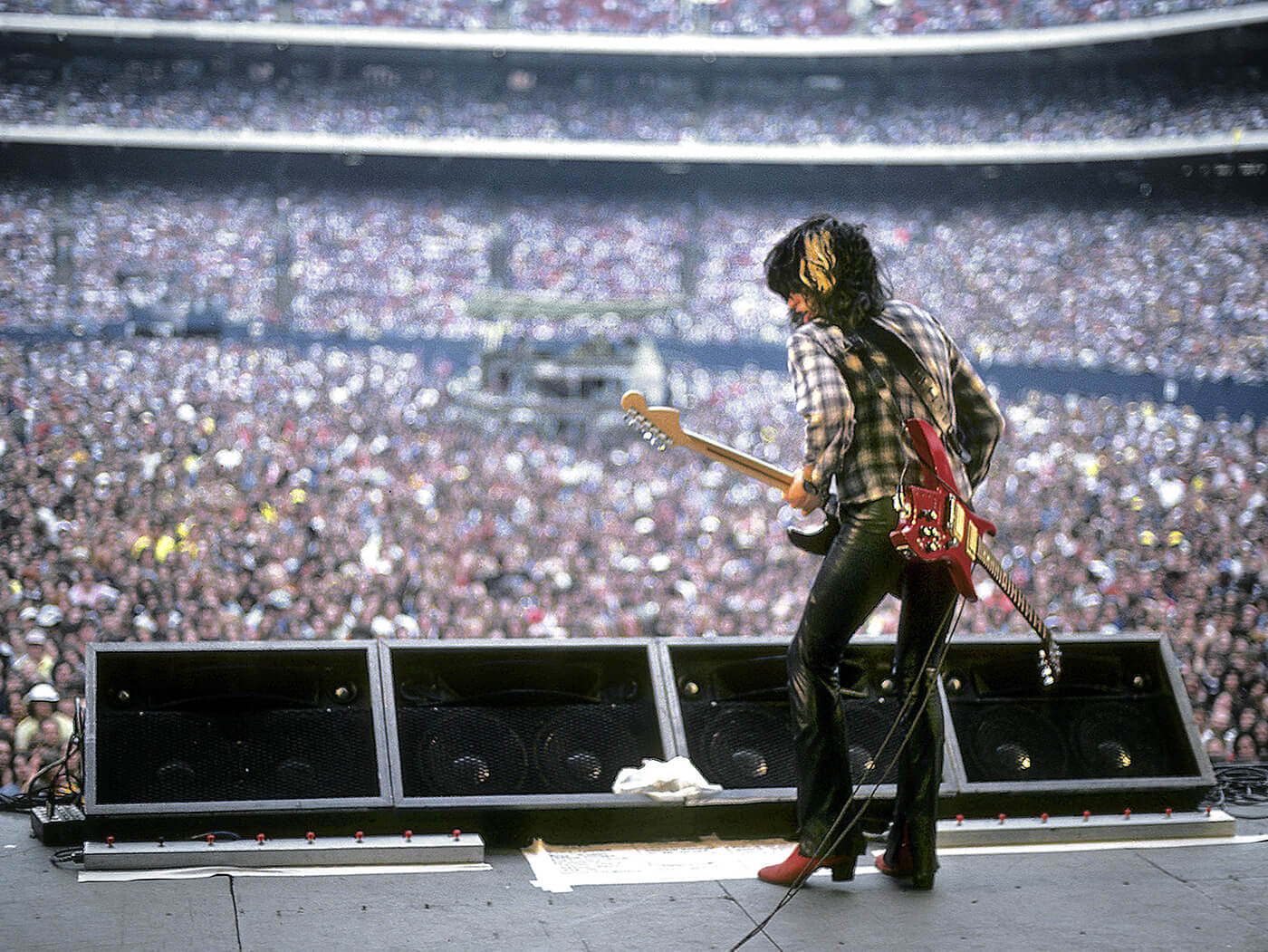
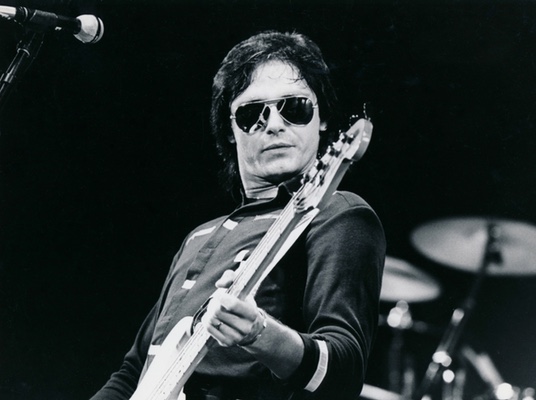
Joe Perry was born on this day in 1950.

Aerosmith, "No More No More" ...

Happy Birthday, Oliver

Agar, Mary Oliver, n/d


Mary Oliver was born on this day in 1935.

I.
Where do I live? If I had no address, as many people
do not, I could nevertheless say that I lived in the
same town as the lilies of the field, and the still
waters.

Spring, and all through the neighborhood now there are
strong men tending flowers.

Beauty without purpose is beauty without virtue. But
all beautiful things, inherently, have this function -
to excite the viewers toward sublime thought. Glory
to the world, that good teacher.

Among the swans there is none called the least, or
the greatest.

I believe in kindness. Also in mischief. Also in
singing, especially when singing is not necessarily
prescribed.

As for the body, it is solid and strong and curious
and full of detail; it wants to polish itself; it
wants to love another body; it is the only vessel in
the world that can hold, in a mix of power and
sweetness: words, song, gesture, passion, ideas,
ingenuity, devotion, merriment, vanity, and virtue.

Keep some room in your heart for the unimaginable.

2.
There are many ways to perish, or to flourish.

How old pain, for example, can stall us at the threshold of function….

Still friends, consider stone, that is without the fret of gravity, and water that is without anxiety. 

And the pine trees that never forget their recipe for renewal. 

And the female wood duck who is looking this way and that way for her children. And the snapping turtle who is looking this way and that way also. This is the world. 

And consider, always, every day, the determination of the grass to grow despite the unending obstacles. 

3. 
I ask you again: if you have not been enchanted by this adventure--your life--what would do for you? 

And, where are you, with your ears bagged down as if with packets of sand? Listen. We all have much more listening to do. Tear the sand away. And listen. The river is singing. …

For myself, I have walked in these woods for
More than forty years, and I am the only
thing, it seems, that is about to be used up.
Or, to be less extravagant, will, in the
Foreseeable future, be used up.

First, though, I want to step out into some
fresh morning and look around and hear myself
crying out:  "The house of money is falling! The house of money is falling! The weeds are rising! The weeds are rising!"

Mary Oliver

09 September 2021

Hang.

"Hang care!" exclaimed he. "This is a delicious evening; the wine has a finer relish here than in the house, and the song is more exciting and melodious under the tranquil sky than in the close room, where the sound is stifled. Come, let us have a bacchanalian chant—let us, with old Sir Toby, make the welkin dance and rouse the night-owl with a catch! I am right merry. Pass the bottle, and tune your voices—a catch, a catch! The lights will be here anon."

Charles Ollier, from "The Haunted Manor-House of Paddington"

For best results, listen to this .. UFO, "Lonely Heart" 


The euphony transformed me and inundated my soul in a roguish countenance, the likes of which I had know well in younger days. Such impishness soon drove out the complaints of the day.

Umberto Limongiello

08 September 2021

07 September 2021

Crave.

Chef Gabriel Kreuther teaching ...
Asking questions can be a treasure for you guys because you have a lot of knowledge around you.  Use it to your advantage.  Nobody is going to knock on your door and say, 'Hey!  I'm going to teach you something.'  You actually have to knock on the door and say, 'Show me something today.'  When you crave for learning, you learn.  That's really what it is ... get the knowledge and then have fun."

Thank you, Jessica.

Wet Leg, "Chaise Longue"

Is your muffin buttered?
Would you like us to assign someone to butter your muffin?
Excuse me
What?


Thank you, Theodora.

Happy Birthday, Hynde


Chrissie Hynde was born on this day in 1951.

Pretenders, "Tattooed Love Boys" ...

Do.


Those who talk should do and only those who do should talk.

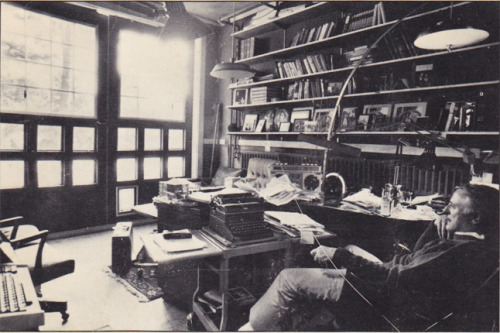
Nassim Nicholas Taleb, from Skin in the Game: Hidden Asymmetries in Daily Life

Pictured: Taleb's study.

06 September 2021

Imagine.

Chatham, Nightfall, September, 1991


Ten minutes alone in thickets
at the edge of town

quickens attention,
so many

silver filaments, green trembles,
small living details.

What was it like in the forest
of those three decades,

his mountain
seclusion?

How can we even begin
to imagine?

Nan-ch’uan

Jackson Browne, "Call It a Loan"

With the incomparable David Lindley ...

Developing.

I sense a welcome pattern developing at Cultural Offering ...


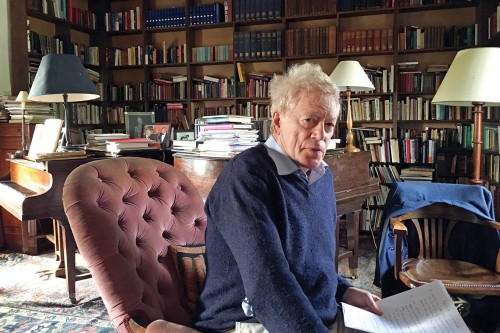
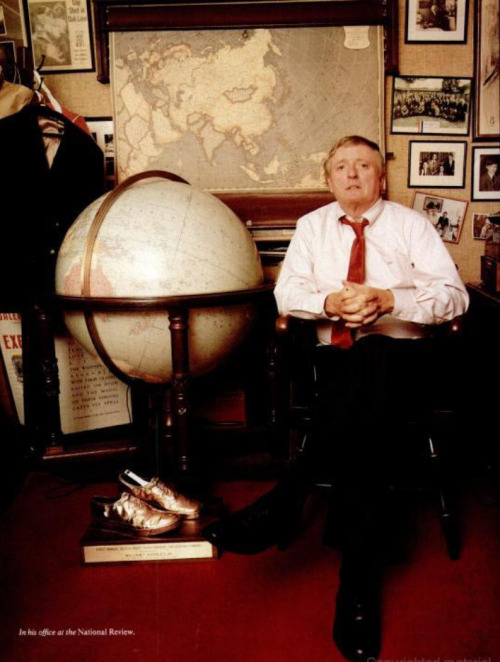
... [B]ien pensant left-liberal guests could be surprised to meet a well-informed, dialectically formidable adversary.  Undogmatic and strategic, he held together his fractious army of cold warriors, moral conservatives, and economic liberals.


A philosopher, journalist, and novelist, who once said if he did not write four thousand words a day, he felt unclean ...

Advanced.


On one side of town, the German food culture of the Firchaus was deeply ingrained with the plying of homemade sausages, sauerkraut (sealed in earthenware crocks and buried in the backyard), bread, and butter, and Grandpa's pear wine (served in pimento-jar juice glasses with strict instruction to, "Make it last").  

On the west side of Saginaw, my Grandma Chenoweth, a welshman through-and-through, did her best to instruct us in Anglo ways.  It began early with simple cinnamon toast served daily at tea-time, but I remember these from our advanced classes ...

DUNDEE BISCUITS

Ingredients
  • 1½ cups all-purpose flour
  • ¼ cup sugar
  • ¼ cup quick-cooking oats
  • ¼ cup butter
  • ⅓ cup milk
  • 1 large egg, divided
  • Sliced almonds
Instructions
  1. Preheat oven to 400°.
  2. In a medium bowl, combine flour, sugar, and oats. Using a pastry blender, cut in butter until mixture resembles coarse crumbs.
  3. In a small bowl, combine milk and egg yolk; stir into flour mixture.
  4. On a lightly floured surface, roll out dough to ½-inch thickness. Using 1½-inch round cutter, cut biscuits. Place on baking sheet. Brush with lightly beaten egg white and top with sliced almonds.
  5. Bake for 10 to 12 minutes or until lightly browned.
  6. Transfer to wire racks to cool.

Cultivate.


Tricycle on joy as a radical act ...
Joy, as we typically understand it, is passive and reactive; it’s caused by something else. A new promotion, a “yes” to a marriage proposal, or a sudden fortune makes us feel joy. Then with time, that joy fades into a dull memory. That type of conditioned happiness is part of what the Buddha called dukkha, or suffering.

But there is another type of joy, a much subtler and more sustainable joy that we can uncover. This joy—which I will refer to here as innate or unconditional joy—cannot be exhausted because it resides within us at all times, though it is often hidden. No external stimulus can evoke it, but as we expand our awareness, our joy is revealed to be increasingly vast and exquisitely infectious. This innate joy is a radical act, because once we learn to recognize it, we can begin to toss aside the everyday understanding of happiness at the heart of our culture as well as any harmful systems that depend on or benefit from our underlying dissatisfaction.

As with many Buddhist notions, the subject of joy can be taken up philosophically, or it can be understood through direct experience. Here, I will do both. I’ll begin by discussing how conditioned and unconditioned joy look in the world, and then I’ll lay out a meditation practice that can allow us to uncover innate joy over time.

Sure, you may think, joy sounds great, but how, in a society founded upon the “pursuit of happiness,” is it radical? The term radical typically conjures up the image of a political extremist or a progressive revolutionary, but what really makes something radical is the extent to which it challenges  conventional paradigms. In order to make a radical change, we first have to return to the root of the problem: our fundamental understanding.

In this sense, supporting a political party or lobbying for a cause is not radical. That doesn’t mean that both sides are the same or that activism can’t be important, righteous, and noble, but when we fixate on our views and contract into our limiting beliefs, we are accepting the underlying framework of the conflict itself. A truly radical act, on the other hand, goes deeper, uprooting the whole system of how we perceive ourselves in the world in order to start anew. Innate joy does just that. It changes the game.

Finding unconditional joy is especially subversive in modern Western culture, where the dominant paradigm equates happiness with conditional joy, which often means material or social gain. I know that in my youth, the idea that inner contentment could be cultivated was totally foreign. I looked for happiness the way the people around me did—in things. Yet, no matter what delicious food I ate or video games I played, a sense of hollowness and disconnection seemed to follow me.

This experience is neither rare nor unique to our era. (During the Buddha’s time, the dharma wasn’t exactly common sense. Otherwise his enlightenment would have been no big deal.) But as our technology advances and makes the world smaller, our conditional view of happiness is accelerating toward its ultimate conclusion: if joy depends on consumption and the things we consume are limited, then there is a finite amount of joy in the world and we must take from others in order to have more for ourselves. Some systems try to redistribute this commodified joy evenly, while others give a disproportionate share of joy to a select few (who do or don’t deserve it, according to one’s worldview). What makes innate joy radical is that it denies the basic idea that happiness is a zero-sum game. Instead of joy being fleeting and dependent, it is revealed to be ever-present and unconditional. By cultivating innate joy, we can turn scarcity into abundance and undermine the whole economy of commodified happiness.

It is in this way that joy is also an act. We tend to only consider something to be an act when it exerts an external force. And while joy can effect change, even before it does, it is already an act—an internal motion that flips the proverbial chess board. We place a disproportionate emphasis on figuring out external solutions to the world’s problems, when it is just as important to consider how we approach life from within. That said, a joyful person will be almost incapable of keeping their compassion from overflowing, whether it is through charity or advocacy or through subtler and smaller kindnesses in everyday interactions (more on this in the practice portion). Joy is also an act in another sense: we need to cultivate it. For most, inner joy is developed over time through regular practice.

cultivate (v.)
... from Latin cultus "care, labor; cultivation," from past participle of colere "to cultivate, to till; to inhabit; to frequent, practice, respect; tend, guard," from PIE root *kwel- (1) "revolve, move round; sojourn, dwell."

Technique.


Technique is the proof of your seriousness.

Wallace Stevens