"I am not one who was born in the custody of wisdom. I am one who is fond of olden times and intense in quest of the sacred knowing of the ancients." Gustave Courbet
Showing posts with label conservatism. Show all posts

19 November 2025

Stop.


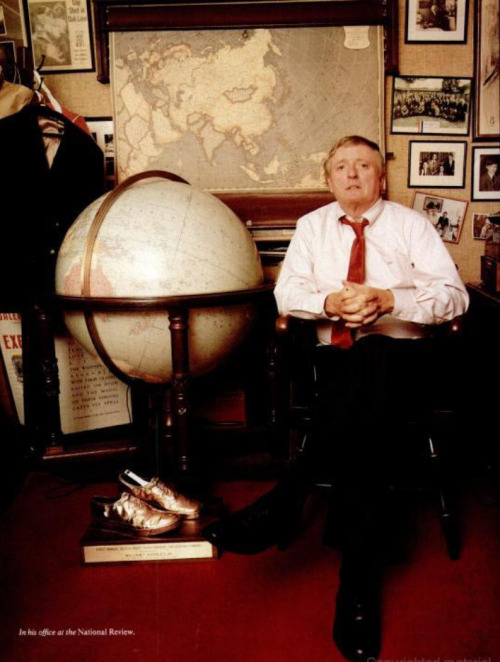
It stands athwart history, yelling Stop, at a time when no one is inclined to do so, or to have much patience with those who so urge it.

William F. Buckley Jr., from the mission statement of National Review, published on this day 70 years ago

28 February 2025

12 January 2025

Excellence.


The largest cultural menace in America is the conformity of the intellectual cliques which, in education as well as the arts, are out to impose upon the nation their modish fads and fallacies, and have nearly succeeded in doing so. In this cultural issue, we are, without reservations, on the side of excellence (rather than "newness") and of honest intellectual combat (rather than conformity).

William F. Buckley Jr., from the National Review mission statement

08 June 2024

Happy Birthday, Wright


Liberty may be granted but freedom cannot be conferred. Freedom is from within. Notwithstanding all the abuses to which freedom is now subject--marking man down as a commercial item and cutting him off from his birthright by senseless excess and the demoralization of the profit-system -- yet man may still be in love with life and find life less and less abundant for this very reason. 

Truth is of freedom, always safe and affirmative, therefore conservative. Truth proclaims rejection of dated minor traditions, doomed by the great Tradition of The Law of Change is truth's great "eternal." Freedom is this "great becoming.

Frank Lloyd Wright, born on this day in 1867, from A Testament

16 June 2023

Honorable.

Adams, Forest Floor, Yosemite, California, 1950


Let us call this turn the Forest Passage, and the person who accomplishes it the Forest Rebel. Like Worker, this word also encompasses a spectrum of meaning, since it can designate not only very divergent forms and fields but also different levels of a single deportment. Although we will further refine the expression here, it is helpful that it already has a history in old Icelandic vocabulary. A forest passage followed a banishment; through this action a man declared his will to self-affirmation from his own resources. This was considered honorable, and it still is today, despite all the platitudes. In those times, the banishment was usually the consequence of a homicide, whereas today it happens to a man automatically, like the turning of a roulette wheel. None of us can know today if tomorrow morning we will not be counted as part of a group considered outside the law. In that moment the civilized veneer of life changes, as the stage props of well-being disappear and are transformed into omens of destruction. The luxury liner becomes a battleship, or the black jolly roger and the red executioner’s flag are hoisted on it.

Ernst Jünger, from The Forest Passage

Reflection.


Man sleeps in the forest—and the moment he awakens to recognize his own power, order is restored. The higher rhythm present in history as a whole may even be reinterpreted as man’s rediscovery of himself. In all epochs there will be powers that seek to force a mask on him, at times totemic powers, at times magical or technical ones. Rigidity then increases, and with it fear. The arts petrify, dogma becomes absolute. Yet, since time immemorial, the spectacle also repeats of man removing the mask, and the happiness that follows is a reflection of the light of freedom.

Ernst Jünger, from The Forest Passage

30 May 2023

Grace.

Caravaggio, Narcissus, 1600


Humility, which Burke ranked high among the virtues, is the only effectual restraint upon this congenital vanity; yet our world has nearly forgotten the nature of humility. Submission to the dictates of humility formerly was made palatable to man by the doctrine of grace; that elaborate doctrine has been overwhelmed by modern presumption.

Russell Kirk, from The Conservative Mind

20 February 2023

True.


George MacDonald Fraser on the (continued) offensiveness of the Good, Old Truth ...
We were freer by far 50 years ago - yes, even with conscription, censorship, direction of labour, rationing, and shortages of everything that nowadays is regarded as essential to enjoyment.

We still had liberty beyond modern understanding because we had other freedoms, the really important ones, that are denied to the youth of today.

We could say what we liked; they can't. We were not subject to the aggressive pressure of special interest minority groups; they are. We had no worries about race or sexual orientation; they have. We could, and did, differ from fashionable opinion with impunity, and would have laughed PC to scorn, had our society been weak and stupid enough to let it exist.

We had available to us an education system, public and private, that was the envy of the world. We had little reason to fear being mugged or raped (killed in war, maybe, but that was an acceptable hazard).

Our children could play in street and country in safety. We had few problems with bullies because society knew how to deal with bullying and was not afraid to punish it in ways that would send today's progressives into hysterics.

We did not know the stifling tyranny of a liberal establishment, determined to impose its views, and beginning to resemble George Orwell's Ministry of Truth.

Above all, we knew who we were and we lived in the knowledge that certain values and standards held true, and that our country, with all its faults and need for reforms, was sound at heart.

Not any more. I find it difficult to identify a time when the country was as badly governed as it has been in the past 50 years.

We have had the two worst Prime Ministers in our history - Edward Heath (who dragooned us into the Common Market) and Tony Blair. The harm these two have done to Britain is incalculable and almost certainly irreparable.

Whether the public can be blamed for letting them pursue their ruinous policies is debatable.

Short of assassination there is little people can do when their political masters have forgotten the true meaning of the democracy of which they are forever prating, are determined to have their own way at all costs and hold public opinion in contempt.

I feel I speak not just for myself but for the huge majority of my generation who think as I do but whose voices are so often lost in the clamour.

We are yesterday's people, the over-the-hill gang. (Yes, the old people - not the senior citizens or the time-challenged, but the old people.) Those of ultra-liberal views may take consolation from this - that my kind won't be around much longer, and then they can get on with wrecking civilisation in peace.

But they should beware. There may well be more who think like me than the liberal Left establishment likes to think. When my views were first published in book form in 2002, I was not surprised that almost all the reviewers were unfavourable. I had expected that my old-fashioned views would get a fairly hostile reception, but the bitterness did astonish me.

I had not realised how offensive the plain truth can be to the politically correct, how enraged they can be by its mere expression, and how deeply they detest the values and standards respected 50 years ago and which dinosaurs like me still believe in, God help us.
23 January 2023

Stop.


It is the job of centralized government (in peacetime) to protect its citizens’ lives, liberty and property. All other activities of government tend to diminish freedom and hamper progress. The growth of government(the dominant social feature of this century) must be fought relentlessly. In this great social conflict of the era, we are, without reservations, on the libertarian side.

William F. Buckley Jr., the mission statement of National Review

14 July 2022

Value.


Value begins where calculation ends, since that which matters most to us is the thing that we will not exchange.

Roger Scruton, from How to Be a Conservative

09 December 2021

Sovereign.

An excellent book ...


The true rightist is not a man who wants to go back to this or that institution for the sake of a return; he wants first to find out what is eternally true, eternally valid, and then either to restore or reinstall it, regardless of whether it seems obsolete, whether it is ancient, contemporary, or even without precedent, brand new, “ultramodern.” Old truths can be rediscovered, entirely new ones found. The Man of the Right does not have a time-bound, but a sovereign mind. 

The right stands for liberty, a free, unprejudiced form of thinking, a readiness to preserve traditional values (provided they are true values), a balanced view of the nature of man, seeing in him neither beast nor angel, insisting also on the uniqueness of human beings who cannot be transformed into or treated as mere numbers or ciphers; but the left is the advocate of the opposite principles. It is the enemy of diversity and the fanatical promoter of identity. Uniformity is stressed in all leftist utopias, a paradise in which everybody should be the “same,” where envy is dead, where the “enemy” either no longer exists, lives outside the gates, or is utterly humiliated. Leftism loathes differences, deviation, stratification. Any hierarchy it accepts is only “functional.”

Erik von Kuehnelt-Leddihn

06 September 2021

Developing.

I sense a welcome pattern developing at Cultural Offering ...


... [B]ien pensant left-liberal guests could be surprised to meet a well-informed, dialectically formidable adversary.  Undogmatic and strategic, he held together his fractious army of cold warriors, moral conservatives, and economic liberals.


A philosopher, journalist, and novelist, who once said if he did not write four thousand words a day, he felt unclean ...

27 July 2021

Degrees.

Barry, Edmund Burke, 1774


We must all obey the great law of change. It is the most powerful law of nature, and the means perhaps of its conservation. All we can do, and that human wisdom can do, is to provide that the change shall proceed by insensible degrees. This has all the benefits which may be in change, without any of the inconveniences of mutation.

Edmund Burke

07 July 2021

Permanent.


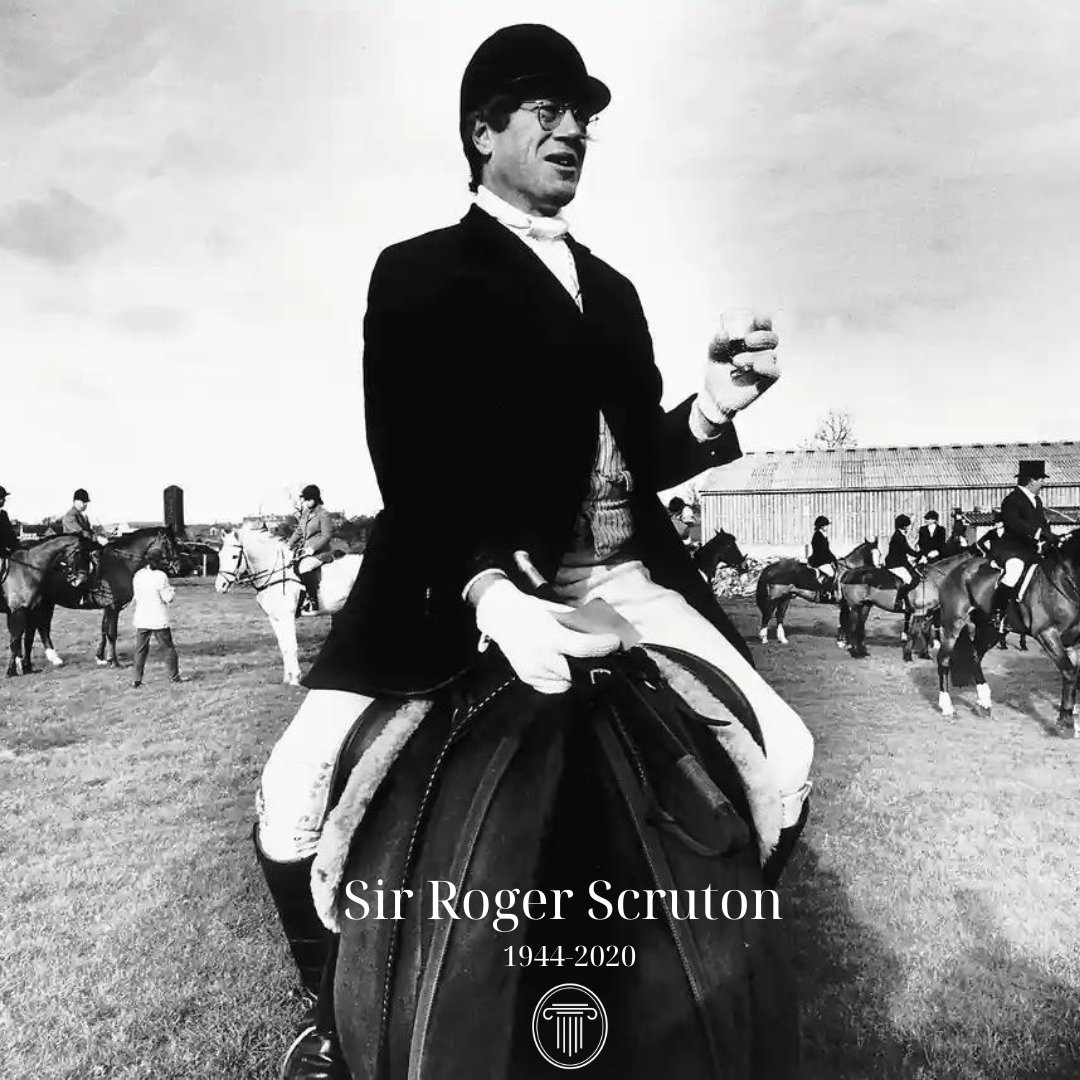
I understood conservatism not as a political credo only, but as a lasting vision of human society, one whose truth would always be hard to perceive, harder still to communicate, and hardest of all to act upon. And especially hard is it now, when religious sentiments follow the whims of fashion, when the global economy throws our local loyalties into disarray, and when materialism and luxury deflect the spirit from the proper business of living. But I do not despair, since experience has taught me that men and women can flee from the truth only for so long, that they will always, in the end, be reminded of the permanent values, and that the dreams of liberty, equality, and fraternity will excite them only in the short-term.

Sir Roger Scruton

20 June 2021

Deliver.

Gunn, Sir Robert Hutchison, 1950


From inability to let well alone; from too much enthusiasm for the new and contempt for what is old; from putting knowledge before wisdom, science before art and cleverness before common sense; from treating patients as cases; and from making the cure of the disease more grievous than the endurance of the same; Good Lord, deliver us.

Sir Robert Hutchison

04 June 2021

Ancestors.


The strange superstition has arisen in the Western world that we can start all over again, remaking human nature, human society, and the possibilities of happiness; as though the knowledge and experience of our ancestors were now entirely irrelevant.

Sir Roger Scruton

29 May 2021

Ideals.

Life without ideals tires of itself.

Sir Roger Scruton

Philosopher Roger Scruton argues for a culture of reason, responsibility and irony in the place of the dangerous fallacies that derive from false optimism.

08 May 2021

Illumination.


No merely critical standpoint can build, let alone "conserve" anything. One can lament the fire ravaging Notre Dame, but a dislike of fire confers exactly none of the knowledge required to build—or indeed, rebuild—that magnificent monument of Western culture. For that, you need architectural-mathematical understanding, aesthetic vision, as well as stone-carvers, carpenters, vitrailleurs, and so forth. Lamenting the Cathedral’s destruction is one thing; rebuilding it is another.

Sir Roger understood that. You can’t counter nihilism, you can’t defeat the iconoclasts, by critique alone. Indeed, even to focus primarily on critique is already to concede that the game is one of tearing-down, one of destruction.  

Once, when I asked him about how to build, and rebuild, he playfully replied: we can’t be about "debunking". Rather, we need "bunking". 

We need to know how to build.

Culture, he went on to say, is simply "the things we have loved". 

Love is the only principle capable of conserving, of transmitting, or of building, anything at all.

So-called conservatives too often think it is enough to be right: right about the economy, right about systems of government, right about civic association, right about fundamental freedoms and dignity. 

But being right isn’t enough. When you have young people burning cities and convinced that their culture is intrinsically oppressive, that its fundamental principles are perverse—then, it is safe to say to conservatives (as the meme goes)—you had one job, and you failed. 

A culture does not, it cannot, continue without mechanisms for its own transmission. The West, terrible though it is to say, no longer has those. 

Sir Roger understood that. He understood that the only way to pass along a culture, the only way to conserve those things we love, is actually to pass them along—to share that love, to instill it in another, and in the young especially. Naturally, Sir Roger knew this was a bedrock philosophical insight of the Western tradition, wonderfully articulated in Aristotle’s De anima, and taken up by Augustine, Dante, the Enlightenment, and elsewhere: that is, that an act of will follows, and only follows, the illumination of intellect. 

20 January 2021

Liberty.


Liberty is traditional and conservative; it remembers its legends and its heroes. But tyranny is always young and seemingly innocent, and asks us to forget the past.

G.K. Chesterton