"I am not one who was born in the custody of wisdom. I am one who is fond of olden times and intense in quest of the sacred knowing of the ancients." Gustave Courbet
Showing posts with label folklore. Show all posts

18 October 2025

Lustreless.


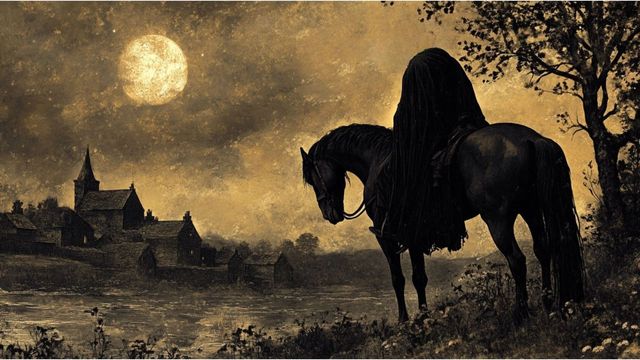
T. Crofton Crocker introduces Ireland's headless horseman, the Dullahan ...
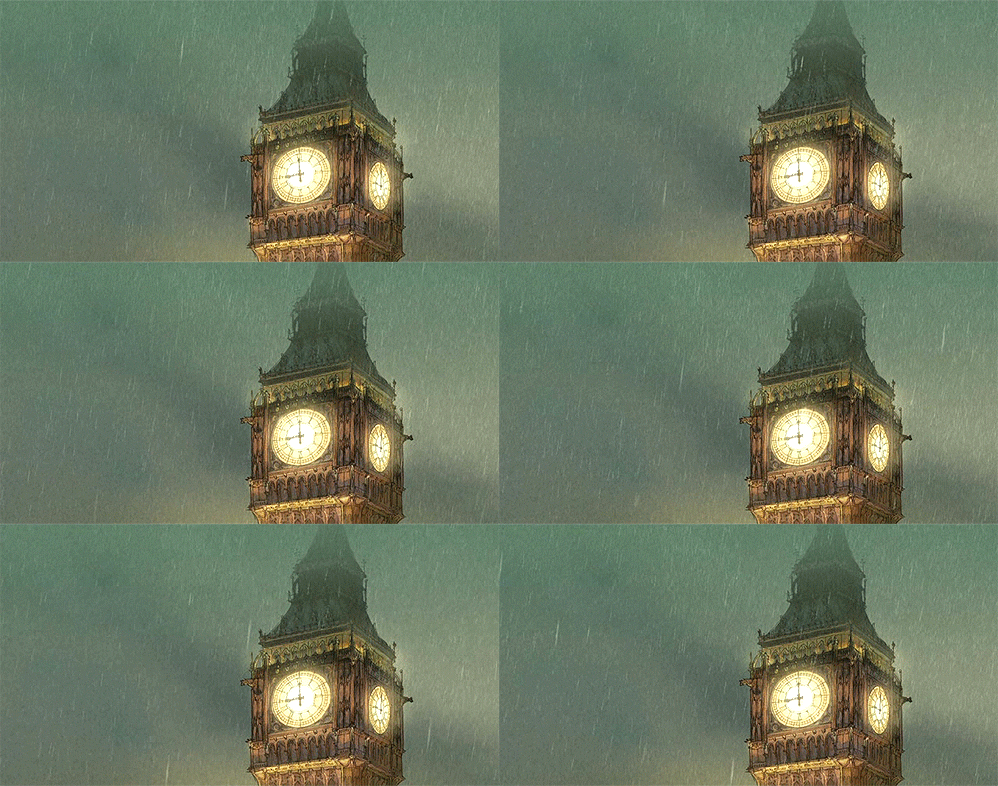
Charley’s eye fell on the old walls that belonged, in former times, to the Templars: but the silent gloom of the ruin was broken only by the heavy rain which splashed and pattered on the grave-stones. He then looked up at the sky, to see if there was, among the clouds, any hopes for mercy on his new snaffle reins; and no sooner were his eyes lowered, than his attention was arrested by an object so extraordinary as almost led him to doubt the evidence of his senses. The head, apparently, of a white horse, with short cropped ears, large open nostrils and immense eyes, seemed rapidly to follow him. No connexion with body, legs, or rider, could possibly be traced—the head advanced—Charley’s old mare, too, was moved at this unnatural sight, and snorting violently, increased her trot up the hill. The head moved forward, and passed on: Charley, pursuing it with astonished gaze, and wondering by what means, and for what purpose, this detached head thus proceeded through the air, did not perceive the corresponding body until he was suddenly startled by finding it close at his side. Charley turned to examine what was thus so sociably jogging on with him, when a most unexampled apparition presented itself to his view. A figure, whose height (judging as well as the obscurity of the night would permit him) he computed to be at least eight feet, was seated on the body and legs of a white horse full eighteen hands and a half high. In this measurement Charley could not be mistaken, for his own mare was exactly fifteen hands, and the body that thus jogged alongside he could at once determine, from his practice in horseflesh, was at least three hands and a half higher.

After the first feeling of astonishment, which found vent in the exclamation “I’m sold now for ever!” was over, the attention of Charley, being a keen sportsman, was naturally directed to this extraordinary body; and having examined it with the eye of a connoisseur, he proceeded to reconnoitre the figure so unusually mounted, who had hitherto remained perfectly mute. Wishing to see whether his companion’s silence proceeded from bad temper, want of conversational powers, or from a distaste to water, and the fear that the opening of his mouth might subject him to have it filled by the rain, which was then drifting in violent gusts against them, Charley endeavoured to catch a sight of his companion’s face, in order to form an opinion on that point. But his vision failed in carrying him farther than the top of the collar of the figure’s coat, which was a scarlet single-breasted hunting frock, having a waist of a very old-fashioned cut reaching to the saddle, with two huge shining buttons at about a yard distance behind. “I ought to see farther than this, too,” thought Charley, “although he is mounted on his high horse, like my cousin Darby, who was made barony constable last week, unless ’tis Con’s whiskey that has blinded me entirely.” However, see farther he could not, and after straining his eyes for a considerable time to no purpose, he exclaimed, with pure vexation, “By the big bridge of Mallow, it is no head at all he has!”

“Look again, Charley Culnane,” said a hoarse voice, that seemed to proceed from under the right arm of the figure.

Charley did look again, and now in the proper place, for he clearly saw, under the aforesaid right arm, that head from which the voice had proceeded, and such a head no mortal ever saw before. It looked like a large cream cheese hung round with black puddings; no speck of colour enlivened the ashy paleness of the depressed features; the skin lay stretched over the unearthly surface, almost like the parchment head of a drum. Two fiery eyes of prodigious circumference, with a strange and irregular motion, flashed like meteors upon Charley, and to complete all, a mouth reached from either extremity of two ears, which peeped forth from under a profusion of matted locks of lustreless blackness. This head, which the figure had evidently hitherto concealed from Charley’s eyes, now burst upon his view in all its hideousness. Charley, although a lad of proverbial courage in the county of Cork, yet could not but feel his nerves a little shaken by this unexpected visit from the headless horseman, whom he considered his fellow-traveller must be. The cropped-eared head of the gigantic horse moved steadily forward, always keeping from six to eight yards in advance. The horseman, unaided by whip or spur, and disdaining the use of stirrups, which dangled uselessly from the saddle, followed at a trot by Charley’s side, his hideous head now lost behind the lappet of his coat, now starting forth in all its horror, as the motion of the horse caused his arm to move to and fro. The ground shook under the weight of its supernatural burden, and the water in the pools became agitated into waves as he trotted by them.

17 October 2024

Undergo.


As the folktale sees I see.
As the folktale lives I live.
And the path to my door, that too is a folktale.

Coming here you either undergo what people undergo in a folktale, or you will never lift my latch.

Little wonder I so rarely hear my latch being lifted.

John Moriarty

31 December 2023

Lore.

Greg Brownderville in discussion with Ronald Hutton ...

"The Mystery of Folklore"


"Living the Lore"

24 December 2023

Probable.


While Christmas Eve is the night par excellence of the supernatural, the whole season of the Twelve Days is charged with it. It is hard to see whence Shakespeare could have got the idea which he puts into the mouth of Marcellus in “Hamlet”:—
Some say that ever ‘gainst that season comes
Wherein our Saviour's birth is celebrated,
The bird of dawning singeth all night long;
And then, they say, no spirit dare stir abroad;
The nights are wholesome; then no planets strike,
No fairy takes, nor witch hath power to charm,
So hallow'd and so gracious is the time.
Against this is the fact that in folk-lore Christmas is a quite peculiarly uncanny time. Not unnatural is it that at this midwinter season of darkness, howling winds, and raging storms, men should have thought to see and hear the mysterious shapes and voices of dread beings whom the living shun.

Throughout the Teutonic world one finds the belief in a “raging host” or “wild hunt” or spirits, rushing howling through the air on stormy nights. In North Devon its name is “Yeth (heathen) hounds”; elsewhere in the west of England it is called the “Wish hounds.” It is the train of the unhappy souls of those who died unbaptized, or by violent hands, or under a curse, and often Woden is their leader. At least since the seventeenth century this “raging host” (das wüthende Heer) has been particularly associated with Christmas in German folk-lore, and in Iceland it goes by the name of the “Yule host.”

In Guernsey the powers of darkness are supposed to be more than usually active between St. Thomas's Day and New Year's Eve, and it is dangerous to be out after nightfall. People are led astray then by Will o’ the Wisp, or are preceded or followed by large black dogs, or find their path beset by white rabbits that go hopping along just under their feet.

In England there are signs that supernatural visitors were formerly looked for during the Twelve Days. First there was a custom of cleansing the house and its implements with peculiar care. In Shropshire, for instance, “the pewter and brazen vessels had to be made so bright that the maids could see to put their caps on in them—otherwise the fairies would pinch them, but if all was perfect, the worker would find a coin in her shoe.” Again in Shropshire special care was taken to put away any suds or “back-lee” for washing purposes, and no spinning might be done during the Twelve Days. It was said elsewhere that if any flax were left on the distaff, the Devil would come and cut it.

The prohibition of spinning may be due to the Church's hallowing of the season and the idea that all work then was wrong. This churchly hallowing may lie also at the root of the Danish tradition that from Christmas till New Year's Day nothing that runs round should be set in motion, and of the German idea that no thrashing must be done during the Twelve Days, or all the corn within hearing will spoil. The expectation of uncanny visitors in the English traditions calls, however, for special attention; it is perhaps because of their coming that the house must be left spotlessly clean and with as little as possible about on which they can work mischief. Though I know of no distinct English belief in the return of the family dead at Christmas, it may be that the fairies expected in Shropshire were originally ancestral ghosts. Such a derivation of the elves and brownies that haunt the hearth is very probable.

14 October 2022

Enchanted.


W. M. Beauchamp's "Indian Corn Stories and Customs", from The Journal of American Folklore, July- September, 1898 ...
The great magician called Masswaweinini, or the Living Statue, remained on the Manitoulin Islands after his friends had left. While hunting one day, he came suddenly to a wide prairie, across which he proceeded. There he met a small man, wearing a red feather on his head, and they smoked together. A wrestling match followed, with doubtful fortunes, but at last the small man was thrown. As directed, the victor cried out, "I have thrown you; wa ge me na;" and his opponent at once disappeared. In his place there lay on the ground a crooked ear of mondamin, or Indian corn, with a red hairy tassel at the top. A voice was heard, directing him to strip the body and throw the fragments all around. The spine, which gave these parts support, was also to be broken up and scattered near the edge of the wood. In one moon he was to return. This he did, and found the plain filled with growing corn. From the broken cob grew luxuriant pumpkin vines. At the end of summer he was on the wrestling ground again, where the corn was in full ear and the pumpkins of great size. Of these he gathered a good store, and the voice was heard again: "Masswaweinini, you have conquered me, and thus saved your own life. Victory has crowned your efforts, and now my body shall forever nourish the human race." Thus came the gift of corn and pumpkins, and the gift of wampum followed closely, brought about by the good fairies of that enchanted land. 

CONNECT

22 January 2022

Recognition.


Like legend and myth, magic fades when it is unused -- hence all the old tales of elfin kingdoms moving further and further away from our world, or that magical beings require our faith, our belief in their existence, to survive. That is a lie. All they require is our recognition.

Charles de Lint

25 November 2020

Folklore.

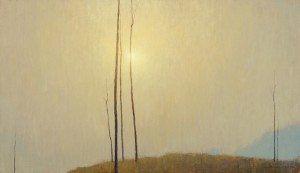
Grossman, Clouded Sun and Bare Trees, n/d


THANKSGIVING WEATHER FOLKLORE
  • Turkeys perched on trees and refusing to descend indicates snow.
  • If the first snow sticks to the trees, it foretells a bountiful harvest in the coming year.
  • If sheep feed facing downhill, watch for a snowstorm.
  • Thunder in November indicates a fertile year to come.
  • If there be ice in November that will bear a duck, there will be nothing thereafter but sleet and muck.
  • As November 21st, so the winter.

19 October 2018

Liquidated.

Wyeth (Jamie), The Raven, 1980


Some witches are said to kill people with graveyard dirt, which is dust scraped from a grave with the left forefinger at midnight. This is mixed with the blood of a black bird; a raven or crow is best, but a black chicken will do in a pinch. The witch ties this mixture up in a rag which has touched a corpse and buries it under the doorstep of the person who is to be liquidated.

Vance Randolph, from Ozark Magic and Folklore

30 October 2014

Fright.

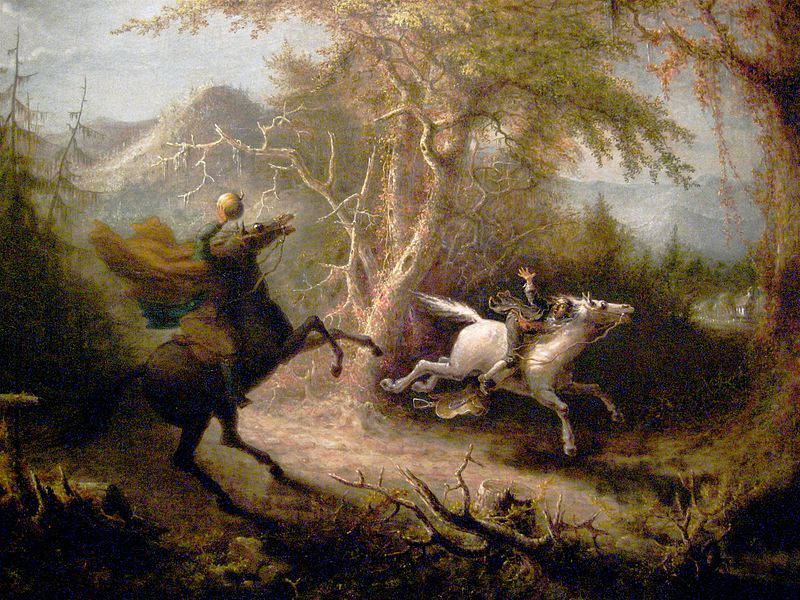
Quidor, The Headless Horseman Pursuing Ichabod Crane, 1858


It was the very witching time of night that Ichabod, heavy-hearted and crestfallen, pursued his travels homewards, along the sides of the lofty hills which rise above Tarry Town, and which he had traversed so cheerily in the afternoon. The hour was as dismal as himself. Far below him the Tappan Zee spread its dusky and indistinct waste of waters, with here and there the tall mast of a sloop, riding quietly at anchor under the land. In the dead hush of midnight, he could even hear the barking of the watchdog from the opposite shore of the Hudson; but it was so vague and faint as only to give an idea of his distance from this faithful companion of man. Now and then, too, the long-drawn crowing of a cock, accidentally awakened, would sound far, far off, from some farmhouse away among the hills—but it was like a dreaming sound in his ear. No signs of life occurred near him, but occasionally the melancholy chirp of a cricket, or perhaps the guttural twang of a bullfrog from a neighboring marsh, as if sleeping uncomfortably and turning suddenly in his bed.
All the stories of ghosts and goblins that he had heard in the afternoon now came crowding upon his recollection. The night grew darker and darker; the stars seemed to sink deeper in the sky, and driving clouds occasionally hid them from his sight. He had never felt so lonely and dismal. He was, moreover, approaching the very place where many of the scenes of the ghost stories had been laid. In the centre of the road stood an enormous tulip-tree, which towered like a giant above all the other trees of the neighborhood, and formed a kind of landmark. Its limbs were gnarled and fantastic, large enough to form trunks for ordinary trees, twisting down almost to the earth, and rising again into the air. It was connected with the tragical story of the unfortunate André, who had been taken prisoner hard by; and was universally known by the name of Major André's tree. The common people regarded it with a mixture of respect and superstition, partly out of sympathy for the fate of its ill-starred namesake, and partly from the tales of strange sights, and doleful lamentations, told concerning it.
As Ichabod approached this fearful tree, he began to whistle; he thought his whistle was answered; it was but a blast sweeping sharply through the dry branches. As he approached a little nearer, he thought he saw something white, hanging in the midst of the tree: he paused and ceased whistling but, on looking more narrowly, perceived that it was a place where the tree had been scathed by lightning, and the white wood laid bare. Suddenly he heard a groan—his teeth chattered, and his knees smote against the saddle: it was but the rubbing of one huge bough upon another, as they were swayed about by the breeze. He passed the tree in safety, but new perils lay before him.
About two hundred yards from the tree, a small brook crossed the road, and ran into a marshy and thickly-wooded glen, known by the name of Wiley's Swamp. A few rough logs, laid side by side, served for a bridge over this stream. On that side of the road where the brook entered the wood, a group of oaks and chestnuts, matted thick with wild grape-vines, threw a cavernous gloom over it. To pass this bridge was the severest trial. It was at this identical spot that the unfortunate André was captured, and under the covert of those chestnuts and vines were the sturdy yeomen concealed who surprised him. This has ever since been considered a haunted stream, and fearful are the feelings of the schoolboy who has to pass it alone after dark.
As he approached the stream, his heart began to thump; he summoned up, however, all his resolution, gave his horse half a score of kicks in the ribs, and attempted to dash briskly across the bridge; but instead of starting forward, the perverse old animal made a lateral movement, and ran broadside against the fence. Ichabod, whose fears increased with the delay, jerked the reins on the other side, and kicked lustily with the contrary foot: it was all in vain; his steed started, it is true, but it was only to plunge to the opposite side of the road into a thicket of brambles and alder bushes. The schoolmaster now bestowed both whip and heel upon the starveling ribs of old Gunpowder, who dashed forward, snuffling and snorting, but came to a stand just by the bridge, with a suddenness that had nearly sent his rider sprawling over his head. Just at this moment a plashy tramp by the side of the bridge caught the sensitive ear of Ichabod. In the dark shadow of the grove, on the margin of the brook, he beheld something huge, misshapen and towering. It stirred not, but seemed gathered up in the gloom, like some gigantic monster ready to spring upon the traveller.
The hair of the affrighted pedagogue rose upon his head with terror. What was to be done? To turn and fly was now too late; and besides, what chance was there of escaping ghost or goblin, if such it was, which could ride upon the wings of the wind? Summoning up, therefore, a show of courage, he demanded in stammering accents, "Who are you?" He received no reply. He repeated his demand in a still more agitated voice. Still there was no answer. Once more he cudgelled the sides of the inflexible Gunpowder, and, shutting his eyes, broke forth with involuntary fervor into a psalm tune. Just then the shadowy object of alarm put itself in motion, and with a scramble and a bound stood at once in the middle of the road. Though the night was dark and dismal, yet the form of the unknown might now in some degree be ascertained. He appeared to be a horseman of large dimensions, and mounted on a black horse of powerful frame. He made no offer of molestation or sociability, but kept aloof on one side of the road, jogging along on the blind side of old Gunpowder, who had now got over his fright and waywardness.                          

04 February 2014

Blood.

In astronomical lore, all the full moons have names. The names typically coincide with months of the year, or seasons.
One of the most famous moon names is the Hunter’s Moon. It is the the full moon immediately following the Harvest Moon, which is the full moon occurring most closely to the autumnal equinox.
The Hunter’s Moon, in skylore, is also sometimes called the Blood Moon. 

CONNECT