"I am not one who was born in the custody of wisdom. I am one who is fond of olden times and intense in quest of the sacred knowing of the ancients." Gustave Courbet
Showing posts with label Tiepolo. Show all posts

10 May 2025

Into.

Tiepolo, Allegory of the Planets and Continents (detail), 1753


Dreams and fables I fashion; and even while I sketch and elaborate fables and dreams upon paper, I so enter into them that I weep and am offended at ills I invented. But am I wiser when art does not deceive me?

Giovanni Battista Tiepolo
18 April 2025

Truly.

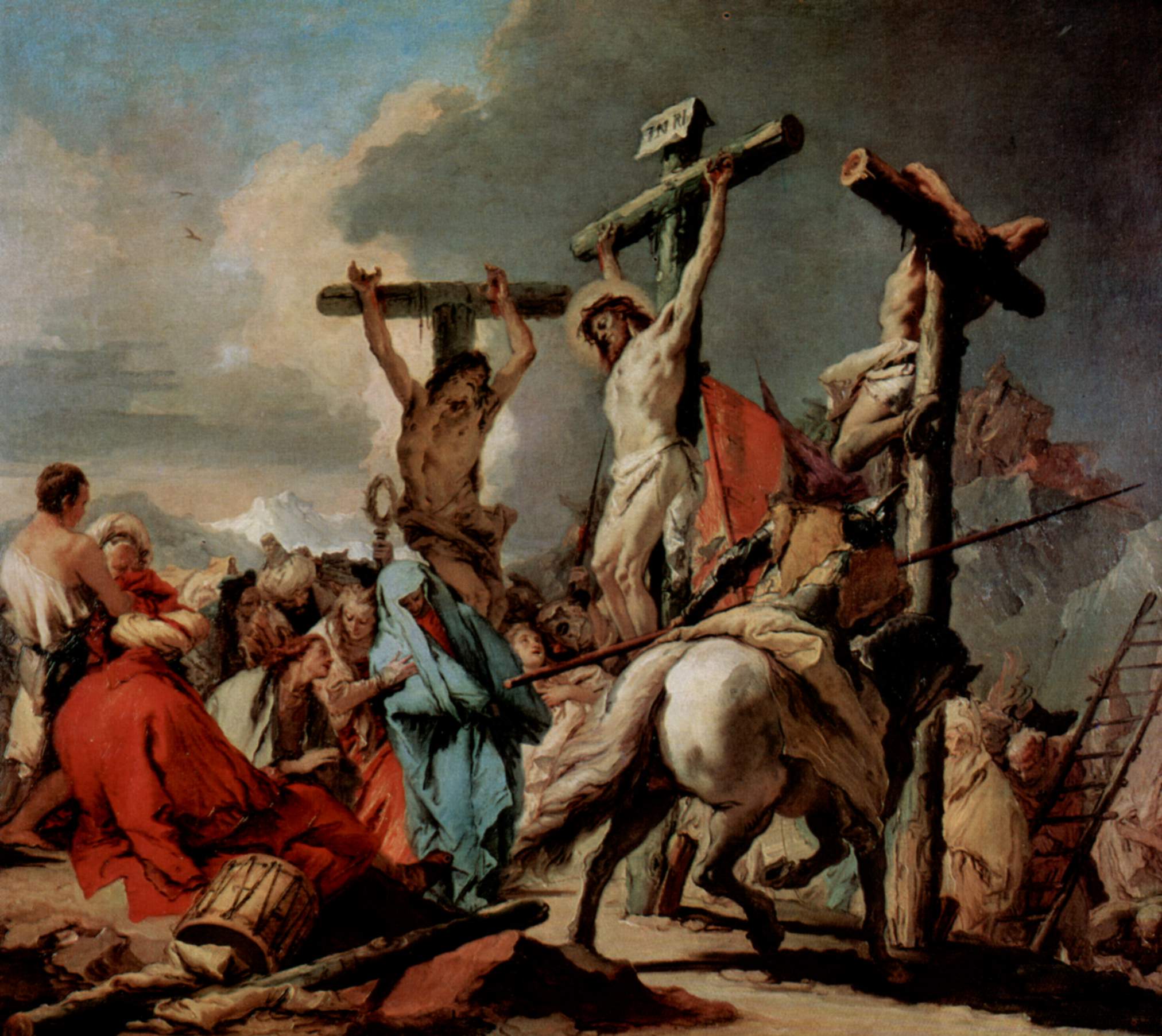
Tiepolo, Christ on the Cross, 1750


MATTHEW 27:32-56
32 And as they came out, they found a man of Cyrene, Simon by name: him they compelled to bear his cross.

33 And when they were come unto a place called Golgotha, that is to say, a place of a skull,

34 They gave him vinegar to drink mingled with gall: and when he had tasted thereof, he would not drink.

35 And they crucified him, and parted his garments, casting lots: that it might be fulfilled which was spoken by the prophet, They parted my garments among them, and upon my vesture did they cast lots.

36 And sitting down they watched him there;

37 And set up over his head his accusation written, This Is Jesus The King Of The Jews.

38 Then were there two thieves crucified with him, one on the right hand, and another on the left.

39 And they that passed by reviled him, wagging their heads,

40 And saying, Thou that destroyest the temple, and buildest it in three days, save thyself. If thou be the Son of God, come down from the cross.

41 Likewise also the chief priests mocking him, with the scribes and elders, said,

42 He saved others; himself he cannot save. If he be the King of Israel, let him now come down from the cross, and we will believe him.

43 He trusted in God; let him deliver him now, if he will have him: for he said, I am the Son of God.

44 The thieves also, which were crucified with him, cast the same in his teeth.

45 Now from the sixth hour there was darkness over all the land unto the ninth hour.

46 And about the ninth hour Jesus cried with a loud voice, saying, Eli, Eli, lama sabachthani? that is to say, My God, my God, why hast thou forsaken me?

47 Some of them that stood there, when they heard that, said, This man calleth for Elias.

48 And straightway one of them ran, and took a spunge, and filled it with vinegar, and put it on a reed, and gave him to drink.

49 The rest said, Let be, let us see whether Elias will come to save him.

50 Jesus, when he had cried again with a loud voice, yielded up the ghost.

51 And, behold, the veil of the temple was rent in twain from the top to the bottom; and the earth did quake, and the rocks rent;

52 And the graves were opened; and many bodies of the saints which slept arose,

53 And came out of the graves after his resurrection, and went into the holy city, and appeared unto many.

54 Now when the centurion, and they that were with him, watching Jesus, saw the earthquake, and those things that were done, they feared greatly, saying, Truly this was the Son of God.

55 And many women were there beholding afar off, which followed Jesus from Galilee, ministering unto him:

56 Among which was Mary Magdalene, and Mary the mother of James and Joses, and the mother of Zebedees children.
26 March 2025

Marvelous.

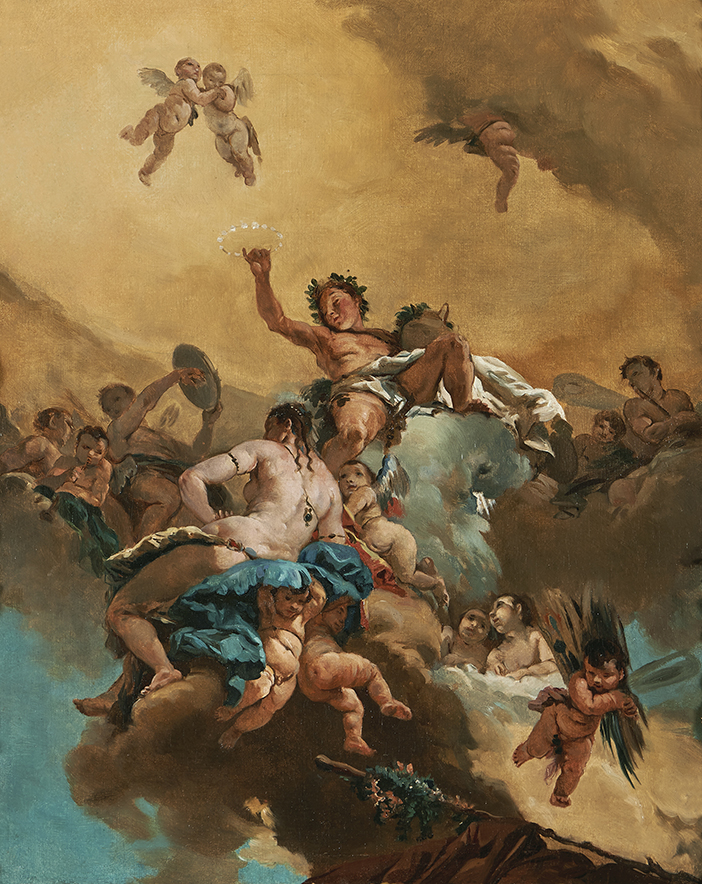
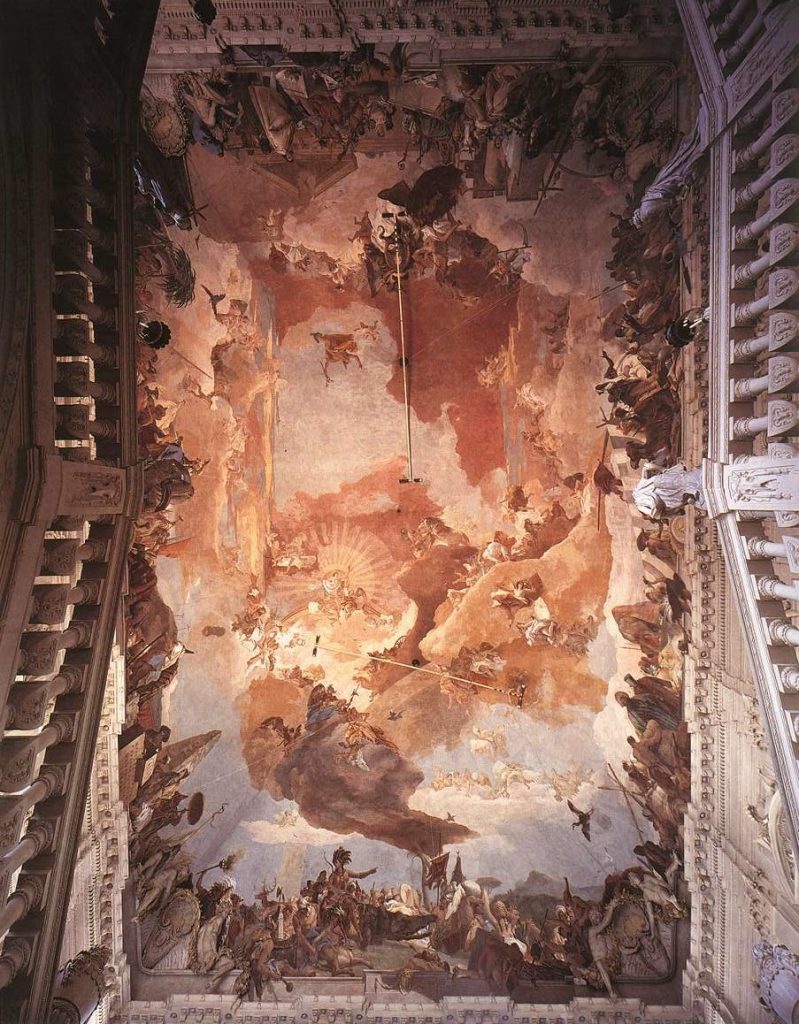
Tiepolo, Bacchus and Ariadne, 1735


I am an excitable person who only understands life lyrically, musically, in whom feelings are much stronger as reason. I am so thirsty for the marvelous that only the marvelous has power over me. Anything I can not transform into something marvelous, I let go. Reality doesn't impress me. I only believe in intoxication, in ecstasy, and when ordinary life shackles me, I escape, one way or another. 

Anaïs Nin

05 March 2025

Happy Birthday, Tiepolo


Dreams and fables I fashion, but even while I sketch and elaborate fables and dreams upon paper, I so enter into them that I weep and am offended at ills I invented. But am I wiser when art does not deceive me?

Giovanni Tiepolo was born on this day 1696

05 March 2024

12 March 2023

Apart.

Tiepolo, The Wind Gods (detail), 1770


Art, as we have known it, stands on the threshold of the transcendental. It points beyond this world of accidental and disconnected things to another realm, in which human life is endowed with an emotional logic that makes suffering noble and love worthwhile. Nobody who is alert to beauty, therefore, is without the concept of redemption – of a final transcendence of mortal disorder into a "kingdom of ends."

It is present in our experience of human beauty. And it is equally present in an experience that anthropologists have puzzled over for two centuries or more, and which appears to be a human universal: the experience of the sacred. In every civilization at every period of history people have devoted time and energy to sacred things. The sacred, like the beautiful, includes every category of object. There are sacred words, sacred gestures, sacred rites, sacred clothes, sacred places, sacred times. Sacred things are not of this world: they are set apart from ordinary reality and cannot be touched or uttered without rites of initiation or the privilege of religious office. To meddle with them without some purifying preparation is to run the risk of sacrilege. It is to desecrate and pollute what is holy, by dragging it down into the sphere of everyday events.

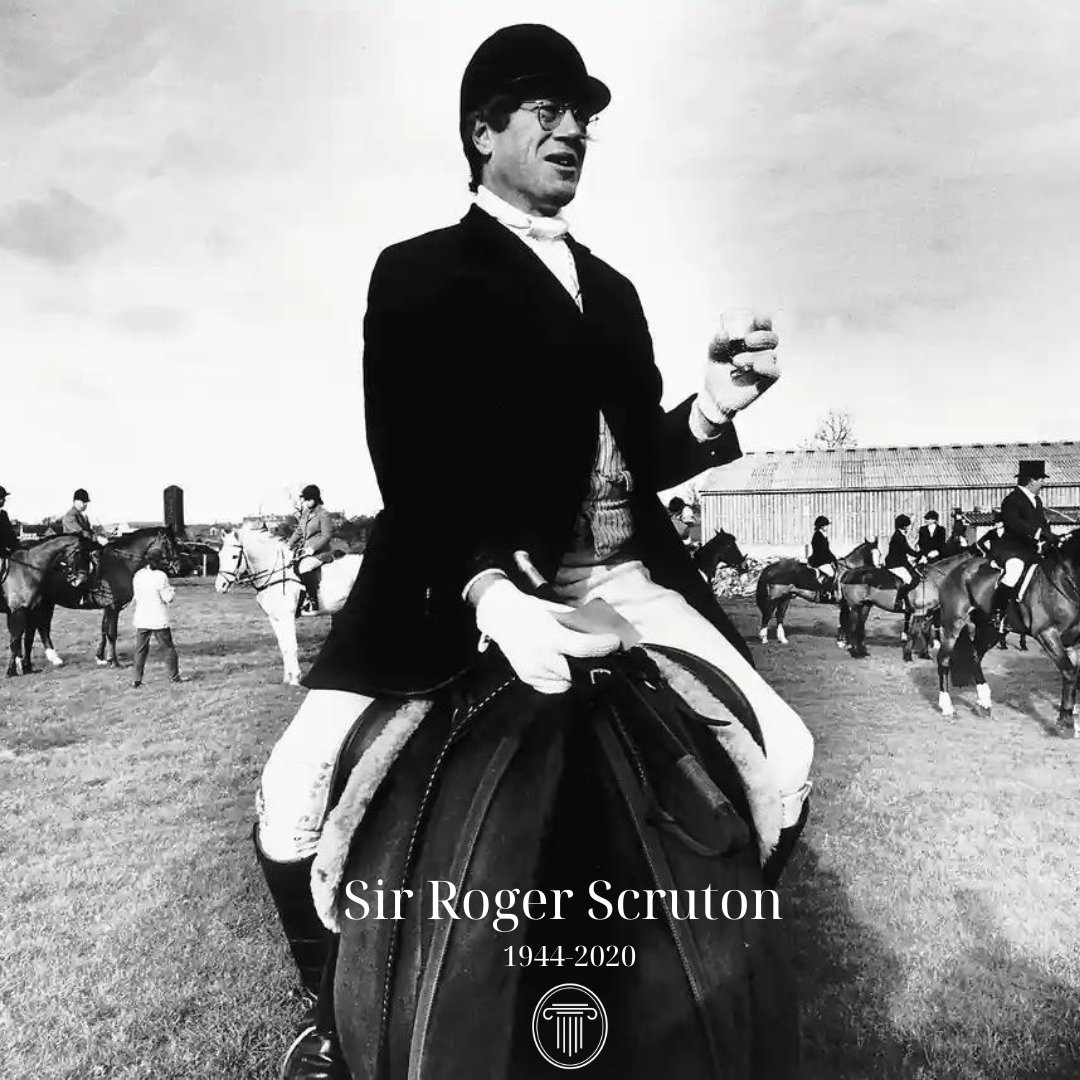
Sir Roger Scruton, from Beauty: A Very Short Introduction

05 March 2022

Happy Birthday, Tiepolo

Tiepolo, Head of a Young Man, Three-Quarter View, 1743


Giovanni Tiepolo was born on this day in 1696.

A portfolio of 48 drawings by Giovanni Battista Tiepolo from the Horne Museum in Florence were restored to commemorate the 50th anniversary of the 1966 floods that struck Florence and Venice ...

14 September 2021

Wisely.

Tiepolo, Armida and Rinaldo, 1753


LOVE'S PROGRESS

Who ever loves, if he do not propose
The right true end of love, he's one that goes
To sea for nothing but to make him sick.
Love is a bear-whelp born: if we o'erlick
Our love, and force it new strange shapes to take,
We err, and of a lump a monster make.
Were not a calf a monster that were grown
Faced like a man, though better than his own?
Perfection is in unity: prefer
One woman first, and then one thing in her.
I, when I value gold, may think upon
The ductileness, the application,
The wholsomeness, the ingenuity,
From rust, from soil, from fire ever free;
But if I love it, 'tis because 'tis made
By our new nature (Use) the soul of trade.
All these in women we might think upon
(If women had them) and yet love but one.
Can men more injure women than to say
They love them for that by which they're not they?
Makes virtue woman? Must I cool my blood
Till I both be, and find one, wise and good?
May barren angels love so! But if we
Make love to woman, virtue is not she,
As beauty's not, nor wealth. He that strays thus
From her to hers is more adulterous
Than if he took her maid. Search every sphere
And firmament, our Cupid is not there;
He's an infernal god, and under ground
With Pluto dwells, where gold and fire abound:
Men to such gods their sacrificing coals
Did not in altars lay, but pits and holes.
Although we see celestial bodies move
Above the earth, the earth we till and love:
So we her airs contemplate, words and heart
And virtues, but we love the centric part.
Nor is the soul more worthy, or more fit,
For love than this, as infinite is it.
But in attaining this desired place
How much they err that set out at the face.
The hair a forest is of ambushes,
Of springs, snares, fetters and manacles;
The brow becalms us when 'tis smooth and plain,
And when 'tis wrinkled shipwrecks us again—
Smooth, 'tis a paradise where we would have
Immortal stay, and wrinkled 'tis our grave.
The nose (like to the first meridian) runs
Not ‘twixt an East and West, but ‘twixt two suns;
It leaves a cheek, a rosy hemisphere,
On either side, and then directs us where
Upon the Islands Fortunate we fall,
(Not faint Canaries, but Ambrosial)
Her swelling lips; to which when we are come,
We anchor there, and think ourselves at home,
For they seem all: there Sirens' songs, and there
Wise Delphic oracles do fill the ear;
There in a creek where chosen pearls do swell,
The remora, her cleaving tongue doth dwell.
These, and the glorious promontory, her chin,
O'erpassed, and the straight Hellespont between
The Sestos and Abydos of her breasts,
(Not of two lovers, but two loves the nests)
Succeeds a boundless sea, but yet thine eye
Some island moles may scattered there descry;
And sailing towards her India, in that way
Shall at her fair Atlantic navel stay;
Though thence the current be thy pilot made,
Yet ere thou be where thou wouldst be embayed
Thou shalt upon another forest set,
Where many shipwreck and no further get.
When thou art there, consider what this chase
Misspent by thy beginning at the face.
Rather set out below; practise my art.
Some symetry the foot hath with that part
Which thou dost seek, and is thy map for that,
Lovely enough to stop, but not stay at;
Least subject to disguise and change it is—
Men say the devil never can change his.
It is the emblem that hath figured
Firmness; 'tis the first part that comes to bed.
Civility we see refined; the kiss
Which at the face began, transplanted is,
Since to the hand, since to the imperial knee,
Now at the papal foot delights to be:
If kings think that the nearer way, and do
Rise from the foot, lovers may do so too;
For as free spheres move faster far than can
Birds, whom the air resists, so may that man
Which goes this empty and ethereal way,
Than if at beauty's elements he stay.
Rich nature hath in women wisely made
Two purses, and their mouths aversely laid:
They then which to the lower tribute owe
That way which that exchequer looks must go:
He which doth not, his error is as great
As who by clyster gave the stomach meat.

John Donne

12 September 2021

Transcendental.

Tiepolo, The Wind Gods (detail), 1770


Art, as we have known it, stands on the threshold of the transcendental. It points beyond this world of accidental and disconnected things to another realm, in which human life is endowed with an emotional logic that makes suffering noble and love worthwhile. Nobody who is alert to beauty, therefore, is without the concept of redemption – of a final transcendence of mortal disorder into a "kingdom of ends."

It is present in our experience of human beauty. And it is equally present in an experience that anthropologists have puzzled over for two centuries or more, and which appears to be a human universal: the experience of the sacred. In every civilization at every period of history people have devoted time and energy to sacred things. The sacred, like the beautiful, includes every category of object. There are sacred words, sacred gestures, sacred rites, sacred clothes, sacred places, sacred times. Sacred things are not of this world: they are set apart from ordinary reality and cannot be touched or uttered without rites of initiation or the privilege of religious office. To meddle with them without some purifying preparation is to run the risk of sacrilege. It is to desecrate and pollute what is holy, by dragging it down into the sphere of everyday events.

Sir Roger Scruton, from Beauty: A Very Short Introduction

27 April 2021

Attains.

Tiepolo, Triumph of the Arts and Sciences (detail), 1731


A poet makes himself a visionary through a long, boundless, and systematized disorganization of all the senses. All forms of love, of suffering, of madness; he searches himself, he exhausts within himself all poisons, and preserves their quintessences. Unspeakable torment, where he will need the greatest faith, a superhuman strength, where he becomes all men the great invalid, the great criminal, the great accursed--and the Supreme Scientist! For he attains the unknown! Because he has cultivated his soul, already rich, more than anyone! He attains the unknown, and if, demented, he finally loses the understanding of his visions, he will at least have seen them! So what if he is destroyed in his ecstatic flight through things unheard of, unnameable: other horrible workers will come; they will begin at the horizons where the first one has fallen!

Arthur Rimbaud

05 March 2021

Happy Birthday, Tiepolo

Tiepolo, Allegory of the Planets and Continents, 1752


Giovanni Battista Tiepolo was born on this day in 1696.

05 March 2020

Happy Birthday, Tiepolo

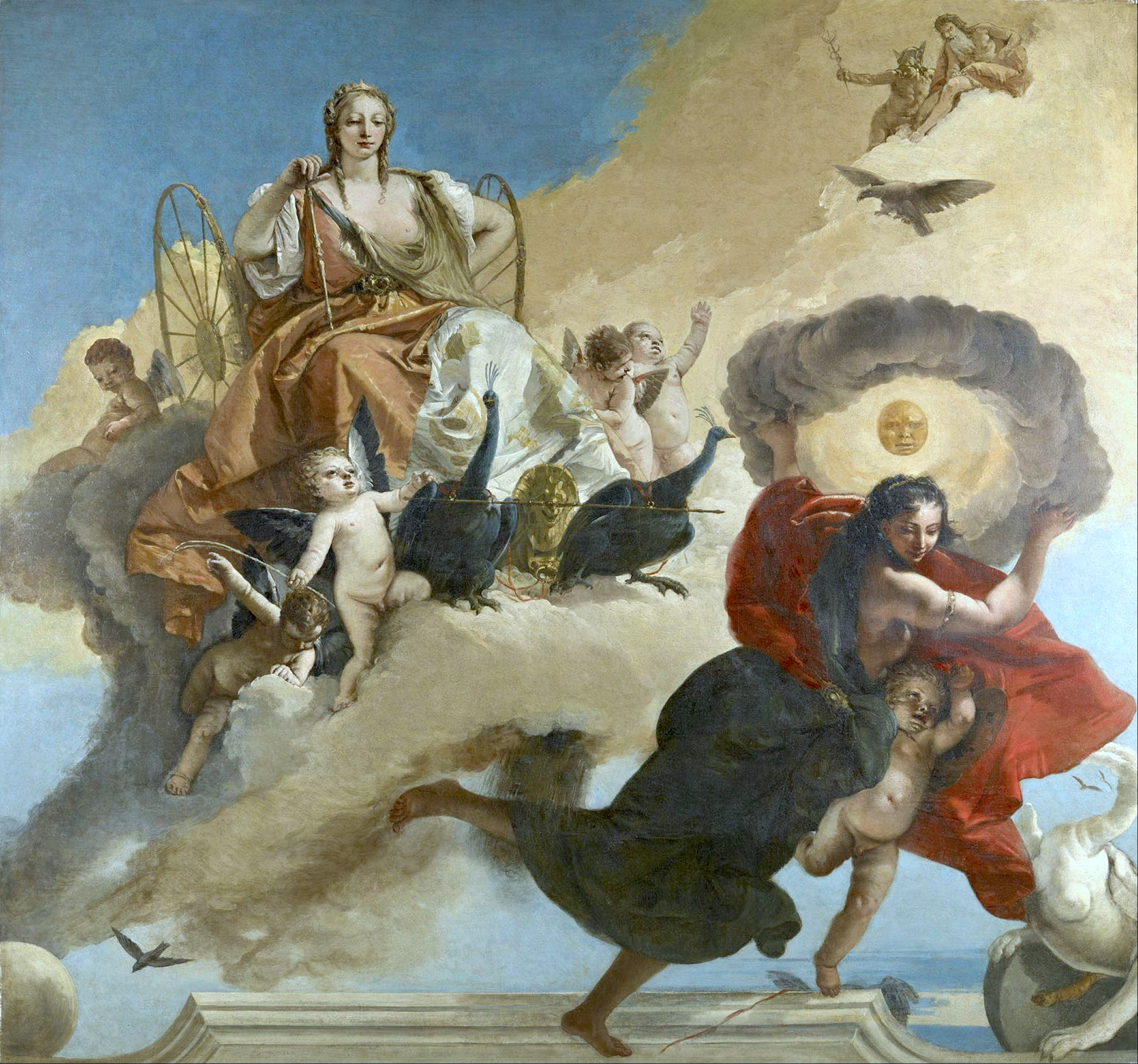
Tiepolo, Juno and Luna, 1745


Giovanni Tiepolo was born on this date in 1796.

05 March 2019

05 March 2018

Happy birthday, Tiepolo.

Tiepolo, The Immaculate Conception (detail), 1768


Giovanni Battista Tiepolo was born on this day in 1696.

10 May 2017

Objectively.

Tiepolo, Woman with as Parrot, 1760


Audience Member:  What’s the most beautiful color … objectively?

Roger Scruton: The most beautiful color, objectively, is the pale violet used by Tiepolo in painting the lips of degenerate women.

Audience Member: What’s the most truthful one?

Scruton:  I think that one is equally truthful.

19 April 2017

Sings.

Tiepolo, The Empire of Flora, 1743


Spring! And Earth is like a child
who has learned many poems by heart.
For the trouble of that long learning
she wins the prize.

Her teacher was strict. We loved the white
of the old man's beard. Now we can ask her
the many names of green, of blue,
and she knows them, she knows them!

Earth, school is out now. You're free
to play with the children. We'll catch you,
joyous Earth. The happiest will catch you!

All that the teacher taught her—the many thoughts
pressed now into roots and long
tough stems: she sings! She sings!

Rainer Maria Rilke

19 June 2015

Up.

Tiepolo, The Sacrifice of Isaac (detail), 1729


Up then, fair phoenix bride, frustrate the sun;
Thyself from thine affection
Takest warmth enough, and from thine eye
All lesser birds will take their jollity.
Up, up, fair bride, and call
Thy stars from out their several boxes, take
Thy rubies, pearls, and diamonds forth, and make
Thyself a constellation of them all;
And by their blazing signify
That a great princess falls, but doth not die.
Be thou a new star, that to us portends
Ends of much wonder; and be thou those ends.

John Donne

CONNECT