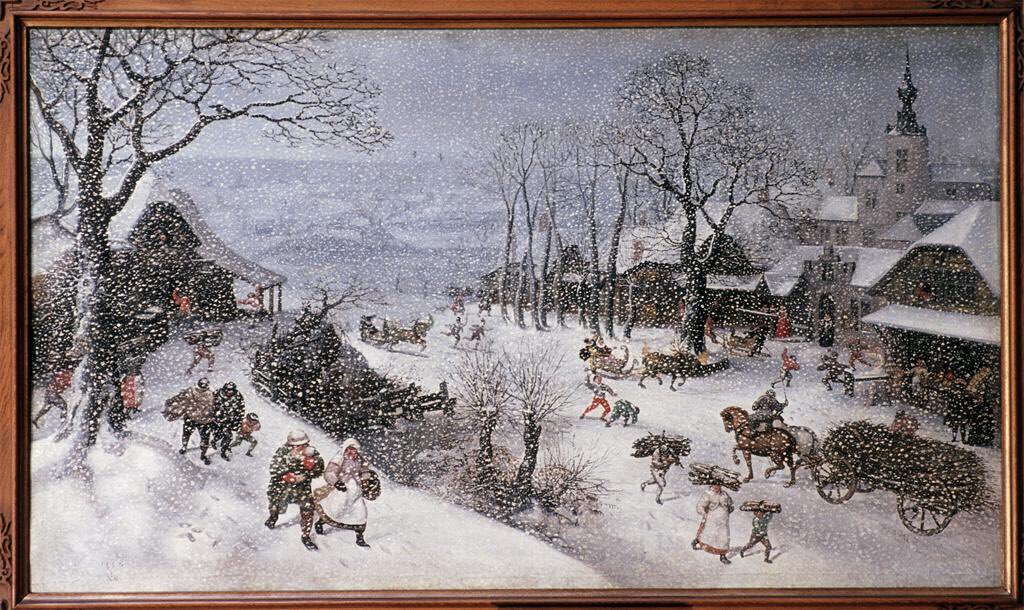
"I am not one who was born in the custody of wisdom. I am one who is fond of olden times and intense in quest of the sacred knowing of the ancients." Gustave Courbet

19 February 2024

Only.


People can foresee the future only when it coincides with their own wishes, and the most grossly obvious facts can be ignored when they are unwelcome.

Study.

Brady, Abraham Lincoln, 1864


We can not have free government without elections; and if the rebellion could force us to forego, or postpone a national election, it might fairly claim to have already conquered and ruined us. The strife of the election is but human-nature practically applied to the facts of the case. What has occurred in this case, must ever recur in similar cases. Human-nature will not change. In any future great national trial, compared with the men of this, we shall have as weak, and as strong; as silly and as wise; as bad and good. Let us, therefore, study the incidents of this, as philosophy to learn wisdom from, and none of them as wrongs to be revenged.

Abraham Lincoln, from his speech given November 10, 1864

Entrusted.


I dwell on this prospect with every satisfaction which an ardent love for my Country can inspire: since there is no truth more thoroughly established, than that there exists in the economy and course of nature, an indissoluble union between virtue and happiness, between duty and advantage, between the genuine maxims of an honest and magnanimous policy, and the solid rewards of public prosperity and felicity: Since we ought to be no less persuaded that the propitious smiles of Heaven, can never be expected on a nation that disregards the eternal rules of order and right, which Heaven itself has ordained: And since the preservation of the sacred fire of liberty, and the destiny of the Republican model of Government, are justly considered as deeply, perhaps as finally staked, on the experiment entrusted to the hands of the American people.

George Washington, from his first Inaugural Speech, April 30, 1789

Happy Birthday, Boccherini

Bourgeois de La Richardière, Luigi Boccherini, after LeFèvre, 1814


Luigi Boccherini was born on this day in 1743.

Maria Sofianska accompanies Božo Paradžik and his double bass in a performance of the second and third movements of the Sonata in A Major ...

18 February 2024

The Gloaming, "The Sailor's Bonnet"

Storm-Stayed.

Caddick, The Night, 1980


The kail grows brittle from the snow in my dank and cheerless garden. A crust of bread gathers timid pheasants round me. The robins, I see, have made the coalhouse their home. Waster Lunny's dog never barks without rousing my sluggish cat to a joyful response. It is Dutch courage with the birds and beasts of the glen, hard driven for food; but I look attentively for them in these long forenoons, and they have begun to regard me as one of themselves. My breath freezes, despite my pipe, as I peer from the door; and with a fortnight-old newspaper I retire to the ingle-nook. The friendliest thing I have seen to-day is the well-smoked ham suspended from my kitchen rafters. It was a gift from the farm of Tullin, with a load of peats, the day before the snow began to fall. I doubt if I have seen a cart since.

This afternoon I was the not altogether passive spectator of a curious scene in natural history. My feet encased in stout "tackety" boots, I had waded down two of Waster Lunny's fields to the glen burn: in summer the never-failing larder from which, with wriggling worm or garish fly, I can any morning whip a savoury breakfast; in the winter-time the only thing in the valley that defies the ice-king's chloroform. I watched the water twisting black and solemn through the snow, the ragged ice on its edge proof of the toughness of the struggle with the frost, from which it has, after all, crept only half victorious. A bare wild rosebush on the further bank was violently agitated, and then there ran from its root a black-headed rat with wings. Such was the general effect. I was not less interested when my startled eyes divided this phenomenon into its component parts, and recognized in the disturbance on the opposite bank only another fierce struggle among the hungry animals for existence: they need no professor to teach them the doctrine of the survival of the fittest. A weasel had gripped a water-hen (whit-rit and beltie they are called in these parts) cowering at the root of the rose-bush, and was being dragged down the bank by the terrified bird, which made for the water as its only chance of escape. In less disadvantageous circumstances the weasel would have made short work of his victim; but as he only had the bird by the tail, the prospects of the combatants were equalized. It was the tug-of-war being played with a life as the stakes. "If I do not reach the water," was the argument that went on in the heaving little breast of the one, "I am a dead bird." "If this water-hen," reasoned the other, "reaches the burn, my supper vanishes with her." Down the sloping bank the hen had distinctly the best of it, but after that came a yard of level snow, and here she tugged and screamed in vain. I had so far been an unobserved spectator; but my sympathies were with the beltie, and, thinking it high time to interfere, I jumped into the water. The water-hen gave one mighty final tug and toppled into the burn; while the weasel viciously showed me his teeth, and then stole slowly up the bank to the rose-bush, whence, "girning," he watched me lift his exhausted victim from the water, and set off with her for the schoolhouse. Except for her draggled tail, she already looks wonderfully composed, and so long as the frost holds I shall have little difficulty in keeping her with me. On Sunday I found a frozen sparrow, whose heart had almost ceased to beat, in the disused pig-sty, and put him for warmth into my breast-pocket. The ungrateful little scrub bolted without a word of thanks about ten minutes afterwards to the alarm of my cat, which had not known his whereabouts.

I am alone in the schoolhouse. On just such an evening as this last year my desolation drove me to Waster Lunny, where I was storm-stayed for the night. The recollection decides me to court my own warm hearth, to challenge my right hand again to a game at the "dambrod" against my left. I do not lock the schoolhouse door at nights; for even a highwayman (there is no such luck) would be received with open arms, and I doubt if there be a barred door in all the glen. But it is cosier to put on the shutters. The road to Thrums has lost itself miles down the valley. I wonder what they are doing out in the world. Though I am the Free Church precentor in Thrums (ten pounds a year, and the little town is five miles away), they have not seen me for three weeks. A packman whom I thawed yesterday at my kitchen fire tells me, that last Sabbath only the Auld Lichts held service. Other people realized that they were snowed up. Far up the glen, after it twists out of view, a manse and half a dozen thatched cottages that are there may still show a candle light, and the crumbling gravestones keep cold vigil round the grey old kirk. Heavy shadows fade into the sky to the north. A flake trembles against the window; but it is too cold for much snow to-night. The shutter bars the outer world from the schoolhouse.

J.M. Barrie, from "The Schoolhouse," found in Auld Light Idylls

Winding-Sheets.


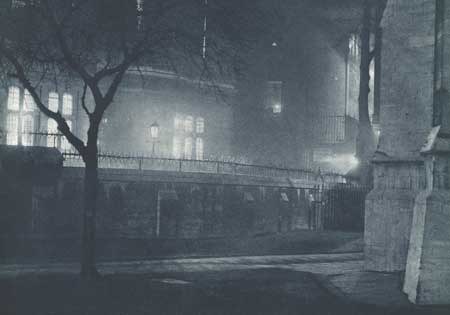
Between the bridge and the two great theatres, there was but the distance of a few hundred paces, so the theatres came next. Grim and black within, at night, those great dry Wells, and lonesome to imagine, with the rows of faces faded out, the lights extinguished, and the seats all empty. One would think that nothing in them knew itself at such a time but Yorick’s skull. In one of my night walks, as the church steeples were shaking the March winds and rain with the strokes of Four, I passed the outer boundary of one of these great deserts, and entered it. With a dim lantern in my hand, I groped my well-known way to the stage and looked over the orchestra—which was like a great grave dug for a time of pestilence—into the void beyond. A dismal cavern of an immense aspect, with the chandelier gone dead like everything else, and nothing visible through mist and fog and space, but tiers of winding-sheets. The ground at my feet where, when last there, I had seen the peasantry of Naples dancing among the vines, reckless of the burning mountain which threatened to overwhelm them, was now in possession of a strong serpent of engine-hose, watchfully lying in wait for the serpent Fire, and ready to fly at it if it showed its forked tongue. A ghost of a watchman, carrying a faint corpse candle, haunted the distant upper gallery and flitted away. Retiring within the proscenium, and holding my light above my head towards the rolled-up curtain—green no more, but black as ebony—my sight lost itself in a gloomy vault, showing faint indications in it of a shipwreck of canvas and cordage. Methought I felt much as a diver might, at the bottom of the sea. 

Charles Dickens, from "Night Walks"

Gavin Bryars, Silva Caledonia

Ludus Gravis Ensemble performs ...


Thank you, Walker's Arms.

Yes, "Madrigal"

Round.

Jaques, Gladiola, n/d


Shall I tell you the secret of the whole world? It is that we have only known the back of the world. We see everything from behind, and it looks brutal. That is not a tree, but the back of a tree. That is not a cloud, but the back of a cloud. Cannot you see that everything is stooping and hiding a face? If we could only get round in front—

G.K. Chesterton, from The Man Who Was Thursday

Monteverdi, Cantate Domino, SV 293

VOCES8 perform ...

Made.


True freedom is impossible without a mind made free by discipline.

Mortimer J. Adler

Stuff.


Stuff your eyes with wonder. Live as if you'd drop dead in ten seconds. See the world. It's more fantastic than any dream made or paid for in factories. Ask no guarantees, ask for no security, there never was such an animal. And if there were, it would be related to the great sloth which hangs upside down in a tree all day every day, sleeping its life away. To hell with that.  Shake the tree and knock the great sloth down on his ass.

Ray Bradbury, from Fahrenheit 451

Happy Birthday, Stegner


All this is to say that I believe in conscience, not as something implanted by divine act, but as something learned from infancy, from the tradition and society which bred us. The outward forms of virtue will vary greatly from nation to nation.  But in the essential outlines of what constitutes human decency, we vary amazingly little. The Chinese and the Indian know as well as I do what kindness is, what generosity is, what fortitude is. They can define justice quite as accurately. It is only when they and I are blinded by tribal and denominational narrowness that we must insist upon our differences and can recognize goodness only in the robes of our own crowd.  I am humble before the responsibilities that are also mine. For no right comes without a responsibility, and being born luckier than most of the world's millions, I am also born more obligated.

Wallace Stegner, born on this day in 1909

17 February 2024

Excellent.


The world was introduced to AC⚡DC on this day in 1975.

Side One, Track One ... is an awful song, so let's flip that platter over and put the needle down on this beauty, the final track ...


It's sandwich time.

Rebuilding.

NOVA's Rebuilding Notre Dame ...

Listen.

From a 1983 episode of Firing Line, Buckley and guest Mortimer Adler in discussion on how to speak and how to listen ...

Gratefulness.

Pozzo, Church of St. Ignatius, 1685
  

The root of joy is gratefulness.  It is not joy that makes us grateful; it is gratitude that makes us joyful.   Gratefulness is the great task, the how of our spiritual work, because, rightly understood, it re-roots us. Look closely and you will find that people are happy because they are grateful. The opposite of gratefulness is just taking everything for granted. 

David Steindl-Rast

Excellent.

An excellent album ...

Civility.

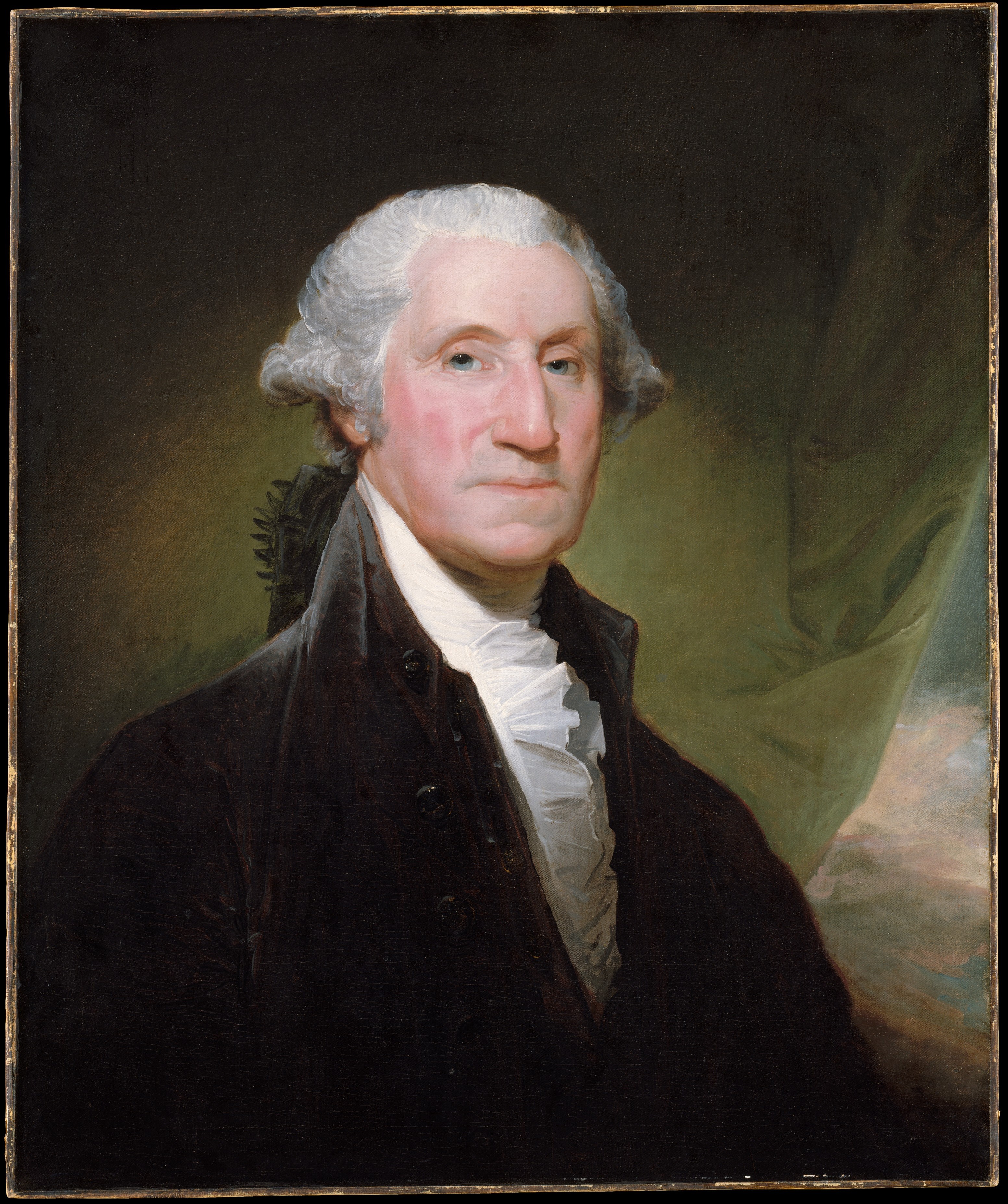
Stuart, George Washington, 1795


These maxims originated in the late sixteenth century in France and were popularly circulated during Washington's time. This exercise, now regarded as a formative influence in the development of his character, included guidelines for behavior in pleasant company, appropriate actions in formal situations, and general courtesies.
My favorite ...
While someone is Speaking, raise not your Index finger while checking your electronic  interrupter.

Happy Birthday, Corelli

Howard, Arcangelo Corelli, 1697


Arcangelo Corelli was born on this day in 1653.

The Concerto Grosso in D Major performed by the Drottningholm Baroque Ensemble, featuring Elin Gabrielsson violin, and Erik Rydvall, nyckelharpa ...

16 February 2024

Happy Birthday, Mac

John McEnroe was born on this day in 1959.

Battling Bjorn Borg in the fourth set tiebreak of the 1980 Wimbledon final ...
15 February 2024

Feminized.


Why Is No One Talking about Muteness Envy? 
Lately, a lot of powerful people, especially men, have been loudly proclaiming themselves to be silenced, powerless victims. The phenomenon has become so widespread and predictable over the last several years that it can feel like its participants are following a set script. Think of Brett Kavanaugh’s tears during his Supreme Court confirmation hearings; of Kyle Rittenhouse sobbing before the courtroom; of Harvey Weinstein’s claim to shame when an accuser described his “deformed” genitals on the stand and photographic evidence was circulated amongst the jury; of the looped videos that interrupted Instagram feeds with superalgorithmic intensity of Johnny Depp silently shaking his head during Amber Heard’s testimony; of comedians taking the stage in soldout theaters or on widely streamed specials, not long after being “canceled” due to sexual assault allegations, to protest the suppression of their speech. Think of police officers and occupying soldiers insisting on their vulnerability as justification for shooting the unarmed; of presidents proclaiming themselves the victims of “witch hunts”; of tenured professors and securely employed staff writers for major publications wailing at the injustice of being “bullied” by adjuncts or trans people on the internet; of the general trend that the critic B. D. McClay has called the reign of “sore winners”— whiners who won’t admit they’re winners. 

As the feminist deconstructionist critic Barbara Johnson demonstrated in her promiscuously wide-ranging yet coolly coy essay “Muteness Envy,” published in 1996, these performances of reticence have been happening for a long time. Johnson’s essay diagnoses this pathology of the powerful as an appropriation of femininized “muteness” that gains a special kind of voice and power precisely through silencing and disempowerment. And it’s been around, she helps us see, for centuries, even millennia, often as a lyric voice. Lyric, after all, has always been the favored genre for anyone looking to win by losing. Lyric is wish fulfillment for people whose wish is that their wish won’t be fulfilled. Muteness envy shows us that if lyric has lost its power as a literary genre, it lives on, immortal as a laurel, as our crypto-dominant cultural one. “Muteness envy!” I’ve exclaimed silently to myself every time I’ve encountered a powerful person exclaiming about being silenced over the past few years, and then, silently, or sometimes to the void of the internet, I’ve asked: “Why is no one talking about muteness envy?” 

Highly-Cited.


Cliques of mathematicians at institutions in China, Saudi Arabia, and elsewhere have been artificially boosting their colleagues’ citation counts by churning out low-quality papers that repeatedly reference their work, according to an unpublished analysis seen by Science. As a result, their universities—some of which do not appear to have math departments—now produce a greater number of highly-cited math papers each year than schools with a strong track record in the field, such as Stanford and Princeton universities.

These so-called “citation cartels” appear to be trying to improve their universities’ rankings, according to experts in publication practices. “The stakes are high—movements in the rankings can cost or make universities tens of millions of dollars,” says Cameron Neylon, a professor of research communication at Curtin University. “It is inevitable that people will bend and break the rules to improve their standing.” In response to such practices, the publishing analytics company Clarivate has excluded the entire field of math from the most recent edition of its influential list of authors of highly cited papers, released in November 2023.

Happy Birthday, Galileo

Carlton, after Suttermans, Galileo, 1842


It is a very beautiful thing, and most gratifying to the sight, to behold the body of the moon, distant from us almost sixty earthly radii, as if it were no farther away than two such measures—so that its diameter appears almost thirty times larger, its surface nearly nine hundred times, and its volume twenty-seven thousand times as large as when viewed with the naked eye. In this way one may learn with all the certainty of sense evidence that the moon is not robed in a smooth and polished surface but is in fact rough and uneven, covered everywhere, just like the earth’s surface, with huge prominences, deep valleys, and chasms.

Again, it seems to me a matter of no small importance to have ended the dispute about the Milky Way by making its nature manifest to the very senses as well as to the intellect. Similarly it will be a pleasant and elegant thing to demonstrate that the nature of those stars which astronomers have previously called “nebulous” is far different from what has been believed hitherto. But what surpasses all wonders by far, and what particularly moves us to seek the attention of all astronomers and philosophers, is the discovery of  four wandering stars not known or observed by any man before us. Like Venus and Mercury, which have their own periods about the sun, these have theirs about a certain star that is conspicuous among those already known, which they sometimes precede and sometimes follow, without ever departing from it beyond certain limits. All these facts were discovered and observed by me not many days ago with the aid of a spyglass which I devised, after first being illuminated by divine grace. Perhaps other things, still more remarkable, will in time be discovered by me or by other observers with the aid of such an instrument, the form and construction of which I shall first briefly explain, as well as the occasion of its having been devised.  Afterwards I shall relate the story of the observations I have made.

Galileo Galilei, born on this day in 1564, from "The Starry Messenger"

Aesthetic.


We can’t go back in time and do the pandemic differently at this point, nor is there any realistic path to putting the smartphone genie back in the bottle. (Though I will note that we as a society do at least attempt to keep other addictive products out of the hands of children.) But I have to think that we can, at the very least, stop actively preventing young people from developing the ability to follow extended narratives and arguments in the classroom. Regardless of their profession or ultimate educational level, they will need those skills. The world is a complicated place. People—their histories and identities, their institutions and work processes, their fears and desires—are simply too complex to be captured in a worksheet with a paragraph and some reading comprehension questions. Large-scale prose writing is the best medium we have for capturing that complexity, and the education system should not be in the business of keeping students from learning how to engage effectively with it.

This is a matter not of snobbery, but of basic justice. I recognize that not everyone centers their lives on books as much as a humanities professor does. I think they’re missing out, but they’re adults and they can choose how to spend their time. What’s happening with the current generation is not that they are simply choosing TikTok over Jane Austen. They are being deprived of the ability to choose—for no real reason or benefit. We can and must stop perpetrating this crime on our young people.
How can I regain that paradise, which was here just a moment ago? Only through art: through music, through story, through the alchemy of verse. I was listening to Abbey Road the other day. Somewhere between “You Never Give Me Your Money” and “Golden Slumbers,” I finally understood Nabokov’s definition of aesthetic bliss: “a sense of being somehow, somewhere, connected with other states of being where art (curiosity, tenderness, kindness, ecstasy) is the norm.”
14 February 2024

Love.


On the corner of Government and Bay Avenue
The old doomsday fanatic wore a crown of kudzu
Sirens were wailing in the gulf coastal heat
And it seemed like the whole world was in forced retreat

Paid no attention, revolved through the door
Passed the newspaper racks on the worn marble floor
Near Civil War history, my heart skipped a beat
She was standing in fiction, stretched high on bare feet

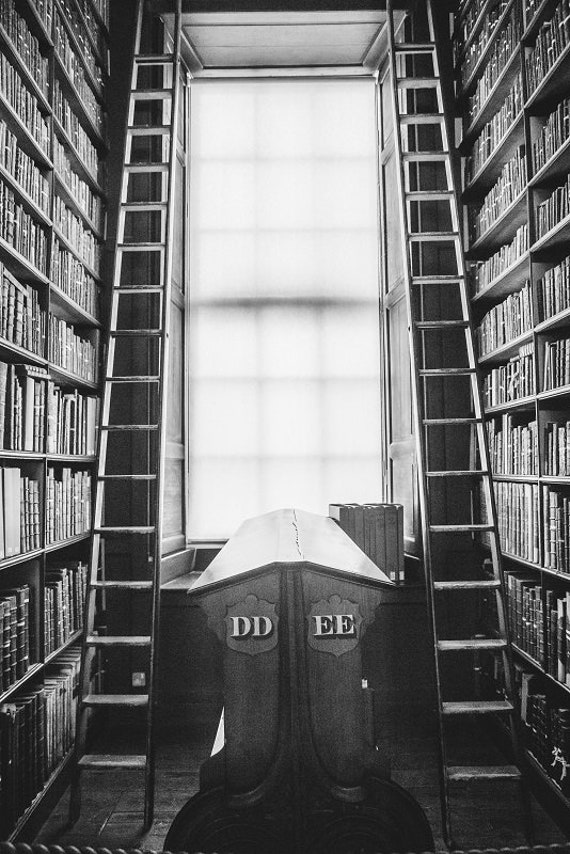
Love in the library, quiet and cool
Love in the library, there are no rules
Surrounded by stories, surreal and sublime
I fell in love in the library, once upon a time

I was the pirate, she was the queen
Sir Francis and Elizabeth, the best there's ever been
Then she strolled past my table and stopped at the stairs
Then she sent me a smile as she reached for Flaubert

Love in the library, quiet and cool
Love in the library, there are no rules
Surrounded by stories, surreal and sublime
I fell in love in the library, once upon a time

She gathered her books, walked while she read
Words never spoken but so much was said
You can read all you want into this rendezvous
But it's safer than most things that lovers can do

Well, stories have endings, fantasies fade
And the guard by the door starts drawing the shade
So, write your own ending and hope it comes true
For the lovers and strangers on Bay Avenue

Love in the library, quiet and cool
Love in the library, there are no rules
Surrounded by stories, surreal and sublime
I fell in love in the library, once upon a time

I fell in love in the library
Once upon a time

Jimmy Buffett

11 February 2024

Excellent.

An excellent album ...

Links.


TOWARD an ORGANIC PHILOSOPHY

SPRING, COAST RANGE
The glow of my campfire is dark red and flameless,   
The circle of white ash widens around it.
I get up and walk off in the moonlight and each time   
I look back the red is deeper and the light smaller.   
Scorpio rises late with Mars caught in his claw;   
The moon has come before them, the light   
Like a choir of children in the young laurel trees.   
It is April; the shad, the hot headed fish,
Climbs the rivers; there is trillium in the damp canyons;   
The foetid adder’s tongue lolls by the waterfall.
There was a farm at this campsite once, it is almost gone now.   
There were sheep here after the farm, and fire   
Long ago burned the redwoods out of the gulch,   
The Douglas fir off the ridge; today the soil   
Is stony and incoherent, the small stones lie flat   
And plate the surface like scales.
Twenty years ago the spreading gully
Toppled the big oak over onto the house.   
Now there is nothing left but the foundations   
Hidden in poison oak, and above on the ridge,   
Six lonely, ominous fenceposts;
The redwood beams of the barn make a footbridge   
Over the deep waterless creek bed;
The hills are covered with wild oats
Dry and white by midsummer.
I walk in the random survivals of the orchard.   
In a patch of moonlight a mole
Shakes his tunnel like an angry vein;
Orion walks waist deep in the fog coming in from the ocean;   
Leo crouches under the zenith.
There are tiny hard fruits already on the plum trees.   
The purity of the apple blossoms is incredible.   
As the wind dies down their fragrance
Clusters around them like thick smoke.
All the day they roared with bees, in the moonlight   
They are silent and immaculate.

SPRING, SIERRA NEVADA
Once more golden Scorpio glows over the col   
Above Deadman Canyon, orderly and brilliant,   
Like an inspiration in the brain of Archimedes.   
I have seen its light over the warm sea,
Over the coconut beaches, phosphorescent and pulsing;   
And the living light in the water
Shivering away from the swimming hand,
Creeping against the lips, filling the floating hair.
Here where the glaciers have been and the snow stays late,   
The stone is clean as light, the light steady as stone.
The relationship of stone, ice and stars is systematic and enduring:   
Novelty emerges after centuries, a rock spalls from the cliffs,   
The glacier contracts and turns grayer,
The stream cuts new sinuosities in the meadow,   
The sun moves through space and the earth with it,   
The stars change places.
                                    The snow has lasted longer this year,   
Than anyone can remember. The lowest meadow is a lake,   
The next two are snowfields, the pass is covered with snow,   
Only the steepest rocks are bare. Between the pass   
And the last meadow the snowfield gapes for a hundred feet,   
In a narrow blue chasm through which a waterfall drops,   
Spangled with sunset at the top, black and muscular   
Where it disappears again in the snow.
The world is filled with hidden running water   
That pounds in the ears like ether;
The granite needles rise from the snow, pale as steel;   
Above the copper mine the cliff is blood red,   
The white snow breaks at the edge of it;
The sky comes close to my eyes like the blue eyes   
Of someone kissed in sleep.
                                        I descend to camp,
To the young, sticky, wrinkled aspen leaves,
To the first violets and wild cyclamen,
And cook supper in the blue twilight.
All night deer pass over the snow on sharp hooves,   
In the darkness their cold muzzles find the new grass   
At the edge of the snow.

FALL, SIERRA NEVADA
This morning the hermit thrush was absent at breakfast,   
His place was taken by a family of chickadees;   
At noon a flock of humming birds passed south,   
Whirling in the wind up over the saddle between   
Ritter and Banner, following the migration lane   
Of the Sierra crest southward to Guatemala.
All day cloud shadows have moved over the face of the mountain,   
The shadow of a golden eagle weaving between them   
Over the face of the glacier.
At sunset the half-moon rides on the bent back of the Scorpion,   
The Great Bear kneels on the mountain.
Ten degrees below the moon
Venus sets in the haze arising from the Great Valley.
Jupiter, in opposition to the sun, rises in the alpenglow   
Between the burnt peaks. The ventriloquial belling   
Of an owl mingles with the bells of the waterfall.   
Now there is distant thunder on the east wind.   
The east face of the mountain above me
Is lit with far off lightnings and the sky
Above the pass blazes momentarily like an aurora.   
It is storming in the White Mountains,
On the arid fourteen-thousand-foot peaks;
Rain is falling on the narrow gray ranges
And dark sedge meadows and white salt flats of Nevada.   
Just before moonset a small dense cumulus cloud,   
Gleaming like a grape cluster of metal,
Moves over the Sierra crest and grows down the westward slope.
Frost, the color and quality of the cloud,
Lies over all the marsh below my campsite.
The wiry clumps of dwarfed whitebark pines   
Are smoky and indistinct in the moonlight,   
Only their shadows are really visible.
The lake is immobile and holds the stars
And the peaks deep in itself without a quiver.   
In the shallows the geometrical tendrils of ice   
Spread their wonderful mathematics in silence.   
All night the eyes of deer shine for an instant
As they cross the radius of my firelight.
In the morning the trail will look like a sheep driveway,   
All the tracks will point down to the lower canyon.   
“Thus,” says Tyndall, “the concerns of this little place   
Are changed and fashioned by the obliquity of the earth’s axis,
The chain of dependence which runs through creation,   
And links the roll of a planet alike with the interests   
Of marmots and of men.”

Kenneth Rexroth

Pause.


All beginnings are delightful; the threshold is the place to pause.

Johann Wolfgang von Goethe 

Thanks for the image, Walker's Arms.

Debussy, Children's Corner, L. 113, IV. The Snow is Dancing

Amadinda Percussion Group performs ...

Unfinished.


In everything, no matter what it may be, uniformity is undesirable. Leaving something incomplete makes it interesting, and gives one the feeling that there is room for growth. Someone once told me, "Even when building the imperial palace, they always leave one place unfinished." In both Buddhist and Confucian writings of the philosophers of former times, there are also many missing chapters.

Prerequisite.


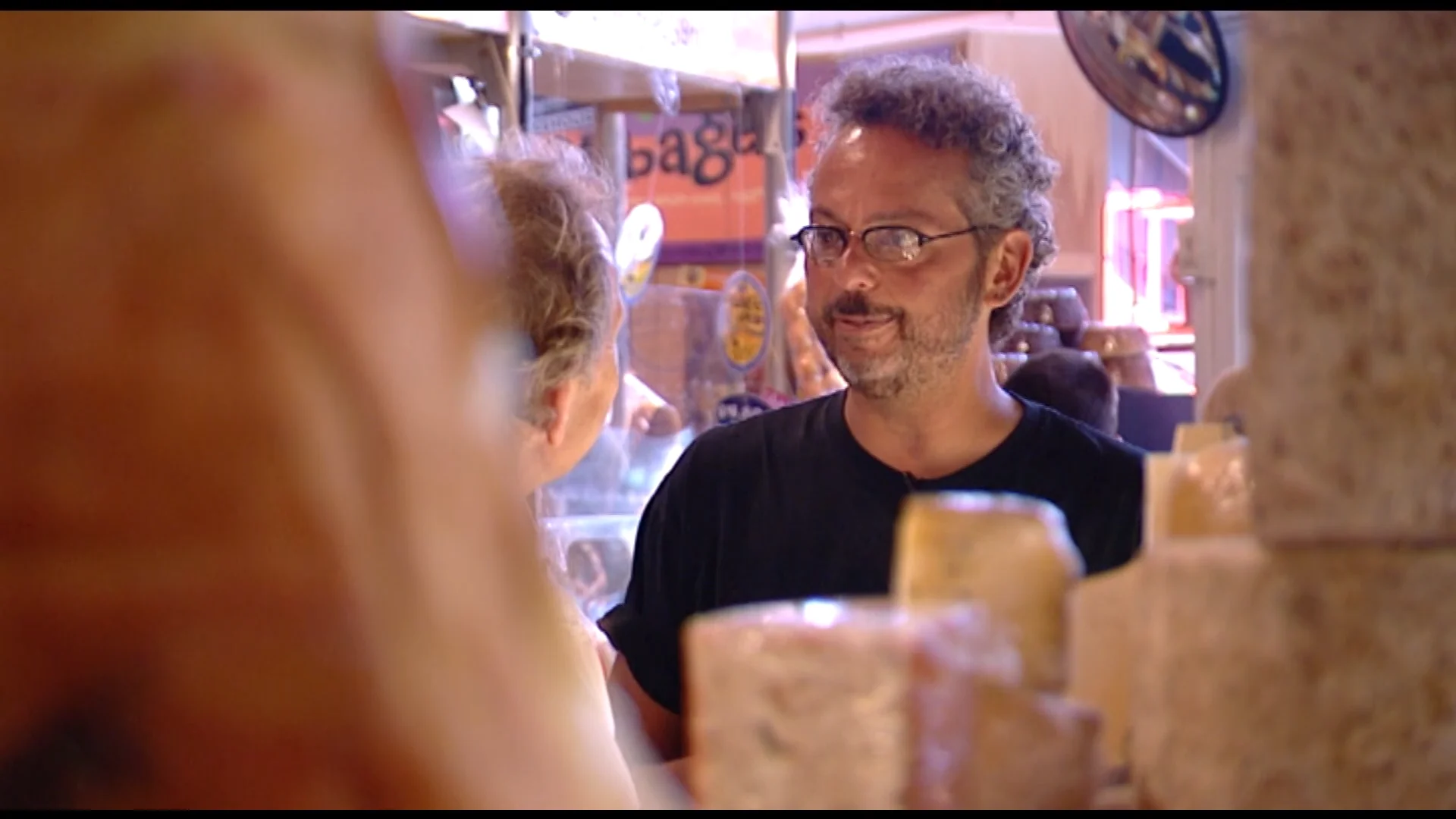
Ari Weinzweig explores nonconformity ...
Had I read Shahn’s “Nonconformity” piece—which was taken from a talk he had given at Harvard the previous spring—it would have made clear why Paul and I were onto something in those early years at the Deli. Shahn is adamant in his belief that those who really do something special are almost certainly going to be nonconformists. And, he makes clear, that’s a good thing:
NONCONFORMITY is not only a desirable thing, it is an actual thing. One need only remark that all art is based upon nonconformity … and that every great historic change has been based upon nonconformity, has been bought either with the blood or with the reputation of nonconformists. Without nonconformity we would have had no Bill of Rights nor Magna Carta, no public education system … no science at all, no philosophy, and considerably fewer religions. … to create anything at all in any field, and especially anything of outstanding worth, requires nonconformity.
A few months ago, I wrote a bunch about courage; this piece reflects what courage often looks like when it’s put into practice. In the context of what Ben Shahn was advocating all the way back in 1957, it’s about nonconformity. With the benefit of hindsight, I can see clearly that creative and caring nonconformity is an essential element of what has made our business what it is. And, as Shahn says so strongly in his essay, it is a critical component of anything really special. Going with the flow, sticking with the mainstream may be easier, and often leads to short-term “success,” but it rarely has the kind of memorable impact that Paul and I (and probably you) were after. I agree with Ben Shahn—whether it’s art, or business, or basketball, or anything else, he makes clear, it’s the nonconformists that we remember many years later.

I’ll share more about Ben Shahn here in a bit, but when I think about courage and conformity, I can’t help but return to the words of 20th-century psychologist Rollo May. In the fall of 1975, May published the tenth of what would eventually be 15 books he authored. In it, May writes,
Many people feel they are powerless to do anything effective with their lives. It takes courage to break out of the settled mold, but most find conformity more comfortable. This is why the opposite of courage in our society is not cowardice, it's conformity.
Next year will mark the 50th anniversary of the release of Dr. May’s book, but the challenge he poses for us is just as important today. As May reminds us, “No nation of liberty is made up of conformists.” And, I would suggest, the same holds true for companies as well: No free thinking, creatively inclusive organization is made mostly of conformists. Still, it is a challenge to embrace nonconformity and live it day by day. Social pressure comes at us from all sides. We’d been in business at Zingerman’s for something like 10 years—doing millions of dollars a year in sales, with over a hundred staff members and a good bit of national press to boot—before I had the courage to tell my mother clearly and unequivocally, that, despite her desires, I was not going to go to law school. Getting to greatness almost always requires us to push back against others’ expectations. Nonconformity, it’s become clear to me, is an essential prerequisite for making great things happen. 

Secret #17, in Building a Great Business, is entitled “A Recipe for Making Something Special.” In it, I share:
I have a natural attraction to the strange and different, the trendsetters, the people and organizations that have the emotional and intellectual wherewithal to do something special. In a world of increasing sameness, what I’m almost always drawn to are the places where there’s that special energy, a sense of aliveness, of something cool, creative, and compelling. … Wherever you find ’em, they’re the businesses that are the total opposite of those standardized settings in strip malls and chain stores.
Considering special things, breaking molds, and not simply conforming to social norms, this week marks the one-year anniversary of the formal rollout of the Zingerman’s Perpetual Purpose Trust (ZPPT). If you were to ask me, “How does it feel, a year down the road, to have chosen a path to the future that is far less traveled—to have given something you have been a part of for so long to the organization?” I’d answer enthusiastically, “It feels good!” It is intellectually, ethically, and spiritually almost exactly what I had long imagined, hoped for, and worked for. Honestly, it’s pretty awesome. And yet, truth be told, I still have those critical voices going in my head. While great things begin with nonconformity, there is a cost. For me at least, it causes me concern and self-doubt. I love to do things differently, but even when I do, I still doubt myself. Mostly, I’ve learned to just brush the voices aside, but when something significant happens, they start back in: Would we regret the decision to essentially gift the “Zingerman’s brand” to the organization? Why would we do this when we could have gotten so much more money for the brand by selling it to some big mainstream business like everyone else does?

Fortunately, I’ve mostly learned to let the voices have their say, and then keep going ahead anyway. Nonconformity or not, I know in my gut that the criticisms I hear in my head are not even remotely close to reality. I share them here because I believe it’s important to know that everyone has some version of these voices. And that when we opt not to conform to the norm, the voices will nearly always kick in. While, on Instagram, it may look like everyone else is happily cruising along, my experience is that nearly every person I’ve met is, in their own way, struggling. Seth Godin, who has made a wonderful life out of cultivating nonconformity and effectively encouraging the rest of us to do the same, writes,
While we’re doing it, it’s easy to imagine that those around us are completely sure of themselves, moving forward in a well-lit space.

In fact, if you visit a growing company, a useful school or anywhere that growth is happening, you’ll quickly see that everyone is stumbling forward in the shadows.

That’s part of the deal.

Happy Birthday, Edison


The most necessary task of civilization is to teach people how to think. It should be the primary purpose of our public schools. The mind of a child is naturally active, it develops through exercise. Give a child plenty of exercise, for body and brain. The trouble with our way of educating is that it does not give elasticity to the mind. It casts the brain into a mold. It insists that the child must accept. It does not encourage original thought or reasoning, and it lays more stress on memory than observation.

Thomas Edison, born on this day in 1847

Edison's ...

10 February 2024

Gordon Lightfoot, "A Painter Passing Through"

If you want to know my secret 
Don't come running after me
For I am just a painter 
Passing through in history ...


Look!

Wasse, Through the Window, 1926


CHILDHOOD'S RETREAT

It’s in the perilous boughs of the tree
out of blue sky    the wind
sings loudest surrounding me.

And solitude,   a wild solitude
’s reveald,  fearfully,  high   I’d climb
into the shaking uncertainties,

part out of longing,  part   daring my self,
part to see that
widening of the world, part

to find my own, my secret
hiding sense and place, where from afar
all voices and scenes come back

—the barking of a dog, autumnal burnings,
far calls,  close calls—the boy I was
calls out to me
here the man where I am “Look!

I’ve been where you

most fear to be.”

Robert Duncan

09 February 2024

Peter Hook & The Light, "Dreams Never End"

Steel Pulse, "Babylon Makes the Rules"

Peter Murphy, "Velocity Bird"

Clash.

Belanger.

Hunter.

Ruskin, A Perspective Study of a Paper Crown, 1870


As soon as one is aware of being “somebody,” to be watched and listened to with extra interest, input ceases, and the performer goes blind and deaf in his overanimation. The best seeing is done by the hunted and the hunter, the vulnerable and the hungry.  Self-importance is a thickened, occluding form of self-consciousness.

John Updike

Steeled.

Evans, Crown Street Children, 1933


Seneca's thoughts on noise ...
“You must be made of iron,” you may say, “or else hard of hearing if your mind is unaffected by all this babel of discordant noises around you, when continual ‘good morning’ greetings were enough to finish off the Stoic Chrysippus!” But I swear I no more notice all this roar of noise than I do the sound of waves or falling water—even if I am here told the story of a people on the Nile who moved their capital solely because they could not stand the thundering of a cataract! Voices, I think, are more inclined to distract one than general noise; noise merely fills one’s ears, battering away at them while voices actually catch one’s attention. Among the things which create a racket all around me without distracting me at all I include the carriages hurrying by in the street, the carpenter who works in the same block, a man in the neighbourhood who saws, and this fellow tuning horns and flutes and the Trickling Fountain and emitting blasts instead of music. I still find an intermittent noise more irritating than a continuous one. But by now I have so steeled myself against all these things that I can even put up with a coxswain’s strident tones as he gives his oarsmen the rhythm. For I force my mind to become self-absorbed and not let outside things distract it. There can be absolute bedlam without so long as there is no commotion within, so long as fear and desire are not at loggerheads, so long as meanness and extravagance are not at odds and harassing each other. For what is the good of having silence throughout the neighbourhood if one’s emotions are in turmoil?
The peaceful stillness of the night had lulled
The world to rest.

Air.

Van Valckenborch, Winter, 1586


ANCIENT WINTER

Desire of your hands white
in the penumbra of the flame:
they had the fragrance of oakwood and roses;
of death. Ancient Winter.

The birds looked for their grain
and were suddenly of snow;
similarly words;
a little sun, an angel’s glory, 
and then the mist, and the trees
and us made of air in the morning.

Salvatore Quasimodo