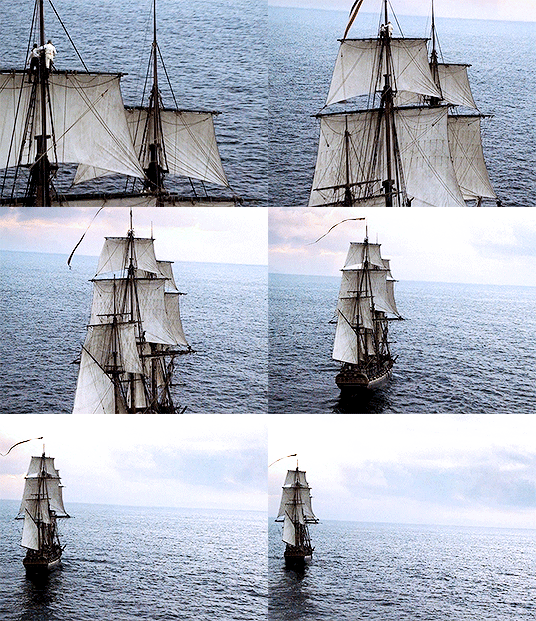
"I am not one who was born in the custody of wisdom. I am one who is fond of olden times and intense in quest of the sacred knowing of the ancients." Gustave Courbet
Showing posts with label preservation. Show all posts

29 June 2026

Oasis.


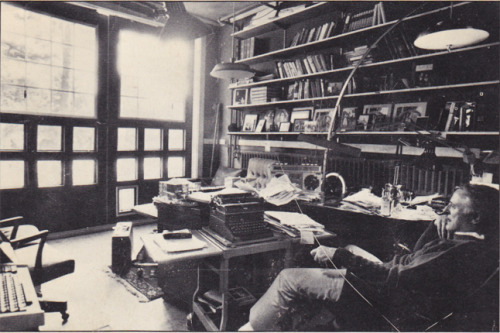
He’s excited about living in this oasis surrounded by the village. Prieto has fond memories of spending summers there as a child, playing in the wooded lot and watching his grandmother bang out one of her columns on an old, manual typewriter.

“When she was typing, it sounded like machine-gun fire,” he said with a smile. 

He has big plans for the old place – to preserve as much as possible and return it to something close to its original look.

That means shoring up several foundational elements of the house – a split beam or two among the dozen or so of the old tree trunks that hold up the first floor and pushing a sagging brick wall on the southwest corner back into position.

While cutting down trees that had grown too close to the house, Prieto said he strategically left a large pine that he plans to use as a brace to push the front wall back into place – a wall made of bricks that were handmade on site 220 years ago.

22 October 2025

Ideals.


"Those only deserve a monument who do not need one; that is, who have raised themselves a monument in the minds and hearts of men."


The Society of Architectural Historians' recommendations, from a letter dated 16 October ...
Known as the “People’s House,” the White House is one of the most significant and visible historic properties in the country. Any project at the White House, whether it involves interior renovation, changes to the landscape, or a new exterior addition, acts as a national precedent in the treatment of historic properties. Recognizing this, we urge the White House to carefully consider our recommendations so that the project can have a positive influence on preservation practice, policies and procedures across the nation.
The National Trust for Historic Preservation responds, characteristically late ...
The federally recognized Secretary of the Interior’s Standards for Rehabilitation offer clear guidance for construction projects affecting historic properties. The Standards provide that new additions should not destroy the historic fabric of the property and that the new work should be compatible with existing massing, size, scale, and architectural features.

Owned by the American people, the White House was designed by Irish architect James Hoban, whose winning proposal was selected by President George Washington. The building respects Georgian and neoclassical principles. It is a National Historic Landmark, a National Park, and a globally recognized symbol of our nation’s ideals.

06 August 2025

Imagination.


Harrison on preserving the sacred ...
In the past few years I have spent more time than I wished wondering how I evolved a land ethic that so troubles my sleep. Up above my desk I keep a small piece of paper that states “You’re just a writer,” which is what a studio head in Hollywood barked at me years ago. Though meant as an insult, this is an essential idea, in that it promotes the humility needed to function as a human being rather than as an ideologue, an altruistic ranter and raver, a religious lunatic who believes that God gave us the earth and we have metaphorically an actually chewed off the fingers and hands of the gift giver. Unfortunately, with my overfed imagination I can see this vision in the manner of a William Blake or Goya painting. To return myself to earth I walk daily with my dog in empty areas that are naked, blasted, and gutted of their essential nature by our own behavior. They are still beautiful, these mountains and valleys in the Southwest and the rivers and forests of my native northern Michigan. They would be much more beautiful if I didn’t know what they could look like, but then they will have to do because they’re all that we have.
Further ...
At my remote cabin, during my sixty-third summer, I dreamt that after a lifetime in which I had spent thousands and thousands of days outdoors looking “at” nature, I was finally inside nature looking out. The meaning of this was imprecise, but the feelings have stayed with me. As a poet, it became far simpler to imagine myself a tree or a boulder, a creek or a field, and easier yet to imagine myself a fellow mammal. When Shakespeare said, “We are nature, too”, he was making a leap away from the fundamental schizophrenia in Western culture that few have made. At my cabin made of logs there is less distance between inside and outside. You can smell the heart of the forest as you sleep, and hear the river passing by the north side of the cabin. At my winter casita, near the Mexican border, the walls are made of adobe, the dried mud of earth. This is comforting, but it doesn’t discount the elegant imagination of man. I once visited a bedridden old woman in the immense bedroom of her hunting lodge in the Forest of Rambouillet, in France. The walls were of quarried stone and covered with ancient tapestries. From the ceiling were suspended hundreds of sets of bronze-tagged stag antlers, the history of centuries of hunting. The property had once been owned by Charlemagne, and the lodge itself seemed to grow out of the forest. The inside and outside circulated freely between each other. I felt as comfortable there as I had sitting in the doorway of an abandoned Hogan on the Navajo Reservation watching the dawn, which seemed to emerge from the ground and into the sky.

13 June 2024

Restored.


On the banks of the Seine, passers-by stopped and looked up to contemplate the new ballet offered by the Notre Dame construction site. On Friday, May 24, the cathedral of Paris regained the cross on the roof over the apse. (The cross and rooster-shaped reliquary over the transept were replaced earlier.) As this cross was the only roof ornament to have miraculously escaped the devastating flames of the tragic fire of April 15, 2019, it was a particularly symbolic moment before the cathedral's scheduled reopening on December 8, 2024.

Suspended in the air at the end of a crane, this work by Viollet-le-Duc has returned to its original position at the top of the apse of the choir roof, once again watching over the capital and its inhabitants.

From above, a clamor rises: The ironworkers and roofers who worked on its restoration turn to the journalists with a shout of victory. From below, cheers and applause respond, as if to thank the hard work of the craftsmen who have spent more than 1,000 hours restoring this two-ton cross, dented by its fall.

17 July 2023

Reconstructing.


The restoration efforts at Notre-Dame continue using ancient tools and techniques ...
"Working inside the massive wooden structure was extremely impressive," he says. "You're in the sky but completely in the dark, so you discovered 'the forest' with flashlight and headlamps, never entirely seeing the whole thing. But you could hear and feel everything going on in the cathedral below — the priests celebrating Mass, the smell of incense. And we were near the belfry, so all of a sudden the bells would ring and resound very strongly. It was as if the cathedral was alive under your feet."

It is thanks to those plans that today's builders know exactly how to reconstruct the charpente, says Fromont. And there are several reasons to rebuild the Gothic masterpiece exactly as it was.

"A cathedral is a structural ensemble that's very complex, and as soon as you change one little thing, one parameter, it impacts everywhere else in the cathedral," he says. "So reconstructing it exactly the same way is also a precaution. It worked very well for 800 years. So we know if we build it back the same way we won't risk damaging the cathedral by trying something new."

13 May 2023

Testament.


In Brideshead Waugh set out with a similar task. Whilst today the purpose of the National Trust seems to be as an occasional stand-in for the John Lewis CafĂ©, it was set up in 1859, with the noble founding purpose of promoting “the permanent preservation for the benefit of the Nation of lands and tenements (including buildings) of beauty or historic interest”. This project, at its inception, was not focused on the acquisition of English stately homes. It was the work of writers like Waugh who demonstrated that England’s country piles were of “beauty” and “historic interest”. The National Trust Land Fund was created in 1946. It is a testament to the work that Waugh did to re-inspire interest in England’s ancestral seats, reviving a sense of national identity in touch with our history. Each stately home now stands testament to pride at the intergenerational work. 

07 May 2023

Sustained.

The Coronation Chair has taken centre stage during coronation ceremonies at Westminster Abbey since 1308. It is one of the most precious and famous pieces of furniture in the world. Conservator Krista Blessley talks about the history of the Chair, the damage it has sustained, and how it is cared for before it is used again for the first time in almost 70 years ...

25 July 2022

24 October 2021

Filled.


DEFEATED? A SONNET to EMPTY CHURCHES

Come on. You lot have survived worse things:
Black Death, Plague and two World wars,
The Reformation (Cromwell clipped the wings
Of angels in the roof); and there are scars

On ancient faces, marble noses cropped
And poppy heads beheaded like the King;
And modern vandals too. But you've not stopped
Your ageless plain ability to sing

Of something quite indifferent to the now;
Built with a trusting love and potent faith
You stand there still in testament to how
Beauty is not a wafted fleeting wraith,

A ghost which chance can whimsically destroy;
You can be filled, if not by faith, with joy.

Anon, June 2020

05 September 2021

Again.


Gordon Linney suggests looking for comfort beyond the here and now ...
In April 2019, the world watched in horror as the historic church of Notre Dame was gutted by fire. A dramatic moment came when the 19th-century spire came crashing down and the future of the great building seemed uncertain. Oak trees donated from across France had been used in the construction of the building and the good news is that once again oak trees are being gathered across France as restoration proceeds. The trees must be between 100 and 200 years old and those intended for roof timbers long enough to support an overhead curve of 65 feet.

Tomorrow’s psalm (84) takes us inside the Temple to remind us of its spiritual significance: “How lovely is your dwelling place, O LORD of hosts! My soul longs, indeed, it faints for the courts of the LORD; my heart and my flesh sing for joy to the living God.”

This psalm would have been used by pilgrims perhaps paying a once in a lifetime visit to this sacred place. Such feelings can of course apply just as much to the smallest and plainest of churches where faith has been nurtured and memories of family baptisms, weddings, and funerals linger. God’s promise recorded in Exodus makes the point: “In all places where I cause my name to be remembered, I will come to you and bless you.”

Johannes Brahms completed his German Requiem following the deaths of his mother in 1865 and his friend Robert Schumann some years earlier. The magnificent How Lovely is Thy Dwelling Place, using words from psalm 84, was the first of several movements to be written. Brahms was an intensely private man and we don’t know what his religious beliefs were except that he was confirmed in the Lutheran church and knew the Bible thoroughly. His German requiem was controversial because he did not use traditional Latin texts, choosing instead words from Luther’s German translation of the Bible that not only mourned the dead but also comforted the living. This departure from tradition caused unease with Church authorities and to calm their fears “I know that my Redeemer Liveth” from Handel’s Messiah was sometimes added to performances.

Brahms’s need for comfort is the experience of all who mourn. No matter how wonderful and reassuring ritual or liturgy may be, loss is real and devastating: the love, the touch, the companionship, the life shared – human be-ing seemingly no longer. It is in such moments of despair that our Christian faith encourages us to trust the promise of God revealed in the life, death and resurrection of Jesus Christ that every life, including those we love who have died, has an eternal purpose and meaning, that there is a life dimension beyond the here and now. This is a God-given hope, not an invention by those who cannot face reality. The first Letter of Peter makes that clear: “Blessed be the God and Father of our Lord Jesus Christ! By his great mercy he has given us a new birth into a living hope through the resurrection of Jesus Christ from the dead, and into an inheritance that is imperishable, undefiled, and unfading, kept in heaven for you.”

10 June 2020

Restoration.


Works have restarted in Paris’ fire-ravaged Notre Dame cathedral after a hiatus linked to the coronavirus pandemic.

On Monday morning operations began to dismantle scaffolding that was already in place before the April 2019 fire amid previous restoration efforts on the old structures.

This current phase of works has been deemed highly dangerous because the scaffolding weighs over 200 tons, and is thought to have melted together in areas because of the heat of the blaze.

Technicians will access the interior of the cathedral by rope to dismantle the 40,000 tubes, one by one. This phase is expected to last three months.

CONNECT

14 April 2020

Sacred.

Pisano, Gherardo, and Simone, Tower of Pisa, Steps, 1372


When we build, let us think that we build forever. Let it not be for present delight, nor for present use alone; let it be such work as our descendants will thank us for, and let us think, as we lay stone on stone, that a time is to come when those stones will be held sacred because our hands have touched them, and that men will say as they look upon the labor and wrought substance of them, See! this our fathers did for us.

John Ruskin

27 February 2020

Function.

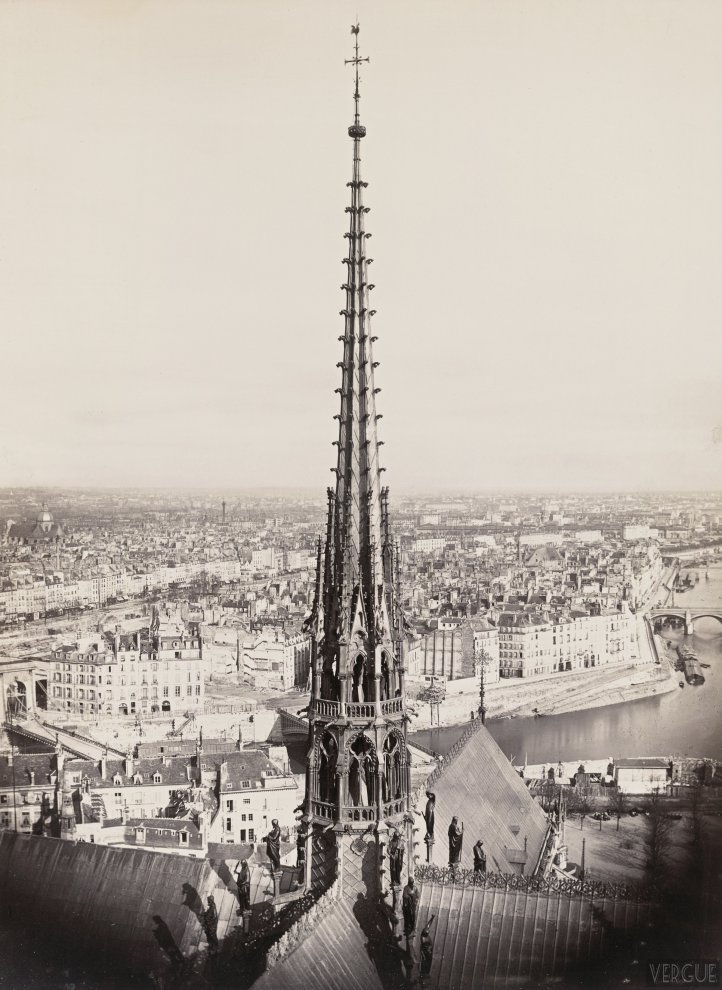
Marville, The Arrow of Notre-Dame de Paris, 1862


The Oxford University Press on the Notre-Dame restoration efforts ...

Sometimes it takes a catastrophic loss for us to realize how important historic architecture and cityscapes are to our lives. For instance, repairs are still ongoing following a 2011 5.8 magnitude earthquake that caused more than $30 million dollars’ worth of damage to the National Cathedral in Washington, DC.  And on 15 April 2019 a cataclysmic fire brought massive destruction to the Gothic cathedral of Notre-Dame in Paris, including the loss of its soaring spire and its centuries-old wood roof structure. There followed an international outpouring of grief for the loss of one of the icons of Western architecture. People from innumerable walks of life and countries around the world mourned the loss of a building that represented the aspirations, creativity, and sheer labor of mostly nameless artists, architects, and workers. The restoration campaign likely will take years, perhaps even a decade or more.

Around the globe, wars and natural disasters—not to mention modernization and development—threaten the built environment. Globally, more than half of the world’s population (according to the United Nations Population Division) now lives in cities, and by 2050 about 70% of the earth’s population will be urban. We can only imagine what the implications of this growth will be for historic cities and buildings and hope that heritage preservation and conservation will keep pace.

It’s not just iconic monuments and buildings by famous architects that we have to be concerned about: historic architecture and urban environments are mostly the work of unnamed (vernacular) builders and craftspeople—not professional designers. All sorts of builders and buildings will be affected in this period of urbanization and development. To become effective preservation advocates, we will all have to become knowledgeable about a wide range of buildings and environments.

Eugène-Emmanuel Viollet-le-Duc (1814-1879), the nineteenth-century restorer of the Cathedral of Notre-Dame in Paris, made the connection between modernization and preservation in his Dictionnaire raisonnĂ© de l’architecture française du XIe au XVIe siècle (Dictionary of French Architecture from the Eleventh through the Sixteenth Centuries) published beginning in 1854. The author began his entry on “Restoration” by saying “The word and the thing are modern.” This seemingly paradoxical statement contains a kernel of truth that is as apt now as it was in the mid-nineteenth century: Although preservation (or restoration, in his terms) is concerned with retaining buildings that represent the past, the very need to do so is a function of modernization.

04 August 2016

First.


The Bodleian First Folio, a digital facsimile of the First Folio of Shakespeare's plays, Bodleian Arch. G c.7., is here.

08 April 2016

Preservation.


Digital preservation requires conscious effort. Unlike in the analog world, digital photo albums shouldn’t be abandoned for decades if one wants their contents to remain accessible. Without constant vigilance (old files, for example, being migrated to new formats) those photos won’t be available for viewing years from now. 

10 March 2016

Preserving.

Evstafiev, A cello player in Sarajevo’s destroyed National Library, 1992


Society ignores the role of libraries and archives at its peril. Last year saw the 800th anniversary of that “great charter of liberties”, Magna Carta. It survives not in one copy but in multiple originals, distributed around the kingdom, as well as numerous later affirmations. Its survival as a potent set of legal and political concepts was in no small measure thanks to the role of libraries and archives in preserving the original documents.

CONNECT