"I am not one who was born in the custody of wisdom. I am one who is fond of olden times and intense in quest of the sacred knowing of the ancients." Gustave Courbet
Showing posts with label walking. Show all posts

23 August 2026

Solitude.


For Nature’s particular gift to the walker, through the semi-mechanical act of walking—a gift no other form of exercise seems to transmit in the same high degree—is to set the mind jogging, to make it garrulous, exalted, a little mad maybe—certainly creative and super-sensitive, until at last it really seems to be outside of you and as it were talking to you, while you are talking back to it. Then everything gradually seems to join in, sun and the wind, the white road and the dusty hedges, the spirit of the season, whichever that may be, the friendly old Earth that is pushing forth life of every sort under your very feet or spellbound in deathlike winter trance, till you walk in the midst of a blessed company, immersed in a dream-talk far transcending any possible human conversation. Time enough, later, for that—across the dinner table, in smoking-room armchairs; here and now, the mind has shaken off its harness, is snorting and kicking up heels like a colt in a meadow. Not a fiftieth part of all your happy imaginings will you ever, later, recapture, note down, reduce to dull inadequate words; but meantime the mind has stretched itself and had its holiday. But this emancipation is only attained in solitude, the solitude which the unseen companions demand before they will come out and talk to you; for, be he who he may, if there is another fellow present, your mind has to trot between shafts.

29 March 2026

Understand.

van Gogh, Undergrowth with Two Figures, 1890


Do go on doing a lot of walking and keep up your love of nature, for that is the right way to understand art better and better. Painters understand nature and love her and teach us to see.

And then there are painters who never do anything that is no good, who cannot do anything bad, just as there are ordinary people who can do nothing but good.

I'm getting on very well here. I've got a delightful home and I'm finding it very pleasurable taking a look at London and the English way of life and the English people themselves, and then I've got nature and art and poetry, and if that isn't enough, what is? 

Vincent van Gogh, from a letter to Theo van Gogh, January 1874

21 March 2026

Shafts.


For Nature’s particular gift to the walker, through the semi-mechanical act of walking—a gift no other form of exercise seems to transmit in the same high degree—is to set the mind jogging, to make it garrulous, exalted, a little mad maybe—certainly creative and super-sensitive, until at last it really seems to be outside of you and as it were talking to you, while you are talking back to it. Then everything gradually seems to join in, sun and the wind, the white road and the dusty hedges, the spirit of the season, whichever that may be, the friendly old Earth that is pushing forth life of every sort under your very feet or spellbound in deathlike winter trance, till you walk in the midst of a blessed company, immersed in a dream-talk far transcending any possible human conversation. Time enough, later, for that—across the dinner table, in smoking-room armchairs; here and now, the mind has shaken off its harness, is snorting and kicking up heels like a colt in a meadow. Not a fiftieth part of all your happy imaginings will you ever, later, recapture, note down, reduce to dull inadequate words; but meantime the mind has stretched itself and had its holiday. But this emancipation is only attained in solitude, the solitude which the unseen companions demand before they will come out and talk to you; for, be he who he may, if there is another fellow present, your mind has to trot between shafts.

A certain amount of "shafts," indeed, is helpful, as setting the mind more free; and so the high road, while it should always give way to the field path when choice offers, still has this particular virtue, that it takes charge of you—your body, that is to say. Its hedges hold you in friendly steering-reins, its milestones and fingerposts are always on hand, with information succinct and free from frills; and it always gets somewhere, sooner or later. So you are nursed along your way, and the mind may soar in cloudland and never need to be pulled earthwards by any string. But this is as much company as you ought to require, the comradeship of the road you walk on, the road which will look after you and attend to such facts as must not be overlooked. Of course the best sort of walk is the one on which it doesn’t matter twopence whether you get anywhere at all at any time or not; and the second best is the one on which the hard facts of routes, times, or trains, give you nothing to worry about. And this is perhaps the only excuse for the presence of that much-deprecated Other Fellow—that you can put all that sort of thing on to him.

Kenneth Graham, from "The Fellow That Goes Alone"

01 March 2026

Leveler.


I haven't got any special religion this morning. My God is the God of Walkers. If you walk hard enough, you probably don't need any other god. Sluggish and sedentary peoples, such as the Ancient Egyptians, with their concept of an afterlife journey through the Field of Reeds, project onto the next world the journeys they failed to make in this one. As a general rule of biology, migratory species are less aggressive than sedentary ones. 

There is one obvious reason why this should be so. The migration itself, like the pilgrimage, is the hard journey: a "leveler" on which the "fit" survive and stragglers fall by the wayside. The journey thus pre-empts the need for hierarchies and shows of dominance. The "dictators" of the animal kingdom are those who live in an ambience of plenty. The anarchists, as always, are the "gentlemen of the road." 

Bruce Chatwin, from The Songlines

27 October 2024

Lost.


EVENING WALK

You give the appearance of listening
To my thoughts, o trees,
Bent over the road I am walking
On a late summer evening
When every one of you is a steep staircase
The night is descending.
 
The leaves like my my mother’s lips
Forever trembling, unable to decide,
Fore there’s a bit of wind,
And it’s like hearing voices,
Or a mouth full of muffled laughter,
A huge dark mouth we can all fit in
Suddenly covered by a hand.
 
Everything quiet. Light
Of some other evening strolling ahead,
Long-ago evening of long dresses,
Pointy shoes, silver cigarettes cases.
Happy heart, what heavy steps you take
As you hurry after them in the thickening
shadows.
 
The sky above still blue.
The nightbirds like children
Who won’t come to dinner.
Lost children singing to themselves.

Charles Simic

12 October 2024

Yearned.


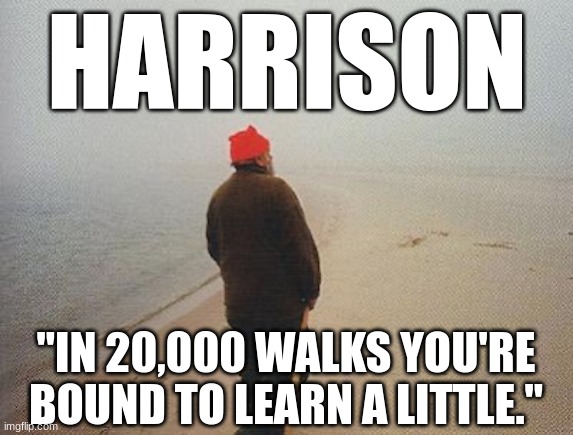
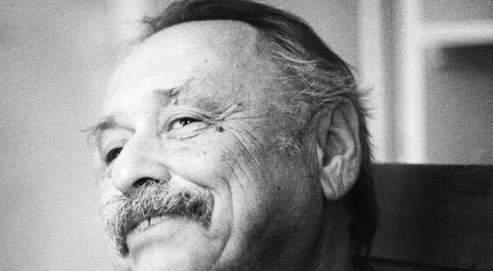
Over the years I've yearned for wisdom.
What have I learned?
Not much; even the dog leads when we go for a walk.

Jim Harrison

18 February 2024

Winding-Sheets.


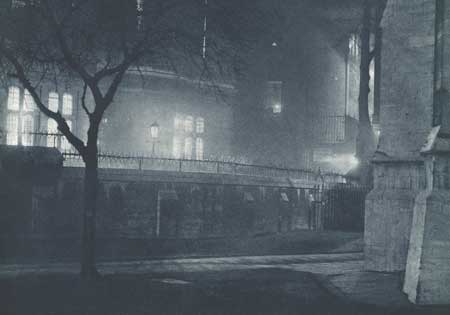
Between the bridge and the two great theatres, there was but the distance of a few hundred paces, so the theatres came next. Grim and black within, at night, those great dry Wells, and lonesome to imagine, with the rows of faces faded out, the lights extinguished, and the seats all empty. One would think that nothing in them knew itself at such a time but Yorick’s skull. In one of my night walks, as the church steeples were shaking the March winds and rain with the strokes of Four, I passed the outer boundary of one of these great deserts, and entered it. With a dim lantern in my hand, I groped my well-known way to the stage and looked over the orchestra—which was like a great grave dug for a time of pestilence—into the void beyond. A dismal cavern of an immense aspect, with the chandelier gone dead like everything else, and nothing visible through mist and fog and space, but tiers of winding-sheets. The ground at my feet where, when last there, I had seen the peasantry of Naples dancing among the vines, reckless of the burning mountain which threatened to overwhelm them, was now in possession of a strong serpent of engine-hose, watchfully lying in wait for the serpent Fire, and ready to fly at it if it showed its forked tongue. A ghost of a watchman, carrying a faint corpse candle, haunted the distant upper gallery and flitted away. Retiring within the proscenium, and holding my light above my head towards the rolled-up curtain—green no more, but black as ebony—my sight lost itself in a gloomy vault, showing faint indications in it of a shipwreck of canvas and cordage. Methought I felt much as a diver might, at the bottom of the sea. 

Charles Dickens, from "Night Walks"

16 January 2024

Sharper.

Thomson, Winter Morning, 1915


Look up at the miracle of the falling snow,—the air a dizzy maze of whirling, eddying flakes, noiselessly transforming the world, the exquisite crystals dropping in ditch and gutter, and disguising in the same suit of spotless livery all objects upon which they fall. How novel and fine the first drifts! The old, dilapidated fence is suddenly set off with the most fantastic ruffles, scalloped and fluted after an unheard-of fashion! Looking down a long line of decrepit stone wall, in the trimming of which the wind had fairly run riot, I saw, as for the first time, what a severe yet master artist old Winter is. Ah, a severe artist! How stern the woods look, dark and cold and as rigid against the horizon as iron!

All life and action upon the snow have an added emphasis and significance. Every expression is underscored. Summer has few finer pictures than this winter one of the farmer foddering his cattle from a stack upon the clean snow,—the movement, the sharply defined figures, the great green flakes of hay, the long file of patient cows, the advance just arriving and pressing eagerly for the choicest morsels,—and the bounty and providence it suggests. Or the chopper in the woods,—the prostrate tree, the white new chips scattered about, his easy triumph over the cold, his coat hanging to a limb, and the clear, sharp ring of his axe. The woods are rigid and tense, keyed up by the frost, and resound like a stringed instrument. Or the road-breakers, sallying forth with oxen and sleds in the still, white world, the day after the storm, to restore the lost track and demolish the beleaguering drifts.

All sounds are sharper in winter; the air transmits better ...

John Burroughs, from "The Snow-Walkers"

12 November 2023

08 October 2023

Accepted.

Ribarz, Quince Branch, n/d


I had no wish to take any determined route on that stroll; I attempted, rather, a maximum latitude of probabilities in order not to wear out expectation with an obligatory anticipation of a single one of them. I was able, within the imperfect limits of possibility, to walk, as they say, at random. I accepted, without any conscious prejudice but that of avoiding the wider avenues and streets, the most obscure invitations of chance.

Jorge Luis Borges

24 January 2023

Roam.


How glad I am to be able to roam in the wood and thicket, among trees and flowers and rocks, in the country, every tree seems to speak to me, saying, "Holy! Holy", in the woods, there is enchantment which expresses all things.

Ludwig van Beethoven

22 January 2023

Exploring.

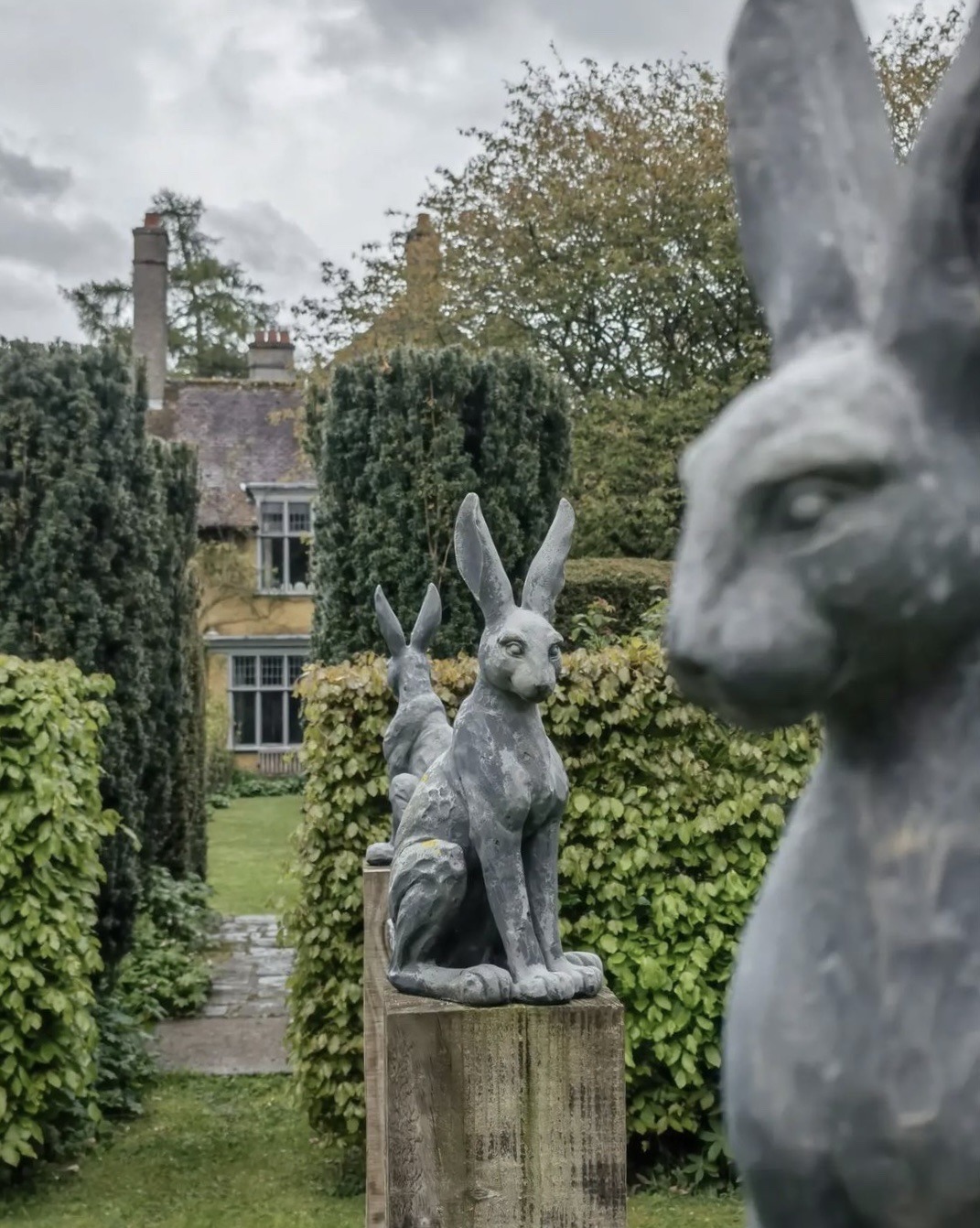
Poortvliet, Hare in Thicket, 1966


When you give yourself to places, they give you yourself back; the more one comes to know them, the more one seeds them with the invisible crop of memories and associations that will be waiting for when you come back, while new places offer up new thoughts, new possibilities. Exploring the world is one the best ways of exploring the mind, and walking travels both terrains.

Rebecca Solnit, from Wanderlust: A History of Walking

21 November 2022

Prevent.


... [T]rying to prevent a few of the students who pass through our Institution from conforming altogether to the approved pattern.

Nan Shepherd

05 October 2022

Rewards.


A PARABLE of SAUNTERING

There is a fourth lesson of the trail. It is one which John Muir taught me [during an early Sierra Club outing].

There are always some people in the mountains who are known as "hikers." They rush over the trail at high speed and take great delight in being the first to reach camp and in covering the greatest number of miles in the least possible time. they measure the trail in terms of speed and distance.

One day as I was resting in the shade Mr. Muir overtook me on the trail and began to chat in that friendly way in which he delights to talk with everyone he meets. I said to him: "Mr. Muir, someone told me you did not approve of the word 'hike.' Is that so?" His blue eyes flashed, and with his Scotch accent he replied: "I don't like either the word or the thing. People ought to saunter in the mountains - not hike!

"Do you know the origin of that word 'saunter?' It's a beautiful word. Away back in the Middle Ages people used to go on pilgrimages to the Holy Land, and when people in the villages through which they passed asked where they were going, they would reply, "A la sainte terre,' 'To the Holy Land.' And so they became known as sainte-terre-ers or saunterers. Now these mountains are our Holy Land, and we ought to saunter through them reverently, not 'hike' through them."

John Muir lived up to his doctrine. He was usually the last man to reach camp. He never hurried. He stopped to get acquainted with individual trees along the way. He would hail people passing by and make them get down on hands and knees if necessary to see the beauty of some little bed of almost microscopic flowers. Usually he appeared at camp with some new flowers in his hat and a little piece of fir bough in his buttonhole.

Now, whether the derivation of saunter Muir gave me is scientific or fanciful, is there not in it another parable? There are people who "hike" through life. They measure life in terms of money and amusement; they rush along the trail of life feverishly seeking to make a dollar or gratify an appetite. How much better to "saunter" along this trail of life, to measure it in terms of beauty and love and friendship! How much finer to take time to know and understand the men and women along the way, to stop a while and let the beauty of the sunset possess the soul, to listen to what the trees are saying and the songs of the birds, and to gather the fragrant little flowers that bloom all along the trail of life for those who have eyes to see!

You can't do these things if you rush through life in a big red automobile at high speed; you can't know these things if you "hike" along the trail in a speed competition. These are the peculiar rewards of the man who has learned the secret of the saunterer!

Albert W. Palmer

02 October 2022

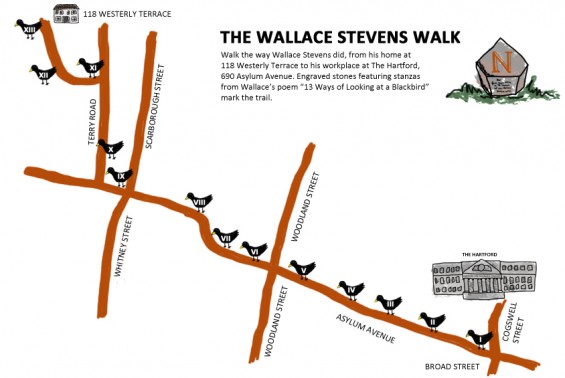
Thirteen.


I
Among twenty snowy mountains,   
The only moving thing   
Was the eye of the blackbird.   

II
I was of three minds,   
Like a tree   
In which there are three blackbirds.   

III
The blackbird whirled in the autumn winds.   
It was a small part of the pantomime.   

IV
A man and a woman   
Are one.   
A man and a woman and a blackbird   
Are one.   

V
I do not know which to prefer,   
The beauty of inflections   
Or the beauty of innuendoes,   
The blackbird whistling   
Or just after.   

VI
Icicles filled the long window   
With barbaric glass.   
The shadow of the blackbird   
Crossed it, to and fro.   
The mood   
Traced in the shadow   
An indecipherable cause.   

VII
O thin men of Haddam,   
Why do you imagine golden birds?   
Do you not see how the blackbird   
Walks around the feet   
Of the women about you?   

VIII
I know noble accents   
And lucid, inescapable rhythms;   
But I know, too,   
That the blackbird is involved   
In what I know.   

IX
When the blackbird flew out of sight,   
It marked the edge   
Of one of many circles.   

X
At the sight of blackbirds   
Flying in a green light,   
Even the bawds of euphony   
Would cry out sharply.   

XI
He rode over Connecticut   
In a glass coach.   
Once, a fear pierced him,   
In that he mistook   
The shadow of his equipage   
For blackbirds.   

XII
The river is moving.   
The blackbird must be flying.   

XIII
It was evening all afternoon.   
It was snowing   
And it was going to snow.   
The blackbird sat   
In the cedar-limbs.

01 October 2022

Solitary.


Some men are daylight readers, who peruse the ambiguous wording of clouds or the individual letter shapes of wandering birds. Some, like myself, are librarians of the night, whose ephemeral documents consist of root-inscribed bones or whatever rustles in the thickets upon solitary walks.

Loren Eiseley

21 July 2022

Sauntering.


I have met with but one or two persons in the course of my life who understood the art of Walking, that is, of taking walks—who had a genius, so to speak, for sauntering, which word is beautifully derived “from idle people who roved about the country, in the Middle Ages, and asked charity, under pretense of going a la SainteTerre,” to the Holy Land, till the children exclaimed, “There goes aSainte-Terrer,” a Saunterer, a Holy-Lander. They who never go to the Holy Land in their walks, as they pretend, are indeed mere idlers and vagabonds; but they who do go there are saunterers in the good sense, such as I mean. Some, however, would derive the word from sans terre without land or a home, which, therefore, in the good sense, will mean, having no particular home, but equally at home everywhere.


For this is the secret of successful sauntering. He who sits still in a house all the time may be the greatest vagrant of all; but the saunterer, in the good sense, is no more vagrant than the meandering river, which is all the while sedulously seeking the shortest course to the sea. But I prefer the first, which, indeed, is the most probable derivation. For every walk is a sort of crusade, preached by some Peter the Hermit in us, to go forth and reconquer this Holy Land from the hands of the Infidels.

Henry Davis Thoreau