"I am not one who was born in the custody of wisdom. I am one who is fond of olden times and intense in quest of the sacred knowing of the ancients." Gustave Courbet
Showing posts with label Barrie. Show all posts

09 May 2026

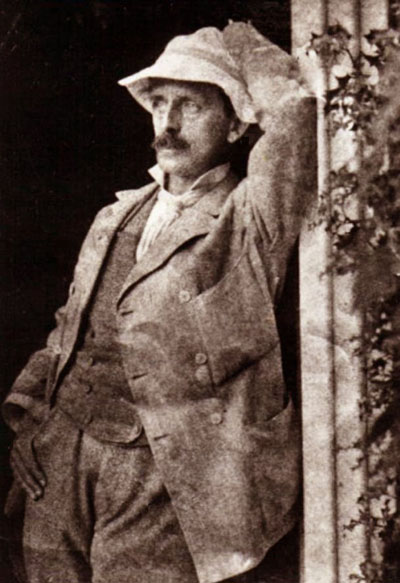
Happy Birthday, J.M. Barrie


How comely a thing is affliction borne cheerfully, which is not beyond the reach of the humblest of us. What is beauty? It is these hard-bitten men singing courage to you from their tent; it is the waves of their island home crooning of their deeds to you who are to follow them. Sometimes beauty boils over and them spirits are abroad. Ages may pass as we look or listen, for time is annihilated. There is a very old legend told to me by Nansen the explorer--I like well to be in the company of explorers--the legend of a monk who had wandered into the fields and a lark began to sing. He had never heard a lark before, and he stood there entranced until the bird and its song had become part of the heavens. Then he went back to the monastery and found there a doorkeeper whom he did not know and who did not know him. Other monks came, and they were all strangers to him. He told them he was Father Anselm, but that was no help. Finally they looked through the books of the monastery, and these revealed that there had been a Father Anselm there a hundred or more years before. Time had been blotted out while he listened to the lark.

That, I suppose, was a case of beauty boiling over, or a soul boiling over; perhaps the same thing. Then spirits walk.

J.M. Barrie, born on this day in 1860, from "Courage," the rectorial address delivered at St. Andrew's University, May 3, 1922.

28 April 2026

Roses.


God gave us memory so that we might have roses in December.

J.M. Barrie, from "Courage: The Rectorial Address" at St. Andrew's University, May 3, 1922

05 May 2025

Golden.


How comely a thing is affliction borne cheerfully, which is not beyond the reach of the humblest of us.  What is beauty?  It is these hard-bitten men singing courage to you from their tent; it is the waves of their island home crooning of their deeds to you who are to follow them.  Sometimes beauty boils over and them spirits are abroad.  Ages may pass as we look or listen, for time is annihilated.  There is a very old legend told to me by Nansen the explorer--I like well to be in the company of explorers--the legend of a monk who had wandered into the fields and a lark began to sing.  He had never heard a lark before, and he stood there entranced until the bird and its song had become part of the heavens.  Then he went back to the monastery and found there a doorkeeper whom he did not know and who did not know him.  Other monks came, and they were all strangers to him.  He told them he was Father Anselm, but that was no help.  Finally they looked through the books of the monastery, and these revealed that there had been a Father Anselm there a hundred or more years before.  Time had been blotted out while he listened to the lark.
That, I suppose, was a case of beauty boiling over, or a soul boiling over; perhaps the same thing.  Then spirits walk.

They must sometimes walk St. Andrews.  I do not mean the ghosts of queens or prelates, but one that keeps step, as soft as snow, with some poor student.  He sometimes catches sight of it.  That is why his fellows can never quite touch him, their best beloved; he half knows something of which they know nothing--the secret that is hidden in the face of the Monna Lisa.  As I see him, life is so beautiful to him that its proportions are monstrous.  Perhaps his childhood may have been overfull of gladness; they don't like that.  If the seekers were kind he is the one for whom the flags of his college would fly one day.  But the seeker I am thinking of is unfriendly, and so our student is "the lad that will never be told."  He often gaily forgets, and thinks he has slain his foe by daring him, like him who, dreading water, was always the first to leap into it.  One can see him serene, astride a Scotch cliff, singing to the sun the farewell thanks of a boy:
   Throned on a cliff serene Man saw the sun
   hold a red torch above the farthest seas,
   and the fierce island pinnacles put on
   in his defence their sombre panoplies;
   Foremost the white mists eddied, trailed and spun
   like seekers, emulous to clasp his knees,
   till all the beauty of the scene seemed one,
   led by the secret whispers of the breeze.

   The sun's torch suddenly flashed upon his face
   and died; and he sat content in subject night
   and dreamed of an old dead foe that had sought
     and found him;
   a beast stirred bodly in his resting-place;
   And the cold came; Man rose to his master-height,
   shivered, and turned away; but the mists were
     round him.
If there is any of you here so rare that the seekers have taken an ill-will to him, as to the boy who wrote those lines, I ask you to be careful.  Henley says in that poem we were speaking of:
   Under the bludgeonings of Chance
   My head is bloody but unbowed.
A fine mouthful, but perhaps "My head is bloody and bowed" is better.

Let us get back to that tent with its songs and cheery conversation. Courage.  I do not think it is to be got by your becoming solemn-sides before your time.  You must have been warned against letting the golden hours slip by.  Yes, but some of them are golden only because we let them slip.  Diligence--ambition; noble words, but only if "touched to fine issues."  Prizes may be dross, learning lumber, unless they bring you into the arena with increased understanding. Hanker not too much after worldly prosperity--that corpulent cigar; if you became a millionaire you would probably go swimming around for more like a diseased goldfish.  Look to it that what you are doing is not merely toddling to a competency. Perhaps that must be your fate, but fight it and then, though you fail, you may still be among the elect of whom we have spoken. Many a brave man has had to come to it at last.

18 February 2024

Storm-Stayed.

Caddick, The Night, 1980


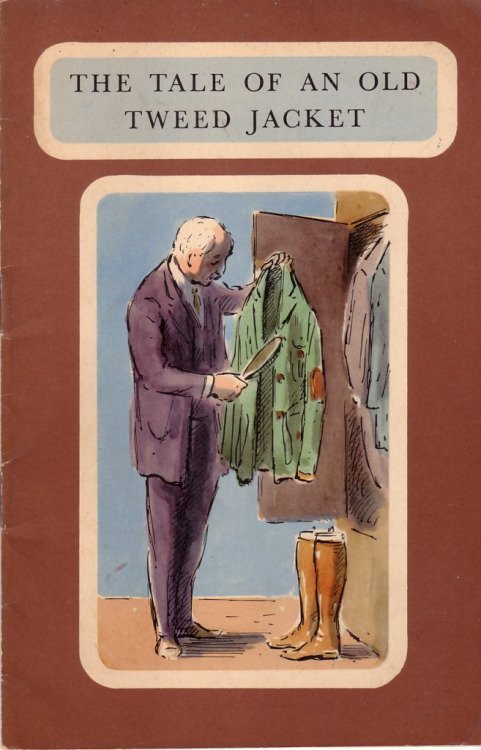
The kail grows brittle from the snow in my dank and cheerless garden. A crust of bread gathers timid pheasants round me. The robins, I see, have made the coalhouse their home. Waster Lunny's dog never barks without rousing my sluggish cat to a joyful response. It is Dutch courage with the birds and beasts of the glen, hard driven for food; but I look attentively for them in these long forenoons, and they have begun to regard me as one of themselves. My breath freezes, despite my pipe, as I peer from the door; and with a fortnight-old newspaper I retire to the ingle-nook. The friendliest thing I have seen to-day is the well-smoked ham suspended from my kitchen rafters. It was a gift from the farm of Tullin, with a load of peats, the day before the snow began to fall. I doubt if I have seen a cart since.

This afternoon I was the not altogether passive spectator of a curious scene in natural history. My feet encased in stout "tackety" boots, I had waded down two of Waster Lunny's fields to the glen burn: in summer the never-failing larder from which, with wriggling worm or garish fly, I can any morning whip a savoury breakfast; in the winter-time the only thing in the valley that defies the ice-king's chloroform. I watched the water twisting black and solemn through the snow, the ragged ice on its edge proof of the toughness of the struggle with the frost, from which it has, after all, crept only half victorious. A bare wild rosebush on the further bank was violently agitated, and then there ran from its root a black-headed rat with wings. Such was the general effect. I was not less interested when my startled eyes divided this phenomenon into its component parts, and recognized in the disturbance on the opposite bank only another fierce struggle among the hungry animals for existence: they need no professor to teach them the doctrine of the survival of the fittest. A weasel had gripped a water-hen (whit-rit and beltie they are called in these parts) cowering at the root of the rose-bush, and was being dragged down the bank by the terrified bird, which made for the water as its only chance of escape. In less disadvantageous circumstances the weasel would have made short work of his victim; but as he only had the bird by the tail, the prospects of the combatants were equalized. It was the tug-of-war being played with a life as the stakes. "If I do not reach the water," was the argument that went on in the heaving little breast of the one, "I am a dead bird." "If this water-hen," reasoned the other, "reaches the burn, my supper vanishes with her." Down the sloping bank the hen had distinctly the best of it, but after that came a yard of level snow, and here she tugged and screamed in vain. I had so far been an unobserved spectator; but my sympathies were with the beltie, and, thinking it high time to interfere, I jumped into the water. The water-hen gave one mighty final tug and toppled into the burn; while the weasel viciously showed me his teeth, and then stole slowly up the bank to the rose-bush, whence, "girning," he watched me lift his exhausted victim from the water, and set off with her for the schoolhouse. Except for her draggled tail, she already looks wonderfully composed, and so long as the frost holds I shall have little difficulty in keeping her with me. On Sunday I found a frozen sparrow, whose heart had almost ceased to beat, in the disused pig-sty, and put him for warmth into my breast-pocket. The ungrateful little scrub bolted without a word of thanks about ten minutes afterwards to the alarm of my cat, which had not known his whereabouts.
I am alone in the schoolhouse. On just such an evening as this last year my desolation drove me to Waster Lunny, where I was storm-stayed for the night. The recollection decides me to court my own warm hearth, to challenge my right hand again to a game at the "dambrod" against my left. I do not lock the schoolhouse door at nights; for even a highwayman (there is no such luck) would be received with open arms, and I doubt if there be a barred door in all the glen. But it is cosier to put on the shutters. The road to Thrums has lost itself miles down the valley. I wonder what they are doing out in the world. Though I am the Free Church precentor in Thrums (ten pounds a year, and the little town is five miles away), they have not seen me for three weeks. A packman whom I thawed yesterday at my kitchen fire tells me, that last Sabbath only the Auld Lichts held service. Other people realized that they were snowed up. Far up the glen, after it twists out of view, a manse and half a dozen thatched cottages that are there may still show a candle light, and the crumbling gravestones keep cold vigil round the grey old kirk. Heavy shadows fade into the sky to the north. A flake trembles against the window; but it is too cold for much snow to-night. The shutter bars the outer world from the schoolhouse.
J.M. Barrie, from "The Schoolhouse," found in Auld Light Idylls

27 July 2021

24 October 2020

Interesting.


A safe but sometimes chilly way of recalling the past is to force open a crammed drawer. If you are searching for anything in particular you don't find it, but something falls out at the back that is often more interesting.

J.M. Barrie

16 June 2020

Happy Birthday, Frampton


Sir George Frampton was born on this date in 1860.

Frampton, La Belle Dame sans Merci, 1912


The 1928 unveiling of Frampton's Peter Pan at Kensington Garden ...

09 May 2017

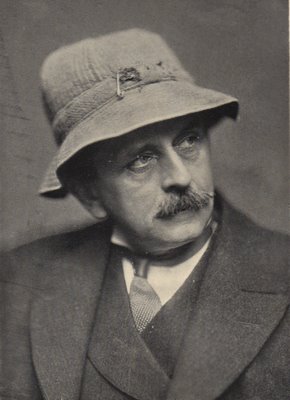
Happy birthday, Barrie.


J.M. Barrie was born on this day in 

To Peter's bewilderment he discovered that every fairy he met fled from him. A band of workmen, who were sawing down a toadstool, rushed away, leaving their tools behind them. A milkmaid turned her pail upside down and hid in it. Soon the Gardens were in an uproar. Crowds of fairies were running this away and that, asking each other stoutly, who was afraid, lights were extinguished, doors barricaded, and from the grounds of Queen Mab's palace came the rubadub of drums, showing that the royal guard had been called out. A regiment of Lancers came charging down the Broad Walk, armed with holly-leaves, with which they jog the enemy horribly in passing. Peter heard the little people crying everywhere that there was a human in the Gardens after Lock-out Time, but he never thought for a moment that he was the human. He was feeling stuffier and stuffier, and more and more wistful to learn what he wanted done to his nose, but he pursued them with the vital question in vain; the timid creatures ran from him, and even the Lancers, when he approached them up the Hump, turned swiftly into a side-walk, on the pretence that they saw him there.

Despairing of the fairies, he resolved to consult the birds, but now he remembered, as an odd thing, that all the birds on the weeping beech had flown away when he alighted on it, and though that had not troubled him at the time, he saw its meaning now. Every living thing was shunning him. Poor little Peter Pan, he sat down and cried, and even then he did not know that, for a bird, he was sitting on his wrong part. It is a blessing that he did not know, for otherwise he would have lost faith in his power to fly, and the moment you doubt whether you can fly, you cease forever to be able to do it. The reason birds can fly and we can't is simply that they have perfect faith, for to have faith is to have wings.

Now, except by flying, no one can reach the island in the Serpentine, for the boats of humans are forbidden to land there, and there are stakes round it, standing up in the water, on each of which a bird-sentinel sits by day and night. It was to the island that Peter now flew to put his strange case before old Solomon Caw, and he alighted on it with relief, much heartened to find himself at last at home, as the birds call the island.

J.M. Barrie, from Peter Pan, Chapter 14, "The White Bird"

CONNECT

09 May 2016

Happy birthday, Barrie.


J.M. Barrie was born on this day in 1860.

The life of every man is a diary in which he means to write one story, and writes another; his humblest hour is when he compares the volume as it is with what he vowed to make it.

J.M. Barrie

17 January 2016

Wonder.


Stars are beautiful, but they may not take an active part in anything, they must just look on for ever. It is a punishment put on them for something they did so long ago that no star now knows what it was. So the older ones have become glassy-eyed and seldom speak (winking is the star language), but the little ones still wonder.

J.M. Barrie

23 November 2015

Lovable.


One could mention many lovable traits in Smee. For instance, after killing, it was his spectacles he wiped instead of his weapon.

J.M. Barrie, from Peter Pan

22 May 2015

See.

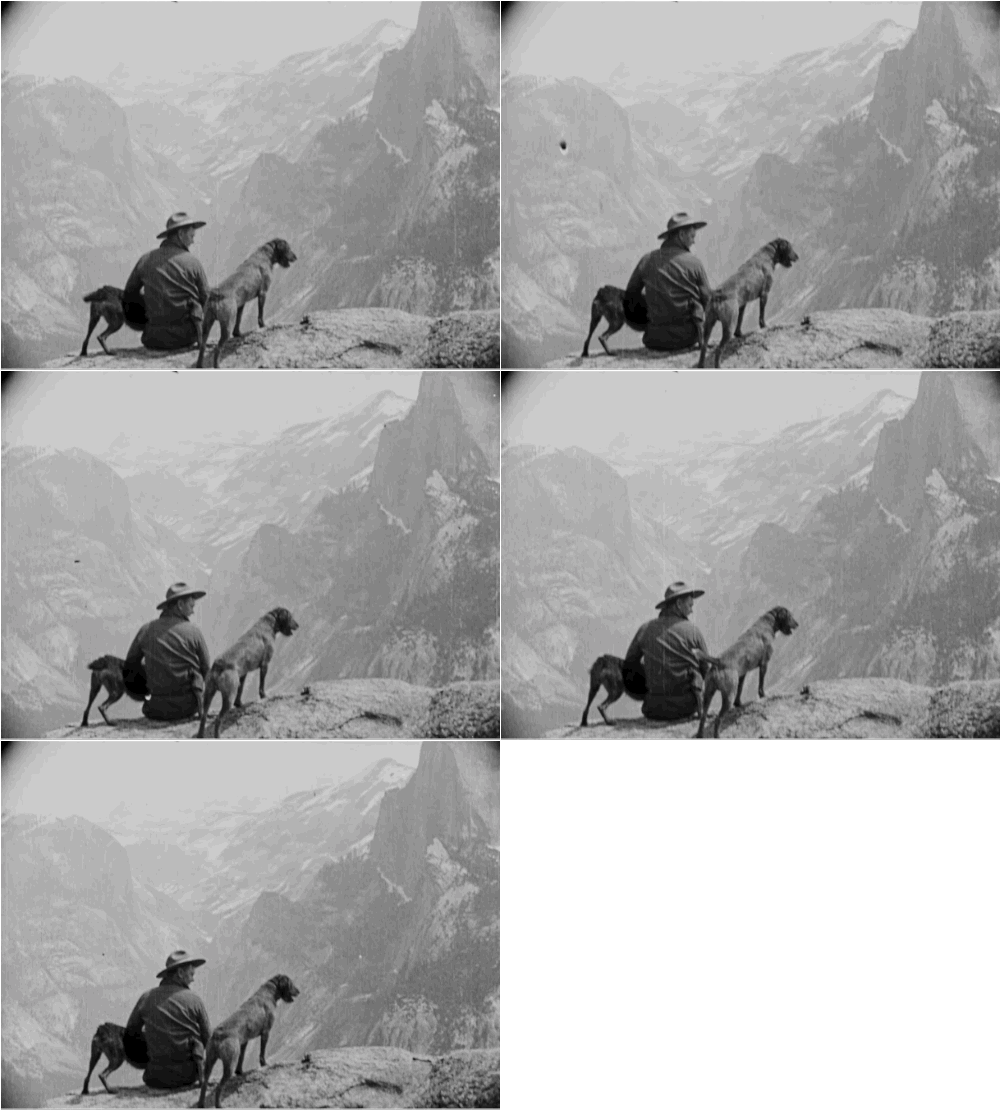
Peter Llewelyn Davies:  What did you bring me over here for?    

Mrs. Llewelyn Davies:  Peter!                         

Peter Llewelyn Davies: This is absurd. It's just a dog.                             

Mrs. Llewelyn Davies: Come on, darling.                              

J.M. Barrie: "Just a dog"? "Just?”                         

Porthos, don't listen to him.                             

Porthos dreams of being a bear and you want to dash those dreams by saying he's "just a dog?”  What a horrible, candle-snuffing word.  That's like saying, "He can't climb that mountain, he's just a man.” Or, "That's not a diamond, it's just a rock."                        

"Just."    

Peter Llewelyn Davies: Fine then. Turn him into a bear ... if you can.                       
Mrs. Llewelyn Davies: Peter, where are your manners?                             
J.M. Barrie: With those eyes, my bonny lad, I'm afraid you'd never see it.  However, with just a wee bit of imagination, I can turn around right now and see … the great bear, Porthos.                             
Dance with me ...