"I am not one who was born in the custody of wisdom. I am one who is fond of olden times and intense in quest of the sacred knowing of the ancients." Gustave Courbet
Showing posts with label Wabi-Sabi. Show all posts

08 February 2026

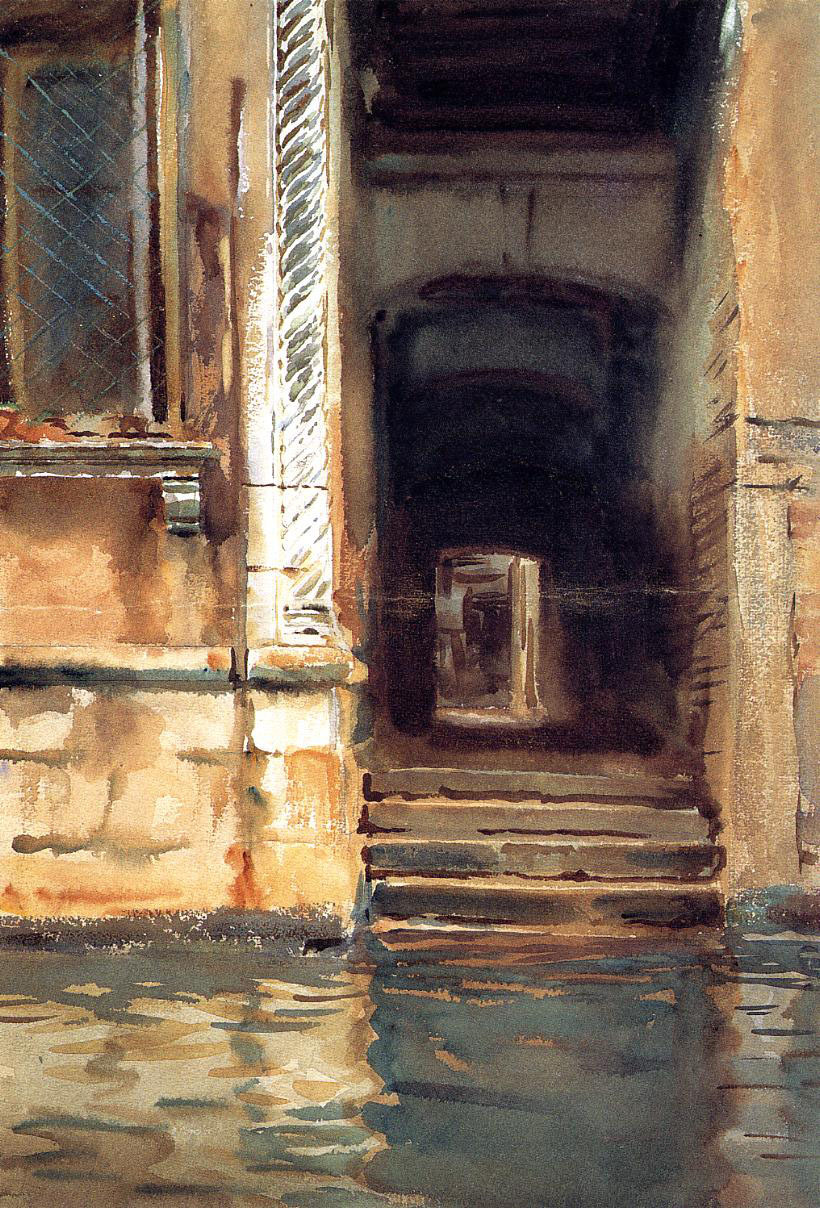
Happy Birthday, John Ruskin

Ruskin, Ca’ d’Oro, Venice, 1845


Imperfection is in some sort essential to all that we know of life. It is the sign of life in a mortal body, that is to say, of a state of progress and change. Nothing that lives is, or can be, ridgidly perfect; part of it is decaying, part nascent. The foxglove blossom--a third part bud, a third part past, a third part in full bloom--is a type of the life of this world. And in all things that live there are certain irregularities and deficiencies which are not only signs of life, but sources of beauty. All admit irregularity as they imply change; and to banish imperfection is to destroy expression, to check exertion, to paralyse vitality.

John Ruskin, born on this day in 1819, from The Stones of Venice

20 April 2024

Mysterious.

Thomson, The Tent, 1915


We do not dislike everything that shines, but we do prefer a pensive luster to a shallow brilliance, a murky light that, whether in a stone or an artifact, bespeaks a sheen of antiquity.

Of course this “sheen of antiquity” of which we hear so much is in fact the glow of grime. In both Chinese and Japanese the words denoting this glow describe a polish that comes of being touched over and over again, a sheen produced by the oils that naturally permeate an object over long years of handling—which is to say grime. If indeed “elegance is frigid,” it can as well be described as filthy. There is no denying, at any rate, that among the elements of the elegance in which we take such delight is a measure of the unclean, the unsanitary. I suppose I shall sound terribly defensive if I say that Westerners attempt to expose every speck of grime and eradicate it, while we Orientals carefully preserve and even idealize it. Yet for better or for worse we do love things that bear the marks of grime, soot, and weather, and we love the colors and the sheen that call to mind the past that made them. Living in these old houses among these old objects is in some mysterious way a source of peace and repose.

Jun'ichirō Tanizaki, from In Praise of Shadows

11 February 2024

Unfinished.


In everything, no matter what it may be, uniformity is undesirable. Leaving something incomplete makes it interesting, and gives one the feeling that there is room for growth. Someone once told me, "Even when building the imperial palace, they always leave one place unfinished." In both Buddhist and Confucian writings of the philosophers of former times, there are also many missing chapters.

21 June 2021

Imperfections.


It is said that there are four kinds of horses: excellent ones, good ones, poor ones, and bad ones. The best horse will run slow and fast, right and left, at the driver’s will, before it sees the shadow of the whip; the second best will run as well as the first one does, just before the whip reaches its skin; the third one will run when it feels pain on its body; the fourth will run after the pain penetrates to the marrow of its bones. You can imagine how difficult it is for the fourth one to learn how to run!

When we hear this story, almost all of us want to be the best horse. If it is impossible to be the best one, we want to be the second best. That is, I think, the usual understanding of this story, and of Zen. You may think that when you sit in zazen you will find out whether you are one of the best horses or one of the worst ones. Here, however, there is a misunderstanding of Zen. If you think the aim of Zen practice is to train you to become one of the best horses, you will have a big problem. This is not the right understanding. If you practice Zen in the right way it does not matter whether you are the best horse or the worst one. When you consider the mercy of Buddha, how do you think Buddha will feel about the four kinds of horses? He will have more sympathy for the worst one than for the best one.

When you are determined to practice zazen with the great mind of Buddha, you will find the worst horse is the most valuable one. In your very imperfections you will find the basis for your firm, way-seeking mind. Those who can sit perfectly physically usually take more time to obtain the true way of Zen, the actual feeling of Zen, the marrow of Zen. But those who find great difficulties in practicing Zen will find more meaning in it. So I think that sometimes the best horse may be the worst horse, and the worst horse can be the best one.

If you understand real practice, then archery or other activities can be zen. If you don't understand how to practice archery in its true sense, then even though you practice very hard, what you acquire is just technique. It won't help you through and through. Perhaps you can hit the mark without trying, but without a bow and arrow you cannot do anything. If you understand the point of practice, then even without a bow and arrow the archery will help you. How you get that kind of power or ability is only through right practice.

If you study calligraphy you will find that those who are not so clever usually become the best calligraphers. Those who are very clever with their hands often encounter great difficulty after they have reached a certain stage. This is also true in art and in Zen. It is true in life. So when we talk about Zen we cannot say, 'He is good,' or 'He is bad,' in the ordinary sense of the words. The posture taken in zazen is not the same for each of us. For some it may be impossible to take the cross-legged posture. But even though you cannot take the right posture, when you arouse your real, way-seeking mind, you can practice Zen in its true sense. Actually it is easier for those who have difficulties in sitting to arouse the true way-seeking mind that for those who can sit easily.

Shunryu Suzuki, from Not Always So: Practicing the True Spirit of Zen

Imperfection.


Treat every moment as your last. It is not preparation for something else.  Life is like stepping onto a boat which is about to sail out to sea and sink.  Enjoy your problems.  Nothing we see or hear is perfect. But right there in the imperfection is perfect reality.

Shunryu Suzuki, from Zen Mind, Beginner's Mind: Informal Talks on Zen Meditation and Practice

11 April 2021

Excellent.

An excellent book ...
When does something's destiny finally come to fruition? Is the plant complete when it flowers? When it goes to seed? When the seeds sprout? When everything turns into compost?
Things are either devolving toward, or evolving from, nothingness. As dusk approaches in the hinterlands, a traveler ponders shelter for the night. He notices tall rushes growing everywhere, so he bundles an armful together as they stand in the field, and knots them at the top. Presto, a living grass hut. The next morning, before embarking on another day's journey, he unknots the rushes and presto, the hut de-constructs, disappears, and becomes a virtually indistinguishable part of the larger field of rushes once again. The original wilderness seems to be restored, but minute traces of the shelter remain. A slight twist or bend in a reed here and there. There is also the memory of the hut in the mind of the traveler — and in the mind of the reader reading this description. Wabi-sabi, in its purest, most idealized form, is precisely about these delicate traces, this faint evidence, at the borders of nothingness ...

Get rid of all that is unnecessary. Wabi-sabi means treading lightly on the planet and knowing how to appreciate whatever is encountered, no matter how trifling, whenever it is encountered. [...] In other words, wabi-sabi tells us to stop our preoccupation with success--wealth, status, power, and luxury--and enjoy the unencumbered life. Obviously, leading the simple wabi-sabi life requires some effort and will and also some tough decisions. Wabi-sabi acknowledges that just as it is important to know when to make choices, it is also important to know when not to make choices: to let things be. Even at the most austere level of material existence, we still live in a world of things. Wabi-sabi is exactly about the delicate balance between the pleasure we get from things and the pleasure we get from freedom of things.
Leonard Koren, Wabi-Sabi: For Artists, Designers, Poets & Philosophers

23 February 2019

Escaped.


The WONDER of the IMPERFECT

Nothing that I do is finished
so I keep returning to it
lured by the notion that I long
to see the whole of it at last
completed and estranged from me

but no the unfinished is what
I return to as it leads me on
I am made whole by what has just
escaped me as it always does
I am made of incompleteness
the words are not there in words

oh gossamer gossamer breath
moment daylight life untouchable
by no name with no beginning

what do we think we recognize

W.S. Merwin

08 October 2018

Battered.


I did not love cold harmony and perfect regularity of organization; what I sought was variety, mystery, tradition, the venerable, the awful. I despised sophisters and calculators; I was groping for faith, honor, and prescriptive loyalties. I would have given any number of neo-classical pediments for one poor battered gargoyle.

Russell Kirk

28 November 2017

Poetry.


Get rid of all that is unnecessary. Wabi-sabi means treading lightly on the planet and knowing how to appreciate whatever is encountered, no matter how trifling, whenever it is encountered. In other words, wabi-sabi tells us to stop our preoccupation with success -- wealth, status, power, and luxury -- and enjoy the unencumbered life. Obviously, leading the simple wabi-sabi life requires some effort and will and also some tough decisions. Wabi-sabi acknowledges that just as it is important to know when to make choices, it is also important to know when not to make choices: to let things be. Even at the most austere level of material existence, we still live in a world of things. Wabi-sabi is exactly about the delicate balance between the pleasure we get from things and the pleasure we get from freedom of things.

Things wabi-sabi have no need for the reassurance of status or the validation of market culture. They have no need for documentation of provenance. Wabi-sabi-ness in no way depends on knowledge of the creator's background or personality. In fact, it is best if the creator is no distinction, invisible, or anonymous.

Pare down to the essence, but don't remove the poetry.

Leonard Koren, from Wabi-Sabi: For Artists, Designers, Poets & Philosophers