"I am not one who was born in the custody of wisdom. I am one who is fond of olden times and intense in quest of the sacred knowing of the ancients." Gustave Courbet
Showing posts with label Notre-Dame. Show all posts

13 June 2024

Restored.


On the banks of the Seine, passers-by stopped and looked up to contemplate the new ballet offered by the Notre Dame construction site. On Friday, May 24, the cathedral of Paris regained the cross on the roof over the apse. (The cross and rooster-shaped reliquary over the transept were replaced earlier.) As this cross was the only roof ornament to have miraculously escaped the devastating flames of the tragic fire of April 15, 2019, it was a particularly symbolic moment before the cathedral's scheduled reopening on December 8, 2024.

Suspended in the air at the end of a crane, this work by Viollet-le-Duc has returned to its original position at the top of the apse of the choir roof, once again watching over the capital and its inhabitants.

From above, a clamor rises: The ironworkers and roofers who worked on its restoration turn to the journalists with a shout of victory. From below, cheers and applause respond, as if to thank the hard work of the craftsmen who have spent more than 1,000 hours restoring this two-ton cross, dented by its fall.

17 July 2023

Reconstructing.


The restoration efforts at Notre-Dame continue using ancient tools and techniques ...
"Working inside the massive wooden structure was extremely impressive," he says. "You're in the sky but completely in the dark, so you discovered 'the forest' with flashlight and headlamps, never entirely seeing the whole thing. But you could hear and feel everything going on in the cathedral below — the priests celebrating Mass, the smell of incense. And we were near the belfry, so all of a sudden the bells would ring and resound very strongly. It was as if the cathedral was alive under your feet."

It is thanks to those plans that today's builders know exactly how to reconstruct the charpente, says Fromont. And there are several reasons to rebuild the Gothic masterpiece exactly as it was.

"A cathedral is a structural ensemble that's very complex, and as soon as you change one little thing, one parameter, it impacts everywhere else in the cathedral," he says. "So reconstructing it exactly the same way is also a precaution. It worked very well for 800 years. So we know if we build it back the same way we won't risk damaging the cathedral by trying something new."

25 July 2022

05 September 2021

Again.


Gordon Linney suggests looking for comfort beyond the here and now ...
In April 2019, the world watched in horror as the historic church of Notre Dame was gutted by fire. A dramatic moment came when the 19th-century spire came crashing down and the future of the great building seemed uncertain. Oak trees donated from across France had been used in the construction of the building and the good news is that once again oak trees are being gathered across France as restoration proceeds. The trees must be between 100 and 200 years old and those intended for roof timbers long enough to support an overhead curve of 65 feet.

Tomorrow’s psalm (84) takes us inside the Temple to remind us of its spiritual significance: “How lovely is your dwelling place, O LORD of hosts! My soul longs, indeed, it faints for the courts of the LORD; my heart and my flesh sing for joy to the living God.”

This psalm would have been used by pilgrims perhaps paying a once in a lifetime visit to this sacred place. Such feelings can of course apply just as much to the smallest and plainest of churches where faith has been nurtured and memories of family baptisms, weddings, and funerals linger. God’s promise recorded in Exodus makes the point: “In all places where I cause my name to be remembered, I will come to you and bless you.”

Johannes Brahms completed his German Requiem following the deaths of his mother in 1865 and his friend Robert Schumann some years earlier. The magnificent How Lovely is Thy Dwelling Place, using words from psalm 84, was the first of several movements to be written. Brahms was an intensely private man and we don’t know what his religious beliefs were except that he was confirmed in the Lutheran church and knew the Bible thoroughly. His German requiem was controversial because he did not use traditional Latin texts, choosing instead words from Luther’s German translation of the Bible that not only mourned the dead but also comforted the living. This departure from tradition caused unease with Church authorities and to calm their fears “I know that my Redeemer Liveth” from Handel’s Messiah was sometimes added to performances.

Brahms’s need for comfort is the experience of all who mourn. No matter how wonderful and reassuring ritual or liturgy may be, loss is real and devastating: the love, the touch, the companionship, the life shared – human be-ing seemingly no longer. It is in such moments of despair that our Christian faith encourages us to trust the promise of God revealed in the life, death and resurrection of Jesus Christ that every life, including those we love who have died, has an eternal purpose and meaning, that there is a life dimension beyond the here and now. This is a God-given hope, not an invention by those who cannot face reality. The first Letter of Peter makes that clear: “Blessed be the God and Father of our Lord Jesus Christ! By his great mercy he has given us a new birth into a living hope through the resurrection of Jesus Christ from the dead, and into an inheritance that is imperishable, undefiled, and unfading, kept in heaven for you.”

10 June 2020

Restoration.


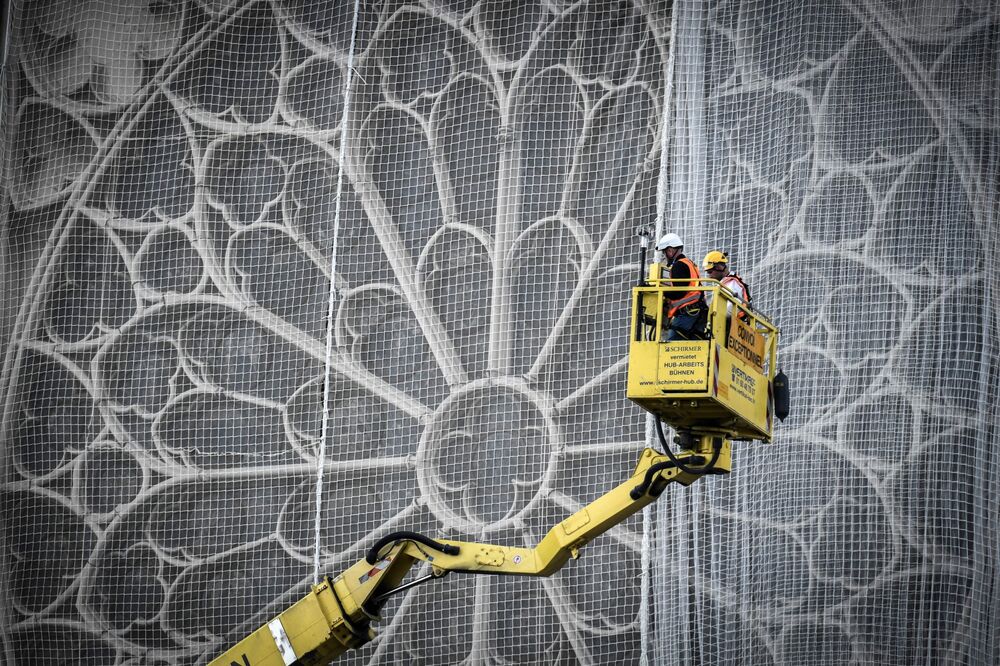
Works have restarted in Paris’ fire-ravaged Notre Dame cathedral after a hiatus linked to the coronavirus pandemic.

On Monday morning operations began to dismantle scaffolding that was already in place before the April 2019 fire amid previous restoration efforts on the old structures.

This current phase of works has been deemed highly dangerous because the scaffolding weighs over 200 tons, and is thought to have melted together in areas because of the heat of the blaze.

Technicians will access the interior of the cathedral by rope to dismantle the 40,000 tubes, one by one. This phase is expected to last three months.

CONNECT

27 February 2020

Function.

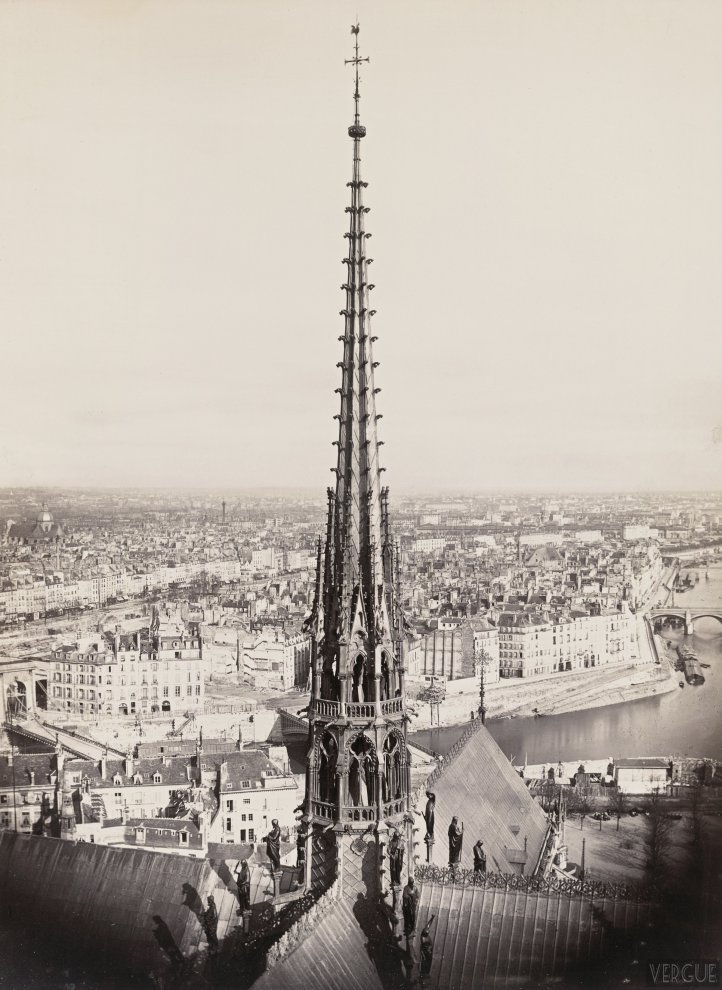
Marville, The Arrow of Notre-Dame de Paris, 1862


The Oxford University Press on the Notre-Dame restoration efforts ...

Sometimes it takes a catastrophic loss for us to realize how important historic architecture and cityscapes are to our lives. For instance, repairs are still ongoing following a 2011 5.8 magnitude earthquake that caused more than $30 million dollars’ worth of damage to the National Cathedral in Washington, DC.  And on 15 April 2019 a cataclysmic fire brought massive destruction to the Gothic cathedral of Notre-Dame in Paris, including the loss of its soaring spire and its centuries-old wood roof structure. There followed an international outpouring of grief for the loss of one of the icons of Western architecture. People from innumerable walks of life and countries around the world mourned the loss of a building that represented the aspirations, creativity, and sheer labor of mostly nameless artists, architects, and workers. The restoration campaign likely will take years, perhaps even a decade or more.

Around the globe, wars and natural disasters—not to mention modernization and development—threaten the built environment. Globally, more than half of the world’s population (according to the United Nations Population Division) now lives in cities, and by 2050 about 70% of the earth’s population will be urban. We can only imagine what the implications of this growth will be for historic cities and buildings and hope that heritage preservation and conservation will keep pace.

It’s not just iconic monuments and buildings by famous architects that we have to be concerned about: historic architecture and urban environments are mostly the work of unnamed (vernacular) builders and craftspeople—not professional designers. All sorts of builders and buildings will be affected in this period of urbanization and development. To become effective preservation advocates, we will all have to become knowledgeable about a wide range of buildings and environments.

Eugène-Emmanuel Viollet-le-Duc (1814-1879), the nineteenth-century restorer of the Cathedral of Notre-Dame in Paris, made the connection between modernization and preservation in his Dictionnaire raisonné de l’architecture française du XIe au XVIe siècle (Dictionary of French Architecture from the Eleventh through the Sixteenth Centuries) published beginning in 1854. The author began his entry on “Restoration” by saying “The word and the thing are modern.” This seemingly paradoxical statement contains a kernel of truth that is as apt now as it was in the mid-nineteenth century: Although preservation (or restoration, in his terms) is concerned with retaining buildings that represent the past, the very need to do so is a function of modernization.

17 December 2019

Planning.


The fire at Notre-Dame de Paris sparked concern throughout the world as one of the most historic landmarks in Europe went up in flames. But how much is truly lost and what precious artefacts were saved by careful planning?


CONNECT

07 December 2019

Value.


The drama surrounding the damaged Notre Dame Cathedral in Paris, Europe’s most visited monument, continues to build as the French government debates the fate of the cathedral’s befallen spire. The National Assembly’s cultural commission was convening last week to discuss the renovation when General Jean-Louis Georgelin, appointed to spearhead the project by French President Emmanuel Macron, suggested chief architect Philippe Villeneuve should “just shut his big mouth.” 

The animosity is due to disagreement over the direction of the $1 billion restoration project. The devastating fire in April, whose cause is still under investigation, completely destroyed the mid-19th-century timber-and-lead spire and the majority of the medieval wooden roof, and President Macron announced an international design competition for a contemporary replacement soon after. Despite the passage of a bill in May ruling that the Notre Dame restoration must maintain the original design, the fate of its spire still appears up in the air. Chief architect Villeneuve, meanwhile, has made his opposition to anything short of an identical reconstruction clear. “I will restore it identically and it will be me, or they will build a modern spire and it won’t be me,” said Villeneuve in an interview with the French radio station RTL last month. He invoked the 1964 Venice Charter, which requires restorations of historic buildings to retain their original architectural and historic value. 

CONNECT

09 October 2019

Heritage.


As we walk around the sacristy towards the cathedral square, where a lapidarium houses all the fragments of stone and iron that have fallen to the ground since the fire, Villeneuve points up at the giant metallic lace of blackened metal that used to cover the spire.

When the fire broke out, Notre-Dame was undergoing restoration work and was covered with scaffolding. Miraculously, this did not collapse in the 800C heat, though many of the 50,000 poles melted, making dismantling the structure extremely difficult and perilous for the vaults underneath. Imagine disentangling a gigantic pile of welded pick-up sticks 95 metres above a world treasure of medieval architecture. And until each weakened rib, vault, flying buttress, gable and pinion is supported by a wooden structure or exoskeleton, Villeneuve is holding his breath.

 architect found his calling right there, under those vaults, visiting Notre-Dame as a child with his family in the late 1960s and 1970s. Sitting quietly on the wooden benches while listening to one of the 20th century’s greatest organists, Pierre Cochereau, Villeneuve remembers gazing at the cathedral’s nooks and crannies, the music enhancing every detail and emotion.

Villeneuve is one of 30 chief architects of historic monuments, a position created in 1893. The idea was, and still is, to recruit the most gifted art historians and architects of their generation to oversee France’s architectural heritage; each is given a portfolio of landmark buildings to look after.

They will of course have their say, albeit a consultative one, on the reconstruction of the cathedral — and in particular its spire, for which a flurry of fantastical propositions emerged on social media after French prime minister Edouard Philippe announced an international architectural competition. Some of the designs attracted more attention than others, such as a Swedish agency’s plan for a cross-shaped rooftop swimming pool, or an eco-friendly forest to replace the “forest” of medieval oak beams that had been ravaged by the flames. The British architect Norman Foster declared his interest, envisaging a light and airy see-through roof topped with a crystal and steel spire.

29 July 2019

Close.


The miscommunication, uncovered in interviews with church officials and managers of the fire security company, Elytis, has set off a bitter round of finger-pointing over who was responsible for allowing the fire to rage unchecked for so long. Who is to blame and how the fire started have not yet been determined and are at the heart of an investigation by the French authorities that will continue for months.

But the damage is done. What happened that night changed Paris. The cathedral — a soaring medieval structure that has captured the hearts of believer and nonbeliever alike for 850 years — was ravaged.

Today three jagged openings mar Notre-Dame’s vaulted ceiling, the stone of the structure is precarious, and the roof is gone. Some 150 workers remain busy recovering the stones, shoring up the building, and protecting it from the elements with two giant tarps.

Some of what went wrong that night has been reported in the French news media, including Le Monde and Le Canard Enchaîné. Now, The New York Times conducted scores of interviews and reviewed hundreds of documents to reconstruct the missteps — and the battle that saved Notre-Dame in the first four critical hours after the blaze began.

What became clear is just how close the cathedral came to collapsing.

CONNECT

28 June 2019

Individuals.


The billionaire French donors who publicly proclaimed they would give hundreds of millions to rebuild Notre Dame have not yet paid a penny toward the restoration of the French national monument, according to church and business officials.

Instead, it's mainly American and French individuals, via Notre Dame charitable foundations, that are behind the first donations paying the bills and salaries for up to 150 workers employed by the cathedral since the April 15 fire that devastated its roof and caused its masterpiece spire to collapse. This month they are handing over the first private payment for the cathedral's reconstruction of 3.6 million euros ($4 million).

CONNECT

12 June 2019

On.


A great master of his craft,
Erwin von Steinbach; but not he alone,
For many generations labored with him.
Children that came to see these Saints in stone,
As day by day out of the blocks they rose,
Grew old and died, and still the work went on,
And on, and on, and is not yet completed.
The generation that succeeds our own
Perhaps may finish it. The architect
Built his great heart into these sculptured stones,
And with him toiled his children, and their lives
Were builded, with his own, into the walls,
As offerings unto God. You see that statue
Fixing its joyous, but deep-wrinkled eyes
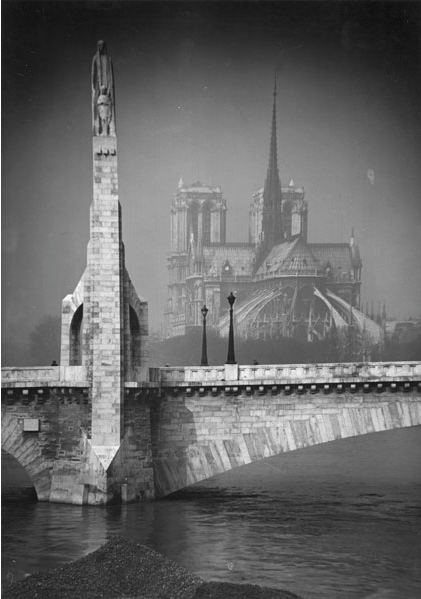
Upon the Pillar of the Angels yonder.
That is the image of the master, carved
By the fair hand of his own child, Sabina.

Henry Wadsworth Longfellow

09 June 2019

Rebuild


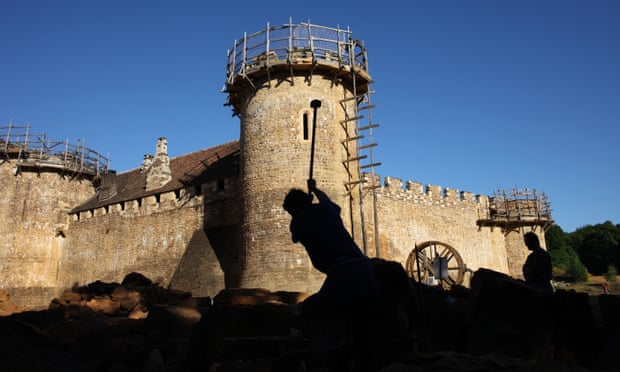
In a clearing in a forest in northern Burgundy, the stonemasons and carpenters of Guédelon are awaiting a call.

If anyone can rebuild Notre Dame Cathedral as it was – if that is what is required – they can.

CONNECT

British artisans preach patience ...

Traditional.


The Notre Dame cathedral in Paris will be rebuilt as it previously stood, according to a new resolution passed by the French Senate. The vote comes after a fire destroyed the international landmark and amidst discussions of modernizing it.

While not yet binding law, the resolution is the biggest sign yet that the dreams of architects around the world will be crushed in the name of tradition. The Senate's resolution, which must be reworded to match the lower National Assembly's, declares that the famed cathedral will appear “in the same way visually as before.”

Despite an outpouring of design ideas, the stars seemed to be aligning toward a traditional visual response to the disaster ever since it began. Nostalgia for the monument, first completed in 1345, has run high.

CONNECT

15 May 2019

Revolutionizing.


If its beauty and magnificence is instantly apparent, so much about Notre Dame is not. To begin with, we don't know who built this cathedral—or how. 

The bishop of Paris, Maurice de Sully, commissioned the massive church complex around 1160. Yet the names of those who first constructed this masterpiece are lost to history. They left no records—only centuries of speculation—behind.

"So much ink has been spilled over that building," says art historian Andrew Tallon. "So much of it is completely wrong."

A former composer, would-be monk, and self-described gearhead—or, as he puts it, "tacklehead"—Tallon intends to make that history right. With the help of 21st-century laser scanners, he is teasing out clues hidden in the ancient stones of Notre Dame and other medieval structures—and revolutionizing our understanding of how these spectacular buildings were made.

CONNECT

05 May 2019

Slow.


The scramble is on to rebuild Notre Dame Cathedral before the 2024 Summer Olympics in Paris, but a concerned coalition of curators, architects, art historians, preservationists, and more have told French president Emmanuel Macron to slow down.

In a petition published by the newspaper Le Figaro on April 28, 1,170 signers spoke out against hastily reconstructing Notre Dame. Macron has taken steps since the April 15 fire to speed up the cathedral’s repair, first announcing an international design competition to replace the downed spire, and then the formation of a draft law that would appoint a citizen’s group to oversee the reconstruction. According to The Art Newspaper, the body would have the authority to forgo preservation regulations in the name of meeting the 2024 deadline.

Philippe de Montebello, former director of the Metropolitan Museum of Art, Davide Gasparotto, senior curator of the painting department at the Getty Museum, Louvre chief curators Nicolas Milovanovic and Cécile Scailliérez, and a number of prominent French preservationists put their names on the Le Figaro petition.


How will Notre-Dame be restored, and precisely which Notre-Dame—a building that has been altered, adjusted, modified, and even mutilated over the centuries and is arguably a 19th-century construct—should be revived?

27 April 2019

Compagnons.


When the world’s most delicate historic sites need expert attention, it’s often the same group at the end of the line: the Compagnons du Devoir.

CONNECT


Les Compagnons du Devoir ... HERE.

24 April 2019

Inheritance.


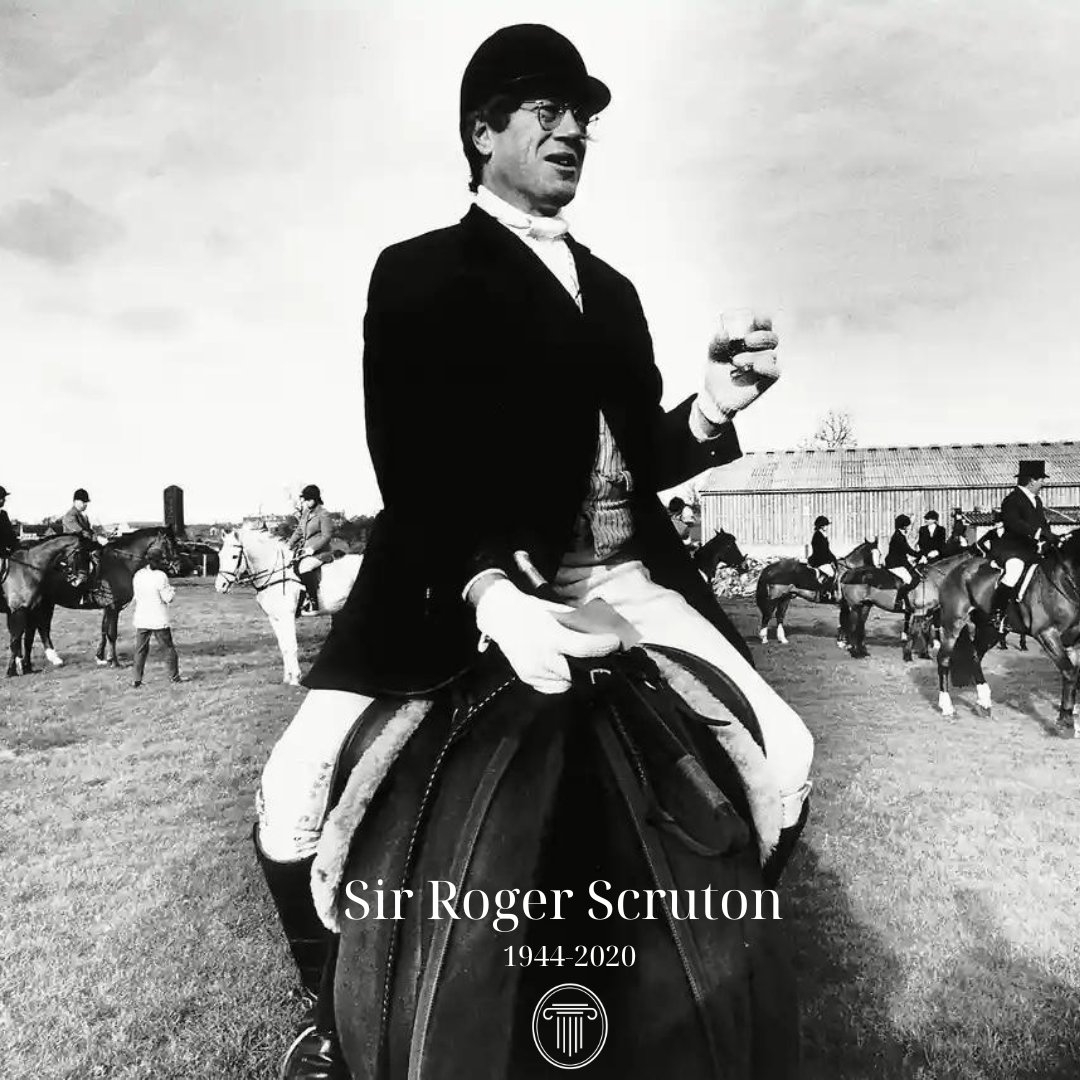
Sir Roger Scruton's thoughts on Notre-Dame ...

We have a national cathedral – Westminster Abbey – where our poets and monarchs are buried. But it is not national as Notre Dame is national. Our heroes are stacked away there, revered for things that are vaguely remembered. In the mysterious interior of Notre-Dame, however, something is celebrated that is far more durable than the deeds of heroes: what is revered is an idea. The Englishman, looking up at those gargoyles from the square below, is made aware of the God-given idea that can reveal itself, now in a King, now in an artist or playwright, now in the peasant girl whom we, the English, martyred in our greatest crime.
We are awe-struck by the presence of this idea, fixed forever in stone, because it is not unique to the cathedral but is embodied in the city all around. We in Britain have destroyed our cities, shovelling away the stone and replacing it with steel and glass. We have done to London what Le Corbusier wished to do to Paris, and what one of our architects, invited by President Pompidou, did to the Marais. We have replaced built form by childish bubbles of steel and glass. Our churches stand in concrete deserts, and it is hardly surprising if nobody visits them or enters them for a time of prayer.

As the angel on the roof has promised, Notre Dame will be resurrected. It will be resurrected because its city, unique among modern capitals, has remained continually itself, from the time when it was the spiritual heart of Europe, through the time when it turned the world upside down, to our present time, when it reminds our troubled continent of the spiritual inheritance that it must not deny.

CONNECT

Kurt offers thoughts on Notre-Dame and expressions of transcendence.

19 April 2019

Bees.


Several types of creatures make themselves at home on the tippy-tops of buildings. You have your gargoyles, their stone gazes fixed forever on the horizon, and pigeons, their poop splattered in putrid white polka dots. And, on some urban rooftops, you have bees.

Beekeepers tend to hives atop several Paris landmarks, including the Opéra Garnier, Musée d’Orsay, and Notre Dame. More than 180,000 honeybees were said to flit around the hives atop the sacristy, their honey doled out among cathedral staff. So when a blaze recently torched Notre Dame’s wood roof and demolished the spire, apiarists were eager to know how the colonies had fared.

CONNECT

Le site officiel est ICI.