"I am not one who was born in the custody of wisdom. I am one who is fond of olden times and intense in quest of the sacred knowing of the ancients." Gustave Courbet
Showing posts with label listening. Show all posts

30 December 2024

Agreement.


Much of what happens to us in life is nameless because our vocabulary is too poor. Most stories get told out loud because the storyteller hopes that the telling of the story can transform a nameless event into a familiar or intimate one.  We tend to associate intimacy with closeness and closeness with a certain sum of shared experiences. Yet every day total strangers, who will never say a single word to one another, can share an intimacy. An intimacy contained in the exchange of a glance, a nod of the head, a smile, a shrug of a shoulder. A closeness which lasts for a second or for the duration of a song being sung and listened to together. An agreement about life. An agreement without clauses. A conclusion spontaneously shared between the untold stories gathered around the song.

John Berger, from Confabulations

27 December 2024

Transcendently.


We hear the kindred vibrations--music!--& we put out our dormant feelers--unto the limits of the universe -- We attain to a wisdom that passeth understanding -- The stable continents undulate.  The hard & fixed becomes fluid. "Unless above himself he doth erect himself how poor a thing is man!" When I hear music fear no danger -- I am invulnerable -- I see no foe. I am related to the earliest times & to the latest.

There are infinite degrees of life--from that which is next to sleep and death, to that which is forever awake & immortal. We must not confound man with man. We cannot conceive of a greater difference than between the life of one man and that of another. I am--constrained to believe that the mass of men are never so lifted above themselves that their destiny is seen to be transcendently beautiful & grand. 

Henry David Thoreau, from his journal dated January 13, 1857

07 August 2024

Listening.


LESSONS from the FUNERAL of a RAVEN

I've been translating the language with which creatures address God, including the non-harmonic bleats of dying sheep, the burpish fish, the tenor grown of the toad in the snake's mouth, the croak of the seagull flopping on the yellow line, misnamed mockingbird, and cat bird singing hundreds of borrowed songs -- coyotes joyous yipe when they bring down a fawn which honks like a bicycle horn for its helpless mother. The ladybug on the table was finally still.  I strained my ear close to her during the final moments, but only heard Mozart from the other room.  She was beyond reach one night under a big moon.  I heard the massive lung scream of a horse pounding the pasture across the creek, then his breathing above the creek.  This language is closer to what we spoke in Africa 70,000 years ago before we started writing things down and now we can't seem to stop.  I can't imagine how thought we though that we're better than the any of these other creatures, but that we wrote ourselves into it.  Someone looked down from Babel's tower and got the wrong idea, ignoring the birds above him.  I learned all of this one day listening to a raven funeral and a fir tree behind my cabin and learned it again listening to a wolf howling from the river delta nearby.  It's an old secret past anyone's caring, or so it seems.

Jim Harrison

17 February 2024

Listen.

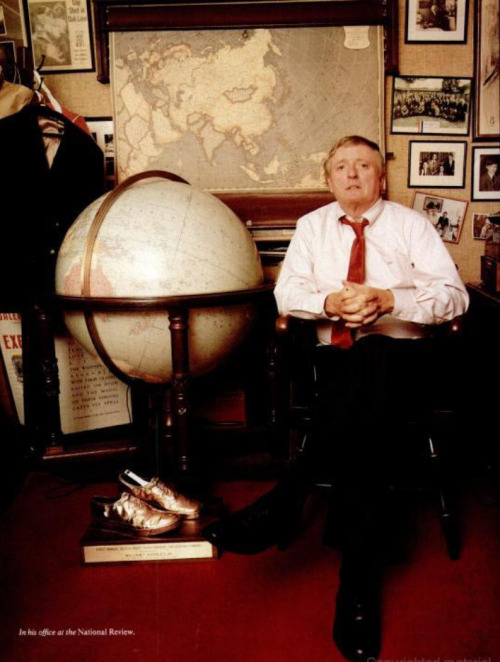
From a 1983 episode of Firing Line, Buckley and guest Mortimer Adler in discussion on how to speak and how to listen ...

13 September 2022

Wash.


Before listening to the way, do not fail to wash your ears.
Otherwise it will be impossible to listen clearly.

What is washing your ears?

Do not hold on to your view.
If you cling to it even a little bit,
you will lose your way.

What is similar to you but wrong, you regard as right.

What is different from you but right, you regard as wrong.

You begin with ideas of right and wrong.
But the way is not so.

Seeking answers with closed ears is
like trying to touch the ocean bottom with a pole.
 
Ryokan

13 July 2021

Understand.


MICE: How can a writer train himself?

Your Correspondent.: Watch what happens today. If we get into a fish see exactly what it is that everyone does. If you get a kick out of it while he is jumping remember back until you see exactly what the action was that gave you the emotion. Whether it was the rising of the line from the water and the way it tightened like a fiddle string until drops started from it, or the way he smashed and threw water when he jumped. Remember what the noises were and what was said. Find what gave you the emotion; what the action was that gave you the excitement. Then write it down making it clear so the reader will see it too and have the same feeling that you had. That’s a five finger exercise.

MICE: All right.

Y.C.: Then get in somebody else’s head for a change. If I bawl you out try to figure what I’m thinking about as well as how you feel about it. If Carlos curses Juan think what both their sides of it are. Don’t just think who is right. As a man things are as they should or shouldn’t be. As a man you know who is right and who is wrong. You have to make decisions and enforce them. As a writer you should not judge. You should understand.

MICE: All right.

Y.C.: Listen now. When people talk listen completely. Don’t be thinking what you’re going to say. Most people never listen. Nor do they observe. You should be able to go into a room and when you come out know everything that you saw there and not only that. If that room gave you any feeling you should know exactly what it was that gave you that feeling. Try that for practice. When you’re in town stand outside the theatre and see how the people differ in the way they get out of taxis or motor cars. There are a thousands ways to practice. And always think of other people.

Ernest Hemingway, from an interview in By-Line: Ernest Hemingway 

29 June 2021

Listen.


When you listen to someone, you should give up all your preconceived ideas and your subjective opinions; you should just listen to him, just observe what his way is. We put very little emphasis on right and wrong or good and bad. We just see things as they are with him, and accept them. This is how we communicate with each other. Usually when you listen to some statement, you hear it as a kind of echo of yourself. You are actually listening to your own opinion. If it agrees with your opinion you may accept it, but if it does not, you will reject it or you may not even really hear it.

Shunryu Suzuki, from Zen Mind, Beginner's Mind: Informal Talks on Zen Meditation and Practice

21 March 2020

Listen.


The RAIN STICK

Up-end the stick and what happens next
is a music that you never would have known
to listen for. In a cactus stalk

Downpour, sluice-rush, spillage and backwash
come flowing through. You stand there like a pipe
being played by water, you shake it again lightly

and diminuendo runs through all its scales
like a gutter stopping trickling. And now here comes
a sprinkle of drops out of the freshened leaves,

Then subtle little wets off grass and daisies;
the glitter-drizzle, almost-breaths of air.
up-end the stick again. What happens next

is undiminished for having happened once,
twice, ten, and thousand times before.
who cares if all the music that transpires

is the fall of grit or dry seeds through a cactus?
You are like a rich man entering heaven
through the ear of a raindrop. Listen now again.

Seamus Heaney

04 December 2018

Wealth.


We have discovered that some teachers, if they really want to hear what children have to say, that their whole state of being is at ease, and they listen closely and that in the process of listening they discover that children are speaking a wealth of information, and these teachers will be receptive to the information that they are hearing. And then some teachers want to hear children say what they the teachers, deep down, want the children to say, things that they want to hear, and will unconsciously overlook what children are actually saying. They can’t hear clearly and are unable to truly understand the child’s expression. And you can see that their physical state of being is one of anxiety.

Wang Zhen

12 September 2018

Healing.


The birdcalls begin their praise.
And it's their right.  We listen closely.
(We behind masks, in costumes!)
What do they call?  a little willfulness,

a little sadness, and such huge promise,
sawing away at the half-locked future.
And in between, healing in our hearing:
the beautiful silence that they break.

Rainer Maria Rilke

25 July 2018

Listen.

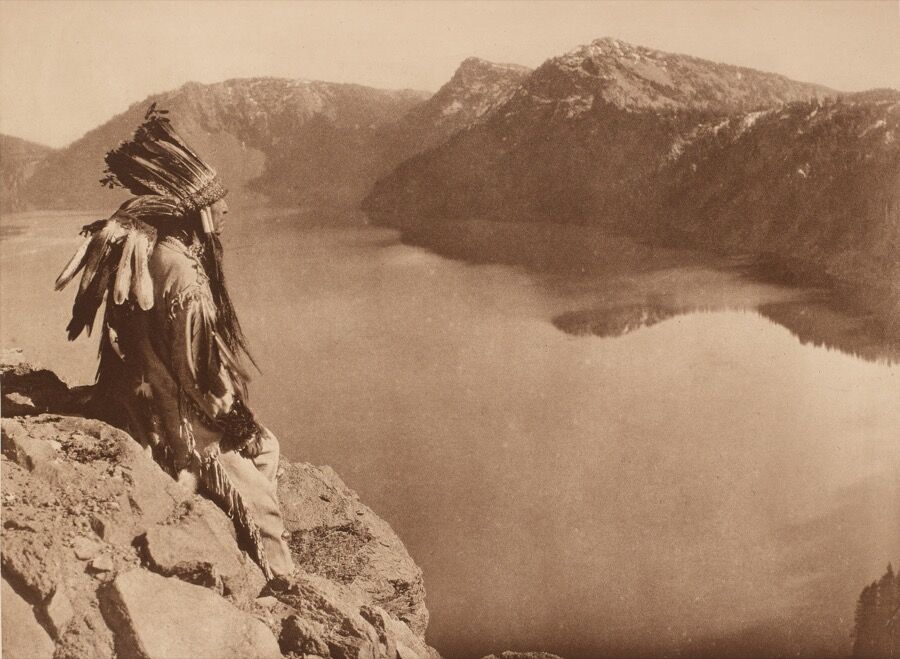
Curtis, Crater Lake, 1923


The word "listen" is often used to begin a story.  Every story needs a storyteller and a story-listener, because while the one offers the necessary words, the other gives the necessary silence.  Children were traditionally taught to pay similar attention to the land, "to listen intently when all seemingly was quiet," in the words of Luther Standing Bear.  Listening lets the outer world be re-created within you.  Listening means being willing to let one's borders be porous.  Listening does what light does for a seed, asking it to swing upwards into life and giving it a reason to do so.  "Listen, and you will hear the patterns of life.  Are they the same, or is there a change in the sounds?" is how the Ojibwa storyteller Ignatia Broker describes an early lesson for a child, adding that children were encouraged to listen to an older person before they spoke themselves.  Inuit people were happier with children who took their time learning to talk because listening was the skill needed to to learn fast: speaking could wait.

To get the attention of a child, you can shout "Shut up!" or you can normally say "Listen!"  When children want other children to hear them, they generally say "Listen!"  And it normally works.  Moreover, there is a different quality of attention given in response: "Shut up!" may provoke resentful attention while "Listen!" may invite an unguarded curiosity.  Demanding someone's silence is one thing; offering your own is another.  I remember disliking -- to the point of fury -- silence being imposed on us, but being spellbound by self-willed silence, breathing in silver air, mirrored as water.

"Silence, love, reverence -- this is the trinity of first lessons," says Charles Eastman, on the trivium of the Native American Ohiyesa people.  Silence is "the sign of perfect equilibrium.  Silence is the absolute poise or balance of body, mind, and spirit."

If silence is revered, words are honored.  From the moment children begin to speak, they are taught to respect speech, "how to use the word and how not to use it," says Henry Old Coyote (Crow).  "The word is all-powerful, because it can build a man up, but it can also tear him down.  That's how powerful it is.  So a child is taught  to use words tenderly and never against anyone."

Jay Griffiths, from Kith: The Riddle of the Childscape

25 April 2018

Profundity.


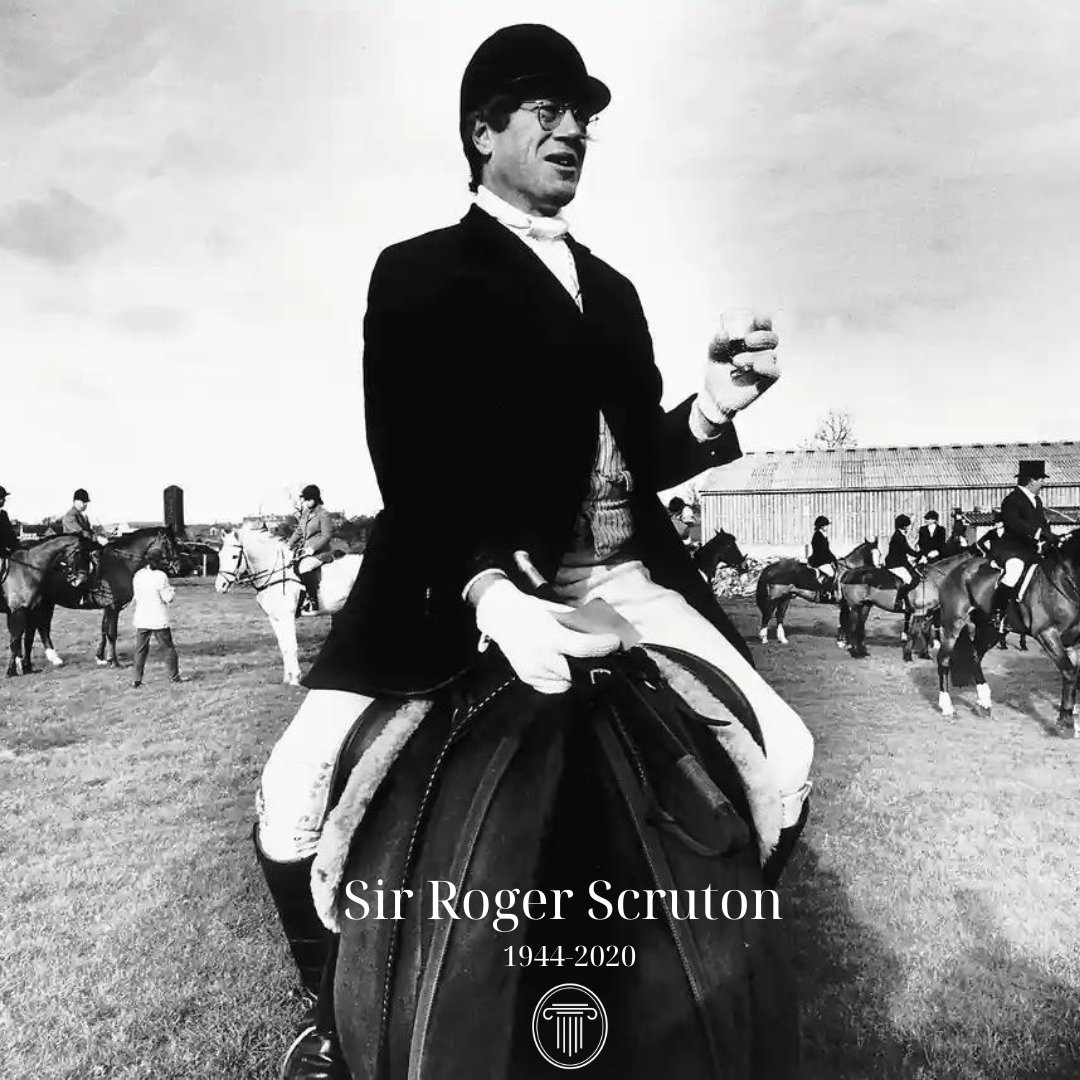
Sir Roger Scruton on the profundity of music and the intense silence of listening, HERE.

09 April 2018

Amplification.


SOME EXTENSIONS on the SOVEREIGNTY of SCIENCE

for my father

1

When the thought came to him it was so simple he shook his head.
People are always looking for kidneys when their kidneys go bad.

But why wait? Why not look when you’re healthy?
If two good kidneys do the trick, wouldn’t three do the job even better?

Three kidneys. Maybe two livers. You know. Two hearts, of course.
Instead of repairing damage, why not think ahead?

Why not soup up the car? Why not be a touring eight-cylinder classic,
Or one of those old, sixteen-cylinder, half-mile-long Duesenbergs?

2

The hardest work of the last quarter of the twentieth century is to find
An edge in the middle. When something explodes, for example,

Nobody is confused about what to do—you look toward it.
Loud is a magnet. But the laws of magnetism are more complex.

One might just as well try this: When something explodes,
Turn exactly opposite from it and see what there is to see.

The loud will take care of itself, and everyone will be able to say
What happened in that direction. But who is looking

The other way? Nature, that magician and author of loud sounds,
Zookeeper and cook, electrician and provocateur—

Maybe these events are Nature’s sleight of hand, and the real
Thing that’s happening is in the other hand,

Or behind or above or below or inside us.

3

On a trip to Bloomington, Indiana, I was being driven there
From Indianapolis and my friend pointed out some hills along the way,

Saying that these hills were made as a result of the farthest reach of
The Ice Age glacier. I had been waiting for this moment

Ever since fifth grade. I could hardly contain myself,
Though I’m sure I just said uh-huh in the conversation.

I took a small and delicious breath. So, I said, slowly,
That’s the terminal moraine, huh? There, I’d said it,

The phrase I had saved up since the moment I found it
In that fifth-grade reader: terminal moraine.

I had never said it aloud. What’s a little scary, of course,
Is that I was more excited about remembering

Than about the hills themselves. But if it was scary, it was sweet
In the mouth, too. In a larger picture, one way or another,

The Ice Age glacier was still a force to be reckoned with.

4

The reason you can’t lose weight later on in life is simple enough.
It’s because of how so many people you know have died,

And that you carry a little of each of them with you.

5

The smallest muscle in the human body is in the ear.
It is also the only muscle that does not have blood vessels;

It has fluid instead. The reason for this is clear:
The ear is so sensitive that the body, if it heard its own pulse,

Would be devastated by the amplification of its own sound.
In this knowledge I sense a great metaphor,

But I do not want to be hasty in trying to capture or describe it.
Words are our weakest hold on the world.

Alberto Rios

02 January 2018

Listen.

Maslowski, Moonrise, 1884


Voices. Voices. Listen, my heart, as only saints have listened ...

Rainer Maria Rilke

01 January 2018

Own.


We cannot live in a world that is interpreted for us by others. An interpreted world is not a home. Part of the terror is to take back our own listening. To use our own voice. To see our own light.

Hildegard von Bingen

13 July 2017

Judgment.


The addictive ear, dulled by repetition, is shut tight as a clam around its pointless treasures. But you can pry it open with musical instruments. Put a young person in a position to make music and not just to hear it and immediately the ear begins to recover from its lethargy. By teaching children to play musical instruments, we acquaint them with the roots of music in human life.

The next step is to introduce the idea of judgment. The belief that there is a difference between good and bad, meaningful and meaningless, profound and vapid, exciting and banal - this belief was once fundamental to musical education. But it offends against political correctness. Today there is only my taste and yours. The suggestion that my taste is better than yours is elitist, an offence against equality. But unless we teach children to judge, to discriminate, to recognise the difference between music of lasting value and mere ephemera, we give up on the task of education. Judgment is the precondition of true enjoyment, and the prelude to understanding art in all its forms.

The good news is that, in their hearts, people are aware of this. All who have had the experience of teaching music appreciation know it to be so. The first step is to introduce the precious commodity of silence, so that your students are listening with open ears to the cosmos, and are beginning to forget their addictive pleasures. Then you play to them the things that you love. They will be bewildered at first. After all, how can this old geezer sit still for 50 minutes listening to something that hasn't got a beat or a tune?

Roger Scruton

CONNECT

07 July 2017

Becomes.

Rengetsu, In Whose Dream Is This Butterfly? (detail), n/d


What is the deep listening? Sama is
a greeting from the secret ones inside

the heart, a letter. The branches of
your intelligence grow new leaves in

the wind of this listening. The body
reaches a peace. Rooster sound comes,

reminding you of your love for dawn.
The reed flute and the singer’s lips:

the knack of how spirit breathes into
us becomes as simple and ordinary as

eating and drinking. The dead rise with
the pleasure of listening. If someone

can’t hear a trumpet melody, sprinkle
dirt on his head and declare him dead.

Listen, and feel the beauty of your
separation, the unsayable absence.

There’s a moon inside every human being.
Learn to be companions with it. Give

more of your life to this listening. As
brightness is to time, so you are to

the one who talks to the deep ear in
your chest. I should sell my tongue

and buy a thousand ears when that
one steps near and begins to speak.

Rumi

27 November 2016

Practice.

Sounds carry intelligence. If you are too narrow in your awareness of sounds, you are likely to be disconnected from your environment. Ears do not listen to sounds; the brain does. Listening is a lifetime practice that depends on accumulated experiences with sound; it can be focused to detail or open to the entire field of sound. Octogenarian composer and sound art pioneer Pauline Oliveros describes the sound experiment that led her to found an institute related to Deep Listening, and develop it as a theory relevant to music, psychology, and our collective quality of life.