"I am not one who was born in the custody of wisdom. I am one who is fond of olden times and intense in quest of the sacred knowing of the ancients." Gustave Courbet
Showing posts with label craftsmanship. Show all posts

24 July 2026

Overlap.


I wandered down a "intellectual craftsmanship" rabbit hole found in this week's essay from Ari Weinzweig ...
Perhaps you may object that the ordinary words of common usage are often loaded with feelings and values, and that accordingly it might be well to avoid them in favour of new words or technical terms. Here is my answer: it is true that ordinary words are often so loaded. But many technical terms in common use in social science are also loaded. To write clearly is to control these loads, to say exactly what you mean in such a way that this meaning and only this will be understood by others. Assume that your intended meaning is circumscribed by a six-foot circle, in which you are standing; assume that the meaning understood by your reader is another such circle, in which he is standing. The circles, let us hope, do overlap. The extent of that overlap is the extent of your communication. In the reader’s circle the part that does not overlap - that is one area of uncontrolled meaning: he has made it up. In your circle the part that does not overlap - that is another token of your failure: you have not got it across. The skill of writing is to get the reader’s circle of meaning to coincide exactly with yours, to write in such a way that both of you stand in the same circle of controlled meaning.

Wittgenstein said, "The limits of my language mean the limits of my world."

07 November 2024

Record.


The Book and Paper Gathering on the conservation of Oxford's University College Buttery Books ...
There was a College tradition, and one that was maintained into the 19th century, of writing your name in the Buttery Book on your first day in College. A good example of the Buttery Books being able to tell a story begins with the signature of Ezreel Tonge, who first made his mark on the college records during the week of 24 May 1639, at the bottom of the list of the poorest undergraduates. Tonge is, according to the College archivist Dr Robin Darwall-Smith, one of University College’s few historical villains.

With the irritating luck that seems to be common to all such base creatures, this unpleasant character gradually worked his way up the pecking order. In the list of the same poor undergraduates from a few pages later in the 1639 buttery book, Tonge’s name has moved up a few notches. He was to rise even higher in subsequent books but is remembered for his transgressions rather than his achievements. As a Fellow and Bursar in the 1650s he caused financial chaos, and then in the late 1670s he teamed with Titus Oates as one of the ringleaders of the Popish Plot, a nasty, McCarthyite-like campaign created to whip up hysteria and hatred against Catholics. So the Buttery Books add considerably to our understanding of the social structures built up within a generation within the College.

Aside from the individual stories these books tell, this breakdown of who was in College during the late 1630s and early 1640s is made doubly important by the historical context: they span the beginnings of the English Civil War, and by the time pen was put to paper in the final volume Charles I was permanently resident in a besieged Oxford. So they become a record of both loyalty and poverty: those who were staying and throwing in their lot with the crown and those who were too poor to leave.

17 July 2023

Reconstructing.


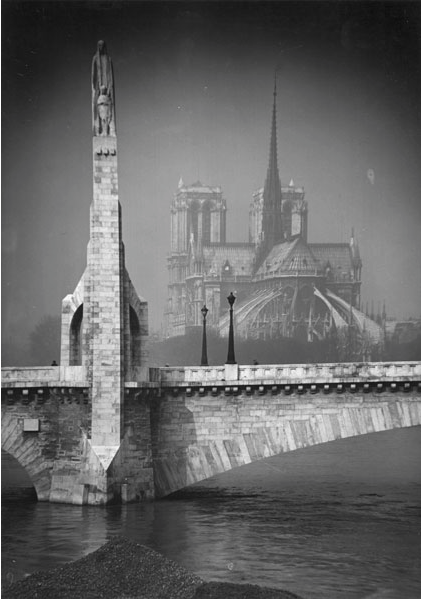
The restoration efforts at Notre-Dame continue using ancient tools and techniques ...
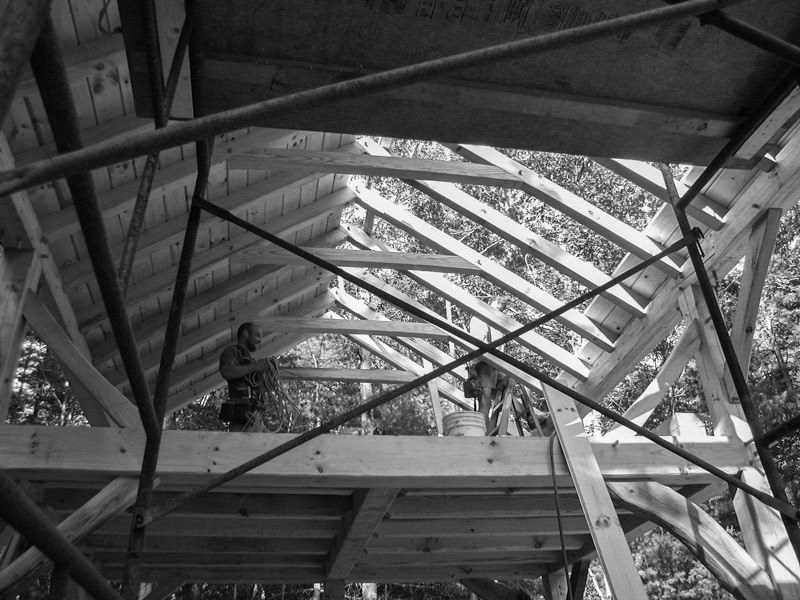
"Working inside the massive wooden structure was extremely impressive," he says. "You're in the sky but completely in the dark, so you discovered 'the forest' with flashlight and headlamps, never entirely seeing the whole thing. But you could hear and feel everything going on in the cathedral below — the priests celebrating Mass, the smell of incense. And we were near the belfry, so all of a sudden the bells would ring and resound very strongly. It was as if the cathedral was alive under your feet."

It is thanks to those plans that today's builders know exactly how to reconstruct the charpente, says Fromont. And there are several reasons to rebuild the Gothic masterpiece exactly as it was.

"A cathedral is a structural ensemble that's very complex, and as soon as you change one little thing, one parameter, it impacts everywhere else in the cathedral," he says. "So reconstructing it exactly the same way is also a precaution. It worked very well for 800 years. So we know if we build it back the same way we won't risk damaging the cathedral by trying something new."

14 August 2022

Lucky.


The craft of stonemason James Preston ...
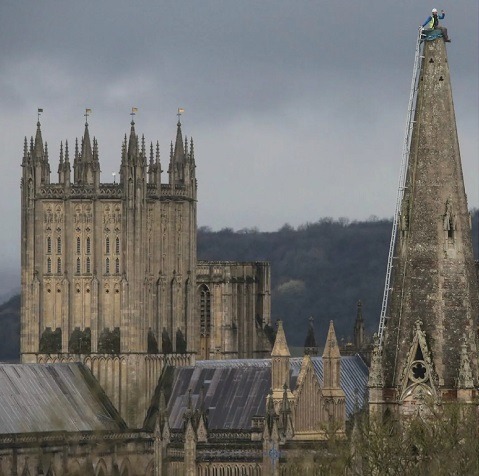
Stonemasons like to grumble about their industry. They cite the poor pay, the long drives, the contrast between the harried contractors and the unhurried in-house cathedral masons, of whom there are still a few groups. Despite his job’s shortcomings, though, Preston counts himself as privileged. On cathedral roofs, he sees grotesques put there for God’s amusement and nobody else’s; and seeing him climbing up spires like some sort of action figure delights and thrills his five-year-old son, Blake. "I think we’re lucky," he says. "I really do."
Thanks, Kurt.

25 July 2022

13 February 2022

Taste.

You taste the farm.

David Lockwood, Managing Director of Neal's Yard Dairy, provides a fascinating tour of their cheese maturing arches ...


Farm Visits (the fonts used in these clips are almost as beautiful as the cheese)
  • Montgomery's Cheddar
  • Appleby's Cheshire
  • Isle of Mull Cheddar

22 January 2022

God.

Prior, St. James Square, 1773


Let Stone be your God and you will find God in the Stone.

Peter Ackroyd, from Hawksmoor

11 October 2020

06 May 2020

Well-founded.

It's National Skilled Trades Appreciation Day.


The satisfactions of manifesting oneself concretely in the world through manual competence have been known to make a man quiet and easy. They seem to relieve him of the felt need to offer chattering interpretations of himself to vindicate his worth. He can simply point: the building stands, the car now runs, the lights are on. Boasting is what a boy does, because he has no real effect in the world. But the tradesman must reckon with the infallible judgment of reality, where one’s failures or shortcomings cannot be interpreted away. His well-founded pride is far from the gratuitous “self-esteem” that educators would impart to students, as though by magic.

Matthew B. Crawford, from Shop Class as Soulcraft: An Inquiry Into the Value of Work

Thank you, Abby, Ben, Judson, and Dick.

Thanks, Nick.

22 February 2020

Evolving.


A third generation stone carver and letterer, Nick Benson specializes in hand-carved gravestones and elegant architectural lettering for public buildings, memorials, and monuments across the country. He learned his craft at the age of 15 from his father John Benson, a renowned letter carver and calligrapher who left his mark on such national treasures as the John F. Kennedy Memorial, the FDR Memorial, and the National Gallery of Art. A master in his own right, Nick Benson designed and carved the inscriptions for the World War II Memorial and the Martin Luther King, Jr. Memorial in Washington, D.C. “My style is a combination of my father’s and my grandfather’s, and it’s constantly evolving. That development is what keeps the passion alive,” he says.

CONNECT

Nick Benson in his studio ...

07 February 2020

Endured.

In Cumberland they built them,
On hills that surely must have killed them,
Through broom and juniper and stunted ling,
Two thousand feet over,
With just a tarpaulin cover,
They crouched in wind and rain and waited for the spring. 
Dave Goulder
Building walls is an antique art that has endured for thousands of years. Extant dry-stone walls, built without the use of mortar or any binding agent, can be dated as far back as 3500 BCE. In the UK, the Celts developed boundary walls or field walls as they transitioned from nomadic pastoralism to settled farming. Farmers built stock-proof walls to confine their livestock. They reformed natural rocky outcrops into useful barriers. They used stone to create irregular systems of dikes and ditches.

If Walls Could Talk ...


Go with Dry Stone Walling! ...

01 February 2020

Ready.


As we shoved off, I sensed only that launching the drift boat, or any boat for that matter, had been a hasty call, one that was unimpeachably mine. Rock Creek several Junes ago was treacherously high. It was also the first time I saw Dan Lahren row a drift boat. Having guided since the 1970s on burly Western rivers, Lahren was the right companion to have aboard.

For all but the least sensible, Rock Creek is raft water in June; we had chosen the drifter, though, because our fishing partner and mutual friend Jim Harrison had grown too old and unstable to fish out of a rubber boat. At peak runoff, with its boulder gardens covered by stained water, a Western freestone like Rock Creek in southwest Montana can appear deceptively innocuous and, with its relative absence of obstacles, can lull even a seasoned guide into a mistaken sense of confidence.

I took the oars initially, and the Clacka felt shot from a sling. Despite my heaving, the quaking alders and willows blurred by. The oarlocks nearly smoked. Kicked loose from the banks by rising water — the result of a thunderstorm in the headwaters, the severity of which we had underestimated — sediment and in-stream particulate ticked against the fiberglass bottom. Holding lies passed by like apparitions. From the bow seat, aiming well downstream, Harrison made a sharp cast with a weighted streamer, which landed, due to our warping speed, even with the port oar. On a straightaway, I looked back at Lahren and shook my head. Without my suggesting it, he had assembled the spare oar and pinned it, at the ready, under his thigh.

“Go another bend or two, and I’ll spell you,” he said. He spit a stream of Skoal over the gunwale. “I’d smoke, but the boat’s going too fast to light a cigarette.”

It took 15 minutes to reach a spot where we could eddy-out. Brown trout, fattened on aquatic worms and stonefly nymphs, were stationed nose-to-tail, it seemed, in a line of bubbles trailing off a grassy island. Harrison, the acclaimed writer best known for his prose and poetry rife with an eloquent and “ravenous love of Earth,” teased a parakeet-yellow streamer through the soft water and managed to catch a few beauties, but we regarded them as mere distractions. Our focus was on the beast that is Rock Creek in runoff. Even in average flows, the water’s steep pitch and middleweight musculature make for arduous rowing; on a day like this one, when deadfalls kicked loose from logjams can form new strainers or render impassable channels that just yesterday were clear, the river, inaptly named a creek, can take a boat in its teeth and refuse to let go. If you get sloppy or make a mistake, it will bite you.

We pushed off, and Lahren took the oars through a stretch of river called the Microburst, where decades ago on the tight-hugging hillsides a sudden and violent downdraft instantly felled a thousand ponderosas. Without missing a stroke, he slipped us impeccably through two tight S-turns; ran us cork-light through a tossy wave train; and, sculling masterfully, fought off a couple of grabby hydraulics. From the stern, I watched him scan the hazards ahead of us; he stayed four strokes in front of the river’s pending threats. When it came time to swap roles again, I asked him how he became so adept at rowing.

“Got good quick,” he deadpanned, “because I don’t know how to swim.”

28 December 2019

12 June 2019

On.


A great master of his craft,
Erwin von Steinbach; but not he alone,
For many generations labored with him.
Children that came to see these Saints in stone,
As day by day out of the blocks they rose,
Grew old and died, and still the work went on,
And on, and on, and is not yet completed.
The generation that succeeds our own
Perhaps may finish it. The architect
Built his great heart into these sculptured stones,
And with him toiled his children, and their lives
Were builded, with his own, into the walls,
As offerings unto God. You see that statue
Fixing its joyous, but deep-wrinkled eyes
Upon the Pillar of the Angels yonder.
That is the image of the master, carved
By the fair hand of his own child, Sabina.

Henry Wadsworth Longfellow

09 June 2019

Rebuild


In a clearing in a forest in northern Burgundy, the stonemasons and carpenters of Guédelon are awaiting a call.

If anyone can rebuild Notre Dame Cathedral as it was – if that is what is required – they can.

CONNECT

British artisans preach patience ...

27 April 2019

Compagnons.


When the world’s most delicate historic sites need expert attention, it’s often the same group at the end of the line: the Compagnons du Devoir.

CONNECT


Les Compagnons du Devoir ... HERE.

27 July 2018

Another.

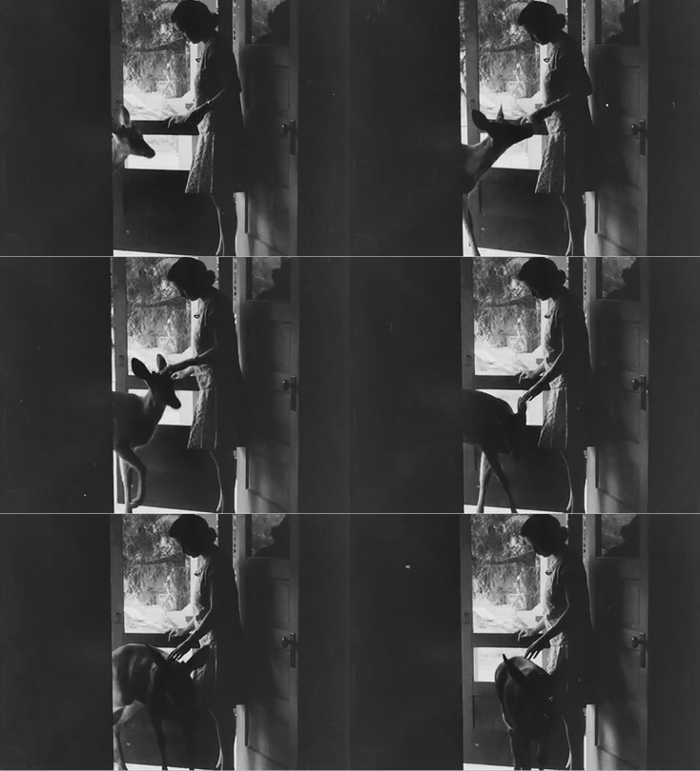
Eisenstaedt, Puppet Show, 1963


Don't limit a child to your own learning, for she was born in another time.

Rabindranath Tagore