"I am not one who was born in the custody of wisdom. I am one who is fond of olden times and intense in quest of the sacred knowing of the ancients." Gustave Courbet
Showing posts with label ruskin. Show all posts

08 February 2026

See.


To be taught to read—what is the use of that, if you know not whether what you read is false or true? To be taught to write or to speak—but what is the use of speaking, if you have nothing to say? To be taught to think—nay, what is the use of being able to think, if you have nothing to think of? But to be taught to see is to gain word and thought at once, and both true.

John Ruskin, from "Of Kings' Treasuries"

Thinking.


Understand this clearly: you can teach a man to draw a straight line, and to carve it; and to copy and carve any number of given lines or forms, with admirable speed and perfect precision; and you find his work perfect of its kind: but if you ask him to think about any of those forms, to consider if he cannot find any better in his own head, he stops; his execution becomes hesitating; he thinks, and ten to one he thinks wrong; ten to one he makes a mistake in the first touch he gives to his work as a thinking being. But you have made a man of him for all that. He was only a machine before, an animated tool.

John Ruskin, from The Stones of Venice

Happy Birthday, John Ruskin

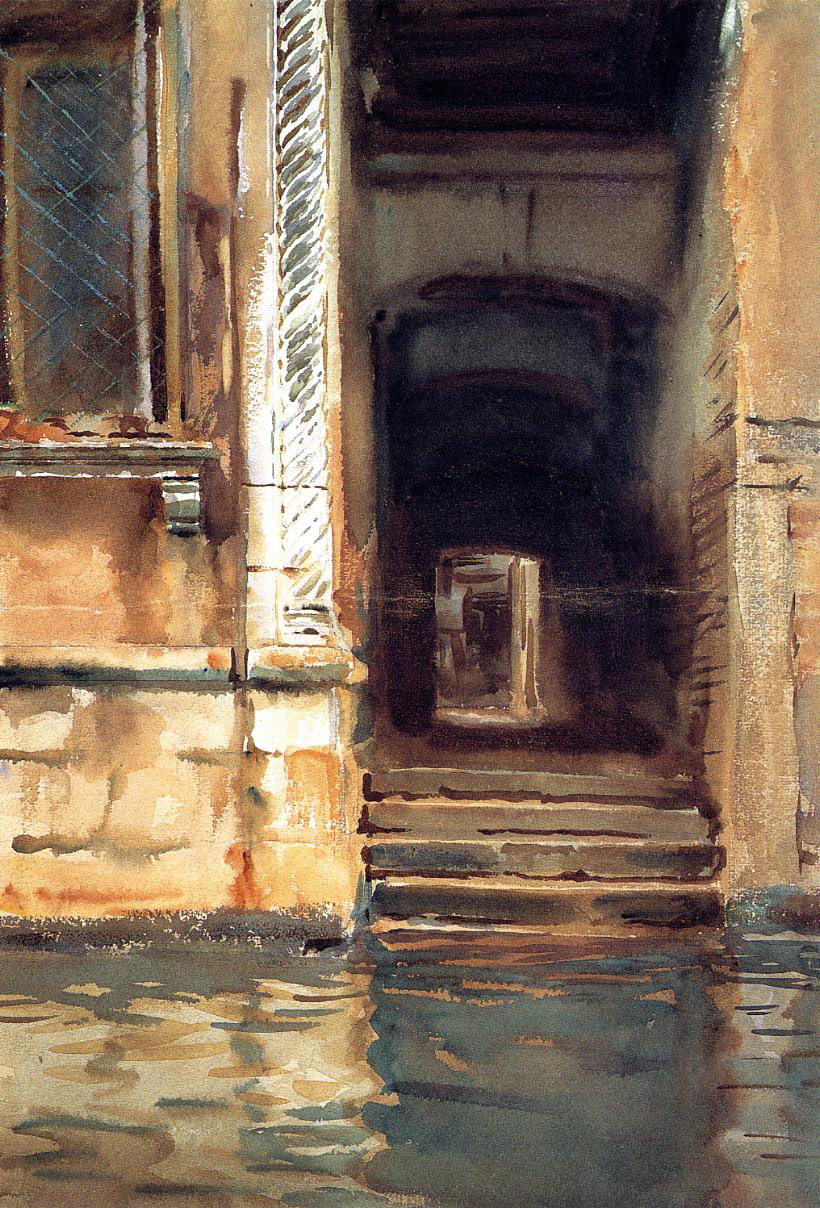
Ruskin, Ca’ d’Oro, Venice, 1845


Imperfection is in some sort essential to all that we know of life. It is the sign of life in a mortal body, that is to say, of a state of progress and change. Nothing that lives is, or can be, ridgidly perfect; part of it is decaying, part nascent. The foxglove blossom--a third part bud, a third part past, a third part in full bloom--is a type of the life of this world. And in all things that live there are certain irregularities and deficiencies which are not only signs of life, but sources of beauty. All admit irregularity as they imply change; and to banish imperfection is to destroy expression, to check exertion, to paralyse vitality.

John Ruskin, born on this day in 1819, from The Stones of Venice

01 January 2026

Amazement.

Ruskin, Trees in a Lane, 1847


No air is sweet that is silent; it is only sweet when full of low currents of under sound—triplets of birds, and murmur and chirp of insects, and deep-toned words of men, and wayward trebles of childhood. As the art of life is learned, it will be found at last that all lovely things are also necessary:—the wild flower by the wayside, as well as the tended corn; and the wild birds and creatures of the forest, as well as the tended cattle; because man doth not live by bread only, but also by the desert manna; by every wondrous word and unknowable work of God. Happy, in that he knew them not, nor did his fathers know; and that round about him reaches yet into the infinite, the amazement of his existence.

Note, finally, that all effectual advancement towards this true felicity of the human race must be by individual, not public effort. Certain general measures may aid, certain revised laws guide, such advancement; but the measure and law which have first to be determined are those of each man's home. We continually hear it recommended by sagacious people to complaining neighbours (usually less well placed in the world than themselves), that they should "remain content in the station in which Providence has placed them." There are perhaps some circumstances of life in which Providence has no intention that people should be content. Nevertheless, the maxim is on the whole a good one; but it is peculiarly for home use. That your neighbour should, or should not, remain content with his position, is not your business; but it is very much your business to remain content with your own.

John Ruskin, from Unto This Last

08 February 2025

Happy Birthday, Ruskin

Ruskin, Saint Mark's Basilica, Venice: Sketch after Rain, 27 May 1846, 1846

People are eternally divided into two classes: the believer, builder, and praiser, and the unbeliever, destroyer, and critic.

John Ruskin, born on this day in 1819

01 April 2024

Liberty

Ruskin, Self-Portrait, 1874


One evening, when I was yet in my nurse's arms, I wanted to touch the tea-urn, which was boiling merrily. It was an early taste for bronzes, I suppose; but I was resolute about it. My mother bade me keep my fingers back; I insisted on putting them forward. My nurse would have taken me away from the urn, but my mother said — "Let him touch it, Nurse."  So I touched it, — and that was my first lesson in the meaning of the word Liberty. It was the first piece of Liberty I got, and the last which for some time I asked for.

John Ruskin, from E.T. Cook's, The Life of John Ruskin

09 February 2024

Hunter.

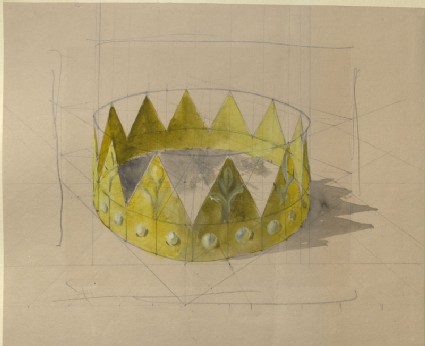
Ruskin, A Perspective Study of a Paper Crown, 1870


As soon as one is aware of being “somebody,” to be watched and listened to with extra interest, input ceases, and the performer goes blind and deaf in his overanimation. The best seeing is done by the hunted and the hunter, the vulnerable and the hungry.  Self-importance is a thickened, occluding form of self-consciousness.

John Updike

08 February 2024

Happy Birthday, Ruskin

Ruskin, North Porch of the West Front of the Cathedral of Amiens, 1871 


The Gothic architecture arose in massy and mountainous strength, axe-hewn and iron-bound, block heaved upon block by the monk’s enthusiasm and the soldier’s force; and cramped and stanchioned into such weight of grisly wall, as might bury the anchoret in darkness, and beat back the utmost storm of battle, suffering but by the same narrow crosslet the passing of the sunbeam, or of the arrow. Gradually, as that monkish enthusiasm grew more thoughtful, and as the sound of war became more & more intermittent beyond the convent or keep, the stony pillar grew slender and the vaulted roof grew light, till they wreathed themselves into the semblance of the summer woods at their fairest. For the very first requirement of Gothic architecture being that it shall admit the aid, and appeal to the admiration, of the rudest as well as the most refined minds, the richness of the work is a part of its humility. That humility, the very life of the Gothic school, is shown not only in the imperfection, but in the accumulation, of ornament. The inferior rank of the workman is often shown as much in the richness, as the roughness, of his work; and if the co-operation of every hand, and the sympathy of every heart, are to be received, we must be content to allow the redundance which disguises the failure of the feeble, and wins the regard of the inattentive. There are, however, far nobler interests mingling, in the Gothic heart, with the rude love of decorative accumulation : a magnificent enthusiasm, which feels as if it never could do enough to reach the fullness of its ideal; an unselfishness of sacrifice, which would rather cast fruitless labour before the altar than stand idle in the market; and, finally, a profound sympathy with the fullness & wealth of the material universe. 

 John Ruskin, born on this day in 1819, from The Stones of Venice

11 June 2023

Good.


Sunshine is delicious, rain is refreshing, wind braces us up, snow is exhilarating; there is really no such thing as bad weather, only different kinds of good weather.

John Ruskin

30 April 2023

Ends.

Unknown, Winged Victory of Samothrace, 295 BC


No good work whatever can be perfect, and the demand for perfection is always a sign of a misunderstanding of the ends of art. 

John Ruskin

12 February 2023

Example.


Education does not mean teaching people what they do not know. It means teaching them to behave as they do not behave.  It is a painful, continual, and difficult work to be done with kindness, by watching, by warning, by precept, and by praise, but above all – by example.

John Ruskin

Heady stuff, this.  Keep reminding me. 

25 November 2022

Good.

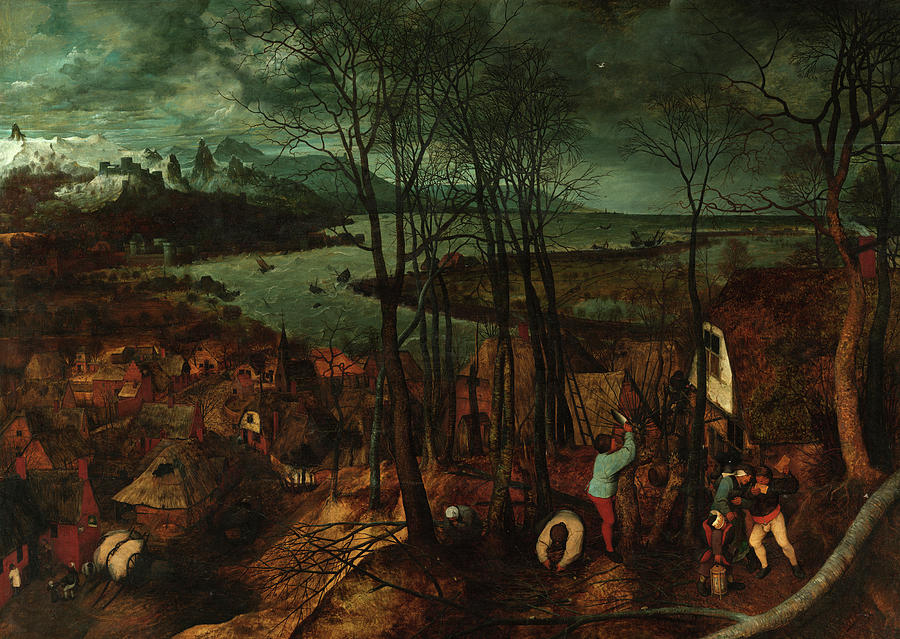
Bruegel, The Elder, A Gloomy Day, 1565


There is no such thing as bad weather, only different kinds of good weather.

John Ruskin

It's sandwich time.

07 July 2022

Spray.

Ruskin, Study of Spray of Dead Oak Leaves, 1879

Through.

Ruskin, Self-Portrait, 1861


I believe that the first test of a great man is his humility. I don't mean by humility, doubt of his power. But really great men have a curious feeling that the greatness is not of them, but through them. And they see something divine in every other man and are endlessly, foolishly, incredibly merciful.

John Ruskin

17 June 2022

Wreathed.

Ruskin, North Porch of the West Front of the Cathedral of Amiens, 1871


The Gothic architecture arose in massy and mountainous strength, axe-hewn and iron-bound, block heaved upon block by the monk’s enthusiasm and the soldier’s force; and cramped and stanchioned into such weight of grisly wall, as might bury the anchoret in darkness, and beat back the utmost storm of battle, suffering but by the same narrow crosslet the passing of the sunbeam, or of the arrow. Gradually, as that monkish enthusiasm grew more thoughtful, and as the sound of war became more & more intermittent beyond the convent or keep, the stony pillar grew slender and the vaulted roof grew light, till they wreathed themselves into the semblance of the summer woods at their fairest.

For the very first requirement of Gothic architecture being that it shall admit the aid, and appeal to the admiration, of the rudest as well as the most refined minds, the richness of the work is a part of its humility.  That humility, the very life of the Gothic school, is shown not only in the imperfection, but in the accumulation, of ornament. The inferior rank of the workman is often shown as much in the richness, as the roughness, of his work; and if the co-operation of every hand, and the sympathy of every heart, are to be received, we must be content to allow the redundance which disguises the failure of the feeble, and wins the regard of the inattentive. There are, however, far nobler interests mingling, in the Gothic heart, with the rude love of decorative accumulation : a magnificent enthusiasm, which feels as if it never could do enough to reach the fullness of its ideal; an unselfishness of sacrifice, which would rather cast fruitless labour before the altar than stand idle in the market; and, finally, a profound sympathy with the fullness & wealth of the material universe.

John Ruskin, from The Stones of Venice

09 April 2022

Performer.

 Ruskin, Perspective Studies of a Paper Crown, 1870


As soon as one is aware of being “somebody,” to be watched and listened to with extra interest, input ceases, and the performer goes blind and deaf in his overanimation. The best seeing is done by the hunted and the hunter, the vulnerable and the hungry.  Self-importance is a thickened, occluding form of self-consciousness.

John Updike

29 December 2021

Patience.

Ruskin, Rouen Cathedral, Lady Chapel, 1854


Endurance is nobler than strength, and patience nobler than beauty.  No good work whatever can be perfect, and the demand for perfection is always a sign of a misunderstanding of the ends of art. 

John Ruskin

21 December 2021

Among.

Ruskin, From Above Baveno, Looking Northwest to Monte Orfano, and the Entrance to the Domodossola Valley Leading to the Simplon Pass, 1845


How divine,
The liberty, for frail, for mortal, man
To roam at large among unpeopled glens
And mountainous retirements . . .
. . . regions consecrate
To oldest time! and, reckless of the storm
That keeps the raven quiet in her nest,
Be as a presence or a motion — one
Among the many there; and while the mists
Flying, and rainy vapours, call out shapes
And phantoms from the crags and solid earth
As fast as a musician scatters sounds
Out of an instrument; and while the streams
(As at a first creation and in haste
To exercise their untried faculties)
Descending from the region of the clouds,
And starting from the hollows of the earth
More multitudinous every moment, rend
Their way before them — what a joy to roam
An equal among mightiest energies;
And haply sometimes with articulate voice,
Amid the deafening tumult, scarcely heard
By him that utters it, exclaim aloud,
"Rage on, ye elements! let moon and stars
Their aspects lend, and mingle in their turn
With this commotion (ruinous though it be)
From day to night, from night to day, prolonged!" 

William Wordsworth

20 December 2021

Extend.

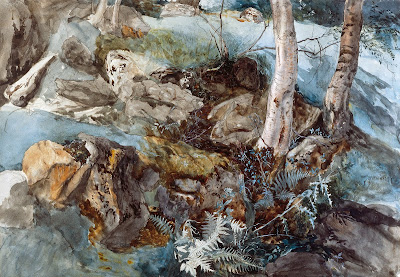
Ruskin, Rocks and Ferns in a Wood at Crossmount, Perthshire, 1847


And for the sublime, — if we consider what are the cares that occupy the passing day, and how remote is the practice and the course of life from the sources of sublimity, in the soul of Man, can it be wondered that there is little existing preparation for a poet charged with a new mission to extend its kingdom, and to augment and spread its enjoyments? 

William Wordsworth

09 June 2021

Great.


Great nations write their autobiographies in three manuscripts – the book of their deeds, the book of their words, and the book of their art. 

John Ruskin