"Good Texan" ...
20 March 2021
Learn.
The best thing for being sad," replied Merlyn, beginning to puff and blow, "is to learn something. That is the only thing that never fails. You may grow old and trembling in your anatomies, you may lie awake at night listening to the disorder of your veins, you may miss your only love, you may see the world about you devastated by evil lunatics, or know your honour trampled in the sewers of baser minds. There is only one thing for it then—to learn. Learn why the world wags and what wags it. That is the only thing which the mind can never exhaust, never alienate, never be tortured by, never fear or distrust, and never dream of regretting. Learning is the thing for you. Look at what a lot of things there are to learn—pure science, the only purity there is. You can learn astronomy in a lifetime, natural history in three, literature in six. And then, after you have exhausted a milliard lifetimes in biology and medicine and theo-criticism and geography and history and economics—why, you can start to make a cartwheel out of the appropriate wood, or spend fifty years learning to begin to learn to beat your adversary at fencing. After that you can start again on mathematics, until it is time to learn to plough.
T.H. White, from The Once and Future King
Unseen.
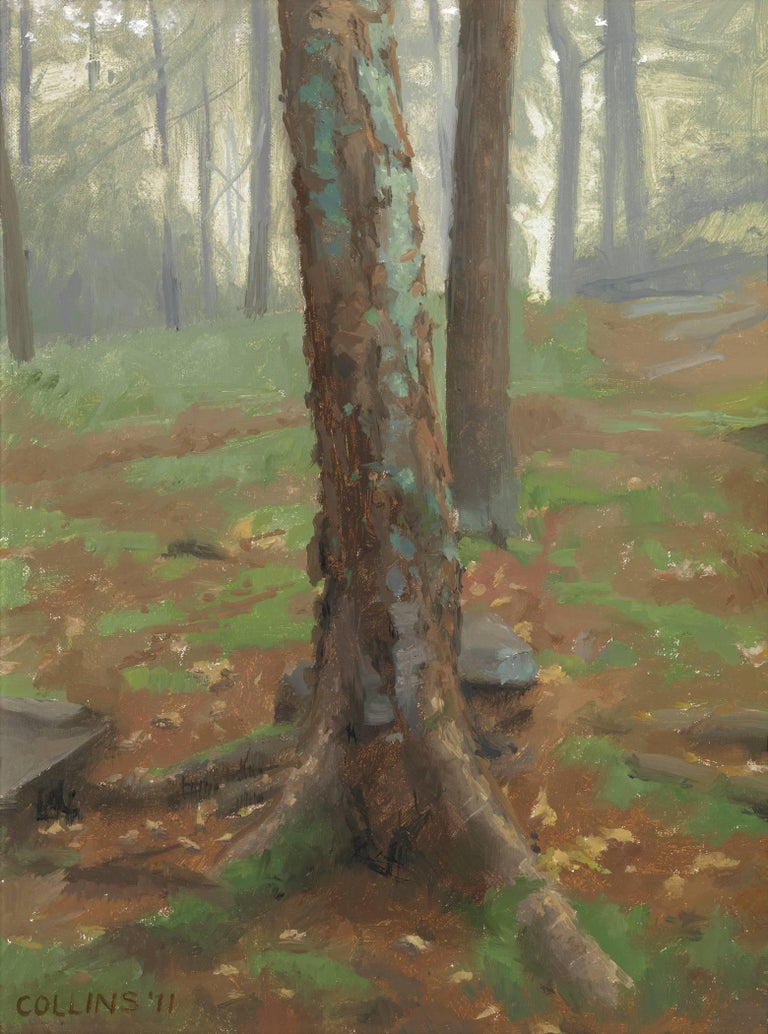
Collins, Birch Trunk, 2011
I peeled bits of straws and I got switches too
From the grey peeling willow as idlers do,
And I switched at the flies as I sat all alone
Till my flesh, blood, and marrow was turned to dry bone.
My illness was love, though I knew not the smart,
But the beauty of love was the blood of my heart.
Crowded places, I shunned them as noises too rude
And fled to the silence of sweet solitude.
Where the flower in green darkness buds, blossoms, and fades,
Unseen of all shepherds and flower-loving maids--
The hermit bees find them but once and away.
There I'll bury alive and in silence decay.
I looked on the eyes of fair woman too long,
Till silence and shame stole the use of my tongue:
When I tried to speak to her I'd nothing to say,
So I turned myself round and she wandered away.
When she got too far off, why, I'd something to tell,
So I sent sighs behind her and walked to my cell.
Willow switches I broke and peeled bits of straws,
Ever lonely in crowds, in Nature's own laws--
My ball room the pasture, my music the bees,
My drink was the fountain, my church the tall trees.
Who ever would love or be tied to a wife
When it makes a man mad all the days of his life?
John Clare
Withdraw.
The great function of poetry is to give us back the situations of our dreams. The house we were born in is more than the embodiment of home, it is also an embodiment of dreams. Each one of its nooks and corners was a resting place for daydreaming. And often the resting place particularized the daydream.
And every retreat on the part of the soul possesses, in my opinion, figures of havens. That most sordid of all havens, the corner, deserves to be examined. To withdraw into one’s corner is undoubtedly a meager expression. But despite its meagerness, it has numerous images, some, perhaps of great antiquity, images that are psychologically primitive. A poet naturally understands this aesthetic category of life.
Gaston Bachelard, from The Poetics of Space
Say.
mistakes I have made. Ask me whether
what I have done is my life. Others
have come in their slow way into
my thought, and some have tried to help
or to hurt: ask me what difference
their strongest love or hate has made.
I will listen to what you say.
You and I can turn and look
at the silent river and wait. We know
the current is there, hidden; and there
are comings and goings from miles away
that hold the stillness exactly before us.
What the river says, that is what I say.
William Stafford
Happy Birthday, Bingham
19 March 2021
Involuntary.
Collins, Bread and Water, 2003
Francis Terry on our ancient love of quality ...
When someone made a beautiful hand axe in prehistoric times or today lays a well-crafted brick wall, though separated by hundreds of thousands of years, these objects both display evidence of the care, intelligence, and judgement of their makers which, in evolutionary terms, are desirable personal qualities and so we respond positively. When we see architecture done well, we react to this quality with an involuntary reaction that goes right back to our distant ancestral past. This is not solely a cultural response but an inherent impulse, similar to our deep, ancient and intense love of well baked bread.
18 March 2021
Deck.
The Mackinac Bridge Authority is auctioning original, 60-year-old steel grating from the Mackinac Bridge deck.
Section of original steel grating from the Mackinac Bridge deck. Selling 5 individual, identical pieces of grating separately. THIS AUCTION IS FOR ONE PIECE. Pieces are approximately 5 1/2 feet X 38 feet and 5 inches deep. Condition is used with corrosion and section loss appropriate to steel that is 60 years old. Each piece weighs about 2 tons.Grating was originally coated with lead based paint. Much of this is gone, but Buyer will have to sign a "Hold Harmless agreement" related to the lead paint and the structural condition of the grating. The Hold Harmless agreement is an attachment to the auction ad.Seller agrees to cut the grating section into two shorter pieces for ease of shipping if desired. Price of this one cut is included in the bid. No other cutting or manipulation of the grating will be done by the seller.Seller will load the grating for transport but is not responsible for securing, etc.
17 March 2021
Make.
HOW to be a POET
(to remind myself)
i
Make a place to sit down.
Sit down. Be quiet.
You must depend upon
affection, reading, knowledge,
skill—more of each
than you have—inspiration,
work, growing older, patience,
for patience joins time
to eternity. Any readers
who like your poems,
doubt their judgment.
ii
Breathe with unconditional breath
the unconditioned air.
Shun electric wire.
Communicate slowly. Live
a three-dimensioned life;
stay away from screens.
Stay away from anything
that obscures the place it is in.
There are no unsacred places;
there are only sacred places
and desecrated places.
iii
Accept what comes from silence.
Make the best you can of it.
Of the little words that come
out of the silence, like prayers
prayed back to the one who prays,
make a poem that does not disturb
the silence from which it came.
Wendell Berry
Filter.
2
Houses and rooms are full of perfumes, the shelves are crowded
with perfumes,
I breathe the fragrance myself and know it and like it,
The distillation would intoxicate me also, but I shall not let it.
The atmosphere is not a perfume, it has no taste of the distillation,
it is odorless,
It is for my mouth forever, I am in love with it,
I will go to the bank by the wood and become undisguised and
naked,
I am mad for it to be in contact with me.
The smoke of my own breath,
Echoes, ripples, buzz'd whispers, love-root, silk-thread, crotch and
vine,
My respiration and inspiration, the beating of my heart, the pass-
ing of blood and air through my lungs,
The sniff of green leaves and dry leaves, and of the shore and
dark-color'd sea-rocks, and of hay in the barn,
The sound of the belch'd words of my voice loos'd to the eddies
of the wind,
A few light kisses, a few embraces, a reaching around of arms,
The play of shine and shade on the trees as the supple boughs
wag,
The delight alone or in the rush of the streets, or along the fields
and hill-sides,
The feeling of health, the full-noon trill, the song of me rising from
bed and meeting the sun.
Have you reckon'd a thousand acres much? have you reckon'd
the earth much?
Have you practis'd so long to learn to read?
Have you felt so proud to get at the meaning of poems?
Stop this day and night with me and you shall possess the origin
of all poems,
You shall possess the good of the earth and sun, (there are millions
of suns left,)
You shall no longer take things at second or third hand, nor look
through the eyes of the dead, nor feed on the spectres in
books,
You shall not look through my eyes either, nor take things from me,
You shall listen to all sides and filter them from your self.
Walt Whitman, from "Song of Myself"
Walkin'.
Oh, hand me down my old great coat
I believe I'll go walkin' in the woods
Oh, my darlin'
Oh, hand me down my big boots.
Oh, hand me down my big boots
I believe I'll go walkin' in the woods
Oh, my darlin'
And she moves by the waterfall
When she moves
She moves just like a deer
Across the meadow
Van Morrison, from "When Heart is Open"
Imaginary.
Gaiman, Untitled, 2020
I am fascinated by people who assume that things that are imaginary have no relevance to their lives.
Neil Gaiman
Oikophilia.
Vital to the conservative environmental movement has been the love of beauty. Through art, literature and local activism the British people have given voice to the idea of beauty as a shared resource, an irreplaceable fund of "social capital". Beauty, they have recognized, acts as a barrier to the top-down brutalities of the exploiters and the social engineers.
Environmental demagogues are determined to brush such obstacles aside. Littering the landscape with pylons and wind-farms appeals to them not because it has any scientific authority – for the science, such as it was, has been exploded – but because it refocuses the problem as a global one. To destroy the home that we have built over centuries is to afflict conservatives in the heart of their way of life. It is to deprive people of the primary source of oikophilia, and to make conservatism – the only political outlook that has ever done anything for the environment – irrelevant.
Moreover, it is through the pursuit of beauty that we could solve our most pressing environmental problem, which is the need for new homes. People resist large-scale development, because they know that it will produce an eyesore ...
The sad thing is that the Conservative Party has said so little to clarify what is at stake. Why do those old-fashioned words like trust, settlement, beauty and home so seldom pass the lips of those who are now, nominally at least, in charge? And why is the agenda still set by those for whom climate change, renewable energy and global warming define the problem, and for whom the favoured solution involves the total destruction of the things we love?
Sir Roger Scruton, from "Conservatism and the Environment"
16 March 2021
Pleasure.
From the ground the quills he gathered,
All the little shining arrows,
Stained them red and blue and yellow,
With the juice of roots and berries;
Into his canoe he wrought them,
Round its waist a shining girdle,
Round its bows a gleaming necklace,
On its breast two stars resplendent.
Thus the Birch Canoe was builded
In the valley, by the river,
In the bosom of the forest;
And the forest's life was in it,
All its mystery and its magic,
All the lightness of the birch-tree,
All the toughness of the cedar,
All the larch's supple sinews;
And it floated on the river
Like a yellow leaf in Autumn,
Like a yellow water-lily.
Paddles none had Hiawatha,
Paddles none he had or needed,
For his thoughts as paddles served him,
And his wishes served to guide him;
Swift or slow at will he glided,
Veered to right or left at pleasure.
Then he called aloud to Kwasind,
To his friend, the strong man, Kwasind,
Saying, "Help me clear this river
Of its sunken logs and sand-bars."
Straight into the river Kwasind
Plunged as if he were an otter,
Dived as if he were a beaver,
Stood up to his waist in water,
To his arm-pits in the river,
Swam and shouted in the river,
Tugged at sunken logs and branches,
With his hands he scooped the sand-bars,
With his feet the ooze and tangle.
And thus sailed my Hiawatha
Down the rushing Taquamenaw,
Sailed through all its bends and windings,
Sailed through all its deeps and shallows,
While his friend, the strong man, Kwasind,
Swam the deeps, the shallows waded.
Up and down the river went they,
In and out among its islands,
Cleared its bed of root and sand-bar,
Dragged the dead trees from its channel,
Made its passage safe and certain,
Made a pathway for the people,
From its springs among the mountains,
To the waters of Pauwating,
To the bay of Taquamenaw.
Henry Wadsworth Longfellow, from "The Song of Hiawatha"
Perpetual.
Ruskin, Self-portrait, 1861
The whole difference between a man of genius and other men, it has been said a thousand times, and most truly, is that the first remains in great part a child, seeing with the large eyes of children, in perpetual wonder, not conscious of much knowledge–conscious, rather of infinite ignorance, and yet infinite power; a fountain of eternal admiration, delight, and creative force within him meeting the ocean of visible and governable things around him.
John Ruskin
Thanks, Kurt.
Pergolesi, Stabat Mater
Robert Mlkeyan directs The National Chamber Orchestra of Armenia with the Our Lady Armenia Choir in the "Quando Corpus Morietur," featuring soprano Mané Galoyan and mezzo-soprano Henrietta Harutyunova ...
Gunge.
Fergus Henderson hints at Scotch Woodcock ...
Be gentle with your egg and hopefully it will be gentle to you. Scrambling, for example, should be a slow process, done on low heat with a good knob of butter in the pan. Crack your eggs into the melting butter and gently stir, breaking the yolks. Don't season with salt until the end - it will throw the scrambling out of kilter - and don't lose your nerve and turn the heat up to try to rush things; just stir them occasionally.When they're cooked to a satisfactory state, you can't do much better than serving your scrambled eggs on buttered toast, but let's go a step further into the world of savouries. Traditionally, savouries were offered at the end of the meal - not a sweet, though, and accompanied by a glass of Port. My favourite savoury is Scotch woodcock. For ours at St John we make an anchovy gunge which is then spread on toast and topped with scrambled eggs. Some prefer the anchovies whole and the eggs poached. This neatly leads us into the world of the poached egg, a very useful culinary bubble on top of smoked haddock and steamed green asparagus and corned beef hash that magically creates its own sauce.
The proper recipe can be found in Fergus' latest, The Book of St. John ...
The "savoury" is a rather old-fashioned course, taken with a glass or port at te end of a meal. This family grouping includes not only the Scotch Woodcock but Welsh Rarebit and the Buck Rarebit, too, which is a rarebit with a poach egg on top. It's not often that you fancy such a thing after your dessert.Throw away the shackles of antiquated convention! Liberate the Scotch Woodcock from its after-dinner perdition! Take a well-spread piece of anchovy toast -- a good white bread is preferable -- and cover with creamy, lightly-scrambled eggs. Your breakfast is ready.
The anchovy gunge.
INGREDIENTS
7 garlic cloves, peeled
a pinch of black pepper
1 tin of anchovies in oil (Ortiz)
225 ml extra virgin olive oil
a splash or red wine vinegar
PREPARATION
- Place the garlic and pepper into a food processor (or use a pestle and mortar if you have time and energy), and crush to a fine purée, then add the anchovies and allow them to break down. Start to add the oil, then the vinegar to taste. Check flavour for seasoning.
- This dressing, depending on how thick you make it, can have many uses.
- With less oil and vinegar added you will have a very firm mix - the Anchovy Gunge - which you can use as a dip for vegetables (as here), or spread it on toast with sweet roasted or pickled shallots, or a boiled egg.
- With a little more oil and vinegar added you should have a looser, though still emulsified mixture, which is ideal for dressing boiled greens or broccoli - which can be eaten on their own or with lamb or beef.
Deep.
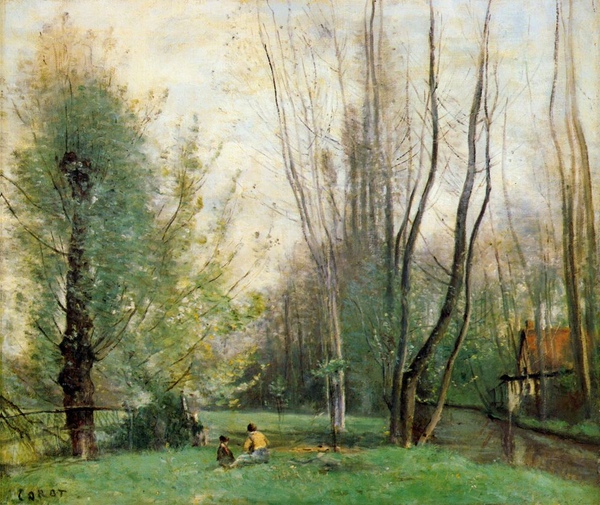
Corot, Morning at Beauvais, 1865
The thought of our past years in me doth breed
Perpetual benediction: not indeed
For that which is most worthy to be blest,
Delight and liberty, the simple creed
Of Childhood, whether busy or at rest,
With new-fledged hope still fluttering in his breast:—
—Not for these I raise
The song of thanks and praise;
But for those obstinate questionings
Of sense and outward things,
Fallings from us, vanishings,
Blank misgivings of a creature
Moving about in worlds not realized,
High instincts, before which our mortal nature
Did tremble like a guilty thing surprised:
But for those first affections,
Those shadowy recollections,
Which, be they what they may,
Are yet the fountain-light of all our day,
Are yet a master-light of all our seeing;
Uphold us—cherish—and have power to make
Our noisy years seem moments in the being
Of the eternal Silence: truths that wake,
To perish never;
Which neither listlessness, nor mad endeavour,
Nor man nor boy,
Nor all that is at enmity with joy,
Can utterly abolish or destroy!
Hence, in a season of calm weather
Though inland far we be,
Our souls have sight of that immortal sea
Which brought us hither;
Can in a moment travel thither—
And see the children sport upon the shore,
And hear the mighty waters rolling evermore.
Then, sing, ye birds, sing, sing a joyous song!
And let the young lambs bound
As to the tabor's sound!
We, in thought, will join your throng,
Ye that pipe and ye that play,
Ye that through your hearts to-day
Feel the gladness of the May!
What though the radiance which was once so bright
Be now for ever taken from my sight,
Though nothing can bring back the hour
Of splendour in the grass, of glory in the flower;
We will grieve not, rather find
Strength in what remains behind;
In the primal sympathy
Which having been must ever be;
In the soothing thoughts that spring
Out of human suffering;
In the faith that looks through death,
In years that bring the philosophic mind.
And 0, ye Fountains, Meadows, Hills, and Groves,
Forebode not any severing of our loves!
Yet in my heart of hearts I feel your might;
I only have relinquish'd one delight
To live beneath your more habitual sway;
I love the brooks which down their channels fret
Even more than when I tripp'd lightly as they;
The innocent brightness of a new-born day
Is lovely yet;
The clouds that gather round the setting sun
Do take a sober colouring from an eye
That hath kept watch o'er man's mortality;
Another race hath been, and other palms are won.
Thanks to the human heart by which we live,
Thanks to its tenderness, its joys, and fears,
To me the meanest flower that blows can give
Thoughts that do often lie too deep for tears.
William Wordsworth, from ¨Intimations of Immortality¨
Self-contained.
Faking depends on a measure of complicity between the perpetrator and the victim, who together conspire to believe what they don’t believe and to feel what they are incapable of feeling. There are fake beliefs, fake opinions, fake kinds of expertise. There is also fake emotion, which comes about when people debase the forms and the language in which true feeling can take root, so that they are no longer fully aware of the difference between the true and the false. Kitsch is one very important example of this. The kitsch work of art is not a response to the real world, but a fabrication designed to replace it. Yet both producer and consumer conspire to persuade each other that what they feel in and through the kitsch work of art is something deep, important and real.
Anyone can lie. One need only have the requisite intention — in other words, to say something with the intention to deceive. Faking, by contrast, is an achievement. To fake things you have to take people in, yourself included. In an important sense, therefore, faking is not something that can be intended, even though it comes about through intentional actions. The liar can pretend to be shocked when his lies are exposed, but his pretense is merely a continuation of his lying strategy. The fake really is shocked when he is exposed, since he had created around himself a community of trust, of which he himself was a member. Understanding this phenomenon is, it seems to me, integral to understanding how a high culture works, and how it can become corrupted.
To convince themselves that they are true progressives, riding in the vanguard of history, the new impresarios surround themselves with others of their kind. They promote them to all the committees that are relevant to their status and expect to be promoted in their turn. Thus arose the contemporary establishment — the self-contained circle of critics and promoters, who form the backbone of our official and semi-official cultural institutions. They trade in "originality", "transgression" and "breaking new paths". But these terms are clichés, as are the things they are used to praise. Hence the flight from cliché ends in cliché.
It is not only beliefs and actions that can be faked. Fake emotions have played a decisive role in the evolution of art in recent times. Real emotion allows no substitutes, and is never the subject of a bargain or an exchange. Fake emotion seeks to discard the cost of feeling while receiving the benefit. It is therefore always ready to exchange its present object for a better one.
Sir Roger Scruton, from "Great Swindle – Culture of Fake Originality"
15 March 2021
Country.
E.M. Halliday on Ernest Hemingway's positive sources of satisfaction and happiness ...
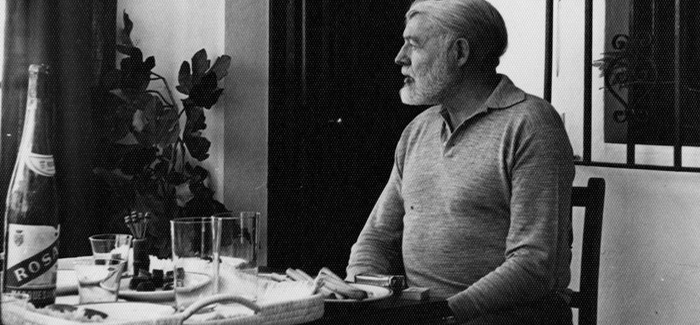
There are few writers who so often characterize smells, for instance, as Hemingway does. Sights and sounds, too, are great sources of pleasure for the Hemingway heroes. They are almost always great lovers of what Hemingway calls “country”—a word that seems to include every aspect of a natural scene that can be taken in by sight, hearing, touch, and sense of smell.
Calms.
Firchau, Molson, 2008
NATURAL WORLD
There is nothing in the picture
you don’t see. That is, there
is nothing in the picture, but
you can’t see it, as there
is also nothing beyond the picture that
you can see. As you watch
the picture and begin to notice
more, the nothing grows less, but
never less than nothing. For you,
the picture has no separate
being, and, like you, the
nothing in the picture exists.
We teach a child to see a ball, a tree,
a dog, sitting at the moment.
The dog knows little of our confusion, and
calms us with her eyes.
Dan Gerber
Labels:
appreciation,
dogs,
Gerber,
Molson,
poetry,
poetry rules!
Quiet.
Nick drank the coffee, the coffee according to Hopkins. The coffee was bitter. Nick laughed. It made a good ending to the story. His mind was starting to work. He knew he could choke it because he was tired enough. He spilled the coffee out of the pot and shook the grounds loose into the fire. He lit a cigarette and went inside the tent. He took off his shoes and trousers, sitting on the blankets, rolled the shoes up inside the trousers for a pillow and got in between the blankets.
Out through the front of the tent he watched the glow of the fire when the night wind blew on it. It was a quiet night. The swamp was perfectly quiet. Nick stretched under the blanket comfortably. A mosquito hummed close to his ear. Nick sat up and lit a match. The mosquito was on the canvas, over his head. Nick moved the match quickly up to it. The mosquito made a satisfactory hiss in the flame. The match went out. Nick lay down again under the blankets. He turned on his side and shut his eyes. He was sleepy. He felt sleep coming. He curled up under the blanket and went to sleep.
Ernest Hemingway, from "The Big Two-Hearted River"
With.
It is a beauteous evening, calm and free,
The holy time is quiet as a Nun
Breathless with adoration; the broad sun
Is sinking down in its tranquility;
The gentleness of heaven broods o'er the Sea;
Listen! the mighty Being is awake,
And doth with his eternal motion make
A sound like thunder—everlastingly.
Dear child! dear Girl! that walkest with me here,
If thou appear untouched by solemn thought,
Thy nature is not therefore less divine:
Thou liest in Abraham's bosom all the year;
And worshipp'st at the Temple's inner shrine,
God being with thee when we know it not.
William Wordsworth
14 March 2021
Happy Birthday, Telemann
Lichtensteger, George Philip Telemann, 1745
Georg Philip Telemann was born on this day in 1681.
Gérard Caussé performs with and conducts the Concerto for Viola in G, TWV 51:G9, with the Orchestre Royal de Chambre de Wallonie ...
13 March 2021
On.
Smell.
Wyeth, Light Wash, 1969
WHAT DANNY SAID
When asked what he’d miss most,
having to leave the house he’d known
the whole nine years of his life,
he squinted and looked off a little
beyond where we were just then,
and said, “The smell. I think
it’s the smell I’ll miss most.
Maybe we can take that with us.”
Dan Gerber
Calls.
Homer, Sandy Beach with Breakers, 1869
The tide rises, the tide falls,
The twilight darkens, the curlew calls;
Along the sea-sands damp and brown
The traveller hastens toward the town,
And the tide rises, the tide falls.
Darkness settles on roofs and walls,
But the sea, the sea in the darkness calls;
The little waves, with their soft, white hands,
Efface the footprints in the sands,
And the tide rises, the tide falls.
The morning breaks; the steeds in their stalls
Stamp and neigh, as the hostler calls;
The day returns, but nevermore
Returns the traveller to the shore,
And the tide rises, the tide falls.
Henry Wadsworth Longfellow
Labels:
appreciation,
art,
Homer,
Longfellow,
night,
ocean,
poetry,
poetry rules!,
sea,
water
Freedom.
There is a real freedom of speech on a job site, which reverberates outward and sustains a wider liberality. You can tell dirty jokes. Where there is real work being done, the order of things isn’t quite so fragile. Not surprisingly, it is the office rather than the job site that has seen the advent of speech codes, diversity workshops, and other forms of higher regulation. Some might attribute this to the greater mixing of the sexes in the office, but I believe a more basic reason is that when there is no concrete task that rules the job—an autonomous good that is visible to all—then there is no secure basis for social relations. Maintaining consensus and preempting conflict become the focus of management, and as a result everyone feels they have to walk on eggshells. Where no appeal to a carpenter’s level is possible, sensitivity training becomes necessary.
Matthew B. Crawford, from Shop Class as Soulcraft: An Inquiry Into the Value of Work
Headed.
Wyeth, Race Run, 1969
13.
The hound I’ve known for three years
trots down the mountain road
with a nod at me, pretending he knows
what he’s doing miles from home
on a sunlit morning. He’s headed
for a kind of place he hasn’t quite found yet
and might not recognize when he gets there.
Jim Harrison
Labels:
appreciation,
art,
Harrison,
poetry,
poetry rules!,
Wyeth
12 March 2021
Subscribe to:
Posts (Atom)
About Me
- Rob Firchau
- "A man should stir himself with poetry, stand firm in ritual, and complete himself in music." -Gary Snyder
Think ...
GASTON BACHELARD
"The house shelters day-dreaming, the house protects the dreamer, the house allows one to dream in peace.”
ARCHIVES
-
▼
2026
(1217)
-
▼
September
(28)
- Silence.
- Learn.
- Tension.
- Fighting.
- Excellent.
- Distance.
- Solace.
- Liberty.
- Absence.
- Wait.
- Anarchy.
- Happy Birthday, Marie-Joseph Paul Yves Roch Gilber...
- Happy Birthday, Johann Christian Bach
- Wonder.
- Know.
- Mary Oliver: Saved by the Beauty of the World
- Happy Birthday, Tommaso Campanella
- Choice.
- Happy Birthday, François-René de Chateaubriand
- Excellent.
- Tinge.
- No title
- Happy Birthday, Sarah Orne Jewett
- Wise.
- Released.
- Home.
- Here.
- Wendell Berry, Rest in Peace
-
▼
September
(28)
CARL R. FIRCHAU (1884-1973)
"The strength of a man’s virtue should not be measured by his special exertions but by his habitual acts.” Blaise Pascal
SEARCH THIS BLOG
REMEMBER
SUPPORT OUR TROOPS
C.S. LEWIS
G.K. CHESTERTON
"Tradition refuses to submit to the small and arrogant oligarchy of those who merely happen to be walking about."
KENNETH GRAHAME
"O Mole! the beauty of it! The merry bubble and joy, the thin, clear, happy call of the distant piping!"
BARRY HINES
"That's why it makes me mad when I take her out and I'll hear somebody say, 'Look, there's Billy Casper there wi' his pet hawk. I could shout at 'em; it's not a pet, Sir, hawks are not pets. Or when folks stop me and say, 'Is it tame?' Is it heck tame, it's trained that's all. It's fierce, and it's wild, an' it's not bothered about anybody, not even about me, right. And that's why it's great.Look, there's Billy Casper there wi' his pet hawk.' I could shout at 'em. It's not a pet, Sir. Hawks are not pets. Or when folks stop me and say, 'Is it tame?' Is it heck tame, it's trained, that's all. It's fierce, and it's wild, an' it's not bothered about anybody, not even about me right. And that's why it's great." (A Kestrel for a Knave)
GEORDIE WALKER
ECHO & THE BUNNYMEN
JIM HARRISON
37. Beware, O wanderer, the road is walking too, said Rilke one day to no one in particular as good poets everywhere address the six directions. If you can’t bow, you’re dead meat. You’ll break like uncooked spaghetti. Listen to the gods. They’re shouting in your ear every second.
GIMME FIIIVE!
THE FURS
Suggestions
WOLFGANG AMADEUS MOZART
"When I am, as it were, completely myself, entirely alone and of good cheer – say travelling in a carriage or walking after a good meal, or during the night when I cannot sleep – it is on such occasions that my ideas flow best and most abundantly. Whence, and how, they come I know not ; nor can I force them. Those ideas that please me I retain in memory and am accustomed, as I have been told, to hum them to myself. If I continue in this way, it soon occurs to me how I may turn this dainty morsel to account, so as to make a good dish of it. That is to say, agreeable to the rules of counterpoint, to the peculiarities of various instruments etc. All this fires my soul, and, provided I am not disturbed, my subject enlarges itself, becomes methodised, and defined, and the whole, though it be long, stands almost complete and finished in my mind, so that I can survey it like a fine picture or a beautiful statue at a glance. Nor do I hear in my imagination the parts successively, but I hear them, as it were, all at once. What a delight this is, I cannot tell."
HOOKY
MARY SHELLEY
GREEN MAN
"Feel wind stir the greenwood, or turn pages of a book made from his flesh -- lean close, then, and hear, Green Man's voice."
WALLACE STEVENS
"Technique is the proof of your seriousness."
N.C. WYETH
Cold Maker, Winter, 1909
Dick's Pour House, Lake Leelanau, Michigan
Smelt Basket
PanAm "Pacific Clipper" (1941)
JOHN SINGER SARGENT
Elizabeth Winthrop Chanler (detail), 1893
WILLIAM F. BUCKLEY JR.
SIR WINSTON CHURCHILL
"A gentleman does not have a ham sandwich without mustard."
J.R.R. TOLKIEN
"If more of us valued food and cheer and song above hoarded gold, it would be a merrier world."
JOHN MASEFIELD
"When the midnight strikes in the belfry dark/And the white goose quakes at the fox’s bark/We saddle the horse that is hayless, oatless/Hoofless and pranceless, kickless and coatless/We canter off for a midnight prowl/Whoo-hoo-hoo, says the hook-eared owl."
IKKYU
VIRGINIA WOOLF
JOHN QUINCY ADAMS
"However tiresome to others, the most indefatigable orator is never tedious to himself. The sound of his own voice never loses its harmony to his own ear; and among the delusions, which self-love is ever assiduous in attempting to pass upon virtue, he fancies himself to be sounding the sweetest tones."
SIR KENNETH GRAHAME
"Take the Adventure, heed the call, now, ere the irrevocable moment passes! ‘Tis but a banging of the door behind you, a blithesome step forward, and you are out of the old life and into the new! Then some day, some day long hence, jog home here if you will, when the cup has been drained and the play has been played, and sit down by your quiet river with a store of goodly memories for company."
JIM HARRISON
"Barring love I'll take my life in large doses alone--rivers, forests, fish, grouse, mountains. Dogs."
WILLIAM WORDSWORTH
WALT WHITMAN
The spotted hawk swoops by and accuses me, he complains of my gab and my loitering. I too am not a bit tamed, I too am untranslatable, I sound my barbaric yawp over the roofs of the world. The last scud of day holds back for me, It flings my likeness after the rest and true as any on the shadow’d wilds, It coaxes me to the vapor and the dusk. I depart as air, I shake my white locks at the runaway sun, I effuse my flesh in eddies, and drift it in lacy jags. I bequeath myself to the dirt to grow from the grass I love, If you want me again look for me under your boot-soles. You will hardly know who I am or what I mean, But I shall be good health to you nevertheless, And filter and fibre your blood. Failing to fetch me at first keep encouraged, Missing me one place search another, I stop somewhere waiting for you.
SAMUEL ADAMS
"It is a very great mistake to imagine that the object of loyalty is the authority and interest of one individual man, however dignified by the applause or enriched by the success of popular actions."
TAO TE CHING, Lao Tzu
MARCUS AURELIUS
"Is your cucumber bitter? Throw it away. Are there briars in your path? Turn aside. That is enough. Do not go on and say, 'Why were things of this sort ever brought into this world?' neither intolerable nor everlasting - if thou bearest in mind that it has its limits, and if thou addest nothing to it in imagination. Pain is either an evil to the body (then let the body say what it thinks of it!)-or to the soul. But it is in the power of the soul to maintain its own serenity and tranquility."
VINCENT van GOGH
"What am I in the eyes of most people? A nonentity or an oddity or a disagreeable person — someone who has and will have no position in society, in short a little lower than the lowest. Very well — assuming that everything is indeed like that, then through my work I’d like to show what there is in the heart of such an oddity, such a nobody. This is my ambition, which is based less on resentment than on love in spite of everything, based more on a feeling of serenity than on passion. Even though I’m often in a mess, inside me there’s still a calm, pure harmony and music. In the poorest little house, in the filthiest corner, I see paintings or drawings. And my mind turns in that direction as if with an irresistible urge. As time passes, other things are increasingly excluded, and the more they are the faster my eyes see the picturesque. Art demands persistent work, work in spite of everything, and unceasing observation."
RICK LEACH (1975-1978)
RICHARD ADAMS
"One cloud feels lonely."
JOHN SINGER SARGENT
"Cultivate an ever continuous power of observation. Wherever you are, be always ready to make slight notes of postures, groups and incidents. Store up in the mind a continuous stream of observations."
WINSLOW HOMER
The Lone Boat, North Woods Club, Adirondacks, 1892
THOMAS BABINGTON MACAULEY
And how can man die better / Than facing fearful odds / For the ashes of his fathers / And the temples of his gods
WATERHOUSE, BOREAS, 1903
WHITE HORSES Far out at sea / There are horses to ride, / Little white horses / That race with the tide. / Their tossing manes / Are the white sea-foam, / And the lashing winds / Are driving them home- / To shadowy stables / Fast they must flee, / To the great green caverns / Down under the sea. Irene Pawsey
UMBERTO LIMONGIELLO
F. SCOTT FITZGERALD
"I don't want to repeat my innocence. I want the pleasure of losing it again.” This Side of Paradise
RALPH WALDO EMERSON
"In skating over thin ice, our safety is in our speed."
ROBERT PLANT
GARY SNYDER
"There are those who love to get dirty and fix things. They drink coffee at dawn, beer after work. And those who stay clean, just appreciate things. At breakfast they have milk and juice at night. There are those who do both, they drink tea.”
IMMANUEL KANT
"Enlightenment is man's emergence from his self-imposed nonage. Nonage is the inability to use one's own understanding without another's guidance. This nonage is self-imposed if its cause lies not in lack of understanding but in indecision and lack of courage to use one's own mind without another's guidance. Dare to know! Sapere aude. 'Have the courage to use your own understanding,' is therefore the motto of the enlightenment."
DAN CAMPBELL
"We’re gonna kick you in the teeth, and when you punch us back we’re gonna smile at you, and when you knock us down we’re going to get up, and on the way, we’re going to bite a kneecap off. We’re going to stand up, and it’s going to take two more shots to knock us down. And on the way up, we’re going to take your other kneecap, and we’re going to get up, and it’s gonna take three shots to get us down. And when we do, we’re gonna take another hunk out of you."
THOMAS HUXLEY
"Sit down before fact as a little child, be prepared to give up every conceived notion, follow humbly wherever and whatever abysses nature leads, or you will learn nothing."
JOHN DRYDEN
"Bold knaves thrive without one grain of sense, but good men starve for want of impudence.”
WILLIAM BLAKE
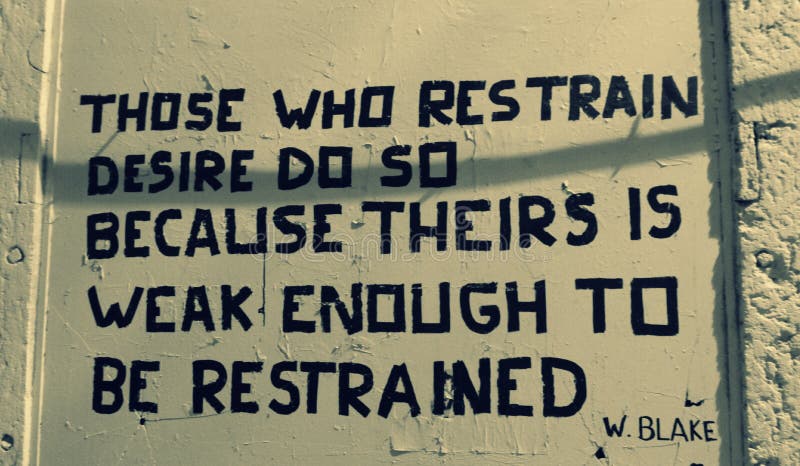
"Those who restrain desire do so because theirs is weak enough to be restrained."
HERMANN HESSE
"Whoever wants music instead of noise, joy instead of pleasure, soul instead of gold, creative work instead of business, passion instead of foolery, finds no home in this trivial world of ours."
GEORGE MACDONALD
"Certainly work is not always required of a man. There is such a thing as a sacred idleness, the cultivation of which is now fearfully neglected."
REV. DR. CORNEL WEST
"You have to have a habitual vision of greatness … you have to believe in fact that you will refuse to settle for mediocrity. You won’t confuse your financial security with your personal integrity, you won’t confuse your success with your greatness or your prosperity with your magnanimity … believe in fact that living is connected to giving.”
IT'S A WONDERFUL LIFE
"You see George, you've really had a wonderful life. Don't you see what a mistake it would be to just throw it away?"
WOODY
"There's a basic rule which runs through all kinds of music, kind of an unwritten rule. I don't know what it is, but I've got it."
MIGGY
"Exuberance is beauty." (William Blake)
Festina Lente
GARAGE SALINGER
JOHN RUSKIN
"Sunshine is delicious, rain is refreshing, wind braces us up, snow is exhilarating; there is really no such thing as bad weather, only different kinds of good weather."
Spitzweg, The Bookworm, 1850
"Literature is the most agreeable way of ignoring life.” Fernando Pessoa
WILLIAM F. BUCKLEY JR.
SYRINX
TINA WEYMOUTH
WALT WHITMAN
"Do I contradict myself? Very well then I contradict myself, (I am large, I contain multitudes)."
H.L. MENCKEN
"Every normal man must be tempted, at times, to spit on his hands, hoist the black flag, and begin slitting throats. But this business, alas, is fatal to the placid moods and fine other-worldliness of the poet."
FYODOR DOSTOEVSKY
"I say let the world go to hell, but I should always have my tea."
DUDLEY
"We all come from our own little planets. That's why we're all different. That's what makes life interesting."
HERMAN MELVILLE
"We're just dancing in the rain ..."
LEO TOLSTOY
"If, then, I were asked for the most important advice I could give, that which I considered to be the most useful to the men of our century, I should simply say: in the name of God, stop a moment, cease your work, look around you."
HAROLD BLOOM
"It is hard to go on living without some hope of encountering the extraordinary."
I'm reading ...
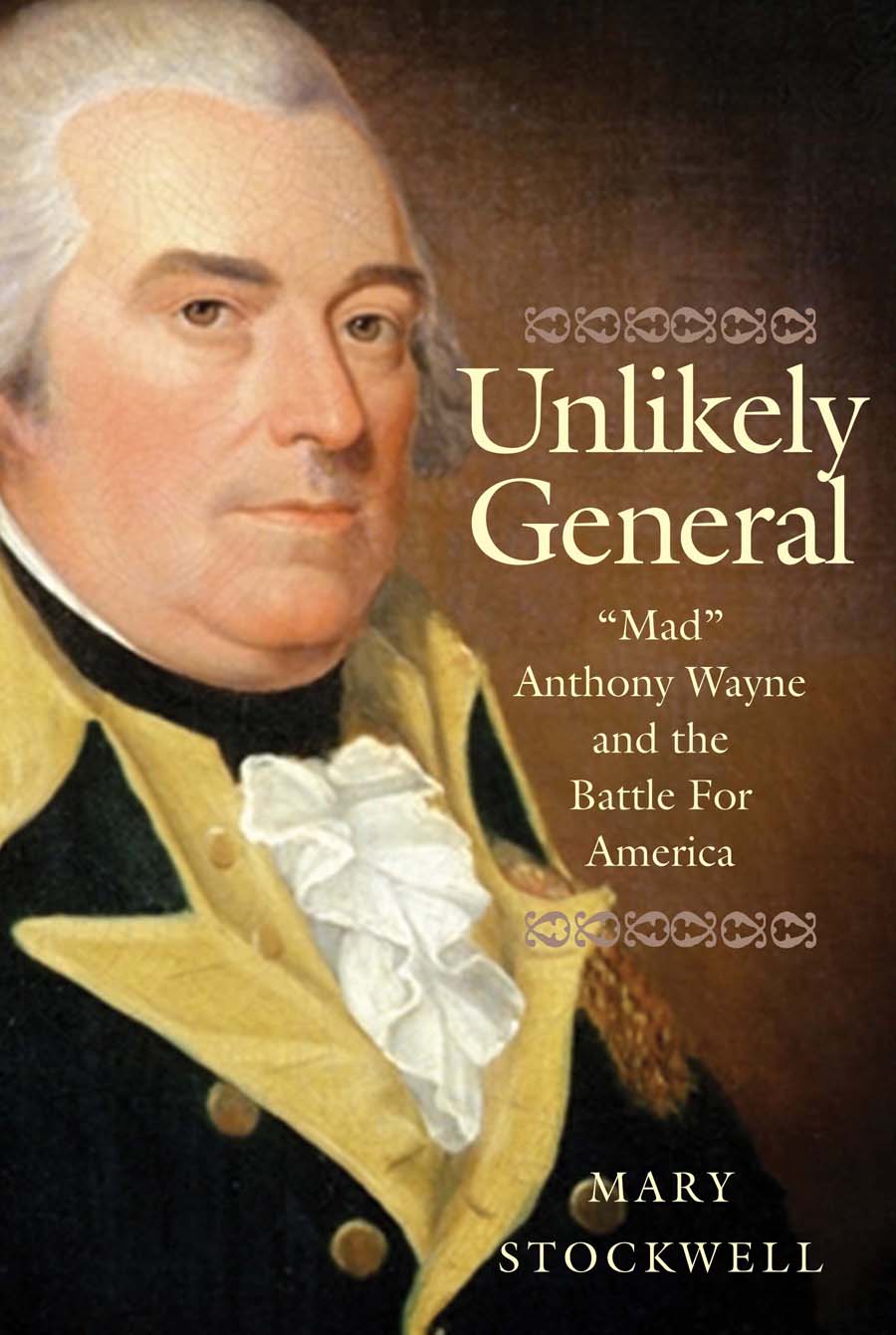
Unlikely General: "Mad" Anthony Wayne and the Battle for America
CURRENT MOON
ARTHUR RIMBAUD
"I have stretched ropes from steeple to steeple; Garlands from window to window; Golden chains from star to star ... And I dance."
RUMI
"When you do things from your soul, you feel a river moving in you, a joy.”
Shunryu Suzuki, "Beginner's Mind"
"In the beginner's mind there are many possibilities, but in the expert's there are few."
JIM HARRISON
NEW ORDER
van EYCK, PORTRAIT of a MAN in a RED TURBAN, 1433
"The Poet is the Priest of The Invisible." Wallace Stevens
Atget, Notre-Dame de Paris, 1923
Technique.
"Technique is the proof of your seriousness." Wallace Stevens
TIGHT LINES!
W.B. Yeats
THE CAPTAIN
NICHOLAS HAWKSMOOR
THOMAS PAINE
"Whatever is my right as a man is also the right of another; and it becomes my duty to guarantee as well as to possess."
LIBERTY
"...the imprisoned lightning"
WILLIAM F. BUCKLEY JR.
"The best defense against a usurpatory government is an assertive citizenry."
SIR PHILIP PULLMAN
"We don’t need a list of rights and wrongs, tables of dos and don’ts: we need books, time, and silence."
TRUE-BORN
THOMAS MERTON
C.S. LEWIS
THOMAS PAINE


.jpg)

.jpg?mode=max)