"I am not one who was born in the custody of wisdom. I am one who is fond of olden times and intense in quest of the sacred knowing of the ancients." Gustave Courbet
Showing posts with label Crawford. Show all posts

15 December 2025

Defended.


Matthew B. Crawford on AI and the ownership of the means of thinking ...
We continue to refer to “the government,” yet that term refers to something bearing little resemblance to the entity described in our civics textbooks. Whatever we call the entity that controls it, the “world operating system” will seek to gather to itself the whole human field. This would bring to fruition what Hannah Arendt called “the rule of Nobody.” The Nobody is an entity that is not accountable and cannot be addressed.

To see our way out of this will require revisiting the basic suppositions that got us to the present ...

Further ... 

We are in for real political turmoil. The establishment is afraid, and rightly so, that the most likely alternative to technocratic rule would be something atavistic. If there is a silver lining in the current confusion, it may be this: Without a social class whose material interests are tied to the homogenizing and reductive metaphysics of technocracy, it may become possible once again to entertain big metaphysical questions. We may become open, as the West has not been for centuries, to truths made available to us in the tradition that runs from classical antiquity through the Hebrew bible and into the Christian teaching. According to this tradition, the human being is something doubly distinct: a natural kind that is oriented beyond itself, indeed beyond nature altogether. Human beings participate in something transcendent, in the image of which they were made. This truth provides a basis—I suspect it may be the only solid basis—on which human possibility may be defended against erasure.
The comments on this article are worth the time, as well.

07 June 2024

Willing.


The path to true individuality is to be willing to be "in conflict with the world" and in collaboration with others - past and present - and the world.  Not accepting abstractions or representations but taking the world as it is - warts and all. 

25 April 2024

Mechanized.

Steve points to Matthew Crawford's essay on AI's ability to alleviate the burden of thinking ...

Mechanized judgment resembles liberal proceduralism. It relies on our habit of deference to rules, and our suspicion of visible, personified authority. But its effect is to erode precisely those pro­cedural liberties that are the great accomplishment of the liberal tradition, and to place authority beyond scrutiny. I mean “authori­ty” in the broadest sense, including our interactions with outsized commercial entities that play a quasi-governmental role in our lives. That is the first problem. A second problem is that decisions made by algorithm are often not explainable, even by those who wrote the algorithm, and for that reason cannot win rational assent. This is the more fundamental problem posed by mechanized decision-making, as it touches on the basis of political legitimacy in any liberal regime.

13 March 2021

Freedom.


There is a real freedom of speech on a job site, which reverberates outward and sustains a wider liberality. You can tell dirty jokes. Where there is real work being done, the order of things isn’t quite so fragile. Not surprisingly, it is the office rather than the job site that has seen the advent of speech codes, diversity workshops, and other forms of higher regulation. Some might attribute this to the greater mixing of the sexes in the office, but I believe a more basic reason is that when there is no concrete task that rules the job—an autonomous good that is visible to all—then there is no secure basis for social relations. Maintaining consensus and preempting conflict become the focus of management, and as a result everyone feels they have to walk on eggshells. Where no appeal to a carpenter’s level is possible, sensitivity training becomes necessary.

Matthew B. Crawford, from Shop Class as Soulcraft: An Inquiry Into the Value of Work

06 May 2020

Well-founded.

It's National Skilled Trades Appreciation Day.


The satisfactions of manifesting oneself concretely in the world through manual competence have been known to make a man quiet and easy. They seem to relieve him of the felt need to offer chattering interpretations of himself to vindicate his worth. He can simply point: the building stands, the car now runs, the lights are on. Boasting is what a boy does, because he has no real effect in the world. But the tradesman must reckon with the infallible judgment of reality, where one’s failures or shortcomings cannot be interpreted away. His well-founded pride is far from the gratuitous “self-esteem” that educators would impart to students, as though by magic.

Matthew B. Crawford, from Shop Class as Soulcraft: An Inquiry Into the Value of Work

Thank you, Abby, Ben, Judson, and Dick.

Thanks, Nick.

22 February 2019

Satisfaction.


A decline in tool use would seem to betoken a shift in our relationship to our own stuff: more passive and more dependent. And indeed, there are fewer occasions for the kind of spiritedness that is called forth when we take things in hand for ourselves, whether to fix them or to make them. What ordinary people once made, they buy; and what they once fixed for themselves, they replace entirely or hire an expert to repair, whose expert fix often involves replacing an entire system because some minute component has failed.

The satisfactions of manifesting oneself concretely in the world through manual competence have been known to make a man quiet and easy. They seem to relieve him of the felt need to offer chattering interpretations of himself to vindicate his worth. He can simply point: the building stands, the car now runs, the lights are on. Boasting is what a boy does, because he has no real effect in the world. But the tradesman must reckon with the infallible judgment of reality, where one’s failures or shortcomings cannot be interpreted away. His well-founded pride is far from the gratuitous “self-esteem” that educators would impart to students, as though by magic.

To live wakefully is to live in full awareness of this, our human situation. To live well is to reconcile ourselves to it, and try to realize whatever excellence we can. For this some economic conditions are more favorable than others. When the conception of work is removed from the scene of its execution, we are divided against one another, and each against himself. For thinking is inherently bound up with doing, and it is in rational activity together with others that we find our peculiar satisfaction.

Matthew B. Crawford

31 July 2017

Excellent.

An excellent book ...


Perhaps it is more generally true that in order to learn from tradition, one has to be able to push against it, and not be bowed by a surfeit of reverence. The point isn’t to replicate the conclusions of tradition, but rather to enter into the same problems as the ancients and make them one’s own. That is how a tradition remains alive.

In Calvin’s time, one might have had a hereditary occupation. And as recently as the 1970s, it was possible to compose a working life centered around the steady accumulation of experience, and be valued in the workplace for that experience; for what you have become. But, as the sociologist Richard Sennett has shown in his studies of contemporary work, it has become difficult to experience the repose of any such settled identity. The ideal of being experienced has given way to the ideal of being flexible. What is demanded is an all-purpose intelligence, the kind one is certified to have by admission to an elite university, not anything in particular that you might have learned along the way. You have to be ready to reinvent yourself at any time, like a good democratic Übermensch. And while in Calvin’s time the threat of damnation might have been dismissed by some as a mere superstition, with our winner-take-all economy the risk of damnation has acquired real teeth. There is a real chance that you may get stuck at the bottom.


The appeal of magic is that it promises to render objects plastic to the will without one’s getting too entangled with them. Treated from arm’s length, the object can issue no challenge to the self. According to Freud, this is precisely the condition of the narcissist: he treats objects as props for his fragile ego and has an uncertain grasp of them as having a reality of their own. The clearest contrast to the narcissist that I can think of is the repairman, who must subordinate himself to the broken washing machine, listen to it with patience, notice its symptoms, and then act accordingly. He cannot treat it abstractly; the kind of agency he exhibits is not at all magical.

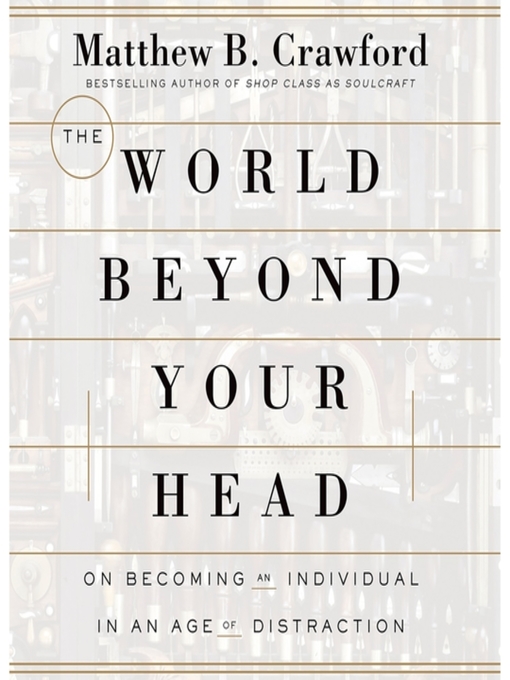
Matthew B. Crawford, from The World Beyond Your Head: On Becoming an Individual in an Age of Distraction

08 June 2016

Exuberant.

Illustrator Allen Crawford has turned Whitman’s poem "Song of Myself" into a sprawling, 256-page work of art. The densely-handwritten text and illustrations intermingle in a way that’s both surprising and wholly in tune with the spirit of the poem—exuberant, rough, and wild. "Whitman Illuminated: Song of Myself" is a sensational reading experience, an artifact in its own right, and a masterful tribute to the Good Gray Poet.


CONNECT