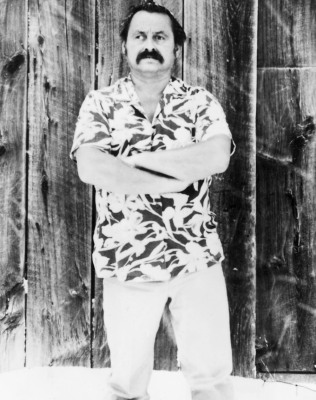
Gary Snyder, the Zen poet, lives on a hundred backcountry
acres in the foothills of the Sierra Nevada, meditates mornings, and thanks his
food before he eats it, clapping his hands together and saying “Itadakimasu,”
which is Japanese for “Thank you very much.” He likes a boilermaker at
dinnertime (a shot of bourbon and a tall glass of beer) and, on occasion, the
bullfrogs from his pond. “I follow the Joy of Cooking," he says. “You’ve got
to skin them and brine them overnight. She recommends rolling them in bread
crumbs and frying them.” He finds that vulture feathers make the best pens for
calligraphy, and collects them when he hikes. Some nights, he takes a blanket
and a thermos of sake and a star map, walks along a gravel riverbed
not far from his house to a spot among the mounded diggings left by the
gold-mining ventures of the past two centuries, and, by the light of a red
torch, works on the constellations.
24 May 2016
23 May 2016
Immensity.
My house is buried in the deepest recess of the forest
Every year, ivy vines grow longer than the year before.
Undisturbed by the affairs of the world I live at ease,
Woodmen’s singing rarely reaching me through the trees.
While the sun stays in the sky, I mend my torn clothes
And facing the moon, I read holy texts aloud to myself.
Let me drop a word of advice for believers of my faith.
To enjoy life’s immensity, you do not need many things.
Ryokan
One.
Everything is far
and long gone by.
I think that the star
glittering above me
has been dead for a million years.
I think there were tears
in the car I heard pass
and something terrible was said.
A clock has stopped striking in the house
across the road...
When did it start?...
I would like to step out of my heart
an go walking beneath the enormous sky.
I would like to pray.
And surely of all the stars that perished
long ago,
one still exists.
I think that I know
which one it is--
which one, at the end of its beam in the sky,
stands like a white city ...
Rainer Maria Rilke
21 May 2016
Starting.
Neil Gaiman gives the 2012 commencement address at The University of the Arts.
The urge, starting out, is to copy. And that's not a bad
thing. Most of us only find our own voices after we've sounded like a lot of
other people. But the one thing that you have that nobody else has is you.
Your voice, your mind, your story, your vision. So write and draw and build and
play and dance and live as only you can.
The moment that you feel that, just possibly, you're walking
down the street naked, exposing too much of your heart and your mind and what
exists on the inside, showing too much of yourself. That's the moment you may
be starting to get it right.
20 May 2016
Listen.
Beware, O wanderer, the road is walking too,
said Rilke one day to no one in particular
as good poets address the six directions.
If you can't bow, you're dead meat. You'll break
like uncooked spaghetti. Listen to the gods.
They're shouting in your ear every second.
as good poets address the six directions.
If you can't bow, you're dead meat. You'll break
like uncooked spaghetti. Listen to the gods.
They're shouting in your ear every second.
Jim Harrison, from After Ikkyu
Greatest.
Before Lewis and Clark there was David Thompson ...
In 1788, David Thompson was working for Hudson’s Bay Company when he suffered an accident, breaking his leg so badly he almost died. But he didn’t die. It took him a year to learn to walk again. And in that year, he spent his time studying astronomy, navigation, and map-making. He looked at the maps at Hudson’s Bay Company, where he worked, and dreamed about what lay beyond their unfinished borders. He decided he wanted to finish those maps. And he did. David Thompson became the greatest map-maker who ever lived, travelling 90,000 kilometres throughout North America, and mapping 4.9 million square kilometers along the way.
The Country of Adventurers: David Thompson ...
Uncharted Territory: David Thompson on the Columbia Plateau ...
19 May 2016
Story.
Looking at a globe close-up is a wonderful thing.
Interacting with a round replica of our world gives an entirely different
sensation to say looking at Google maps and even a physical atlas doesn’t really
give the true geographical sense of our planet. Two dimensional maps, often
relying on the Mercator Projection, can show Greenland to be the size of all of
Africa when it’s really more like Mexico. It takes a globe to really see that
Texas may be the largest state in the continental U.S. but Australia’s largest
state is three times its size. Or that the entire eastern seaboard of America
fits quite comfortably into Kazakhstan.
For Peter Bellerby, a passion for globes has quite
unexpectedly turned into a successful business—his company is one of the
world’s only remaining traditional globe makers. “I think everyone has some
sort of soft spot for globes,” he explains. “Maps are wonderful but globes are
tangible and tell so much more of a story."
Superior.
Rinehart, Little Bear, 1899
American sculptors travel thousands of miles to study Greek Statues in the Vatican in Rome, seemingly unaware that in their own country there exists a race of men equal in form and grace (if not superior) to the finest beau ideal ever dreamed of by the Greeks. And it does seem a little extraordinary that up to this time (as far as I am aware) not a single sculptor has thought it worth his while to make a journey among these Indians, who are now sojourning on the western side of the Rocky Mountains, and are rapidly passing away. Most unquestionably, that sculptor who travels here, -- and models from what he sees (supposing him to have equal power and genius), will far excel any other who merely depends on his own conception of what it ought to be.
Alfred Jacob Miller, The West
Forward.
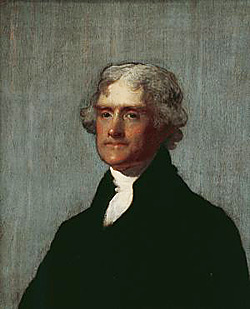
Stuart, The Edgehill Jefferson, 1825
The ground of liberty is to be gained by inches, that we
must be contented to secure what we can get from time to time, and eternally
press forward for what is yet to get. It takes time to persuade men to do even
what is for their own good.
Thomas Jefferson
Keep reminding me.
One.
THE SUMMER DAY
Who made the world?
Who made the swan, and the black bear?
Who made the grasshopper?
This grasshopper, I mean-
the one who has flung herself out of the grass,
the one who is eating sugar out of my hand,
who is moving her jaws back and forth instead of up and down-
who is gazing around with her enormous and complicated eyes.
Now she lifts her pale forearms and thoroughly washes her face.
Now she snaps her wings open, and floats away.
I don't know exactly what a prayer is.
I do know how to pay attention, how to fall down
into the grass, how to kneel in the grass,
how to be idle and blessed, how to stroll through the fields,
which is what I have been doing all day.
Tell me, what else should I have done?
Doesn't everything die at last, and too soon?
Tell me, what is it you plan to do
With your one wild and precious life?
Mary Oliver
Far.
Homer, Saguenay River, Lower Rapids, 1897
THE GOLDEN WINDOW
THE GOLDEN WINDOW
By accident my heart lifted with a rush.
Gone for weeks, finally home on a darkish day
of blustery wind, napped, waking in a few minutes
and the sun had come clean and crept around the house,
this light from one of trillions of stars
falling through the window skeined
by the willow’s greenish bright yellow leaves
so that my half-asleep head opened wide
for the first time in many months, a cold sunstroke,
so yellow-gold, so gold-yellow, yellow-gold,
this eye beyond age bathed in yellow light.
Seventy days on the river with a confusion between
river turbulence and human tribulation. We are here
to be curious not consoled. The gift of the gods
is consciousness not my forlorn bleating prayers
for equilibrium, the self dog-paddling in circles
on its own alga-lidded pond. Emily Walter wrote:
“We are given rivers so we know our hearts
can break, but still keep us breathing.”
When you run through the woods blindfolded
you’re liable to collide with trees, I thought
one hot afternoon on the river. You can’t drown yourself
if you swim well. We saw some plovers
and then a few yellow legs with their peculiar cries,
and I remembered a very cold, windy September day
with Matthiessen and Danny when the birds lifted
me far out of myself. It was so cold and blustery the avian
world descended into the river valley and while fishing
we saw a golden eagle, two immature and two adult
bald eagles, two prairie falcons, two peregrines, Cooper’s
hawks, two Swainson’s, a sharp-shinned,
a rough-legged, a harrier, five turkey vultures,
three ospreys, and also saw buffleheads, widgeon,
teal, mallards, morning doves, kingfishers,
ring-billed gulls, killdeer, spotted plovers,
sandpipers and sandhill cranes.
They also saw us. If a peregrine sees fifty times better
than we, what do we look like to them?
Unanswerable.
Nearing seventy there is a tinge of the usually
unseen miraculous when you wake up alive
from a night’s sleep or a nap. We always rise in the terrifying
posture of the living. Some days the river is incomprehensible.
No, not the posture, but that a terrifying beauty
is born within us. I think of the 20-acre thicket
my mother planted after the deaths 40 years ago,
the thicket now nearly impenetrable as its own beauty.
Across the small pond the green heron looked at me quizzically—
who is this? I said I wasn’t sure at that moment
wondering if the green heron could be Mother.
Now back in the Absarokas I’m awake
to these diffuse corridors of light. The grizzlies
have buried themselves below that light cast down
across the mountain meadow, following a canyon
to the valley floor where the rattlesnakes will also sleep
until mid-April. Meanwhile we’ll travel toward the border
with the birds. The moon is swollen tonight
and the mountain this summer I saw bathed
in a thunderstorm now bathes itself in a mist of snow.
Rushing, turbulent water and light, convinced by animals
and rivers that nature only leads us to herself,
so openly female through the window of my single eye.
For half a year my alphabet blinded me to beauty,
forgetting my nature which came from the boy lost
comfortably in the woods, how and why he suspected home,
this overmade world where old paths are submerged
in metal and cement.
This morning in the first clear sunlight making its way
over the mountains, the earth covered with crunchy frost,
I walked the dogs past Weber’s sheep pasture
where a ram was covering a ewe who continued eating,
a wise and experienced woman. I headed due west
up the slope toward Antelope Butte in the delicious
cold still air, turning at the irrigation ditch hearing
the staccato howl of sandhill cranes behind me,
a couple of hundred rising a mile away from Cargill’s
alfalfa, floating up into the white mist rising
from the frost, and moving north in what I judge
is the wrong direction for this weather. Birds make mistakes,
so many dying against windows and phone wires.
I continued west toward the snake den to try to catch
the spirit of the place when it’s asleep, the sheer otherness
of hundreds of rattlesnakes sleeping in a big ball
deep in the rocky earth beneath my feet. The dogs,
having been snake trained, are frightened of this place.
So am I. So much protective malevolence. I fled.
Back home in the studio, a man-made wonder. We planted
a chokecherry tree near the window and now through cream-
colored blinds the precise silhouette of the bare branches,
gently but firmly lifting my head, a Chinese screen
that no one made which I accept from the nature of light.
I think of Mother’s thicket as her bird garden.
How obsessed she was with these creatures. When I told
her a schizophrenic in Kentucky wrote, “Birds are holes
in heaven through which a man must pass,” her eyes teared.
She lost husband and daughter to the violence of the road
and I see their spirits in the bird garden. On our last night
a few years ago she asked me, “Are we the same species as God?”
At eighty-five she was angry that the New Testament wasn’t fair
to women and then she said, “During the Great Depression
we had plenty to eat,” meaning at the farmhouse,
barn and chicken coop a hundred yards to the north
that are no longer there, disappeared with the inhabitants.
The child is also the mother of the man.
In the U.P. in the vast place southeast of the river
I found my way home by following the path
where my shadow was the tallest
which led to the trail which led
to another trail which led to the road home
to the cabin where I wrote to her:
“Found two dead redtail hawks, missing
their breasts, doubtless a goshawk took them
as one nests just north of here a half mile
in a tall hemlock on the bend of the river.”
With only one eye I’ve learned
to celebrate vision, the eye a painter,
the eye a monstrous fleshy camera
which can’t stop itself in the dark
where it sees its private imagination.
The tiny eye that sees the cosmos overhead.
to celebrate vision, the eye a painter,
the eye a monstrous fleshy camera
which can’t stop itself in the dark
where it sees its private imagination.
The tiny eye that sees the cosmos overhead.
Last winter I lost heart between each of seven cities.
Planes never land with the same people who boarded.
Walking Mary and Zilpha every morning I wonder
how many dogs are bound by regret
because they are captured by our imaginations
and affixed there by our need to have them do
as we wish when their hearts are quite otherwise.
how many dogs are bound by regret
because they are captured by our imaginations
and affixed there by our need to have them do
as we wish when their hearts are quite otherwise.
I hope to define my life, whatever is left,
by migrations, south and north with the birds
and far from the metallic fever of clocks,
the self staring at the clock saying, “I must do this.”
I can’t tell the time on the tongue of the river
in the cool morning air, the smell of the ferment
of greenery, the dust off the canyon’s rock walls,
the swallows swooping above the scent of raw water.
Maybe we’re not meant to wake up completely.
I’m trying to think of what I can’t remember.
Last week in France I read that the Ainu in Japan
receive messages from the gods through willow trees
so I’m not the only one. I looked down into the garden
of Matignon and wondered at the car trip the week before
where at twilight in Narbonne 27,000 blackbirds swirled
and that night from the window
it was eerie with a slip of the waning moon
off the right shoulder of the Romanesque cathedral
with Venus sparkling shamelessly above the moon,
Venus over whom the church never had any power.
Who sees? Whose eye is this? A day later in Collioure
from the Hermitage among vineyards in the mountains
I could look down steep canyons still slightly green
from the oaks in November to the startling blue of the Mediterranean,
storm-wracked from the mistral’s seventy knot winds,
huge lumpy whitecaps, their crests looking toward Africa.
I always feared losing my remaining eye,
my singular window to the world. When closed it sees
the thousands of conscious photos I’ve taken with it,
impressionist rather than crystalline, from a lion’s mouth
in the Serengeti in 1972 to a whale’s eye in the Humboldt current,
the mountain sun gorged with the color of forest
fires followed by a moon orange as a simple orange,
a thousand girls and women I’ve seen but never met,
the countless birds I adopted since losing the eye in 1945
including an albino grouse creamy as that goshawk’s breast
that came within feet of Mother in our back pasture,
the female trogon that appeared when Dalva
decided to die, and the thousands of books out of whose print
vision is created in the mind’s eye, as real as any garden at dawn.
No rhapsodies today. Home from France
and the cold wind and a foot of snow have destroyed
my golden window, but then the memory
has always been more vivid than the life. The memory
is the not-quite-living museum of our lives.
Sometimes its doors are insufferably wide open
with black stars in a grey sky, and horses
clattering in and out, our dead animals resting here
and there but often willing to come to life again
to greet us, parents and brothers and sisters sit
at the August table laughing while they eat twelve
fresh vegetables from the garden. Rivers, creeks, lakes
over which birds funnel like massive schools of minnows.
In memory the clocks have drowned themselves, leaving
time to the life spans of trees. The world of our lives
comes unbidden as night.
Jim Harrison
Labels:
appreciation,
art,
Harrison,
Homer,
poetry,
poetry rules!,
water
Honored.
When famed Arizona author and naturalist Edward Abbey died
in 1989 his friends honored his last wishes and packed him in dry ice, drove
him into the desert and buried him. Doug Peacock was there and shares his
experience.
Free.
Wyeth, Spruce Grove, 1970
THE SKYLARK
The rolls and harrows lie at rest beside
THE SKYLARK
The rolls and harrows lie at rest beside
The battered road; and spreading far and wide
Above the russet clods, the corn is seen
Sprouting its spiry points of tender green,
Where squats the hare, to terrors wide awake,
Like some brown clod the harrows failed to break.
Opening their golden caskets to the sun,
The buttercups make schoolboys eager run,
To see who shall be first to pluck the prize
Up from their hurry, see, the skylark flies,
And o'er her half-formed nest, with happy wings
Winnows the air, till in the cloud she sings,
Then hangs a dust-spot in the sunny skies,
And drops, and drops, till in her nest she lies,
Which they unheeded passednot dreaming then
That birds which flew so high would drop agen
To nests upon the ground, which anything
May come at to destroy. Had they the wing
Like such a bird, themselves would be too proud,
And build on nothing but a passing cloud!
As free from danger as the heavens are free
From pain and toil, there would they build and be,
And sail about the world to scenes unheard
Of and unseen Oh, were they but a bird!
So think they, while they listen to its song,
And smile and fancy and so pass along;
While its low nest, moist with the dews of morn,
Lies safely, with the leveret, in the corn.
John Clare
John Clare
Labels:
appreciation,
art,
Childhood,
Clare,
nature,
outdoors,
poetry,
poetry rules!,
Wyeth
18 May 2016
Health.
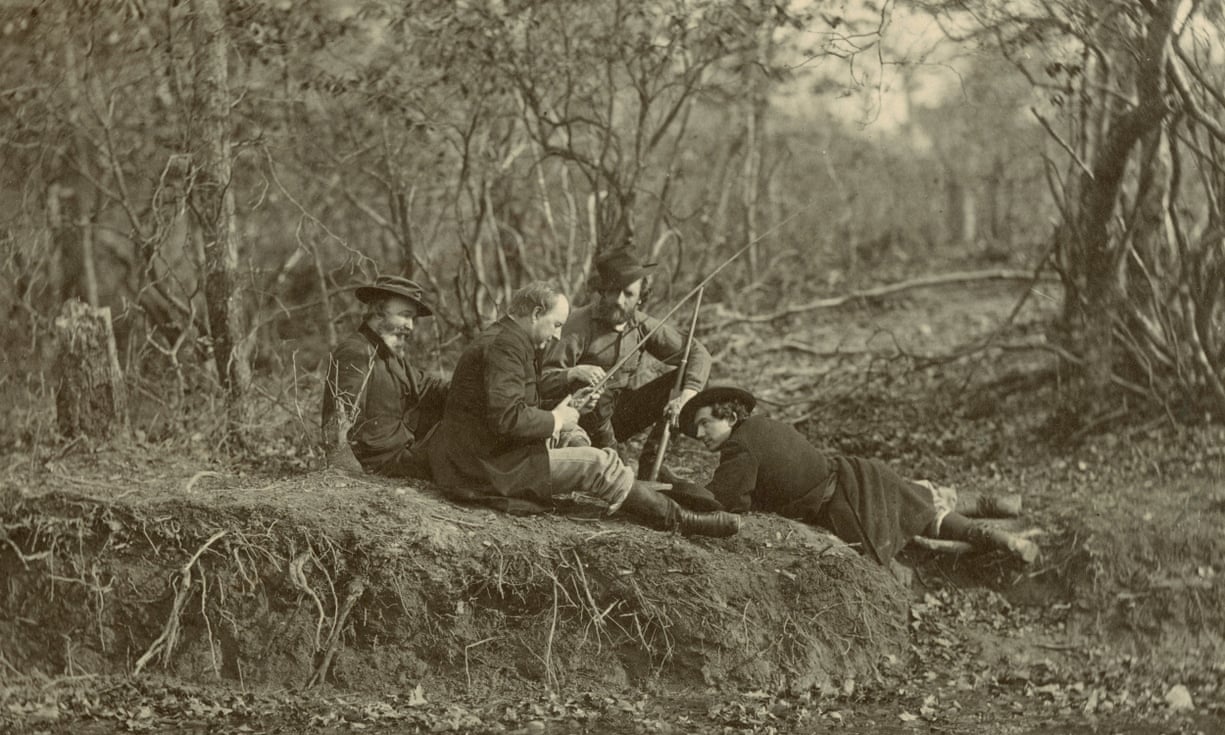
Unattributed, Walt Whitman Fishing with Friends, 1863
A long-lost book-length guide to “manly health” by Walt
Whitman, in which the great American poet tackles everything from virility to
“care of the feet” and the attainment of a “nobler physique”, has been
rediscovered by a scholar, more than 150 years after it was first published
under a pen-name.
Labels:
appreciation,
culture,
eating,
food,
health,
history,
outdoors,
photography,
Whitman,
writing
Passion.
For Guy Clark ...
BERRYMAN
I will tell you what he told me
in the years just after the war
as we then called
the second world war
don't lose your arrogance yet he said
you can do that when you're older
lose it too soon and you may
merely replace it with vanity
just one time he suggested
changing the usual order
of the same words in a line of verse
why point out a thing twice
he suggested I pray to the Muse
get down on my knees and pray
right there in the corner and he
said he meant it literally
it was in the days before the beard
and the drink but he was deep
in tides of his own through which he sailed
chin sideways and head tilted like a tacking sloop
he was far older than the dates allowed for
much older than I was he was in his thirties
he snapped down his nose with an accent
I think he had affected in England
as for publishing he advised me
to paper my wall with rejection slips
his lips and the bones of his long fingers trembled
with the vehemence of his views about poetry
he said the great presence
that permitted everything and transmuted it
in poetry was passion
passion was genius and he praised movement and invention
I had hardly begun to read
I asked how can you ever be sure
that what you write is really
any good at all and he said you can't
you can't you can never be sure
you die without knowing
whether anything you wrote was any good
if you have to be sure don't write
W.S. Merwin
17 May 2016
Figured.
The poet Sappho was so celebrated in the ancient world that
the Roman Empire was still producing statues and paintings of her centuries
after her death. Her work was organized into nine books of lyric poetry in the
famous library at Alexandria, yet we know almost nothing about her life, except
that she lived on the Greek island of Lesbos and wrote love poems to women. She
remains famous to the present day, even though only a few fragments of her
poetry have survived. One of these fragments, called "Midnight Poem,"
was written in the mid-sixth century BCE to an absent lover. Due to tantalizing
hints in the poem, scholars have long debated when it was written. Now, thanks
to software used to simulate night skies in planetariums, scientists have
figured it out.
CONNECT
CONNECT
Lives.
VIRTUE
Sweet day, so cool, so calm, so bright,
The bridal of the earth and sky;
The dew shall weep thy fall to-night,
For thou must die.
Sweet rose, whose hue angry and brave
Bids the rash gazer wipe his eye;
Thy root is ever in its grave,
And thou must die.
Sweet spring, full of sweet days and roses,
A box where sweets compacted lie;
My music shows ye have your closes,
And all must die.
Only a sweet and virtuous soul,
Like season'd timber, never gives;
But though the whole world turn to coal,
Then chiefly lives.
Then chiefly lives.
George Herbert
For Jessica, with Love.
Haunts.
McCleary, Morning Sun on the Meadow, undated
PRELUDE: BOOK 2: SCHOOL-TIME
Thus far, O Friend! have we, though leaving much
Unvisited, endeavour'd to retrace
My life through its first years, and measured back
The way I travell'd when I first began
To love the woods and fields; the passion yet
Was in its birth, sustain'd, as might befal,
By nourishment that came unsought, for still,
From week to week, from month to month, we liv'd
A round of tumult: duly were our games
Prolong'd in summer till the day-light fail'd;
No chair remain'd before the doors, the bench
And threshold steps were empty; fast asleep
The Labourer, and the old Man who had sate,
A later lingerer, yet the revelry
Continued, and the loud uproar: at last,
When all the ground was dark, and the huge clouds
Were edged with twinkling stars, to bed we went,
With weary joints, and with a beating mind.
Ah! is there one who ever has been young,
Nor needs a monitory voice to tame
The pride of virtue, and of intellect?
And is there one, the wisest and the best
Of all mankind, who does not sometimes wish
For things which cannot be, who would not give,
If so he might, to duty and to truth
The eagerness of infantine desire?
A tranquillizing spirit presses now
On my corporeal frame: so wide appears
The vacancy between me and those days,
Which yet have such self-presence in my mind
That, sometimes, when I think of them, I seem
Two consciousnesses, conscious of myself
And of some other Being. A grey Stone
Of native rock, left midway in the Square
Of our small market Village, was the home
And centre of these joys, and when, return'd
After long absence, thither I repair'd,
I found that it was split, and gone to build
A smart Assembly-room that perk'd and flar'd
With wash and rough-cast elbowing the ground
Which had been ours. But let the fiddle scream,
And be ye happy! yet, my Friends! I know
That more than one of you will think with me
Of those soft starry nights, and that old Dame
From whom the stone was nam'd who there had sate
And watch'd her Table with its huckster's wares
Assiduous, thro' the length of sixty years.
We ran a boisterous
race; the year span round
With giddy motion. But the time approach'd
That brought with it a regular desire
For calmer pleasures, when the beauteous forms
Of Nature were collaterally attach'd
To every scheme of holiday delight,
And every boyish sport, less grateful else,
And languidly pursued.
When summer came
It was the pastime of our afternoons
To beat along the plain of Windermere
With rival oars, and the selected bourne
Was now an Island musical with birds
That sang for ever; now a Sister Isle
Beneath the oaks' umbrageous covert, sown
With lillies of the valley, like a field;
And now a third small Island where remain'd
An old stone Table, and a moulder'd Cave,
A Hermit's history. In such a race,
So ended, disappointment could be none,
Uneasiness, or pain, or jealousy:
We rested in the shade, all pleas'd alike,
Conquer'd and Conqueror. Thus the pride of strength,
And the vain-glory of superior skill
Were interfus'd with objects which subdu'd
And temper'd them, and gradually produc'd
A quiet independence of the heart.
And to my Friend, who knows me, I may add,
Unapprehensive of reproof, that hence
Ensu'd a diffidence and modesty,
And I was taught to feel, perhaps too much,
The self-sufficing power of solitude.
No delicate viands
sapp'd our bodily strength;
More than we wish'd we knew the blessing then
Of vigorous hunger, for our daily meals
Were frugal, Sabine fare! and then, exclude
A little weekly stipend, and we lived
Through three divisions of the quarter'd year
In pennyless poverty. But now, to School
Return'd, from the half-yearly holidays,
We came with purses more profusely fill'd,
Allowance which abundantly suffic'd
To gratify the palate with repasts
More costly than the Dame of whom I spake,
That ancient Woman, and her board supplied.
Hence inroads into distant Vales, and long
Excursions far away among the hills,
Hence rustic dinners on the cool green ground,
Or in the woods, or near a river side,
Or by some shady fountain, while soft airs
Among the leaves were stirring, and the sun
Unfelt, shone sweetly round us in our joy.
Nor is my aim
neglected, if I tell
How twice in the long length of those half-years
We from our funds, perhaps, with bolder hand
Drew largely, anxious for one day, at least,
To feel the motion of the galloping Steed;
And with the good old Inn-keeper, in truth,
On such occasion sometimes we employ'd
Sly subterfuge; for the intended bound
Of the day's journey was too distant far
For any cautious man, a Structure famed
Beyond its neighbourhood, the antique Walls
Of that large Abbey which within the vale
Of Nightshade, to St. Mary's honour built,
Stands yet, a mouldering Pile, with fractured Arch,
Belfry, and Images, and living Trees,
A holy Scene! along the smooth green turf
Our Horses grazed: to more than inland peace
Left by the sea wind passing overhead
(Though wind of roughest temper) trees and towers
May in that Valley oftentimes be seen,
Both silent and both motionless alike;
Such is the shelter that is there, and such
The safeguard for repose and quietness.
Our steeds remounted,
and the summons given,
With whip and spur we by the Chauntry flew
In uncouth race, and left the cross-legg'd Knight,
And the stone-Abbot, and that single Wren
Which one day sang so sweetly in the Nave
Of the old Church, that, though from recent showers
The earth was comfortless, and, touch'd by faint
Internal breezes, sobbings of the place,
And respirations, from the roofless walls
The shuddering ivy dripp'd large drops, yet still,
So sweetly 'mid the gloom the invisible Bird
Sang to itself, that there I could have made
My dwelling-place, and liv'd for ever there
To hear such music. Through the Walls we flew
And down the valley, and a circuit made
In wantonness of heart, through rough and smooth
We scamper'd homeward. Oh! ye Rocks and Streams,
And that still Spirit of the evening air!
Even in this joyous time I sometimes felt
Your presence, when with slacken'd step we breath'd
Along the sides of the steep hills, or when,
Lighted by gleams of moonlight from the sea,
We beat with thundering hoofs the level sand.
Upon the Eastern Shore
of Windermere,
Above the crescent of a pleasant Bay,
There stood an Inn, no homely-featured Shed,
Brother of the surrounding Cottages,
But 'twas a splendid place, the door beset
With Chaises, Grooms, and Liveries, and within
Decanters, Glasses, and the blood-red Wine.
In ancient times, or ere the Hall was built
On the large Island, had this Dwelling been
More worthy of a Poet's love, a Hut,
Proud of its one bright fire, and sycamore shade.
But though the rhymes were gone which once inscribed
The threshold, and large golden characters
On the blue-frosted Signboard had usurp'd
The place of the old Lion, in contempt
And mockery of the rustic painter's hand,
Yet to this hour the spot to me is dear
With all its foolish pomp. The garden lay
Upon a slope surmounted by the plain
Of a small Bowling-green; beneath us stood
A grove; with gleams of water through the trees
And over the tree-tops; nor did we want
Refreshment, strawberries and mellow cream.
And there, through half an afternoon, we play'd
On the smooth platform, and the shouts we sent
Made all the mountains ring. But ere the fall
Of night, when in our pinnace we return'd
Over the dusky Lake, and to the beach
Of some small Island steer'd our course with one,
The Minstrel of our troop, and left him there,
And row'd off gently, while he blew his flute
Alone upon the rock; Oh! then the calm
And dead still water lay upon my mind
Even with a weight of pleasure, and the sky
Never before so beautiful, sank down
Into my heart, and held me like a dream.
Thus daily were my
sympathies enlarged,
And thus the common range of visible things
Grew dear to me: already I began
To love the sun, a Boy I lov'd the sun,
Not as I since have lov'd him, as a pledge
And surety of our earthly life, a light
Which while we view we feel we are alive;
But, for this cause, that I had seen him lay
His beauty on the morning hills, had seen
The western mountain touch his setting orb,
In many a thoughtless hour, when, from excess
Of happiness, my blood appear'd to flow
With its own pleasure, and I breath'd with joy.
And from like feelings, humble though intense,
To patriotic and domestic love
Analogous, the moon to me was dear;
For I would dream away my purposes,
Standing to look upon her while she hung
Midway between the hills, as if she knew
No other region; but belong'd to thee,
Yea, appertain'd by a peculiar right
To thee and thy grey huts, my darling Vale!
Those incidental charms
which first attach'd
My heart to rural objects, day by day
Grew weaker, and I hasten on to tell
How Nature, intervenient till this time,
And secondary, now at length was sought
For her own sake. But who shall parcel out
His intellect, by geometric rules,
Split, like a province, into round and square?
Who knows the individual hour in which
His habits were first sown, even as a seed,
Who that shall point, as with a wand, and say,
'This portion of the river of my mind
Came from yon fountain?' Thou, my Friend! art one
More deeply read in thy own thoughts; to thee
Science appears but, what in truth she is,
Not as our glory and our absolute boast,
But as a succedaneum, and a prop
To our infirmity. Thou art no slave
Of that false secondary power, by which,
In weakness, we create distinctions, then
Deem that our puny boundaries are things
Which we perceive, and not which we have made.
To thee, unblinded by these outward shows,
The unity of all has been reveal'd
And thou wilt doubt with me, less aptly skill'd
Than many are to class the cabinet
Of their sensations, and, in voluble phrase,
Run through the history and birth of each,
As of a single independent thing.
Hard task to analyse a soul, in which,
Not only general habits and desires,
But each most obvious and particular thought,
Not in a mystical and idle sense,
But in the words of reason deeply weigh'd,
Hath no beginning.
Bless'd the infant Babe,
(For with my best conjectures I would trace
The progress of our Being) blest the Babe,
Nurs'd in his Mother's arms, the Babe who sleeps
Upon his Mother's breast, who, when his soul
Claims manifest kindred with an earthly soul,
Doth gather passion from his Mother's eye!
Such feelings pass into his torpid life
Like an awakening breeze, and hence his mind
Even [in the first trial of its powers]
Is prompt and watchful, eager to combine
In one appearance, all the elements
And parts of the same object, else detach'd
And loth to coalesce. Thus, day by day,
Subjected to the discipline of love,
His organs and recipient faculties
Are quicken'd, are more vigorous, his mind spreads,
Tenacious of the forms which it receives.
In one beloved presence, nay and more,
In that most apprehensive habitude
And those sensations which have been deriv'd
From this beloved Presence, there exists
A virtue which irradiates and exalts
All objects through all intercourse of sense.
No outcast he, bewilder'd and depress'd;
Along his infant veins are interfus'd
The gravitation and the filial bond
Of nature, that connect him with the world.
Emphatically such a Being lives,
An inmate of this active universe;
From nature largely he receives; nor so
Is satisfied, but largely gives again,
For feeling has to him imparted strength,
And powerful in all sentiments of grief,
Of exultation, fear, and joy, his mind,
Even as an agent of the one great mind,
Creates, creator and receiver both,
Working but in alliance with the works
Which it beholds.—Such, verily, is the first
Poetic spirit of our human life;
By uniform control of after years
In most abated or suppress'd, in some,
Through every change of growth or of decay,
Pre-eminent till death.
From early days,
Beginning not long after that first time
In which, a Babe, by intercourse of touch,
I held mute dialogues with my Mother's heart
I have endeavour'd to display the means
Whereby this infant sensibility,
Great birthright of our Being, was in me
Augmented and sustain'd. Yet is a path
More difficult before me, and I fear
That in its broken windings we shall need
The chamois' sinews, and the eagle's wing:
For now a trouble came into my mind
From unknown causes. I was left alone,
Seeking the visible world, nor knowing why.
The props of my affections were remov'd,
And yet the building stood, as if sustain'd
By its own spirit! All that I beheld
Was dear to me, and from this cause it came,
That now to Nature's finer influxes
My mind lay open, to that more exact
And intimate communion which our hearts
Maintain with the minuter properties
Of objects which already are belov'd,
And of those only. Many are the joys
Of youth; but oh! what happiness to live
When every hour brings palpable access
Of knowledge, when all knowledge is delight,
And sorrow is not there. The seasons came,
And every season to my notice brought
A store of transitory qualities
Which, but for this most watchful power of love
Had been neglected, left a register
Of permanent relations, else unknown,
Hence life, and change, and beauty, solitude
More active, even, than 'best society',
Society made sweet as solitude
By silent inobtrusive sympathies,
And gentle agitations of the mind
From manifold distinctions, difference
Perceived in things, where to the common eye,
No difference is; and hence, from the same source
Sublimer joy; for I would walk alone,
In storm and tempest, or in starlight nights
Beneath the quiet Heavens; and, at that time,
Have felt whate'er there is of power in sound
To breathe an elevated mood, by form
Or image unprofaned; and I would stand,
Beneath some rock, listening to sounds that are
The ghostly language of the ancient earth,
Or make their dim abode in distant winds.
Thence did I drink the visionary power.
I deem not profitless those fleeting moods
Of shadowy exultation: not for this,
That they are kindred to our purer mind
And intellectual life; but that the soul,
Remembering how she felt, but what she felt
Remembering not, retains an obscure sense
Of possible sublimity, to which,
With growing faculties she doth aspire,
With faculties still growing, feeling still
That whatsoever point they gain, they still
Have something to pursue.
And not alone,
In grandeur and in tumult, but no less
In tranquil scenes, that universal power
And fitness in the latent qualities
And essences of things, by which the mind
Is mov'd by feelings of delight, to me
Came strengthen'd with a superadded soul,
A virtue not its own. My morning walks
Were early; oft, before the hours of School
I travell'd round our little Lake, five miles
Of pleasant wandering, happy time! more dear
For this, that one was by my side, a Friend
Then passionately lov'd; with heart how full
Will he peruse these lines, this page, perhaps
A blank to other men! for many years
Have since flow'd in between us; and our minds,
Both silent to each other, at this time
We live as if those hours had never been.
Nor seldom did I lift our cottage latch
Far earlier, and before the vernal thrush
Was audible, among the hills I sate
Alone, upon some jutting eminence
At the first hour of morning, when the Vale
Lay quiet in an utter solitude.
How shall I trace the history, where seek
The origin of what I then have felt?
Oft in these moments such a holy calm
Did overspread my soul, that I forgot
That I had bodily eyes, and what I saw
Appear'd like something in myself, a dream,
A prospect in my mind.
'Twere long to tell
What spring and autumn, what the winter snows,
And what the summer shade, what day and night,
The evening and the morning, what my dreams
And what my waking thoughts supplied, to nurse
That spirit of religious love in which
I walked with Nature. But let this, at least
Be not forgotten, that I still retain'd
My first creative sensibility,
That by the regular action of the world
My soul was unsubdu'd. A plastic power
Abode with me, a forming hand, at times
Rebellious, acting in a devious mood,
A local spirit of its own, at war
With general tendency, but for the most
Subservient strictly to the external things
With which it commun'd. An auxiliar light
Came from my mind which on the setting sun
Bestow'd new splendor, the melodious birds,
The gentle breezes, fountains that ran on,
Murmuring so sweetly in themselves, obey'd
A like dominion; and the midnight storm
Grew darker in the presence of my eye.
Hence by obeisance, my devotion hence,
And hence my transport.
Nor should this, perchance,
Pass unrecorded, that I still have lov'd
The exercise and produce of a toil
Than analytic industry to me
More pleasing, and whose character I deem
Is more poetic as resembling more
Creative agency. I mean to speak
Of that interminable building rear'd
By observation of affinities
In objects where no brotherhood exists
To common minds. My seventeenth year was come
And, whether from this habit, rooted now
So deeply in my mind, or from excess
Of the great social principle of life,
Coercing all things into sympathy,
To unorganic natures I transferr'd
My own enjoyments, or, the power of truth
Coming in revelation, I convers'd
With things that really are, I, at this time
Saw blessings spread around me like a sea.
Thus did my days pass on, and now at length
From Nature and her overflowing soul
I had receiv'd so much that all my thoughts
Were steep'd in feeling; I was only then
Contented when with bliss ineffable
I felt the sentiment of Being spread
O'er all that moves, and all that seemeth still,
O'er all, that, lost beyond the reach of thought
And human knowledge, to the human eye
Invisible, yet liveth to the heart,
O'er all that leaps, and runs, and shouts, and sings,
Or beats the gladsome air, o'er all that glides
Beneath the wave, yea, in the wave itself
And mighty depth of waters. Wonder not
If such my transports were; for in all things
I saw one life, and felt that it was joy.
One song they sang, and it was audible,
Most audible then when the fleshly ear,
O'ercome by grosser prelude of that strain,
Forgot its functions, and slept undisturb'd.
If this be error, and
another faith
Find easier access to the pious mind,
Yet were I grossly destitute of all
Those human sentiments which make this earth
So dear, if I should fail, with grateful voice
To speak of you, Ye Mountains and Ye Lakes,
And sounding Cataracts! Ye Mists and Winds
That dwell among the hills where I was born.
If, in my youth, I have been pure in heart,
If, mingling with the world, I am content
With my own modest pleasures, and have liv'd,
With God and Nature communing, remov'd
From little enmities and low desires,
The gift is yours; if in these times of fear,
This melancholy waste of hopes o'erthrown,
If, 'mid indifference and apathy
And wicked exultation, when good men,
On every side fall off we know not how,
To selfishness, disguis'd in gentle names
Of peace, and quiet, and domestic love,
Yet mingled, not unwillingly, with sneers
On visionary minds; if in this time
Of dereliction and dismay, I yet
Despair not of our nature; but retain
A more than Roman confidence, a faith
That fails not, in all sorrow my support,
The blessing of my life, the gift is yours,
Ye mountains! thine, O Nature! Thou hast fed
My lofty speculations; and in thee,
For this uneasy heart of ours I find
A never-failing principle of joy,
And purest passion.
Thou,
my Friend! wert rear'd
In the great City, 'mid far other scenes;
But we, by different roads at length have gain'd
The self-same bourne. And for this cause to Thee
I speak, unapprehensive of contempt,
The insinuated scoff of coward tongues,
And all that silent language which so oft
In conversation betwixt man and man
Blots from the human countenance all trace
Of beauty and of love. For Thou hast sought
The truth in solitude, and Thou art one,
The most intense of Nature's worshippers
In many things my Brother, chiefly here
In this my deep devotion.
Fare
Thee well!
Health, and the quiet of a healthful mind
Attend thee! seeking oft the haunts of men,
And yet more often living with Thyself,
And for Thyself, so haply shall thy days
Be many, and a blessing to mankind.
William Wordsworth
William Wordsworth
Immediately.
AMY GOODMAN: Why
did you find comfort in grizzlies, coming back from Vietnam?
DOUG PEACOCK: Mainly
because they got you out of your own mind. You know, if you put on a Kelty pack
and you hike in Colorado or California, you’re top dog. You know, you walk down
a trail, you think about your girlfriend or your portfolio or I don’t know
what. In grizzly country, you can’t do that, because there’s something out
there that, if it chose, could kill and eat you at anytime it wanted to. And
just having to take that into stock, you know, totally and fundamentally just
changes the ambiance of a place.
All of a sudden, you’re not top dog. And you look a little
more closely. You walk like an animal. You scent the wind. You listen to the
brush. And it really accelerates your inner — much more ancient finished system
than our modern industrial culture provides. I mean, getting back into the
wilderness like that, having a grizzly bear in there, just within three or four
days, something happens to me. You know, I’m really like another animal almost.
And it’s a wonderful thing, because everything is externalized, and, you know,
you live immediately in the present.
Heart.
Labels:
appreciation,
Auden,
Childhood,
maps,
place,
poetry,
poetry rules!
13 May 2016
Subscribe to:
Posts (Atom)


.jpg)