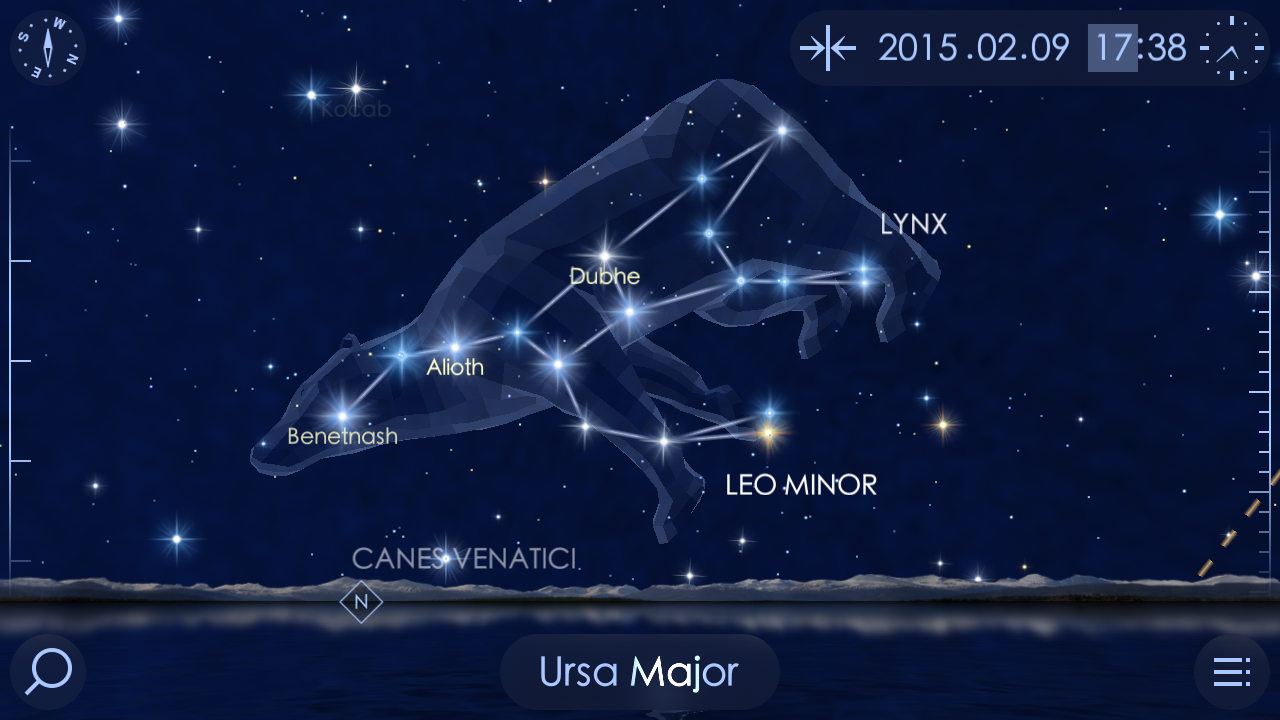
The Greek version of a familiar myth starts with Artemis,
goddess of the hunt and fierce protectress of innocent young women. Artemis
demands that Callisto, “the most beautiful,” and her other handmaidens take a
vow of chastity. Zeus tricks Callisto into giving up her virginity, and she
gives birth to a son, Arcas. Zeus’ jealous wife, Hera, turns Callisto into a
bear and banishes her to the mountains. Meanwhile Arcas grows up to become a
hunter and one day happens on a bear that greets him with outstretched arms.
Not recognizing his mother, he takes aim with his spear, but Zeus comes to the
rescue. He transforms Callisto into the constellation Ursa Major, or “great
bear,” and places Arcas nearby as Ursa Minor, the “little bear.”
As the Iroquois of the northeastern U.S. tell it, three
hunters pursue a bear; the blood of the wounded animal colors the leaves of the
autumnal forest. The bear then climbs a mountain and leaps into the sky. The
hunters and the animal become the constellation Ursa Major. Among the Chukchi,
a Siberian people, the constellation Orion is a hunter who pursues a reindeer,
Cassiopeia. Among the Finno-Ugric tribes of Siberia, the pursued animal is an
elk and takes the form of Ursa Major.
Although the animals and the constellations may differ, the
basic structure of the story does not. These sagas all belong to a family of
myths known as the Cosmic Hunt that spread far and wide in Africa, Europe, Asia
and the Americas among people who lived more than 15,000 years ago. Every
version of the Cosmic Hunt shares a core story line—a man or an animal pursues
or kills one or more animals, and the creatures are changed into constellations.
CONNECT