"I am not one who was born in the custody of wisdom. I am one who is fond of olden times and intense in quest of the sacred knowing of the ancients." Gustave Courbet
Showing posts with label Native Americans. Show all posts

26 October 2016

Origin.


Doug Peacock on the origins of the first Americans ...

We finally have a definitive answer to the timeless mystery of where the First Americans came from: They walked across the Bering Straits from Asia (and not from southwest Europe paddling kayaks across the frigid Atlantic sea, as some have claimed).

The first people to successfully colonize North America are called “Clovis,” and they made their appearance in the lower United States just prior to 13,000 years ago. The only known Clovis burial is in Montana, about forty miles north of my house on the Yellowstone River (also known as the Anzick site). Here prehistoric people buried a one and a half year old boy with about 115 stone and bone funeral offerings, all covered with sacred red ocher. The burial objects, discovered by construction workers in 1968, constitute the largest and most spectacular assemblage of Clovis artifacts ever found.

A recent analysis of the child’s DNA (Nature 2-13-2014) reveals a genome sequence showing the Montana Clovis people are direct ancestors to some 80 percent of all Native North and South Americans living today. The child’s ancestors came over in a single migration from Northeastern Asia. This data is a very big deal.

Archeologists call this report “the final shovelful of dirt” on the European hypothesis. And, yes, previous to the release of this information, a popular alternative theory argued that the sophisticated Clovis stone-flaking technology came from Southwestern Europe, from Solutrean people living in Spain and France who paddled across the ocean 18,000 years ago. That meant the Clovis child should be of European ancestry. The iconic Clovis projectile point, many of which have been found imbedded in the bones of huge animals who became extinct around 12,900 years ago, appeared suddenly and is a large, extremely well-crafted weapon. A troubling insinuation of the “Solutrean” theory is that Native Americans weren’t somehow able to invent the distinctive Clovis point on their own.

One might think that the Out-of-Europe hypothesis was, at its worst, a harmless crackpot theory--that this very terrestrial-adapted culture of the Iberian Peninsula, with no evidence of maritime technology, overcame a frigid Atlantic ocean during a time span of 5,000 years by iceberg-hopping in skin boats in order to deliver the distinctive Clovis weapon system to the Southeastern United States. But this scholarly squabble quickly grew ugly with the discovery of Kennewick Man in 1996.

Civility evaporated during the nasty eight-year legal squabble over Kennewick Man (a 9,000-year-old skeleton found in the Columbia River), and we were reminded that archaeology lingers yet as a barely disguised insult to many Native Americans. The central issue of Kennewick Man was his ancestry: Was he of European origin?

30 July 2016

Beauty.

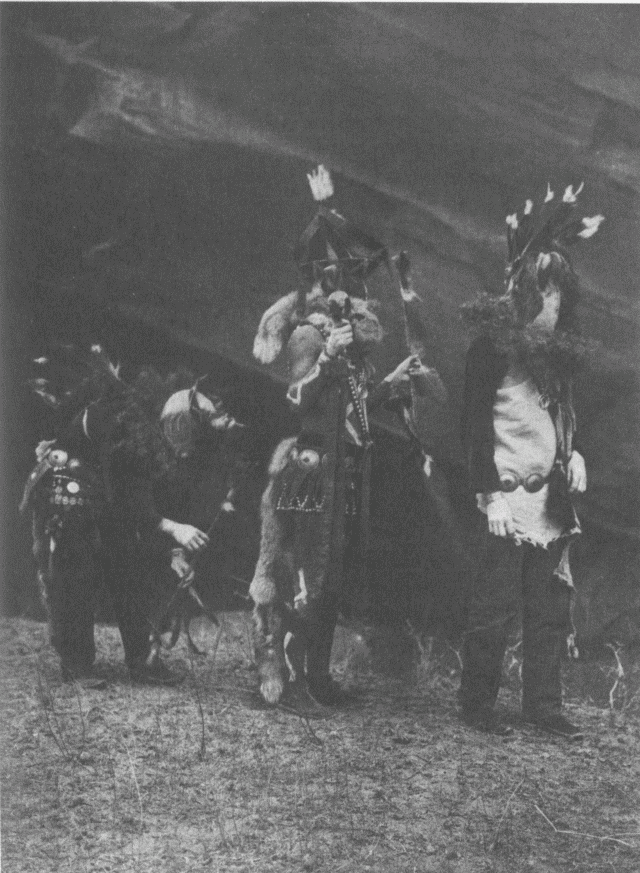
Curtis, God of Harvest, Fringe Mouth, and Talking God, 1907


HOUSE MADE OF DAWN
Navajo Night Chant

In Tse'gihi
In the house made of the dawn,
In the house made of the evening twilight,
In the house made of the dark cloud,
In the house made of the he-rain,
In the house made of the dark mist,
In the house made of the she-rain,
In the house made of pollen,
In the house made of grasshoppers,
Where the dark mist curtains the doorway,
The path to which is on the rainbow,
Where the zigzag lightning stands high on top,
Where the he-rain stands high on top,
Oh, male divinity!
With your moccasins of dark cloud, come to us.
With your leggings of dark cloud, come to us.
With your shirt of dark cloud, come to us.
With your head-dress of dark cloud, come to us.
With your mind enveloped in dark cloud, come to us.
With the dark thunder above you, come to us soaring.
With the shapen cloud at your feet, come to us soaring.
With the far darkness made of the dark cloud over your head, come to us soaring.
With the far darkness made of the he-rain over your head, come to us soaring..
With the far darkness made of the dark mist over your head, come to us soaring.
With the far darkness made of the she-rain over your head, come to us soaring.
With the zigzag lightning flung out on high over your head, come to us soaring.
With the rainbow hanging high over your head, come to us soaring.
With the far darkness made of the he-rain on the ends of your wings, come to us soaring.
With the far darkness made of the dark mist on the ends of your wings, come to us soaring.
With the far darkness made of the she-rain on the ends of your wings, come to us soaring.
With the zigzag lightning flung out on high on the ends of your wings, come to us soaring.
With the rainbow hanging high on the ends of your wings, come to us soaring.
With the near darkness made of the dark cloud, of the he-rain, of the dark mist and of the she-rain, come to us.
With the darkness of the earth, come to us.
With these I wish the foam floating on the flowing water over the roots of the great corn.
I have made your sacrifice.
I have prepared a smoke for you.
My feet restore for me.
My limbs restore for me.
My body restore for me.
Mt mind restore for me.
My voice restore for me.
Today, take out your spell for me.
Today, take away your spell for me.
Away from me you have taken it.
Far off from me, it is taken.
Far off you have done it.
Happily I recover.
Happily my interior becomes cool.
Happily my eyes regain their power.
Happily my head becomes cool.
Happily my limbs regain their power.
Happily I hear again.
Happily for me is taken off.
Happily I walk.
Impervious to pain, I walk.
Feeling light within, I walk.
With lively feelings, I walk.
Happily abundant dark clouds I desire.
Happily abundant dark mists I desire.
Happily abundant passing showers I desire.
Happily an abundance of vegetation I desire.
Happily an abundance of pollen I desire.
Happily abundant dew I desire.
Happily may fair white corn, to the ends of the earth, come with you.
Happily may fair yellow corn, to the ends of the earth, come with you.
Happily may fair blue corn, to the ends of the earth, come with you.
Happily may fair plants of all kinds, to the ends of the earth, come with you.
Happily may fair goods of all kinds, to the ends of the earth, come with you.
Happily may fair jewels of all kinds, to the ends of the earth, come with you.
With these before you, happily may they come with you.
With these behind you, happily may they come with you.
With these below you, happily may they come with you.
With these abovee you, happily may they come with you.
With these all around you, happily may they come with you.
Thus happily you accomplish your tasks.
Happily the old men will regard you.
Happily the old women will regard you.
Happily the young men will regard you.
Happily the young women will regard you.
Happily the boys will regard you.
Happily the girls will regard you.
Happily the children will regard you.
Happily the chiefs will regard you.
Happily, as they scatter in different directions, they will regard you.
Happily, as they approach their homes, they will regard you.
Happily may their roads back home be on the trail of pollen.
Happily may they all get back.
In beauty I walk.
With beauty before me, I walk.
With beauty behind me, I walk.
With beauty below me, I walk.
With beauty above me, I walk.
With beauty all around me, I walk.
It is finished in beauty,

It is finished in beauty.

Thank You, Jessica.

25 June 2016

Top-notch.


Nathaniel Philbrick gives a top-notch description of the Battle of Little Bighorn ... here.

Bighorn.

Russell, The Custer Fight, 1903


The Battle of Little Bighorn took place on this day in 1876.

American Experience: Custer's Last Stand ...

24 June 2016

Up.


TUTUWAS

 I know the names
 on this land
 have been changed,
 printed on maps
 made by those
 who claim their ownership.

 Some say nothing survives.

 But the wind
 still sings
 the same song
 of our breath.

 The hilltop trees
 still bend like dancers
 in ceremonies
 that never ended.

 And the little pines,
 tutuwas, tutuwas,
 lift up, protected
 from the weight of snow
 by the held-out arms
 of their elders.

Joseph Bruchac

16 June 2016

Happy birthday, Geronimo.


Geronimo is thought to have been born on this day in 1829.

The song that I will sing is an old song, so old that none knows who made it. It has been handed down through generations and was taught to me when I was but a little lad. It is now my own song. It belongs to me. This is a medicine-song and great is its power. The song tells how, as I sing, I go through the air to a holy place where Yusun will give me power to do wonderful things. I am surrounded by little clouds, and as I go through the air I change, becoming spirit only.

Geronimo

From the PBS series, We Shall Remain ...

15 June 2016

Lived.

Curtis, Lakota Camp, 1908


Lakota children were taught that true politeness was to be defined in actions rather than in words. They were never allowed to pass between the fire and the older person or a visitor, to speak while others were speaking, or to make fun of a crippled or disfigured person. If a child thoughtlessly tried to do so, a parent, in a quiet voice, immediately set him right.

Expressions such as "excuse me," "pardon me," and "so sorry" now so often lightly and unnecessarily used, are not in the Lakota language. If one chanced to injure or cause inconvenience to another wanunhecun, or "mistake," was spoken. This was sufficient to indicate that no discourtesy was intended and that what happened was accidental.

Our young people, raised under old rules of courtesy, never indulged in the present habit of talking incessantly and all at the same time. To do so would have been not only impolite, but foolish; for poise, so much admired as a social grace, could not be accompanied by restlessness. Pauses were acknowledged gracefully and did not cause lack of ease or embarrassment.

In talking to children, the old Lakota would place a hand on the ground and explain: "We sit in the lap of our Mother. From her we, and all other living things, come. We shall soon pass, but the place where we now rest will last forever." So we, too, learned to sit or lie on the ground and become conscious of life about us in its multitude of forms.

Sometimes we boys would sit motionless and watch the swallows, the tiny ants, or perhaps some small animal at its work and ponder its industry and ingenuity; or we lay on our backs and looked long at the sky, and when the stars came out made shapes from the various groups.

Everything was possessed of personality, only differing from us in form. Knowledge was inherent in all things. The world was a library and its books were the stones, leaves, grass, brooks, and the birds and animals that shared, alike with us, the storms and blessings of earth. We learned to do what only the student of nature learns, and that was to feel beauty. We never railed at the storms, the furious winds, and the biting frosts and snows. To do so intensified human futility, so whatever came we adjusted ourselves, by more effort and energy if necessary, but without complaint.

Even the lightning did us no harm, for whenever it came too close, mothers and grandmothers in every tipi put cedar leaves on the coals and their magic kept danger away. Bright days and dark days were both expressions of the Great Mystery, and the Indian reveled in being close to the Great Holiness.

Observation was certain to have its rewards. Interest, wonder, admiration grew, and the fact was appreciated that life was more than mere human manifestation; it was expressed in a multitude of forms.

This appreciation enriched Lakota existence. Life was vivid and pulsing; nothing was casual and commonplace. The Indian lived -- lived in every sense of the word -- from his first to his last breath.

Luther Standing Bear

04 June 2016

Wise.

Curtis, Crow Heart, 1908


Wherever forests have not been mowed down, wherever the animal is recessed in their quiet protection, wherever the earth is not bereft of four-footed life - that to the white man is an 'unbroken wilderness.'

But for us there was no wilderness, nature was not dangerous but hospitable, not forbidding but friendly. Our faith sought the harmony of man with his surroundings; the other sought the dominance of surroundings.

For us, the world was full of beauty; for the other, it was a place to be endured until he went to another world.

But we were wise. We knew that man's heart, away from nature, becomes hard.

Luther Standing Bear

19 May 2016

Superior.

Rinehart, Little Bear, 1899


American sculptors travel thousands of miles to study Greek Statues in the Vatican in Rome, seemingly unaware that in their own country there exists a race of men equal in form and grace (if not superior) to the finest beau ideal ever dreamed of by the Greeks.  And it does seem a little extraordinary that up to this time (as far as I am aware) not a single sculptor has thought it worth his while to make a journey among these Indians, who are now sojourning on the western side of the Rocky Mountains, and are rapidly passing away.  Most unquestionably, that sculptor who travels here, -- and models from what he sees (supposing him to have equal power and genius), will far excel any other who merely depends on his own conception of what it ought to be.

Alfred Jacob Miller, The West

10 May 2016

Transcontinental.


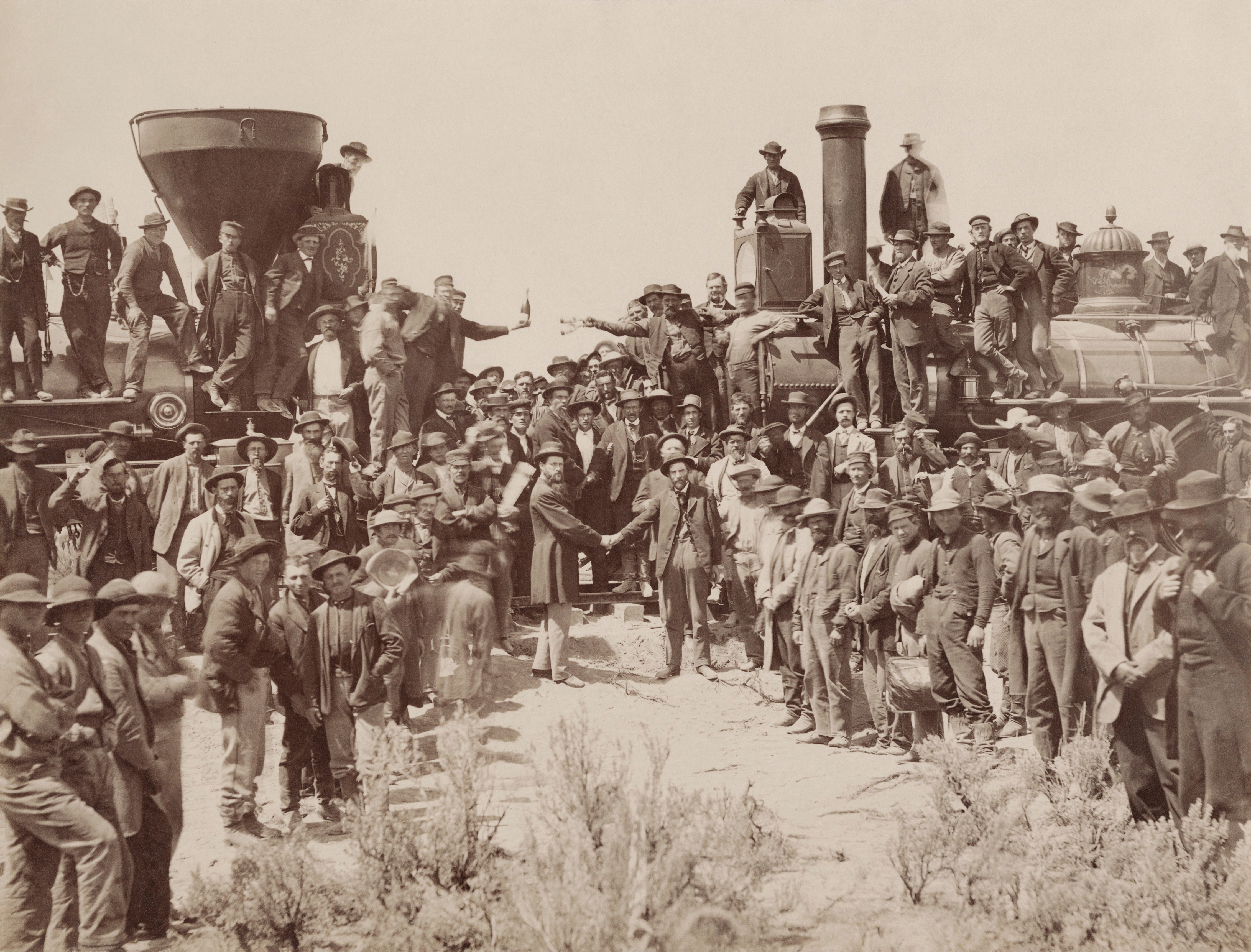
On this day in 1869 a golden spike was driven at Promontory, Utah, marking the completion of the first transcontinental railroad in the United States.

American Experience: The Transcontinental Railroad ...


02 May 2016

Longing.

Remington, Indians around Camp Fire, 1908


That night the secret societies held meetings, the Foxes, the Warclubs, the Big-dogs, the Muddy-hands, the Fighting-bulls, and others.  Bright fires blazed and crackled among the pines, and drums were going all night long.  I wished with all my heart that I might belong to one of these secret societies.  I thought most of the Foxes, and I looked with longing eyes at their firelit lodge, where men spoke of things I did not know.  But I was yet only a boy.

Colonel Richard Irving Dodge, Our Wild Indians: Thirty-Three Years Personal Experience

26 April 2016

Dignified.

Anderton, Three Bulls, Sitting on an Eagle Tail Feathers, Crowfoot,  and Red Crow at Fort Walsh, 1884


Joy was a word that belonged to the Indians.  Life was rich, and the Indians were only very stoical and sullen in the presence of whites during the war and reservation period.  They were really a happy, delightful people, so ready to laugh an amusing incident or a clever joke that they reminded the early white visitors of children at play.

In his manner and bearing, the Indian is habitually grave and dignified, and in the presence of strangers he is reserved and silent.

Richard Irving Dodge

21 April 2016

Spiraling.


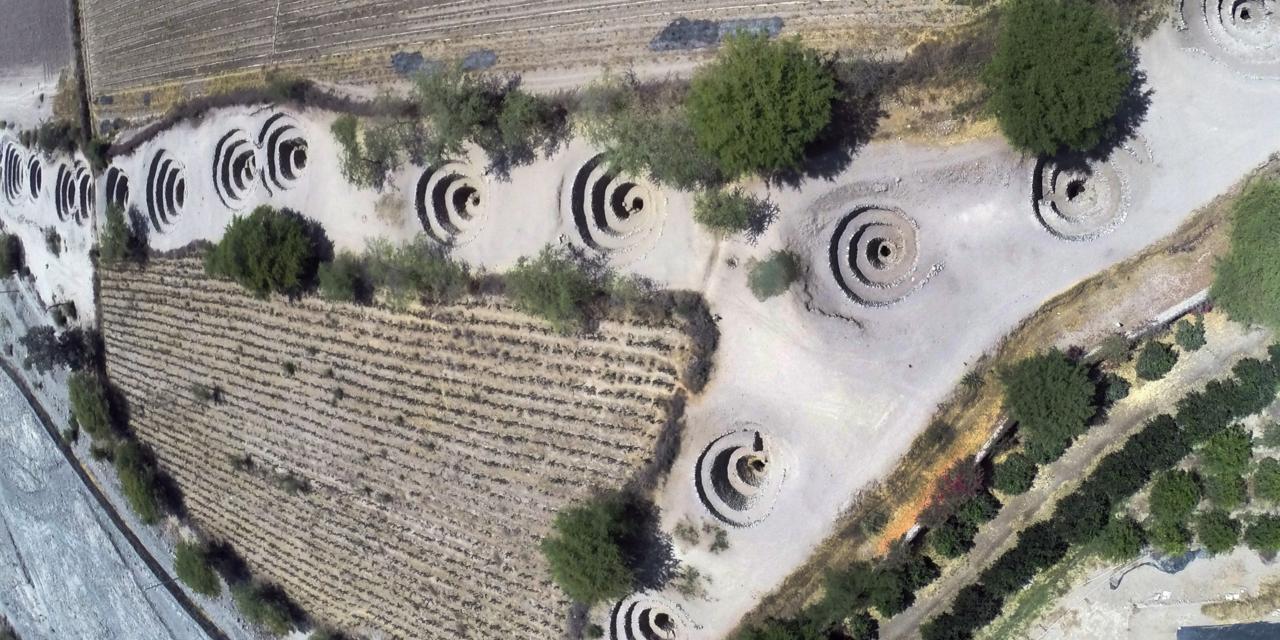
In one of the most arid regions in the world a series of carefully constructed, spiraling holes form lines across the landscape. Known as puquios, their origin has been a puzzle – one that could only be solved from space.

The holes are from the Nasca region of Peru – an area famous for the Nasca lines, several enormous geometric images carved into the landscape; immaculate archaeological evidence of ceremonial burials; and the rapid decline of this once flourishing society.

Remember.

Curtis, Crow War Party, 1908


"Yes," he smiled. "I shall always remember my first war-party.  I was asked to go by the man who was to carry the pipe, and I felt so proud I could scarcely keep the secret to myself.  I thought the day very long, and was relieved when at night we rode silently out of the village with our faces toward the east.  We wore only light shirts and leggings made from the skins of bighorns, and carried nothing except our bows and shields.  War-bonnets and bright colors were hidden away, because they can be seen easily, and no war-party wishes to be seen.  Bonnets were never used by warriors until all chance of surprise was gone.  Then they were brought out, if there was time.  Our bonnets were in rawhide cases and might not be used at all.  

We rode all night without seeing our Wolves.  Yet I know, of course, they were out ahead of us somewhere.  I kept looking at every knoll top until we hid away for the day.  Then they came in, looking exactly like wolves.

Colonel Richard Irving Dodge, Our Wild Indians: Thirty-Three Years Personal Experience

11 April 2016

Carried.

Curtis, Offering the Buffalo Skull, Mandan, 1908


Spoken stories were the living encyclopedias of our oral ancestors, dynamic and lyrical compendiums of practical knowledge. Oral tales told on special occasions carried the secrets of how to orient in the local cosmos. Hidden in the magic adventures of their characters were precise instructions for the hunting of various animals, and for enacting the appropriate rituals of respect and gratitude if the hunt was successful, as well as specific insights regarding which plants were good to eat and which were poisonous, and how to prepare certain herbs to heal cramps, or sleeplessness, or a fever. The stories carried instructions about how to construct a winter shelter, and what to do during a drought, and -- more generally -- how to live well in this land without destroying the land's wild vitality.

Such practical intelligence, intimately related to a particular place, is the hallmark of any oral culture. Continually tested in interaction with the living land, altering in tandem with subtle changes in the local earth, even today such living knowledge resists the fixity and permanence of the printed page. Because it is specific to the way things happen here, in this high desert -- or coastal estuary, or mountain valley -- this kind of intimate intelligence loses its meaning when abstracted from its terrain, and from the particular persons and practices that are a part of its terrain. Such place-specific savvy, which deepens its value when honed and tempered over the course of several generations, forfeits much of its power when uprooted from the soil of its home and carried -- via the printed page or the glowing screen – to other places. Such intelligence, properly speaking, is an attribute of the living land itself; it thrives only in the direct, face-to-face exchange between those who dwell and work in this place.

So much earthly savvy was carried in the old tales! And since, for our indigenous ancestors, there was no written medium in which to record and preserve the stories -- since there were no written books -- the surrounding landscape, itself, functioned as the primary mnemonic, or memory trigger, for preserving the oral tales. To this end, diverse animals common to the local earth figured as prominent characters within the oral stories -- whether as teachers or tricksters, as buffoons or as bearers of wisdom. Hence, a chance encounter with a particular creature as a tribesperson went about his daily business (an encounter with a coyote, perhaps, or a magpie) would likely stir the memory of one or another story in which that animal played a decisive role. Moreover, crucial events in the stories were commonly associated with particular sites in the local terrain where those events were assumed to have happened, and whenever one noticed that place in the course of one’s daily wanderings -- when one came upon that particular cluster of boulders, or that sharp bend in the river -- the encounter would spark the memory of the storied events that had unfolded there.

Thus, while the accumulated knowledge of our oral ancestors was carried in stories, the stories themselves were carried by the surrounding earth. The local landscape was alive with stories! Traveling through the terrain, one felt teachings and secrets sprouting from every nook and knoll, lurking under the rocks and waiting to swoop down from the trees. The wooden planks of one's old house would laugh and whine, now and then, when the wind leaned hard against them, and whispered wishes would pour from the windswept grasses. To the members of a traditionally oral culture, all things had the power of speech …

David Abram

Kris Kristofferson, "Johnny Lobo"