06 April 2016
Found.
Wyeth, Cosmos, 1994
Tea at the Palaz of Hoon
Not less because in purple I descended
The western day through what you called
The loneliest air, not less was I myself.
What was the ointment sprinkled on my beard?
What were the hymns that buzzed beside my ears?
What was the sea whose tide swept through me there?
Out of my mind the golden ointment rained,
And my ears made the blowing hymns they heard.
I was myself the compass of that sea:
I was the world in which I walked, and what I saw
Or heard or felt came not but from myself;
And there I found myself more truly and more strange.
Wallace Stevens
Labels:
appreciation,
art,
poetry,
poetry rules!,
Stevens,
Wyeth
Buffett.
Paris was like the Pleiades, it was out there ... and I didn't know how I was going to get there, but I did.
Jimmy Buffett speaks with The American Library in Paris' Programs Manager Grant Rosenberg about his life and career ...
One.
O'Keeffe, Blue Hills, No. III, 1916
The inner life has its soft and gentle beauty; an abstract formlessness as well as a subtle charm. I often consider myself as a figure in a foggy painting: faltering lines, insecure distances, and a merging of greys and blacks. An emotion or a mood—a mere wisp of color—is shaded off and made to spread until it becomes one with all that surrounds it.
Virginia Woolf
Memory.
How does memory function? What is history? How do
contemporary artists frame the past in their work?
From the PBS series Art 21 ...
Thank you, Jennilyn.
Peripheral.
Wyeth, Shed Lantern, 1954
Spirit Birds
The spirit world the negative of this one, soft outlines of
soft whites against soft darks, someone crossing Broadway at Cathedral, walking
toward the god taking the picture, but now, inside the camera, suddenly still.
Or the spirit world the detail through the window, manifest if stared at long
enough, the shapes of this or that, the lights left on, the lights turned off,
the spirits under arcs of sycamores the gray-gold mists of migratory birds and
spotted leaves recognize.
Autumnal evening chill, knife-edges of the avenues, wind
kicking up newspaper off the street, those ghost peripheral moments you catch
yourself beside yourself going down a stair or through a door—the spirit world
surprising: those birds, for instance, bursting from the trees and turning into
shadow, then nothing, like spirit birds called back to life from memory or a
book, those shadows in my hands I held, surprised. I found them interspersed
among the posthumous pages
of a friend, some hundreds of saved poems: dun sparrows and
a few lyrical wrens in photocopied profile perched in air, focused on an
abstract abrupt edge. Blurred, their natural color bled, they’d passed from one
world to another: the poems, too, sung in the twilit middle of the night,
loved, half-typed, half-written-over, flawed, images of images. He’d kept them to forget them. And every twenty
pages, in xerox ash-and-frost, Gray Eastern, Gold Western, ranging across borders.
Stanley Plumly
Labels:
appreciation,
art,
Plumly,
poetry,
poetry rules!,
Wyeth
Anticipate.
According to Wayne Potts, a zoologist who published in the
journal Nature in 1984, birds in flocks are able to change direction quickly
not just because they are following a leader, or their neighbors, but
because they see a movement far down the line and anticipate what to do next.
CONNECT
Jimmy Buffett, "Death of an Unpopular Poet"
He left all of his royalties
To Spooner, his ol' hound
Growin' old on steak and bacon
In a doghouse ten feet 'round
And everybody wonders
Did he really lose his mind
No he was just a poet who lived before his time
He was just a poet who lived before his time
To Spooner, his ol' hound
Growin' old on steak and bacon
In a doghouse ten feet 'round
And everybody wonders
Did he really lose his mind
No he was just a poet who lived before his time
He was just a poet who lived before his time
Flying.
Conjugation
I want to walk
with you through parks,
for your laugh & blue sea
for the boats.
For red moon,
black dress,
wide widow.
Omonia Square,
tambourines.
For buses
& the sellers
of peacock feathers
& for the rain.
I did not think
I would see Greece
again. But I do
see. & hear the gypsies
playing clarinets
& violins.
& hear gypsies
dancing in the streets.
Tonight,
I will write poems
in a cold house
with an open oven.
I will think of Crete,
its wild oregano
& trees punctuated
by apostrophes of figs.
Every thing
will be magic.
The night will be black
& the stars will fall.
The moon will be a lantern
in the blackness.
You will be
a fisherman
or a net.
& I will be
a herd, of birds,
that body in the sky, there,
flying.
Aracelis Girmay
Aracelis Girmay
Learning.
New Moon
How much it must bear on its back,
a great ball of blue shadow,
yet somehow it shines, keeps up
an appearance. For hours tonight,
I walk beneath it, learning.
I want to be better at carrying sorrow.
If my face is a mask, formed over
the shadows that fill me,
may I smile on the world like the moon.
Ted Kooser
True.
Cézanne, The Roofs of Paris, 1882
But sometimes when I was starting a new story and I could
not get it going, I would sit in front of the fire and squeeze the peel of the
little oranges into the edge of the flame and watch the sputter of blue that
they made. I would stand and look out over the roofs of Paris and think, 'Do
not worry. You have always written before and you will write now. All you have
to do is write one true sentence. Write the truest sentence that you know.' So
finally I would write one true sentence, and then go on from there.
Ernest Hemingway, from A Moveable Feast
Away.
Has it never happened to you to lose yourself for a moment
in a swift and satisfying experience for which you found no name? When the
world took on a strangeness, and you rushed out to meet it, in a mood at once
exultant and ashamed? Was there not an instant when you took the lady who now
orders your dinner into your arms, and she suddenly interpreted to you the
whole of the universe? a universe so great, charged with so terrible an
intensity, that you have hardly dared to think of it since. Do you remember
that horrid moment at the concert, when you became wholly unaware of your
comfortable seven-and-sixpenny seat? Those were onsets of involuntary
contemplation; sudden partings of the conceptual veil. Dare you call them the
least significant moments of your life?
Almost without thinking, we jump to rationalize these
moments or ignore them entirely. We turn them into feelings and dismiss them.
The most difficult task is to see these moments for what they are — glimpses of
Reality. To see Reality, you have to be directed away from the rickety,
temporal self to the unchanging world of the Whole. The task will be a
difficult one. Each moment of attention toward Reality will be met by boredom
and restlessness. You will be attacked by your own incapacity.
CONNECT
CONNECT
Welcomed.
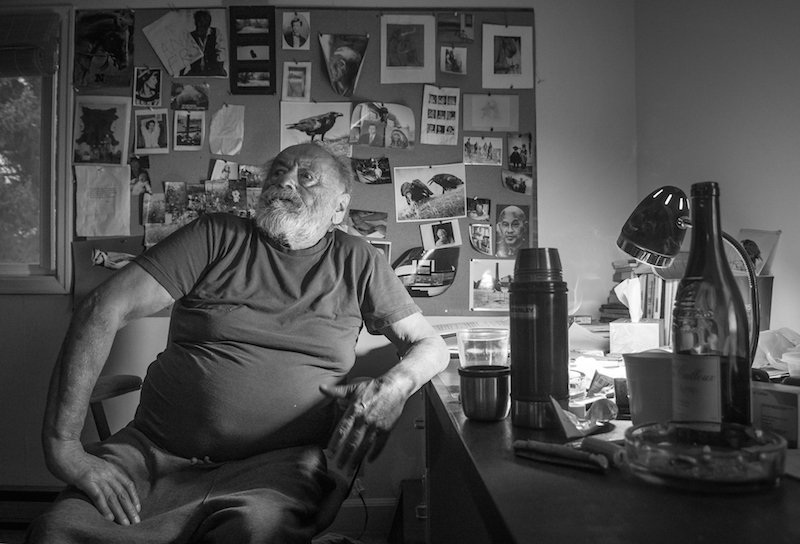
Jim welcomed us into his writing studio where he sat at his
writing desk. He was shirtless and wore grey fleece shorts. Brown hiking boots
dangled from his feet.
Smoke rose from his ashtray where a cigarette had been
recently stubbed out. A crushed empty box of smokes lay next to a full one.
Books lined the back of his desk and yellow legal pads, full of scrawling, sat
in front of him.
Duke Ellington’s voice crackled from the vintage radio on a
bookshelf next to bear claws, masks, animal skulls, and war clubs. A dried and
wrinkled rattlesnake hung from a tack above the window. Pinned to a bulletin
board behind his desk were Buddhist maxims, family photos, and a photo of a
raven and a vulture sharing a carcass.
Only.
“28,000 Things Only People Who Are LARGE and
Contain MULTITUDES Will Understand”
by Walt Whitman
by Walt Whitman
Happy birthday, Raphael.
Raphael, Portrait of a Cardinal, 1511
Raffaello Sanzio da Urbino was born on this day in 1483.
The liberality with which Heaven now and again unites in one person the inexhaustible riches of its treasures and all those graces and rare gifts which are usually shared among many over a long period is seen in Raphael Sanzio of Urbino, who was as excellent as gracious, and endowed with a natural modesty and goodness sometimes seen in those who possess to an unusual degree a humane and gentle nature adorned with affability and good-fellowship, and he always showed himself sweet and pleasant with persons of every degree and in all circumstances. Thus Nature created Michelangelo Buonarroti to excel and conquer in art, but Raphael to excel in art and in manners also. Most artists have hitherto displayed something of folly and savagery, which, in addition to rendering them eccentric and fantastical, has also displayed itself in the darkness of vice and not in the splendor of those virtues which render men immortal. In Raphael, on the other hand, the rarest gifts were combined with such grace, diligence, beauty, modesty and good character that they would have sufficed to cover the ugliest vice and the worst blemishes. We may indeed say that those who possess such gifts as Raphael are not mere men, but rather mortal gods, and that those who by their works leave an honored name among us on the roll of fame may hope to receive a fitting reward in heaven for their labors and their merits.
Giorgio Vasari, from The Lives of Artists
The BBC's A Mortal God ...The liberality with which Heaven now and again unites in one person the inexhaustible riches of its treasures and all those graces and rare gifts which are usually shared among many over a long period is seen in Raphael Sanzio of Urbino, who was as excellent as gracious, and endowed with a natural modesty and goodness sometimes seen in those who possess to an unusual degree a humane and gentle nature adorned with affability and good-fellowship, and he always showed himself sweet and pleasant with persons of every degree and in all circumstances. Thus Nature created Michelangelo Buonarroti to excel and conquer in art, but Raphael to excel in art and in manners also. Most artists have hitherto displayed something of folly and savagery, which, in addition to rendering them eccentric and fantastical, has also displayed itself in the darkness of vice and not in the splendor of those virtues which render men immortal. In Raphael, on the other hand, the rarest gifts were combined with such grace, diligence, beauty, modesty and good character that they would have sufficed to cover the ugliest vice and the worst blemishes. We may indeed say that those who possess such gifts as Raphael are not mere men, but rather mortal gods, and that those who by their works leave an honored name among us on the roll of fame may hope to receive a fitting reward in heaven for their labors and their merits.
Giorgio Vasari, from The Lives of Artists
Fully.
I did not want to live out my life in the strenuous effort
to hold a ghost world together. It was plain as the stars that time herself
moved in grand tidal sweeps rather than the tick-tocks we suffocate within, and
that I must reshape myself to fully inhabit the earth rather than dawdle in the
sump of my foibles.
Jim Harrison
05 April 2016
Monteverdi, Vespro della Beata Vergine
The Baroque Orchestra of the Latvian Music Academy performs ...
Everything.
I couldn’t read one of those poems without remembering our
conversations or a piece we’d worked on or a walk or a meal or a bottle of
wine. Sometimes the details were too real, and I’d think there was poetry in
everything Jim touched. In a last e-mail, he wrote he had learned you can
walk between the valves of a blue whale’s seven ton heart. Nobody like him.
Read his poetry. Read everything.
Dr. Joe Medicine Crow, R.I.P.
Born October 27, 1913 near Lodge Grass, Montana, Dr. Joseph Medicine Crow is the last living person with a direct oral history from a participant of the Battle of Little Bighorn in 1876. His grandfather, White Man Runs Him was a scout with General Custer and died in 1925 when Medicine Crow was 11 years old.
Study.
Bridge
Most of my life was spent
building a bridge out over the sea
but the sea was too wide and it didn't
go anyplace. I'm proud of the bridge
hanging in the pure sea air. Machado
came for a visit and we sat on the
end of the bridge which was his idea.
Now that I'm old the work goes slowly
but the material keeps coming as I hang
here in the air. Ever nearer death I like
it out here high above the sea bundled
up for the arctic storms of late fall,
the resounding crash and moan of the sea,
the hundred foot depth of the green troughs.
Sometimes the sea roars and howls like
the animal it is, a continent wide and alive.
What beauty in this the darkest music
which imitates the sky's thunder
over which you can hear the lightest music of human
behavior, the tender connection between men and galaxies.
So I sit on the edge, wagging my feet above
the abyss, the fatal plummet. Tonight the moon
will be in my lap. This is my job, to study
the universe from my bridge. I have the sky, the sea,
the faint green streak of Canadian forest on the far shore.
Jim Harrison
04 April 2016
03 April 2016
Happy birthday, Irving.
Washington Irving was born on this day in 1783.
There are certain half-dreaming moods of mind in which we
naturally steal away from noise and glare, and seek some quiet haunt where we
may indulge our reveries and build our air castles undisturbed. In such a mood
I was loitering about the old gray cloisters of Westminster Abbey, enjoying
that luxury of wandering thought which one is apt to dignify with the name of
reflection, when suddenly an irruption of madcap boys from Westminster school,
playing at football, broke in upon the monastic stillness of the place, making
the vaulted passages and mouldering tombs echo with their merriment. I sought
to take refuge from their noise by penetrating still deeper into the solitudes
of the pile, and applied to one of the vergers for admission to the library. He
conducted me through a portal rich with the crumbling sculpture of former ages,
which opened upon a gloomy passage leading to the chapter-house and the chamber
in which Doomsday Book is deposited. Just within the passage is a small door on
the left. To this the verger applied a key; it was double locked, and opened
with some difficulty, as if seldom used. We now ascended a dark narrow
staircase, and, passing through a second door, entered the library.
I found myself in a lofty antique hall, the roof supported by
massive joists of old English oak. It was soberly lighted by a row of Gothic
windows at a considerable height from the floor, and which apparently opened
upon the roofs of the cloisters. An ancient picture of some reverend dignitary
of the Church in his robes hung over the fireplace. Around the hall and in a
small gallery were the books, arranged in carved oaken cases. They consisted
principally of old polemical writers, and were much more worn by time than use.
In the centre of the library was a solitary table with two or three books on
it, an inkstand without ink, and a few pens parched by long disuse. The place
seemed fitted for quiet study and profound meditation. It was buried deep among
the massive walls of the abbey and shut up from the tumult of the world. I
could only hear now and then the shouts of the school-boys faintly swelling
from the cloisters, and the sound of a bell tolling for prayers echoing soberly
along the roofs of the abbey. By degrees the shouts of merriment grew fainter
and fainter, and at length died away; the bell ceased to toll, and a profound
silence reigned through the dusky hall.
I had taken down a little thick quarto, curiously bound in
parchment, with brass clasps, and seated myself at the table in a venerable
elbow-chair. Instead of reading, however, I was beguiled by the solemn monastic
air and lifeless quiet of the place, into a train of musing. As I looked around
upon the old volumes in their mouldering covers, thus ranged on the shelves and
apparently never disturbed in their repose, I could not but consider the
library a kind of literary catacomb, where authors, like mummies, are piously
entombed and left to blacken and moulder in dusty oblivion.
How much, thought I, has each of these volumes, now thrust
aside with such indifference, cost some aching head! how many weary days! how
many sleepless nights! How have their authors buried themselves in the solitude
of cells and cloisters, shut themselves up from the face of man, and the still
more blessed face of Nature; and devoted themselves to painful research and
intense reflection! And all for what? To occupy an inch of dusty shelf—to have
the titles of their works read now and then in a future age by some drowsy
churchman or casual straggler like myself, and in another age to be lost even
to remembrance. Such is the amount of this boasted immortality. A mere
temporary rumor, a local sound; like the tone of that bell which has tolled
among these towers, filling the ear for a moment, lingering transiently in
echo, and then passing away, like a thing that was not!
Washington Irving, "The Mutability of Literature: A Colloquy in Westminster Abbey," from Geoffrey Crayon's Sketchbook
02 April 2016
Charpentier, Stabat Mater pour des religieuses, H. 15
Jordi Savall performs with Les Concert des Nations ...
Alive.
His canon is as diverse as it is prodigious: 14 books of
poetry, 11 novels, 9 novellas, 3 non-fiction works and one children's book. But
his poetry is what he wishes to be remembered for. "We are suppose to
write poetry to keep the gods alive," says Harrison.
Advice.
Labels:
appreciation,
drinking,
Harrison,
heroes,
nature
Hermano.
Mi Hermano: Jim Harrison and the end of the road
I knew a lot about Jim Harrison before we ever met. He was many things to many different people. But to put it in Michigan terminology, the chassis on which the sum of all his parts rode was the undeniable fact that he was a force of nature. No, he could not shift tectonic plates or cause tidal waves. But he came pretty damn close.
We met at the end of the road, like so many other nomads who came looking for beginnings or endings, in Key West in 1972. I was a reject from Nashville and he was a published poet from Michigan, which put us just about at equal points on the road to success.
Thomas McGuane, my landlord in those days, not my brother-in-law, introduced us. He and Harrison had been best friends since college. Tom knew, with his gin-clear perception of the world, that we would get along. Tom watches the world, after all, like an osprey on the prowl above the shallow flats of our adopted home of Key West.
After seeing my “Bar singer goes wild on the rebound”
routine for a few nights up and down Duval Street, Tom would repeat to me in
numerous dinner conversations and bar stool banter, “Wait till you meet
Harrison.”
Many generations of misfits have claimed Key West as their
town, but I would have to argue that, in the early 70s, it truly was our
town.
Jim did not live in Key West back then, but visited on a regular basis, which, of course, was in the spring when the tarpon were running. Finding, hooking, fighting and releasing a 100-pound fish requires a certain skill set and a lot of time on the water. You couldn’t go to the gym to learn how. And to the best of my recollection, nobody I knew in Key West in those days ever came close to a gym -- least of all Harrison. We went to the flats not to slay fish, but to play with them in their own backyard.
When I got word from Guy de la Valdene this morning that Jim had died at his desk while he was writing, I was, of course, sad he was gone but glad he went that way. As Tom put it in a piece he did for The New Yorker, “He was active and creative til the end, but but it was time to go. No one was less suited for assisted living.” Of course the flashbacks fired up, painting fragments of so many good times and great adventures.
Like the fantasy of us trying to act like we were filmmakers, yet actually producing a documentary called “Tarpon,” which is now a classic among fly fishermen and women. Like the early Livingston days, when Jane and Roxy and I drove across country to spend a summer at the Raw Deal Ranch outside Livingston, and Hollywood this time came calling in the form of “Rancho DeLuxe.” And the West was never the same -- at least, Livingston wasn’t. Like the Brautigan period when Richard lived at the Pine Creek cabins next door to Jim, long before they both owned property in Paradise Valley. They would share a bottle and a stove where Harrison once cooked a venison ragout on one burner, while Brautigan boiled his boots in beef broth in a pot on the other burner. (I opted for the stew.) Like the road trip down A1A in a two-seater 1968 MGB with a film crew from a PBS station in Miami following and trying to keep up.
Like the Paris days when we lived like kings in a real castle, with little money, but possessing a big bag of Columbian gold and the key to the wine cellar. Why, you might ask, would sane people allow us to do this? Because they were as crazy as we were and because it was our job. For the price of a plane ticket to Paris, (room and board included), Jim did the narration and I wrote the music for “Tarpon.”
Like New York rendezvous at Elaine's and JP’s that rarely ever ended before the sun was up. Like Michigan summers when I was playing in Detroit and would escape to his house between gigs up in Lake Leelanau. Like the unforgettable drive across country, just the two of us, in his Ford Cortina, taking turns at the wheel as we crossed the heartland from Montana back to Michigan and sharing our vision of America to each other and the cows we passed along the way.
I have been lucky enough to sing my way across America countless times -- first hitchhiking, then in a car, tour bus and multiple airplanes. But my two most inspiring trips were in an airplane with Walter Cronkite and in that goddamn Ford Cortina of Harrison’s.
It was no secret that he loved his success in Hollywood. He loved hanging with stars and starlets and he made enough money in the process to fix up his barn and rent a winter home in Palm Beach, where he would do his “laps” walking the short distance across a long lap pool, with a drink in one hand and a cigarette in the other.
He spent more time in Key West and eventually found his nesting places in Montana and Arizona. He seemed happy in that world but we were all still terrified at his refusal to quit smoking and cut down on his drinking. But that was his choice, and he always knew the consequences. It was his life.
He lived longer than I ever expected him to, so I will take that as a gift. His words will always be with me, like that goofy one-eyed stare that reminded me of Long John Silver. There are plenty of video clips of him in action that I am sure are making their way to YouTube at this very moment. If you get a chance, check some out.
We artists seem to be rediscovered a lot after we leave the planet and that is good for Jim’s kids and grandchildren. They will be provided for, thanks to his amazing work ethic. And more people will know of his work and his view of the world, which was as unique as he was.
After I hung up the phone with Guy yesterday, still trying to come to grips with it, I did what always seems to work for me. I went to the beach and jumped in the water, remembering more things about the days that we had shared together. The water was warm, and there was stiff breeze out of the Southwest and a little rip tide running along the beach. I got my bearings and headed to Southeast, humming a song as I swam. Barely audible at first but as the waves got higher and the current stronger, I had turned my humming up to “11.” I checked my bearings again to my beach reference point, and figured I had made a good couple of hundred yards to weather. I stopped swimming and just floated back down stream with the current and wind behind me now, smiling and crying and singing the chorus to one of Jim’s and my favorite songs, that I had chimed in on two nights previous in Havana with a half-a-million Cuban kids, when the Rolling Stones let the genie out of the Cuban bottle. The words seem to fit the moment, both for the opening of Cuba and the passing of Jim Harrison.
“No, you can’t always get what you wantBut if you try sometime, You just may findYou get what you need.”
Jim got what he needed and gave us a whole lot more. Adiòs mi hermano.
Jimmy Buffett
27 March 2016
Palm Beach, Florida
Remembering.
Remembering Jim Harrison ...
Tom McGuane.
Phil Caputo.
Doug Peacock.
Jimmy Buffett.
Mario Batali.
Marshall Cutchin.
Now.
Barking
The moon comes up.
The moon goes down.
This is to inform you
that I didn’t die young.
Age swept past me
but I caught up.
Spring has begun here and each day
brings new birds up from Mexico.
Yesterday I got a call from the outside
world but I said no in thunder.
I was a dog on a short chain

and now there’s no chain.
Jim Harrison
Subscribe to:
Posts (Atom)