"I am not one who was born in the custody of wisdom. I am one who is fond of olden times and intense in quest of the sacred knowing of the ancients." Gustave Courbet
Showing posts with label interviews. Show all posts

25 February 2024

Hanson.

From his Office Hours series, Victor David Hanson discusses Themistocles' leadership ..
We at the public school of public policy are trying to give people degrees and training, but that does not mean that they have to be quiet and invisible bureaucrats. So what we're trying to do is inculcate the ability, whether it's in themselves or maybe more often they have in others, to spot Mavericks.  If you look at the cursus honorum or the dossier of Jeff Bezos or Warren Buffett or especially Elon Musk, they don't fit the right the right steps to power and yet they're three of the richest most most successful men in the world because they're mavericks, they're eccentrics, they have ideas that go against consensus.  If you can train people who will more likely be in positions in the corporate boardroom or in government to encounter those people rather than to be those people, although some will be those people, then you want to make them open for the uncharacteristic or the maverick and not to be prejudicial just because because their resumés are not what most people would like.  I think that's very important and there does seem to be in these cases a connection with enormously capable minds, instinctive brilliance, common sense, all the the aspects of leadership that in some ways are antithetical to getting along with people or to being approved.

18 May 2021

Excellent.

An excellent book ...


Russ King discusses the subject of his latest book, the 15th century Florentine merchant, craftsman, and intellectual, Vespasiano da Bisticci, who is often referred to as “the king of the world’s booksellers.” ...

08 July 2017

Learning.


I am learning the difficult terrain of the heart of darkness. No maps are available. Light never enters here. The brain is helpless.

Jim Harrison

29 March 2017

Tribute.

Listen carefully ... The Grand Library's tribute to Harrison ....

06 March 2017

Nice.

O'Keeffe, Untitled (Blue Abstractions), 1973


I have lived up there at the end of the world by myself a long time. You walk around with your thing out in the field and nobody cares. It's nice.

Georgia O'Keeffe, interviewed by Andy Warhol

01 March 2017

Experience.


The average person asks, “How do you know what you are doing?” Well, you don’t know what you are doing—that’s the whole point. You do and you don’t. Creating is an experience. It is not a given that step one will be followed by two, three, four, five, six, then you’re done. You have no idea the order. You may repeat steps, you may not have any sequence.

Russell Chatham 

CONNECT

31 January 2017

Incuriosity.


INTERVIEWER
You are one of the world’s most famous public intellectuals. How would you define the term intellectual? Does it still have a particular meaning? 

ECO
If by intellectual you mean somebody who works only with his head and not with his hands, then the bank clerk is an intellectual and Michelangelo is not. And today, with a computer, everybody is an intellectual. So I don’t think it has anything to do with someone’s profession or with someone’s social class. According to me, an intellectual is anyone who is creatively producing new knowledge. A peasant who understands that a new kind of graft can produce a new species of apples has at that moment produced an intellectual activity. Whereas the professor of philosophy who all his life repeats the same lecture on Heidegger doesn’t amount to an intellectual. Critical creativity—criticizing what we are doing or inventing better ways of doing it—is the only mark of the intellectual function.

INTERVIEWER
Are intellectuals today still committed to the notion of political duty, as they were in the days of Sartre and Foucault?

ECO
I don’t believe that in order to be politically committed an intellectual must act as a member of a party or, worse, write exclusively about contemporary social problems. Intellectuals should be as politically engaged as any other citizen. At most, an intellectual can use his reputation to support a given cause. If there is a manifesto on the environmental question, for instance, my signature might help, so I would use my reputation for a single instance of common engagement. The problem is that the intellectual is truly useful only as far as the future is concerned, not the present. If you are in a theater and there is a fire, a poet must not climb up on a seat and recite a poem. He has to call the fireman like everyone else. The function of the intellectual is to say beforehand, Pay attention to that theater because it’s old and dangerous! So his word can have the prophetic function of an appeal. The intellectual’s function is to say, We should do that, not, We must do this now!—that’s the politician’s job. If the utopia of Thomas More were ever realized, I have little doubt it would be a Stalinist society.

INTERVIEWER
What benefits have knowledge and culture afforded you in your lifetime?

ECO
An illiterate person who dies, let us say at my age, has lived one life, whereas I have lived the lives of Napoleon, Caesar, d’Artagnan. So I always encourage young people to read books, because it’s an ideal way to develop a great memory and a ravenous multiple personality. And then at the end of your life you have lived countless lives, which is a fabulous privilege.

INTERVIEWER
But an enormous memory can also be an enormous burden. Like the memory of Funes, one of your favorite Borges characters, in the story “Funes the Memorious.”

ECO
I like the notion of stubborn incuriosity. To cultivate a stubborn incuriosity, you have to limit yourself to certain areas of knowledge. You cannot be totally greedy. You have to oblige yourself not to learn everything. Or else you will learn nothing. Culture in this sense is about knowing how to forget. Otherwise, one indeed becomes like Funes, who remembers all the leaves of the tree he saw thirty years ago. Discriminating what you want to learn and remember is critical from a cognitive standpoint.

05 November 2016

Ready.


A poet always has to be ready for the bread that comes fresh from the oven. Isn’t that an interesting statement? St. Augustine said a remarkable thing: The reward of patience is patience. Which is true. I’ve thought — I don’t know if you’d agree — what writers need above all else is humility. Because pretty much nothing that they do can make them more successful. It’s such a crapshoot. Humility works. 

Two parts of an amazing interview with Harrison begin HERE.

16 October 2016

Sturdy.


I didn’t want it to end, but it was time. Harrison said Linda had dinner going on the stove. Beer unfinished, he made his way slowly out of the bar and I thought of the many paths in his life, which is so tied to Michigan, and which in a reliably sturdy fashion has yielded so much poetry and prose to the delight of so many. I was teetering on the brink of irreconcilable homesickness when I started reading him years ago. This night, on his way out of the Wagon Wheel, Harrison himself teetered, leaning heavily on his cane. I wondered how this man, so vibrant on the page, got so damn old and frail? In my time with him, I kept thinking of lyrics from Guy Clark’s song Desperados Waiting for a Train:
“To me he’s one of the heroes of this country;
 So why’s he all dressed up like them old men?”
Harrison, unsurprisingly, has answered the unasked question with a line of his own poetry.

“‘Our bodies are beautiful women never meant to be faithful to us,’” he said with a mischievous twinkle in his eye, moments before our goodbye.

Should I have told him what his writing meant to me? In the end, I simply paid for our drinks, something Harrison never lets guests do, the waitress informed me.

“I’m glad you didn’t turn out to be a [unprintable],” he said as we left.

30 June 2016

More-than-you.


INTERVIEWER:  Is the important thing that ogham was preclassical?

ROBERT GRAVES:  That's right. Before Plato. Before the Greeks went wrong. You know, the Jews had a saying—“of the ten measures of folly the Greeks have nine.” They were all right until about the sixth century B.C. By the time of Alexander the Great they'd gone to pieces altogether.

INTERVIEWER: In what way?

GRAVES:  They tried to decry myth. They tried to put in its place what we would now call scientific concepts. They tried to give it a literal explanation. Socrates jokes about myths, and Horace makes fun of them. When put to it, Socrates could clarify a myth in a way that deprived it of all sense. They simply had no use for poetic thought. Logic works at a very high level in consciousness. The academic never goes to sleep logically, he always stays awake. By doing so, he deprives himself of sleep. And he misses the whole thing, you see. Sleep has seven levels, topmost of which is the poetic trance—in it you still have access to conscious thought while keeping in touch with dream . . . with the topmost fragments of dream . . . you own memory . . . pictorial imagery as children know it and as it was known to primitive man. No poem is worth anything unless it starts from a poetic trance, out of which you can be wakened by interruption as from a dream. In fact, it is the same thing.

INTERVIEWER:  But where does this itself come from?

GRAVES:  From yourself, under the direction of the more-than-you formed by your relation with the person with whom you are in rapport at the time. If anybody were really observant, he'd be able to take a poem and draw a picture of the person it was addressed to.

27 May 2016

Harrison.

If you can get through the jabbering, somewhere in here there's an interview Jim Harrison did with French TV in 2015.


Ah, the discovery of subtitles (don't miss the advice at 13:46) ...


26 April 2016

Neither.


Interviewer: Can you walk us through an average day in your life?

Most Interesting Man in the World:  I have neither the time nor the proper waivers and legal representation.

17 April 2016

Happy birthday, Msabu.


Baroness Karen von Blixen-Finecke, Isak Dinesen, was born on this day in 1885.

“Who then,” she continues, “tells a finer tale than any of us? Silence does. And where does one read a deeper tale than upon the most perfectly printed page of the most precious book? Upon the blank page. When a royal, and gallant pen, in the moment of its highest inspiration, has written down its tale with the rarest ink of all—where, then, may one read a still deeper, sweeter, merrier, and more cruel tale than that? Upon the blank page.

CONNECT

11 April 2016

06 April 2016

Welcomed.


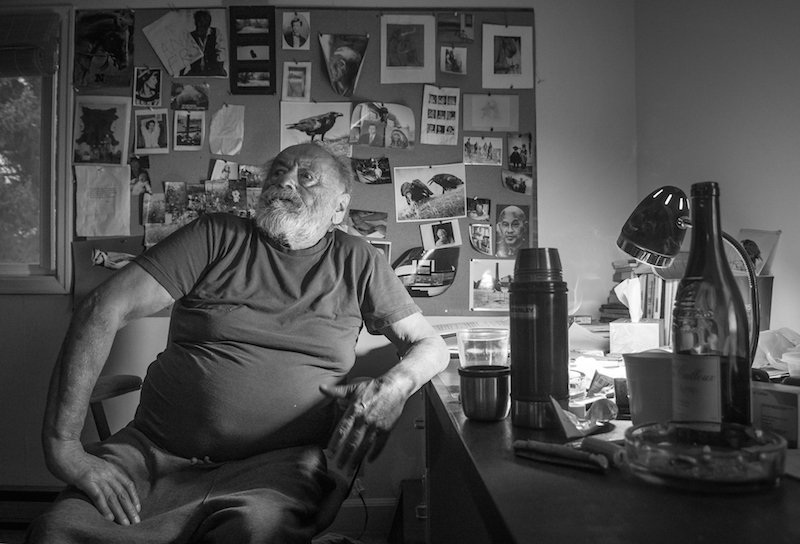
Jim welcomed us into his writing studio where he sat at his writing desk. He was shirtless and wore grey fleece shorts. Brown hiking boots dangled from his feet.

Smoke rose from his ashtray where a cigarette had been recently stubbed out. A crushed empty box of smokes lay next to a full one. Books lined the back of his desk and yellow legal pads, full of scrawling, sat in front of him.

Duke Ellington’s voice crackled from the vintage radio on a bookshelf next to bear claws, masks, animal skulls, and war clubs. A dried and wrinkled rattlesnake hung from a tack above the window. Pinned to a bulletin board behind his desk were Buddhist maxims, family photos, and a photo of a raven and a vulture sharing a carcass.