
14 April 2025


13 April 2025
If.
Wood, The Midnight Ride of Paul Revere, 1931

ECHOESWhat if the militiamen had not been waiting at the Lexington Green at dawn that April day in 1775, to test and slow the British? What if they had not then been at Concord a few hours later, 220 strong, ready and resolute on the high ground?Those patriot soldiers arrived by the hundreds that morning, then by the thousands, armed and keen and strengthened in their numbers. They mustered on the damp, open fields and on the forest edges along the Old Concord Road. Farmers and tradesmen, with their muskets and fowling pieces in hand. They turned back the redcoats and then fired on them in their retreat, routing them out of town and back off the that the patriots knew now as their own. Villagers from the highlands and the low, ministers and deists and nonbelievers, men dressed in whatever clothes they had – their patched and varied breeches, their worn straight-last boots – a hodgepodge of an earnest crew transformed by necessity and determination into American soldiers who that morning showed the will that would drive them in the weeks and months ahead, the will that would win the Revolutionary War.Suppose they had not come that morning after all, suppose they had not been so timely in their arrival, not been so committed to their call?Suppose instead the seasoned British soldiers, in their fine cocked hats and under their general’s command, had in their ransacking of Concord’s Barrett Farm found and taken the stores of gunpowder and ammunition they had come to seize. Imagine if the British had caught the American’s by surprise, as they’d intended. Imagine if, in Lexington, they had killed or captured Samuel Adams or John Hancock, delivering the bounty that had been put on those men by the king. What would have happened to the path of the American Revolution then?If not for that first morning of battle – of impudent, plucky, stunning, and world-shifting Patriot success – would the rebelling American army have continued to mobilize so confidently? Would it have stayed so unified in the face of defeat and death, have remained so emboldened to succeed? Would the army have fared so well (even in defeat) in the Battle of Bunker Hill, eight weeks later? Would the Revolution have unfolded so quickly as it did? Would we have July 4, 1776, as our Day of Independence? Or how much longer might the British have held their grip? Into the 1780s, the 1790s, the 1800s, and beyond? And if they had held that longer grip, what might then have been the implications for the establishment and growth of the American democracy in the years and decades that followed? What would be the implications today?When we ask these things, when we consider the plausible alternatives to the chain of events that occurred on April 18 and April 19, 1775, we are asking this: What might have happened, how might the much-documented and much-deconstructed birth of our nation have unfolded, and with what repercussions, had not Paul Revere mounted his borrowed horse and set out to ride those critical miles in those critical hours across the simmering moonlit land, to rouse the countryside and deliver the news? What would have become of the Revolution, of its crucial early days? What would have become of the whole hard, taxing, extraordinary journey to independence, if not for Paul Revere and his midnight ride?Kostya Kennedy, from the first chapter of The Ride: Paul Revere and the Night that Saved America
Excellent books ...

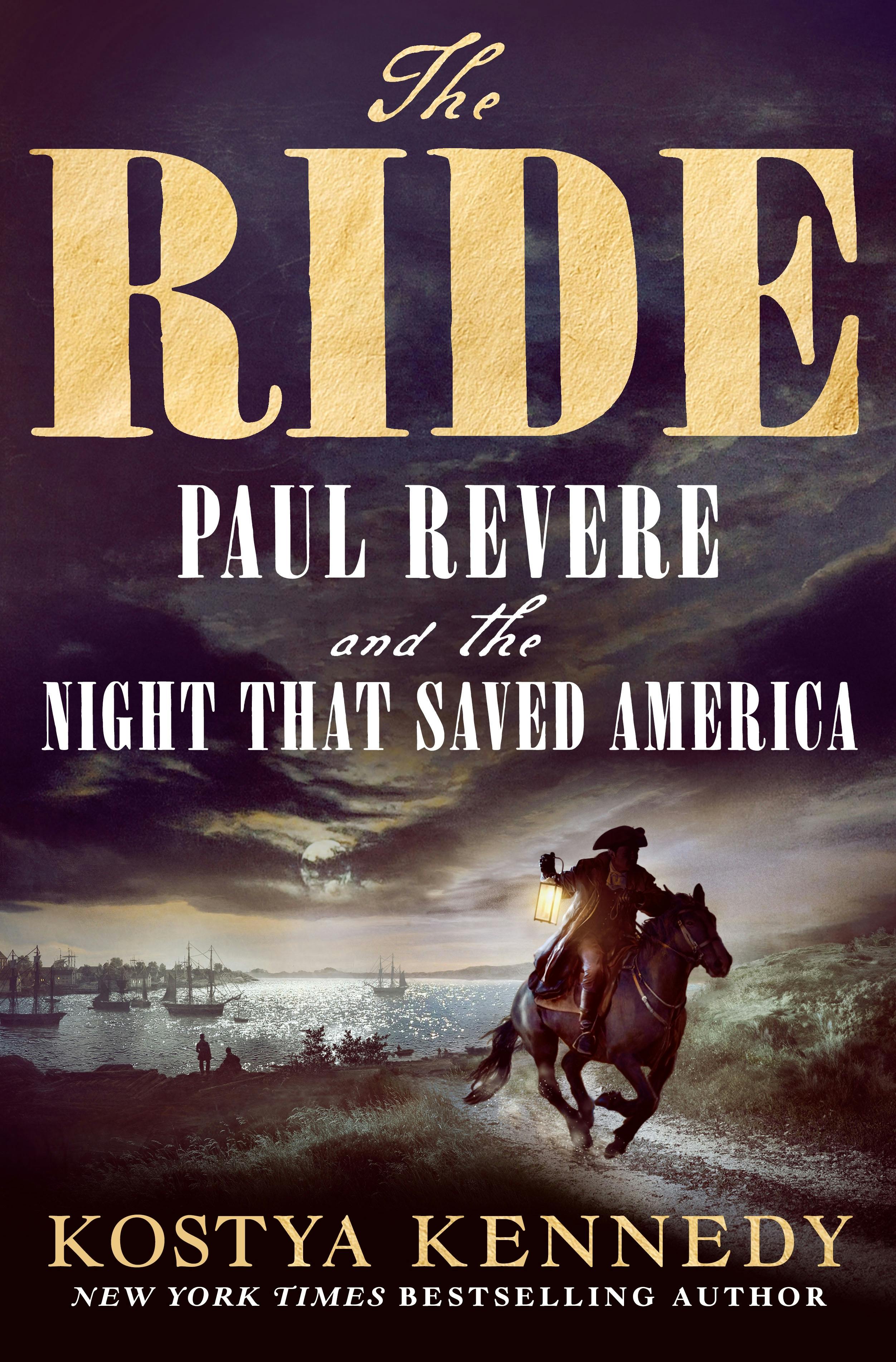
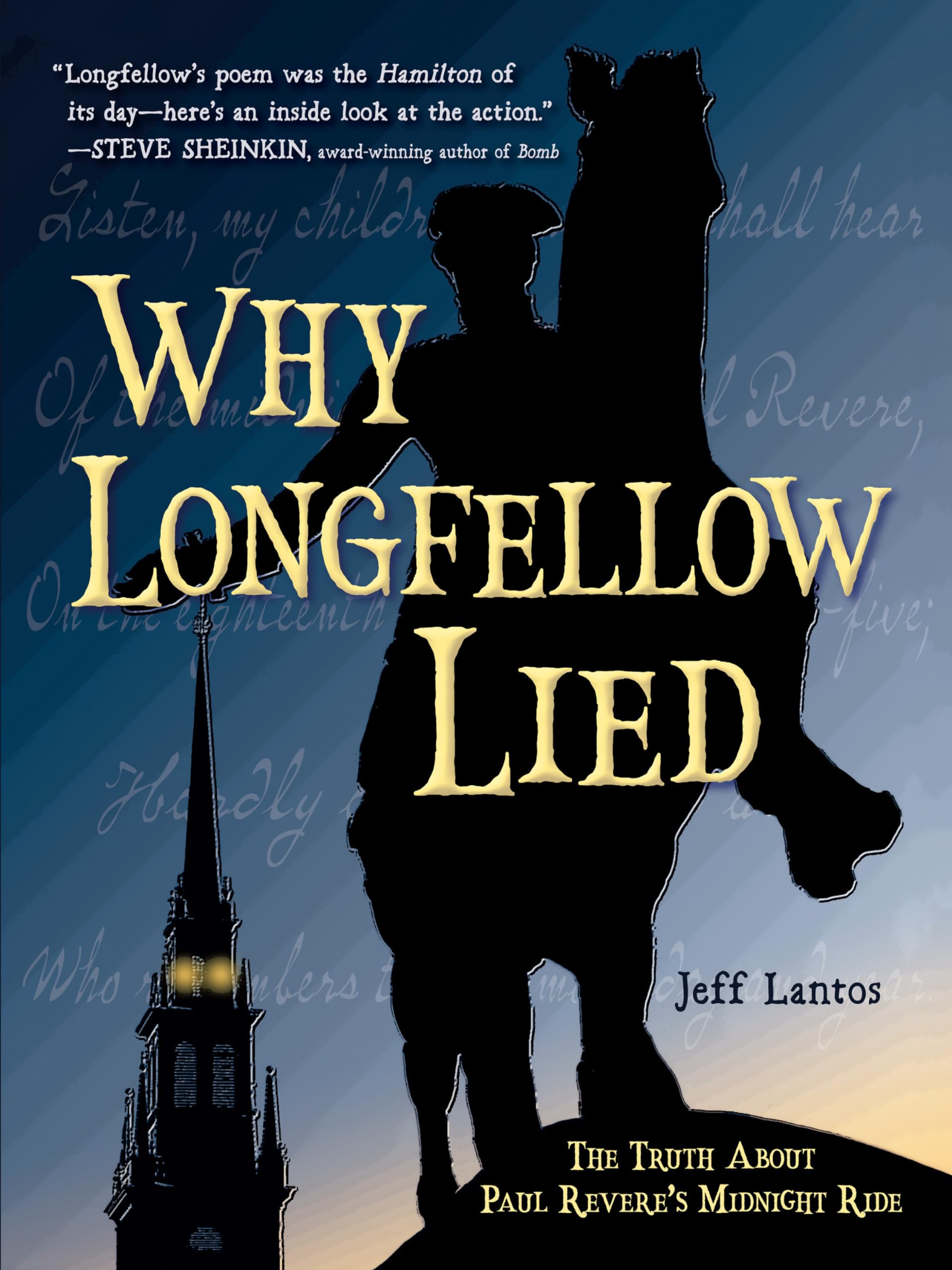
Do NOT miss an hour of Professor Fischer and Brian lamb discussing The Ride.


Happy Birthday, Jefferson
Peale, R., Portrait of Thomas Jefferson, 1805

Your letter has kindled all the fond recollections of antient times, recollections much dearer to me than any thing I have known since. There are minds which can be pleased by honors and preferments, but I see nothing in them but envy and enmity. It is only necessary to possess them to know how little they contribute to happiness, or rather how hostile they are to it. No attachments soothe the mind so much as those contracted in early life: nor do I recollect any societies which have given me more pleasure than those of which you have partaken with me. I had rather be shut up in a very modest cottage, with my books, my family and a few old friends, dining on simple bacon, and letting the world roll on as it liked, than to occupy the most splendid post which any human power can give.
Thomas Jefferson, born on this day in 1743, from a letter to Alexander Donald, February 7, 1788
12 April 2025

06 April 2025
Own.
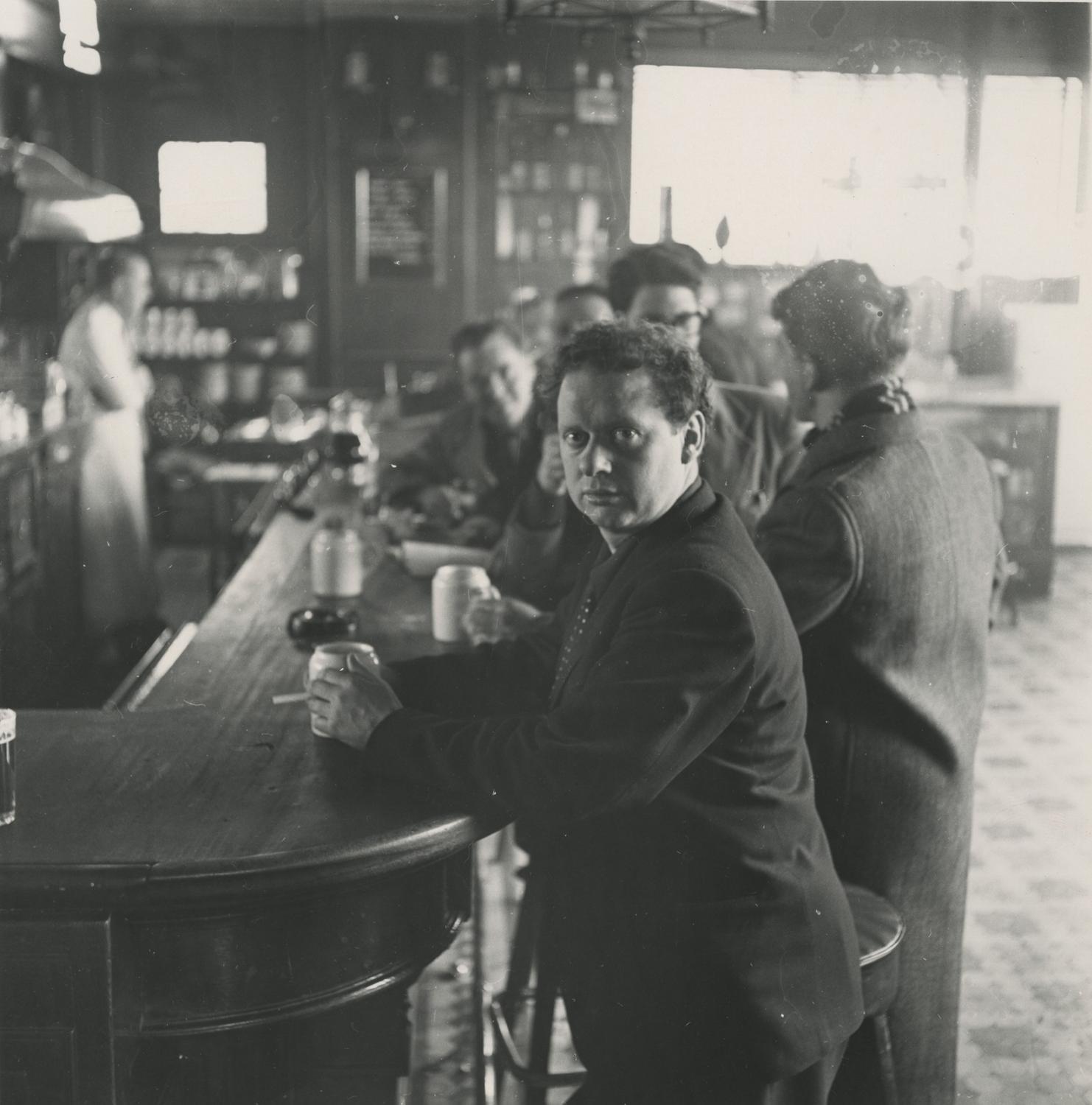
Poetry is what in a poem makes you laugh, cry, prickle, be silent, makes your toenails twinkle, makes you want to do this or that or nothing, makes you know that you are alone and not alone in the unknown world, that your bliss and suffering is forever shared and forever all your own.
Dylan Thomas

Steer.
Wyeth, N.C., The Roaring Skipper, 1914

“But, said Lewis, "myths are lies, even though lies breathed through silver."
"No," said Tolkien, "they are not. Just as speech is an invention about objects and ideas, so myth is invention about truth. We have come from God and inevitably the myths woven by us, though they contain error, will also reflect a splintered fragment of the true light, the eternal truth that is with God. Indeed only by myth-making, only by becoming a 'sub-creator' and inventing stories, can Man aspire to the state of perfection that he knew before the Fall. Our myths may be misguided, but they steer, however shakily, towards the true harbor, while materialistic progress leads only to a yawning abyss and the Iron Crown of the power of evil.
"You mean," asked Lewis, "that the story of Christ is simply a true myth, a myth that works on us in the same way as the others, but a myth that really happened? In that case," he said, "I begin to understand.”
Humphrey Carpenter, from J.R.R. Tolkien: A Biography
Discovering.
Kierkegaard, N.C., Søren Kierkegaard, 1840

The majority of men in every generation, even those who, as it is described, devote themselves to thinking, live and die under the impression that life is simply a matter of understanding more and more, and that if it were granted to them to live longer, that life would continue to be one long continuous growth in understanding. How many of them ever experience the maturity of discovering that there comes a critical moment where everything is reversed, after which the point becomes to understand more and more that there is something which cannot be understood.
Søren Kierkegaard, from The Journals of Kierkegaard
Birth.
Spenser, The Shepherd's Calendar, 1579

THE SHEPHERD'S CALENDAR: APRIL
I
Now infant April joins the Spring,
And views the watery sky,
As youngling linnet tries its wing,
And fears at first to fly;
With timid step she ventures on,
And hardly dares to smile,
Till blossoms open one by one,
And sunny hours beguile.
II
But finer days are coming yet,
With scenes more sweet to charm,
And suns arrive that rise and set
Bright strangers to a storm:
Then, as the birds with louder song
Each morning's glory cheer,
With bolder step she speeds along,
And loses all her fear.
III
In wanton gambols, like a child,
She tends her early toils,
And seeks the buds along the wild,
That blossoms while she smiles;
Or, laughing on, with nought to chide,
She races with the Hours,
Or sports by Nature's lovely side,
And fills her lap with flowers.
IV
The shepherd on his pasture walks
The first fair cowslip finds,
Whose tufted flowers, on slender stalks,
Keep nodding to the winds.
And though the thorns withhold the May,
Their shades the violets bring,
Which children stoop for in their play
As tokens of the Spring.
V
Those joys which childhood calls its own,
Would they were kin to men!
Those treasures to the world unknown,
When known, are wither'd then!
But hovering round our growing years,
To gild Care's sable shroud,
Their spirit through the gloom appears
As suns behind a cloud.
VI
Since thou didst meet my infant eyes,
As through the fields I flew,
Whose distance, where they meet the skies,
Was all the world I knew;
That warmth of Fancy's wildest hours,
Which fill'd all things with life,
Which heard a voice in trees and flowers,
Has swoon'd in Reason's strife.
VII
Sweet Month! thy pleasures bid thee be
The fairest child of Spring;
And every hour, that comes with thee,
Comes some new joy to bring:
The trees still deepen in their bloom,
Grass greens the meadow-lands,
And flowers with every morning come,
As dropt by fairy hands.
VIII
The field and garden's lovely hours
Begin and end with thee;
For what's so sweet, as peeping flowers
And bursting buds to see,
What time the dew's unsullied drops,
In burnish'd gold, distil
On crocus flowers' unclosing tops,
And drooping daffodil?
IX
To see thee come, all hearts rejoice;
And, warm with feelings strong,
With thee all Nature finds a voice,
And hums a waking song.
The lover views thy welcome hours,
And thinks of summer come,
And takes the maid thy early flowers,
To tempt her steps from home.
X
Along each hedge and sprouting bush
The singing birds are blest,
And linnet green and speckled thrush
Prepare their mossy nest;
On the warm bed thy plains supply,
The young lambs find repose,
And 'mid thy green hills basking lie
Like spots of ling'ring snows.
XI
Thy open'd leaves and ripen'd buds
The cuckoo makes his choice,
And shepherds in thy greening woods
First hear his cheering voice:
And to thy ripen'd blooming bowers
The nightingale belongs;
And, singing to thy parting hours,
Keeps night awake with songs!
XII
With thee the swallow dares to come,
And cool his sultry wing;
And, urged to seek his yearly home,
Thy suns the martin bring.
O! lovely Month! be leisure mine
Thy yearly mate to be;
Though May-day scenes may brighter shine,
Their birth belongs to thee.
XIII
I waked me with thy rising sun,
And thy first glories viewed,
And, as thy welcome hours begun,
Their sunny steps pursued.
And now thy sun is on thee set,
Like to a lovely eve,
I view thy parting with regret,
And linger loath to leave. —
XIV
Though at her birth the northern gale
Come with its withering sigh;
And hopeful blossoms, turning pale,
Upon her bosom die;
Ere April seeks another place,
And ends her reign in this,
She leaves us with as fair a face
As e'er gave birth to bliss!
Happy Birthday, Raphael
Raphael, A Study for Two Apostles, 1520

Raphael was born on this day in 1483.
More.

If a little day-dreaming is dangerous, the cure for it is not to dream less but to dream more, dream all the time.
Marcel Proust
Imagine.
Chenoweth, Untitled, 1972

Imagine the time the particle you are
returns where it came from!
The family darling comes home. Wine
without being contained in cups,
is handed around.
A red glint appears in a granite outcrop,
and suddenly the whole cliff turns to ruby.
Rumi
05 April 2025

Reverence.

JIM HARRISON: NOTES on the SACRED ART of LOG SITTING
Approach the log cautiously with proper reverence as if you were entering a French cathedral.
If it’s over 60 degrees, inspect the lower sides of the log for rattlesnakes.
Now examine the log closely for the most comfortable place to sit, usually away from the sun.
Sit down.
Empty your mind of everything except what is in front of you—the natural landscape of the canyon.
Dismiss or allow to slide away any aspect of your grand or pathetic life.
Breathe softly. Avoid a doze.
Internalize what you see in the canyon: the oaks and mesquites, the rumpled and grassy earth, hawks flying by, a few songbirds.
Stay put for forty-five minutes to an hour. When you get up bow nine times to the log.
Three logs a day is generally my goal.
Smile.

'Tis the season for Valençay.
Raw goat.
Lemony tang.
Crack a few Tellicherry peppercorns over it.
Put some Benny Goodman wax on the hi-fi and swig some ice-cold Ferrari-Carano Fumé Blanc straight from the bottle.
Smile at one of the best parts of Spring.

Social.
Caley, Untitled, 1960

“Why aren't you in school? I see you every day wandering around."
"Oh, they don't miss me," she said. "I'm antisocial, they say. I don't mix. It's so strange. I'm very social indeed. It all depends on what you mean by social, doesn't it? Social to me means talking to you about things like this."
She rattled some chestnuts that had fallen off the tree in the front yard.
"Or talking about how strange the world is. Being with people is nice. But I don't think it's social to get a bunch of people together and then not let them talk, do you? An hour of TV class, an hour of basketball or baseball or running, another hour of transcription history or painting pictures, and more sports, but do you know, we never ask questions, or at least most don't; they just run the answers at you, bing, bing, bing, and us sitting there for four more hours of film-teacher. That's not social to me at all. It's a lot of funnels and lot of water poured down the spout and out the bottom, and them telling us it's wine when it's not."
Ray Bradbury, from Fahrenheit 451
Unsought.
Pourbus, The Younger, Francis Bacon, Lord Keeper, and afterwards, Lord Chancellor of England, 1617

Write down the thoughts of the moment. Those that come unsought for are commonly the most valuable.
Francis Bacon


03 April 2025
A-Titling.

Our intention is simply to instruct the young, reform the old, correct the town, and castigate the age: this is an arduous task, and, therefore, we undertake it with confidence. We intend for this purpose to present a striking picture of the town; and as everybody is anxious to see his own phiz on canvass, however stupid or ugly it may be, we have no doubt but the whole town will flock to our exhibition. Our picture will necessarily include a vast variety of figures; and should any lady or gentleman be displeased with the inveterate truth of their likenesses, they may ease their spleen by laughing at those of their neighbours — this being what toe understand by poetical justice.
Like all true and able Editors, we consider ourselves infallible; and, therefore, with the customary diffidence of our brethren of the quill, we shall take the liberty of interfering in all matters either of a public or private nature. We are critics, amateurs, diletanti, and cognoscenti ; and as we know " by the pricking of our thumbs," that every opinion which we may advance in either of those characters will be correct, we are determined, though it may be questioned, contradicted, or even controverted, yet it shall never be revoked.
We beg the public particularly to understand, that we solicit no patronage. We are determined, on the contrary, that the patronage shall be entirely on our side. We have nothing to do with the pecuniary concerns of the paper: its success will yield us neither pride nor profit; nor will its failure occasion to us either loss or mortification. We advise the public, therefore, to purchase our numbers merely for their own sakes; if they do not, let them settle the affair with their consciences and posterity.
To conclude, we invite all editors of newspapers and literary journals to praise us heartily in advance, as we assure them that we intend to deserve their praises. To our next door neighbour, "Town," we hold out a hand of amity, declaring to him that, after ours, his paper will stand the best chance for immortality. We proffer an exchange of civilities ; he shall furnish us with notices of epic poems and tobacco — and we, in return, will enrich him with original speculations on all manner of subjects, together with " the rummaging of my grandfather's mahogany chest of drawers," " the life and amours of mine uncle John," anecdotes of the Cockloft family," and learned quotations from that unheard of writer of folios, Linkum Fidelus ...
If any one should feel himself offended by our remarks, let him attack us in return—we shall not wince from the combat. If his passes be successful, we will be the first to cry out, a hit! a hit ! and we doubt not we shall frequently lay ourselves open to the weapons of our assailants. But let them have a care how they run a-tilting with us; they have to deal with stubborn foes,who can bear a world of pummeling; we will be relentless in our vengeance, find will fight "till from our bones the flesh behack't."
Washington Irving, from Salmagundi; or, the Whim-Whams and Opinions of Launcelot Langstaff
Happy Birthday, Irving
White, The Author in Westminster Abbey, 1864
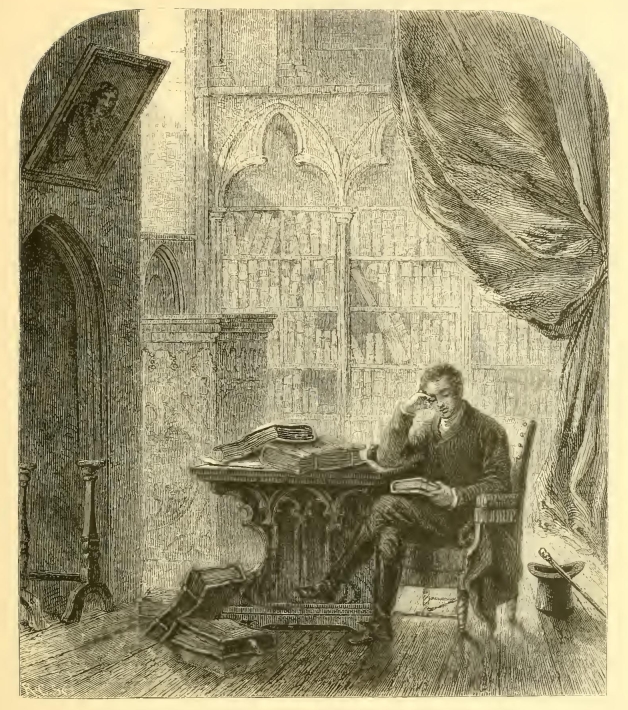
There are certain half-dreaming moods of mind in which we naturally steal away from noise and glare, and seek some quiet haunt where we may indulge our reveries and build our air castles undisturbed. In such a mood I was loitering about the old gray cloisters of Westminster Abbey, enjoying that luxury of wandering thought which one is apt to dignify with the name of reflection, when suddenly an irruption of madcap boys from Westminster school, playing at football, broke in upon the monastic stillness of the place, making the vaulted passages and mouldering tombs echo with their merriment. I sought to take refuge from their noise by penetrating still deeper into the solitudes of the pile, and applied to one of the vergers for admission to the library. He conducted me through a portal rich with the crumbling sculpture of former ages, which opened upon a gloomy passage leading to the chapter-house and the chamber in which Doomsday Book is deposited. Just within the passage is a small door on the left. To this the verger applied a key; it was double locked, and opened with some difficulty, as if seldom used. We now ascended a dark narrow staircase, and, passing through a second door, entered the library.
I found myself in a lofty antique hall, the roof supported by massive joists of old English oak. It was soberly lighted by a row of Gothic windows at a considerable height from the floor, and which apparently opened upon the roofs of the cloisters. An ancient picture of some reverend dignitary of the Church in his robes hung over the fireplace. Around the hall and in a small gallery were the books, arranged in carved oaken cases. They consisted principally of old polemical writers, and were much more worn by time than use. In the centre of the library was a solitary table with two or three books on it, an inkstand without ink, and a few pens parched by long disuse. The place seemed fitted for quiet study and profound meditation. It was buried deep among the massive walls of the abbey and shut up from the tumult of the world. I could only hear now and then the shouts of the school-boys faintly swelling from the cloisters, and the sound of a bell tolling for prayers echoing soberly along the roofs of the abbey. By degrees the shouts of merriment grew fainter and fainter, and at length died away; the bell ceased to toll, and a profound silence reigned through the dusky hall.
I had taken down a little thick quarto, curiously bound in parchment, with brass clasps, and seated myself at the table in a venerable elbow-chair. Instead of reading, however, I was beguiled by the solemn monastic air and lifeless quiet of the place, into a train of musing. As I looked around upon the old volumes in their mouldering covers, thus ranged on the shelves and apparently never disturbed in their repose, I could not but consider the library a kind of literary catacomb, where authors, like mummies, are piously entombed and left to blacken and moulder in dusty oblivion.
How much, thought I, has each of these volumes, now thrust aside with such indifference, cost some aching head! how many weary days! how many sleepless nights! How have their authors buried themselves in the solitude of cells and cloisters, shut themselves up from the face of man, and the still more blessed face of Nature; and devoted themselves to painful research and intense reflection! And all for what? To occupy an inch of dusty shelf—to have the titles of their works read now and then in a future age by some drowsy churchman or casual straggler like myself, and in another age to be lost even to remembrance. Such is the amount of this boasted immortality. A mere temporary rumor, a local sound; like the tone of that bell which has tolled among these towers, filling the ear for a moment, lingering transiently in echo, and then passing away, like a thing that was not!
While I sat half-murmuring, half-meditating, these unprofitable speculations with my head resting on my hand, I was thrumming with the other hand upon the quarto, until I accidentally loosened the clasps; when, to my utter astonishment, the little book gave two or three yawns, like one awaking from a deep sleep, then a husky hem, and at length began to talk. At first its voice was very hoarse and broken, being much troubled by a cobweb which some studious spider had woven across it, and having probably contracted a cold from long exposure to the chills and damps of the abbey. In a short time, however, it became more distinct, and I soon found it an exceedingly fluent, conversable little tome. Its language, to be sure, was rather quaint and obsolete, and its pronunciation what, in the present day, would be deemed barbarous; but I shall endeavor, as far as I am able, to render it in modern parlance.
Washington Irving, born on this day in 1783, from "The Mutability of Literature," found in The Sketch Book of Geoffrey Crayon, Gent.
02 April 2025
Magnificent.
Karr, Meg, The Magnificent, 2025


“What I would do for wisdom,”
I cried out as a young man.
Evidently not much.
Or so it seems.
Even on walks
I follow the dog.
Jim Harrison
31 March 2025
30 March 2025


Assertive.

The best defense against usurpatory government is an assertive citizenry.
William F. Buckley Jr.


Important.

Mr. Russ' important questions ...
“Was he strong enough to schlep barrels of herring? Smart enough to add up a column of numbers on a brown paper bag? Could he make change? Would he look good behind the counter?” If so, “Fine, you can marry him."
Food culture is the only culture that matters. It transcends all others. Art, music, literature -- all important, and will be appreciated and enhanced proportionally with the food culture in which it is found. But, as Harrison says, "If you eat badly, you are very probably living badly."
Surrender.

To see the beauty of nature, you need total surrender. Shut your mouth, open your eyes and ears. That’s why I never learned to drive. The happiest hours of my life were spent walking the countryside with old friends before heading to a small pub or inn.
C.S. Lewis
Happy Birthday, van Gogh
van Gogh, Self-Portrait, 1888
Painters — to speak only of them — being dead and buried, speak to a following generation or to several following generations through their works. Is that all, or is there more, even? In the life of the painter, death may perhaps not be the most difficult thing.
For myself, I declare I don’t know anything about it. But the sight of the stars always makes me dream in as simple a way as the black spots on the map, representing towns and villages, make me dream.
Why, I say to myself, should the spots of light in the firmament be less accessible to us than the black spots on the map of France.
Just as we take the train to go to Tarascon or Rouen, we take death to go to a star. What’s certainly true in this argument is that while alive, we cannot go to a star, any more than once dead we’d be able to take the train. So it seems to me not impossible that cholera, the stone, consumption, cancer are celestial means of locomotion, just as steamboats, omnibuses and the railway are terrestrial ones.
To die peacefully of old age would be to go there on foot.
Vincent van Gogh, born on this day in 1853, from a letter to Theo van Gogh, July 9 or 10, 1888
28 March 2025
Released.
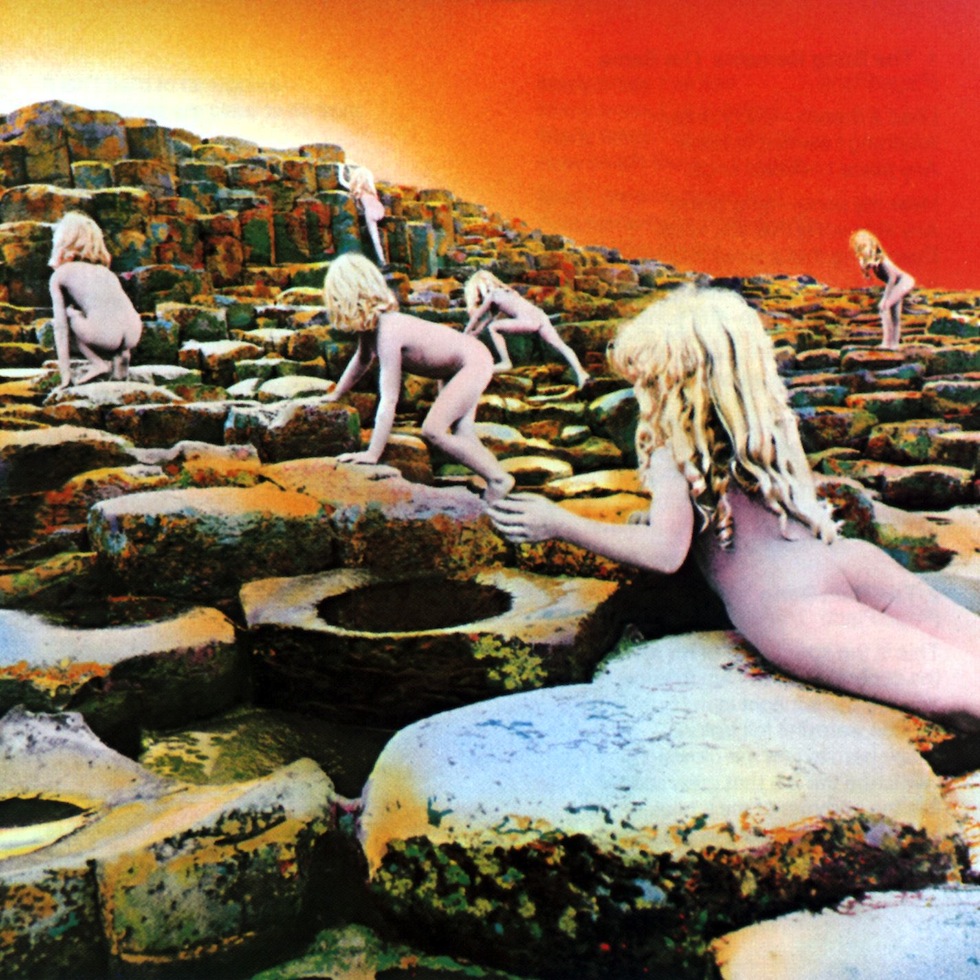
Led Zeppelin released Houses of the Holy on this day in 1973.
"The Song Remains the Same/Rain Song" ...
Ignore.

Decent people should ignore politics, if only they could be confident that politics would ignore them.
William F. Buckley Jr.
Sacred.

CAMPBELL: You must have a room, or a certain hour or so a day, where you don’t know what was in the newspapers that morning, you don’t know who your friends are, you don’t know what you owe anybody, you don’t know what anybody owes to you. This is a place where you can simply experience and bring forth what you are and what you might be. This is the place of creative incubation. At first you may find that nothing happens there. But if you have a sacred place and use it, something eventually will happen.MOYERS: This sacred place does for you what The Plains did for the hunter.CAMPBELL: For them, the whole world was a sacred place. But our life has become so economic and practical in its orientation that, as you get older, the claims of the moment upon you are so great, you hardly know where the hell you are, or what it is you intended. You are always doing something that is required of you. Where is your bliss station? You have to try to find it. Get a phonograph and put on the music that you really love, even if it’s corny music that nobody else respects.
Subscribe to:
Posts (Atom)


































































































































