"I am not one who was born in the custody of wisdom. I am one who is fond of olden times and intense in quest of the sacred knowing of the ancients." Gustave Courbet
Showing posts with label American Revolution. Show all posts

25 July 2026

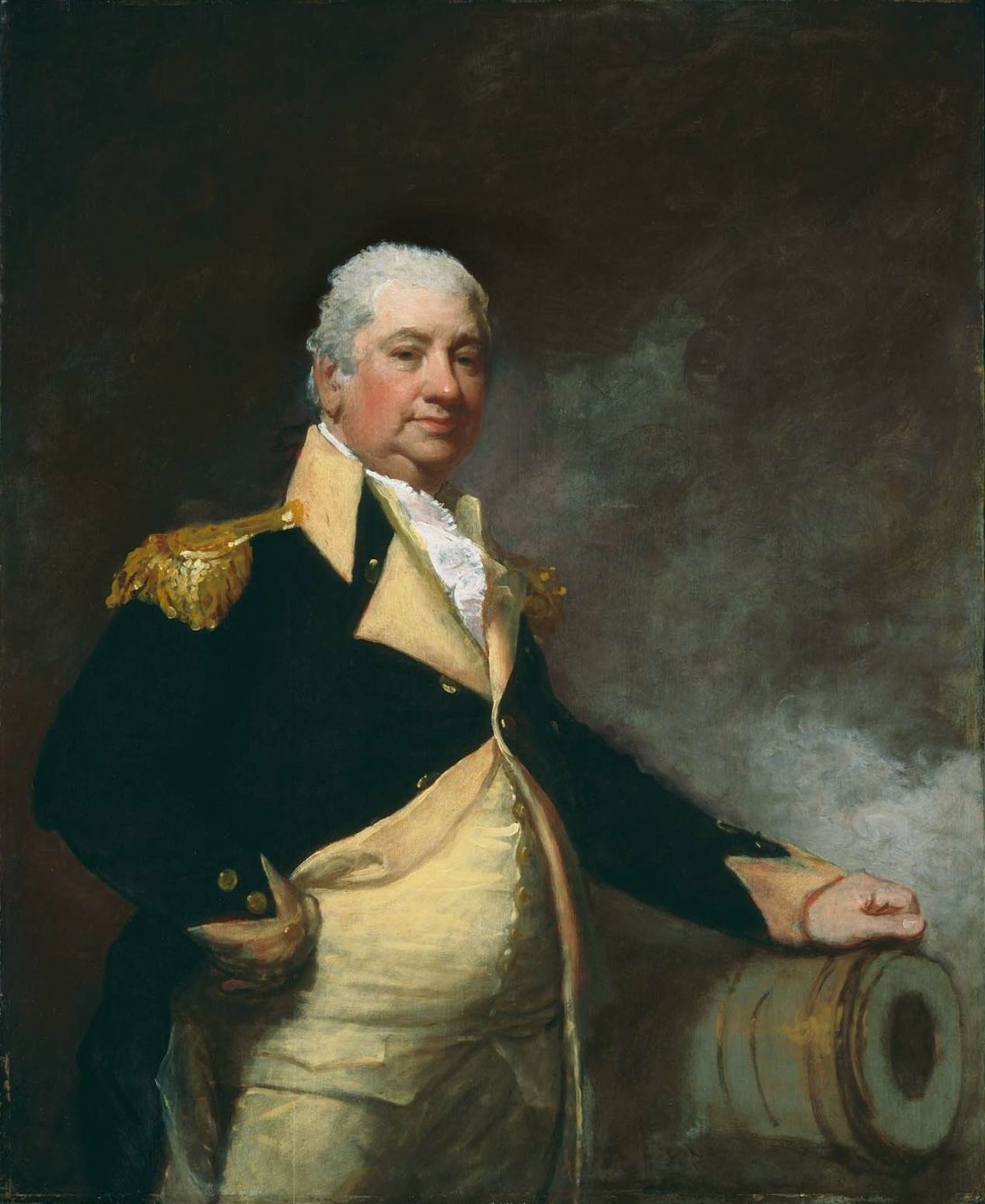
Happy Birthday, Henry Knox

Stuart, Henry Knox, 1806
On the very first impression of Faction and licentiousness the fine theoretic government of Massachusetts has given away and its laws arrested and trampled under foot. Men at a distance, who have admired our systems of government, unfounded in nature, are apt to accuse the rulers, and say that taxes have been assessed coo high and collected coo rigidly. This is a deception equal to any that has been hitherto entertained. It is indeed a face, that high taxes are the ostensible cause of the commotions, but that they are the real cause is as far remote from truth as light from darkness. The people who are the insurgents have never paid any, or but very little taxes—But they see the weakness of government; They feel at once their own poverty, compared with the opulent, and their own force, and they are determined to make use of the latter, in order to remedy the former. Their creed is "That the property of the United States has been protected from the confiscations of Britain by the joint exertions of all, and therefore ought to be the common property of all. And he that attempts opposition to this creed is an enemy to equity and justice, and ought to be swept off the face of the earth." In a word they are determined to annihilate all debts public and private and have agrarian Laws which are easily effected by the means of unfunded paper money which shall be a tender in all cases whatever. 
The numbers of these people may amount in [M]assachusetts to about one fifth part of several populous counties, and to them may be collected, people of similar sentiments, from the States of Rhode Island, Connecticut and New Hampshire so as to constitute a body of 12 or 15,000 desperate and unprincipled men—They are chiefly of the Young and active part of the community, more easily collected than perhaps Kept together afterwards—But they will probably commit overt acts of treason which will compel them to embody for their own safety—once embodied they will be constrained to submit to discipline for the same reason. Having proceeded to this length for which they are now ripe, we shall have a formidable rebellion against reason, the principles of all government, and against the very name of liberty. This dreadful situation has alarmed every man of principle and property in New England—They start as from a dream, and ask what has been the Cause of our delusion? What is to afford us security against the violence of lawless men? Our government must be braced, changed, or altered to secure our lives and property. We imagined that the mildness of our government and the virtue of the people were so correspondent, that we were not as other nations requiring brutal force to support the laws—But we find that we are men, actual men, possessing all the turbulent passions belonging to that animal and that we must have a government proper and adequate for him—The people of Massachusetts for instance, are far advanced in this doctrine, and the men of reflection, and principle, are determined to endeavor to establish a government which shall have the power to protect them in their lawful pursuits, and which will be efficient in all cases of internal commotions or foreign invasions—They mean that liberty shall form the basis, a liberty resulting from the equal and firm administration of the laws. They wish for a general government of unity as they see that the local legislatures, must naturally and necessarily tend to retard general government. 
We have arrived at that point of time in which we are forced to see our national humiliation, and that a progression in this line, cannot be productive of happiness either private or public—something is wanting and something must be done or we shall be involved in all the horror of faction and civil war without a prospect of its termination—Every tried friend to the liberties of his country is bound to reflect, and step forward to prevent the dreadful consequences which will result from a government of events—Unless this is done we shall be liable to be ruled by an Arbitrary and Capricious armed tyranny, whose word and will must be Law. 

 Henry Knox, born on this date in 1750, from his letter to George Washington, October 23, 1786

The "Knox Moving Co." scene from John Adams ...


An excellent book ...

14 July 2026

Never.


Benjamin Warner’s Revolutionary-era linen knapsack and note to future generations remain two of Fort Ticonderoga’s most treasured artifacts ...
And whilst one shred of it shall remain, never surrender your liberties to a foreign invader or an aspiring demagogue.

09 July 2026

Gravity.


We need more Hercules Mulligan-types around ...
Washington’s own guard were willing to accept hard currency to betray their master.  They preferred to kidnap Washington, but the contingency plan was to poison the meal of buttered peas, lettuce and ham that Washington was fond of.   
Recognizing the gravity of the situation, Mulligan hastily shooed out Mathews and sought to inform Washington. He made about half the three-mile trip to Washington’s headquarters on horseback before running into Hamilton, who relayed the information to Washington which, combined with the prison intelligence mentioned above from the conventional story, stopped the conspiracy. Hickey was hanged, while the remaining conspirators including Mathews, were jailed in Connecticut.

More HERE

Aloud.

McRae, Pulling Down the Statue of George III, 1853


On this day in 1776, The Declaration of Independence was read aloud to General George Washington's troops in New York ...
As tensions ran high, the Continental Congress adopted the Declaration of Independence on July 4th, and word reached New York on July 9th. Washington ordered the declaration to be read aloud to troops that day. Following the public reading, soldiers and civilians marched down Broadway and on to Bowling Green. Erected on the green was an equestrian statue of George III. The rowdy crowd toppled the statue and paraded the King’s lead head on a spike, a symbolic regicide. The body of the statue, about four-thousand pounds of lead, was sent to Connecticut and melted into musket balls to use against the King’s troops. 

28 June 2026

Billings, "Chester"

When men know not what to do, John, they ought not to do they know not what.


How extraordinary fortunate we were to have such human beings found this country.
What grateful Off’ring shall we bring?
What shall we render to the Lord?
Loud Halleluiahs let us Sing,
And praise his name on ev’ry Chord.

18 June 2026

Sure.

Wyeth, N.C., Backcountry Militia on the Move, 1928


The Congress has likewise resolved that fifteen thousand men shall be supported at the expense of the continent; ten thousand at Massachusetts, and five thousand at New York; and that ten companies of riflemen be sent immediately; six from Pennsylvania, two from Maryland, and two from Virginia, consisting of sixty-eight privates in each company, to join our army at Boston. These are said to be all exquisite marksmen, and by means of the excellence of their firelocks, as well as their skill in the use of them, to send sure destruction to great distances.

John Adams, from a letter to Elbridge Gerry, 18 June 1775

15 June 2026

Glory.

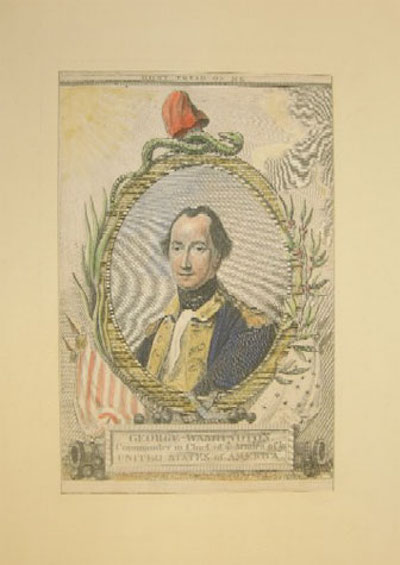
Shepherd, George Washington, Esq., General and Commander in Chief of the Continental Army in America, 1775


The General does not mean to discourage the practice of bathing, whilst the weather is warm enough to continue it; but he expressly forbids, any persons doing it, at or near the Bridge in Cambridge, where it has been observed and complained of, that many Men, lost to all sense of decency and common modesty, are running about naked upon the Bridge, whilst Passengers, and even Ladies of the first fashion in the neighbourhood, are passing over it, as if they meant to glory in their shame: The Guards and Centries at the Bridge, are to put a stop to this practice for the future.

George Washington, from his General Orders, 22 August 1775

Appointed.

Sharp, George Washington, Commander in Chief of Ye Armies of Ye United States of America, 1780


George Washington was appointed head of the Continental Army on this day in 1775 ...
I shall hope that my undertaking of it, is designd to answer some good purpose—You might, and I suppose did perceive, from the Tenor of my letters, that I was apprehensive I could not avoid this appointment, as I did not even pretend ⟨t⟩o intimate when I should return—that was the case—it was utterly out of my power to refuse this appointment without exposing my Character to such censures as would have reflected dishonour upon myself, and given pain to my friends—this I am sure could not, and ought not to be pleasing to you, & must have lessend me considerably in my own esteem. I shall rely therefore, confidently, on that Providence which has heretofore preservd, & been bountiful to me, not doubting but that I shall return safe to you in the fall—I shall feel no pain from the Toil, or the danger of the Campaign—My unhappiness will flow, from the uneasiness I know you will feel at being left alone—I therefore beg of you to summon your whole fortitude & Resolution, and pass your time as agreeably as possible—nothing will give me so much sincere satisfaction as to hear this, and to hear it from your own Pen.

George Washington, from a letter to Martha Washington, 18 June 1775

09 June 2026

Excellent.

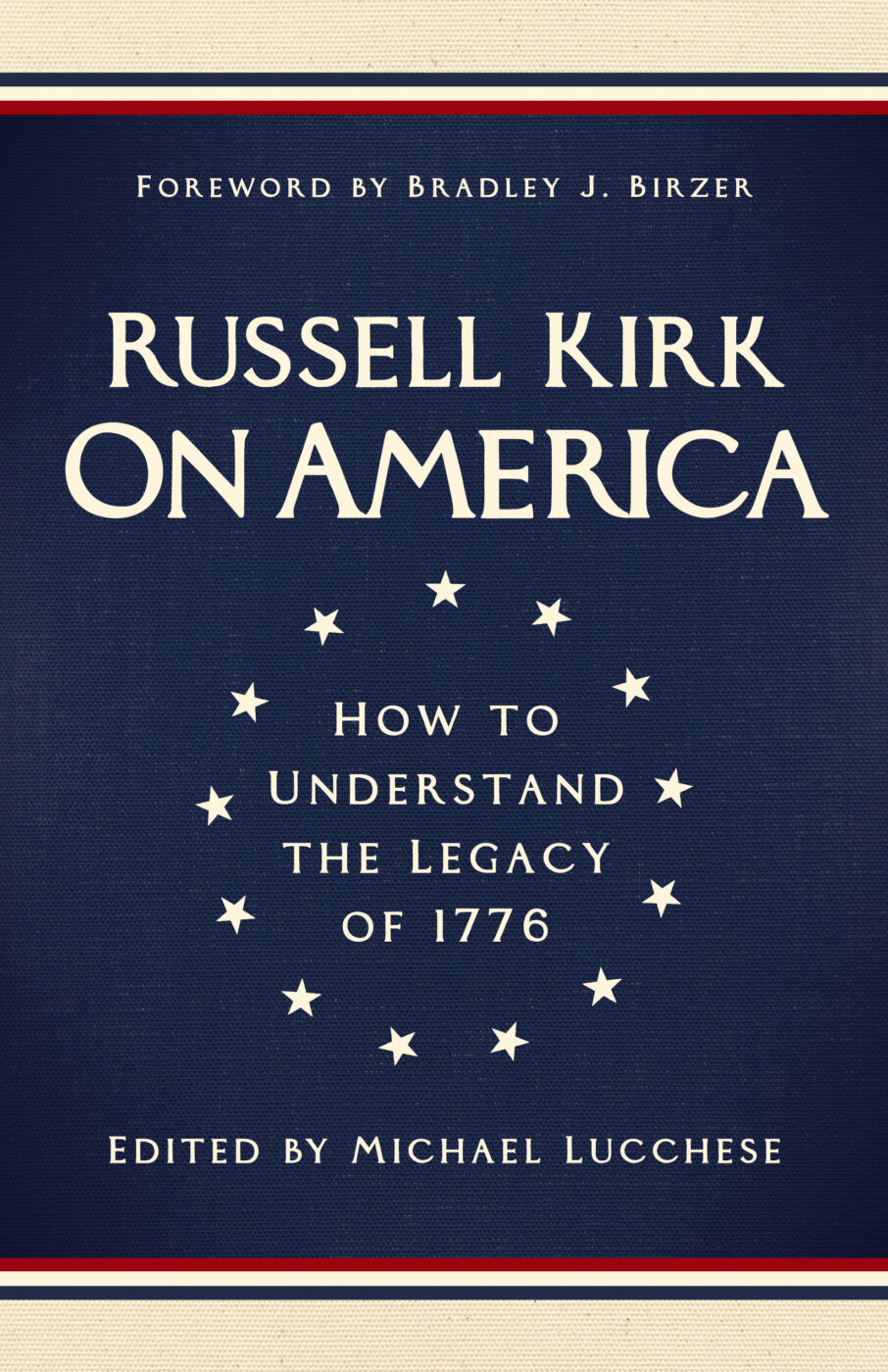
An excellent book ...


Great states with good constitutions develop when most people think of their duties and restrain their appetites. Great states sink toward their dissolution when most people think of their privileges and indulge their appetites freely.  This rule is as true for democracies as it is fro autocracies.  And no matter how admirable a constitution may look upon paper, it will be ineffectual unless the written constitution, the web of custom and convention, affirms an enduring moral order of obligation and personal responsibility.

The ruin or recovery of American constitutions, and the general future of of American politics, will be determined more by choices than by circumstances.  Here I have done no more than to suggest what some of those choices might be.  "Not to lose ourselves in  the infinite void of the conjectural world," Burke wrote near the end of his life in  the First Letter of the Regicide Peace, "our business is with what is likely to be affected for the better or worse by the wisdom or weakness of our plans."  To share the American political future through prudent and courageous choices is yet within the realm of possibility.  "I despair neither of the public fortune or of the public mind," Burke continued.  "There is much to be done undoubtedly, and much to be retrieved.  We must walk in new ways, or we can never encounter our enemy in his devious march.  We are not at an end of our struggle, nor near it.  Let us not deceive ourselves; we are at the beginning of great troubles.

Russell Kirk, from On America: How to Understand the Legacy of 1776

10 May 2026

Sneak.

Davis, Ethan Allen's Capture of Fort Ticonderoga, 1875


On this day in 1775, Ethan Allen and his Green Mountain Boys captured the British-held fortress at Ticonderoga, N.Y.

American Battlefield Trust has the details ...
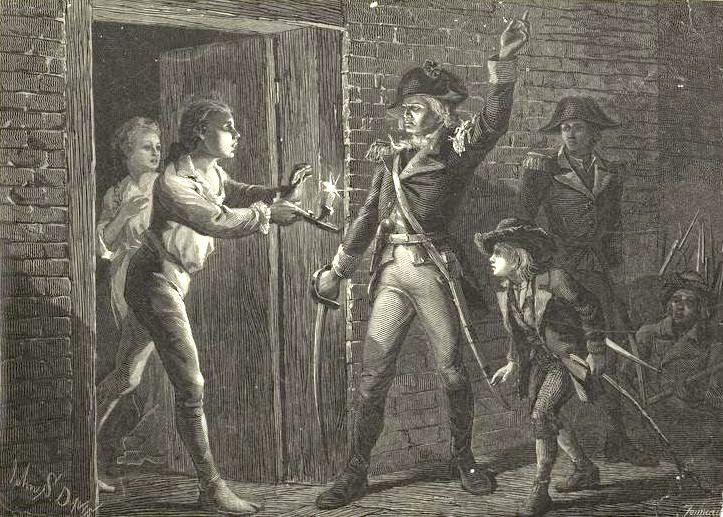
During the American War for Independence, several engagements were fought at the five-pointed star-shaped Fort Ticonderoga. The most famous of these occurred on May 10, 1775, when Ethan Allen and his band of Green Mountain Boys, accompanied by Benedict Arnold, who held a commission from Massachusetts, silently rowed across Lake Champlain from present-day Vermont and stormed the fort in a swift, late-night sneak attack. 

Months later, George Washington, commander of the Continental Army, sent one of his officers, Colonel Henry Knox, to gather the artillery left at Ticonderoga and bring it to Boston. Knox organized the transfer of the heavy guns over frozen rivers and the snow-covered Berkshire Mountains of western Massachusetts. Mounted on Dorchester Heights, the guns from Ticonderoga compelled the British to evacuate the city of Boston in March of 1776. 

The Ticonderoga episode of The Revolutionary War in Four Minutes ...

"No Quarter!", a 250th anniversary vignette of the Capture of Fort Ticonderoga ...

19 April 2026

Spirit.


The American Revolution began on this day, at this hour, in 1775.

CONCORD HYMN

By the rude bridge that arched the flood, 
   Their flag to April’s breeze unfurled, 
Here once the embattled farmers stood 
   And fired the shot heard round the world. 

The foe long since in silence slept; 
   Alike the conqueror silent sleeps; 
And Time the ruined bridge has swept 
   Down the dark stream which seaward creeps. 

On this green bank, by this soft stream, 
   We set today a votive stone; 
That memory may their deed redeem, 
   When, like our sires, our sons are gone. 

Spirit, that made those heroes dare 
   To die, and leave their children free, 
Bid Time and Nature gently spare 
   The shaft we raise to them and thee.

Ralph Waldo Emerson

18 April 2026

Hoof-Beats.

Wyeth, N.C., Paul Revere's Ride, 1922


This evening, in 1775, Revere, Dawes, and Prescott were on their way to absolutely, positively getting it there overnight.

PAUL REVERE'S RIDE

Listen, my children, and you shall hear
Of the midnight ride of Paul Revere,
On the eighteenth of April, in Seventy-Five:
Hardly a man is now alive
Who remembers that famous day and year.

He said to his friend, “If the British march
By land or sea from the town to-night,
Hang a lantern aloft in the belfry-arch
Of the North-Church-tower, as a signal-light,—
One if by land, and two if by sea;
And I on the opposite shore will be,
Ready to ride and spread the alarm
Through every Middlesex village and farm,
For the country-folk to be up and to arm.”

Then he said “Good night!” and with muffled oar
Silently rowed to the Charlestown shore,
Just as the moon rose over the bay,
Where swinging wide at her moorings lay
The Somerset, British man-of-war:
A phantom ship, with each mast and spar
Across the moon, like a prison-bar,
And a huge black hulk, that was magnified
By its own reflection in the tide.

Meanwhile, his friend, through alley and street
Wanders and watches with eager ears,
Till in the silence around him he hears
The muster of men at the barrack door,
The sound of arms, and the tramp of feet,
And the measured tread of the grenadiers
Marching down to their boats on the shore.

Then he climbed to the tower of the church,
Up the wooden stairs, with stealthy tread,
To the belfry-chamber overhead,
And startled the pigeons from their perch
On the sombre rafters, that round him made
Masses and moving shapes of shade,—
By the trembling ladder, steep and tall,
To the highest window in the wall,
Where he paused to listen and look down
A moment on the roofs of the town,
And the moonlight flowing over all.

Beneath, in the churchyard, lay the dead,
In their night-encampment on the hill,
Wrapped in silence so deep and still
That he could hear, like a sentinel’s tread,
The watchful night-wind, as it went
Creeping along from tent to tent,
And seeming to whisper, “All is well!”
A moment only he feels the spell
Of the place and the hour, and the secret dread
Of the lonely belfry and the dead;
For suddenly all his thoughts are bent
On a shadowy something far away,
Where the river widens to meet the bay,—
A line of black, that bends and floats
On the rising tide, like a bridge of boats.

Meanwhile, impatient to mount and ride,
Booted and spurred, with a heavy stride,
On the opposite shore walked Paul Revere.
Now he patted his horse’s side,
Now gazed on the landscape far and near,
Then impetuous stamped the earth,
And turned and tightened his saddle-girth;
But mostly he watched with eager search
The belfry-tower of the old North Church,
As it rose above the graves on the hill,
Lonely and spectral and sombre and still.
And lo! as he looks, on the belfry’s height,
A glimmer, and then a gleam of light!
He springs to the saddle, the bridle he turns,
But lingers and gazes, till full on his sight
A second lamp in the belfry burns!

A hurry of hoofs in a village-street,
A shape in the moonlight, a bulk in the dark,
And beneath from the pebbles, in passing, a spark
Struck out by a steed that flies fearless and fleet:
That was all! And yet, through the gloom and the light,
The fate of a nation was riding that night;
And the spark struck out by that steed, in his flight,
Kindled the land into flame with its heat.

He has left the village and mounted the steep,
And beneath him, tranquil and broad and deep,
Is the Mystic, meeting the ocean tides;
And under the alders, that skirt its edge,
Now soft on the sand, now loud on the ledge,
Is heard the tramp of his steed as he rides.

It was twelve by the village clock
When he crossed the bridge into Medford town.
He heard the crowing of the cock,
And the barking of the farmer’s dog,
And felt the damp of the river-fog,
That rises when the sun goes down.

It was one by the village clock,
When he galloped into Lexington.
He saw the gilded weathercock
Swim in the moonlight as he passed,
And the meeting-house windows, blank and bare,
Gaze at him with a spectral glare,
As if they already stood aghast
At the bloody work they would look upon.

It was two by the village clock,
When he came to the bridge in Concord town.
He heard the bleating of the flock,
And the twitter of birds among the trees,
And felt the breath of the morning breeze
Blowing over the meadows brown.
And one was safe and asleep in his bed
Who at the bridge would be first to fall,
Who that day would be lying dead,
Pierced by a British musket-ball.

You know the rest. In the books you have read,
How the British Regulars fired and fled,—
How the farmers gave them ball for ball,
From behind each fence and farmyard-wall,
Chasing the red-coats down the lane,
Then crossing the fields to emerge again
Under the trees at the turn of the road,
And only pausing to fire and load.

So through the night rode Paul Revere;
And so through the night went his cry of alarm
To every Middlesex village and farm,—
A cry of defiance, and not of fear,
A voice in the darkness, a knock at the door,
And a word that shall echo forevermore!
For, borne on the night-wind of the Past,
Through all our history, to the last,
In the hour of darkness and peril and need,
The people will waken and listen to hear
The hurrying hoof-beats of that steed,
And the midnight message of Paul Revere.

Henry Wadsworth Longfellow

11 April 2026

Memory.

An excellent book ...


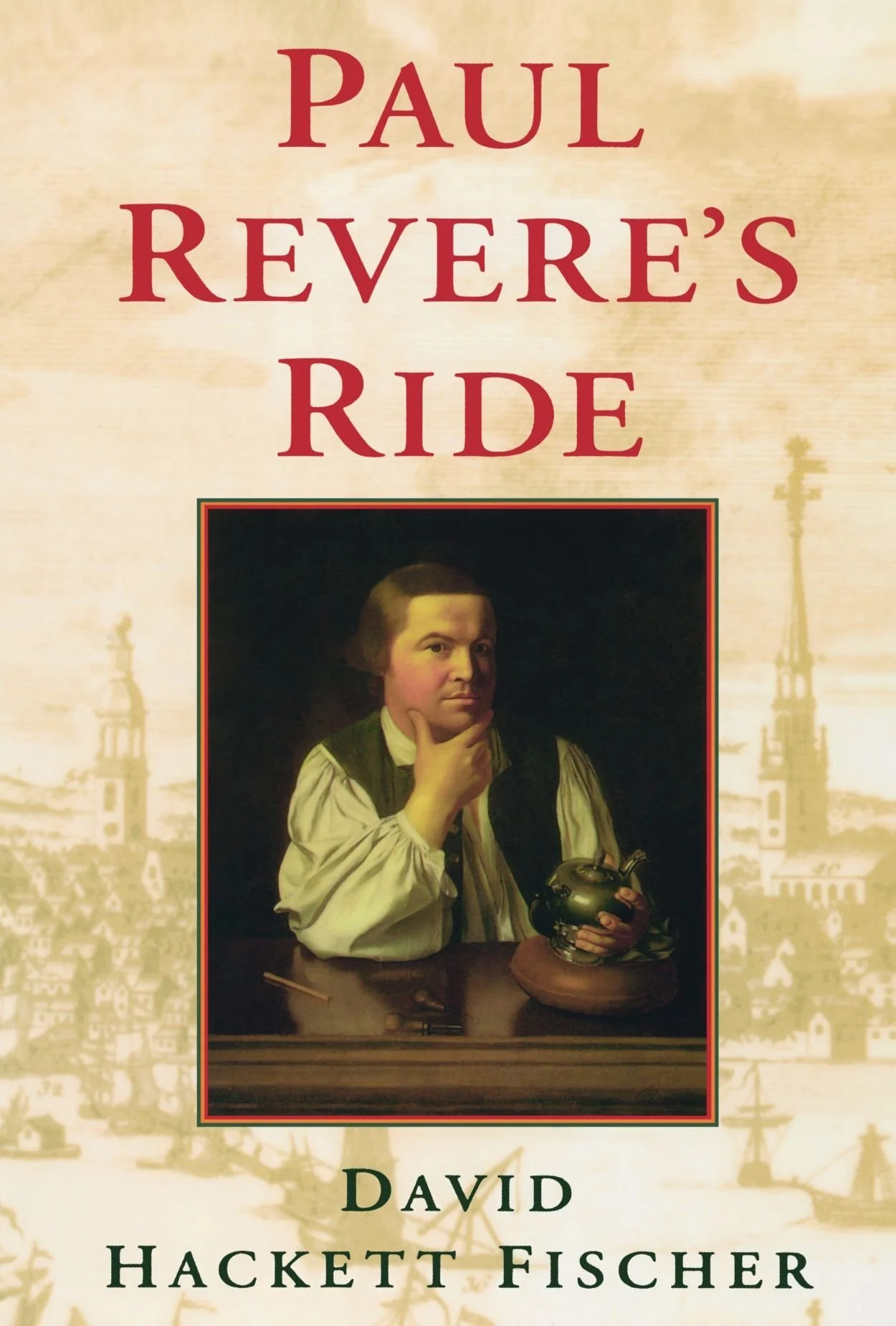
We misunderstand Paul Revere's revolutionary thinking if we identify it with our modern ideas of individual freedom and tolerance that later spread through the world.  Bostonians had very different attitudes in 1775.  Samuel Adams often spoke of what he called "publick liberty," or the "liberty of America," or sometimes the "liberty of Boston."  Their idea of liberty was both a corporate and individual possession.  It had a double meaning in New England, akin to the Puritan idea of a special and general calling and Cotton Mather's two oars.  It referred not only to the autonomy of each person's rights, but also to the integrity of the group, and especially to the responsibility of a people to regulate their own affairs.  We remember the individual rights and forget the collective responsibilities.  We tend to interpret Thomas Jefferson's ambiguous reference the "the pursuit of happiness" as an individual quest, but in 1774, Paul Revere's town meeting spoke of "social happiness" as its goal. 

Also distinctive to this culture was its idea of equality.  The motto of the Sons of Liberty was "Equality Before the Law."  They did not believe in equality of possessions, or even equality of esteem, but they thought that all people had the right to be judged according to their worth.  Paul Revere's business associate Nathaniel Ames wrote:
All men are by Nature equal
But different greatly in the sequel
For Paul Revere and "town-born" Boston these principles did not derive from abstract premises, but from tradition and historical experience.  In America it has always been so.  Milan Kundera has recently reminded us that "the struggle against power is the struggle of memory against forgetting."  This was Paul Revere's road to revolution.  It was also his message for our time.

David Hackett Fischer, from Paul Revere's Ride

25 January 2026

Eternal.

Stuart, George Washington (The Constable-Hamilton Portrait), 1797

Thinking of civil-military relationships after the war, he urged his “virtuous fellow Citizens in the field” that they “should carry with them into civil Society the most conciliating dispositions; and that they should prove themselves not less virtuous and usefull as Citizens than they have been persevering and victorious as Soldiers.” The army began demobilizing, and British forces departed New York City at noon on 25 November. Washington was careful to let civilian authorities reclaim the city, not his army, although he rode in with the New York militia regiments alongside Governor Clinton.

After securing New York City, Washington focused on returning to civil life. On 19 December 1783, he arrived in Annapolis, where the Continental Congress was operating, and on 23 December 1783—eight years, six months, and five days after Congress granted him command of the army in Philadelphia—he surrendered his commission in front of Congress in Annapolis. In prepared remarks, Washington closed the loop on the civil-military relationship granted in his initial commission of June 1775. “The great events on which my resignation depended having at length taken place,” he remarked, “I have now the honor of offering my sincere Congratulations to Congress & of presenting myself before them to surrender into their hands the trust committed to me, and to claim the indulgence of retiring from the Service of my Country.” He then returned to Mount Vernon just in time for Christmas.

At that moment, he rejected becoming an American Caesar and instead chose to embody Cincinnatus. Educated like most of his generation on popularizations of ancient history, Washington had patterned his behavior on his understanding of Roman heroes. Joseph Addison’s 1713 play Cato: A Tragedy shaped Washington’s conception of himself as he took steps to model his behavior from the Roman leader who exemplified public virtue and liberty. Fabian served as his example for victory and Cincinnatus for his postwar life. Cincinnatus is famous for having picked up the sword when called to save his country in 458 BCE and laying it down again to return to the plough and the life of a yeoman farmer. He embodied the citizen-soldier ideal that influenced Enlightenment thinking on the matter.

Washington’s experience provides ample material for students of civil-military relations. His experience, on the one hand, suggests that civilians and citizen-soldiers are effective, that expertise in arms was unnecessary in a republic, and that the need for a professional officer corps was moot. Despite Washington’s argument for the contrary, his experience fueled advocates for a small military establishment ...

The “myth of Cincinnatus,” that valiant citizens will defend the country when called has informed how Americans have mobilized and prepared for war since the revolution.  Washington understood that citizen-soldier militias were limited, which informed his desire to develop a well-paid, professional standing army. This tension, however, lay at the base of contemporary notions of civilian control of the military and was something with which Washington struggled throughout the conflict.
Mackubin Thomas Owens at Hillsdale on civilian-military relations ...
All service members learn early in their training that they have an affirmative obligation to refuse unlawful orders. But service members do not get to refuse orders because they disagree with the administration’s policies. And this video, at the very least, carelessly blurs the line between these things in a way to undermine trust between civilian policymakers and the military and between seniors and subordinates within the military.

The video was clearly political in nature and is likely to foster confusion within the military ranks. The lawmakers failed to identify any specifics regarding unlawful orders. Nor did they offer examples of the kinds of orders soldiers should refuse to obey. Without context, the phrase “refuse illegal orders” blurs the line between legitimate legal instruction and political signaling. For a system that depends on discipline, clarity, and stability, ambiguity is a real problem.

The civil–military implications are serious. Civilian control of the military rests on a clear hierarchy. Congress passes laws, the executive directs operations, and the military follows lawful commands. By addressing the troops directly about which orders to follow, the participants in the video disrupt that structure. Military leaders, not legislators, are responsible for issuing guidance to troops on how to evaluate or report questionable orders. 
Governors have no right to seek and take what they please; by this, instead of being content with the station assigned them, that of honorable servants of the society, they would soon become absolute masters, despots, and tyrants. Hence, as a private man has a right to say what wages he will give in his private affairs, so has a community to determine what they will give and grant of their substance for the administration of public affairs. And, in both cases, more are ready to offer their service at the proposed and stipulated price than are able and willing to perform their duty.

In short, it is the greatest absurdity to suppose it in the power of one, or any number of men, at the entering into society, to renounce their essential natural rights, or the means of preserving those rights; when the grand end of civil government, from the very nature of its institution, is for the support, protection, and defence of those very rights; the principal of which, as is before observed, are Life, Liberty, and Property. If men, through fear, fraud, or mistake, should in terms renounce or give up any essential natural right, the eternal law of reason and the grand end of society would absolutely vacate such renunciation. The right to freedom being the gift of God Almighty, it is not in the power of man to alienate this gift and voluntarily become a slave.

19 December 2025

Hunkered.


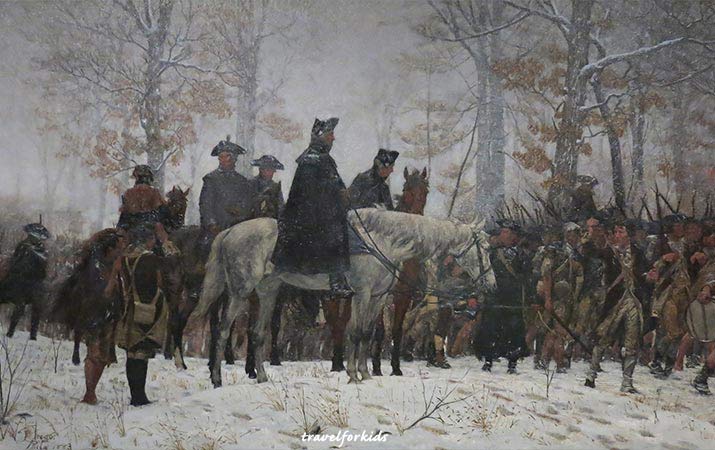
On this day in 1777, General George Washington led his army of about 11,000 men to Valley Forge, Pa., to camp for the winter.

American Battlefield Trust details the encampment ...
The army spent the night of December 18 at Gulph Mills, then marched up the road toward a prominence ironically named Mount Joy, five miles from the previous night’s encampment. Mount Joy was one of two prominent hills that provided protection for the ensuing winter encampment, the other was named Mount Misery. Both names are applicable to what the Continental Army would face during the six months at Valley Forge.

As the soldiers continued the march, a 5,000-acre plot of land unfolded in front of their vision. The area was known to locals as Valley Forge. Due to the geographic outlay of the land and the forge in operation gave the name Valley Forge. European inhabitation stretched back to the turn of the eighteenth century in the surrounding area.

The approach of the Continental Army was not the first instance of the war coming to Valley Forge. On September 18, 1777, British soldiers arrived in the area and in the ensuing two days torched the forge and accompanying buildings while confiscating any supplies that could be transported. Out of consideration of the locals, the gristmill was left undisturbed in September.

Washington’s army would spread out even more within the Valley Forge area eventually covering approximately 7,800 acres of land. Higher ranking officers fanned out to look for their winter accommodations in permanent structures that dotted the landscape. Washington’s staff selected the Isaac Potts house as his headquarters for the winter. The stone house took over two years to construct and was finished in 1770. By December 1777 the house was occupied by Mrs. Deborah Hewes, a relative of the Potts. Due to Continental law, which forbade mandatory accommodations, Washington’s staff arranged a price with Mrs. Hewes on rent.

The native Virginian hunkered down within Valley Forge to suffer, in a degree, with the wintry weather and privations faced by the rank-and-file. The encampment began on the night of December 19, the men sleeping either under the late autumn moon or under canvas tent flaps. The next morning, construction began on the more permanent winter abodes.

The details of the painting are HERE

18 December 2025

Blessed.


In 1635, when the Massachusetts General Court authorized the founding of the town, it possessed a natural setting with distinct advantages replicated nowhere else in New England. Over millennia, the forces of geology had fashioned a physical landscape that the Native inhabitants had improved to sustain their way of life, and had unwittingly made ready for appropriation by the newcomers from across the sea. These resources drew pioneers into the interior, well beyond the seaboard, for the first time, and enabled the creation of new social and intellectual landscapes. Nature blessed Concord from the start. 

16 December 2025

O'erflows.


A BALLAD of the BOSTON TEA-PARTY

No! never such a draught was poured
Since Hebe served with nectar
The bright Olympians and their Lord,
Her over-kind protector,--
Since Father Noah squeezed the grape
And took to such behaving
As would have shamed our grandsire ape
Before the days of shaving,--
No! ne'er was mingled such a draught
In palace, hall, or arbor,
As freemen brewed and tyrants quaffed
That night in Boston Harbor!
The Western war-cloud's crimson stained
The Thames, the Clyde, the Shannon;
Full many a six-foot grenadier
The flattened grass had measured,
And many a mother many a year
Her tearful memories treasured;
Fast spread the tempest's darkening pall,
The mighty realms were troubled,
The storm broke loose, but first of all
The Boston teapot bubbled!

An evening party,--only that,
No formal invitation,
No gold-laced coat, no stiff cravat,
No feast in contemplation,
No silk-robed dames, no fiddling band,
No flowers, no songs, no dancing,--
A tribe of red men, axe in hand,--
Behold the guests advancing!
How fast the stragglers join the throng,
From stall and workshop gathered!
The lively barber skips along
And leaves a chin half-lathered;
The smith has flung his hammer down,
The horseshoe still is glowing;
The truant tapster at the Crown
Has left a beer-cask flowing;
The cooper's boys have dropped the adze,
And trot behind their master;
Up run the tarry ship-yard lads,--
The crowd is hurrying faster,--
Out from the Millpond's purlieus gush
The streams of white-faced millers,
And down their slippery alleys rush
The lusty young Fort-Hillers--
The ropewalk lends its 'prentice crew,--
The tories seize the omen:
"Ay, boys, you'll soon have work to do
For England's rebel foemen,
'King Hancock,' Adams, and their gang,
That fire the mob with treason,--
When these we shoot and those we hang
The town will come to reason."

On--on to where the tea-ships ride!
And now their ranks are forming,--
A rush, and up the Dartmouth's side
The Mohawk band is swarming!
See the fierce natives! What a glimpse
Of paint and fur and feather,
As all at once the full-grown imps
Light on the deck together!
A scarf the pigtail's secret keeps,
A blanket hides the breeches,--
And out the cursed cargo leaps,
And overboard it pitches!

O woman, at the evening board
So gracious, sweet, and purring,
So happy while the tea is poured,
So blest while spoons are stirring,
What martyr can compare with thee,
The mother, wife, or daughter,
That night, instead of best Bohea,
Condemned to milk and water!

Ah, little dreams the quiet dame
Who plies with' rock and spindle
The patient flax, how great a flame
Yon little spark shall kindle!
The lurid morning shall reveal
A fire no king can smother
Where British flint and Boston steel
Have clashed against each other!
Old charters shrivel in its track,
His Worship's bench has crumbled,

It climbs and clasps the union-jack,
Its blazoned pomp is humbled,
The flags go down on land and sea
Like corn before the reapers;
So burned the fire that brewed the tea
That Boston served her keepers!

The waves that wrought a century's wreck
Have rolled o'er whig and tory;
The Mohawks on the Dartmouth's deck
Still live in song and story;
The waters in the rebel bay
Have kept the tea-leaf savor;
Our old North-Enders in their spray
Still taste a Hyson flavor;
And Freedom's teacup still o'erflows
With ever fresh libations,
To cheat of slumber all her foes
And cheer the wakening nations.

Oliver Wendell Holmes

23 November 2025

Miscounted.

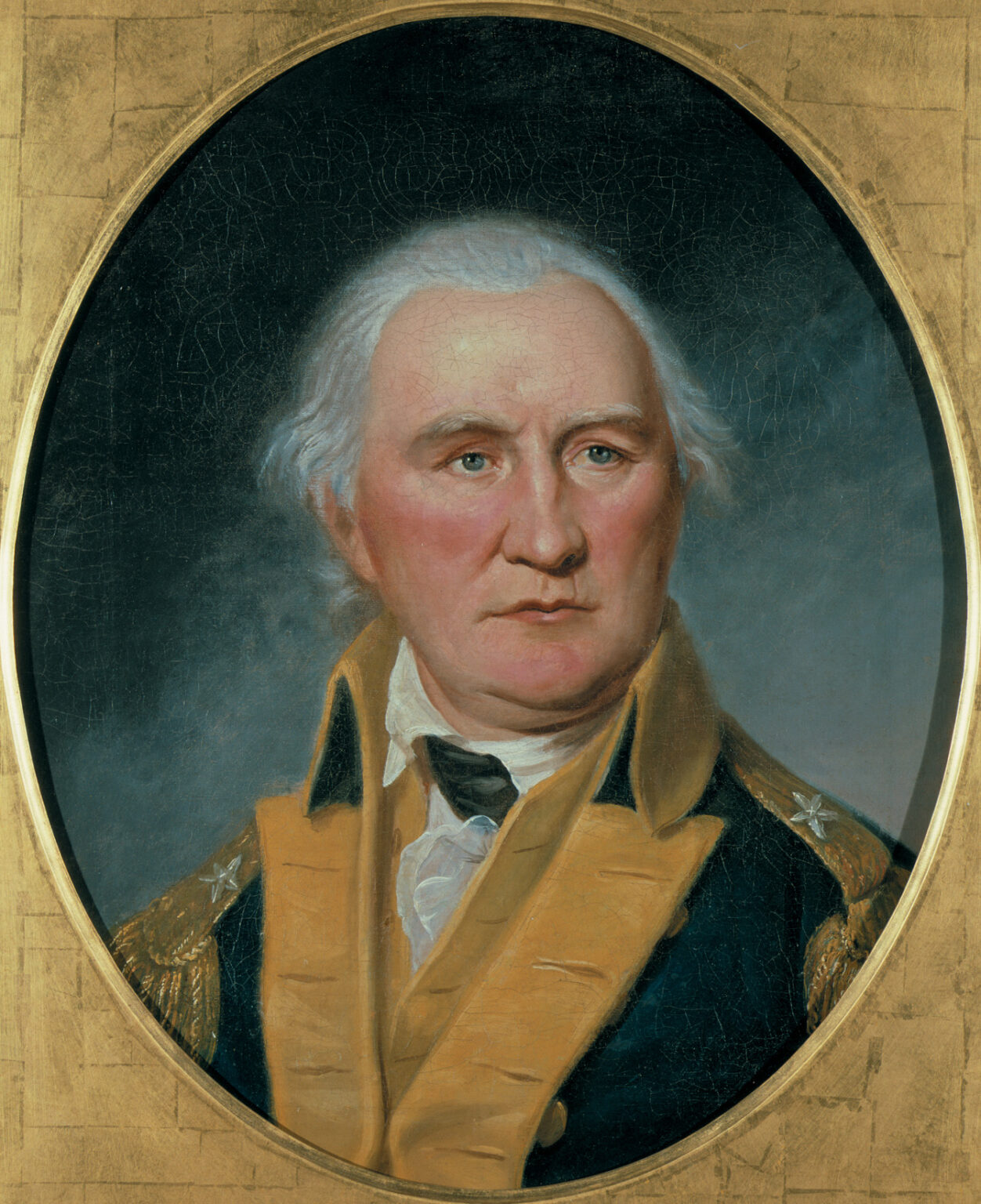
Peale, C.W., Captain Daniel Morgan, 1794


American Battlefield Trust tells the story of Captain Daniel Morgan ...
Daniel Morgan, an American hero during the American Revolution, grew up with a rebellious streak. As a young man, he settled in Virginia's Shenandoah Valley outside Winchester. Morgan worked as a teamster, hauling freight to the eastern part of the colony.

His teamster career drew him into the French and Indian War, during which he helped to supply the British Army. He soon became known as the “Old Wagoner.” He accompanied General Edward Braddock on his ill-fated campaign against the French and Indians at Fort Duquesne. During the expedition, Morgan annoyed a superior officer who struck him with the flat of his sword. Morgan knocked the man down. For his impertinence, Morgan was punished with 500 lashes—typically fatal number. He survived the ordeal, carrying his scars and his disdain for the rest of his life. Afterward, when Morgan retold the story, he commonly boasted that the British had miscounted, only giving him 499.

17 September 2025

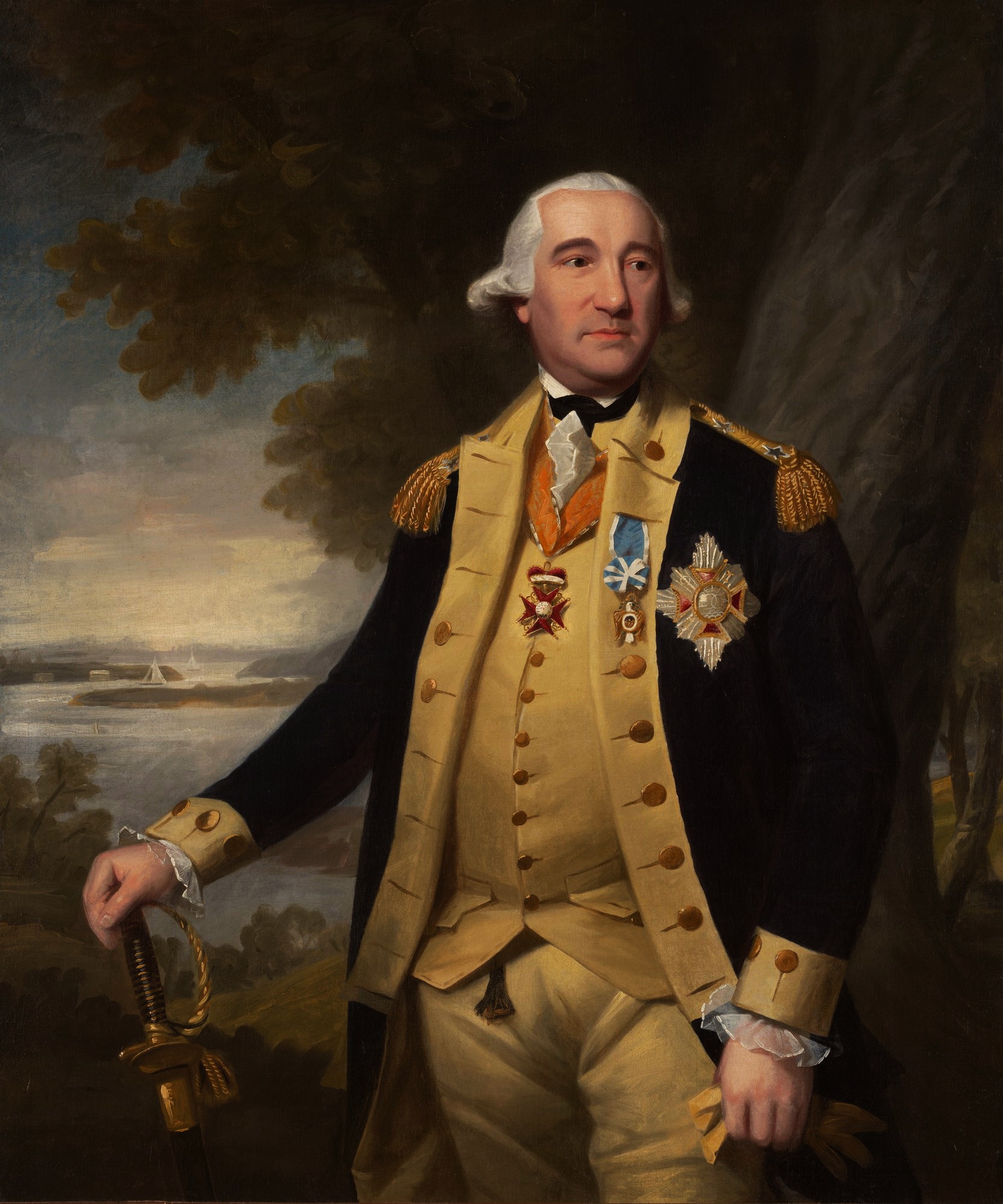
Happy Birthday, Friedrich Wilhelm Augustus, Baron von Steuben

Earl, Major General Friedrich Wilhelm Augustus, Baron von Steuben, 1786


“Baron Steuben has arrived at camp,” Washington wrote soon after. “He appears to be much of a gentleman, and as far as I have had an opportunity of judging, a man of military knowledge and acquainted with the world.” Washington’s confidence in von Steuben grew quickly. Within two weeks, he made the baron acting inspector general and asked him to examine the Continental Army’s condition.

“What [Steuben] discovered was nothing less than appalling,” wrote Fleming in Washington’s Secret War. “He was confronting a wrecked army. A less courageous (or less bankrupt) man would have quit on the spot.” Unlike the American forces in New York, who had beaten the British at Saratoga in fall 1777, the army in Pennsylvania had suffered a series of defeats. When they lost the Battle of Brandywine in September 1777, the British had seized Philadelphia. Now—following common military practice of the era—they had camped for the winter. But Valley Forge, their winter quarters, was nearly as punishing as battle: hastily built huts, cruel temperatures, scarce food.

The baron found soldiers without uniforms, rusted muskets without bayonets, companies with men missing and unaccounted for. Short enlistments meant constant turnover and little order. Regiment sizes varied wildly. Different officers used different military drill manuals, leading to chaos when their units tried to work together. If the army had to fight on short notice, von Steuben warned Washington, he might find himself commanding one-third of the men he thought he had. The army had to get into better shape before fighting resumed in the spring.

So, von Steuben put the entire army through Prussian-style drills, starting with a model company of 100 men. He taught them how to reload their muskets quickly after firing, charge with a bayonet and march in compact columns instead of miles-long lines. Meanwhile, he wrote detailed lists of officers’ duties, giving them more responsibility than in English systems.

Soldiers gaped at the sight of a German nobleman, in a French-style black beaver hat, drilling poorly clothed troops. Though von Steuben raged and cursed in a garbled mixture of French, English, and German, his instructions and presence began to build morale. “If anything, the curses contributed to Steuben’s reputation as an exotic character who was good for a laugh now and then,” wrote Fleming.


Breaking down The Baron's Blue Book, HERE.

"Building the Continental Army," HERE.