Thank you, Veerle.
Showing posts with label van Gogh. Show all posts
Showing posts with label van Gogh. Show all posts
19 September 2026


20 July 2026
Musically.
van Gogh, Wheat Field with a Lark, Summer, 1887

In the end we shall have had enough of cynicism, skepticism and humbug, and we shall want to live more musically.
Vincent van Gogh, from his letter to Theo van Gogh, 24 September 1888
20 June 2026
Searching.

If I cease searching, then, woe is me, I am lost. That is how I look at it - keep going, keep going, come what may.
Vincent van Gogh, from a letter to his brother, Theo, July, 1880
17 June 2026
Most.
van Gogh, Shoes, 1886

The PHILOSOPHER
I saw him sitting in his door,
—Trembling as old men do;
His house was old; his barn was old,
—And yet his eyes seemed new.
His eyes had seen three times my years
—And kept a twinkle still,
Though they had looked at birth and death
—And three graves on a hill.
“I will sit down with you,” I said,
—“And you will make me wise;
Tell me how you have kept the joy
—Still burning in your eyes.”
Then like an old-time orator
—Impressively he rose;
“I make the most of all that comes,
—The least of all that goes.”
The jingling rhythm of his words
—Echoes as old songs do,
Yet this had kept his eyes alight
—Till he was ninety-two.
Sara Teasdale
01 April 2026
Delightful.
van Gogh, Landscape at Auvers in the Rain, 1890

APRIL SHOWERS
Delightful weather for all sorts of moods
& most for him – grey morn and swarthy eye
Found rambling up the little narrow lane
Where primrose banks amid the hazly woods
Peep most delightfully on passers bye
While Aprils little clouds about the sky
Mottle & freak unto fancy lie
Idling and ending travel for the day
Till darker clouds sail up with cumberous heave
South oer the woods & scares them all away
Then comes the rain pelting with pearly drops
The primrose crowds until they stoop & lie
All fragrance to his mind that musing stops
Beneath the hawthorn till the shower is bye
John Clare
30 March 2026
Happy Birthday, Vincent van Gogh
van Gogh, Self-Portrait with Dark Felt Hat at the Easel, 1886
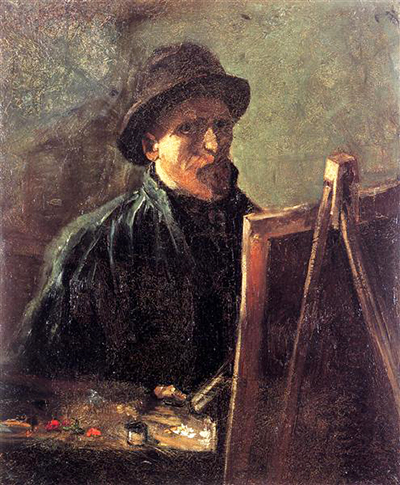
I, for one, am a man of passions, capable of and liable to do rather foolish things for which I sometimes feel rather sorry. I do often find myself speaking or acting somewhat too quickly when it would be better to wait more patiently. I think that other people may also sometimes do similar foolish things. Now that being so, what’s to be done, must one consider oneself a dangerous man, incapable of anything at all? I don’t think so. But it’s a matter of trying by every means to turn even these passions to good account. For example, to name one passion among others, I have a more or less irresistible passion for books, and I have a need continually to educate myself, to study, if you like, precisely as I need to eat my bread.
Vincent van Gogh, born on this day in 1853, from a letter to Theo van Gogh, June 1880
29 March 2026
Ample.
Delacroix, A Vase of Flowers, 1833

We are nothing but links in a chain. Old Gauguin and I understand each other basically, and if we are a bit mad, what of it? Aren't we also thoroughly artists enough to contradict suspicions on that score by what we say with our brush? Perhaps someday everyone will have neurosis, St. Vitus' dance, or something else.
But doesn't the antidote exist? In Delacroix, in Berlioz, and Wagner? And really, as for the artist's madness of all the rest of us, I do not say that I especially am not infected through and through, but I say and will maintain that our antidotes and consolations may, with a little good will, be considered ample compensation.
Vincent van Gogh, from a letter to Theo van Gogh. Monday, 28 January 1889
Feeling.

The Van Gogh Museum explores Vincent's palette ...
For Vincent, an understanding of colour theory was essential in painting. He also realised that a painter should not attempt to reproduce the exact colour he saw before him. That was merely "the reflection of reality in the mirror," not art. "The effects colours produce through their harmonies or discords should be boldly exaggerated" to convey a feeling.
Understand.
van Gogh, Undergrowth with Two Figures, 1890

Do go on doing a lot of walking and keep up your love of nature, for that is the right way to understand art better and better. Painters understand nature and love her and teach us to see.
And then there are painters who never do anything that is no good, who cannot do anything bad, just as there are ordinary people who can do nothing but good.
I'm getting on very well here. I've got a delightful home and I'm finding it very pleasurable taking a look at London and the English way of life and the English people themselves, and then I've got nature and art and poetry, and if that isn't enough, what is?
Vincent van Gogh, from a letter to Theo van Gogh, January 1874
28 March 2026
Remembers.
van Gogh, Boats at Sea, Saintes-Maries-de-la-Mer, 1888

He who hoists the Ambition & Co. sail and no other on his mast, sails through life on a straight course without accidents, without wavering until - until at last, at last, circumstances arise which make him think, I haven't enough sail. Then he says, I would give everything I possess for another square of sail, and I have not got it. He is in despair.
But now he remembers that he possesses another power which he can use; he thinks of the sail which he has despised until now, which he had put away with the ballast. And it is this sail that saves him. Love's sail must save him; without hoisting it, he cannot arrive.
Vincent van Gogh, from a letter to Theo van Gogh, 12 November 1881
27 March 2026
Through.
van Gogh, Rain, 1889
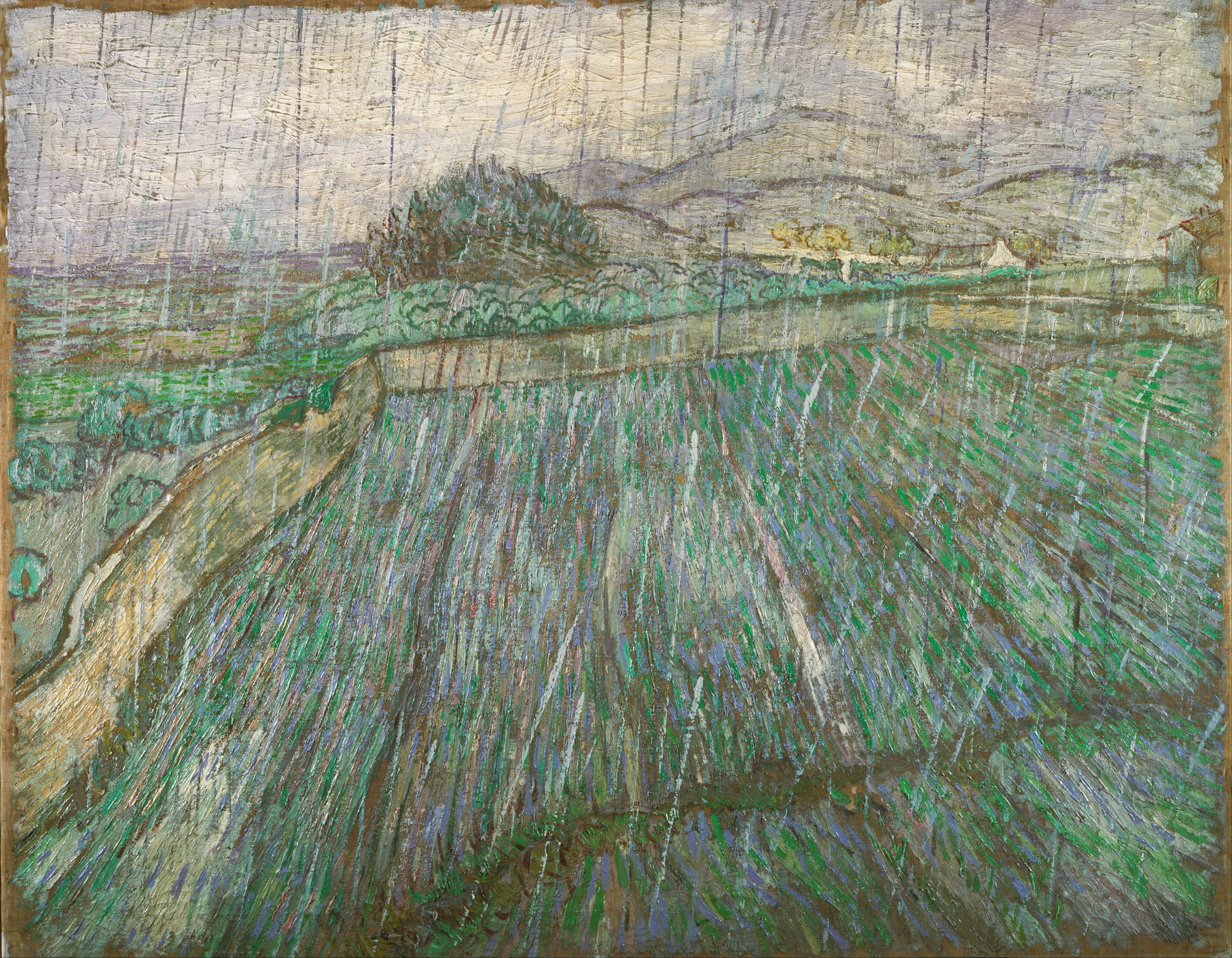
What am I in the eyes of most people? A nonentity or an oddity or a disagreeable person — someone who has and will have no position in society, in short a little lower than the lowest.
Very well — assuming that everything is indeed like that, then through my work I’d like to show what there is in the heart of such an oddity, such a nobody.
This is my ambition, which is based less on resentment than on love in spite of everything, based more on a feeling of serenity than on passion.
Vincent van Gogh, from a letter to Theo van Gogh on or about Friday, 21 July 1882
25 March 2026
Pining.
van Gogh, Still Life with Bread, 1887

For one’s own work, thoughts and observation are not enough, we need the comfort and blessing and guidance of a higher power, and that is something anyone who is at all serious and who longs to lift up his soul to the light is sure to recognize and experience. Pining for God works like leaven on dough.
Vincent van Gogh, from a letter to his brother Theo, May 19, 1887
24 March 2026
Service.
van Gogh, Sprig of Flowering Almond in a Glass, 1888

There is a great difference between one idler and another idler. There is someone who is an idler out of laziness and lack of character, owing to the baseness of his nature. If you like, you may take me for one of those. Then there is the other kind of idler, the idler despite himself, who is inwardly consumed by a great longing for action who does nothing because his hands are tied, because he is, so to speak, imprisoned somewhere, because he lacks what he needs to be productive, because disastrous circumstances have brought him forcibly to this end. Such a one does not always know what he can do, but he nevertheless instinctively feels, I am good for something! My existence is not without reason! I know that I could be a quite a different person! How can I be of use, how can I be of service? There is something inside me, but what can it be? He is quite another idler. If you like you may take me for one of those.
Vincent van Gogh, from a letter to Theo van Gogh, July 1880
24 January 2026
Hold.
van Gogh, The Potato Eaters, 1885

The likelihood that your acts of resistance cannot stop the injustice does not exempt you from acting in what you sincerely and reflectively hold to be the best interests of your community.
Susan Sontag
We frequently have conversations after dinner concerning influence and where some loved ones get bogged down and desperate, I can see clearly and confidently.
Saving the planet is impossible. Saving the world sitting with you at dinner is not only possible, but paramount. Listen, ask questions, listen some more, think, discuss, hold hands -- tightly, pat on the back and hug. Disagree? Listen some more. Think. Keep talking. Stay together. Come back to the table. Listen.
Then act.
Your world is small. Possible. Paramount.
Stay out of my yard.
20 November 2025
Hopeful.
van Gogh, Self-Portrait Dedicated to Paul Gaugin (detail), 1888

Our life is a pilgrim's progress. I once saw a very beautiful picture, it was a landscape at evening. In the distance on the right hand side a row of hills appearing blue in the evening mist. Above those hills the splendour of the sunset, the grey clouds with their linings of silver and gold and purple. The landscape is a plain or heath covered with grass and heather, here and there the white stem of a birch tree and its yellow leaves, for it was in Autumn. Through the landscape a road leads to a high mountain far far away, on the top of that mountain a city whereon the setting sun casts a glory. On the road walks a pilgrim, staff in hand. He has been walking for a good long while already and he is very tired. And now he meets a woman, a figure in black that makes one think of St Paul's word, "As being sorrowful yet always rejoicing." That Angel of God has been placed there to encourage the pilgrims and to answer their questions:
And the pilgrim asks her: Does the road go uphill then all the way?and the answer is “Yes to the very end”─and he asks again: And will the journey take all day long?and the answer is: “From morn till night my friend”.
And the pilgrim goes on sorrowful yet always rejoicing – sorrowful because it is so far off and the road so long. Hopeful as he looks up to the eternal city far away, resplendent in the evening glow.
Vincent van Gogh, from a letter to his brother, Theo, Friday, 3 November 1876
26 October 2025
Accessible.
van Gogh, Self-Portrait as an Artist, 1888
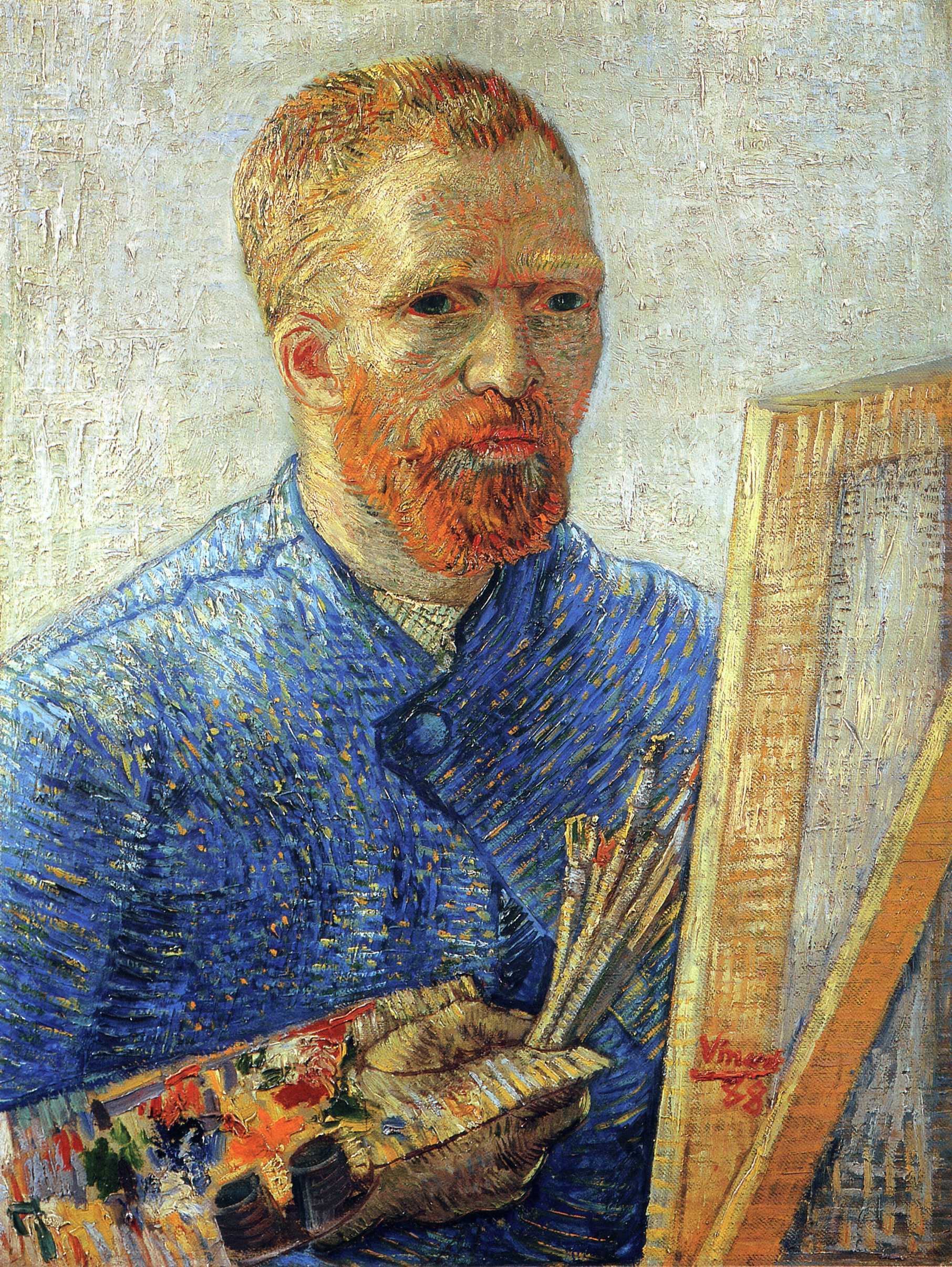
It certainly is a strange phenomenon that all the artists, poets, musicians, painters, are unfortunate in material things — the happy ones as well — what you said lately about Guy de Maupassant is a fresh proof of it. That brings up again the eternal question: is life completely visible to us, or isn't it rather that this side of death we see one hemisphere only?
Painters — to take them only — being dead and buried, speak to the next generation or to several succeeding generations through their work.
Is that all, or is there more besides? In a painter's life death is not perhaps the hardest thing there is.
For my own part, I declare I know nothing whatever about it. But to look at the stars always makes me dream, as simply as I dream over the black dots of a map representing towns and villages. Why, I ask myself, should the shining dots of the sky not be as accessible as the black dots on the map of France? If we take the train to get to Tarascon or Rouen, we take death to reach a star. One thing undoubtedly true in this reasoning is this: that while we are alive we cannot get to a star, any more than when we are dead we can take the train.
Vincent van Gogh, from a letter to his brother, Theo, 9 July 1888
27 September 2025
Deserve.
van Gogh, Glass with Carnations, 1890

We are not alive in order to be happy, but we must try to deserve happiness.
Vincent van Gogh, from a letter to Theo van Gogh, Sunday, 10 December 1882
21 August 2025
Needs.
van Gogh, Cafe Terrace at Night, 1888

“I am one of those who like to stay late at the cafe," the older waiter said. "With all those who do not want to go to bed. With all those who need a light for the night."
"I want to go home and into bed."
"We are of two different kinds," the older waiter said. He was now dressed to go home. "It is not only a question of youth and confidence although those things are very beautiful. Each night. I am reluctant to close up because there may be someone who needs the cafe.”
Ernest Hemingway, from A Clean Well-Lighted Place
06 July 2025
Elsewhere.
van Gogh, Flowering Garden with Path, Arles, 1888

Daydream undoubtedly feeds on all kinds of sights, but through a sort of natural inclination, it contemplates grandeur. And this contemplation produces an attitude that is so special, an inner state that is so unlike any other, that the daydream transports the dreamer outside the immediate world to a world that bears the mark of infinity.
Far from the immensities of sea and land, merely through memory, we can recapture, by means of meditation, the resonances of this contemplation of grandeur. But is this really memory? Isn't imagination alone able to enlarge indefinitely the images of immensity? In point of fact, daydreaming, from the very first second, is an entirely constituted state. We do not see it start, and yet it always starts the same way, that is, it flees the object nearby and right away it is far off, elsewhere, in the space of elsewhere.
Gaston Bachelard, from The Poetics of Space
30 May 2025
Always.
van Gogh, Patch of Grass, 1887

It is a good thing in winter to be deep in the snow, in the autumn deep in the yellow leaves, in summer among the ripe corn, in spring amid the grass; it is a good thing to be always with the mowers and the peasant girls, in summer with a big sky overhead, in winter by the fireside, and to feel that it always has been and always will be so.
Vincent van Gogh, from a letter to Theo van Gogh, June 1885
Subscribe to:
Posts (Atom)