16 January 2017
Happy birthday, Service.
Robert W. Service was born on this day in 1874.
CARRY ON!
It's easy to fight when everything's right,
And you're mad with the thrill and the glory;
It's easy to cheer when victory's near,
And wallow in fields that are gory.
It's a different song when everything's wrong,
When you're feeling infernally mortal;
When it's ten against one, and hope there is none,
Buck up, little soldier, and chortle:
Carry on! Carry on!
There isn't much punch in your blow.
You're glaring and staring and hitting out blind;
You're muddy and bloody, but never you mind.
Carry on! Carry on!
You haven't the ghost of a show.
It's looking like death, but while you've a breath,
Carry on, my son! Carry on!
And so in the strife of the battle of life
It's easy to fight when you're winning;
It's easy to slave, and starve and be brave,
When the dawn of success is beginning.
But the man who can meet despair and defeat
With a cheer, there's the man of God's choosing;
The man who can fight to Heaven's own height
Is the man who can fight when he's losing.
Carry on! Carry on!
Things never were looming so black.
But show that you haven't a cowardly streak,
And though you're unlucky you never are weak.
Carry on! Carry on!
Brace up for another attack.
It's looking like hell, but -- you never can tell:
Carry on, old man! Carry on!
There are some who drift out in the deserts of doubt,
And some who in brutishness wallow;
There are others, I know, who in piety go
Because of a Heaven to follow.
But to labour with zest, and to give of your best,
For the sweetness and joy of the giving;
To help folks along with a hand and a song;
Why, there's the real sunshine of living.
Carry on! Carry on!
Fight the good fight and true;
Believe in your mission, greet life with a cheer;
There's big work to do, and that's why you are here.
Carry on! Carry on!
Let the world be the better for you;
And at last when you die, let this be your cry:
Carry on, my soul! Carry on!
Robert W. Service
Blueprint.
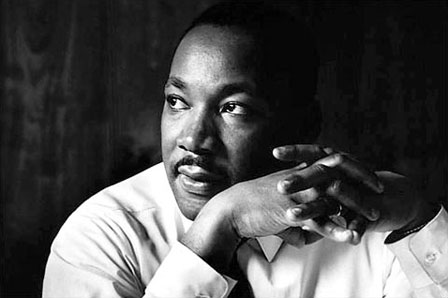
I want to ask you a question, and that is: What is your life's blueprint?
Whenever a building is constructed, you usually have an architect who draws a blueprint, and that blueprint serves as the pattern, as the guide, and a building is not well erected without a good, solid blueprint.
Now each of you is in the process of building the structure of your lives, and the question is whether you have a proper, a solid and a sound blueprint.
I want to suggest some of the things that should begin your life's blueprint. Number one in your life's blueprint, should be a deep belief in your own dignity, your worth and your own somebodiness. Don't allow anybody to make you fell that you're nobody. Always feel that you count. Always feel that you have worth, and always feel that your life has ultimate significance.
Secondly, in your life's blueprint you must have as the basic principle the determination to achieve excellence in your various fields of endeavor. You're going to be deciding as the days, as the years unfold what you will do in life — what your life's work will be. Set out to do it well.
And I say to you, my young friends, doors are opening to you--doors of opportunities that were not open to your mothers and your fathers — and the great challenge facing you is to be ready to face these doors as they open.
Ralph Waldo Emerson, the great essayist, said in a lecture in 1871, "If a man can write a better book or preach a better sermon or make a better mousetrap than his neighbor, even if he builds his house in the woods, the world will make a beaten path to his door."
This hasn't always been true — but it will become increasingly true, and so I would urge you to study hard, to burn the midnight oil; I would say to you, don't drop out of school. I understand all the sociological reasons, but I urge you that in spite of your economic plight, in spite of the situation that you're forced to live in — stay in school.
And when you discover what you will be in your life, set out to do it as if God Almighty called you at this particular moment in history to do it. don't just set out to do a good job. Set out to do such a good job that the living, the dead or the unborn couldn't do it any better.
If it falls your lot to be a street sweeper, sweep streets like Michelangelo painted pictures, sweep streets like Beethoven composed music, sweep streets like Leontyne Price sings before the Metropolitan Opera. Sweep streets like Shakespeare wrote poetry. Sweep streets so well that all the hosts of heaven and earth will have to pause and say: Here lived a great street sweeper who swept his job well. If you can't be a pine at the top of the hill, be a shrub in the valley. Be be the best little shrub on the side of the hill.
Be a bush if you can't be a tree. If you can't be a highway, just be a trail. If you can't be a sun, be a star. For it isn't by size that you win or fail. Be the best of whatever you are.
Martin Luther King, Jr.
15 January 2017
Lifts.
A WINTER EDEN
A winter garden in an alder swamp,
Where conies now come out to sun and romp,
As near a paradise as it can be
And not melt snow or start a dormant tree.
It lifts existence on a plane of snow
One level higher than the earth below,
One level nearer heaven overhead,
And last year's berries shining scarlet red.
It lifts a gaunt luxuriating beast
Where he can stretch and hold his highest feat
On some wild apple tree's young tender bark,
What well may prove the year's high girdle mark.
So near to paradise all pairing ends:
Here loveless birds now flock as winter friends,
Content with bud-inspecting. They presume
To say which buds are leaf and which are bloom.
A feather-hammer gives a double knock.
This Eden day is done at two o'clock.
An hour of winter day might seem too short
To make it worth life's while to wake and sport.
Robert Frost
Labels:
appreciation,
Frost,
nature,
noticing,
outdoors,
poetry,
poetry rules!,
seasons,
winter
Typography.
Realization.
In a time when most construction was still quite primitive and utilitarian, the world’s great Gothic buildings were being assembled one stone at a time, through immense trial and error. Consider being chosen by the Church to design one of these structures: imagine your excitement at the undertaking being tempered by the realization that your grandchildren would be long dead by the time it was complete.
Vivaldi, Mandolin Concerto in C Major, RV 425
Avi Avital performs with the Venice Baroque Orchestra ...
Humility.
As the night wore on we talked about various things until, at one point, I asked, “Why grizzlies?”
He explained that after returning from the war he began doing a lot of camping in wild places. One of those places was the backcountry of Yellowstone and it was there that he started finding himself in the company of bears. During one of his very first encounters he had been soaking in a thermal pool when he was startled by a sow and her cub. The bear had treed him and Peacock had ended up naked and shivering up in the tree for over an hour.
Gradually, grizzlies became not the natural byproduct of his trips into the backcountry but the goal. Though he didn’t like the word, it was hard to say there wasn’t a spiritual aspect to his trips into grizzly country. He came to believe that many of our basic religious archetypes grew out of observing bears. After all, what better animal to embody resurrection, the death of a winter’s hibernation followed by the rebirth of spring’s emergence from the den?
Peacock loved guns and owned many but he refused to bring them along when he knew he would encounter the bears.
“That would defeat the purpose,” he said.
CONNECT
Hear.
There is another physical law that teases me, too: the Doppler Effect. The sound of anything coming at you- a train, say, or the future- has a higher pitch than the sound of the same thing going away. If you have perfect pitch and a head for mathematics you can compute the speed of the object by the interval between its arriving and departing sounds. I have neither perfect pitch nor a head for mathematics, and anyway who wants to compute the speed of history? Like all falling bodies, it constantly accelerates. But I would like to hear your life as you heard it, coming at you, instead of hearing it as I do, a somber sound of expectations reduced, desires blunted, hopes deferred or abandoned, chances lost, defeats accepted, griefs borne.
Wallace Stegner
14 January 2017
Happy birthday, Fantin-Latour.
Fantin-Latour, Self-portrait, 1861
Ignace Henri Jean Théodore Fantin-Latour was born on this day in 1836.
To make a painting representing things as they are found in
nature, I put a great deal of thought into the arrangement, but with the idea
of making it look like a natural arrangement of random objects. This is an idea
that I have been mulling over a great deal: giving the appearance of a total
lack of artistry.
Henri Fantin-Latour
Fantin-Latour, A Basket of Roses, 1890
New Order, Power, Corruption, and Lies, 1983
13 January 2017
Relearn.
Suzuki, Beginner's Mind, undated
The illiterate of the 21st century will not be those who
cannot read and write, but those who cannot learn, unlearn and relearn.
Alvin Toffler
12 January 2017
Translucent.
Wyeth, Hoffman's Barn, 1959
Birches, snow, firewood, sky, road, fire, smoke, frost— I
repeated the words that I remembered for only a slightly shorter time than I
remembered myself. Birches, snow, firewood, sky, road, fire, smoke, frost— the
words grew, as if they were material, had material energy; the words sounded
symphonically, one through another, without blending, the frost was frosty, the
fire fiery, the smoke smoky; the words became translucent, melting slightly,
like pure flame, their phonetic casings lost their hardened precision, and the
eye perceived the pure essence of meaning— like a bubble of air in a precious
stone, refracting the light differently.
Sergei Lebedev
Same.
through my veins night and day runs
through the world and dances in rhythmic measure.
It is the same life that shoots in joy
through the dust of the earth in numberless blades of grass and
breaks into tumultuous waves of leaves and flowers.
It is the same life that is rocked in the oceans-cradle
of birth and of death, In ebb and in flow
I feel my limbs are made glorious by the touch of this world
of life. And my pride is from the life-throb of ages
dancing in my blood this moment.
Rabindranath Tagore
Labels:
appreciation,
flow,
life,
poetry,
poetry rules!,
rivers,
Tagore
Strauss, Till Eulenspiegel's Merry Pranks
Bavarian Broadcasting Symphony Orchestra, conducted by Lorin Maazel, performs ...
Experience.
Your teacher cannot bridge the gap between what you know and
what you want to know. For his words to ‘educate’ you, you must welcome them,
think about them, find somewhere for your mind to organize them, and remember
them. Your learning is your job, not your teacher’s job. And all you need to
start with is desire. You don’t need a schoolteacher to get knowledge – you can
get it from looking at the world, from watching films, from conversations, from
reading, from asking questions, from experience.
People who have never gone to school have never developed
negative attitudes toward exploring their world. Unfortunately, you probably
have. It’s not your fault if you don’t immediately want to run out and watch
ladybugs with a magnifying glass. It might take time before your desire to
learn surfaces from beneath the layers of guilt – the voices insisting, I
should learn this, I have to learn that. Give yourself time. Don’t push. You’ll
recover.
In the end, the secret to learning is so simple: forget
about it. Think only about whatever you love. Follow it, do it, dream it. One
day, you will glance up at your collection of Japanese literature, or trip over
the solar oven you built, and it will hit you: learning was there all the time,
happening by itself.
Grace LLewellyn
Happy birthday, London.
Jack London was born on this day in 1876.
One day
A stranger came up to me
Speaking in riddles
He said:
"Inspiration incites the incense within that incarnates indigo indians."
I did not know what he meant until he added:
"You can't wait for inspiration. You must go after it with a club."
Jack London
Labels:
appreciation,
art,
London,
poetry,
poetry rules!
The unexamined life is surely worth living, but is the
unlived life worth examining? It seems a strange question until one realizes
how much of our so-called mental life is about the lives we are not living, the
lives we are missing out on, the lives we could be leading but for some reason
are not. What we fantasize about, what we long for, are the experiences, the
things and the people that are absent. It is the absence of what we need that
makes us think, that makes us cross and sad. We have to be aware of what is
missing in our lives — even if this often obscures both what we already have
and what is actually available — because we can survive only if our appetites
more or less work for us. Indeed, we have to survive our appetites by making
people cooperate with our wanting. We pressurize the world to be there for our
benefit. And yet we quickly notice as children — it is, perhaps, the first
thing we do notice — that our needs, like our wishes, are always potentially
unmet. Because we are always shadowed by the possibility of not getting what we
want, we learn, at best, to ironize our wishes — that is, to call our wants
wishes: a wish is only a wish until, as we say, it comes true — and, at worst,
to hate our needs. But we also learn to live somewhere between the lives we
have and the lives we would like.
We refer to them as our unlived lives because somewhere we
believe that they were open to us; but for some reason — and we might spend a
great deal of our lived lives trying to find and give the reason — they were
not possible. And what was not possible all too easily becomes the story of our
lives. Indeed, our lived lives might become a protracted mourning for, or an
endless tantrum about, the lives we were unable to live. But the exemptions we
suffer, whether forced or chosen, make us who we are.
We are always haunted by the myth of our potential, of what
we might have it in ourselves to be or do. We share our lives with the people
we have failed to be.
Our lives become an elegy to needs unmet and desires
sacrificed, to possibilities refused, to roads not taken. The myth of our
potential can make of our lives a perpetual falling-short, a continual and
continuing loss, a sustained and sometimes sustaining rage.
We have an abiding sense, however obscure and obscured, that
the lives we do lead are informed by the lives that escape us.
Because we are nothing special — on a par with ants and
daffodils — it is the work of culture to make us feel special; just as parents
need to make their children feel special to help them bear and bear with — and
hopefully enjoy — their insignificance in the larger scheme of things. In this
sense growing up is always an undoing of what needed to be done: first,
ideally, we are made to feel special; then we are expected to enjoy a world in
which we are not… When people realize how accidental they are, they are tempted
to think of themselves as chosen. We certainly tend to be more special, if only
to ourselves, in our imaginary unlived lives.
So it is worth wondering what the need to be special
prevents us seeing about ourselves — other, that is, than the unfailing
transience of our lives; what the need to be special stops us from being. This,
essentially, is the question psychoanalysis was invented to address: what kind
of pleasures can sustain a creature that is nothing special? Once the promise
of immortality, of being chosen, was displaced by the promise of more life —
the promise, as we say, of getting more out of life — the unlived life became a
haunting presence in a life legitimated by nothing more than the desire to live
it. For modern people, stalked by their choices, the good life is a life lived
to the full. We become obsessed, in a new way, by what is missing in our lives;
and by what sabotages the pleasures that we seek.
We make our lives pleasurable, and therefore bearable, by
picturing them as they might be; it is less obvious, though, what these
compelling fantasy lives — lives of, as it were, a more complete satisfaction —
are a self-cure for. Our solutions tell us what our problems are; our fantasy
lives are not — or not necessarily — alternatives to, or refuges from, those
real lives but an essential part of them. There is nothing more obscure than
the relationship between the lived and the unlived life. (Each member of a
couple, for example, is always having a relationship, wittingly or unwittingly,
with their partner’s unlived lives; their initial and initiating relationship
is between what they assume are their potential selves.) So we may need to
think of ourselves as always living a double life, the one that we wish for and
the one that we practice; the one that never happens and the one that keeps
happening.
There is a gap between what we want and what we can have,
and that gap is our link, our connection, to the world. This discord, this
supposed mismatch, is the origin of our experience of missing out.
Our utopias tell us more about our lived lives, and their
privations, than about our wished-for lives.
In our unlived lives we are always more satisfied, far less
frustrated versions of ourselves… Our possibilities for satisfaction depend
upon our capacity for frustration; if we can’t let ourselves feel our
frustration — and, surprisingly, this is a surprisingly difficult thing to do —
we can’t get a sense of what it is we might be wanting, and missing, of what
might really give us pleasure. That frustration is where we start from; the
child’s dawning awareness of himself is an awareness of something necessary not
being there. The child becomes present to himself in the absence of something
he needs.
The more we frustrate ourselves in wanting something, the
more we value our desire for it. Waiting too long poisons desire, but waiting
too little pre-empts it; the imagining is in the waiting. Wanting takes time;
partly because it takes some time to get over the resistances to wanting, and
partly because we are often unconscious of what it is that we do want. But the
worst thing we can be frustrated of is frustration itself; to be deprived of
frustration is to be deprived of the possibilities of satisfaction.
CONNECT
Phillips' "The Art of Nonfiction" interview in The Paris Review ... HERE.
Institution.

Of all the objects that we pickle, only the pickled cucumber
goes by the simple one-word nickname "pickle," an iconic if still
curious gastronomic institution. But how long have pickles been with us?
Labels:
appreciation,
Eat or die,
eating,
food,
history,
tradition
Happy birthday, Sargent.
Sargent, Pavement in San Marco, Venice, 1901
John Singer Sargent
John Singer Sargent was born on this day in 1856.
Cultivate an ever-continuous power of observation. Wherever
you are, be always ready to make slight notes of postures, groups and
incidents. Store up in the mind... a continuous stream of observations from
which to make selections later. Above all things get abroad, see the sunlight
and everything that is to be seen.
John Singer Sargent
Peace.
We always knew there was no Orpheus in Ireland.
No music stored at the doors of hell.
No god to make it.
No wild beasts to weep and lie down to it.
But I remember an evening when the sky
was underworld-dark at four.
When ice had seized every part of the city
and we sat talking
the air making a wreath for our cups of tea.
And you began to speak of our own gods.
Our heartbroken pantheon:
No Attic light for them and no Herodotus.
But thin rain and dogfish and the stopgap
of the sharp cliffs
they spent their winters on.
And the pitch-black Atlantic night.
And how the sound
of a bird’s wing in a lost language sounded.
You made the noise for me.
Made it again.
Until I could see the flight of it: suddenly
the silvery, lithe rivers of your south-west
lay down in silence.
And the savage acres no one could predict
were all at ease, soothed and quiet and
listening to you, as I was. As if to music, as if to peace.
Eavan Boland
Silent.
His music, His
art.
Sacred books we are, for the infinite camps
in our
souls.
Every act reveals God and expands His Being.
I know that may be hard
to comprehend.
All creatures are doing their best
to help God in His birth
of Himself.
Enough talk for the night
He is laboring in me;
I need to be silent
for a while,
worlds are forming
in my
heart.
Meister Eckhart
Labels:
art,
Eckhart,
poetry,
poetry rules!,
silence,
spirituality,
Wyeth
11 January 2017
Here.
Wyeth, Cellar Fireplace, 1955
Every morning, even before I open my eyes, I know I am in my
bedroom and my bed. But if I go to sleep after lunch in the room where I work,
sometimes I wake up with a feeling of childish amazement — why am I myself?
What astonishes me, just as it astonishes a child when he becomes aware of his
own identity, is the fact of finding myself here, and at this moment, deep in
this life and not in any other. What stroke of chance has brought this about?
What astonishes me, just as it astonishes a child when he becomes aware of his
own identity, is the fact of finding myself here, and at this moment, deep in
this life and not in any other.
Simone de Beauvoir
10 January 2017
Lost.
Wyeth, The Mill, 1964
LANDSCAPE
I want to write a book of chaste and simple verse,
Sleep in an attic, like the old astrologers,
Up near the sky, and hear upon the morning air
The tolling of the bells. I want to sit and stare,
My chin in my two hands, out on the humming shops,
The weathervanes, the chimneys, and the steepletops
That rise like masts above the city, straight and tall,
And the mysterious big heavens over all.
I want to watch the blue mist of the night come on,
The windows and the stars illumined, one by one,
The rivers of dark smoke pour upward lazily,
And the moon rise and turn them silver. I shall see
The springs, the summers, and the autumns slowly pass;
And when old Winter puts his blank face to the glass,
I shall close all my shutters, pull the curtains tight,
And build me stately palaces by candlelight.
And I shall dream of luxuries beyond surmise,
Gardens that are a stairway into azure skies,
Fountains that weep in alabaster, birds that sing
All day — of every childish and idyllic thing.
A revolution thundering in the street below
Will never lure me from my task, I shall be so
Lost in that quiet ecstasy, the keenest still,
Of calling back the springtime at my own free will,
Of feeling a sun rise within me, fierce and hot,
And make a whole bright landscape of my burning thought.
Charles Baudelaire
Subscribe to:
Posts (Atom)


_front_cover.png)