"I am not one who was born in the custody of wisdom. I am one who is fond of olden times and intense in quest of the sacred knowing of the ancients." Gustave Courbet
Showing posts with label Shelley. Show all posts

04 August 2026

Happy Birthday, Percy Bysshe Shelley

Severn, Posthumous Portrait of Shelley, 1845


In the youth of the world, men dance and sing and imitate natural objects, observing in these actions, as in all others, a certain rhythm or order. And, although all men observe a similar, they observe not the same order, in the motions of the dance, in the melody of the song, in the combinations of language, in the series of their imitations of natural objects. For there is a certain order or rhythm belonging to each of these classes of mimetic representation, from which the hearer and the spectator receive an intenser and purer pleasure than from any other: the sense of an approximation to this order has been calledtaste by modern writers. Every man in the infancy of art observes an order which approximates more or less closely to that from which this highest delight results: but the diversity is not sufficiently marked, as that its gradations should be sensible, except in those instances where the predominance of this faculty of approximation to the beautiful (for so we may be permitted to name the relation between this highest pleasure and its cause) is very great. Those in whom it exists in excess are poets, in the most universal sense of the word, in the most universal sense of the word; and the pleasure resulting from the manner in which they express the influence of society or nature upon their own minds, communicates itself to others, and gathers a sort of reduplication from that community.

Poets, or those who imagine and express this indestructible order, are not only the authors of language and of music, of the dance, and architecture, and statuary, and painting: they are the institutors of laws, and the founders of civil society, and the inventors of the arts of life, and the teachers, who draw into a certain propinquity with the beautiful and the true that partial apprehension of the agencies of the invisible world which is called religion. Hence all original religions are allegorical, or susceptible of allegory, and, like Janus, have a double face of false and true. Poets, according to the circumstances of the age and nation in which they appeared, were called, in the earlier epochs of the world, legislators, or prophets: a poet essentially comprises and unites both these characters. For he not only beholds intensely the present as it is, and discovers those laws according to which present things ought to be ordered, but he beholds the future in the present, and his thoughts are the germs of the flower and the fruit of latest time. 

A poet participates in the eternal, the infinite, and the one.

Percy Bysshe Shelley, born on this day in 1792, from "In Defence of Poetry"

09 July 2025

Stretch.

Severn, Posthumous Portrait of Shelley, 1845


OZYMANDIAS

I met a traveller from an antique land,
Who said—“Two vast and trunkless legs of stone
Stand in the desert. . . . Near them, on the sand,
Half sunk a shattered visage lies, whose frown,
And wrinkled lip, and sneer of cold command,
Tell that its sculptor well those passions read
Which yet survive, stamped on these lifeless things,
The hand that mocked them, and the heart that fed;
And on the pedestal, these words appear:
My name is Ozymandias, King of Kings;
Look on my Works, ye Mighty, and despair!
Nothing beside remains. Round the decay
Of that colossal Wreck, boundless and bare
The lone and level sands stretch far away.”

Percy Bysshe Shelley

30 August 2024

Orchestral Manoeuvres in the Dark , "ABC Auto-Industry"

Frankenstein's monster ...

Happy Birthday, Shelley

Rothwell, Mary Shelley, 1840


It was nearly noon when I arrived at the top of the ascent. For some time I sat upon the rock that overlooks the sea of ice. A mist covered both that and the surrounding mountains. Presently a breeze dissipated the cloud, and I descended upon the glacier. The surface is very uneven, rising like the waves of a troubled sea, descending low, and interspersed by rifts that sink deep. The field of ice is almost a league in width, but I spent nearly two hours in crossing it. The opposite mountain is a bare perpendicular rock. From the side where I now stood Montanvert was exactly opposite, at the distance of a league; and above it rose Mont Blanc, in awful majesty. I remained in a recess of the rock, gazing on this wonderful and stupendous scene. The sea, or rather the vast river of ice, wound among its dependent mountains, whose aerial summits hung over its recesses. Their icy and glittering peaks shone in the sunlight over the clouds. My heart, which was before sorrowful, now swelled with something like joy; I exclaimed, “Wandering spirits, if indeed ye wander, and do not rest in your narrow beds, allow me this faint happiness, or take me, as your companion, away from the joys of life.”

As I said this I suddenly beheld the figure of a man, at some distance, advancing towards me with superhuman speed. He bounded over the crevices in the ice, among which I had walked with caution; his stature, also, as he approached, seemed to exceed that of man. I was troubled; a mist came over my eyes, and I felt a faintness seize me, but I was quickly restored by the cold gale of the mountains. I perceived, as the shape came nearer (sight tremendous and abhorred!) that it was the wretch whom I had created. I trembled with rage and horror, resolving to wait his approach and then close with him in mortal combat. He approached; his countenance bespoke bitter anguish, combined with disdain and malignity, while its unearthly ugliness rendered it almost too horrible for human eyes. But I scarcely observed this; rage and hatred had at first deprived me of utterance, and I recovered only to overwhelm him with words expressive of furious detestation and contempt.

“Devil,” I exclaimed, “do you dare approach me? And do not you fear the fierce vengeance of my arm wreaked on your miserable head? Begone, vile insect! Or rather, stay, that I may trample you to dust! And, oh! That I could, with the extinction of your miserable existence, restore those victims whom you have so diabolically murdered!”

“I expected this reception,” said the dæmon. “All men hate the wretched; how, then, must I be hated, who am miserable beyond all living things! Yet you, my creator, detest and spurn me, thy creature, to whom thou art bound by ties only dissoluble by the annihilation of one of us. You propose to kill me. How dare you sport thus with life? Do your duty towards me, and I will do mine towards you and the rest of mankind. If you will comply with my conditions, I will leave them and you at peace; but if you refuse, I will glut the maw of death, until it be satiated with the blood of your remaining friends.”

“Abhorred monster! Fiend that thou art! The tortures of hell are too mild a vengeance for thy crimes. Wretched devil! You reproach me with your creation, come on, then, that I may extinguish the spark which I so negligently bestowed.”

My rage was without bounds; I sprang on him, impelled by all the feelings which can arm one being against the existence of another.

He easily eluded me and said,

“Be calm! I entreat you to hear me before you give vent to your hatred on my devoted head. Have I not suffered enough, that you seek to increase my misery? Life, although it may only be an accumulation of anguish, is dear to me, and I will defend it. Remember, thou hast made me more powerful than thyself; my height is superior to thine, my joints more supple. But I will not be tempted to set myself in opposition to thee. I am thy creature, and I will be even mild and docile to my natural lord and king if thou wilt also perform thy part, the which thou owest me. Oh, Frankenstein, be not equitable to every other and trample upon me alone, to whom thy justice, and even thy clemency and affection, is most due. Remember that I am thy creature; I ought to be thy Adam, but I am rather the fallen angel, whom thou drivest from joy for no misdeed. Everywhere I see bliss, from which I alone am irrevocably excluded. I was benevolent and good; misery made me a fiend. Make me happy, and I shall again be virtuous.”

“Begone! I will not hear you. There can be no community between you and me; we are enemies. Begone, or let us try our strength in a fight, in which one must fall.”

“How can I move thee? Will no entreaties cause thee to turn a favorable eye upon thy creature, who implores thy goodness and compassion? Believe me, Frankenstein, I was benevolent; my soul glowed with love and humanity; but am I not alone, miserably alone? You, my creator, abhor me; what hope can I gather from your fellow creatures, who owe me nothing? They spurn and hate me. The desert mountains and dreary glaciers are my refuge. I have wandered here many days; the caves of ice, which I only do not fear, are a dwelling to me, and the only one which man does not grudge. These bleak skies I hail, for they are kinder to me than your fellow beings. If the multitude of mankind knew of my existence, they would do as you do, and arm themselves for my destruction. Shall I not then hate them who abhor me? I will keep no terms with my enemies. I am miserable, and they shall share my wretchedness. Yet it is in your power to recompense me, and deliver them from an evil which it only remains for you to make so great, that not only you and your family, but thousands of others, shall be swallowed up in the whirlwinds of its rage. Let your compassion be moved, and do not disdain me. Listen to my tale; when you have heard that, abandon or commiserate me, as you shall judge that I deserve. But hear me. The guilty are allowed, by human laws, bloody as they are, to speak in their own defense before they are condemned. Listen to me, Frankenstein. You accuse me of murder, and yet you would, with a satisfied conscience, destroy your own creature. Oh, praise the eternal justice of man! Yet I ask you not to spare me; listen to me, and then, if you can, and if you will, destroy the work of your hands.”

Mary Shelley, born on this day in 1797, from a special annotated edition of Frankenstein, "for scientists, engineers, and creators of all kinds"

04 August 2024

Redeems.

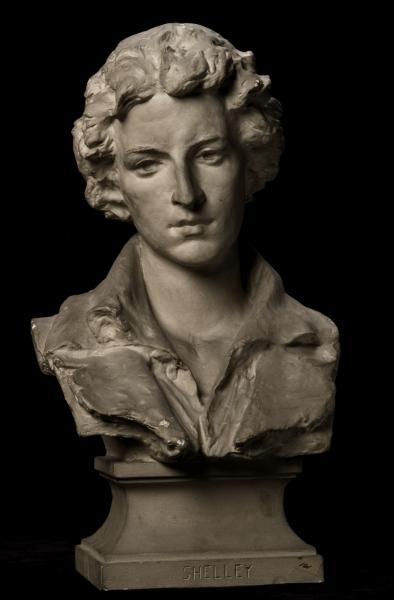
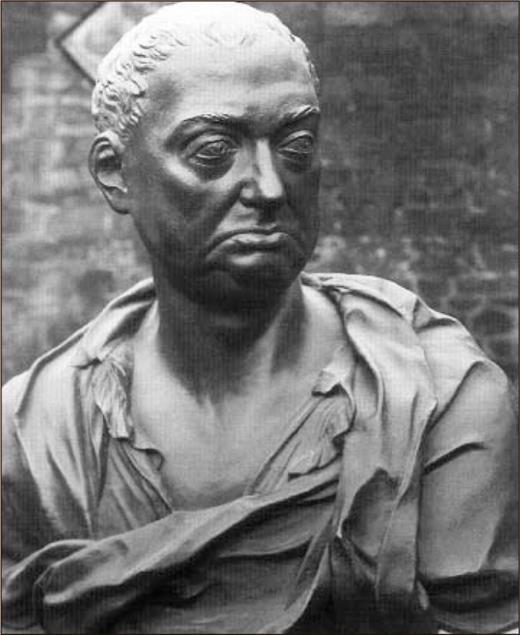
Partridge, Bust of Percy Bysshe Shelly, n.d.


Poetry is indeed something divine. It is at once the centre and circumference of knowledge; it is that which comprehends all science, and that to which all science must be referred. It is at the same time the root and blossom of all other systems of thought; it is that from which all spring, and that which adorns all; and that which, if blighted, denies the fruit and the seed, and withholds from the barren world the nourishment and the succession of the scions of the tree of life. It is the perfect and consummate surface and bloom of all things; it is as the odour and the colour of the rose to the texture of the elements which compose it, as the form and splendour of unfaded beauty to the secrets of anatomy and corruption. What were virtue, love, patriotism, friendship—what were the scenery of this beautiful universe which we inhabit; what were our consolations on this side of the grave—and what were our aspirations beyond it, if poetry did not ascend to bring light and fire from those eternal regions where the owl-winged faculty of calculation dare not ever soar? Poetry is not like reasoning, a power to be exerted according to the determination of the will. A man cannot say, 'I will compose poetry.' The greatest poet even cannot say it; for the mind in creation is as a fading coal, which some invisible influence, like an inconstant wind, awakens to transitory brightness; this power arises from within, like the colour of a flower which fades and changes as it is developed, and the conscious portions of our natures are unprophetic either of its approach or its departure. Could this influence be durable in its original purity and force, it is impossible to predict the greatness of the results; but when composition begins, inspiration is already on the decline, and the most glorious poetry that has ever been communicated to the world is probably a feeble shadow of the original conceptions of the poet. I appeal to the greatest poets of the present day, whether it is not an error to assert that the finest passages of poetry are produced by labour and study. The toil and the delay recommended by critics, can be justly interpreted to mean no more than a careful observation of the inspired moments, and an artificial connexion of the spaces between their suggestions by the intertexture of conventional expressions; a necessity only imposed by the limitedness of the poetical faculty itself; for Milton conceived the Paradise Lost as a whole before he executed it in portions; We have his own authority also for the muse having 'dictated' to him the 'unpremeditated song'. And let this be an answer to those who would allege the fifty-six various readings of the first line of the Orlando Furioso. Compositions so produced are to poetry what mosaic is to painting. This instinct and intuition of the poetical faculty, is still more observable in the plastic and pictorial arts; a great statue or picture grows under the power of the artist as a child in the mother's womb; and the very mind which directs the hands in formation is incapable of accounting to itself for the origin, the gradations, or the media of the process.

Poetry is the record of the best and happiest moments of the happiest and best minds. We are aware of evanescent visitations of thought and feeling sometimes associated with place or person, sometimes regarding our own mind alone, and always arising unforeseen and departing unbidden, but elevating and delightful beyond all expression; so that even in the desire and regret they leave, there cannot but be pleasure, participating as it does in the nature of its object. It is as it were the interpenetration of a diviner nature through our own; but its footsteps are like those of a wind over the sea, which the coming calm erases, and whose traces remain only, as on the wrinkled sand which paves it. These and corresponding conditions of being are experienced principally by those of the most delicate sensibility and the most enlarged imagination; and the state of mind produced by them is at war with every base desire. The enthusiasm of virtue, love, patriotism, and friendship, is essentially linked with such emotions; and whilst they last, self appears as what it is, an atom to a universe. Poets are not only subject to these experiences as spirits of the most refined organization, but they can colour all that they combine with the evanescent hues of this ethereal world; a word, a trait in the representation of a scene or a passion, will touch the enchanted chord, and reanimate, in those who have ever experienced these emotions, the sleeping, the cold, the buried image of the past. Poetry thus makes immortal all that is best and most beautiful in the world; it arrests the vanishing apparitions which haunt the interlunations of life, and veiling them, or in language or in form, sends them forth among mankind, bearing sweet news of kindred joy to those with whom their sisters abide—abide, because there is no portal of expression from the caverns of the spirit which they inhabit into the universe of things. Poetry redeems from decay the visitations of the divinity in man.

Poetry turns all things to loveliness; it exalts the beauty of that which is most beautiful, and it adds beauty to that which is most deformed; it marries exultation and horror, grief and pleasure, eternity and change; it subdues to union under its light yoke, all irreconcilable things. It transmutes all that it touches, and every form moving within the radiance of its presence is changed by wondrous sympathy to an incarnation of the spirit which it breathes: its secret alchemy turns to potable gold the poisonous waters which flow from death through life; it strips the veil of familiarity from the world, and lays bare the naked and sleeping beauty, which is the spirit of its forms.

All things exist as they are perceived; at least in relation to the percipient. 'The mind is its own place, and of itself can make a heaven of hell, a hell of heaven.' But poetry defeats the curse which binds us to be subjected to the accident of surrounding impressions. And whether it spreads its own figured curtain, or withdraws life's dark veil from before the scene of things, it equally creates for us a being within our being. It makes us the inhabitants of a world to which the familiar world is a chaos. It reproduces the common universe of which we are portions and percipients, and it purges from our inward sight the film of familiarity which obscures from us the wonder of our being. It compels us to feel that which we perceive, and to imagine that which we know. It creates anew the universe, after it has been annihilated in our minds by the recurrence of impressions blunted by reiteration. It justifies the bold and true words of Tasso: Non merita nome di creatore, se non Iddio ed il Poeta.

A poet, as he is the author to others of the highest wisdom, pleasure, virtue and glory, so he ought personally to be the happiest, the best, the wisest, and the most illustrious of men. As to his glory, let time be challenged to declare whether the fame of any other institutor of human life be comparable to that of a poet. That he is the wisest, the happiest, and the best, inasmuch as he is a poet, is equally incontrovertible: the greatest poets have been men of the most spotless virtue, of the most consummate prudence, and, if we would look into the interior of their lives, the most fortunate of men: and the exceptions, as they regard those who possessed the poetic faculty in a high yet inferior degree, will be found on consideration to confine rather than destroy the rule. Let us for a moment stoop to the arbitration of popular breath, and usurping and uniting in our own persons the incompatible characters of accuser, witness, judge, and executioner, let us decide without trial, testimony, or form, that certain motives of those who are 'there sitting where we dare not soar', are reprehensible. Let us assume that Homer was a drunkard, that Virgil was a flatterer, that Horace was a coward, that Tasso a madman, that Lord Bacon was a peculator, that Raphael was a libertine, that Spenser was a poet laureate. It is inconsistent with this division of our subject to cite living poets, but posterity has done ample justice to the great names now referred to. Their errors have been weighed and found to have been dust in the balance; if their sins 'were as scarlet, they are now white as snow'; they have been washed in the blood of the mediator and redeemer, Time. Observe in what a ludicrous chaos the imputation of real or fictitious crime have been confused in the contemporary calumnies against poetry and poets; consider how little is, as it appears—or appears, as it is; look to your own motives, and judge not, lest ye be judged.

Percy Bysshe Shelley, from "A Defence of Poetry"

04 August 2023

Happy Birthday, Shelley

Severn, Posthumous Portrait of Shelley Writing Prometheus Unbound, 1845


HYMN of PAN

From the forests and highlands
         We come, we come;
From the river-girt islands,
         Where loud waves are dumb
                Listening to my sweet pipings.
The wind in the reeds and the rushes,
         The bees on the bells of thyme,
The birds on the myrtle bushes,
         The cicale above in the lime,
And the lizards below in the grass,
Were as silent as ever old Tmolus was,
                Listening to my sweet pipings.

Liquid Peneus was flowing,
         And all dark Tempe lay
In Pelion's shadow, outgrowing
         The light of the dying day,
                Speeded by my sweet pipings.
The Sileni, and Sylvans, and Fauns,
         And the Nymphs of the woods and the waves,
To the edge of the moist river-lawns,
         And the brink of the dewy caves,
And all that did then attend and follow,
Were silent with love, as you now, Apollo,
                With envy of my sweet pipings.

I sang of the dancing stars,
         I sang of the daedal Earth,
And of Heaven, and the giant wars,
         And Love, and Death, and Birth—
                And then I chang'd my pipings,
Singing how down the vale of Maenalus
         I pursu'd a maiden and clasp'd a reed.
Gods and men, we are all deluded thus!
         It breaks in our bosom and then we bleed.
All wept, as I think both ye now would,
If envy or age had not frozen your blood,
                At the sorrow of my sweet pipings.

Percy Bysshe Shelley, born on this day in

Don't miss Peter Ackroyd's masterpiece, The Romantics, featuring, in this the last of its three episodes, Keats, Byron, and Shelley ...

03 August 2023

Onward.

Harrison & Harrison, Westminster Abbey Organ, 1937


HYMN to INTELLECTUAL BEAUTY

The awful shadow of some unseen Power
         Floats though unseen among us; visiting
         This various world with as inconstant wing
As summer winds that creep from flower to flower;
Like moonbeams that behind some piny mountain shower,
                It visits with inconstant glance
                Each human heart and countenance;
Like hues and harmonies of evening,
                Like clouds in starlight widely spread,
                Like memory of music fled,
                Like aught that for its grace may be
Dear, and yet dearer for its mystery.

Spirit of BEAUTY, that dost consecrate
         With thine own hues all thou dost shine upon
         Of human thought or form, where art thou gone?
Why dost thou pass away and leave our state,
This dim vast vale of tears, vacant and desolate?
                Ask why the sunlight not for ever
                Weaves rainbows o'er yon mountain-river,
Why aught should fail and fade that once is shown,
                Why fear and dream and death and birth
                Cast on the daylight of this earth
                Such gloom, why man has such a scope
For love and hate, despondency and hope?

No voice from some sublimer world hath ever
         To sage or poet these responses given:
         Therefore the names of Demon, Ghost, and Heaven,
Remain the records of their vain endeavour:
Frail spells whose utter'd charm might not avail to sever,
                From all we hear and all we see,
                Doubt, chance and mutability.
Thy light alone like mist o'er mountains driven,
                Or music by the night-wind sent
                Through strings of some still instrument,
                Or moonlight on a midnight stream,
Gives grace and truth to life's unquiet dream.

Love, Hope, and Self-esteem, like clouds depart
         And come, for some uncertain moments lent.
         Man were immortal and omnipotent,
Didst thou, unknown and awful as thou art,
Keep with thy glorious train firm state within his heart.
                Thou messenger of sympathies,
                That wax and wane in lovers' eyes;
Thou, that to human thought art nourishment,
                Like darkness to a dying flame!
                Depart not as thy shadow came,
                Depart not—lest the grave should be,
Like life and fear, a dark reality.

While yet a boy I sought for ghosts, and sped
         Through many a listening chamber, cave and ruin,
         And starlight wood, with fearful steps pursuing
Hopes of high talk with the departed dead.
I call'd on poisonous names with which our youth is fed;
                I was not heard; I saw them not;
                When musing deeply on the lot
Of life, at that sweet time when winds are wooing
                All vital things that wake to bring
                News of birds and blossoming,
                Sudden, thy shadow fell on me;
   I shriek'd, and clasp'd my hands in ecstasy!

I vow'd that I would dedicate my powers
         To thee and thine: have I not kept the vow?
         With beating heart and streaming eyes, even now
I call the phantoms of a thousand hours
Each from his voiceless grave: they have in vision'd bowers
                Of studious zeal or love's delight
                Outwatch'd with me the envious night:
They know that never joy illum'd my brow
                Unlink'd with hope that thou wouldst free
                This world from its dark slavery,
                That thou, O awful LOVELINESS,
Wouldst give whate'er these words cannot express.

The day becomes more solemn and serene
         When noon is past; there is a harmony
         In autumn, and a lustre in its sky,
Which through the summer is not heard or seen,
As if it could not be, as if it had not been!
                Thus let thy power, which like the truth
                Of nature on my passive youth
Descended, to my onward life supply
                Its calm, to one who worships thee,
                And every form containing thee,
                Whom, SPIRIT fair, thy spells did bind
To fear himself, and love all human kind.

Percy Bysshe Shelley

21 August 2022

Lifts.

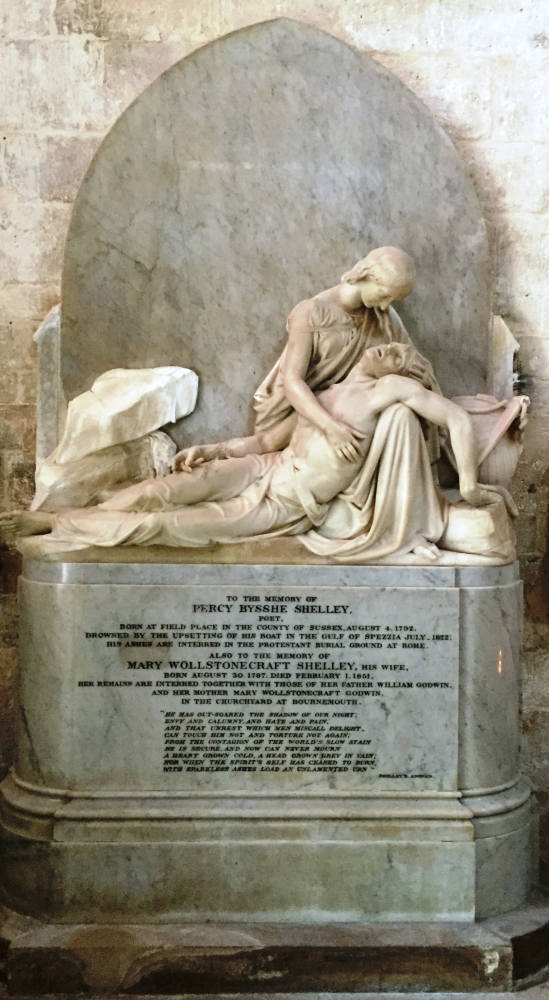
Weekes, Memorial to Shelley, 1854


[Poetry] awakens and enlarges the mind itself by rendering it the receptacle of a thousand unapprehended combinations of thought. Poetry lifts the veil from the hidden beauty of the world, and makes familiar objects be as if they were not familiar; it reproduces all that it represents, and the impersonations clothed in its Elysian light stand thenceforward in the minds of those who have once contemplated them as memorials of that gentle and exalted content which extends itself over all thoughts and actions with which it coexists. The great secret of morals is love; or a going out of our own nature, and an identification of ourselves with the beautiful which exists in thought, action, or person, not our own. A man, to be greatly good, must imagine intensely and comprehensively; he must put himself in the place of another and of many others; the pains and pleasures of his species must become his own. The great instrument of moral good is the imagination.

Percy Bysshe Shelley, from "A Defence of Poetry"

04 August 2022

Lifts.

Severn, Posthumous Portrait of Shelley, 1845


[Poetry] awakens and enlarges the mind itself by rendering it the receptacle of a thousand unapprehended combinations of thought. Poetry lifts the veil from the hidden beauty of the world, and makes familiar objects be as if they were not familiar; it reproduces all that it represents, and the impersonations clothed in its Elysian light stand thenceforward in the minds of those who have once contemplated them as memorials of that gentle and exalted content which extends itself over all thoughts and actions with which it coexists. The great secret of morals is love; or a going out of our own nature, and an identification of ourselves with the beautiful which exists in thought, action, or person, not our own. A man, to be greatly good, must imagine intensely and comprehensively; he must put himself in the place of another and of many others; the pains and pleasures of his species must become his own. The great instrument of moral good is the imagination.

Percy Bysshe Shelley, from "A Defence of Poetry"

Happy Birthday, Shelley


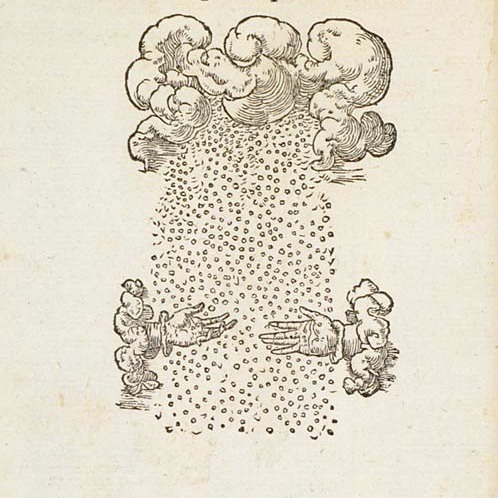
THE CLOUD

From the seas and the streams; 
I bear light shade for the leaves when laid 
In their noonday dreams. 
From my wings are shaken the dews that waken 
The sweet buds every one, 
When rocked to rest on their mother's breast, 
As she dances about the sun. 
I wield the flail of the lashing hail, 
And whiten the green plains under, 
And then again I dissolve it in rain, 
And laugh as I pass in thunder.

I sift the snow on the mountains below, 
And their great pines groan aghast; 
And all the night 'tis my pillow white, 
While I sleep in the arms of the blast. 
Sublime on the towers of my skiey bowers, 
Lightning my pilot sits; 
In a cavern under is fettered the thunder, 
It struggles and howls at fits; 
Over earth and ocean, with gentle motion, 
This pilot is guiding me, 
Lured by the love of the genii that move 
In the depths of the purple sea; 
Over the rills, and the crags, and the hills, 
Over the lakes and the plains, 
Wherever he dream, under mountain or stream, 
The Spirit he loves remains; 
And I all the while bask in Heaven's blue smile, 
Whilst he is dissolving in rains.

The sanguine Sunrise, with his meteor eyes, 
And his burning plumes outspread, 
Leaps on the back of my sailing rack, 
When the morning star shines dead; 
As on the jag of a mountain crag, 
Which an earthquake rocks and swings, 
An eagle alit one moment may sit 
In the light of its golden wings. 
And when Sunset may breathe, from the lit sea beneath, 
Its ardours of rest and of love, 
And the crimson pall of eve may fall 
From the depth of Heaven above, 
With wings folded I rest, on mine aëry nest, 
As still as a brooding dove.

That orbèd maiden with white fire laden, 
Whom mortals call the Moon, 
Glides glimmering o'er my fleece-like floor, 
By the midnight breezes strewn; 
And wherever the beat of her unseen feet, 
Which only the angels hear, 
May have broken the woof of my tent's thin roof, 
The stars peep behind her and peer; 
And I laugh to see them whirl and flee, 
Like a swarm of golden bees, 
When I widen the rent in my wind-built tent, 
Till calm the rivers, lakes, and seas, 
Like strips of the sky fallen through me on high, 
Are each paved with the moon and these.

I bind the Sun's throne with a burning zone, 
And the Moon's with a girdle of pearl; 
The volcanoes are dim, and the stars reel and swim, 
When the whirlwinds my banner unfurl. 
From cape to cape, with a bridge-like shape, 
Over a torrent sea, 
Sunbeam-proof, I hang like a roof, 
The mountains its columns be. 
The triumphal arch through which I march 
With hurricane, fire, and snow, 
When the Powers of the air are chained to my chair, 
Is the million-coloured bow; 
The sphere-fire above its soft colours wove, 
While the moist Earth was laughing below.

I am the daughter of Earth and Water, 
And the nursling of the Sky; 
I pass through the pores of the ocean and shores; 
I change, but I cannot die. 
For after the rain when with never a stain 
The pavilion of Heaven is bare, 
And the winds and sunbeams with their convex gleams 
Build up the blue dome of air, 
I silently laugh at my own cenotaph, 
And out of the caverns of rain, 
Like a child from the womb, like a ghost from the tomb, 
I arise and unbuild it again. 

Percy Bysshe Shelley, born on this day in 1792

20 March 2022

Rose.

Wyeth, Cold Spring, 1977


And the spring arose on the garden fair,         
Like the spirit of love felt everywhere;
And each flower and herb on earth’s dark breast
Rose from the dreams of its wintry rest.

Percy Bysshe Shelley, from "The Sensitive Plant: Part First"

04 August 2021

Rise.


The old laws of England -- they
Whose reverend heads with age are gray,
Children of a wiser day;
And whose solemn voice must be
Thine own echo -- Liberty!

On those who first should violate
Such sacred heralds in their state
Rest the blood that must ensue,
And it will not rest on you.

And if then the tyrants dare
Let them ride among you there,
Slash, and stab, and maim, and hew,--
What they like, that let them do.

With folded arms and steady eyes,
And little fear, and less surprise,
Look upon them as they slay
Till their rage has died away.

Then they will return with shame
To the place from which they came,
And the blood thus shed will speak
In hot blushes on their cheek.

 Every woman in the land
Will point at them as they stand--
They will hardly dare to greet
Their acquaintance in the street.

And the bold, true warriors
Who have hugged Danger in wars
Will turn to those who would be free,
Ashamed of such base company.

And that slaughter to the Nation
Shall steam up like inspiration,
Eloquent, oracular;
A volcano heard afar.

And these words shall then become
Like Oppression's thundered doom
Ringing through each heart and brain,
Heard again -- again -- again--

Rise like Lions after slumber
In unvanquishable number--
Shake your chains to earth like dew
Which in sleep had fallen on you--
Ye are many -- they are few.

Happy Birthday, Shelley

Severn, Posthumous Portrait of Shelley Writing Prometheus Unbound in Italy, 1845


Percy Bysshe Shelley was born on this day in 1792.

Poets, or those who imagine and express this indestructible order, are not only the authors of language and of music, of the dance, and architecture, and statuary, and painting; they are the institutors of laws, and the founders of civil society, and the inventors of the arts of life, and the teachers, who draw into a certain propinquity with the beautiful and the true, that partial apprehension of the agencies of the invisible world which is called religion. Hence all original religions are allegorical, or susceptible of allegory, and, like Janus, have a double face of false and true. Poets, according to the circumstances of the age and nation in which they appeared, were called, in the earlier epochs of the world, legislators, or prophets: a poet essentially comprises and unites both these characters. For he not only beholds intensely the present as it is, and discovers those laws according to which present things ought to be ordered, but he beholds the future in the present, and his thoughts are the germs of the flower and the fruit of latest time. Not that I assert poets to be prophets in the gross sense of the word, or that they can foretell the form as surely as they foreknow the spirit of events: such is the pretence of superstition, which would make poetry an attribute of prophecy, rather than prophecy an attribute of poetry. A poet participates in the eternal, the infinite, and the one; as far as relates to his conceptions, time and place and number are not. The grammatical forms which express the moods of time, and the difference of persons, and the distinction of place, are convertible with respect to the highest poetry without injuring it as poetry; and the choruses of Aeschylus, and the book of Job, and Dante's Paradise, would afford, more than any other writings, examples of this fact, if the limits of this essay did not forbid citation. The creations of sculpture, painting, and music, are illustrations still more decisive.

Language, colour, form, and religious and civil habits of action, are all the instruments and materials of poetry; they may be called poetry by that figure of speech which considers the effect as a synonym of the cause. But poetry in a more restricted sense expresses those arrangements of language, and especially metrical language, which are created by that imperial faculty; whose throne is curtained within the invisible nature of man. And this springs from the nature itself of language, which is a more direct representation of the actions and passions of our internal being, and is susceptible of more various and delicate combinations, than colour, form, or motion, and is more plastic and obedient to the control of that faculty of which it is the creation. For language is arbitrarily produced by the imagination and has relation to thoughts alone; but all other materials, instruments and conditions of art, have relations among each other, which limit and interpose between conception and expression The former is as a mirror which reflects, the latter as a cloud which enfeebles, the light of which both are mediums of communication. Hence the fame of sculptors, painters, and musicians, although the intrinsic powers of the great masters of these arts may yield in no degree to that of those who have employed language as the hieroglyphic of their thoughts, has never equalled that of poets in the restricted sense of the term, as two performers of equal skill will produce unequal effects from a guitar and a harp. The fame of legislators and founders of religions, so long as their institutions last, alone seems to exceed that of poets in the restricted sense; but it can scarcely be a question, whether, if we deduct the celebrity which their flattery of the gross opinions of the vulgar usually conciliates, together with that which belonged to them in their higher character of poets, any excess will remain.

We have thus circumscribed the word poetry within the limits of that art which is the most familiar and the most perfect expression of the faculty itself. It is necessary, however, to make the circle still narrower, and to determine the distinction between measured and unmeasured language; for the popular division into prose and verse is inadmissible in accurate philosophy.

Sounds as well as thoughts have relation both between each other and towards that which they represent, and a perception of the order of those relations has always been found connected with a perception of the order of the relations of thoughts. Hence the language of poets has ever affected a certain uniform and harmonious recurrence of sound, without which it were not poetry, and which is scarcely less indispensable to the communication of its influence, than the words themselves, without reference to that peculiar order. Hence the vanity of translation; it were as wise to cast a violet into a crucible that you might discover the formal principle of its colour and odour, as seek to transfuse from one language into another the creations of a poet. The plant must spring again from its seed, or it will bear no flower—and this is the burthen of the curse of Babel.

Percy Bysshe Shelley, from "A Defence of Poetry"

03 August 2021

Listening.


We look before and after,
And pine for what is not:
Our sincerest laughter
With some pain is fraught;
Our sweetest songs are those that tell of saddest thought.

Yet if we could scorn
Hate, and pride, and fear;
If we were things born
Not to shed a tear,
I know not how thy joy we ever should come near.

Better than all measures
Of delightful sound,
Better than all treasures
That in books are found,
Thy skill to poet were, thou scorner of the ground!

Teach me half the gladness
That thy brain must know,
Such harmonious madness
From my lips would flow
The world should listen then, as I am listening now.

Percy Bysshe Shelley, from "To a Skylark"

22 June 2021

Strength.


18.
A mighty pile of wood the God then heaped,
And having soon conceived the mystery
Of fire, from two smooth laurel branches stripped
The bark, and rubbed them in his palms;—on high
Suddenly forth the burning vapour leaped
And the divine child saw delightedly.—
Mercury first found out for human weal
Tinder-box, matches, fire-irons, flint and steel.

19.
And fine dry logs and roots innumerous
He gathered in a delve upon the ground—
And kindled them—and instantaneous
The strength of the fierce flame was breathed around:
And whilst the might of glorious Vulcan thus
Wrapped the great pile with glare and roaring sound,
Hermes dragged forth two heifers, lowing loud,
Close to the fire—such might was in the God.

Percy Bysshe Shelley, from "Hymn to Mercury"

28 April 2021

Romantics.

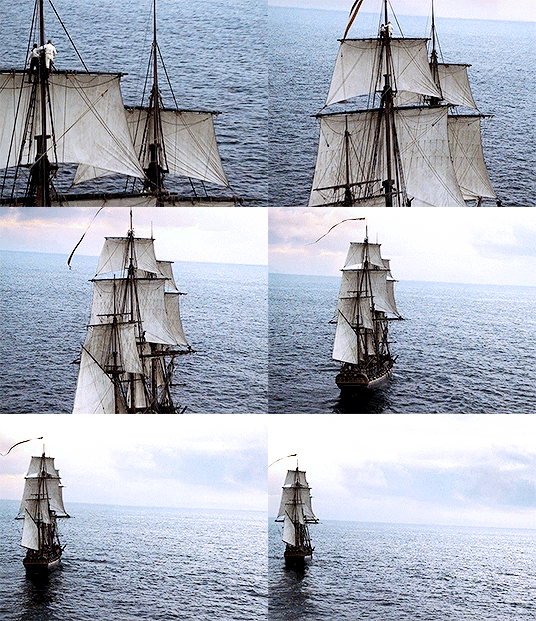
Peter Ackroyd narrates the BBC masterpiece, The Romantics ...

"Liberty" ...

"Nature" ...


"Eternity" ...

10 November 2020

Arise.


I am the daughter of Earth and Water,
And the nursling of the Sky:
I pass through the pores of the ocean and shores;
I change, but I cannot die.
For after the rain, when with never a stain
The pavilion of heaven is bare,
And the winds and sunbeams with their convex gleams
Build up the blue dome of air,
I silently laugh at my own cenotaph, --
And out of the caverns of rain,
Like a child from the womb, like a ghost from the tomb,
I arise, and unbuild it again.

Percy Bysshe Shelley

04 August 2020

Happy Birthday, Shelley

Partridge, Bust of Percy Bysshe Shelly, 1899


Percy Bysshe Shelley was born on this date in 1792.

[Poetry] awakens and enlarges the mind itself by rendering it the receptacle of a thousand unapprehended combinations of thought. Poetry lifts the veil from the hidden beauty of the world, and makes familiar objects be as if they were not familiar; it reproduces all that it represents, and the impersonations clothed in its Elysian light stand thenceforward in the minds of those who have once contemplated them as memorials of that gentle and exalted content which extends itself over all thoughts and actions with which it coexists. The great secret of morals is love; or a going out of our own nature, and an identification of ourselves with the beautiful which exists in thought, action, or person, not our own. A man, to be greatly good, must imagine intensely and comprehensively; he must put himself in the place of another and of many others; the pains and pleasures of his species must become his own. The great instrument of moral good is the imagination.

Percy Bysshe Shelley, from "A Defence of Poetry"