"I am not one who was born in the custody of wisdom. I am one who is fond of olden times and intense in quest of the sacred knowing of the ancients." Gustave Courbet

28 December 2017

Instinct.


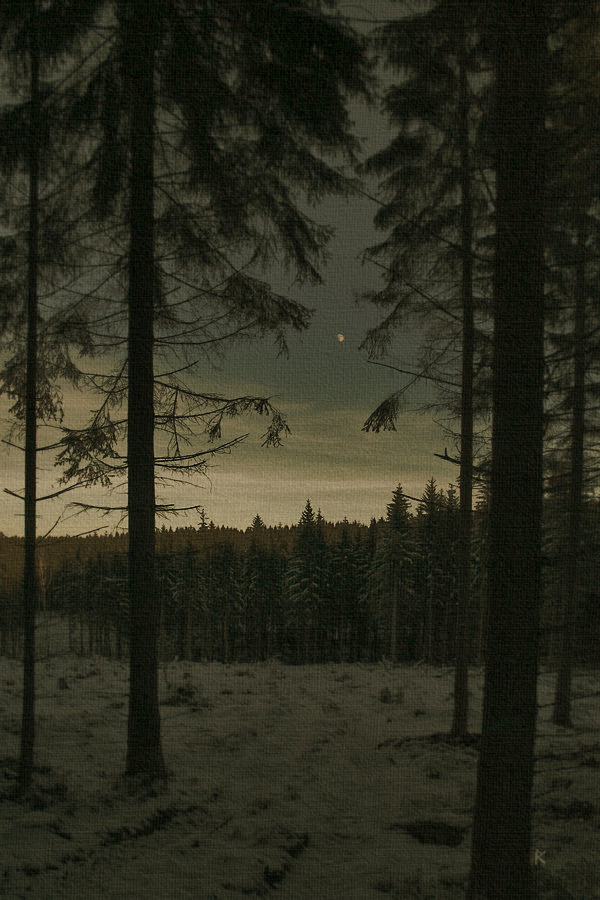
The man flung a look back along the way he had come. The Yukon lay a mile wide and hidden under three feet of ice. On top of this ice were as many feet of snow. It was all pure white, rolling in gentle undulations where the ice-jams of the freeze-up had formed. North and south, as far as his eye could see, it was unbroken white, save for a dark hair-line that curved and twisted from around the spruce-covered island to the south, and that curved and twisted away into the north, where it disappeared behind another spruce-covered island. This dark hair-line was the trail -- the main trail -- that led south five hundred miles to the Chilcoot Pass, Dyea, and salt water; and that led north seventy miles to Dawson, and still on to the north a thousand miles to Nulato, and finally to St. Michael on Bering Sea, a thousand miles and half a thousand more.

But all this -- the mysterious, far-reaching hair-line trail, the absence of sun from the sky, the tremendous cold, and the strangeness and weirdness of it all -- made no impression on the man. It was not because he was long used to it. He was a newcomer in the land, a chechaquo, and this was his first winter. The trouble with him was that he was without imagination. He was quick and alert in the things of life, but only in the things, and not in the significances. Fifty degrees below zero meant eighty-odd degrees of frost. Such fact impressed him as being cold and uncomfortable, and that was all. It did not lead him to meditate upon his frailty as a creature of temperature, and upon man's frailty in general, able only to live within certain narrow limits of heat and cold; and from there on it did not lead him to the conjectural field of immortality and man's place in the universe. Fifty degrees below zero stood for a bite of frost that hurt and that must be guarded against by the use of mittens, ear-flaps, warm moccasins, and thick socks. Fifty degrees below zero was to him just precisely fifty degrees below zero. That there should be anything more to it than that was a thought that never entered his head.

As he turned to go on, he spat speculatively. There was a sharp, explosive crackle that startled him. He spat again. And again, in the air, before it could fall to the snow, the spittle crackled. He knew that at fifty below spittle crackled on the snow, but this spittle had crackled in the air. Undoubtedly it was colder than fifty below -- how much colder he did not know. But the temperature did not matter. He was bound for the old claim on the left fork of Henderson Creek, where the boys were already. They had come over across the divide from the Indian Creek country, while he had come the roundabout way to take a look at the possibilities of getting out logs in the spring from the islands in the Yukon. He would be in to camp by six o'clock; a bit after dark, it was true, but the boys would be there, a fire would be going, and a hot supper would be ready. As for lunch, he pressed his hand against the protruding bundle under his jacket. It was also under his shirt, wrapped up in a handkerchief and lying against the naked skin. It was the only way to keep the biscuits from freezing. He smiled agreeably to himself as he thought of those biscuits, each cut open and sopped in bacon grease, and each enclosing a generous slice of fried bacon.

He plunged in among the big spruce trees. The trail was faint. A foot of snow had fallen since the last sled had passed over, and he was glad he was without a sled, travelling light. In fact, he carried nothing but the lunch wrapped in the handkerchief. He was surprised, however, at the cold. It certainly was cold, he concluded, as he rubbed his numb nose and cheek-bones with his mittened hand. He was a warm-whiskered man, but the hair on his face did not protect the high cheek-bones and the eager nose that thrust itself aggressively into the frosty air.

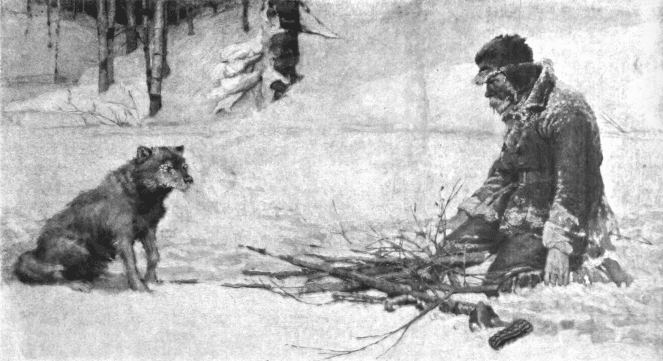
At the man's heels trotted a dog, a big native husky, the proper wolf-dog, gray-coated and without any visible or temperamental difference from its brother, the wild wolf. The animal was depressed by the tremendous cold. It knew that it was no time for travelling. Its instinct told it a truer tale than was told to the man by the man's judgment. In reality, it was not merely colder than fifty below zero; it was colder than sixty below, than seventy below. It was seventy-five below zero. Since the freezing-point is thirty-two above zero, it meant that one hundred and seven degrees of frost obtained. The dog did not know anything about thermometers. Possibly in its brain there was no sharp consciousness of a condition of very cold such as was in the man's brain. But the brute had its instinct. It experienced a vague but menacing apprehension that subdued it and made it slink along at the man's heels, and that made it question eagerly every unwonted movement of the man as if expecting him to go into camp or to seek shelter somewhere and build a fire. The dog had learned fire, and it wanted fire, or else to burrow under the snow and cuddle its warmth away from the air.

The frozen moisture of its breathing had settled on its fur in a fine powder of frost, and especially were its jowls, muzzle, and eyelashes whitened by its crystalled breath. The man's red beard and mustache were likewise frosted, but more solidly, the deposit taking the form of ice and increasing with every warm, moist breath he exhaled. Also, the man was chewing tobacco, and the muzzle of ice held his lips so rigidly that he was unable to clear his chin when he expelled the juice. The result was that a crystal beard of the color and solidity of amber was increasing its length on his chin. If he fell down it would shatter itself, like glass, into brittle fragments. But he did not mind the appendage. It was the penalty all tobacco-chewers paid in that country, and he had been out before in two cold snaps. They had not been so cold as this, he knew, but by the spirit thermometer at Sixty Mile he knew they had been registered at fifty below and at fifty-five.

Jack London, from "To Build a Fire"

CONNECT

Delve.


A SONG of the ROLLING EARTH

Were you thinking that those were the words, Those upright lines? those curves, angles, dots? No, those are not the words, The substantial words are in the ground and sea, They are in the air, they are in you…

The workmanship of souls is by those inaudible words of the earth, The masters know the earth’s words and use them more than audible words… To her children the words of the eloquent dumb Great mother never fail…

Say on, sayers! Sing on, singers! Delve! mould! Pile the words of the earth! Work on, age after age, nothing is to be lost, It may have to wait long, but it will certainly come in use, When the materials are prepared and ready, The architects shall appear.


Walt Whitman

27 December 2017

Astounde.

Friedrich, Ruins at Dusk, 1831


Stay, curyous traveller, and pass not bye,
Until this fetive pile astounde thine eye.
Whole rocks on rocks with yron joynd surveie,
And okes with okes entremed disponed lie.
This mightie pile, that keeps the wyndes at baie,
Fyre-levyn and the mokie storme defie,
That shootes aloofe into the reaulmes of daie,
Shall be the record of the Buylders fame for aie.
Thou seest this maystrie of a human hand,
The pride of Brystowe and the Westerne lande,                  
Yet is the Buylders vertues much moe greete,
Greeter than can bie Rowlies pen be scande.
Thou seest the saynctes and kynges in stonen state,
That seemd with breath and human soule dispande,
As payrde to us enseem these men of slate,
Such is greete Canynge's mynde when payrd to God elate.
Well maiest thou be astound, but view it well;
Go not from hence before thou see thy fill,
And learn the Builder's vertues and his name;
Of this tall spyre in every countye telle,                    
And with thy tale the lazing rych men shame;
Showe howe the glorious Canynge did excelle;
How hee good man a friend for kynges became,
And gloryous paved at once the way to heaven and fame.

Thomas Chatterton

Arts.


SLY DICK

Sharp was the frost, the wind was high
And sparkling stars bedeckt the sky
Sly Dick in arts of cunning skill'd,
Whose rapine all his pockets fill'd,
Had laid him down to take his rest
And soothe with sleep his anxious breast.
'Twas thus a dark infernal sprite
A native of the blackest night,
Portending mischief to devise
Upon Sly Dick he cast his eyes;
Then straight descends the infernal sprite,
And in his chamber does alight;
In visions he before him stands,
And his attention he commands.
Thus spake the sprite— hearken my friend,
And to my counsels now attend.
Within the garret's spacious dome
There lies a well stor'd wealthy room,
Well stor'd with cloth and stockings too,
Which I suppose will do for you,
First from the cloth take thou a purse,
For thee it will not be the worse,
A noble purse rewards thy pains,
A purse to hold thy filching gains;
Then for the stockings let them reeve
And not a scrap behind thee leave,
Five bundles for a penny sell
And pence to thee will come pell mell;
See it be done with speed and care
Thus spake the sprite and sunk in air.
When in the morn with thoughts erect
Sly Dick did on his dreams reflect,
Why faith, thinks he, 'tis something too,
It might— perhaps— it might be true,
I'll go and see— away he hies,
And to the garret quick he flies,
Enters the room, cuts up the clothes
And after that reeves up the hose;
Then of the cloth he purses made,
Purses to hold his filching trade.

Thomas Chatterton

Excellent.

An excellent album ...

Zest.

Brueghel, the Younger, Peasants Warming Themselves Beside a Hearth, 1633


The INN KITCHEN

Shall I not take mine ease in mine inn?

Falstaff

During a journey that I once made through the Netherlands, I had arrived one evening at the Pomme d’Or, the principal inn of a small Flemish village. It was after the hour of the table d’hote, so that I was obliged to make a solitary supper from the relics of its ampler board. The weather was chilly; I was seated alone in one end of a great gloomy dining-room, and, my repast being over, I had the prospect before me of a long dull evening, without any visible means of enlivening it. I summoned mine host and requested something to read; he brought me the whole literary stock of his household, a Dutch family Bible, an almanac in the same language, and a number of old Paris newspapers. As I sat dozing over one of the latter, reading old news and stale criticisms, my ear was now and then struck with bursts of laughter which seemed to proceed from the kitchen. Every one that has travelled on the Continent must know how favorite a resort the kitchen of a country inn is to the middle and inferior order of travellers, particularly in that equivocal kind of weather when a fire becomes agreeable toward evening. I threw aside the newspaper and explored my way to the kitchen, to take a peep at the group that appeared to be so merry. It was composed partly of travellers who had arrived some hours before in a diligence, and partly of the usual attendants and hangers-on of inns. They were seated round a great burnished stove, that might have been mistaken for an altar at which they were worshipping. It was covered with various kitchen vessels of resplendent brightness, among which steamed and hissed a huge copper tea-kettle. A large lamp threw a strong mass of light upon the group, bringing out many odd features in strong relief. Its yellow rays partially illumined the spacious kitchen, dying duskily away into remote corners, except where they settled in mellow radiance on the broad side of a flitch of bacon or were reflected back from well-scoured utensils that gleamed from the midst of obscurity. A strapping Flemish lass, with long golden pendants in her ears and a necklace with a golden heart suspended to it, was the presiding priestess of the temple.

Many of the company were furnished with pipes, and most of them with some kind of evening potation. I found their mirth was occasioned by anecdotes which a little swarthy Frenchman, with a dry weazen face and large whiskers, was giving of his love-adventures; at the end of each of which there was one of those bursts of honest unceremonious laughter in which a man indulges in that temple of true liberty, an inn.

As I had no better mode of getting through a tedious blustering evening, I took my seat near the stove, and listened to a variety of travellers’ tales, some very extravagant and most very dull. All of them, however, have faded from my treacherous memory except one, which I will endeavor to relate. I fear, however, it derived its chief zest from the manner in which it was told, and the peculiar air and appearance of the narrator. He was a corpulent old Swiss, who had the look of a veteran traveller. He was dressed in a tarnished green travelling-jacket, with a broad belt round his waist, and a pair of overalls with buttons from the hips to the ankles. He was of a full rubicund countenance, with a double chin, aquiline nose, and a pleasant twinkling eye. His hair was light, and curled from under an old green velvet travelling-cap stuck on one side of his head. He was interrupted more than once by the arrival of guests or the remarks of his auditors, and paused now and then to replenish his pipe; at which times he had generally a roguish leer and a sly joke for the buxom kitchen-maid.

I wish my readers could imagine the old fellow lolling in a huge arm-chair, one arm a-kimbo, the other holding a curiously twisted tobacco-pipe formed of genuine ecume de mer, decorated with silver chain and silken tassel, his head cocked on one side, and a whimsical cut of the eye occasionally ...

Washington Irving, From The Sketchbook of Geoffrey Crayon

Valuable.


The root of culture is emulation and, thanks to the screen in the hand, we are learning to emulate what is beneath us.  Traditional culture was about emulating what is above us: the examples and achievements that lend dignity to the social order and which teach us to be proud of it.  The social media are an assault on this culture and on the idea of accountability on which it rests; the correct response to the current abuse therefore is to launch an effort of cultural renewal, through teaching and example, and through dramatizing the abuses, as Shakespeare dramatized the abuse of law in The Merchant of Venice.  We should explain to children the presumption of innocence that lies at the heart of our legal inheritance, and the protection that this offers to ordinary people against all those who would intimidate or exploit them.  We should show why respect for other people involves respect for their privacy, for their secrets, for all that is intimate and of no true public concern.

That is easier said than done, you will respond, and the response is right.  Everything truly valuable is easier said than done.  But we have sunk into a cultural morass, and must extricate ourselves, which we can do only by cultural means.  People are being tempted into a malicious web of gossip, and are becoming trapped in its sticky threads.  To fight against this we have to show, through example, how to live in another way, how to free oneself from the web before being wound into a ball of malice and eaten, body and soul, by the "post-truth" spider.

Teachers should see their principal goal as one of averting their pupils from the spider's new temptations, so that they can face other people with respect.  Such an education is what Plato meant by "the care of the soul," and he regarded it as the indispensable foundation of political existence.  In this matter, I believe, Plato was right, and he defined a task that falls on all of us, the national media included.

Sir Roger Scruton

CONNECT

Strauss, Artist's Life, Op. 316

Philippe Jordan leads the Vienna Symphony ...

Forth.


The untold want by life and land ne'er granted,
Now voyager sail thou forth to seek and find.

Walt Whitman

Sing.

Gilchrist, Blake's Cottage at Felpham, 1880


The LAUGHING SONG

When the green woods laugh with the voice of joy,
And the dimpling stream runs laughing by;
When the air does laugh with our merry wit,
And the green hill laughs with the noise of it;

When the meadows laugh with lively green,
And the grasshopper laughs in the merry scene;
When Mary and Susan and Emily
With their sweet round mouths sing 'Ha ha he!'

When the painted birds laugh in the shade,
Where our table with cherries and nuts is spread:
Come live, and be merry, and join with me,
To sing the sweet chorus of 'Ha ha he!'


William Blake

Riot.


Jeeves: Pardon me for asking, sir, but are you proposing to appear in public in those garments?
Bertie Wooster: Well, certainly, Jeeves. What — a bit vivid, do you think?
Jeeves: Not necessarily, sir. I am told that Mr. Freddie "He's a Riot" Flowerdew often appears on the music-hall stage in comparable attire.

Schubert, Four Impromptus, D. 935

Alfred Brendel performs ...

26 December 2017

Musical.

Levitan, Forest in Winter, 1885


The small wind whispers through the leafless hedge
Most sharp and chill, where the light snowy flakes
Rest on each twig and spike of wither'd sedge,
Resembling scatter'd feathers;--vainly breaks
The pale split sunbeam through the frowning cloud,
On Winter's frowns below--from day to day
Unmelted still he spreads his hoary shroud,
In dithering pride on the pale traveller's way,
Who, croodling, hastens from the storm behind
Fast gathering deep and black, again to find
His cottage-fire and corner's sheltering bounds;
Where, haply, such uncomfortable days
Make musical the wood-sap's frizzling sounds,
And hoarse loud bellows puffing up the blaze.

John Clare

Pinewoods.


In the pinewoods is where the owl floats, and where the white egret paces, in summer, like a winged snake, in the flashing shallows. Here is where two deer approached me one morning, in an unforgettable sweetness, their faces like light-brown flowers, their eyes kindred and full of curiosity. The mouth of one of them, and its vibrant tongue, licked my hand. This is where the coyotes appeared, one season, and followed me, bold beyond belief, and nimble— lean ferocities just held in check. This is where, once, I heard suddenly a powerful beating of wings, a feisty rhythm, a pomp of sound, within it a thrust then a slight uptake. The wings of angels might sound so, who are after all not mild but militant, and cross the skies on important missions. Then, just above the trees, their feet trailing and their eyes blazing, two swans flew by.

Mary Oliver

Lully, Jubilate Deo, LWV 77/16

Jordi Savall conducts La Capella Reial de Catalunya ...

Take.

Excellent.

An excellent book ...

Mozart, Piano Concerto No. 23 in A Major, K. 488

Vladimir Horowitz performs with The Orchestra of La Scala, Carlo Maria Giulini conducting ...

Tea


Consistent, high-quality products.

Quick, friendly, and knowledgeable service.

Full.


The night is fresh and cool,
Staff in hand I walk through the gate.
Wisteria and ivy grow together along the winding mountain path;
Birds sing quietly in their nests and a monkey howls nearby.
As I reach a high peak a village appears in the distance.
The old pines are full of poems;
I bend down for a drink of pure spring water.
There is a gentle breeze, and the round moon hangs overhead.
Standing by a deserted building,
I pretend to be a crane softly floating among the clouds ...

Ryokan

Beethoven String Quartet No 7 in F major, Op 59, No 1

The Alban Berg Quartet performs ...

25 December 2017

Listen.

Sting, A Winter's Night

Excellent.

An excellent album ...


Thanks, Mom.

Merriment.


We had not been long home when the sound of music was heard from a distance. A band of country lads without coats, their shirt-sleeves fancifully tied with ribands, their hats decorated with greens, and clubs in their hands, were seen advancing up the avenue, followed by a large number of villagers and peasantry. They stopped before the hall door, where the music struck up a peculiar air, and the lads performed a curious and intricate dance, advancing, retreating, and striking their clubs together, keeping exact time to the music; while one, whimsically crowned with a fox's skin, the tail of which flaunted down his back, kept capering round the skirts of the dance, and rattling a Christmas-box with many antic gesticulations.

The Squire eyed this fanciful exhibition with great interest and delight, and gave me a full account of its origin, which he traced to the times when the Romans held possession of the island; plainly proving that this was a lineal descendant of the sword-dance of the ancients. "It was now," he said, "nearly extinct, but he had accidentally met with traces of it in the neighbourhood, and had encouraged its revival; though, to tell the truth, it was too apt to be followed up by rough cudgel-play and broken heads in the evening."

After the dance was concluded, the whole party was entertained with brawn and beef, and stout home-brewed. The Squire himself mingled among the rustics, and was received with awkward demonstrations of deference and regard. It is true I perceived two or three of the younger peasants, as they were raising their tankards to their mouths when the Squire's back was turned, making something of a grimace, and giving each other the wink; but the moment they caught my eye they pulled grave faces, and were exceedingly demure. With Master Simon, however, they all seemed more at their ease. His varied occupations and amusements had made him well known throughout the neighbourhood. He was a visitor at every farm-house and cottage; gossiped with the farmers and their wives; romped with their daughters; and, like that type of a vagrant bachelor, the humble bee, tolled the sweets from all the rosy lips of the country round.

The bashfulness of the guests soon gave way before good cheer and affability. There is something genuine and affectionate in the gaiety of the lower orders, when it is excited by the bounty and familiarity of those above them; the warm glow of gratitude enters into their mirth, and a kind word or a small pleasantry, frankly uttered by a patron, gladdens the heart of the dependant more than oil and wine. When the Squire had retired the merriment increased, and there was much joking and laughter, particularly between Master Simon and a hale, ruddy-faced, white-headed farmer, who appeared to be the wit of the village; for I observed all his companions to wait with open mouths for his retorts, and burst into a gratuitous laugh before they could well understand them.

Washington Irving, from Old Christmas

Praetorius, "Es Ist ein Ros' entsprungen"

The Gesualdo Six perform ...

Christmas.


MERRY CHRISTMAS!

Wagner, Siegfried Idyll, WWW 103

The first performance took place on the staircase in the Wagner’s villa in Lucerne, on the morning of Christmas Day 1870 (Wagner's wife Cosima’s birthday was Christmas Eve). Cosima was sleeping, and she woke up to the beautiful opening melody, with Wagner conducting the small group of musicians he had invited from Zürich. We know from her diary that in her opinion it was a lovely birthday present!

CONNECT

Donald Runnicles leads the BBC Scottish Radio Symphony Orchestra ...

Peace.

Caravaggio, Madonna di Loreto, 1605


I heard the bells on Christmas Day
Their old, familiar carols play,
   And wild and sweet
   The words repeat
Of peace on earth, good-will to men!

And thought how, as the day had come,
The belfries of all Christendom
   Had rolled along
   The unbroken song
Of peace on earth, good-will to men!

Till ringing, singing on its way,
The world revolved from night to day,
   A voice, a chime,
   A chant sublime
Of peace on earth, good-will to men!

Then from each black, accursed mouth
The cannon thundered in the South,
   And with the sound
   The carols drowned
Of peace on earth, good-will to men!

It was as if an earthquake rent
The hearth-stones of a continent,
   And made forlorn
   The households born
Of peace on earth, good-will to men!

And in despair I bowed my head;
“There is no peace on earth," I said;
   “For hate is strong,
   And mocks the song
Of peace on earth, good-will to men!”

Then pealed the bells more loud and deep:
“God is not dead, nor doth He sleep;
   The Wrong shall fail,
   The Right prevail,
With peace on earth, good-will to men.”

Henry Wadsworth Longfellow

Keep.

Caldecott, Old Christmas Frontispiece, 1886


From noise of scare-fires rest ye free,
From murders Benedicite!
From all mischances that may fright
Your pleasing slumbers in the night:
Mercy secure ye all, and keep
The goblin from ye, while ye sleep.
Past one o'clock, and almost two,
My masters all, "Good day to you."

Robert Herrick

24 December 2017

Beware.

Carol.

A Christmas Carol, starring George C. Scott, from 1984 ...

Tchaikovsky, The Nutcracker, Op, 71

Performed by The Bolsoi Theatre Orchestra, directed by Aleksandr Kopilov ...

Asleep.


My chamber was in the old part of the mansion, the ponderous furniture of which might have been fabricated in the days of the giants. The room was panelled with cornices of heavy carved-work, in which flowers and grotesque faces were strangely intermingled; and a row of black-looking portraits stared mournfully at me from the walls. The bed was of rich though faded damask, with a lofty tester, and stood in a niche opposite a bow-window. I had scarcely got into bed when a strain of music seemed to break forth in the air just below the window. I listened, and found it proceeded from a band, which I concluded to be the waits from some neighbouring village. They went round the house, playing under the windows. I drew aside the curtains, to hear them more distinctly. The moonbeams fell through the upper part of the casement, partially lighting up the antiquated apartment. The sounds, as they receded, became more soft and aërial, and seemed to accord with quiet and moonlight. I listened and listened—they became more and more tender and remote, and, as they gradually died away, my head sank upon the pillow and I fell asleep.

Washingron Irving, from Old Christmas

Imagination.

van Bijlert, Young Man Drinking a Glass of Wine, 1640


How delightfully the imagination, when wrought upon by these moral influences, turns everything to melody and beauty.

Washington Irving, from Old Christmas

Ian Anderson, "A Christmas Song"

Bob & Doug McKenzie, "Twelve Days of Christmas"