"I am not one who was born in the custody of wisdom. I am one who is fond of olden times and intense in quest of the sacred knowing of the ancients." Gustave Courbet
Showing posts with label Caravaggio. Show all posts

14 December 2025

Homeless.


The HOUSE of CHRISTMAS

There fared a mother driven forth
Out of an inn to roam;
In the place where she was homeless
All men are at home.
The crazy stable close at hand,
With shaking timber and shifting sand,
Grew a stronger thing to abide and stand
Than the square stones of Rome.

For men are homesick in their homes,
And strangers under the sun,
And they lay on their heads in a foreign land
Whenever the day is done.
Here we have battle and blazing eyes,
And chance and honour and high surprise,
But our homes are under miraculous skies
Where the yule tale was begun.

A Child in a foul stable,
Where the beasts feed and foam;
Only where He was homeless
Are you and I at home;
We have hands that fashion and heads that know,
But our hearts we lost – how long ago!
In a place no chart nor ship can show
Under the sky’s dome.

This world is wild as an old wives’ tale,
And strange the plain things are,
The earth is enough and the air is enough
For our wonder and our war;
But our rest is as far as the fire-drake swings
And our peace is put in impossible things
Where clashed and thundered unthinkable wings
Round an incredible star.

To an open house in the evening
Home shall men come,
To an older place than Eden
And a taller town than Rome.
To the end of the way of the wandering star,
To the things that cannot be and that are,
To the place where God was homeless
And all men are at home.

G.K. Chesterton

25 June 2025

Lightning.


Caravaggio’s art is made from darkness and light. His pictures present spotlit moments of extreme and often agonized human experience. A man is decapitated in his bedchamber, blood spurting from a deep gash in his neck. A man is assassinated on the high altar of a church. A woman is shot in the stomach with a bow and arrow at point-blank range. Caravaggio’s images freeze time but also seem to hover on the brink of their own disappearance. Faces are brightly illuminated. Details emerge from darkness with such uncanny clarity that they might be hallucinations. Yet always the shadows encroach, the pools of blackness that threaten to obliterate all. Looking at his pictures is like looking at the world by flashes of lightning.

Andrew Graham-Dixon, from Caravaggio: A Life Sacred and Profane

08 December 2024

Unleash.

Leoni, Caravaggio, 1621


Even then, everyone knew something shocking had happened. Painters were “looking upon his works as miracles,” it was written. Rivals groused that “this monster of genius” had wrought the “end of painting.” Artists had spent the previous 50 years revering Raphael, Leonardo, and Michelangelo, so much that ersatz Renaissance paintings had become a cottage industry among worshipful painters and princes wanting to show they had the same taste as popes and potentates — much like current monkey-see-monkey-do collectors of contemporary art. Yet there were brilliant Mannerists like Pontormo and Bronzino, who were estranged from this type of classicizing but found ways around it by wildly exaggerating certain aspects of Renaissance paintings: elongating necks, fingers, and torsos till bodies became paranormal apparitions to express strained emotions in ethereal spaces. In one fell swoop, Caravaggio shattered Renaissance wholeness, clarity, recessional space, and unity, along with Mannerism’s aristocratic affectations, anxious self-consciousness, and abstruse optical effects. (I adore Mannerism for all of this.) Caravaggio’s work seems to unleash new human forces into art; whirling, corkscrewing space; shafts of light and shadow; theatricality; and, above all, a new, colossal unideal naturalism of painting from life. He creates an almost modern psychological interiority that leads directly to geniuses like Rembrandt and Velázquez (who dispense with theatrics for miracles of sensual inwardness), Vermeer and Bernini, and, in English literature, to John Milton’s lines like “Blood, death, and deathful deeds are in that noise, Ruin, destruction at the utmost point.” All this is why Caravaggio’s follower Nicolas Poussin praised him for coming “into the world to destroy painting.

29 September 2024

28 July 2024

Caravaggio.


Andrew Graham-Dixon talks with Diane Rehm about what made Caravaggio Caravaggio ...
Caravaggio smashed a plate of food into a Roman waiter’s face because his artichokes had been cooked in butter instead of olive oil. Because the artist was from northern Italy, and Roman artichokes were almost always cooked in olive oil, Caravaggio took the plate of food for what it probably was – what Graham-Dixon called “a racial insult disguised as a piece of food.

24 July 2024

Excellent.

An excellent book ...


Caravaggio’s art is made from darkness and light. His pictures present spotlit moments of extreme and often agonized human experience. A man is decapitated in his bedchamber, blood spurting from a deep gash in his neck. A man is assassinated on the high altar of a church. A woman is shot in the stomach with a bow and arrow at point-blank range. Caravaggio’s images freeze time but also seem to hover on the brink of their own disappearance. Faces are brightly illuminated. Details emerge from darkness with such uncanny clarity that they might be hallucinations. Yet always the shadows encroach, the pools of blackness that threaten to obliterate all. Looking at his pictures is like looking at the world by flashes of lightning.

Andrew Graham-Dixon, from Caravaggio: A Life Sacred and Profane

23 July 2024

Confidence.

Caravaggio, Narcissus, 1603


If one really has confidence in oneself, one doesn’t feel the need to boast. It’s because one’s feeling of inferiority is strong that one boasts. One feels the need to flaunt one’s superiority all the more. There’s the fear that if one doesn’t do that, not a single person will accept one “the way I am.” 

Ichiro Kishimi, from The Courage to Be Disliked

29 June 2024

Voice.

Caravaggio, Basket of Fruit, 1599


The artist, and particularly the poet, is always an anarchist in the best sense of the word. He must heed only the call that arises within him from three strong voices: the voice of death, with all its foreboding, the voice of love, and the voice of art.

Federico García-Lorca

27 May 2024

Greatest.

Caravaggio, Ecce Homo, 1609


Newly verified Caravaggio goes on display today in Madrid ...
Ecce Homo, which shows Roman governor Pontius Pilate presenting Christ to the people, is one of only about 60 known works by the Italian master - but it nearly escaped the attention of the wider art world, having initially been attributed to a lesser artist.

It was withdrawn from sale on the orders of the Spanish government in 2021, hours before it was due to be sold at auction for an opening price of €1,500 (£1,280).

Now, three years after that decisive intervention, the work is being exhibited for the first time since its true status was confirmed.

Earlier this month, the Prado said the painting was "without a doubt, a Caravaggio masterpiece", calling it "one of the greatest discoveries in the history of art".

25 December 2023

Wondered.


Luke Chapter 2

1 And it came to pass in those days, that there went out a decree from Caesar Augustus, that all the world should be taxed.

2 (And this taxing was first made when Cyrenius was governor of Syria.)

3 And all went to be taxed, every one into his own city.

4 And Joseph also went up from Galilee, out of the city of Nazareth, into Judaea, unto the city of David, which is called Bethlehem; (because he was of the house and lineage of David:)

5 To be taxed with Mary his espoused wife, being great with child.

6 And so it was, that, while they were there, the days were accomplished that she should be delivered.

7 And she brought forth her firstborn son, and wrapped him in swaddling clothes, and laid him in a manger; because there was no room for them in the inn.

8 And there were in the same country shepherds abiding in the field, keeping watch over their flock by night.

9 And, lo, the angel of the Lord came upon them, and the glory of the Lord shone round about them: and they were sore afraid.

10 And the angel said unto them, Fear not: for, behold, I bring you good tidings of great joy, which shall be to all people.

11 For unto you is born this day in the city of David a Saviour, which is Christ the Lord.

12 And this shall be a sign unto you; Ye shall find the babe wrapped in swaddling clothes, lying in a manger.

13 And suddenly there was with the angel a multitude of the heavenly host praising God, and saying,

14 Glory to God in the highest, and on earth peace, good will toward men.

15 And it came to pass, as the angels were gone away from them into heaven, the shepherds said one to another, Let us now go even unto Bethlehem, and see this thing which is come to pass, which the Lord hath made known unto us.

16 And they came with haste, and found Mary, and Joseph, and the babe lying in a manger.

17 And when they had seen it, they made known abroad the saying which was told them concerning this child.

18 And all they that heard it wondered at those things which were told them by the shepherds.

21 July 2023

Tasted.

Caravaggio, Basket of Fruit (detail), 1599


You have to love. You have to feel. It is the reason you are here on earth. You are here to risk your heart. You are here to be swallowed up. And when it happens that you are broken, or betrayed, or left, or hurt, or death brushes near, let yourself sit by an apple tree and listen to the apples falling all around you in heaps, wasting their sweetness. Tell yourself you tasted as many as you could. 

Louise Erdrich

30 May 2023

Grace.

Caravaggio, Narcissus, 1600


Humility, which Burke ranked high among the virtues, is the only effectual restraint upon this congenital vanity; yet our world has nearly forgotten the nature of humility. Submission to the dictates of humility formerly was made palatable to man by the doctrine of grace; that elaborate doctrine has been overwhelmed by modern presumption.

Russell Kirk, from The Conservative Mind

02 March 2023

Hollowed.

Caravaggio, Narcissus, 1596


It's true ...
Above all, the one overarching lesson that students receive is the true end of education: the only essential knowledge is that know ourselves to be radically autonomous selves within a comprehensive global system with a common commitment to mutual indifference. Our commitment to mutual indifference is what binds us together as a global people. Any remnant of a common culture would interfere with this prime directive:  a common culture would imply that we share something thicker, an inheritance that we did not create, and a set of commitments that imply limits and particular devotions.
Ancient philosophy and practice praised as an excellent form of government a res publica – a devotion to public things, things we share together. We have instead created the world’s first Res Idiotica – from the Greek word idiotes, meaning “private individual.” Our education system produces solipsistic, self-contained selves whose only public commitment is an absence of commitment to a public, a common culture, a shared history. They are perfectly hollowed vessels, receptive and obedient, without any real obligations or devotions.
They won’t fight against anyone, because that’s not seemly, but they won’t fight for anyone or anything either. They are living in a perpetual Truman Show, a world constructed yesterday that is nothing more than a set for their solipsism, without any history or trajectory.

Thank you, Kurt. 

15 May 2021

Gimmicks.


Clever gimmicks of mass distraction yield a cheap soulcraft of addicted and self-medicated narcissists.

Rev. Dr. Cornel West

With gratitude and apologies to Caravaggio.

24 October 2020

Gazed.


Michelangelo Merisi da Caravaggio, the father of Baroque painting, shocked the upper class aesthetes of his day by drafting prostitutes and proletariats as models for his primarily Biblical subjects.

Ten years ago, under the direction of founder Ludovica Rambelli, eight members of the Italian company, Malatheatre, discovered first hand the insanely rigorous poses Caravaggio demanded of his models, creating 23 tableaux vivants inspired by the master’s oeuvre.

The company sought less to reproduce the paintings than the scene Caravaggio would have gazed on from behind his easel.


14 August 2020

Flashes.

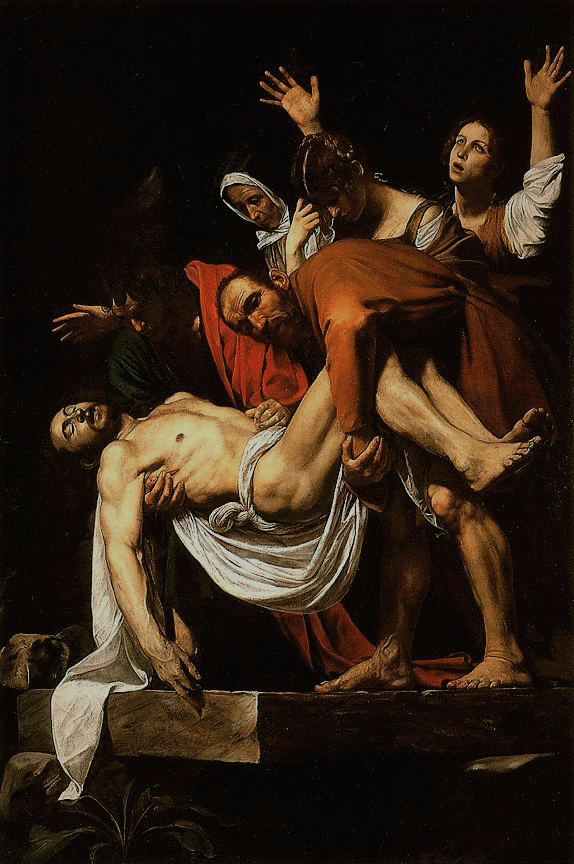
Caravaggio, The Deposition of Christ, 1604


Caravaggio’s art is made from darkness and light. His pictures present spotlit moments of extreme and often agonized human experience. A man is decapitated in his bedchamber, blood spurting from a deep gash in his neck. A man is assassinated on the high altar of a church. A woman is shot in the stomach with a bow and arrow at point-blank range. Caravaggio’s images freeze time but also seem to hover on the brink of their own disappearance. Faces are brightly illuminated. Details emerge from darkness with such uncanny clarity that they might be hallucinations. Yet always the shadows encroach, the pools of blackness that threaten to obliterate all. Looking at his pictures is like looking at the world by flashes of lightning.

Andrew Graham-Dixon, from Caravaggio: A Life Sacred and Profane

Graham-Dixon's Who Killed Caravaggio? ...


On the survival of Caravaggio ...


Caravaggio's sending the artichokes back ...

27 February 2020

Only.

Caravaggio, Deposition, 1604


Beauty is the only thing that time cannot harm. 

Oscar Wilde

10 June 2019

Awaken.

Caravaggio, Madonna di Loreto, 1604


Pure water from a clear spring 
simmering over the clay stove 
battered robe and tattered cap 
brown with fume and tea smudge. 

Don't think I'm some old gaffer 
with a wild-eyed love for tea. 

My purpose is to awaken you 
out of your worldly sleep.

Baisao

16 May 2019

Apparatus.

Caravaggio, David with the Head of Goliath, 1610


Whether the mask is labeled fascism, democracy, or dictatorship of the proletariat, our great adversary remains the apparatus—the bureaucracy, the police, the military. Not the one facing us across the frontier of the battle lines, which is not so much our enemy as our brothers' enemy, but the one that calls itself our protector and makes us its slaves. No matter what the circumstances, the worst betrayal will always be to subordinate ourselves to this apparatus and to trample underfoot, in its service, all human values in ourselves and in others.

Simone Weil

28 April 2019

Awareness.

Carravaggio, The Incredulity of Saint Thomas, 1602


Then the voice says, "They have washed their robes and have made them white in the blood of the Lamb."

There they are. There "we" are - the multitude who so wanted to be faithful, who at times got defeated, soiled by life, and bested by trials, wearing the bloodied garments of life's tribulations, but through it all clung to faith. 

My friends, if this is not good news to you, you have never understood the gospel of grace.

When I get honest, I admit I am a bundle of paradoxes. I believe and I doubt, I hope and get discouraged, I love and I hate, I feel bad about feeling good, I feel guilty about not feeling guilty. I am trusting and suspicious. I am honest and I still play games. Aristotle said I am a rational animal; I say I am an angel with an incredible capacity for beer.

To live by grace means to acknowledge my whole life story, the light side and the dark. In admitting my shadow side I learn who I am and what God's grace means. As Thomas Merton put it, "A saint is not someone who is good but who experiences the goodness of God."

The gospel of grace nullifies our adulation of televangelists, charismatic superstars, and local church heroes. It obliterates the two-class citizenship theory operative in many American churches. For grace proclaims the awesome truth that all is gift. All that is good is ours not by right but by the sheer bounty of a gracious God. While there is much we may have earned--our degree and our salary, our home and garden, a Miller Lite and a good night's sleep--all this is possible only because we have been given so much: life itself, eyes to see and hands to touch, a mind to shape ideas, and a heart to beat with love. We have been given God in our souls and Christ in our flesh. We have the power to believe where others deny, to hope where others despair, to love where others hurt. This and so much more is sheer gift; it is not reward for our faithfulness, our generous disposition, or our heroic life of prayer. Even our fidelity is a gift, "If we but turn to God," said St. Augustine, "that itself is a gift of God." 
My deepest awareness of myself is that I am deeply loved by Jesus Christ and I have done nothing to earn it or deserve it.

Brennan Manning, from The Ragamuffin Gospel