"I am not one who was born in the custody of wisdom. I am one who is fond of olden times and intense in quest of the sacred knowing of the ancients." Gustave Courbet
Showing posts with label Friedrich. Show all posts

31 March 2026

Reciprocal.

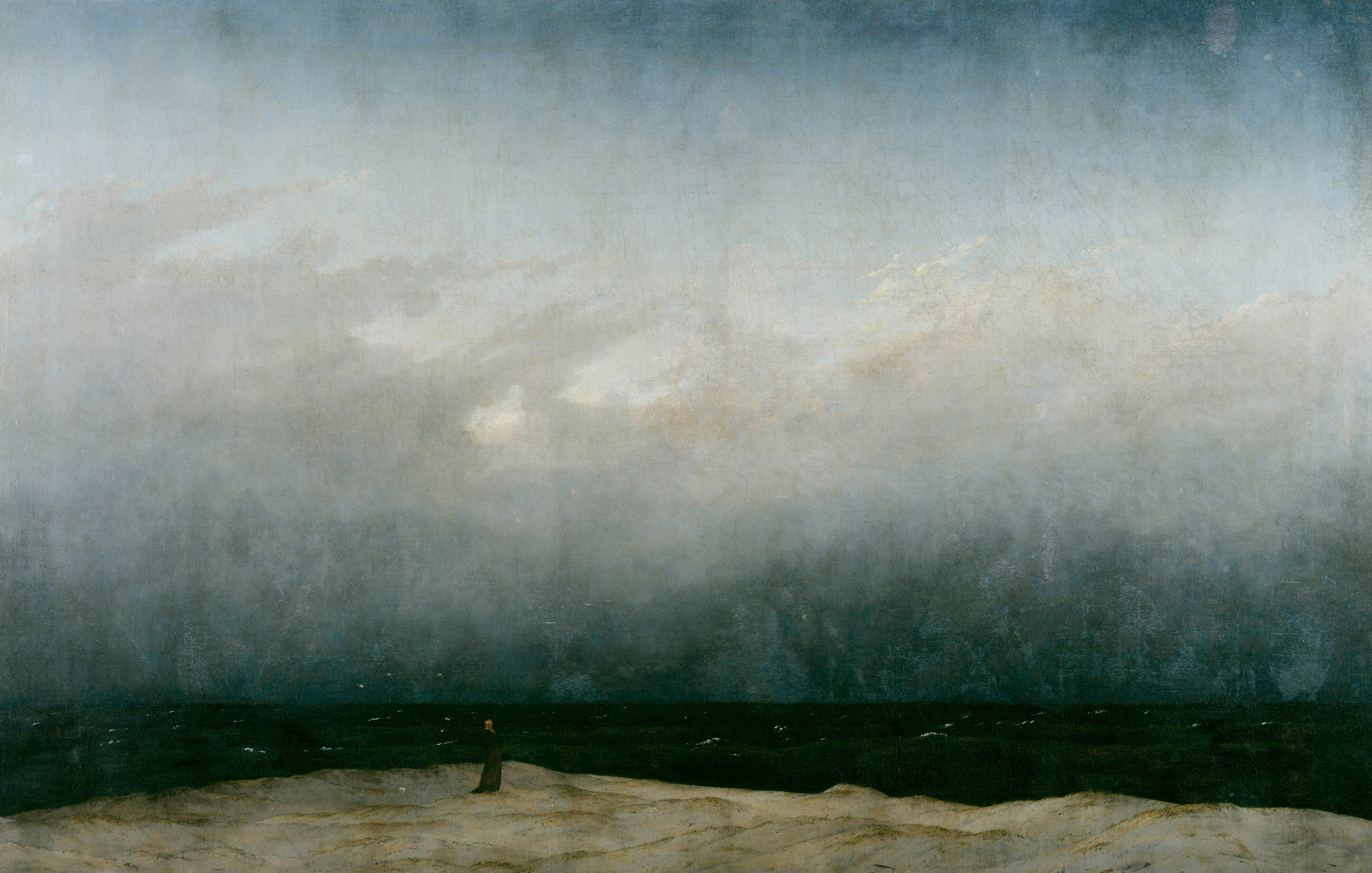
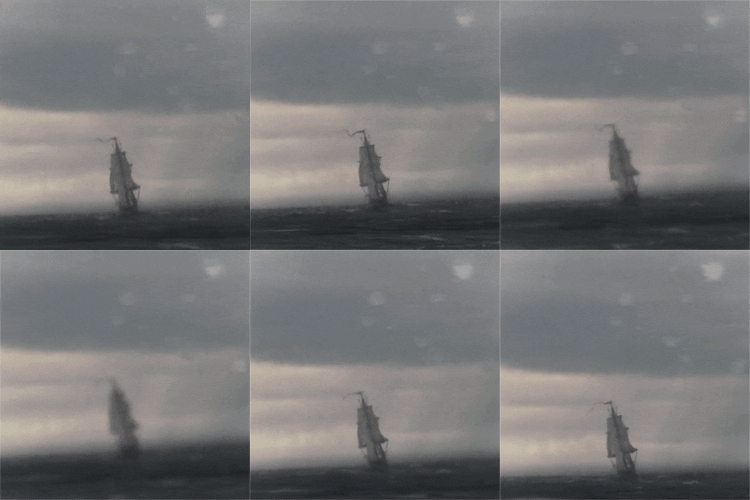
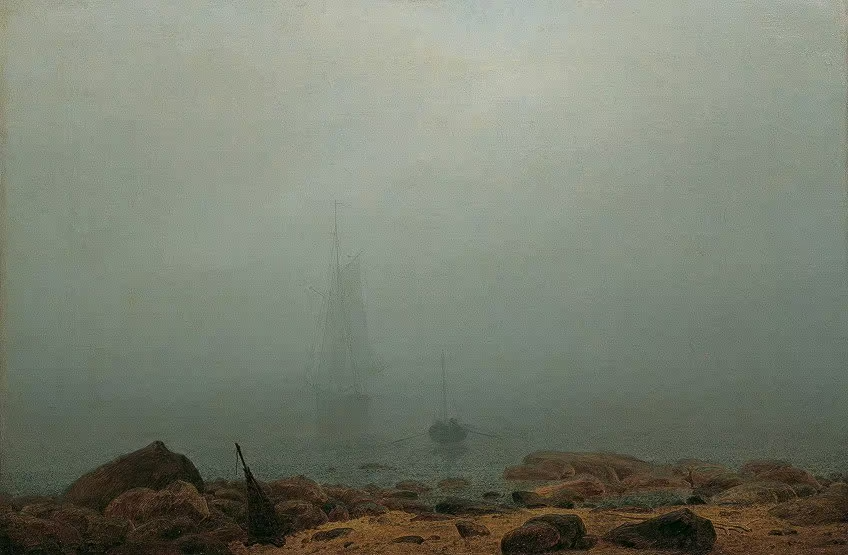
Friedrich, Seashore in the Fog, 1807


Among other things, you'll find that you're not the first person who was ever confused and frightened and even sickened by human behavior. You're by no means alone on that score, you'll be excited and stimulated to know. Many, many men have been just as troubled morally and spiritually as you are right now. Happily, some of them kept records of their troubles. You'll learn from them—if you want to. Just as someday, if you have something to offer, someone will learn something from you. It's a beautiful reciprocal arrangement. And it isn't education. It's history. It's poetry.

J.D. Salinger, from The Catcher in the Rye

27 January 2026

Freedom.

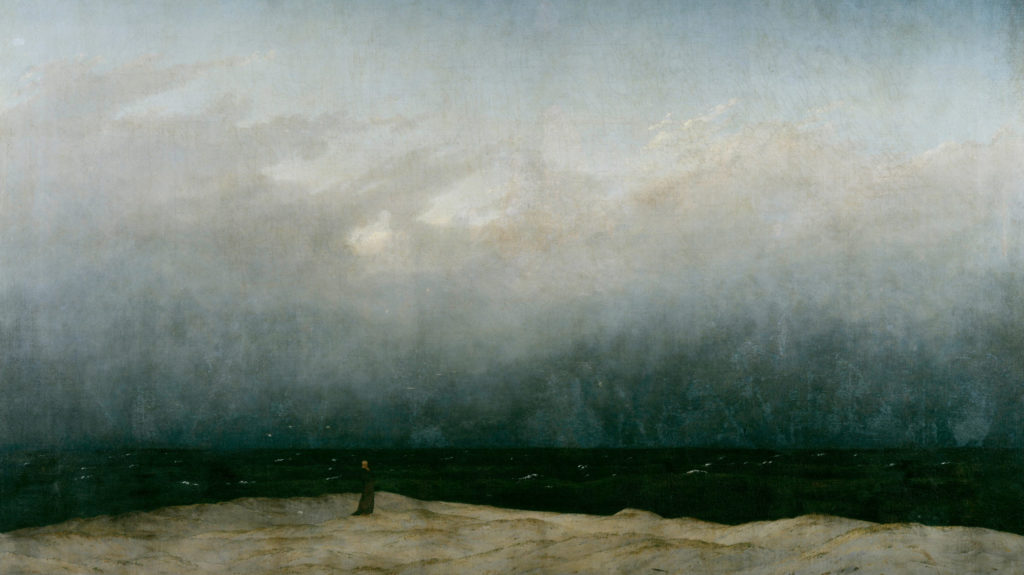
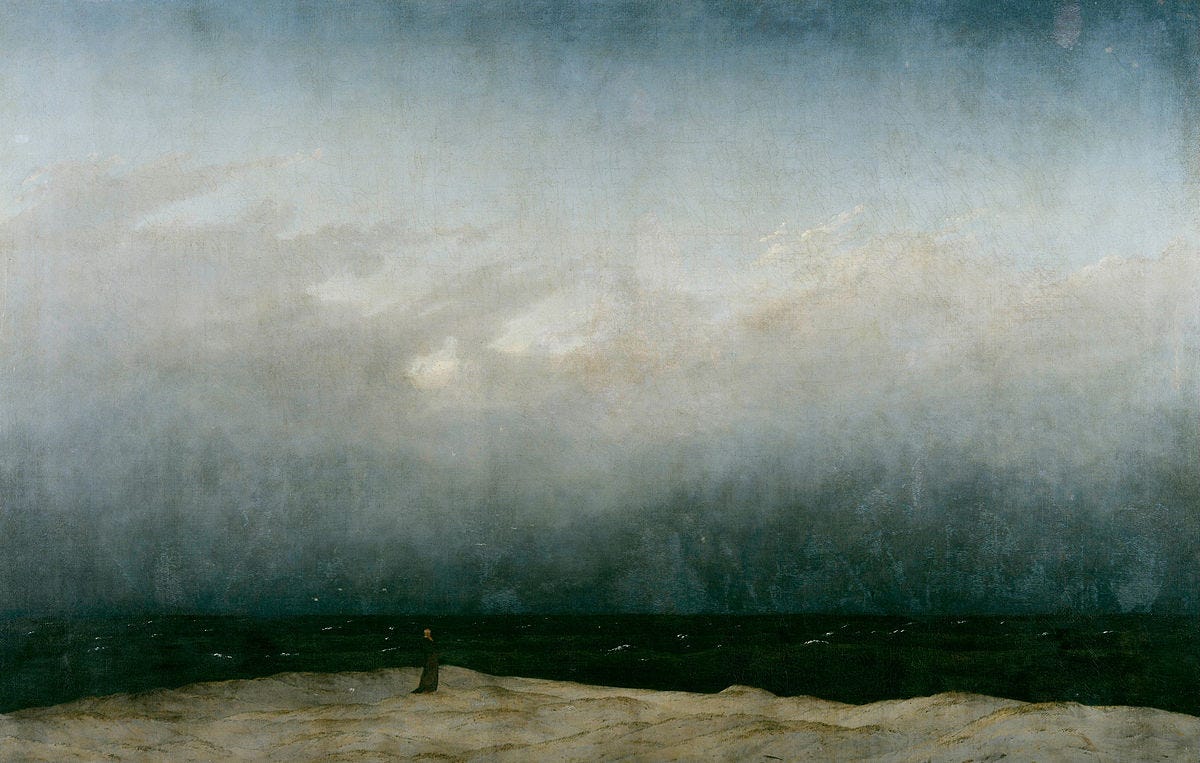
Friedrich, The Monk by the Sea, 1810


Steve reminds us that life is a mystery to be lived ... 
Story conveys the reality of human freedom, for although "real," our freedom is limited, and although "limited," our freedom is real ... 
We find miracle only when we stop looking for magic.

08 December 2024

Responsibility.

Friedrich, Monk by the Sea, 1810


As a teacher who has learned with kids for twenty years, I have witnessed a need for a drastic transformation in the way mental health is perceived and managed.  The amount of time, effort, and dollars spent on physical health must, at least, be the model for the attention given to mental and spiritual health.

Remember our responsibility to each other.

From Dickens' A Christmas Carol  ...
“Spirit,” said Scrooge, with an interest he had never felt before, “tell me if Tiny Tim will live.”

“I see a vacant seat,” replied the Ghost, “in the poor chimney-corner, and a crutch without an owner, carefully preserved. If these shadows remain unaltered by the Future, the child will die.”

“No, no,” said Scrooge. “Oh, no, kind Spirit! say he will be spared.”

“If these shadows remain unaltered by the Future, none other of my race,” returned the Ghost, “will find him here. What then? If he be like to die, he had better do it, and decrease the surplus population.”

Scrooge hung his head to hear his own words quoted by the Spirit, and was overcome with penitence and grief.

“Man,” said the Ghost, “if man you be in heart, not adamant, forbear that wicked cant until you have discovered What the surplus is, and Where it is. Will you decide what men shall live, what men shall die? It may be, that in the sight of Heaven, you are more worthless and less fit to live than millions like this poor man’s child. Oh God! to hear the Insect on the leaf pronouncing on the too much life among his hungry brothers in the dust!”
1 Corinthians 15:8-10 (KJV)
8 And last of all he was seen of me also, as of one born out of due time.

9 For I am the least of the apostles, that am not meet to be called an apostle, because I persecuted the church of God.

10 But by the grace of God I am what I am: and his grace which was bestowed upon me was not in vain; but I laboured more abundantly than they all: yet not I, but the grace of God which was with me.
Jean-Paul Sartre, from Existentialism is a Humanism
When we say that man chooses for himself, we do mean that every one of us must choose himself; but by that we also mean that in choosing for himself he chooses for all men. For in effect, of all the actions a man may take in order to create himself as he wills to be, there is not one which is not creative, at the same time, of an image of man such as he believes he ought to be. To choose between this or that is at the same time to affirm the value of that which is chosen; for we are unable ever to choose the worse. What we choose is always the better; and nothing can be better for us unless it is better for all.

15 March 2024

Indespensible.

Friedrich, The Monk by the Sea, 1810


I must stay alone and know that I am alone to contemplate and feel nature in full; I have to surrender myself to what encircles me, I have to merge with my clouds and rocks in order to be what I am. Solitude is indispensible for my dialogue with nature.

Caspar David Friedrich

It's sandwich time.

31 December 2023

Sprung.

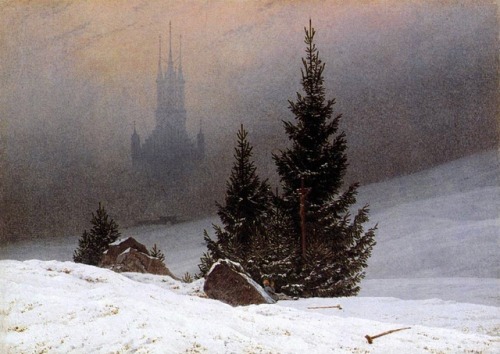
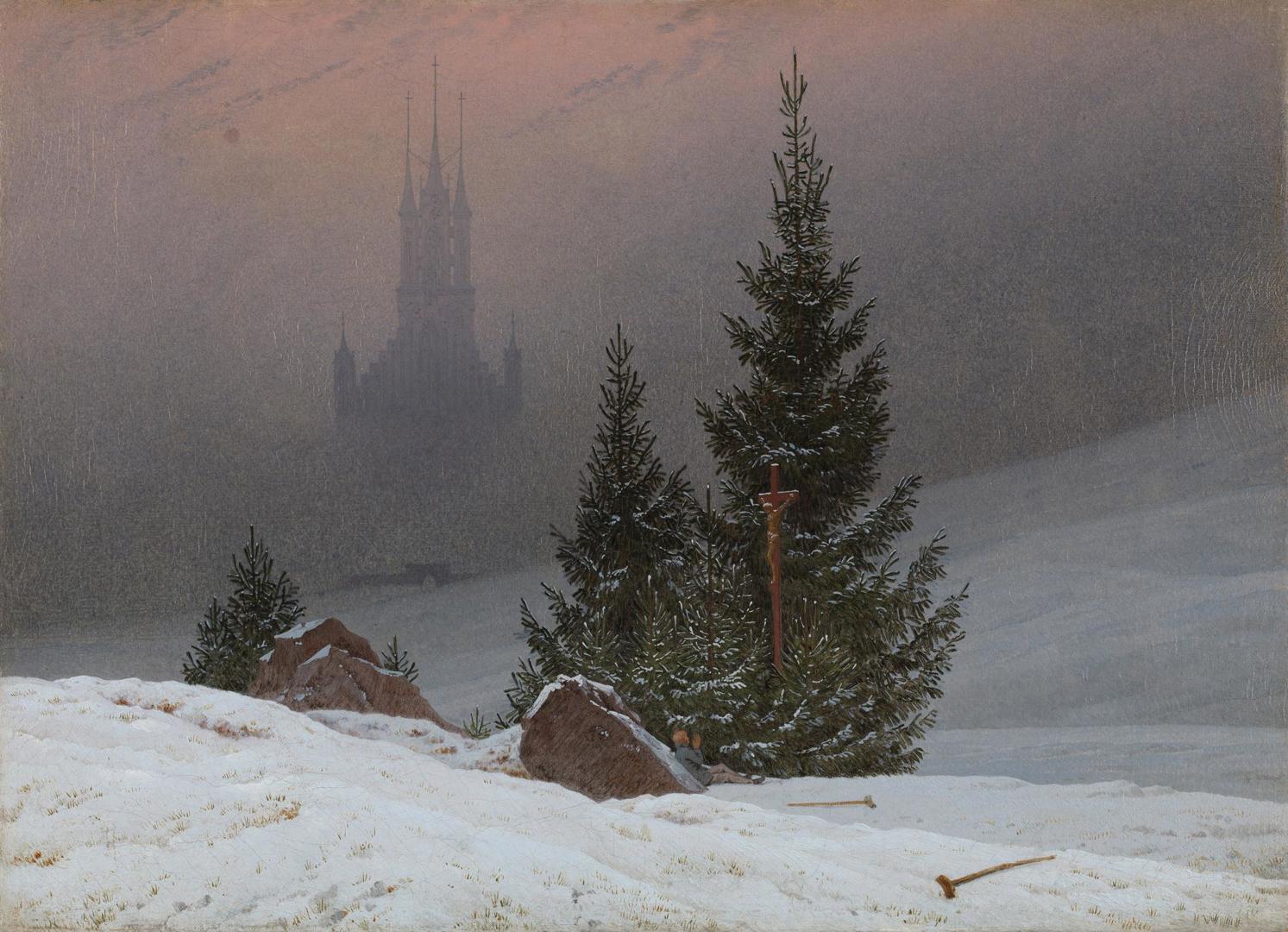
Friedrich, Winter Landscape, 1811

Sweet music, sweeter far
Than any song is sweet:
Sweet music, heavenly rare,
Mine ears, O peers, doth greet.
You gentle flocks, whose fleeces, pearled with dew,
Resemble heaven, whom golden drops make bright,
Listen, O listen, now, O not to you
Our pipes make sport to shorten weary night;
But voices most divine
Make blissful harmony:
Voices that seem to shine,
For what else clears the sky?
Tunes can we hear, but not the singers see,
The tunes divine, and so the singers be.

Lo, how the firmament
Within an azure fold
The flock of stars hath pent,
That we might them behold;
Yet from their beams proceedeth not this light,
Nor can their crystals such reflection give.
What then doth make the element so bright?
The heavens are come down upon earth to live.
But hearken to the song,
Glory to glory's king,
And peace all men among,
These quiristers do sing.
Angels they are, as also (Shepherds) he
Whom in our fear we do admire to see.

Let not amazement blind
Your souls, said he, annoy:
To you and all mankind
My message bringeth joy.
For lo, the world's great Shepherd now is born
A blessed babe, an infant full of power:
After long night uprisen is the morn,
Renowning Bethl'em in the Saviour.
Sprung is the perfect day,
By prophets seen afar:
Sprung is the mirthful May,
Which winter cannot mar.
In David's city doth this sun appear
Clouded in flesh, yet, shepherds, sit we here?

Edward Bolton
21 May 2023

Rigorous.


Professor Stanley Fish on intellectual diversity ...
Isn't it the case that, at least in the humanities and social sciences, the materials to be studied are fraught with political and ideological implications? How could those implications be ignored or removed without producing a classroom experience that would be arid and just plain dull? Easy. What you do is regard the political and ideological implications of your materials as something to be studied and not as something you and your students vote on. The master rule was given long ago by Max Weber when he insisted that while canvassing for votes and trying to persuade others to your partisan views is perfectly appropriate in the political arena, it is perfectly inappropriate in the classroom. "It is one thing," says Weber, "to determine...the internal structure of cultural values, while it is another thing to answer questions of the value of culture." I have coined an ugly word which, I think, captures Weber's understanding of what should and should not go on in higher education. The word is "academicize," and it is easily turned into a slogan on the model of Duke Professor Fredrick Jameson's famous advice to cultural critics--always historicize. My advice is always academicize, by which I mean always remove the materials you bring to the classroom from the context of their real-world urgency--where you ask and answer questions like what should we do now and which of the alternative courses of action is just and moral--and insert them into the context of academic urgencies--where you ask and answer questions like what is the structure of the arguments on either side of this issue or what are the historical antecedents of the present controversy or what is the relationship between this controversy and others now playing out in neighboring areas of inquiry? The more you ask this second kind of question, the less you and your students will ask, or even be interested in, the first kind. Academicizing a subject means draining it of the energies that animate partisan proponents of one position or another, and infusing it with the energies that come along with rigorous intellectual interrogation. And you can do this without losing the political significance of the subject; it's just that that significance becomes part of what is being studied rather an occasion for real-life decision making.

Martin Hackworth on the orthodoxy of the elites ...

The triumph of group-think over intellectual diversity has occurred to our considerable detriment. Our government is vastly incompetent and the progenitor of bad outcomes because political parties and the federal bureaucracy each rely on only their own corrals of acceptable thought. You may be incompetent (see Pete Buttigieg), you may be of any race, creed, or sexual orientation, you may even identify as a puppy and still get a seat at the table with the big kids, as long as you don’t object to the orthodoxy du jour. Do that, and you are out.

07 March 2023

Guard.

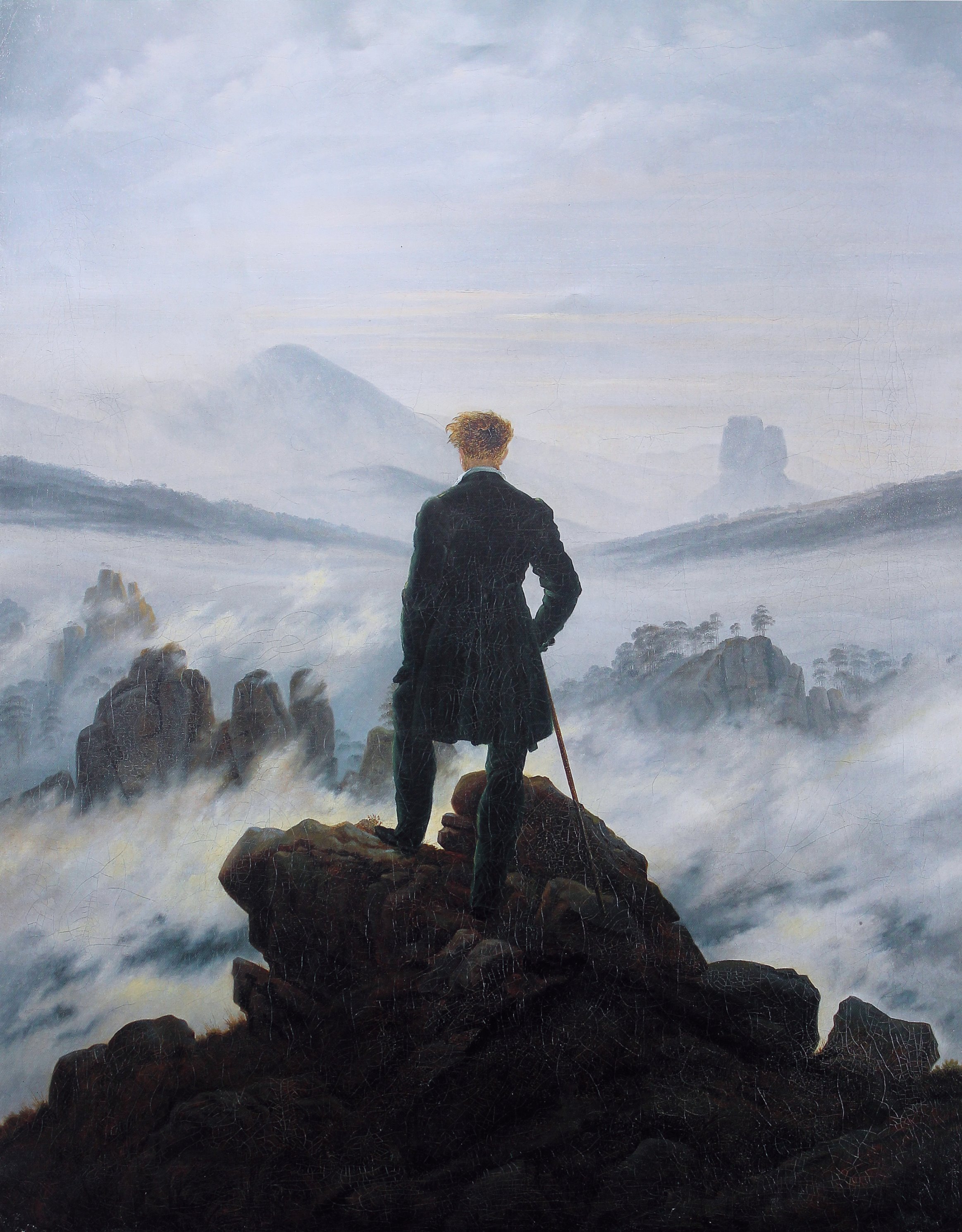
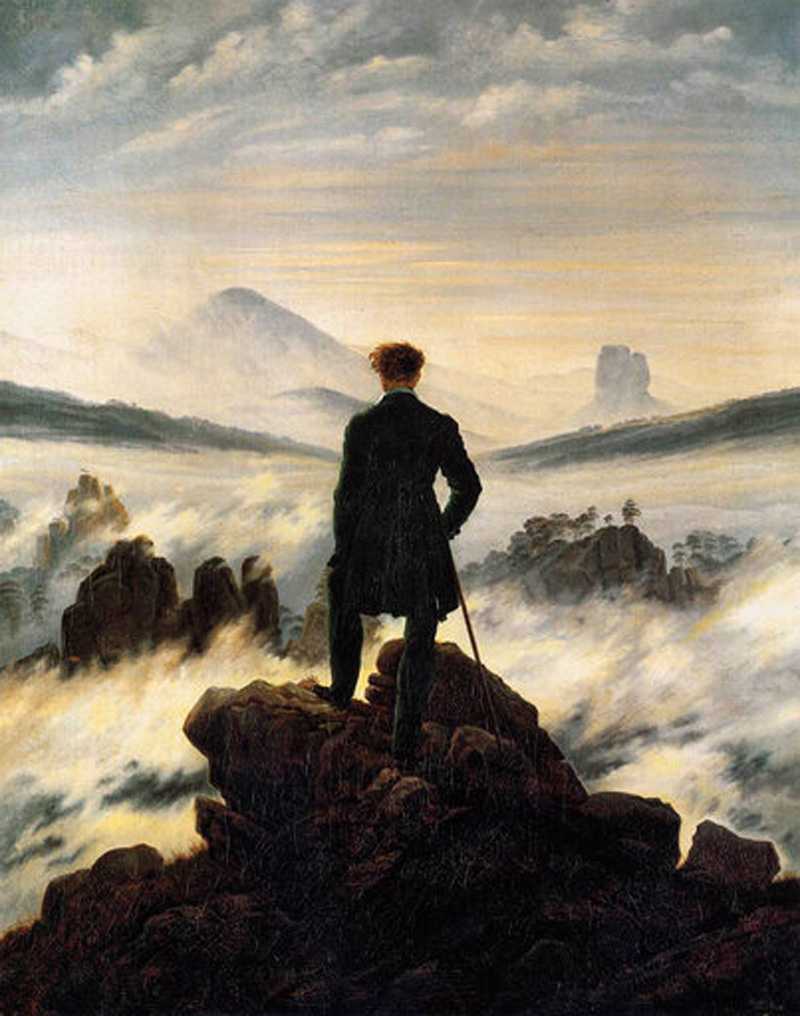
Friedrich, Wanderer Above the Sea of Fog, 1817


Experience should teach us to be most on our guard to protect liberty when the Government’s purposes are beneficent. Men born to freedom are naturally alert to repel invasion of their liberty by evil-minded rulers. The greatest dangers to liberty lurk in insidious encroachment by men of zeal, well-meaning but without understanding.

Justice Louis Brandeis, from Olmstead v. United States (1928)

01 March 2023

26 January 2023

Beginning.

Friedrich, Wanderer Above the Sea of Fog, 1818


First Amendment freedoms are most in danger when the government seeks to control thought or to justify its laws for that impermissible end. The right to think is the beginning of freedom, and speech must be protected from the government because speech is the beginning of thought.


Just read and keep reading.

04 January 2023

Solitude.

Friedrich, The Dreamer, 1835


I must stay alone and know that I am alone to contemplate and feel nature in full; I have to surrender myself to what encircles me, I have to merge with my clouds and rocks in order to be what I am. Solitude is indispensable for my dialogue with nature.

Caspar David Friedrich

04 August 2022

Highest.

Friedrich, Monk by the Sea, 1810


Art comes to you proposing frankly to give nothing but the highest quality to your moments as they pass.

Walter Pater

27 December 2017

Astounde.

Friedrich, Ruins at Dusk, 1831


Stay, curyous traveller, and pass not bye,
Until this fetive pile astounde thine eye.
Whole rocks on rocks with yron joynd surveie,
And okes with okes entremed disponed lie.
This mightie pile, that keeps the wyndes at baie,
Fyre-levyn and the mokie storme defie,
That shootes aloofe into the reaulmes of daie,
Shall be the record of the Buylders fame for aie.
Thou seest this maystrie of a human hand,
The pride of Brystowe and the Westerne lande,                  
Yet is the Buylders vertues much moe greete,
Greeter than can bie Rowlies pen be scande.
Thou seest the saynctes and kynges in stonen state,
That seemd with breath and human soule dispande,
As payrde to us enseem these men of slate,
Such is greete Canynge's mynde when payrd to God elate.
Well maiest thou be astound, but view it well;
Go not from hence before thou see thy fill,
And learn the Builder's vertues and his name;
Of this tall spyre in every countye telle,                    
And with thy tale the lazing rych men shame;
Showe howe the glorious Canynge did excelle;
How hee good man a friend for kynges became,
And gloryous paved at once the way to heaven and fame.

Thomas Chatterton

18 October 2016

Highest.

Friedrich, A Walk at Dusk, 1840


So it is that we might almost say silence is the tribute we pay to holiness; we slip off words when we enter a sacred space, just as we slip off shoes. A "moment of silence'' is the highest honor we can pay someone; it is the point at which the mind stops and something else takes over (words run out when feelings rush in). A "vow of silence'' is for holy men the highest devotional act. We hold our breath, we hold our words; we suspend our chattering selves and let ourselves "fall silent,'' and fall into the highest place of all.

Pico Iyer

19 September 2016

Act.

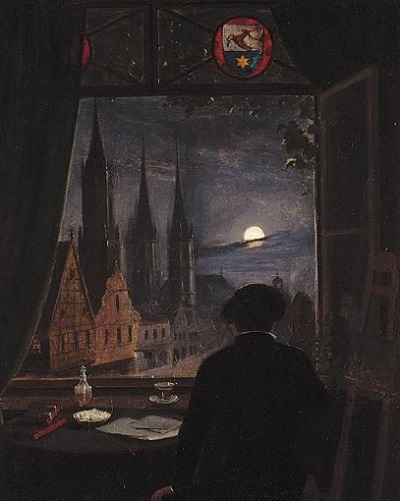
Friedrich, An Artist In His Studio Contemplating A Moonlit Street From His Opened Window, 1904


The fear of the inexplicable has not only impoverished the reality of the individual, it has also narrowed the relationship between one human being and another, which has, as it were, been lifted out of the riverbed of infinite possibilities and set down in a fallow place on the bank, where nothing happens. For it is not only indolence that causes human relationships to be repeated from case to case with such unspeakable monotony and boredom; it is timidity before any new, inconceivable experience, which we don't think we can deal with. But only someone who is ready for everything, who doesn't exclude any experience, even the most incomprehensible, will live the relationship with another person as something alive and will himself sound the depths of his own being. For if we imagine this being of the individual as a larger or smaller room, it is obvious that most people come to know only one corner of their room, one spot near the window, one narrow strip on which they keep walking back and forth. In this way they have a certain security. And yet how much more human is the dangerous in security that drives those prisoners in Poe's stories to feel out the shapes of their horrible dungeons and not be strangers to the unspeakable terror of their cells. We, however, are not prisoners. No traps or snares have been set around us, and there is nothing that should frighten or upset us. We have been put into life as into the element we most accord with, and we have, moreover, through thousands of years of adaptation, come to resemble this life so greatly that when we hold still, through a fortunate mimicry we can hardly be differentiated from everything around us. We have no reason to harbor any mistrust against our world, for it is not against us. If it has terrors, they are our terrors; if it has abysses, these abysses belong to us; if there are dangers, we must try to love them. And if only we arrange our life in accordance with the principle which tells us that we must always trust in the difficult, then what now appears to us as the most alien will become our most intimate and trusted experience. How could we forget those ancient myths that stand at the beginning of all races, the myths about dragons that at the last moment are transformed into princesses? Perhaps all the dragons in our lives are princesses who are only waiting to see us act, just once, with beauty and courage. Perhaps everything that frightens us is, in its deepest essence, something helpless that wants our love.

Rainer Maria Rilke

15 August 2016

Off.

Friedrich, Riesengebirge, 1935


I went off with my hands in my torn coat pockets;
My overcoat too was becoming ideal;
I travelled beneath the sky, Muse! and I was your vassal;
Oh dear me! what marvellous loves I dreamed of!

My only pair of breeches had a big whole in them.
– Stargazing Tom Thumb, I sowed rhymes along my way.
My tavern was at the Sign of the Great Bear.
– My stars in the sky rustled softly.

And I listened to them, sitting on the road-sides
On those pleasant September evenings while I felt drops
Of dew on my forehead like vigorous wine;

And while, rhyming among the fantastical shadows,
I plucked like the strings of a lyre the elastics
Of my tattered boots, one foot close to my heart!

Arthur Rimbaud

30 June 2016

Poetry.

Friedrich, Drifting Clouds, 1820


ON THE GRASSHOPPER AND CRICKET

The Poetry of earth is never dead:    
  When all the birds are faint with the hot sun,    
  And hide in cooling trees, a voice will run    
From hedge to hedge about the new-mown mead;    
That is the Grasshopper’s—he takes the lead       
  In summer luxury,—he has never done    
  With his delights; for when tired out with fun    
He rests at ease beneath some pleasant weed.    
The poetry of earth is ceasing never:    
  On a lone winter evening, when the frost      
    Has wrought a silence, from the stove there shrills    
The Cricket’s song, in warmth increasing ever,    
  And seems to one in drowsiness half lost,    
    The Grasshopper’s among some grassy hills.

John Keats