Showing posts with label Poortvliet. Show all posts
Showing posts with label Poortvliet. Show all posts
18 October 2025


02 January 2025
Magic.
Poortvliet, Deer in Landscape with Pheasant, n/d
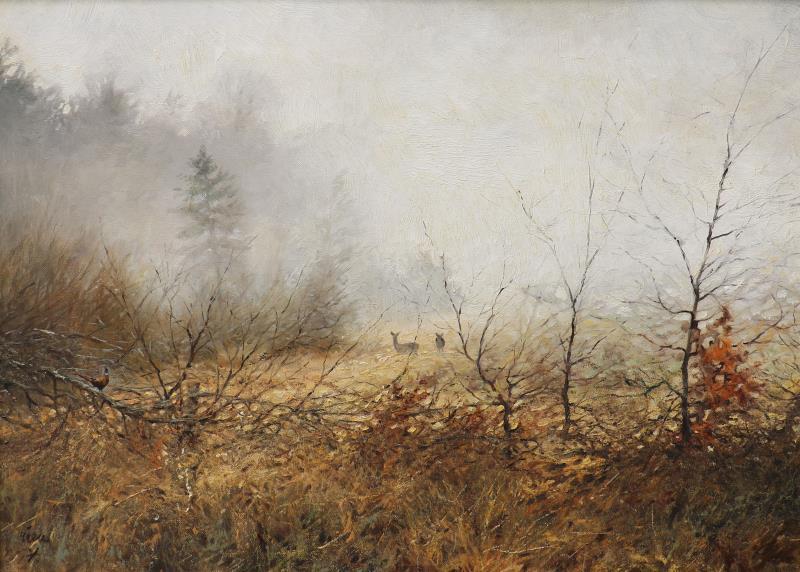
There seemed to be a magic all round that fire of big logs quietly smouldering in the woods upon Autumn's discarded robe that lay brilliant there; and it was not the magic of Elfland, nor had Ziroonderel called it up with her wand: it was only a magic of the wood's very own.
Lord Dunsany, from The King of Elfland's Daughter
21 December 2024
Miracle.
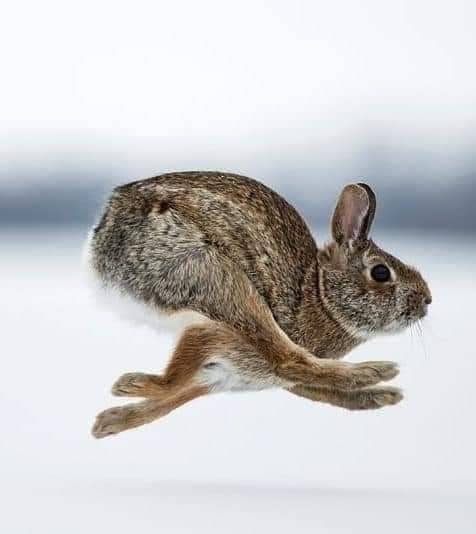
Poortvliet, Hare, 1976
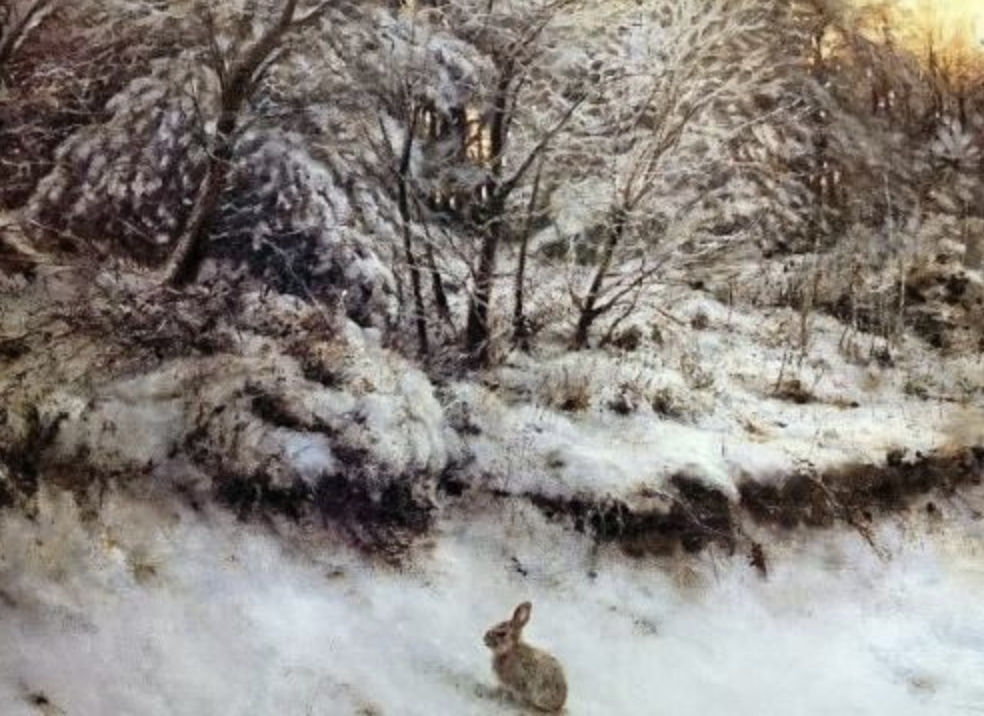
Look up at the miracle of the falling snow, - the air a dizzy maze of whirling, eddying flakes, noiselessly transforming the world, the exquisite crystals dropping in ditch and gutter, and disguising in the same suit of spotless livery all objects upon which they fall. How novel and fine the first drifts! The old, dilapidated fence is suddenly set off with the most fantastic ruffles, scalloped and fluted after an unheard-of fashion! Looking down a long line of decrepit stone wall, in the trimming of which the wind had fairly run riot, I saw, as for the first time, what a severe yet master artist old Winter is. Ah, a severe artist! How stern the woods look, dark and cold and as rigid against the horizon as iron!
John Burroghs, from "The Snow-Walkers"
26 October 2024
Home.
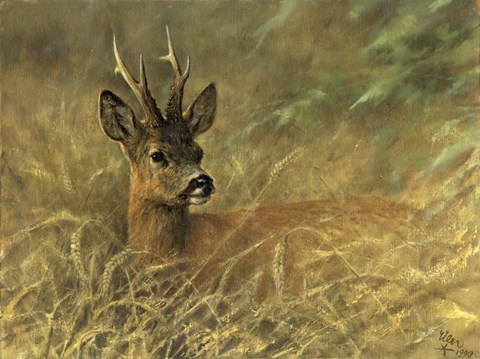
Poortvliet, Resting, n/d
I will wait here in the fields
to see how well the rain
brings on the grass.
In the labor of the fields
longer than a man’s life
I am at home. Don’t come with me.
You stay home too.
I will be standing in the woods
where the old trees
move only with the wind
and then with gravity.
In the stillness of the trees
I am at home. Don’t come with me.
You stay home too.
Wendell Berry
20 October 2024
Infinitude.
Poortvliet, Untitled, 1977

The FAR FIELD
I
I dream of journeys repeatedly:
Of flying like a bat deep into a narrowing tunnel
Of driving alone, without luggage, out a long peninsula,
The road lined with snow-laden second growth,
A fine dry snow ticking the windshield,
Alternate snow and sleet, no on-coming traffic,
And no lights behind, in the blurred side-mirror,
The road changing from glazed tarface to a rubble of stone,
Ending at last in a hopeless sand-rut,
Where the car stalls,
Churning in a snowdrift
Until the headlights darken.
II
At the field's end, in the corner missed by the mower,
Where the turf drops off into a grass-hidden culvert,
Haunt of the cat-bird, nesting-place of the field-mouse,
Not too far away from the ever-changing flower-dump,
Among the tin cans, tires, rusted pipes, broken machinery, --
One learned of the eternal;
And in the shrunken face of a dead rat, eaten by rain and ground-beetles
(I found in lying among the rubble of an old coal bin)
And the tom-cat, caught near the pheasant-run,
Its entrails strewn over the half-grown flowers,
Blasted to death by the night watchman.
I suffered for young birds, for young rabbits caught in the mower,
My grief was not excessive.
For to come upon warblers in early May
Was to forget time and death:
How they filled the oriole's elm, a twittering restless cloud, all one morning,
And I watched and watched till my eyes blurred from the bird shapes, --
Cape May, Blackburnian, Cerulean, --
Moving, elusive as fish, fearless,
Hanging, bunched like young fruit, bending the end branches,
Still for a moment,
Then pitching away in half-flight,
Lighter than finches,
While the wrens bickered and sang in the half-green hedgerows,
And the flicker drummed from his dead tree in the chicken-yard.
-- Or to lie naked in sand,
In the silted shallows of a slow river,
Fingering a shell,
Thinking:
Once I was something like this, mindless,
Or perhaps with another mind, less peculiar;
Or to sink down to the hips in a mossy quagmire;
Or, with skinny knees, to sit astride a wet log,
Believing:
I'll return again,
As a snake or a raucous bird,
Or, with luck, as a lion.
I learned not to fear infinity,
The far field, the windy cliffs of forever,
The dying of time in the white light of tomorrow,
The wheel turning away from itself,
The sprawl of the wave,
The on-coming water.
III
The river turns on itself,
The tree retreats into its own shadow.
I feel a weightless change, a moving forward
As of water quickening before a narrowing channel
When banks converge, and the wide river whitens;
Or when two rivers combine, the blue glacial torrent
And the yellowish-green from the mountainy upland, --
At first a swift rippling between rocks,
Then a long running over flat stones
Before descending to the alluvial plane,
To the clay banks, and the wild grapes hanging from the elmtrees.
The slightly trembling water
Dropping a fine yellow silt where the sun stays;
And the crabs bask near the edge,
The weedy edge, alive with small snakes and bloodsuckers, --
I have come to a still, but not a deep center,
A point outside the glittering current;
My eyes stare at the bottom of a river,
At the irregular stones, iridescent sandgrains,
My mind moves in more than one place,
In a country half-land, half-water.
I am renewed by death, thought of my death,
The dry scent of a dying garden in September,
The wind fanning the ash of a low fire.
What I love is near at hand,
Always, in earth and air.
IV
The lost self changes,
Turning toward the sea,
A sea-shape turning around, --
An old man with his feet before the fire,
In robes of green, in garments of adieu.
A man faced with his own immensity
Wakes all the waves, all their loose wandering fire.
The murmur of the absolute, the why
Of being born falls on his naked ears.
His spirit moves like monumental wind
That gentles on a sunny blue plateau.
He is the end of things, the final man.
All finite things reveal infinitude:
The mountain with its singular bright shade
Like the blue shine on freshly frozen snow,
The after-light upon ice-burdened pines;
Odor of basswood on a mountain-slope,
A scent beloved of bees;
Silence of water above a sunken tree :
The pure serene of memory in one man, --
A ripple widening from a single stone
Winding around the waters of the world.
Theodore Roethke
21 December 2023
Half-Lit.
Poortvliet, Deer in the Woods, n/d
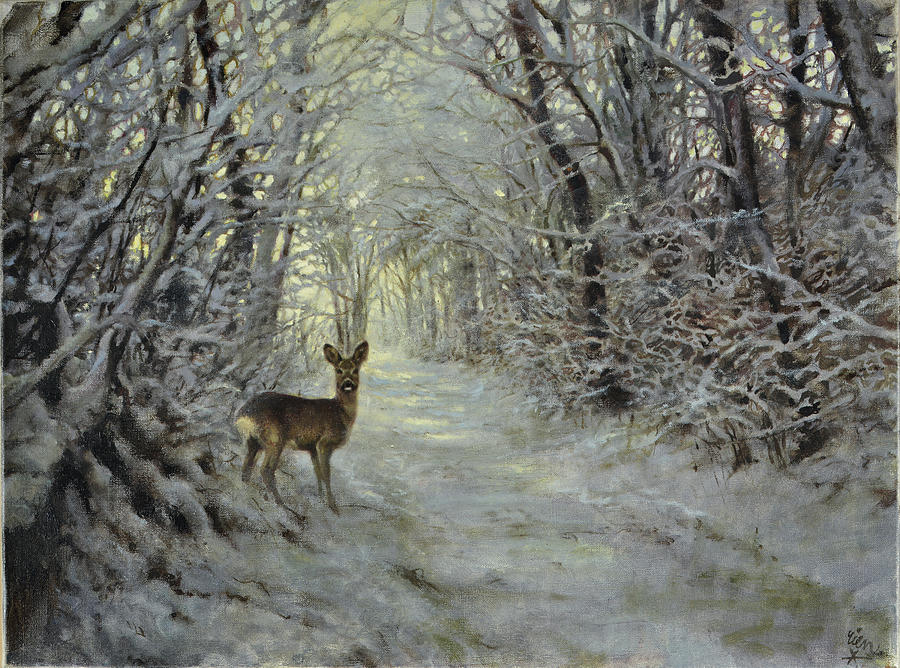
SINGING to DEER
At solstice, the woods were bright in a snowy way, the sky pearl gray above the stately maples and gnarled burr oaks. An Alaskan marooned in the urban Midwest, it took me years to find this nearby patch of relatively undisturbed land where I can sense the power of wildness. Now I go there often, watching the seasons unfold their changeful unchanging patterns in the increasingly familiar forest.
I especially like to walk among the sleeping trees in the half-lit silence of winter dawns. The trail I follow winds and twists, new patches of mixed woodland appearing at every turn. That morning, I reached a point where the path turns sharply left to follow a small ravine. In spring, ephemeral ponds—lively with salamanders, loud with frogs—form in the creases of the forest there. But in frozen winter, I expected nothing beyond silence and wind.
So I did not see them at first, three deer beside three empty larches. When I made them out—gray-dun hides against a gray-dun world—they were motionless, white tails aloft like flags of distress. I stopped in my tracks, thinking how lucky I was to meet the animal my Celtic forebears called the spirit of wildness on that auspicious day.
I often encounter deer on my morning walks. The woods are close enough to roads and homes that we humans are no strangers to them. But like any animal of the suburban wild—squirrel or opossum or raccoon—the deer keep their distance. An instant after they see me, they bound silently away, their white-flag tails on high alert.
But this morning, the deer only stared at me across the ravine. To the left stood a tall stately doe; to the right, an older heavier one; in the center, one of the previous spring’s fawns, all gangly adolescence. Huge soft ears held high, they cast dark liquid gazes at me.
And did not run.
Desire burst in my heart: to speak to the deer, to tell them how beautiful they were, to thank them for bringing wildness to the edge of the vast city. To speak from my heart, my own little wild heart, to theirs. To celebrate the season with them.
But I stood silent, for I do not speak the language of deer. I stared silently at them, awaiting the inevitable flight. But moments stretched out like fingers of light from the rising sun, and the deer did not run away.
Then, for no reason I can easily explain, I began to sing, my voice loud in the silent forest. A plaintive minor-keyed medieval song sprang to my lips, a holiday carol I’ve known since girlhood. Lo how a rose e’er blooming, from tender stem hath sprung. . . It came a floweret bright, amidst the snows of winter, when half-spent was the night.
I thought the sound of my voice would frighten the deer away, but I wanted to speak to them, and music seemed the only way.
Just as I expected, they began to move. But not swiftly. And not into the forest. Not away from me at all.
No. One slow step at a time, the deer moved towards me.
When I started singing, they were perhaps fifty feet away. By the time I began the second verse, they were half that distance. By the time I finished the song, the deer stood just across the ravine.
In the sudden silence at the song’s end, three tails went suddenly up again, sounding a silent alert. So I began another song. Tails went down, ears moved slightly forward. Dawn light emblazoned lemon and melon stripes upon the snow as three deer listened to carol after carol after carol.
A quarter-hour passed and still they did not move. I kept singing.
It was not the deer but me who ended our encounter. The sky had moved from pearl to sherbet to azure, and I had promises to keep. I thanked the deer for listening to my dawn chorus. The sound of my words shook them awake. Tails went up, forelegs tucked up, and in an instant they were gone.
In the silence, I stared into the gray forest. Only a few months earlier, standing below a high-massed mountain glacier I have known since childhood, now shrinking fast away, its ancient snows surging down to the gray sea in cold torrents, I had felt overwhelmed with hopelessness. Do we only take from nature, giving nothing in return? If so, what use are we? Why should the universe continue to provide for us, if we are such ungrateful children?
But there on the edge of a tiny ravine, hope washed over me like light. Perhaps there is a reason for our being. Perhaps what we give our lovely blue earth is song. Beauty. Art. Perhaps that is the reason we were created: to entertain the universe. Perhaps the great spirit is amused and touched, thrilled and delighted by our childlike creativity. Today we leave art to the professionals: to those with beautiful voices and firm bodies and exciting visions. But perhaps art is not frozen moments of perfection but the process of creation itself. Perhaps we were put here to pleasure the world, making art as spontaneously and joyfully as children drawing great yellow suns with wax crayons. Perhaps we should all be singing more, and dancing, and painting with bright colors, and chanting out poems. Perhaps we silly wonderful amateurs most please the universe when we act that way.
Patricia Monaghan
23 October 2023

21 June 2023
Wonders.
Poorvliet, Sentry, 1979
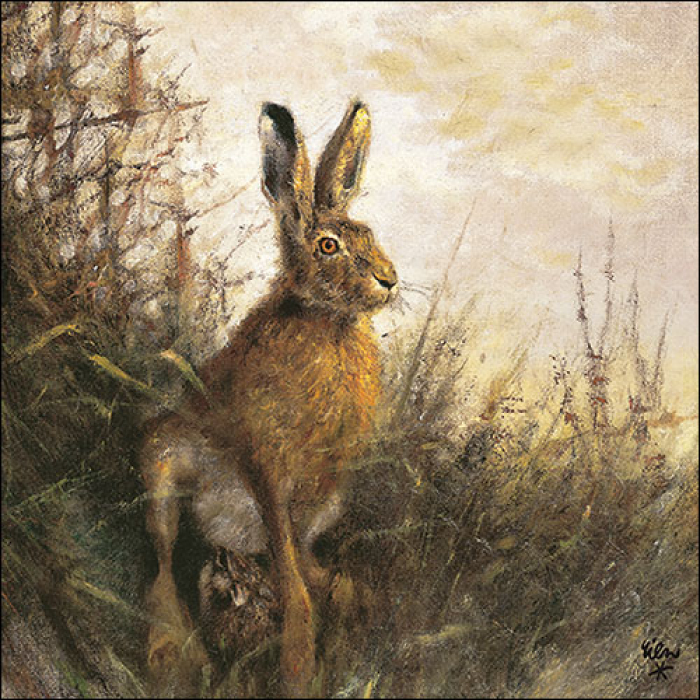
SUMMER MORNING
I love to peep out on a summer's morn,
— Just as the scouting rabbit seeks her shed,
And the coy hare squats nestling in the corn,
— Frit at the bow'd ear tott'ring o'er her head;
And blund'ring pheasant, that from covert springs,
— His short sleep broke by early trampling feet,
Makes one to startle with his rustling wings,
— As through the boughs he seeks more safe retreat.
The little flower, begemm'd around with drops
— That shine at sunrise like to burnish'd gold,
'Tis sweet to view: the milk-maid often stops,
— And wonders much such spangles to behold;
The hedger, too, admires them deck the thorn,
And thinks he sees no beauties like the morn.
John Clare
22 January 2023
Exploring.
Poortvliet, Hare in Thicket, 1966
.JPG)
When you give yourself to places, they give you yourself back; the more one comes to know them, the more one seeds them with the invisible crop of memories and associations that will be waiting for when you come back, while new places offer up new thoughts, new possibilities. Exploring the world is one the best ways of exploring the mind, and walking travels both terrains.
Rebecca Solnit, from Wanderlust: A History of Walking
25 December 2022
Perhaps.
Poortvliet, Deer in the Woods, n/d
SINGING to DEER
At solstice, the woods were bright in a snowy way, the sky pearl gray above the stately maples and gnarled burr oaks. An Alaskan marooned in the urban Midwest, it took me years to find this nearby patch of relatively undisturbed land where I can sense the power of wildness. Now I go there often, watching the seasons unfold their changeful unchanging patterns in the increasingly familiar forest.
I especially like to walk among the sleeping trees in the half-lit silence of winter dawns. The trail I follow winds and twists, new patches of mixed woodland appearing at every turn. That morning, I reached a point where the path turns sharply left to follow a small ravine. In spring, ephemeral ponds—lively with salamanders, loud with frogs—form in the creases of the forest there. But in frozen winter, I expected nothing beyond silence and wind.
So I did not see them at first, three deer beside three empty larches. When I made them out—gray-dun hides against a gray-dun world—they were motionless, white tails aloft like flags of distress. I stopped in my tracks, thinking how lucky I was to meet the animal my Celtic forebears called the spirit of wildness on that auspicious day.
I often encounter deer on my morning walks. The woods are close enough to roads and homes that we humans are no strangers to them. But like any animal of the suburban wild—squirrel or opossum or raccoon—the deer keep their distance. An instant after they see me, they bound silently away, their white-flag tails on high alert.
But this morning, the deer only stared at me across the ravine. To the left stood a tall stately doe; to the right, an older heavier one; in the center, one of the previous spring’s fawns, all gangly adolescence. Huge soft ears held high, they cast dark liquid gazes at me.
And did not run.
Desire burst in my heart: to speak to the deer, to tell them how beautiful they were, to thank them for bringing wildness to the edge of the vast city. To speak from my heart, my own little wild heart, to theirs. To celebrate the season with them.
But I stood silent, for I do not speak the language of deer. I stared silently at them, awaiting the inevitable flight. But moments stretched out like fingers of light from the rising sun, and the deer did not run away.
Then, for no reason I can easily explain, I began to sing, my voice loud in the silent forest. A plaintive minor-keyed medieval song sprang to my lips, a holiday carol I’ve known since girlhood. Lo how a rose e’er blooming, from tender stem hath sprung. . . It came a floweret bright, amidst the snows of winter, when half-spent was the night.
I thought the sound of my voice would frighten the deer away, but I wanted to speak to them, and music seemed the only way.
Just as I expected, they began to move. But not swiftly. And not into the forest. Not away from me at all.
No. One slow step at a time, the deer moved towards me.
When I started singing, they were perhaps fifty feet away. By the time I began the second verse, they were half that distance. By the time I finished the song, the deer stood just across the ravine.
In the sudden silence at the song’s end, three tails went suddenly up again, sounding a silent alert. So I began another song. Tails went down, ears moved slightly forward. Dawn light emblazoned lemon and melon stripes upon the snow as three deer listened to carol after carol after carol.
A quarter-hour passed and still they did not move. I kept singing.
It was not the deer but me who ended our encounter. The sky had moved from pearl to sherbet to azure, and I had promises to keep. I thanked the deer for listening to my dawn chorus. The sound of my words shook them awake. Tails went up, forelegs tucked up, and in an instant they were gone.
In the silence, I stared into the gray forest. Only a few months earlier, standing below a high-massed mountain glacier I have known since childhood, now shrinking fast away, its ancient snows surging down to the gray sea in cold torrents, I had felt overwhelmed with hopelessness. Do we only take from nature, giving nothing in return? If so, what use are we? Why should the universe continue to provide for us, if we are such ungrateful children?
But there on the edge of a tiny ravine, hope washed over me like light. Perhaps there is a reason for our being. Perhaps what we give our lovely blue earth is song. Beauty. Art. Perhaps that is the reason we were created: to entertain the universe. Perhaps the great spirit is amused and touched, thrilled and delighted by our childlike creativity. Today we leave art to the professionals: to those with beautiful voices and firm bodies and exciting visions. But perhaps art is not frozen moments of perfection but the process of creation itself. Perhaps we were put here to pleasure the world, making art as spontaneously and joyfully as children drawing great yellow suns with wax crayons. Perhaps we should all be singing more, and dancing, and painting with bright colors, and chanting out poems. Perhaps we silly wonderful amateurs most please the universe when we act that way.
Patricia Monaghan
26 November 2022

09 March 2022
Baptized.
Poortvliet, Fox, n/d

Nearer to the earth's heart,
Deeper within its silence:
Animals know this world
In a way we never will.
We who are ever
Distanced and distracted
By the parade of bright
Windows thought opens:
Their seamless presence
Is not fractured thus.
Stranded between time
Gone and time emerging,
We manage seldom
To be where we are:
Whereas they are always
Looking out from
The here and now.
May we learn to return
And rest in the beauty
Of animal being,
Learn to lean low,
Leave our locked minds,
And with freed senses
Feel the earth
Breathing with us.
May we enter
Into lightness of spirit,
And slip frequently into
The feel of the wild.
Let the clear silence
Of our animal being
Cleanse our hearts
Of corrosive words.
May we learn to walk
Upon the earth
With all their confidence
And clear-eyed stillness
So that our minds
Might be baptized
In the name of the wind
And light and the rain.
John O'Donohue
24 October 2021
05 April 2020
Home.
Poortvliet, Resting, n/d
I will wait here in the fields
to see how well the rain
brings on the grass.
In the labor of the fields
longer than a man’s life
I am at home. Don’t come with me.
You stay home too.
I will be standing in the woods
where the old trees
move only with the wind
and then with gravity.
In the stillness of the trees
I am at home. Don’t come with me.
You stay home too.
Wendell Berry
04 April 2020
Multiplies.
Mannion, Nature Rien Poortvliet, 2018

Overnight, very
Whitely, discreetly,
Very quietly
Our toes, our noses
Take hold on the loam,
Acquire the air.
Nobody sees us,
Stops us, betrays us;
The small grains make room.
Soft fists insist on
Heaving the needles,
The leafy bedding,
Even the paving.
Our hammers, our rams,
Earless and eyeless,
Perfectly voiceless,
Widen the crannies,
Shoulder through holes. We
Diet on water,
On crumbs of shadow,
Bland-mannered, asking
Little or nothing.
So many of us!
So many of us!
We are shelves, we are
Tables, we are meek,
We are edible,
Nudgers and shovers
In spite of ourselves.
Our kind multiplies:
We shall by morning
Inherit the earth.
Our foot's in the door.
Sylvia Plath
Overnight, very
Whitely, discreetly,
Very quietly
Our toes, our noses
Take hold on the loam,
Acquire the air.
Nobody sees us,
Stops us, betrays us;
The small grains make room.
Soft fists insist on
Heaving the needles,
The leafy bedding,
Even the paving.
Our hammers, our rams,
Earless and eyeless,
Perfectly voiceless,
Widen the crannies,
Shoulder through holes. We
Diet on water,
On crumbs of shadow,
Bland-mannered, asking
Little or nothing.
So many of us!
So many of us!
We are shelves, we are
Tables, we are meek,
We are edible,
Nudgers and shovers
In spite of ourselves.
Our kind multiplies:
We shall by morning
Inherit the earth.
Our foot's in the door.
Sylvia Plath
31 October 2017
More.
Poortvliet, Robin in a Thicket, 1979

I'm a poet and we tend to err on the side that life is more than it appears rather than less.
Jim Harrison
09 October 2017

01 August 2017
Life.
Poortvliet, Fox, n/d
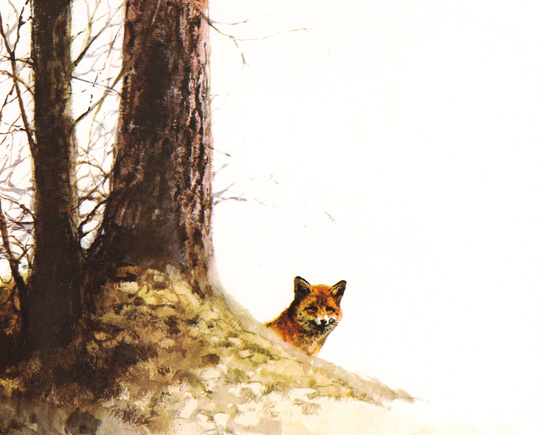
STRAIGHT TALK from FOX
Listen says fox it is music to run
over the hills to lick
dew from the leaves to nose along
the edges of the ponds to smell the fat
ducks in their bright feathers but
far out, safe in their rafts of
sleep. It is like
music to visit the orchard, to find
the vole sucking the sweet of the apple, or the
rabbit with his fast-beating heart. Death itself
is a music. Nobody has ever come close to
writing it down, awake or in a dream. It cannot
be told. It is flesh and bones
changing shape and with good cause, mercy
is a little child beside such an invention. It is
music to wander the black back roads
outside of town no one awake or wondering
if anything miraculous is ever going to
happen, totally dumb to the fact of every
moment’s miracle. Don’t think I haven’t
peeked into windows. I see you in all your seasons
making love, arguing, talking about God
as if he were an idea instead of the grass,
instead of the stars, the rabbit caught
in one good teeth-whacking hit and brought
home to the den. What I am, and I know it, is
responsible, joyful, thankful. I would not
give my life for a thousand of yours.
Mary Oliver
09 November 2016
Baptized.

Nearer to the earth's heart,
Deeper within its silence:
Animals know this world
In a way we never will.
We who are ever
Distanced and distracted
By the parade of bright
Windows thought opens:
Their seamless presence
Is not fractured thus.
Stranded between time
Gone and time emerging,
We manage seldom
To be where we are:
Whereas they are always
Looking out from
The here and now.
May we learn to return
And rest in the beauty
Of animal being,
Learn to lean low,
Leave our locked minds,
And with freed senses
Feel the earth
Breathing with us.
May we enter
Into lightness of spirit,
And slip frequently into
The feel of the wild.
Let the clear silence
Of our animal being
Cleanse our hearts
Of corrosive words.
May we learn to walk
Upon the earth
With all their confidence
And clear-eyed stillness
So that our minds
Might be baptized
In the name of the wind
And light and the rain.
And light and the rain.
John O'Donohue
Subscribe to:
Posts (Atom)