"I am not one who was born in the custody of wisdom. I am one who is fond of olden times and intense in quest of the sacred knowing of the ancients." Gustave Courbet
Showing posts with label kids. Show all posts

20 June 2025

Literacy.


More than the combined threats of illegal immigration, the Middle East, and beans in chili, childhood literacy is the biggest crisis facing the United States.
  • I've taught for twenty years and I can count on one hand the number kids who were still reluctant to read when given the choice of what to read.  Reading comics, graphic novels, websites, etc. is reading that develops momentum; all gateway drugs to the reading life.  Choice comes first. 
  • The books that kids are able to choose from on the shelves of their school libraries, "book fairs", and classroom sales from sources like Scholastic, are crap.  Trust the classics -- their authors, their culture, their language.
  • Have plenty of things around to read.  Buy books instead of ten-dollar coffees and tattoos.

16 March 2024

Changer.

 Execupundit on relationships ...

Here's a rule of life: you have to be there. You have to listen and laugh and argue and comfort the people around you in a multitude of exchanges where life's mystery means you may not know just which exchange was the most important.

I can recall off-hand conversations from long ago that seriously affected my life and even my world view.

You never know, but that raised eyebrow, that quiet reassurance, that brief pat on the back may be another person's life changer.

Don't hide away. Get out among 'em.

There is a student in our school, Clementine, who stops by my classroom every single morning for a brief chat before heading upstairs to her homeroom.  We aren't in any classes together, but in the past I've had her siblings, Ruby, Olive, and Violet (no joke).  Clementine makes my day with her smiles, her corny jokes, and the fact that she usually brings a friend in tow, a student that, most likely, I'd never have gotten the chance to meet.  Some of Clementine's friends have begun Clementine's routine on their own, so now I'm meeting drama club kids, skater kids, kids who cook, new kids who don't speak a word of English, kids whose siblings are classroom legacies, kids who teach me dances, handshakes, and suggest good books I should read.

This year, walking the hallways is quite a different experience.  Kids rule!

(Oh! I've been told by these kids that saying "Good morning" to students I don't know is creepy and they won't respond [this happens].  Instead, they've taught me to say, "'Sup" [it works].  We often discuss what I call "reading the room"; they call it "matching energy." We're both learning.)

Thanks to Clementine and Mr. Wade.

23 October 2021

Vivaldi, Violin Concerto in D major, RV 208

Yesterday my students asked that this video be played on loop as they wrote expositions inspired by the first chapter of Something Wicked This Way Comes.  There are a few Onofri-heads in our school's orchestra now.

Enrico Onofri performs with Il Giardino Armonico ...

09 April 2020

Figured.


In light of the novel coronavirus pandemic ravaging the world, the famous saying “not all heroes wear capes” applies to more and more people every day. The doctors and the rest of the medical staff fighting the virus on the frontlines, all the people who can’t stay home and are going to work every day, keeping our civilization intact and functioning as it’s supposed to – shopkeepers, cashiers, electricians, plumbers, garbagemen, you name it. We also can’t forget the people who are locking themselves at home so they can relieve at least some of the tension on the healthcare system of their country.

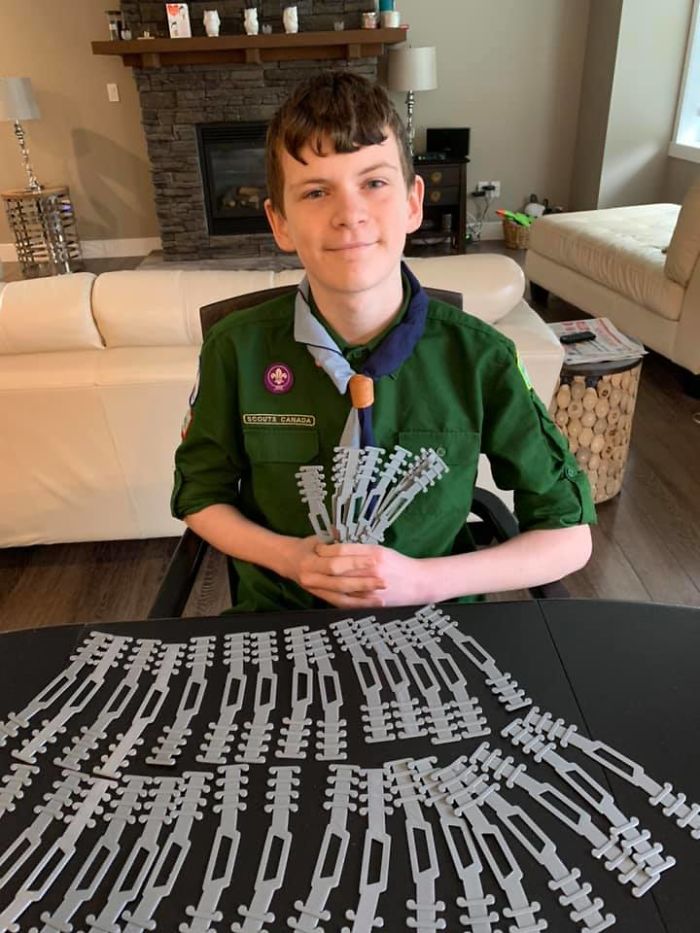
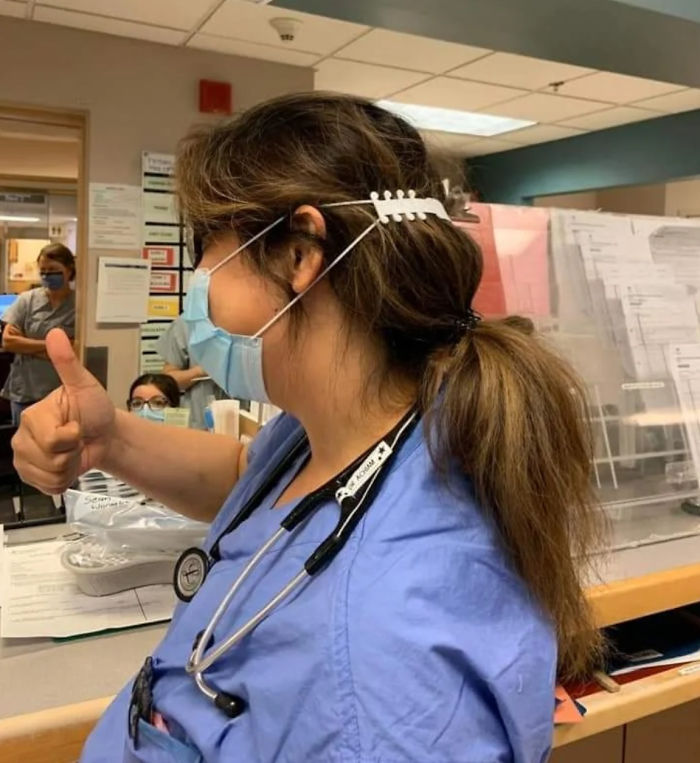
And yet another hero has joined these forces. Canadian boy scout Quinn Callander recently responded to the call of help by his local hospital and figured out a brilliant way to relieve some of the pain the medical workers have to deal with from wearing protective gear all day long every single day on the frontlines.


He figured he would use his 3D-printing skills to create an “ear guard” for medical workers who have to wear masks all day.

04 December 2018

Wealth.


We have discovered that some teachers, if they really want to hear what children have to say, that their whole state of being is at ease, and they listen closely and that in the process of listening they discover that children are speaking a wealth of information, and these teachers will be receptive to the information that they are hearing. And then some teachers want to hear children say what they the teachers, deep down, want the children to say, things that they want to hear, and will unconsciously overlook what children are actually saying. They can’t hear clearly and are unable to truly understand the child’s expression. And you can see that their physical state of being is one of anxiety.

Wang Zhen

08 February 2018

Conscience.

Doisneau, The Car that Melted, 1944


The CHURCHWARDEN & the APPARITION: A FABLE

The night was cold, the wind was high,
And stars bespangled all the sky;
Churchwarden Joe had laid him down,
And slept secure on bed of down;
But still the pleasing hope of gain,
That never left his active brain,
Exposed the churchyard to his view,
That seat of treasure wholly new.
“Pull down that cross,” he quickly cried,
The mason instantly complied:
When lo! behold, the golden prize
Appears—joy sparkles in his eyes.
The door now creaks, the window shakes,
With sudden fear he starts and wakes;
Quaking and pale, in eager haste
His haggard eyes around he cast;
A ghastly phantom, lean and wan,
That instant rose, and thus began:
“Weak wretch—to think to blind my eyes!
Hypocrisy's a thin disguise;
Your humble mien and fawning tongue
Have oft deceived the old and young.
On this side now, and now on that,
The very emblem of the bat:
Whatever part you take, we know
'Tis only interest makes it so,
And though with sacred zeal you burn,
Religion's only for your turn;
I'm Conscience called!” Joe greatly feared;
The lightning flashed—it disappeared.

Thomas Chatterton

17 April 2017

Skill.


In the book De Bono's Thinking Course, Edward de Bono asserts that thinking is a skill. His finding has been that intelligence and thinking skill are not directly related; the existence of this effect is counterintuitive for most people. Dr. de Bono calls this effect "The Intelligence Trap."

CONNECT

Thank you, Casey.

21 March 2017

Matters.

Over the weekend, coach Geno Auriemma provided some sage advice -- body language matters ...

05 December 2016

Help.


Who will help the tree when all the kids who built forts in the woods are dead and the people who vote spent their little time outdoors only on the trail, hands jammed in pockets, leaving the woods untouched and unloved?

12 August 2016

Happy.

Sayn-Wittgenstein-Sayn, Princess Yvonne and Prince Alexander, 1955


People don’t notice whether it’s winter or summer when they’re happy.

Anton Chekhov

11 May 2016

Kith.


Imagine time as a landscape: long hills of open afternoons, unfenced horizons of hours, the vast and immaculate freedom of time which, until so very recently, all of humanity knew.  But foreshorten the horizons, fence the days, restrict the hours, erect deadline, add punctuality, alarm clocks and speed -- enclose the commons of time, in other word -- and people will feel pressured, even if they know how to live in a clock-driven world.

Every generation of children instinctively nests itself in nature, no matter matter how tiny a scrap of it they can grasp. In a tale of one city child, the poet Audre Lord remembers picking tufts of grass which crept up through the paving stones in New York City and giving them as bouquets to her mother. It is a tale of two necessities. The grass must grow, no matter the concrete suppressing it. The child must find her way to the green, no matter the edifice which would crush it.

The Maori word for placenta is the same word for land, so at birth the placenta is buried, put back in the mothering earth. A Hindu baby may receive the sun-showing rite surya-darsana when, with conch shells ringing to the skies, the child is introduced to the sun. A newborn child of the Tonga people 'meets' the moon, dipped in the ocean of Kosi Bay in KwaZulu-Natal. Among some of the tribes of India, the qualities of different aspects of nature are invoked to bless the child, so he or she may have the characteristics of earth, sky and wind, of birds and animals, right down to the earthworm. Nothing is unbelonging to the child.

"My oldest memories have the flavor of earth," wrote Frederico García Lorca. In the traditions of the Australian deserts, even from its time in the womb, the baby is catscradled in kinship with the world. Born into a sandy hollow, it is cleaned with sand and "smoked" by fire, and everything -- insects, birds, plants, and animals -- is named to the child, who is told not only what everything is called but also the relationship between the child and each creature. Story and song weave the child into the subtle world of the Dreaming, the nested knowledge of how the child belongs.

The threads which tie the child to the land include its conception site and the significant places of the Dreaming inherited through its parents. Introduced to creatures and land features as to relations, the child is folded into the land, wrapped into country, and the stories press on the child's mind like the making of felt -- soft and often -- storytelling until the feeling of the story of the country is impressed into the landscape of the child's mind.

That the juggernaut of ants belongs to a child, belligerently following its own trail. That the twitch of an animal's tail is part of a child's own tale or storyline, once and now again. That on the papery bark of a tree may be written the songline of a child's name. That the prickles of a thornbush may have dynamic relevance to conscience. That a damp hollow by the riverbank is not an occasional place to visit but a permanent part of who you are. This is the beginning of belonging, the beginning of love.

In the art and myth of Indigenous Australia, the Ancestors seeded the country with its children, so the shimmering, pouring, circling, wheeling, spinning land is lit up with them, cartwheeling into life.


Land can make someone who they are, can create their psyche, giving them fragments of themselves. On losing this, Indigenous Tasmanian Errol West writes: "There is no one to teach me the songs that bring the Moon bird, the fish or any other thing that makes me what I am." Shatter the relation to land and you shatter personalities like a smashed wing-mirror kicked into the dust.

From song, from dream, from elements of earth and water, spirit-children are immanent in the land. They are left there by the Ancestors of the Dreaming, who sang their way across the land, leaving an imprint of music like an aural footstep. And sometimes a woman who has already physically conceived a child chances to step in that same footstep, and, if she does, part of the song and the spirit-child leap up into her so she feels a quickening, sharp as an intake of breath at a kick within, sweet as a night surprised by song. Sometimes it is the father who, seeing something unusual – a particularly large fish or an animal behaving strangely – may know it as an indication of a spirit-child. Or a man walking by a lake may find a spirit-child jumping into his mind, which he will send in a dream to his wife, inseminating the spirit-child within her. Then the Lawmen, the knowers of the songline which the father or mother was on, can tell which stanzas of the song belong to that child, its conception totem and, in that sinuous reflexivity of belonging, its quintessential home.

To be born is, in Latin, nasci, and the word is related to natura, so birth, nature, the laws of nature and the idea of an essence are related. It is as if language itself has embedded birth in the natural world. In the Amazon, people say childbirth should always take place in the forest-gardens so the condensed energy of the plants can nourish the child. In New Guinea, future generations are called "our children who are still in the soil" and when I was in West Papua, the western half of the island, I was told that in the Dani language the expression for digging potatoes is the same as that for giving birth to a child. Women say they can sometimes hear the unearthed potatoes, which are always handled gently, calling out to them, the land singing things into being to be mothered into the world.

Legends of childhood across the world suggest whole landscapes lit with incipience. Everywhere is potential, beginningness. It may be the inheld energy of an acorn or the liquid and endless possibilities of water; it may be the fattening of a potato in the secret earth or the leaping of a salmon which is the child Taliesin – in whatever form it takes, the land itself is kindling children. In Indigenous Australian culture, there is a common idea that the land is mentor, teacher and parent to a child. People talk of being "grown up by" their land; their country as kin.

So do English-speakers – without quite realizing it. A child may be looked after by its "kith and kin," we say, as if both terms meant family or relations. Not so. "Kith" is from the Old English cydˉdˉ, which can mean kinship but which in this phrase means native country – one’s home outside the house – but no one I have yet met has known that meaning. This sense of belonging has nothing whatsoever to do with a nation state or political homeland, but rather with one’s immediate locale, one’s square mile, the first landscape which we know as children. W. H. Auden wrote of this as "Amor Loci," the love of his childhood landscape. Kith kindles the kinship which children so easily feel for the natural world and without that kinship, nature also loses out, bereft of the children who grow up to protect it.


10 May 2016

Spirit.


Why are so many children in Euro-American cultures unhappy?  Why is it that children in many traditional cultures seem happier, fluent in their child-nature?  Nature is at the core of the riddle: I began to look for the nature of childhood, whose quintessence is inextricable from nature itself.  I was interested in how children belong, needing their kith, their local acre, as they need their kin.  An entire history of childhood is in that one word “kith,” which is now used as if it means only an extended family, whereas in the phrase “kith and kin,” “kith” originally meant country, home, one’s land.  Childhood has not only lost it’s country but the word for it too: a country called childhood.

How has childhood become so unnatural?  Why does the dominant culture treat young humans in ways which would be illegal if applied to young dogs?  Born to burrow and nest in nature, children are now exiled from it.  They are enclosed indoors, caged and shut out of the green and vivid world, in ways unthinkable a generation ago.  Bit by bit a pattern came clear – children’s lives have been subject to intolerable enclosure for the profit of others.

The riddle took me to that other natural world: human nature, a term so complex, so simple and so wise.  Human nature in childhood asks for freedom and closeness.  A child’s mind is constellated with animals as the nightsky is with stars.  Child-nature salutes the gods of play and pays homage to wild time.  It needs autonomy and self-will.  The riddle asked: who owns a child, anyway?  Do children naturally create their own tribes?  It is in the nature of the child to want to learn, yet society has historically contrived a school system that is half factory, half prison, and too easily ignores the very education which children crave.

Then the riddle took me further in, to the spirit of childhood, its sense of quest; the importance of woodlands for the psyche; the faerie realm of metaphor; the secret world of a child’s soul where the stories of childhood are whistled with the deft and fragile panache of poetry.  Throughout, I had a hunch that Romanticism reflected the nature of childhood not as a period in cultural history but as a perennial truth, because children are themselves the first Romantics.

This book draws on my experience of children’s lives among indigenous cultures of the Arctic, West Papua, Australia, North and South America and Northern Europe, and touches on the history of childhood in mainland Europe and Scandinavia, as well as the intriguing psychodrama of childhood played out when the Native American philosophy of childhood met Settler philosophy.  Behind all of these, though, is the spirit of childhood itself, whose imagination knows no borders.

Jay Griffiths, from “The Riddle,” the introduction to ACountry Called Childhood: Children and the Exuberant World

10 December 2014

Young.


Don’t let anyone look down on you because you are young, but set an example for the believers in speech, in conduct, in love, in faith and in purity.

1 Timothy 4:12

Thank you, Chelsie.

05 November 2014

Collaboration.

I don’t think there are “bad books” for children, mostly because people leave one ingredient out of the equation – which is the child… What you’re failing to realize is the kid is bringing [him or herself] to the book – which is also a failure to understand that books are collaborative. Fiction is collaborative – it’s collaboration between the person who wrote it and the person reading it… Kids improve the books they read.
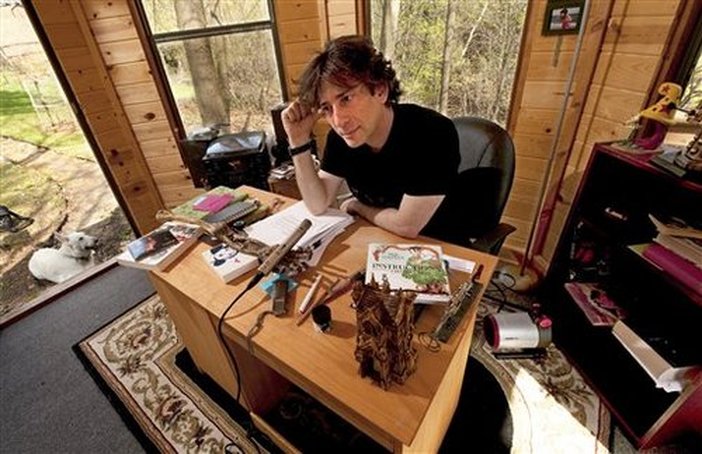
On Halloween, Neil Gaiman visited the New York Public Library dressed as a dead Charles Dickens to read from his fantastic adaptation of the Brothers Grimm’s Hansel and Gretel and talk to the library’s intellectual impresario, Paul Holdengräber. 

25 June 2014

Pleasure.

What will it be tomorrow? Could it be that we don't need to go to school at all? Could it be that, at the point in time when you need to know something, you can find out in two minutes? Could it be -- a devastating question, a question that was framed for me by Nicholas Negroponte -- could it be that we are heading towards or maybe in a future where knowing is obsolete? But that's terrible. We are homo sapiens. Knowing, that's what distinguishes us from the apes. But look at it this way. It took nature 100 million years to make the ape stand up and become Homo sapiens. It took us only 10,000 to make knowing obsolete. What an achievement that is. But we have to integrate that into our own future.

Encouragement seems to be the key. If you look at Kuppam, if you look at all of the experiments that I did, it was simply saying, "Wow," saluting learning.

There is evidence from neuroscience. The reptilian part of our brain, which sits in the center of our brain, when it's threatened, it shuts down everything else, it shuts down the prefrontal cortex, the parts which learn, it shuts all of that down. Punishment and examinations are seen as threats. We take our children, we make them shut their brains down, and then we say, "Perform." Why did they create a system like that? Because it was needed. There was an age in the Age of Empires when you needed those people who can survive under threat. When you're standing in a trench all alone, if you could have survived, you're okay, you've passed. If you didn't, you failed. But the Age of Empires is gone. What happens to creativity in our age? We need to shift that balance back from threat to pleasure.

Sugata Mitra's TED Talk, "Build a School in the Cloud" …

02 August 2012

Together.

Levitt, Kids Over Doorway, 1940


The Creativity Post has "Ten Suggestions for Raising Creative Kids" ...

2. Find Answers Together

As your children grow older, they will increasingly often ask questions that you cannot answer. As a parent, you may occasionally feel the need to cover up your ignorance. After all, your children look to you as the ultimate source of knowledge. At other times one of your children will ask a question in which you believe you know the correct answer, but are not sure.

Rather than hazard a guess at the answer, a better response is, “I don’t know” or “I’m not sure. I believe the answer is....” and then add, “Let’s find out the correct answer.” Then do some research with your child in order to find that answer. That research may be a simple matter of searching on the web. But do not neglect other possibilities. Perhaps you have a book on the subject. Fetch it and look it up. Your child might be interested in reading the book. Go to the library. Before the age of the web and Google, libraries were the best information resource available. They are still wonderful places of reference with the added benefit that you often find interesting information that you were not seeking.

You might also try experiments and illustration. When my science loving son asked why, if you drive a car around a curve too fast and lose control, you should turn into the skid, I drew a sketch showing how the different forces were at work in a car accelerating around a curve. This made it very clear.


Read the rest here.

14 June 2012

Play.


While it is ultimately up to parents how best to deal with the risks to their children, it is worth asking the question whether the pendulum has swung too far. As children withdrew from public spaces, those spaces became less safe – not more. And the withdrawal became habitual. Hence, children between grades 6 and 12 spend an average of seven hours 48 minutes on various screens each day. Horrifying, if true. And not without risks, whether from the health problems associated with a sedentary life, cyberbullying or even pedophiles reaching through their screens. But more than all that, how do we quantify the more subtle risk of losing spontaneous play from childhood? It is not a catastrophic risk – but it’s close.

Read the rest of "The Loss of Spontaneous Play From Childhood" here.

This year an interesting thing started happening in my class. I've never experienced it before -- fifth grade students didn't want to go outside for recess. Recess was becoming "a pain" to them. "Do we have to go out for recess?" they would whine. "It's either that or stay in here and listen to my bluegrass music," would be my reply. That usually did the trick. So would walking out with them to the the treeline and and exploring the small wonders of the woods or stretching out in the grass, staring up at the cloud architecture above and asking questions like a scientist or an artist would ask. Later, these activities were the fertilizer for great pieces written by these same reluctant kids.

My point is that kids need guidance. Kids have a fire inside of them. They need a trail guide to show them the glories at their feet. They need to be taught.

My dad used to say, "Get outside." He said this not so that he could have some peace and quiet or take a nap (which he probably wanted to do and certainly deserved). He said it so that we would grow in the appreciation of ourselves and our surroundings, so that we would be physically, mentally, and spiritually healthy. Trees in our woods had names that came from a great deal of time contemplating their shape and personality. One night after my sister and I had already been to bed, dad brought the news that school had been cancelled for the next day, and within minutes we were excitedly traipsing through those same woods "looking for Redcoat camps." Throughout the night we evaded the British sentries by diving beneath the thousands of Christmas trees that filled the neighboring farm, sustained only by mom's Christmas cookies with which dad had filled the pockets of his o.d. green field coat.

Kids need a role model, a guide, an inspiration. Kids need a parent. Nothing is more important.