"I am not one who was born in the custody of wisdom. I am one who is fond of olden times and intense in quest of the sacred knowing of the ancients." Gustave Courbet
Showing posts with label Griffiths. Show all posts

24 January 2024

Within.


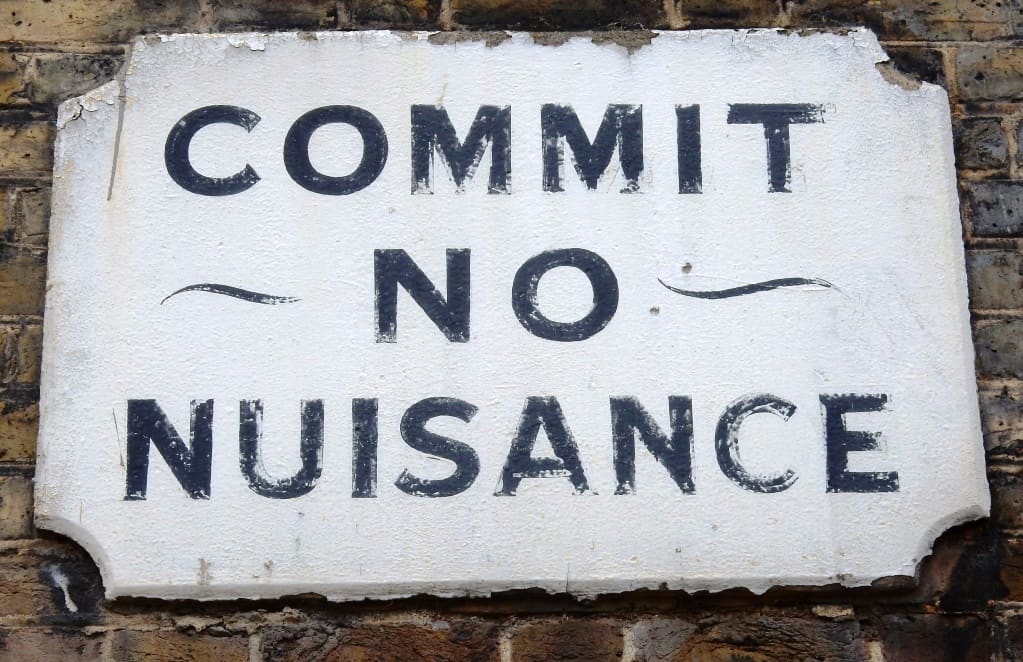
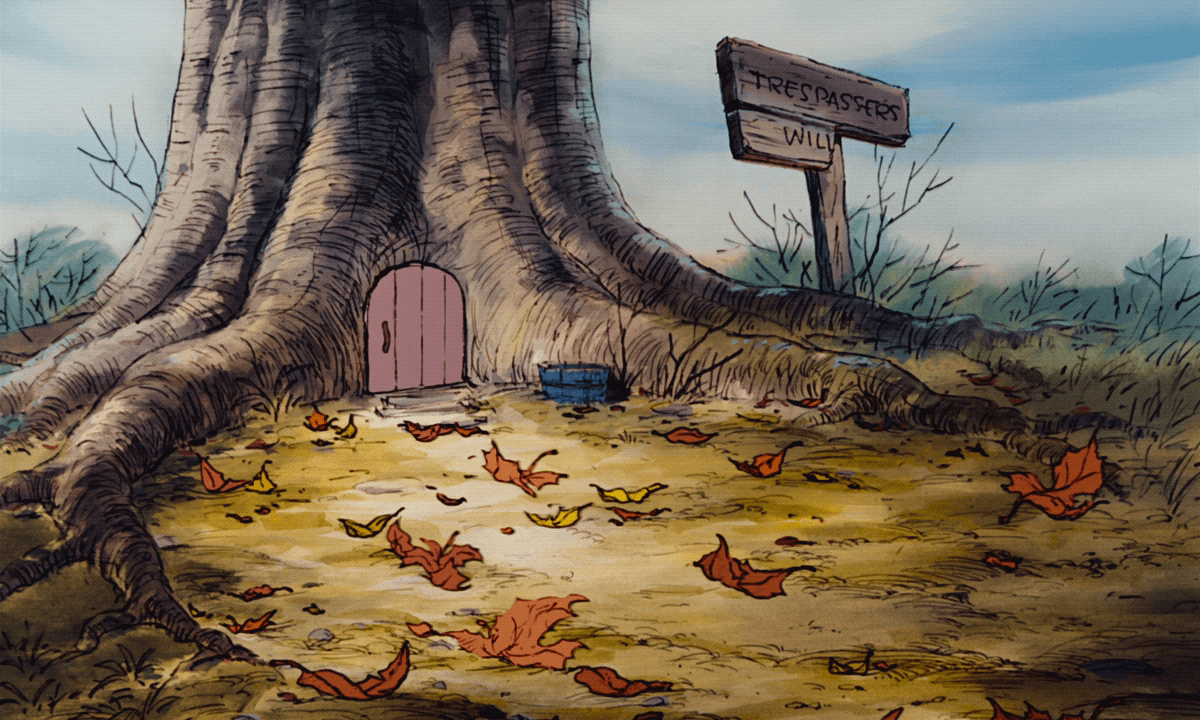
Childhood and Romanticism alike put the mind's own life at the heart of experience.  Wordsworth writes of his childhood ways of thinking as "the hiding places of my power" and says that the paths to them seem "open" until he approaches, at which point they close, tantalizingly, so "I see glimpses now."  As ifonly in those brief moments when the guards are off duty can he nip back to the light.  But Romanticism finds too often that this way (of thinking) has been barred and padlocked, no way through, and those who try to cross over are mocked and attacked like Wordsworth and Coleridge, despised and ignored like Blake, or Keats or Ibsen.  John Clare found the TRESPASSERS WILL sign nailed up in his own mind, as so completely does he identify with his land that the paths on the ground are fused with the pathways of his mind, the tracks of his memory.
On paths to freedom and to childhood dear
A board sticks up to notice "no road here."

Novalis thought of fairy tales as "that homeland which is everywhere and nowhere."  Where is that?  Right inside the mind, in the cosmic trespass of imagination.  This is the heart of it: this is why Romanticism comprehends what is perennially important, beautiful, valuable and good in the human condition, and finds those treasures within us all. 

Jay Griffiths, from A Country Called Childhood: Children and the Exuberant World

08 June 2023

Before.


Children are Romantics before they are Utilitarians; visionaries before they are Gradgrinds.  They think in the right hemisphere before the left.  We humans sang before we spoke.  Poetry came before prose.  The depth was there before the shallowness, the extraordinary before the ordinary, metaphysics before physics.  Metaphor before all.

Jay Griffiths, from A Country Called Childhood

04 June 2023

Ludic.


Aristotle said, "Nature requires us not only to be able to work well but also to idle well."  Sigh. It's so hard. The Idea of the Idle which disses and rejects the clock is an ambition harder than it seems. To really play is to let go of the hand of the clock, to dive deep into the fathoms of time — a state of water this, deep play, with affinities to music, art, sex, deep drinking and deep thought. It is chancey, risky, fluxy, underwater world where immersion in the moment is all. This wild time is far richer, though far flukier, than clock-time, this is time enlivened and various, time as fast and slow as a waterfall's cascade. It is not necessarily easy to be in, for its waters are uncontrolled by a clock, uncommanded and uncharted. Without a clock you are on your own and it is a difficult but rich experience, this, the beautiful duress of ludic creativity — idlesse oblige."

Jay Griffiths, from A Sideways Look at Time

01 June 2022

Learned.


My brothers and I spent weeks with our grandparents by the sea where we learned so much more than it may have seemed. Not because we saw an actual shipwreck but because we saw the potential for it. Not because we actually found treasure but because we could feel the immanence of treasure at every seashore.  We fished for wishes and caught them; we swam to find mermaids and became them; and we dived for pearls and returned with a stick, a bit of litter, a coin or the makings of a joke. Pearls, in other words. We learned about tides and chance, storms and sun, the vicissitudes of what is lost and found, flotsam and jetsam, castaway luck, islands, sea-songs, rings, riddles and pledges. 

Jay Griffiths, from Kith: The Riddle of the Childscape

24 April 2022

Landscape.


Foreshorten the horizons, fence the days, restrict the hours, erect deadline, add punctuality, alarm clocks and speed -– enclose the commons of time, in other word -– and people will feel pressured, even if they know how to live in a clock-driven world.  But, i
magine time as a landscape: long hills of open afternoons, unfenced horizons of hours, the vast and immaculate freedom of time which, until so very recently, all of humanity knew. 

Jay Griffiths, from A Country Called Childhood

One of the most important books I've ever read.

30 January 2022

Glint.


All humans are essentially wild creatures and hate confinement. We need what is wild, and we thrill to it, our wildness bubbling over with an anarchic joie de vivre. We glint when the wild light shines. The more suffocatingly enclosed we are - tamed by television, controlled by mortgages and bureaucracy - the louder our wild genes scream in aggression, anger and depression.

Jay Griffiths

09 August 2021

Precious.

Doisneau, Boys Playing, 1955


The wild. I have drunk it, deep and raw, and heard it's primal, unforgettable roar. We know it in our dreams, when our mind is off the leash, running wild. "Outwardly, the equivalent of the unconscious is the wilderness: both of these terms meet, one step even further on, as one," wrote Gary Snyder. "It is in vain to dream of a wildness distinct from ourselves. There is none such," wrote Thoreau. "It is the bog in our brains and bowels, the primitive vigor of Nature in us, that inspires the dream."

And as dreams are essential to the psyche, wildness is to life.

We are animal in our blood and in our skin. We were not born for pavements and escalators but for thunder and mud. More. We are animal not only in body but in spirit. Our minds are the minds of wild animals. Artists, who remember their wildness better than most, are animal artists, lifting their heads to sniff a quick wild scent in the air, and they know it unmistakably, they know the tug of wildness to be followed through your life is buckled by that strange and absolute obedience. ("You must have chaos in your soul to give birth to a dancing star,"wrote Nietzsche.) Children know it as magic and timeless play. Shamans of all sorts and inveterate misbehavers know it; those who cannot trammel themselves into a sensible job and life in the suburbs know it.

What is wild cannot be bought or sold, borrowed or copied. It is. Unmistakeable, unforgettable, unshamable, elemental as earth and ice, water, fire and air, a quitessence, pure spirit, resolving into no constituents. Don't waste your wildness: it is precious and necessary.

Jay Griffiths

20 June 2020

Precious.


The wild. I have drunk it, deep and raw, and heard it's primal, unforgettable roar. We know it in our dreams, when our mind is off the leash, running wild. 'Outwardly, the equivalent of the unconscious is the wilderness: both of these terms meet, one step even further on, as one,' wrote Gary Snyder. 'It is in vain to dream of a wildness distinct from ourselves. There is none such,' wrote Thoreau. 'It is the bog in our brains and bowls, the primitive vigor of Nature in us, that inspires the dream.'

And as dreams are essential to the psyche, wildness is to life.

We are animal in our blood and in our skin. We were not born for pavements and escalators but for thunder and mud. More. We are animal not only in body but in spirit. Our minds are the minds of wild animals. Artists, who remember their wildness better than most, are animal artists, lifting their heads to sniff a quick wild scent in the air, and they know it unmistakably, they know the tug of wildness to be followed through your life is buckled by that strange and absolute obedience. ("You must have chaos in your soul to give birth to a dancing star," wrote Nietzsche.) Children know it as magic and timeless play. Shamans of all sorts and inveterate misbehavers know it; those who cannot trammel themselves into a sensible job and life in the suburbs know it.

What is wild cannot be bought or sold, borrowed or copied. It is. Unmistakeable, unforgettable, unshamable, elemental as earth and ice, water, fire and air, a quitessence, pure spirit, resolving into no contituents. Don't waste your wildness: it is precious and necessary.

Jay Griffiths 

28 July 2019

Seek.


While children must learn to control themselves, what they can never control is luck. They must learn how to live with it, how to dance with chance and mischance. Children recognize life is a huge adventure, and they must accept the dare. “Setting out to seek one’s fortune” is the readying line of folk tales, leaving safe harbor to meet luck both good and bad. Children play with risk, draw straws with hazard. A lottery, a lucky dip, or a lucky number all appeal to children’s knowledge that life is riddled with luck and that freedom means being able to deal with chance. But the risk-averse society, denying hazard and what is hazardous alike, is not only annoying but conceptually malevolent. It works against the child’s instinct to find a working relationship with chance and risk — otherwise their adventures cannot even begin, and they will remain infantilized, stuck forever safe indoors in the house “hard by the great forest” (as many folk tales begin), with no chance of setting out on the quest through it.

Jay Griffiths

CONNECT

25 July 2019

Den

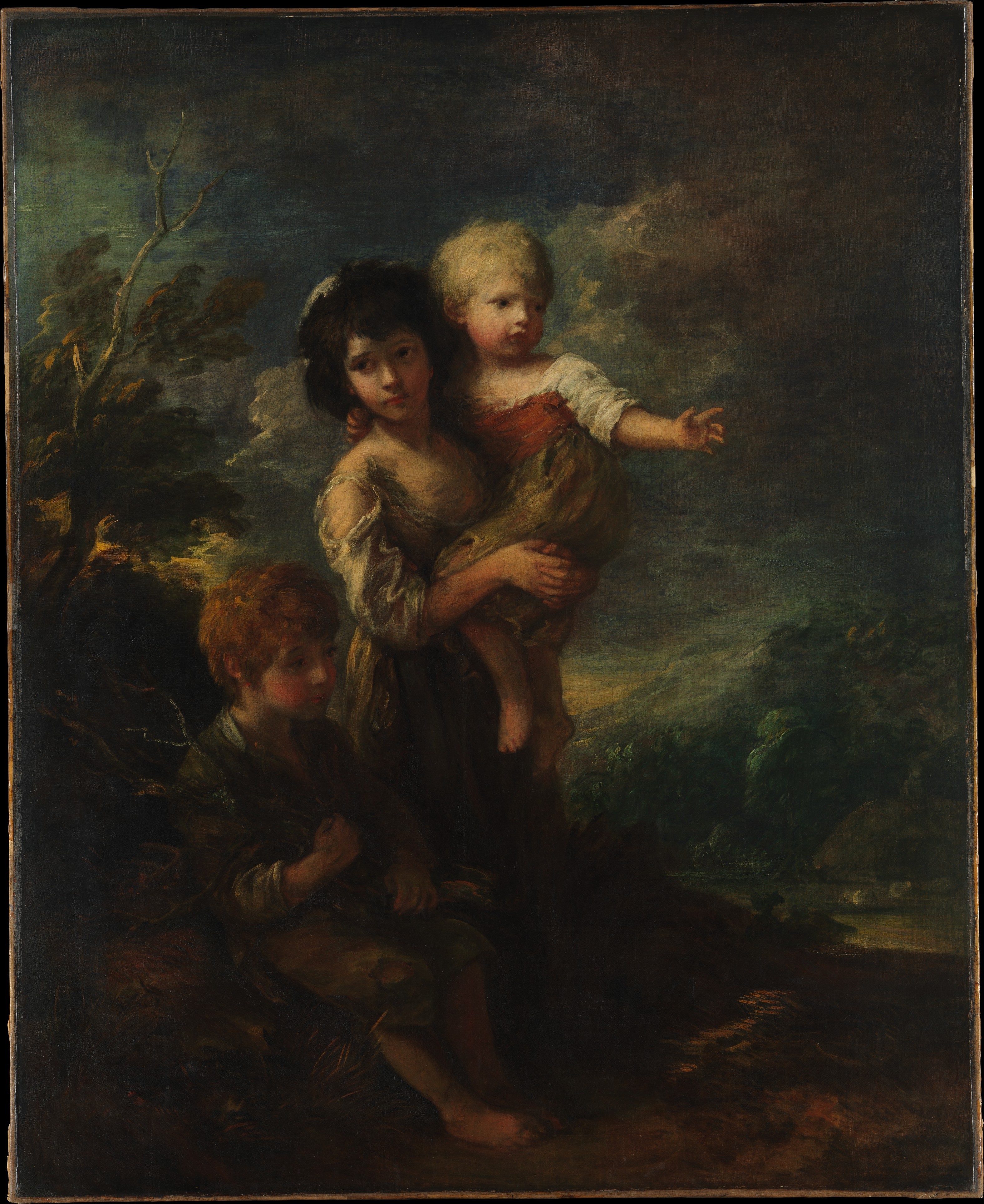
Gainsborough, The Wood Gatherers, 1787


It doesn’t have to be vast acres of rolling woodland.  It can be some little scrubby commons. Children don’t need a lot of big green nature. They just need something.  There is that sense that children have of loving a particular tree.  I think being outdoors gives them a sense of tranquility. The woods are a place where children can go to think. Children gravitate towards these spaces. When I was a child it was nothing more than a scrubby little overhang under a rhododendron bush but it was incredibly important to me. Cities everywhere become so over-tidied and controlled and subject to surveillance. Children want their own dens, which are like cocoons. Any child who has had a den remembers that place, the importance of it. It’s a place of reverie, a state which is so important to childhood.

Jay Griffiths

30 August 2018

Storehouses.


Every society seems to use stories for the education of the heart.  Each story is a store of ripened knowledge in the oldest barns of human culture.  Myths, ripened in October, are the apples of the mind, carefully laid out to preserve their meanings.  In the soft darkness of the strorehouses, close your ordinary eyes to the ordinary world and open your extraordinary eyes to the extraordinary world, best illuminated by the grandparent voice in the autumn years telling tales in the dark, the dark of the evening and the fertile dark of the mind.  These, in potent story-warmth, the subconscious breathes in the texture, significance, and meaning of the story like quietness steeped in the smell of apples.

Jay Griffiths, from Kith: The Riddle of the Childscape

23 August 2018

Bold.


There are galaxies within the human mind, and madness wants to risk everything for the daring flight, reckless and beautiful and crazed.

Jay Griffiths

25 July 2018

Listen.

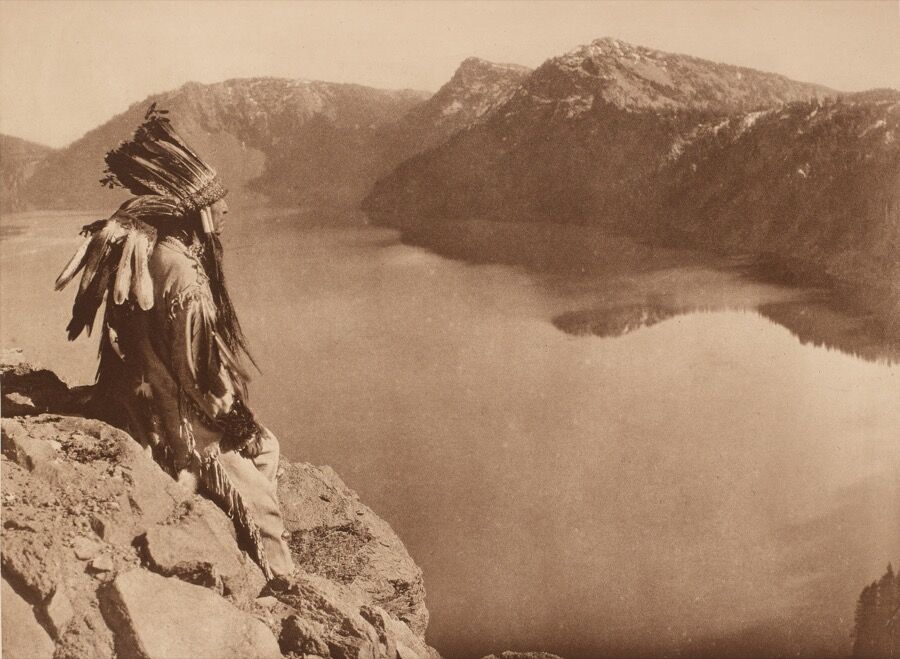
Curtis, Crater Lake, 1923


The word "listen" is often used to begin a story.  Every story needs a storyteller and a story-listener, because while the one offers the necessary words, the other gives the necessary silence.  Children were traditionally taught to pay similar attention to the land, "to listen intently when all seemingly was quiet," in the words of Luther Standing Bear.  Listening lets the outer world be re-created within you.  Listening means being willing to let one's borders be porous.  Listening does what light does for a seed, asking it to swing upwards into life and giving it a reason to do so.  "Listen, and you will hear the patterns of life.  Are they the same, or is there a change in the sounds?" is how the Ojibwa storyteller Ignatia Broker describes an early lesson for a child, adding that children were encouraged to listen to an older person before they spoke themselves.  Inuit people were happier with children who took their time learning to talk because listening was the skill needed to to learn fast: speaking could wait.

To get the attention of a child, you can shout "Shut up!" or you can normally say "Listen!"  When children want other children to hear them, they generally say "Listen!"  And it normally works.  Moreover, there is a different quality of attention given in response: "Shut up!" may provoke resentful attention while "Listen!" may invite an unguarded curiosity.  Demanding someone's silence is one thing; offering your own is another.  I remember disliking -- to the point of fury -- silence being imposed on us, but being spellbound by self-willed silence, breathing in silver air, mirrored as water.

"Silence, love, reverence -- this is the trinity of first lessons," says Charles Eastman, on the trivium of the Native American Ohiyesa people.  Silence is "the sign of perfect equilibrium.  Silence is the absolute poise or balance of body, mind, and spirit."

If silence is revered, words are honored.  From the moment children begin to speak, they are taught to respect speech, "how to use the word and how not to use it," says Henry Old Coyote (Crow).  "The word is all-powerful, because it can build a man up, but it can also tear him down.  That's how powerful it is.  So a child is taught  to use words tenderly and never against anyone."

Jay Griffiths, from Kith: The Riddle of the Childscape

07 July 2018

Glint.


All humans are essentially wild creatures and hate confinement. We need what is wild, and we thrill to it, our wildness bubbling over with an anarchic joie de vivre. We glint when the wild light shines. The more suffocatingly enclosed we are - tamed by television, controlled by mortgages and bureaucracy - the louder our wild genes scream in aggression, anger and depression.

Jay Griffiths

05 July 2018

Without.


Consumer societies are stealing children away from their kith, their family of nature, in a steady alienation. This is not about some luxury, a hobby, a bit of playtime in the garden. This is about the longest, deepest necessity of the human spirit to know itself in nature, and about the homesickness children feel, whose genesis is so obvious but so little examined. Writer on Native American spirituality Linda Hogan describes the term susto as a sickness of soul caused by disconnection from nature and cured by "the great without."

Jay Griffiths, from A Country Called Childhood; Children and the Exuberant World

20 March 2018

Much.


AMOR LOCI

I could draw its map by heart,
showing its contours,
strata and vegetation,
name every height,
small burn and lonely sheiling,
but nameless to me,
faceless as heather or grouse,
are those who live there,

its dead too vague for judgement,
tangible only
what they wrought, their giant works
of delve and drainage
in days preterite: long since
their hammering stopped
as the lodes all petered out
in the Jew Limestone.

Here and there a tough chimney
still towers over
dejected masonry, moss,
decomposed machines,
with no one about, no chance
of buttering bread,
a land postured in my time
for marginal farms.

Any musical future
is most unlikely.
Industry wants Cheap Power,
romantic muscle
a perilous wilderness,
Mr Pleasure pays
for surf-riding, claret, sex:
it offers them none.

To me, though, much: a vision,
not (as perhaps at
twelve I thought it) of Eden,
still less of a New
Jerusalem but, for one,
convinced he will die,
more comely, more credible
than either day-dream.

How but with some real focus
of desolation
could I, by analogy,
imagine a Love
that, however often smeared,
shrugged at, abandoned
by a frivolous worldling,
does not abandon?

W.H. Auden

02 March 2018

Excellent.

An excellent book ...


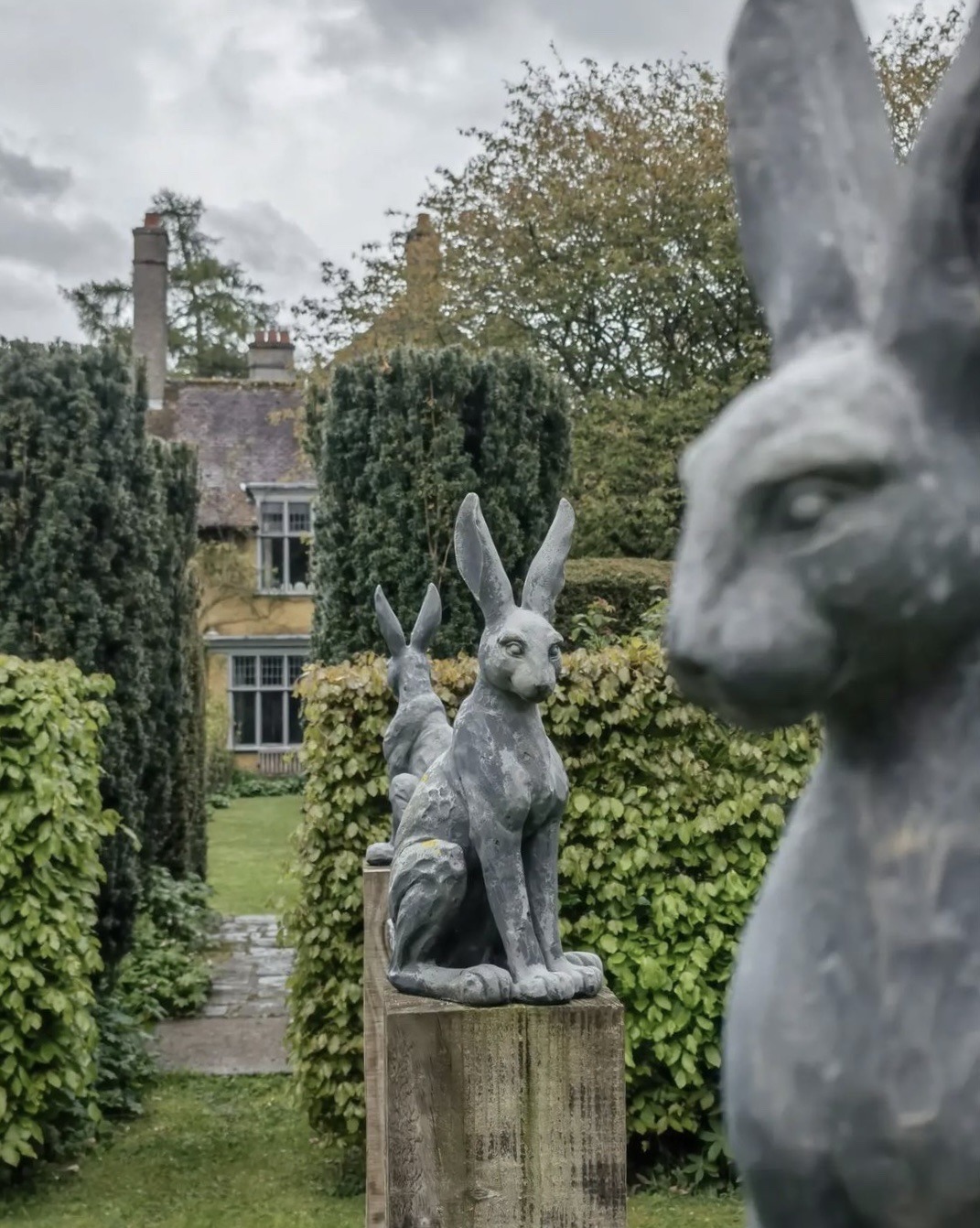
They had all night, and the whole of the moon, and five miles of country to hide in.  We chased them through all of the world, through jungles, swamps and tundra, across pampas plains and steppes of wheat and plateaux of shooting stars, while hares made love in the silver grasses, and the large hot moon climbed over us, raising tides in my head of night and summer that moves there even yet.

13 November 2017

Wild.

Johnson, In the Hayloft, 1878


We are animal in our blood and in our skin. We were not born for pavements and escalators but for thunder and mud. More. We are animal not only in body but in spirit. Our minds are the minds of wild animals. Artists, who remember their wildness better than most, are animal artists, lifting their heads to sniff a quick wild scent in the air, and they know it unmistakably, they know the tug of wildness to be followed through your life is buckled by that strange and absolute obedience. ('You must have chaos in your soul to give birth to a dancing star,' wrote Nietzsche.) Children know it as magic and timeless play. Shamans of all sorts and inveterate misbehavers know it; those who cannot trammel themselves into a sensible job and life in the suburbs know it.

What is wild cannot be bought or sold, borrowed or copied. It is. Unmistakable, unforgettable, unshamable, elemental as earth and ice, water, fire and air, a quintessence, pure spirit, resolving into no constituents. Don't waste your wildness: it is precious and necessary.

Jay Griffiths
14 September 2017

Know.


The wild. I have drunk it, deep and raw, and heard it's primal, unforgettable roar. We know it in our dreams, when our mind is off the leash, running wild. "Outwardly, the equivalent of the unconscious is the wilderness: both of these terms meet, one step even further on, as one," wrote Gary Snyder. "It is in vain to dream of a wildness distinct from ourselves. There is none such," wrote Thoreau. "It is the bog in our brains and bowls, the primitive vigor of Nature in us, that inspires the dream."

And as dreams are essential to the psyche, wildness is to life.

We are animal in our blood and in our skin. We were not born for pavements and escalators but for thunder and mud. More. We are animal not only in body but in spirit. Our minds are the minds of wild animals. Artists, who remember their wildness better than most, are animal artists, lifting their heads to sniff a quick wild scent in the air, and they know it unmistakably, they know the tug of wildness to be followed through your life is buckled by that strange and absolute obedience. ("You must have chaos in your soul to give birth to a dancing star," wrote Nietzsche.) Children know it as magic and timeless play. Shamans of all sorts and inveterate misbehavers know it; those who cannot trammel themselves into a sensible job and life in the suburbs know it.

What is wild cannot be bought or sold, borrowed or copied. It is. Unmistakeable, unforgettable, unshamable, elemental as earth and ice, water, fire and air, a quitessence, pure spirit, resolving into no contituents. Don't waste your wildness: it is precious and necessary.

Jay Griffiths