"I am not one who was born in the custody of wisdom. I am one who is fond of olden times and intense in quest of the sacred knowing of the ancients." Gustave Courbet
Showing posts with label Stuart. Show all posts

25 July 2026

Happy Birthday, Henry Knox

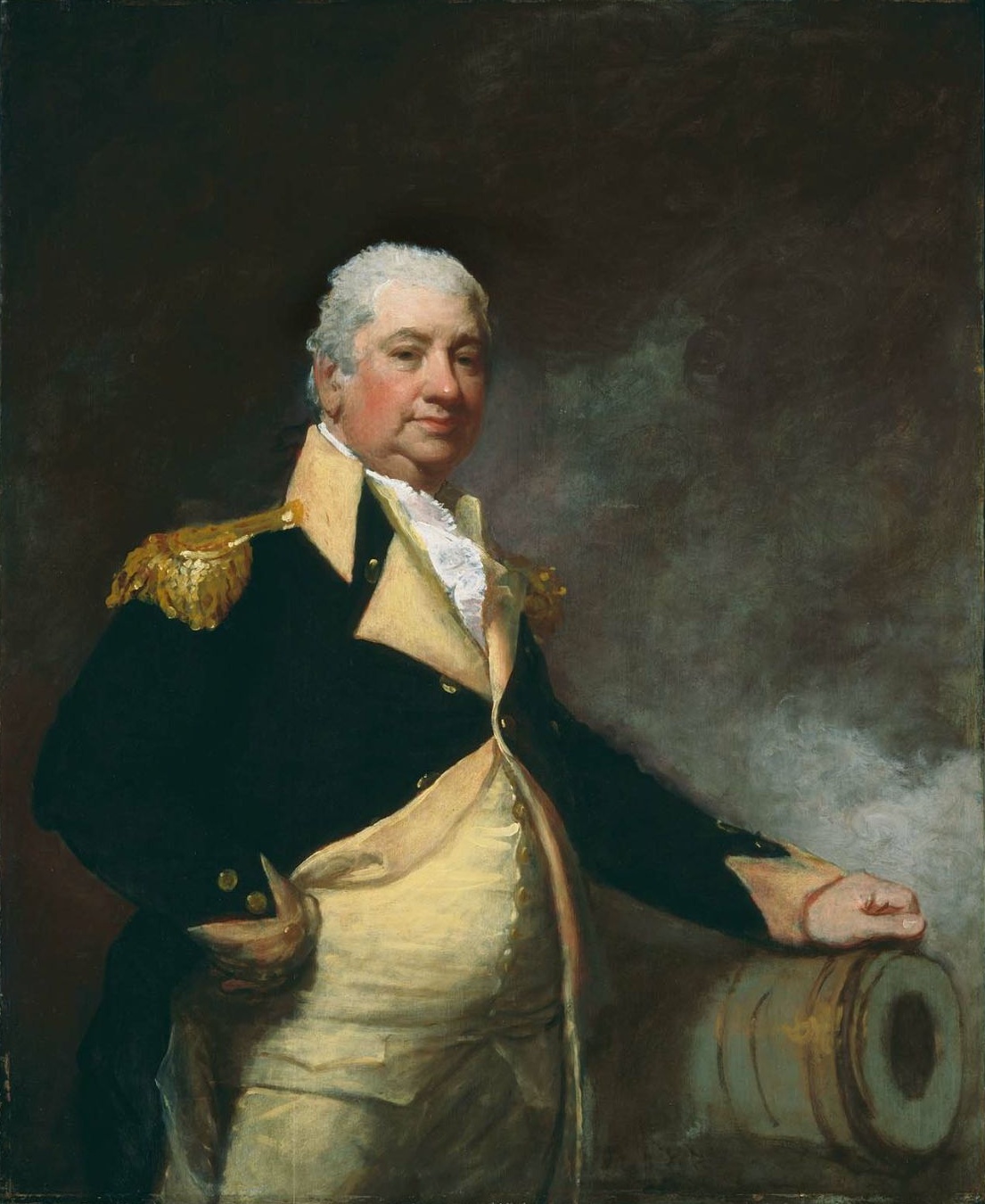
Stuart, Henry Knox, 1806
On the very first impression of Faction and licentiousness the fine theoretic government of Massachusetts has given away and its laws arrested and trampled under foot. Men at a distance, who have admired our systems of government, unfounded in nature, are apt to accuse the rulers, and say that taxes have been assessed coo high and collected coo rigidly. This is a deception equal to any that has been hitherto entertained. It is indeed a face, that high taxes are the ostensible cause of the commotions, but that they are the real cause is as far remote from truth as light from darkness. The people who are the insurgents have never paid any, or but very little taxes—But they see the weakness of government; They feel at once their own poverty, compared with the opulent, and their own force, and they are determined to make use of the latter, in order to remedy the former. Their creed is "That the property of the United States has been protected from the confiscations of Britain by the joint exertions of all, and therefore ought to be the common property of all. And he that attempts opposition to this creed is an enemy to equity and justice, and ought to be swept off the face of the earth." In a word they are determined to annihilate all debts public and private and have agrarian Laws which are easily effected by the means of unfunded paper money which shall be a tender in all cases whatever. 
The numbers of these people may amount in [M]assachusetts to about one fifth part of several populous counties, and to them may be collected, people of similar sentiments, from the States of Rhode Island, Connecticut and New Hampshire so as to constitute a body of 12 or 15,000 desperate and unprincipled men—They are chiefly of the Young and active part of the community, more easily collected than perhaps Kept together afterwards—But they will probably commit overt acts of treason which will compel them to embody for their own safety—once embodied they will be constrained to submit to discipline for the same reason. Having proceeded to this length for which they are now ripe, we shall have a formidable rebellion against reason, the principles of all government, and against the very name of liberty. This dreadful situation has alarmed every man of principle and property in New England—They start as from a dream, and ask what has been the Cause of our delusion? What is to afford us security against the violence of lawless men? Our government must be braced, changed, or altered to secure our lives and property. We imagined that the mildness of our government and the virtue of the people were so correspondent, that we were not as other nations requiring brutal force to support the laws—But we find that we are men, actual men, possessing all the turbulent passions belonging to that animal and that we must have a government proper and adequate for him—The people of Massachusetts for instance, are far advanced in this doctrine, and the men of reflection, and principle, are determined to endeavor to establish a government which shall have the power to protect them in their lawful pursuits, and which will be efficient in all cases of internal commotions or foreign invasions—They mean that liberty shall form the basis, a liberty resulting from the equal and firm administration of the laws. They wish for a general government of unity as they see that the local legislatures, must naturally and necessarily tend to retard general government. 
We have arrived at that point of time in which we are forced to see our national humiliation, and that a progression in this line, cannot be productive of happiness either private or public—something is wanting and something must be done or we shall be involved in all the horror of faction and civil war without a prospect of its termination—Every tried friend to the liberties of his country is bound to reflect, and step forward to prevent the dreadful consequences which will result from a government of events—Unless this is done we shall be liable to be ruled by an Arbitrary and Capricious armed tyranny, whose word and will must be Law. 

 Henry Knox, born on this date in 1750, from his letter to George Washington, October 23, 1786

The "Knox Moving Co." scene from John Adams ...


An excellent book ...

03 December 2025

Happy Birthday, Gilbert Stuart

Stuart, George Washington (unfinished), 1796


Gilbert Stuart was born on this date in 1755.

Ron Chernow, from George Washington ...
As a portraitist, the garrulous Stuart had perfected a technique to penetrate his subjects’ defenses. He would disarm them with a steady stream of personal anec­dotes and irreverent wit, hoping that this glib patter would coax them into self-revelation. In the taciturn George Washington, a man of granite self-control and a stranger to spontaneity, Gilbert Stuart met his match. From boyhood, Washington had struggled to master and conceal his deep emotions. When the wife of the Brit­ish ambassador later told him that his face showed pleasure at his forthcoming departure from the presidency, Washington grew indignant: “You are wrong. My countenance never yet betrayed my feelings!” He tried to govern his tongue as much as his face: “With me it has always been a maxim rather to let my designs ap­pear from my works than by my expressions.”

When Washington swept into his first session with Stuart, the artist was awe­struck by the tall, commanding president. Predictably, the more Stuart tried to pry open his secretive personality, the tighter the president clamped it shut. Stuart’s opening gambit backfired. “Now, sir,” Stuart instructed his sitter, “you must let me forget that you are General Washington and that I am Stuart, the painter.” To which Washington retorted drily that Mr. Stuart need not forget “who he is or who Gen­eral Washington is.”

A master at sizing people up, Washington must have cringed at Stuart’s facile bonhomie, not to mention his drinking, snuff taking, and ceaseless chatter. With Washington, trust had to be earned slowly, and he balked at instant familiarity with people. Instead of opening up with Stuart, he retreated behind his stolid mask. The scourge of artists, Washington knew how to turn himself into an impenetrable monument long before an obelisk arose in his honor in the nation’s capital.

As Washington sought to maintain his defenses, Stuart made the brilliant deci­sion to capture the subtle interplay between his outward calm and his intense hidden emotions, a tension that defined the man. He spied the extraordinary force of per­sonality lurking behind an extremely restrained facade. The mouth might be com­pressed, the parchment skin drawn tight over ungainly dentures, but Washington’s eyes still blazed from his craggy face. In the enduring image that Stuart captured and that ended up on the one-dollar bill—a magnificent statement of Washington’s moral stature and sublime, visionary nature—he also recorded something hard and suspicious in the wary eyes with their penetrating gaze and hooded lids.

With the swift insight of artistic genius, Stuart grew convinced that Washington was not the placid and composed figure he presented to the world. In the words of a mutual acquaintance, Stuart had insisted that “there are features in [Washington’s] face totally different from what he ever observed in that of any other human being; the sockets of the eyes, for instance, are larger than he ever met with before, and the upper part of the nose broader. All his features, [Stuart] observed, were indica­tive of the strongest and most ungovernable passions, and had he been born in the forests, it was his opinion that [Washington] would have been the fiercest man among the savage tribes.” The acquaintance confirmed that Washington’s intimates thought him “by nature a man of fierce and irritable disposition, but that, like Socrates, his judgment and great self-command have always made him appear a man of a different cast in the eyes of the world.

06 July 2024

Affected.

Copley, Self-Portrait, 1783


From Dr. Prown's Wyeth Lecture in American Art at the National Gallery: "Friends and Rivals: Copley, West, Peale, Trumbull, and Stuart" ...
John Singleton Copley and Benjamin West were born in 1738; Charles Willson Peale, some two and one-half years later. Gilbert Stuart and John Trumbull, born in 1755 and 1756, respectively, belonged to the next generation. Their paths crossed and recrossed throughout their uniformly long lives. They formed friendships, influenced each other both through their art and personally, competed for clients, and eventually drifted apart, or, in the case of Copley and West, became bitter enemies. Jules David Prown focuses on the artists’ personal and professional encounters and interactions to tell the story of how they affected each other’s lives and work.

03 December 2023

Happy Birthday, Stuart

Stuart, Self-Portrait (detail), 1778


Gilbert Stuart was born on this day in 1755.

Paul Staiti talked about his book, Of Arms and Artists: The American Revolution through Painters' Eyes. In his book, he focuses on the artists Charles Willson Peale, Benjamin West, John Singleton Copley, John Trumbull, and Gilbert Stuart.

12 October 2023

Gnawed.

Thomsen, Northern Lake, 1913


JOURNEY NORTH

Skyline waving like a banner
tugging folds and wrinkles straight,
vaulting bridges, shadowed valleys
plunge into the tunnel’s maw and then –
A bight out of the land, a crescent shore
of splintered shoals and rocks
gnawed by the breakers, rank on rank –
a hunch-backed cottage clenched against the cold

and in a scratched out garden by the beach,
raising their faces to the silent sky

a blaze of sunflowers.

Ian Stuart

It's sandwich time.

05 July 2023

Truth.

Stuart, James Madison, 1807


Friendship like all Truth delights in plainness and simplicity and It is the Counterfeit alone that needs ornament and ostentation.

James Madison

Thank you, Kurt.

04 July 2023

Consume.

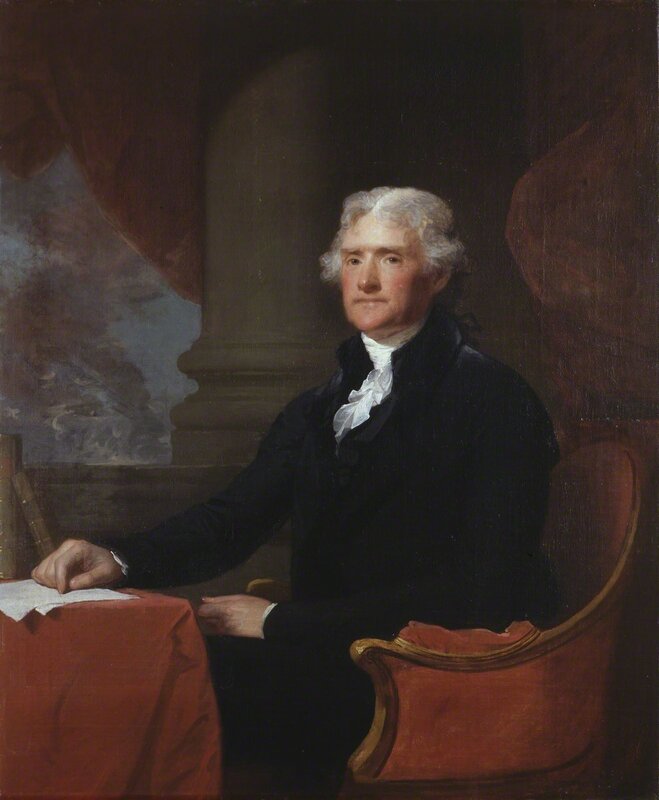
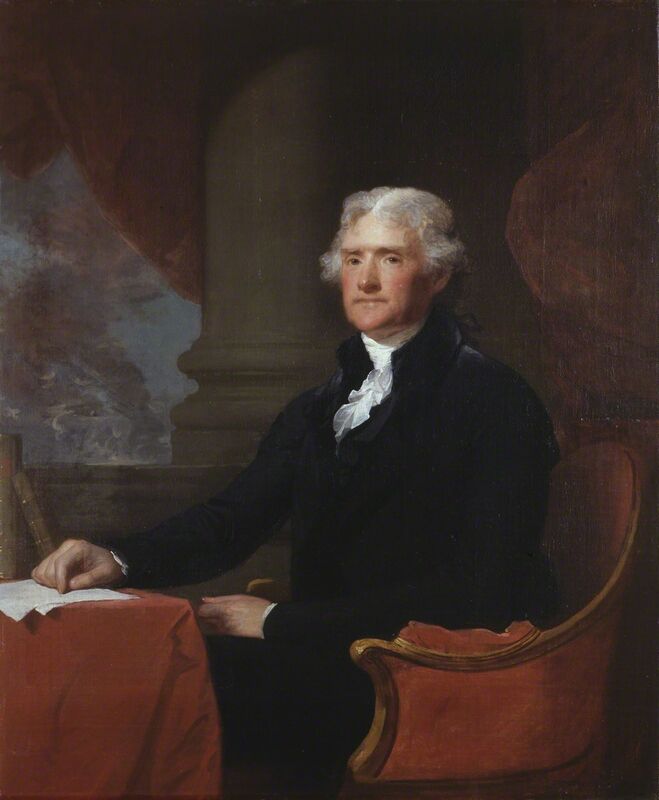
Stuart, Thomas Jefferson, 1805


I shall not die without a hope that light and liberty are on steady advance. We have seen indeed once within the record. of history a compleat eclipse of the human mind continuing for centuries. and this too by swarms of the same Northern barbarians, conquering and taking possession of the countries and governments of the civilized world. should this be again attempted, should the same Northern hordes, allured again by the corn wine, and oil of the South, be able again to settle their swarms in the countries of their growth, the art of printing alone and the vast dissemination of books, will maintain the mind where it is, and raise the conquering ruffians to the level of the conquered, instead of degrading those to that of their conquerors and even should the cloud of barbarism and despotism again obscure the science and liberties of Europe, this country remains to preserve and restore light and liberty to them. in short, the flames kindled on the 4th of July 1776 have spread over too much of the globe to be extinguished by the feeble engines of despotism. on the contrary they will consume these engines, and all who work them.

Thomas Jefferson, from a letter to John Adams, 12 September 1821

21 May 2023

Result.

Stuart, Portrait of Thomas Jefferson, 1805


The general objects of this law are to provide an education adapted to the years, to the capacity, and the condition of every one, and directed to their freedom and happiness. Specific details were not proper for the law. These must be the business of the visitors entrusted with its execution. The first stage of this education being the schools of the hundreds, wherein the great mass of the people will receive their instruction, the principal foundations of future order will be laid here. Instead therefore of putting the Bible and Testament into the hands of the children, at an age when their judgments are not sufficiently matured for religious enquiries, their memories may here be stored with the most useful facts from Grecian, Roman, European and American history. The first elements of morality too may be instilled into their minds; such as, when further developed as their judgments advance in strength, may teach them how to work out their own greatest happiness, by shewing them that it does not depend on the condition of life in which chance has placed them, but is always the result of a good conscience, good health, occupation, and freedom in all just pursuits.--Those whom either the wealth of their parents or the adoption of the state shall destine to higher degrees of learning, will go on to the grammar schools, which constitute the next stage, there to be instructed in the languages. The learning Greek and Latin, I am told, is going into disuse in Europe. I know not what their manners and occupations may call for: but it would be very ill-judged in us to follow their example in this instance. There is a certain period of life, say from eight to fifteen or sixteen years of age, when the mind, like the body, is not yet firm enough for laborious and close operations. If applied to such, it falls an early victim to premature exertion; exhibiting indeed at first, in these young and tender subjects, the flattering appearance of their being men while they are yet children, but ending in reducing them to be children when they should be men. The memory is then most susceptible and tenacious of impressions; and the learning of languages being chiefly a work of memory, it seems precisely fitted to the powers of this period, which is long enough too for acquiring the most useful languages antient and modern. I do not pretend that language is science. It is only an instrument for the attainment of science. But that time is not lost which is employed in providing tools for future operation: more especially as in this case the books put into the hands of the youth for this purpose may be such as will at the same time impress their minds with useful facts and good principles. If this period be suffered to pass in idleness, the mind becomes lethargic and impotent, as would the body it inhabits if unexercised during the same time. The sympathy between body and mind during their rise, progress and decline, is too strict and obvious to endanger our being misled while we reason from the one to the other.--As soon as they are of sufficient age, it is supposed they will be sent on from the grammar schools to the university, which constitutes our third and last stage, there to study those sciences which may be adapted to their views.--By that part of our plan which prescribes the selection of the youths of genius from among the classes of the poor, we hope to avail the state of those talents which nature has sown as liberally among the poor as the rich, but which perish without use, if not sought for and cultivated.--But of all the views of this law none is more important, none more legitimate, than that of rendering the people the safe, as they are the ultimate, guardians of their own liberty. For this purpose the reading in the first stage, where they will receive their whole education, is proposed, as has been said, to be chiefly historical. History by apprising them of the past will enable them to judge of the future; it will avail them of the experience of other times and other nations; it will qualify them as judges of the actions and designs of men; it will enable them to know ambition under every disguise it may assume; and knowing it, to defeat its views. In every government on earth is some trace of human weakness, some germ of corruption and degeneracy, which cunning will discover, and wickedness insensibly open, cultivate, and improve. Every government degenerates when trusted to the rulers of the people alone. The people themselves therefore are its only safe depositories. And to render even them safe their minds must be improved to a certain degree.

Thomas Jefferson, Notes on the State of Virginia, Queries 14 and 19, 1784

20 April 2023

Enlighten.

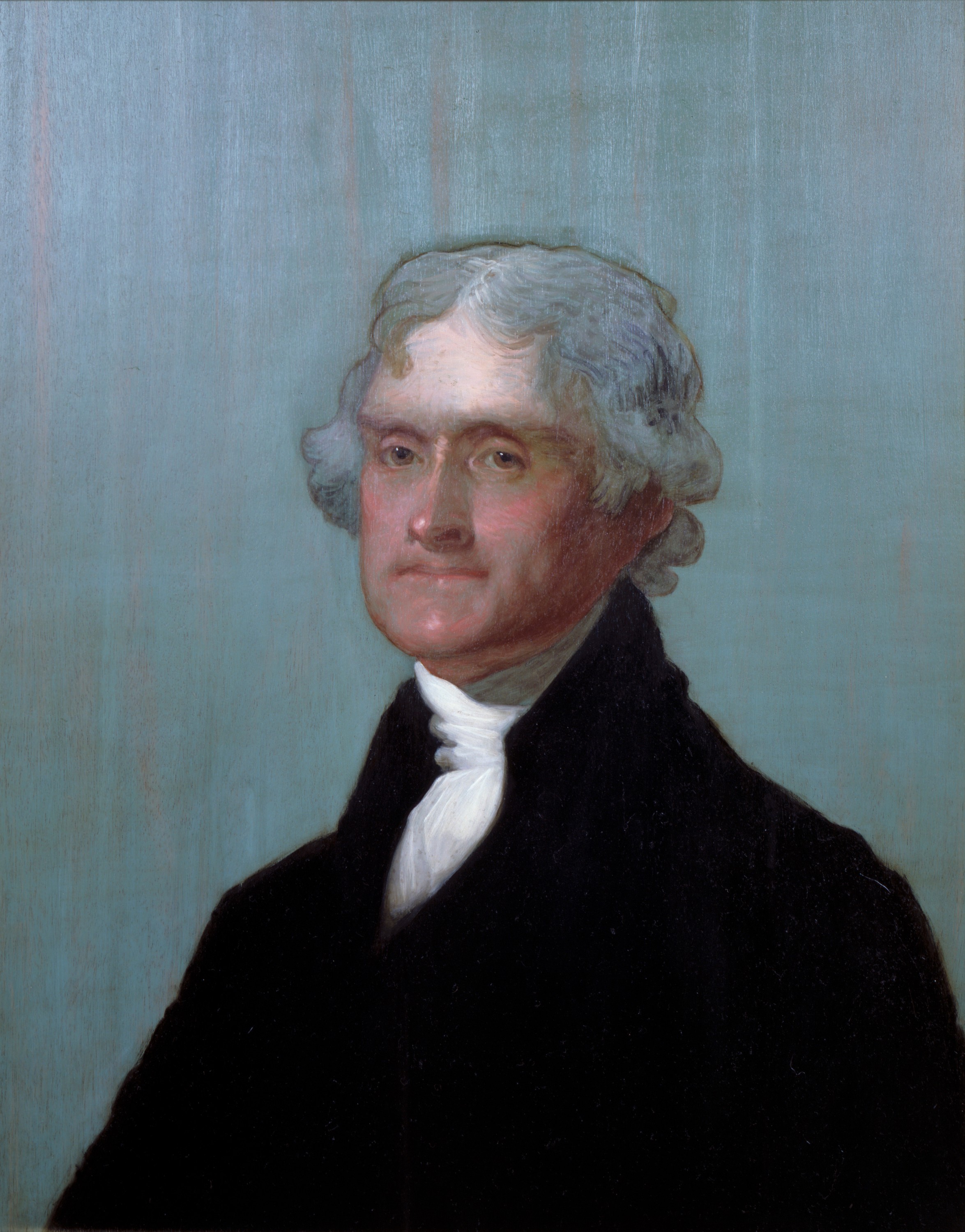
Stuart, Thomas Jefferson, 1805


Enlighten the people generally, and tyranny and oppressions of body and mind will vanish like evil spirits at the dawn of day.

Thomas Jefferson, from a letter to Pierre Samuel Du Pont de Nemours, 24 April 1816

03 December 2022

03 December 2021

Happy Birthday, Stuart

Stuart, William Woollett, the Engraver, 1783


Gilbert Stuart was born on this date in 1755.

07 June 2021

Happy Birthday, White


Clarence White was born on this day in 1944.

"Listen to the Mockingbird" ...


Marty Stuart tells the story ...


Thanks for the introduction, John.

03 December 2020

Happy Birthday, Stuart

Stuart, William Woollett, the Engraver, 1783


Gilbert Stuart was born on this day in 1755.

25 July 2020

Happy Birthday, Knox

Stuart, Henry Knox, 1806

On the very first impression of Faction and licentiousness the fine theoretic government of Massachusetts has given away and its laws arrested and trampled under foot. Men at a distance, who have admired our systems of government, unfounded in nature, are apt to accuse the rulers, and say that taxes have been assessed coo high and collected coo rigidly. This is a deception equal to any that has been hitherto entertained. It is indeed a face, that high taxes are the ostensible cause of the commotions, but that they are the real cause is as far remote from truth as light from darkness. The people who are the insurgents have never paid any, or but very little taxes—But they see the weakness of government; They feel at once their own poverty, compared with the opulent, and their own force, and they are determined to make use of the latter, in order to remedy the former. Their creed is "That the property of the United States has been protected from the confiscations of Britain by the joint exertions of all, and therefore ought to be the common property of all. And he that attempts opposition to this creed is an enemy to equity and justice, and ought to be swept off the face of the earth." In a word they are determined to annihilate all debts public and private and have agrarian Laws which are easily effected by the means of unfunded paper money which shall be a tender in all cases whatever. 
The numbers of these people may amount in [M]assachusetts to about one fifth part of several populous counties, and to them may be collected, people of similar sentiments, from the States of Rhode Island, Connecticut and New Hampshire so as to constitute a body of 12 or 15,000 desperate and unprincipled men—They are chiefly of the Young and active part of the community, more easily collected than perhaps Kept together afterwards—But they will probably commit overt acts of treason which will compel them to embody for their own safety—once embodied they will be constrained to submit to discipline for the same reason. Having proceeded to this length for which they are now ripe, we shall have a formidable rebellion against reason, the principles of all government, and against the very name of liberty. This dreadful situation has alarmed every man of principle and property in New England—They start as from a dream, and ask what has been the Cause of our delusion? What is to afford us security against the violence of lawless men? Our government must be braced, changed, or altered to secure our lives and property. We imagined that the mildness of our government and the virtue of the people were so correspondent, that we were not as other nations requiring brutal force to support the laws—But we find that we are men, actual men, possessing all the turbulent passions belonging to that animal and that we must have a government proper and adequate for him—The people of Massachusetts for instance, are far advanced in this doctrine, and the men of reflection, and principle, are determined to endeavor to establish a government which shall have the power to protect them in their lawful pursuits, and which will be efficient in all cases of internal commotions or foreign invasions—They mean that liberty shall form the basis, a liberty resulting from the equal and firm administration of the laws. They wish for a general government of unity as they see that the local legislatures, must naturally and necessarily tend to retard general government. 
We have arrived at that point of time in which we are forced to see our national humiliation, and that a progression in this line, cannot be productive of happiness either private or public—something is wanting and something must be done or we shall be involved in all the horror of faction and civil war without a prospect of its termination—Every tried friend to the liberties of his country is bound to reflect, and step forward to prevent the dreadful consequences which will result from a government of events—Unless this is done we shall be liable to be ruled by an Arbitrary and Capricious armed tyranny, whose word and will must be Law. 

 Henry Knox, born on this date in 1750, from his letter to George Washington, October 23, 1786

The "Knox Moving Co." scene from John Adams ...


An excellent book ...

07 June 2020

Education.

Stuart, Thomas Jefferson, 1805


I know no safe depository of the ultimate powers of the society, but the people themselves: and if we think them not enlightened enough to exercise their controul with a wholsome discretion, the remedy is, not to take it from them, but to inform their discretion by education. this is the true corrective of abuses of constitutional power. Pardon me, Sir, for this difference of opinion. my personal interest in such questions is entirely extinct; but not my wishes for the longest possible continuance of our government on it’s pure principles. if the three powers maintain their mutual independance on each other, it may last long: but not so if either can assume the authoritie’s of the other. 

Thomas Jefferson, letter to W. C. Jarvis, September 28, 1820

04 July 2019

Remains.

Stuart, Thomas Jefferson, 1805


I shall not die without a hope that light and liberty are on steady advance. We have seen indeed once within the record. of history a compleat eclipse of the human mind continuing for centuries. and this too by swarms of the same Northern barbarians, conquering and taking possession of the countries and governments of the civilized world. should this be again attempted, should the same Northern hordes, allured again by the corn wine, and oil of the South, be able again to settle their swarms in the countries of their growth, the art of printing alone and the vast dissemination of books, will maintain the mind where it is, and raise the conquering ruffians to the level of the conquered, instead of degrading those to that of their conquerors and even should the cloud of barbarism and despotism again obscure the science and liberties of Europe, this country remains to preserve and restore light and liberty to them. in short, the flames kindled on the 4th of July 1776 have spread over too much of the globe to be extinguished by the feeble engines of despotism. on the contrary they will consume these engines, and all who work them.

Thomas Jefferson

CONNECT

24 March 2019

Esprit.


I have a reputation of being fond of saying "no," but I have only one rule of action from the first, and that is duty.  I realize that if we oppose force to force we cannot win, for their resources are greater than ours.  We must make up in quality what we lack in numbers.  We must substitute esprit for numbers.  Therefore, I strive to inculcate in my men the spirit of the chase.

Jeb Stuart