Trego, The March to Valley Forge, December 19, 1777, 1883
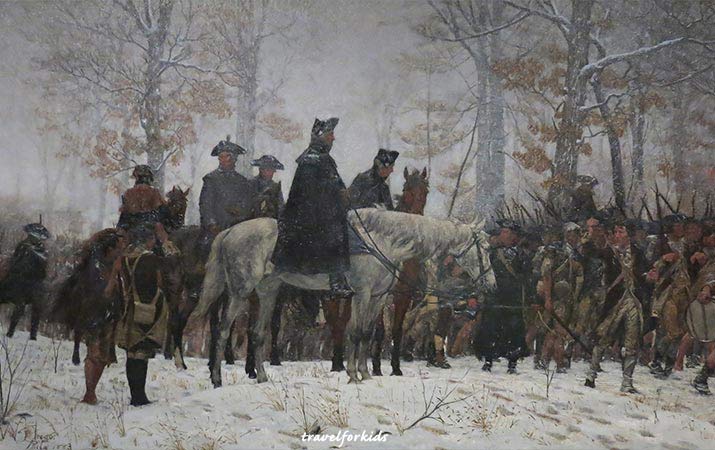
American Battlefield Trust details the encampment ...
The army spent the night of December 18 at Gulph Mills, then marched up the road toward a prominence ironically named Mount Joy, five miles from the previous night’s encampment. Mount Joy was one of two prominent hills that provided protection for the ensuing winter encampment, the other was named Mount Misery. Both names are applicable to what the Continental Army would face during the six months at Valley Forge.As the soldiers continued the march, a 5,000-acre plot of land unfolded in front of their vision. The area was known to locals as Valley Forge. Due to the geographic outlay of the land and the forge in operation gave the name Valley Forge. European inhabitation stretched back to the turn of the eighteenth century in the surrounding area.The approach of the Continental Army was not the first instance of the war coming to Valley Forge. On September 18, 1777, British soldiers arrived in the area and in the ensuing two days torched the forge and accompanying buildings while confiscating any supplies that could be transported. Out of consideration of the locals, the gristmill was left undisturbed in September.Washington’s army would spread out even more within the Valley Forge area eventually covering approximately 7,800 acres of land. Higher ranking officers fanned out to look for their winter accommodations in permanent structures that dotted the landscape. Washington’s staff selected the Isaac Potts house as his headquarters for the winter. The stone house took over two years to construct and was finished in 1770. By December 1777 the house was occupied by Mrs. Deborah Hewes, a relative of the Potts. Due to Continental law, which forbade mandatory accommodations, Washington’s staff arranged a price with Mrs. Hewes on rent.The native Virginian hunkered down within Valley Forge to suffer, in a degree, with the wintry weather and privations faced by the rank-and-file. The encampment began on the night of December 19, the men sleeping either under the late autumn moon or under canvas tent flaps. The next morning, construction began on the more permanent winter abodes.
The details of the painting are HERE.

































































































No comments:
Post a Comment