"I am not one who was born in the custody of wisdom. I am one who is fond of olden times and intense in quest of the sacred knowing of the ancients." Gustave Courbet

22 August 2024

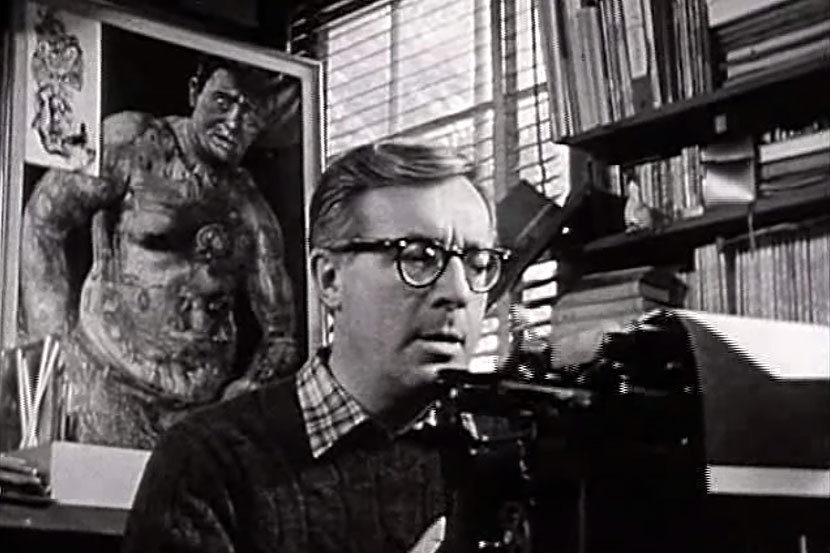
Happy Birthday, Bradbury


For there comes a time in the day's occupations when old Money Writer falls so in love with an idea that he begins to gallop, steam, pant, rave, and write from the heart, in spite of himself.  So, too, the man with the quill pen is suddenly taken with fevers, gives up purple ink for pure hot perspiration. Then he tatters quills by the dozen and, hours later, emerges ruinous from the bed of creation looking as if he had channeled an avalanche through his house.

Now, you ask, what transpired? What caused these two almost compulsive liars to start telling the truth?

Let me haul out my signs again.

WORK

It's quite obvious that both men were working.

And work itself, after awhile, takes on a rhythm. The mechanical begins to fall away. The body begins to take over. The guard goes down. What happens then?

RELAXATION

And then the men are happily following my last advice:

DON'T THINK

Which results in more relaxation and more unthinkingness and greater creativity.

Now that I have you thoroughly confused, let me pause to hear your own dismayed cry.

Impossible! you say. How can you work and relax? How can you create and not be a nervous wreck?

It can be done. It is done, every day of every week of every year.  Athletes do it. Painters do it. Mountain climbers do it. Zen Buddhists with their little bows and arrows do it.

Even I can do it.

And if even I can do it, as you are probably hissing now, through clenched teeth, you can do it, too!

All right, let's line up the signs again. We could put them in any order, really. RELAXATION or DON'T THINK could come first, or simultaneously, followed by WORK.

But, for convenience let's do it this way, with a fourth developmental sign added:

WORK RELAXATION DON'T THINK FURTHER RELAXATION

Shall we analyze word number one?

WORK

You have been working, haven't you?

Or do you plan some sort of schedule for yourself starting as soon as you put down this article?

What kind of schedule?

Something like this. One-thousand or two-thousand words every day for the next twenty years. At the start, you might shoot for one short story a week, fifty-two stories a year, for five years.  You will have to write and put away or burn a lot of material before you are comfortable in this medium. You might as well start now and get the necessary work done.

For I believe that eventually quantity will make for quality.

How so?

Michelangelo's, da Vinci's, Tintoretto's billion sketches, the quantitative, prepared them for the qualitative, single sketches further down the line, single portraits, single landscapes of incredible control and beauty. 

A great surgeon dissects and re-dissects a thousand, ten thousand bodies, tissues, organs, preparing thus by quantity the time when quality will count—with a living creature under his knife.

An athlete may run ten thousand miles in order to prepare for one hundred yards.

Quantity gives experience. From experience alone can quality come.

All arts, big and small, are the elimination of waste motion in favor of the concise declaration.

The artist learns what to leave out.

The surgeon knows how to go directly to the source of trouble, how to avoid wasted time and complications.

The athlete learns how to conserve power and apply it now here, now there, how to utilize this muscle, rather than that.

Is the writer different? I think not.

Ray Bradbury, born on this day in 1920, from Zen in the Art of Writing: Essays on Creativity

21 August 2024

Only.

Gainsborough, Wooded Landscape with Resting Peasant, 1747


THE POET DREAMS of the MOUNTAIN

Sometimes I grow weary of the days, with all their fits and starts.
I want to climb some old gray mountain, slowly, taking
the rest of my lifetime to do it, resting often, sleeping
under the pines or, above them, on the unclothed rocks.
I want to see how many stars are still in the sky
that we have smothered for years now, a century at least.
I want to look back at everything, forgiving it all,
and peaceful, knowing the last thing there is to know.
All that urgency! Not what the earth is about!
How silent the trees, their poetry being of themselves only.
I want to take slow steps, and think appropriate thoughts.
In ten thousand years, maybe, a piece of the mountain will fall.

Mary Oliver

19 August 2024

Paint.

Spartan.


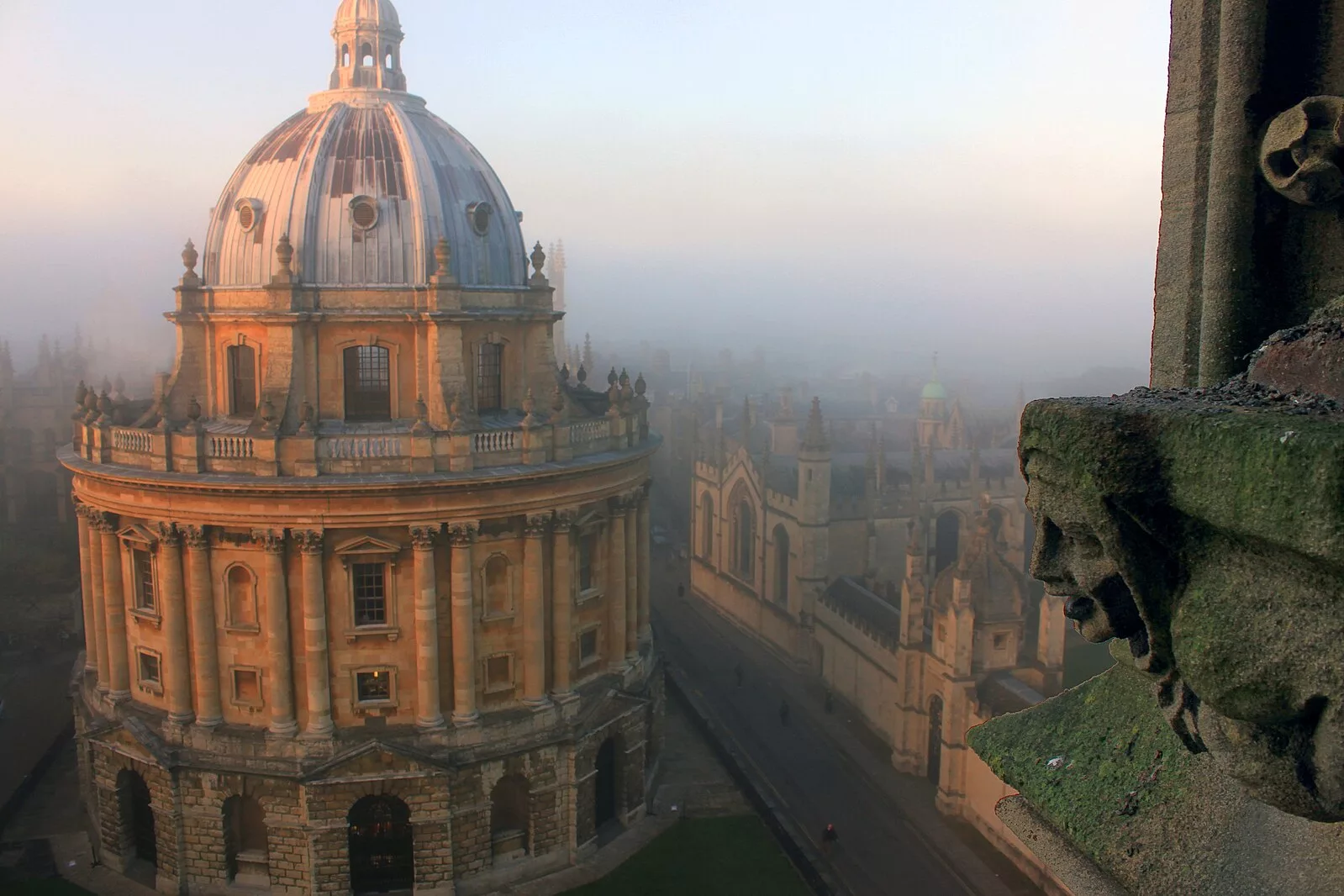
Much of Lewis’s years at Oxford will be recognisable to those who know the university today, though modernity has intruded into aspects of Oxford life that were still familiar in the late twentieth century. The sheer level of spartan discomfort, for instance, that university denizens were expected to endure is now mostly a thing of the past.

When elected to his first teaching position at Magdalen in 1925 on the princely salary of £500 a year, Lewis was allocated unheated rooms without a lavatory. He held tutorials in a dressing gown with a heavy cardigan underneath, and students recall him occasionally leaving tutorials to use a chamber pot in the bedroom. 

In winter the bedroom was so cold that he slept wearing two pullovers and trousers over his pyjamas. Mice were regular nocturnal visitors; Lewis wrote with characteristic humour to a correspondent that they would poke their heads out as if to say “Time for you to go to bed. We want to come out and play.” 

Holbytlan.


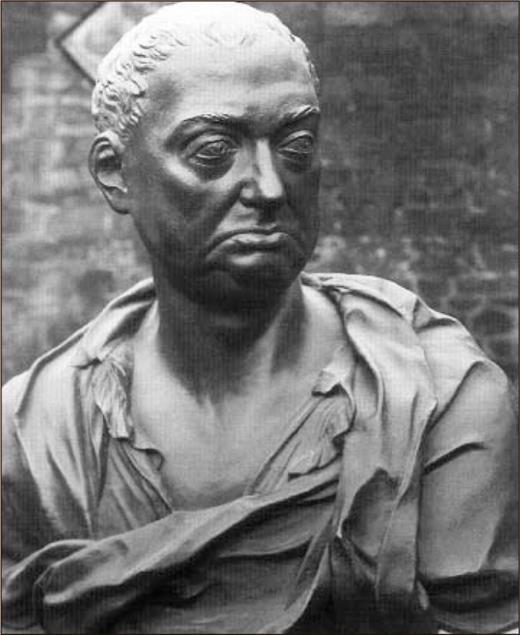
Happy Birthday, Dryden

Richardson, John Dryden, 1730


VENI, CREATOR SPIRITUS

Creator Spirit, by whose aid
The world's foundations first were laid,
Come, visit ev'ry pious mind;
Come, pour thy joys on human kind;
From sin, and sorrow set us free;
And make thy temples worthy Thee.

O, Source of uncreated Light,
The Father's promis'd Paraclete!
Thrice Holy Fount, thrice Holy Fire,
Our hearts with heav'nly love inspire;
Come, and thy Sacred Unction bring
To sanctify us, while we sing!

Plenteous of grace, descend from high,
Rich in thy sev'n-fold energy!
Thou strength of his Almighty Hand,
Whose pow'r does heav'n and earth command:
Proceeding Spirit, our Defence,
Who do'st the gift of tongues dispence,
And crown'st thy gift with eloquence!

Refine and purge our earthly parts;
But, oh, inflame and fire our hearts!
Our frailties help, our vice control;
Submit the senses to the soul;
And when rebellious they are grown,
Then, lay thy hand, and hold 'em down.

Chase from our minds th' Infernal Foe;
And peace, the fruit of love, bestow;
And, lest our feet should step astray,
Protect, and guide us in the way.

Make us Eternal Truths receive,
And practise, all that we believe:
Give us thy self, that we may see
The Father and the Son, by thee.

Immortal honour, endless fame,
Attend th' Almighty Father's name:
The Saviour Son be glorified,
Who for lost Man's redemption died:
And equal adoration be,
Eternal Paraclete, to thee.

John Dryden, born on this day in 1631

Haydn, String Quartet in B-Flat Major, Op. 76, No. 4, "Sunrise"

The Dover Quartet performs ...

Happy Birthday, Nash


Free from flashiness, free from trashiness
Is the essence of Ogdenashiness.
Rich, original, rash and rational,
Stands the monument Ogdenational.

Ogden Nash, born on this day in 1902

Actions.

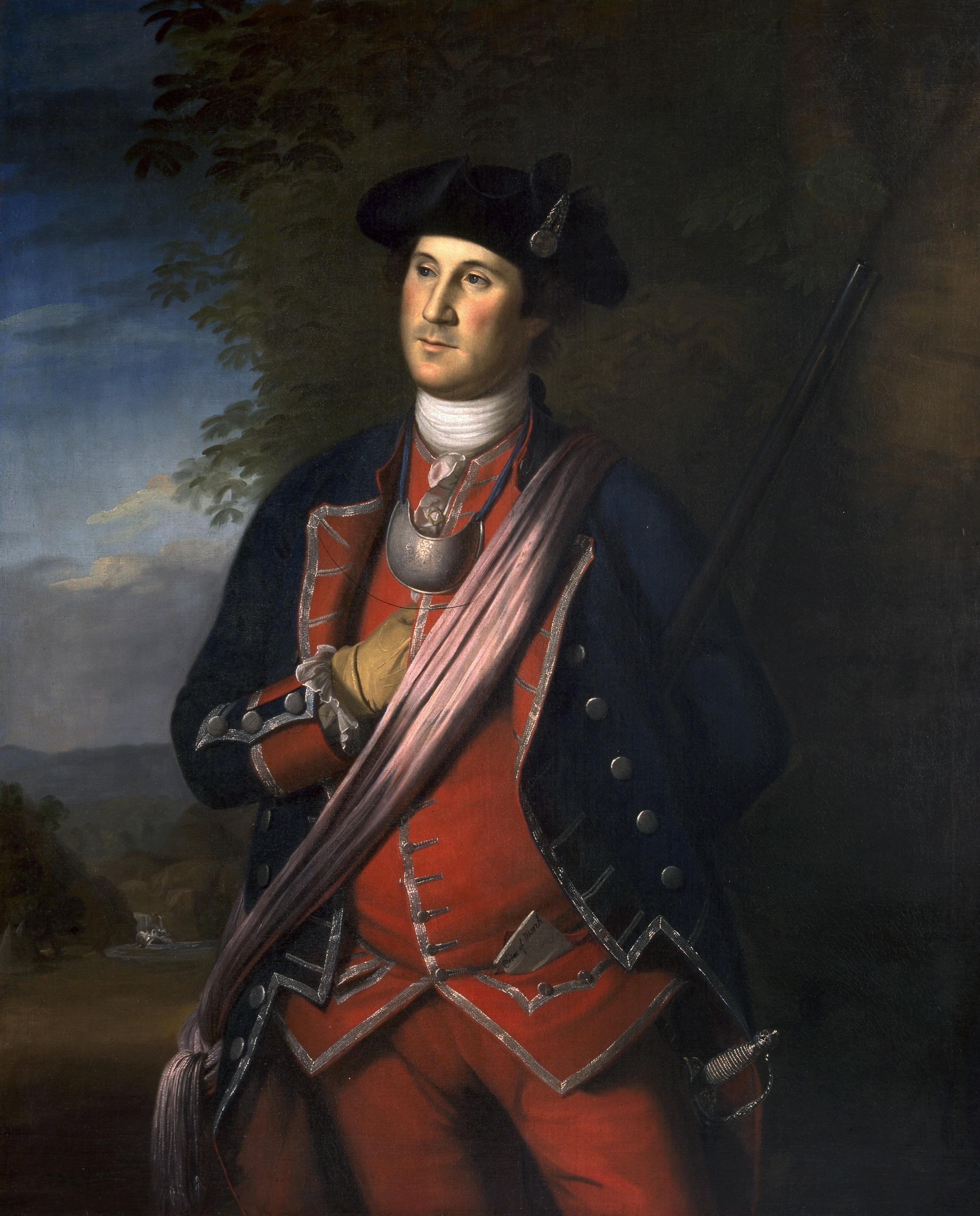
Peale, C.W., George Washington, 1772


Remember that it is the actions, and not the commission, that make the officer, and that there is more expected from him than the title.

George Washington, from his "Address to the Officers of the Virginia Regiment," January, 8, 1756

18 August 2024

Bonus.


Tribe.


Late mornings on Tuesdays from 1933 (although some reports say it could have been earlier) until 1949, Lewis could be found on the other side of Oxford, usually at the Eagle and Child pub, holding court with the Inklings, the informal literary society, most likely over a pint or three. Lewis was a founder of the small tribe, which included Tolkien and the writers Charles Williams and Owen Barfield.

Works in progress, including drafts from “The Lord of the Rings” and the first Narnia proofs, were presented here.

Members did not shy away from disagreement. Lewis struggled at times with Tolkien’s books for all their “Hobbit talk,” and Tolkien thought Narnia was a haphazard attempt at mythology, regretting that Narnia and Lewis’s work “should remain outside the range of my sympathy as much of my work was outside his,” Tolkien wrote in a 1964 letter.

Decide.


If you know how to read, you have a complete education about life, then you know how to vote within a democracy. But if you don’t know how to read, you don’t know how to decide. That’s the great thing about our country — we’re a democracy of readers, and we should keep it that way.

Excellent.

An excellent album ...

Reflect.


I think that all things, in their way, reflect heavenly truth, the imagination not least. "Reflect" is an important word. This lower life of the imagination is not a beginning of, nor a step towards, the higher life of the spirit, merely an image.  But it still has, at however many removes, the shape of the reality it reflected.


Thanks, Pop.

17 August 2024

Charlie Dore, "Pilot of the Airwaves"

Schooners of Lowenbrau and carafes of Black Tower liebfraumilch are two-for-one.  I recommend the chicken nachos with an extra side of ranch.

It's always five plays for a buck ...

First.


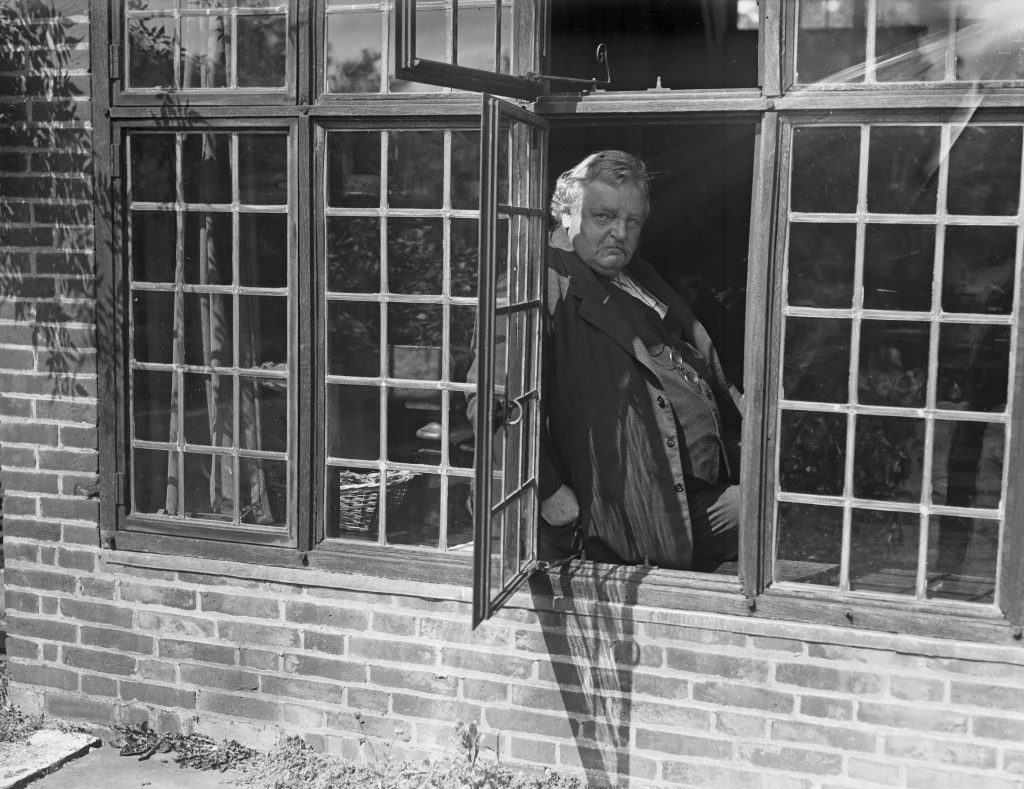
There is a law written in the darkest of the Books of Life, and it is this: If you look at a thing nine hundred and ninety-nine times, you are perfectly safe; if you look at it the thousandth time, you are in frightful danger of seeing it for the first time.

G.K. Chesterton, from The Napoleon of Notting Hill

Knowing.


Is imagination merely a talent, such as a good singing voice, the ability to “make things up” or “think things up” or “get ideas”? Or is it, like science, a way of knowing things that can be known in no other way? We have much reason to think that it is a way of knowing things not otherwise knowable. As the word itself suggests, it is the power to make us see, and to see, moreover, things that without it would be unseeable. In one of its aspects it is the power by which we sympathize. By its means we may see what it was to be Odysseus or Penelope, David or Ruth, or what it is to be one’s neighbor or one’s enemy. By it, we may “see ourselves as others see us.” It is also the power by which we see the place, the predicament, or the story we are in.

Wendell Berry, from Imagination in Place

16 August 2024

Spirit's.


OXFORD

It is well that there are palaces of peace
And discipline and dreaming and desire,
Lest we forget our heritage and cease
The Spirit's work -- to hunger and aspire:
Lest we forget that we were born divine,
Now tangled in red battle's animal net,
Murder the work and lust the anodyne,
Pains of the beast 'gainst bestial solace set.
But this shall never be: to us remains
One city that has nothing of the beast,
That was not built for gross, material gains,
Sharp, wolfish power or empire's glutted feast.
We are not wholly brute. To us remains
A clean, sweet city lulled by ancient streams,
A place of visions and of loosening chains,
A refuge of the elect, a tower of dreams.
She was not builded out of common stone
But out of all men's yearning and all prayer
That she might live, eternally our own,
The Spirit's stronghold-barred against despair.

C.S. Lewis

14 August 2024

13 August 2024

Luka Bloom, "My Friend the Old Oak Tree"

Search.


Logical activity is not the whole of intelligence. One can be intelligent without being particularly logical. The main functions of intelligence, that of inventing solutions, and that of verifying them, do not necessarily involve one another. The first partakes of imagination, the second alone is properly logical. Demonstration, search for truth, is therefore the true function of logic. 

If.


You start dying slowly;
if you do not travel,
if you do not read,
If you do not listen to the sounds of life,
If you do not appreciate yourself.

You start dying slowly:
When you kill your self-esteem,
When you do not let others help you.

You start dying slowly;
If you become a slave of your habits,
Walking everyday on the same paths…
If you do not change your routine,
If you do not wear different colours
Or you do not speak to those you don’t know.

You start dying slowly:
If you avoid to feel passion
And their turbulent emotions;
Those which make your eyes glisten
And your heart beat fast.

You start dying slowly:
If you do not risk what is safe for the uncertain
If you do not go after a dream
If you do not allow yourself
At least once in your lifetime
To run away from sensible advice
Don't let yourself die slowly
Do not forget to be happy!

Pablo Neruda

09 August 2024

See.


Those of us who have been true readers all our life seldom fully realise the enormous extension of our being which we owe to authors. We realise it best when we talk with an unliterary friend. He may be full of goodness and good sense but he inhabits a tiny world. In it, we should be suffocated. The man who is contented to be only himself, and therefore less a self, is in prison. My own eyes are not enough for me, I will see through those of others. Reality, even seen through the eyes of many, is not enough. I will see what others have invented.

C.S. Lewis, from The Reading Life: The Joy of Seeing New Worlds Through Others' Eyes

Scott Ballew, "Morning Pirate"

Excellent.

An excellent album ...

Before.


If you would be more creative stay in part a child, with the creativity and invention that characterizes children before they are deformed by adult society.

Jean Piaget

Flow.


I've decided to make up my mind
about nothing. To assume the water mask,
to finish my life disguised as a creek,
an eddy, joining at night the full,
sweet flow, to absorb the sky,
to swallow the heat and cold, the moon
and the stars, to swallow myself
in ceaseless flow.

Jim Harrison

Mozart, Rondo in C Major, K. 373

Albrecht Meyer performs with the Deutsche Kammerphilharmonie Bremen ...

Go.

Spear, Sunrise Water Nymphs, 1920


The breeze at dawn has secrets to tell you.
Don’t go back to sleep.

You must ask for what you really want.
Don’t go back to sleep.

People are going back and forth across the doorsill
where the two worlds touch.

The door is round and open.
Don’t go back to sleep.

Rumi

Happy Birthday, Piaget


Children should be able to do their own experimenting and their own research. Teachers, of course, can guide them by providing appropriate materials, but the essential thing is that in order for a child to understand something, he must construct it himself, he must re-invent it.  Each time one prematurely teaches a child something he could have discovered himself, that child is kept from inventing it and consequently from understanding it completely.  On the other hand that which we allow him to discover by himself will remain with him visibly for the rest of his life.

Jean Piaget, born on this day in 1896.

Happy Birthday, Walton


Quivering fears, heart-tearing cares,
Anxious sighs, untimely tears,
Fly, fly to courts,
Fly to fond worldlings' sports,
Where strain'd sardonic smiles are glosing still,
And Grief is forc'd to laugh against her will:
Where mirth's but mummery,
And sorrows only real be.
Fly from our country pastimes, fly,
Sad troops of human misery.
Come, serene looks,
Clear as the crystal brooks,
Or the pure azur'd heaven that smiles to see
The rich attendance of our poverty:
Peace and a secure mind,
Which all men seek, we only find.
Abused mortals I did you know
Where joy, heart's-ease, and comforts grow,
You'd scorn proud towers,
And seek them in these bowers;
Where winds, sometimes, our woods perhaps may shake,
But blust'ring care could never tempest make,
Nor murmurs e'er come nigh us,
Saving of fountains that glide by us.
Here's no fantastick mask, nor dance,
But of our kids that frisk and prance;
Nor wars are seen
Unless upon the green
Two harmless lambs are butting one the other,
Which done, both bleating run, each to his mother
And wounds are never found,
Save what the plough-share gives the ground.
Here are no false entrapping baits,
To hasten too, too hasty Fates,
Unless it be
The fond credulity
Of silly fish, which worldling like, still look
Upon the bait, but never on the hook;
Nor envy, unless among
The birds, for prize of their sweet song.
We all pearls scorn,
Save what the dewy morn
Congeals upon each little spire of grass,
Which careless shepherds beat down as they pass:
And gold ne'er here appears,
Save what the yellow Ceres bears,
Blest silent groves, oh may ye be,
For ever, mirth's best nursery !
May pure contents
For ever pitch their tents
Upon these downs, these meads, these rocks, these mountains.
And peace still slumber by these purling fountains:
Which we may, every year,
Meet when we come a-fishing here.

Izaak Walton, born on this day in in 1593, from The Compleat Angler, or the Contemplative Man's Recreation

Incombustible.

Published.


I know of no more encouraging fact than the unquestionable ability of man to elevate his life by a conscious endeavor. It is something to be able to paint a particular picture, or to carve a statue, and so to make a few objects beautiful; but it is far more glorious to carve and paint the very atmosphere and medium through which we look, which morally we can do. To affect the quality of the day, that is the highest of arts.

Henry David Thoreau, from Walden, published on this day in 1854

08 August 2024

The Replacements, "Left of the Dial"

Passin' through and it's late, the station started to fade
Picked another one up in the very next state ...


Simonon.

John Doran inducts Paul Simonon into British Masters (whatever that is) ...

Inquiring.


EPIGRAPH for a BANNED BOOK

Gentle reader, being—as you are—
a cautious man of uncorrupted tastes,
lay aside this disobliging work,
as orgiastic as it is abject.

Unless you’ve graduated from the school
of Satan (devil of a pedagogue!)
the poems will be Greek to you, or else
you’ll set me down for one more raving fool.

If, however, your impassive eye
can plunge into the chasms on each page,
read on, my friend: you’ll learn to love me yet.

Inquiring spirit, fellow-sufferer
in search, even here, of your own Paradise,
pity me. . . If not, to Hell with you!

Charles Baudelaire

Echo.

Though my father might have been born a poet, and born an eater, he was definitely not born a cook. His passion for tarragon chicken in the early seventies, and his talent for delivering it to the plate slippery and lukewarm; his general life-long impatience with grilling temperatures and times; the time he used the wrong stomach for menudo, and we all ran outside retching as the smell permeated the house; another exodus when he overheated chilies in oil for an early Chinese attempt, everyone running out of the house screaming and clawing at their eyes while the pan caught on fire. He was not good at details and he was not patient—he never reclosed a jar in his life; he never ceased to quarrel about cooking times with my husband—and he always thought more was better (garlic, peppers, wine).

He remained, at heart, a pork chop and herring kind of guy, but he was spurred by a deep competition with my mother and with close friends who knew what they were doing: a Frenchman named Guy de la Valdene, and the painter Russell Chatham, who would arrive in early October for grouse and woodcock hunting and stay three inspired, somewhat sodden weeks. We went from pot roast with iceberg and blue cheese dressing (not that there is anything wrong with these things) to grouse with grapes, ravioli with truffles, salmi de bécasses. By fifteen I was making spring rolls and screaming at failed meringues. By seventeen I was fighting for the Calvados and hiding the cocaine. When I took my little sister to the first Star Wars, we carried along a paper bag of Mrs. Chiang’s dry-fried beef for snacking, and ignored the people who stared; we drove to the theater in a dented red Chevy Vega that stalled in first gear, which my father and I had pooled our money to buy. A few years later he sold the rights to the three novellas of Legends of the Fall and the wine budget changed, but by then I’d moved to New York.

I slid some of the family dishes in the novel—the effort, serving, and clean-up rather than recipe details. We cook them all, still, as well as things from the subsequent forty years’ worth of cookbooks that cover a wall in the kitchen and fill boxes in the garage and basement. It’s a joy, but I feel the echo in the room. Almost everything I cook makes me think about someone I miss, living or dead. 

Scott Ballew, "Old Fashioned"

One.


My right hand has written all the poems that I have composed.
My left hand has not written a single poem.
But my right hand does not think,
"Left Hand, you are good for nothing."

My right hand does not have a superiority complex.
That is why it is very happy.
My left hand does not have any complex at all.
In my two hands there is the kind of wisdom
called the wisdom of nondiscrimination.

One day I was hammering a nail
and my right hand was not very accurate
and instead of pounding on the nail
it pounded on my finger.

It put the hammer down and took care
of my left hand in a very tender way,
as if it were taking care of itself.

It did not say, "Left Hand, you have to remember
that I have taken good care of you
and you have to pay me back in the future."
There was no such thinking…

And my left hand did not say,
"Right Hand, you have done me a lot of harm
— give me that hammer, I want justice."

My two hands know that they are members
of one body; they are in each other.

Thich Nhat Hanh

Always.


Sports Illustrated reports that Ohio fans want to speak to the manager -- again ...
Not surprisingly, Ohio State's fan base latched on to this latest news in hopes that it would bring them some sort of joy and happiness. In many ways, the Buckeye faithful have become the overbearing "Karens" of college football - always crying, always whining, always asking for the manager. 

Beingness.


In a life properly lived, you’re a river. You touch things lightly or deeply; you move along because life herself moves, and you can’t stop it; you can’t figure out a banal game plan applicable to all situations; you just have to go with the "beingness" of life.

Jim Harrison

Happy Birthday, Bulfinch

Bulfinch, Otis House, 1796


Charles Bulfinch was born on this day in 1763.

Joseph Cornish, architectural historian and director of Design Review of the Boston Landmarks Commission,"Building Boston: The Architecture of Charles Bulfinch" ...

07 August 2024

Listening.


LESSONS from the FUNERAL of a RAVEN

I've been translating the language with which creatures address God, including the non-harmonic bleats of dying sheep, the burpish fish, the tenor grown of the toad in the snake's mouth, the croak of the seagull flopping on the yellow line, misnamed mockingbird, and cat bird singing hundreds of borrowed songs -- coyotes joyous yipe when they bring down a fawn which honks like a bicycle horn for its helpless mother. The ladybug on the table was finally still.  I strained my ear close to her during the final moments, but only heard Mozart from the other room.  She was beyond reach one night under a big moon.  I heard the massive lung scream of a horse pounding the pasture across the creek, then his breathing above the creek.  This language is closer to what we spoke in Africa 70,000 years ago before we started writing things down and now we can't seem to stop.  I can't imagine how thought we though that we're better than the any of these other creatures, but that we wrote ourselves into it.  Someone looked down from Babel's tower and got the wrong idea, ignoring the birds above him.  I learned all of this one day listening to a raven funeral and a fir tree behind my cabin and learned it again listening to a wolf howling from the river delta nearby.  It's an old secret past anyone's caring, or so it seems.

Jim Harrison

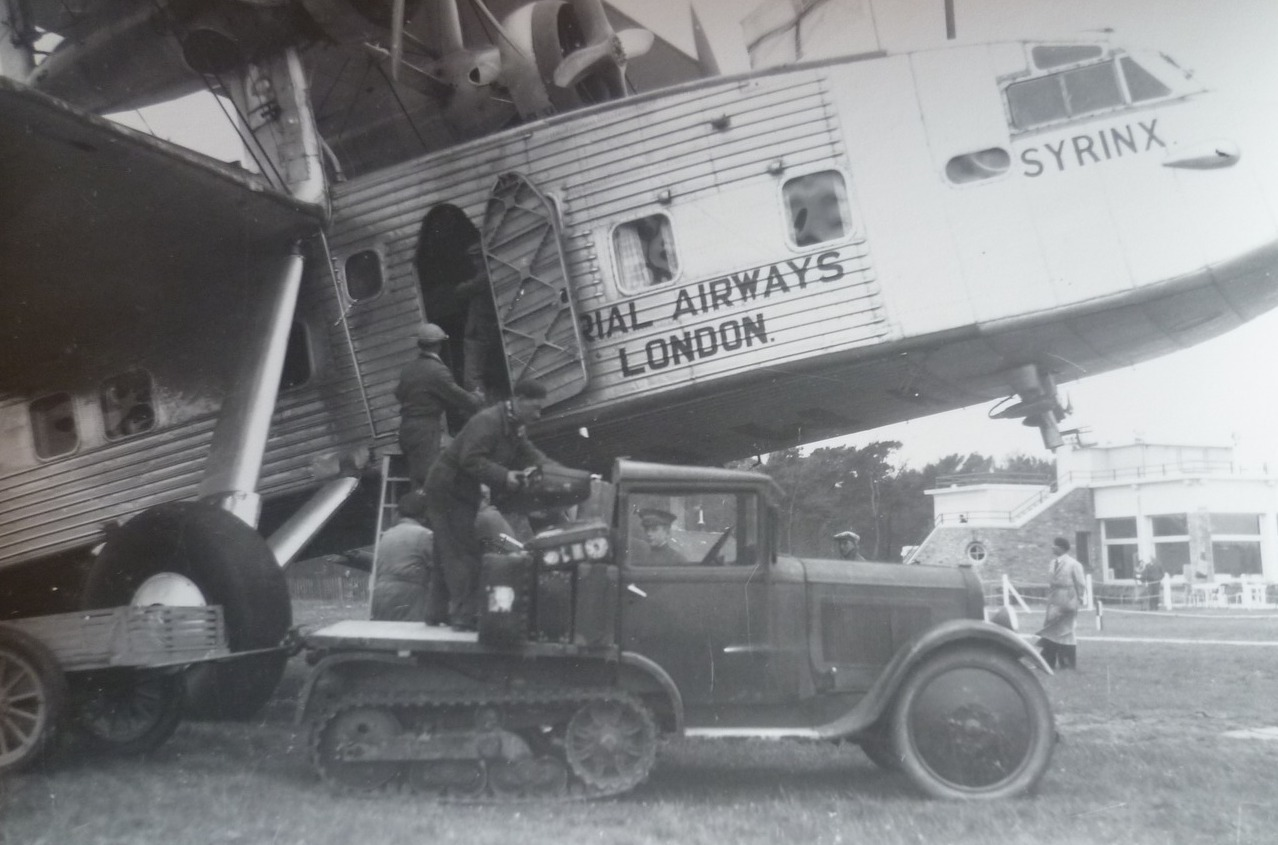
Stinson.

Exceed.


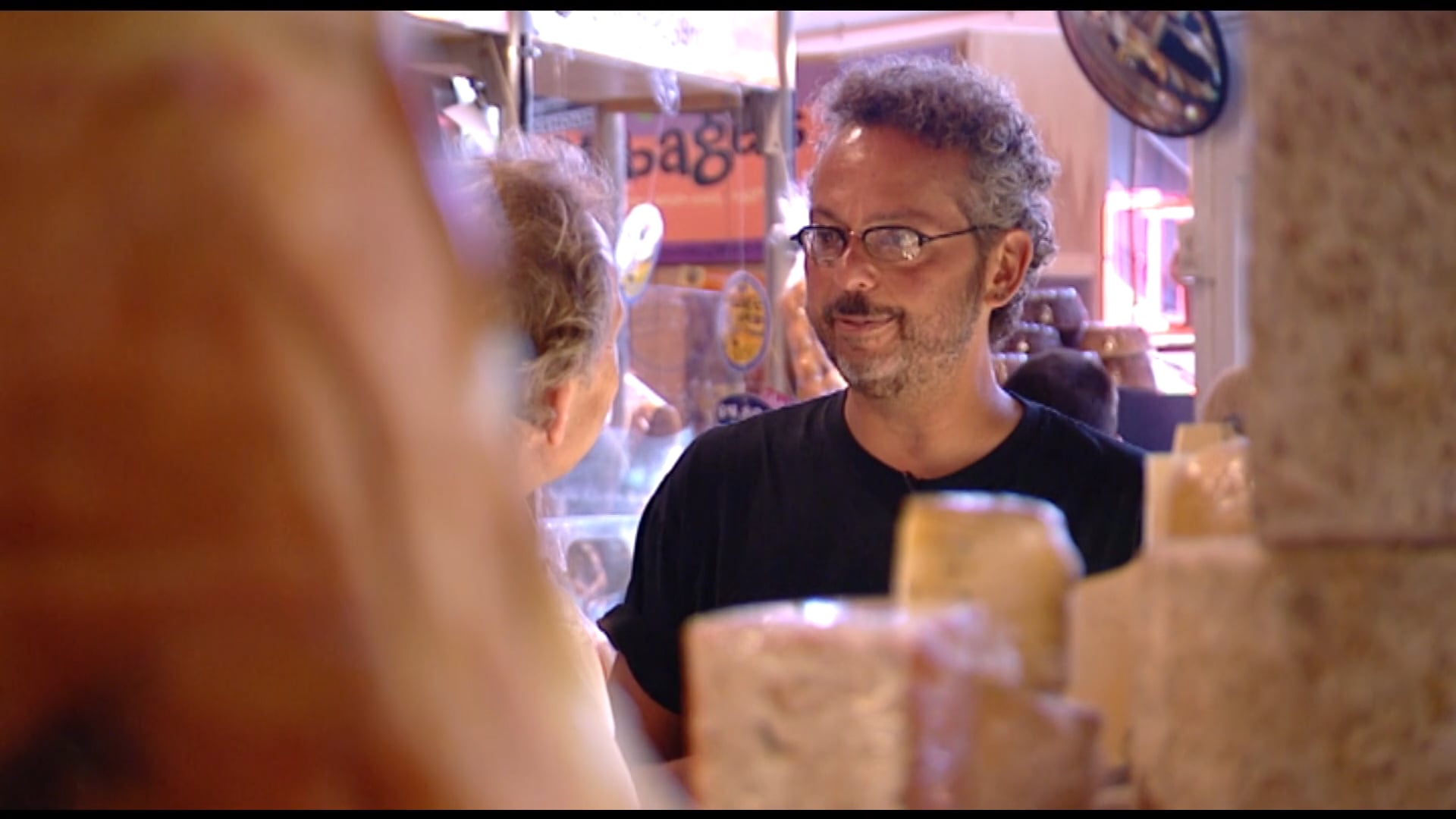
Ari Weinzweig on going the extra mile ...
Extra miles, barely noticeable to the casual observer, can make the difference between keeping a customer or losing them, enriching our community or exhausting it, and even staying in business or going under. They are, I believe, a beautiful way to illustrate French author Antoine de Saint-Exupéry's statement: “What is essential is invisible to the eye.” The point of creating an extra-mile-centric culture is not about what you and I might be able to accomplish on our own. It’s about what the collective can make happen when nearly everyone in the organization gets on board with the idea. As Timothy Snyder says, “If 10,000 little groups do 5,000 little things, that will make a tremendous difference.”

Some extra miles can be systematized. Will Guidara writes: “Identify moments that recur in your business, and build a tool kit your team can deploy without much effort.” The Roadhouse has just such a book, and databases and idea banks with other extra miles abound around the ZCoB. Here, we long ago agreed to use what we call the “:05/:55 Rule.” In order to exceed guest expectations, we actually unlock our doors, and are ready to go, five minutes before our posted opening time, and lock them five minutes after our closing time. Small thing, but really, why not?