Showing posts with label Sloane. Show all posts
Showing posts with label Sloane. Show all posts
26 November 2025


24 November 2025
Acoustics.
Sloane, Autumn in New England, n/a
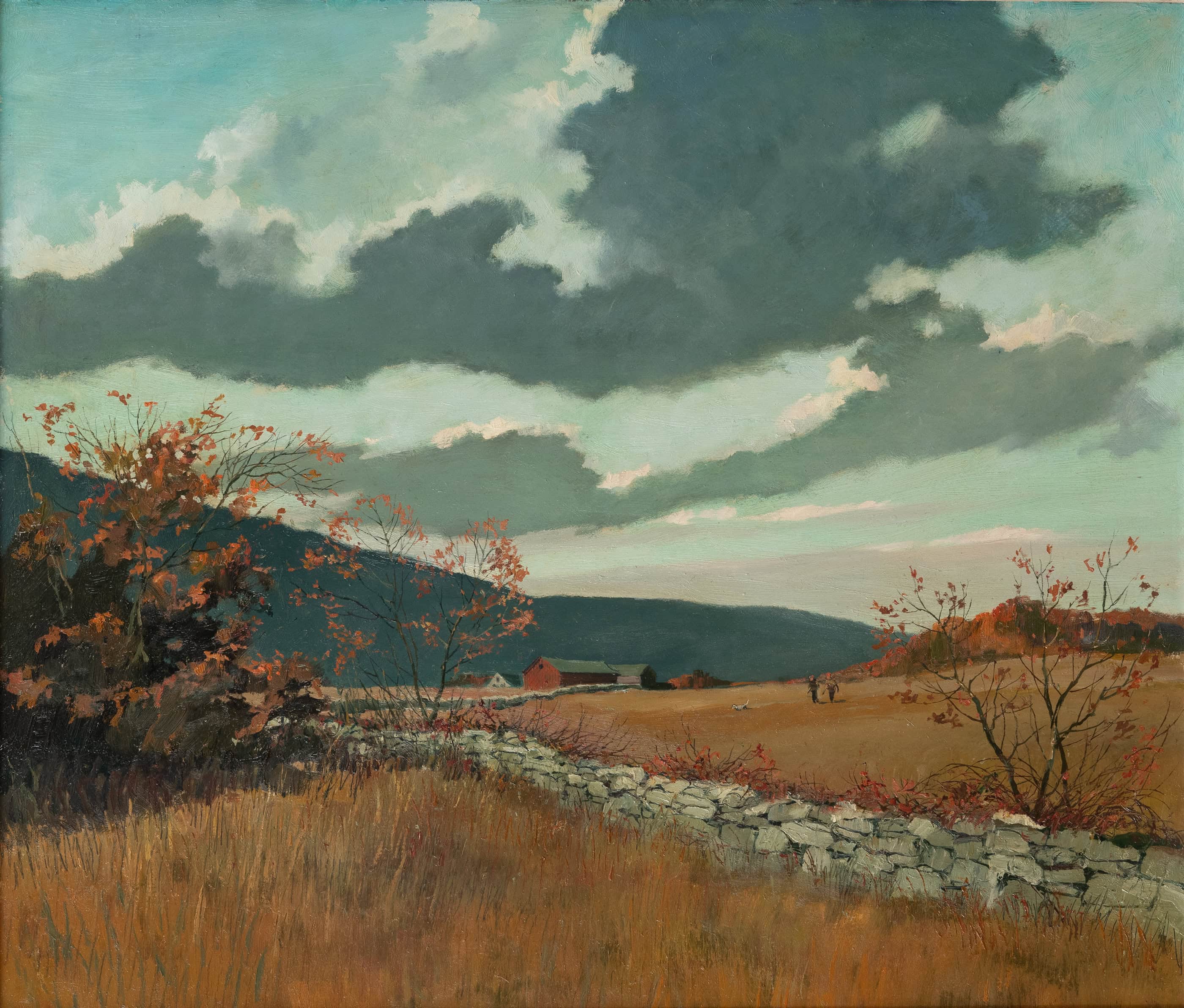
A few days ago I walked along the edge of the lake and was treated to the crunch and rustle of leaves with each step I made. The acoustics of this season are different and all sounds, no matter how hushed, are as crisp as autumn air.
Eric Sloane
07 October 2024
Benediction.
Sloane, Cornwall Bridge, n/d
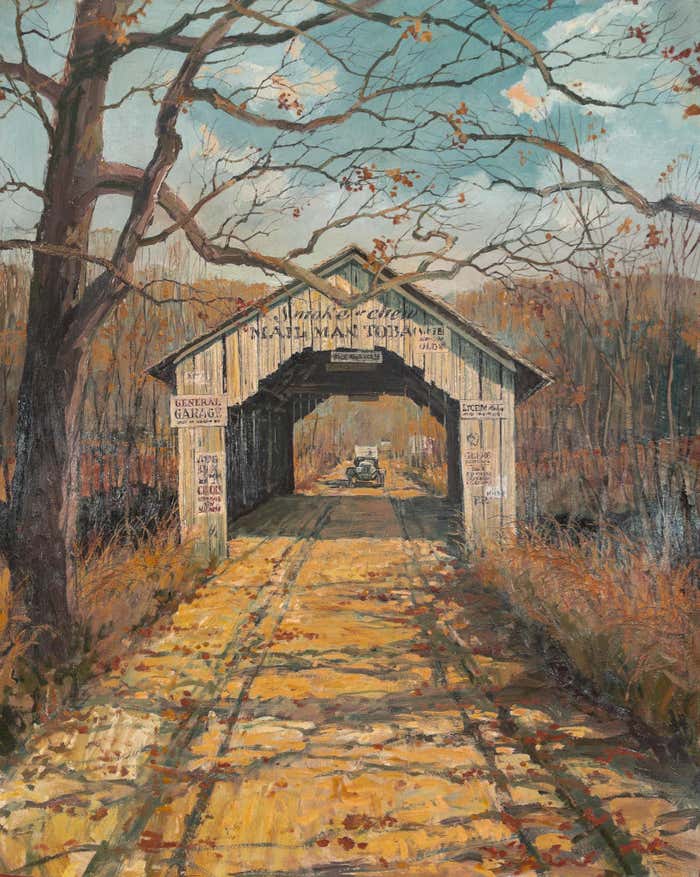
Now comes the sunset of the verdant year,
Chemic fires, still and slow,
Burn in the leaves, till trees and groves appear
Dipped in the sunset's glow.
Through many-stained windows of the wood
The day sends down its beams,
Till all the acorn-punctured solitude
Of sunshine softly dreams.
I take my way where sentry cedars stand
Along the bushy lane,
And whitethroats stir and call on every hand,
Or lift their wavering strain;
The hazel-bush holds up its crinkled gold
And scents the loit'ring breeze--
A nuptial wreath amid its leafage old
That laughs at frost's decrees.
A purple bloom is creeping o'er the ash--
Dull wine against the day,
While dusky cedars wear a crimson sash
Of woodbine's kindled spray.
I see the stolid oak tree's smould'ring fire
Sullen against emerald rye;
And yonder sugar maple's wild desire
To match the sunset sky.
On hedge and tree the bittersweet has hung
Its fruit that looks a flower;
While alder spray with coral berries strung
Is part of autumn's dower.
The plaintive calls of bluebirds fill the air,
Wand'ring voices in the morn;
The ruby kinglet, flitting here and there,
Winds again his elfin horn.
Now Downy shyly drills his winter cell,
His white chips strew the ground;
While squirrels bark from hill or acorned dell--
A true autumnal sound.
I hear the feathered thunder of the grouse
Soft rolling through the wood,
Or pause to note where hurrying mole or mouse
Just stirs the solitude.
Anon the furtive flock-call of the quail
Comes up from weedy fields;
Afar the mellow thud of lonely flail
Its homely music yields.
Behold the orchards piled with painted spheres
New plucked from bending trees;
And bronzèd huskers tossing golden ears
In genial sun and breeze.
Once more the tranquil days brood o'er the hills,
And soothe earth's toiling breast;
A benediction all the landscape fills
That breathes of peace and rest.
John Burroughs
05 July 2024
Not-Understanding.
Sloane, Low Tide, 1979

What is necessary, after all, is only this: solitude, vast inner solitude. To walk inside yourself and meet no one for hours — that is what you must be able to attain. To be solitary as you were when you were a child, when the grown-ups walked around involved with matters that seemed large and important because they looked so busy and because you didn’t understand a thing about what they were doing.
And when you realize that their activities are shabby, that their vocations are petrified and no longer connected with life, why not then continue to look upon it all as a child would, as if you were looking at something unfamiliar, out of the depths of your own solitude, which is itself work and status and vocation? Why should you want to give up a child’s wise not-understanding in exchange for defensiveness and scorn, since not understanding is, after all, a way of being alone, whereas defensiveness and scorn are participation in precisely what, by these means, you want to separate yourself from.
Rainer Maria Rilke, from Letters to a Young Poet
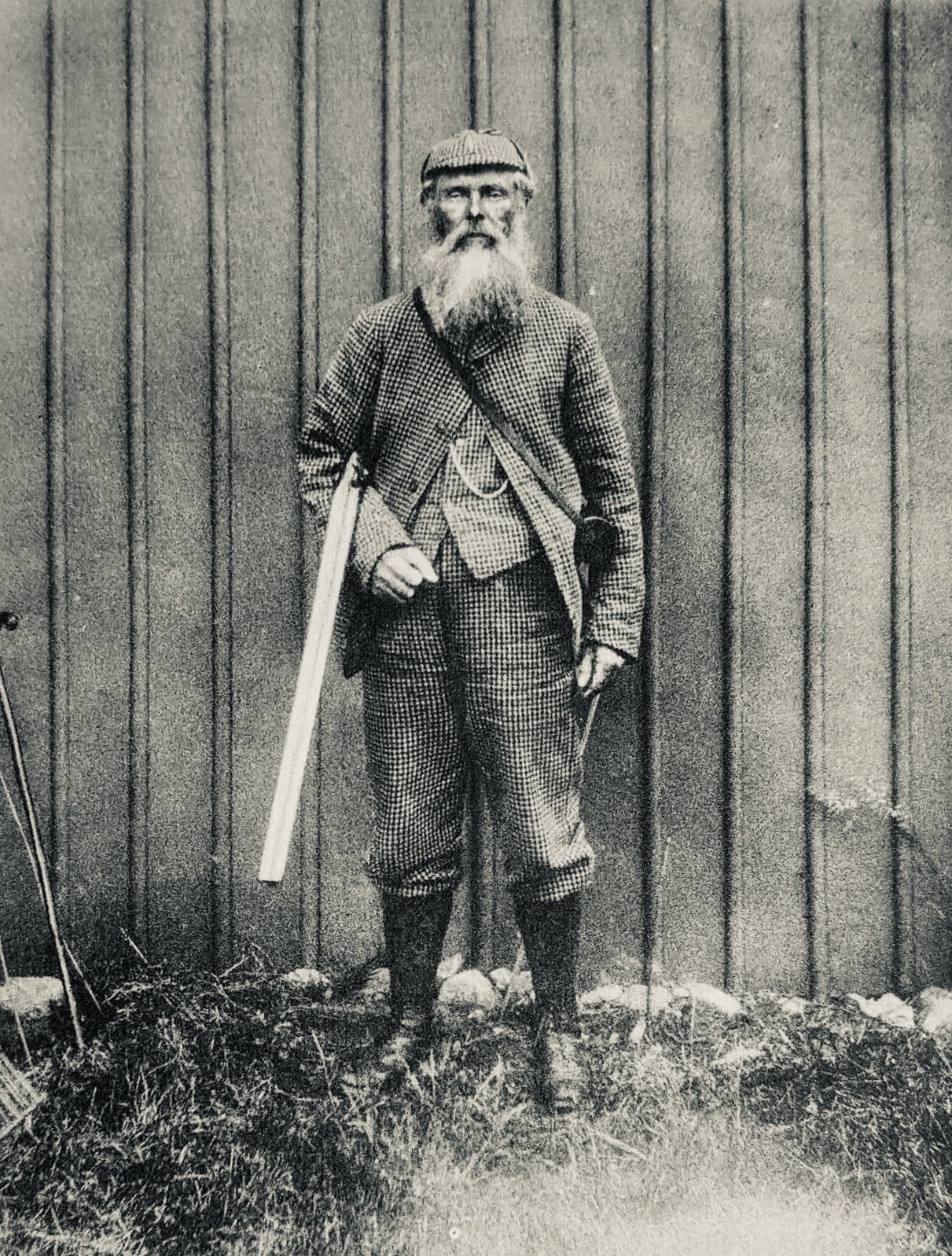
Thanks to Walker's Arms for the image.
30 September 2023
20 September 2023
04 March 2021
Chartless.
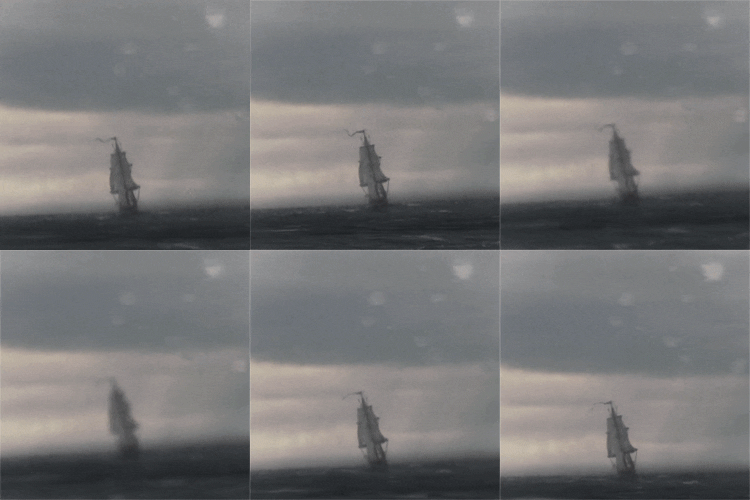
Sloane, Cloud Symphony, 1981

T.H. White, from The Once and Future King
30 January 2019



31 October 2018
Fond.
Sloane, The Autumn of a Barn, 1973

When years have left these walls and siding gray
And wind has dug its nails into the piney board
Around this relic chants the raucous jay
His lonely notes above the prairie sward.
Then, in your heart of hearts, what may befall
Remembering days with byre in the barnyard red,
When Charlie sawed his fiddle, gave the call,
Flesh soft, my hand, her glance and toss of head.
Our striplings, grown, then lend the dance anew,
Within the loft, they shone in bright array,
fresh partners laughed, grasped hands on cue,
Each one, each youth, there found its glorious day.
So, hailing what we leave, come, toll the bell,
And bid the barn, the past, a fond farewell.
Robert Tallant Loudon
30 October 2018

14 October 2018
Spiritual.

Our heads are often bowed down with the material burdens of life, but we know that all through the ages thinking people have found time to look upward and to seek peace and solace in the panorama of weather. Emerson called the sky the daily bread of his eyes. Ruskin called it almost human in its passions, almost spiritual in its tenderness, almost divine in its infinity. Lincoln said he could not imagine a man looking up a the sky and denying God. These spiritual qualities of weather frequently outweight the adverse influences that rain and snow have on our daily lives.
Eric Sloane
01 April 2018


31 August 2017

02 June 2016
Arise.
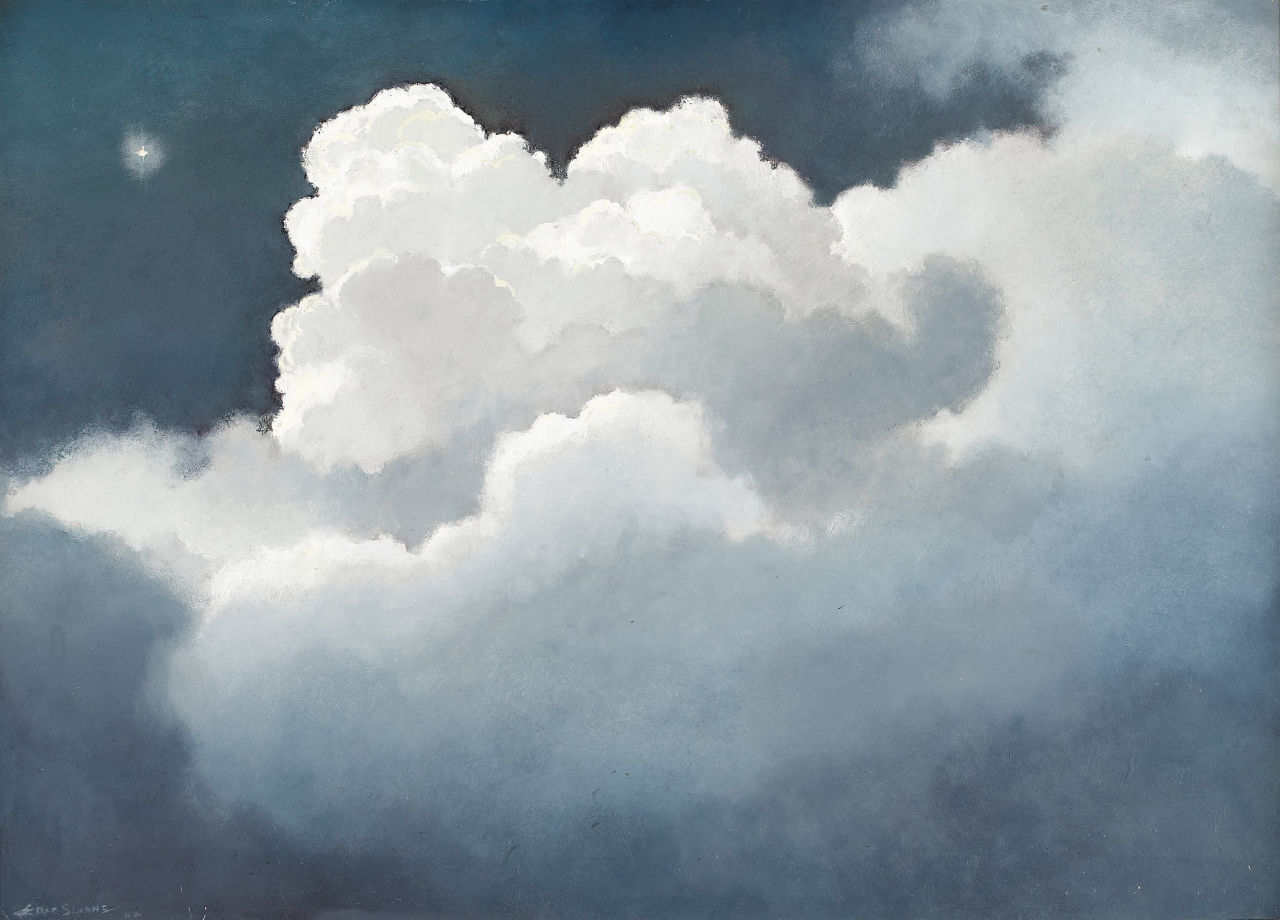
Sloane, Cloud Symphony, 1981

THE CLOUD
From the seas and the streams;
THE CLOUD
From the seas and the streams;
I bear light shade for the leaves when laid
In their noonday dreams.
From my wings are shaken the dews that waken
The sweet buds every one,
When rocked to rest on their mother's breast,
As she dances about the sun.
I wield the flail of the lashing hail,
And whiten the green plains under,
And then again I dissolve it in rain,
And laugh as I pass in thunder.
I sift the snow on the mountains below,
I sift the snow on the mountains below,
And their great pines groan aghast;
And all the night 'tis my pillow white,
While I sleep in the arms of the blast.
Sublime on the towers of my skiey bowers,
Lightning my pilot sits;
In a cavern under is fettered the thunder,
It struggles and howls at fits;
Over earth and ocean, with gentle motion,
This pilot is guiding me,
Lured by the love of the genii that move
In the depths of the purple sea;
Over the rills, and the crags, and the hills,
Over the lakes and the plains,
Wherever he dream, under mountain or stream,
The Spirit he loves remains;
And I all the while bask in Heaven's blue smile,
Whilst he is dissolving in rains.
The sanguine Sunrise, with his meteor eyes,
The sanguine Sunrise, with his meteor eyes,
And his burning plumes outspread,
Leaps on the back of my sailing rack,
When the morning star shines dead;
As on the jag of a mountain crag,
Which an earthquake rocks and swings,
An eagle alit one moment may sit
In the light of its golden wings.
And when Sunset may breathe, from the lit sea beneath,
Its ardours of rest and of love,
And the crimson pall of eve may fall
From the depth of Heaven above,
With wings folded I rest, on mine aëry nest,
As still as a brooding dove.
That orbèd maiden with white fire laden,
That orbèd maiden with white fire laden,
Whom mortals call the Moon,
Glides glimmering o'er my fleece-like floor,
By the midnight breezes strewn;
And wherever the beat of her unseen feet,
Which only the angels hear,
May have broken the woof of my tent's thin roof,
The stars peep behind her and peer;
And I laugh to see them whirl and flee,
Like a swarm of golden bees,
When I widen the rent in my wind-built tent,
Till calm the rivers, lakes, and seas,
Like strips of the sky fallen through me on high,
Are each paved with the moon and these.
I bind the Sun's throne with a burning zone,
I bind the Sun's throne with a burning zone,
And the Moon's with a girdle of pearl;
The volcanoes are dim, and the stars reel and swim,
When the whirlwinds my banner unfurl.
From cape to cape, with a bridge-like shape,
Over a torrent sea,
Sunbeam-proof, I hang like a roof,
The mountains its columns be.
The triumphal arch through which I march
With hurricane, fire, and snow,
When the Powers of the air are chained to my chair,
Is the million-coloured bow;
The sphere-fire above its soft colours wove,
While the moist Earth was laughing below.
I am the daughter of Earth and Water,
I am the daughter of Earth and Water,
And the nursling of the Sky;
I pass through the pores of the ocean and shores;
I change, but I cannot die.
For after the rain when with never a stain
The pavilion of Heaven is bare,
And the winds and sunbeams with their convex gleams
Build up the blue dome of air,
I silently laugh at my own cenotaph,
And out of the caverns of rain,
Like a child from the womb, like a ghost from the tomb,
I arise and unbuild it again.
Percy Bysshe Shelley
I arise and unbuild it again.
Percy Bysshe Shelley
Subscribe to:
Posts (Atom)