"I am not one who was born in the custody of wisdom. I am one who is fond of olden times and intense in quest of the sacred knowing of the ancients." Gustave Courbet
Showing posts with label summer. Show all posts

01 August 2026

Quiet.

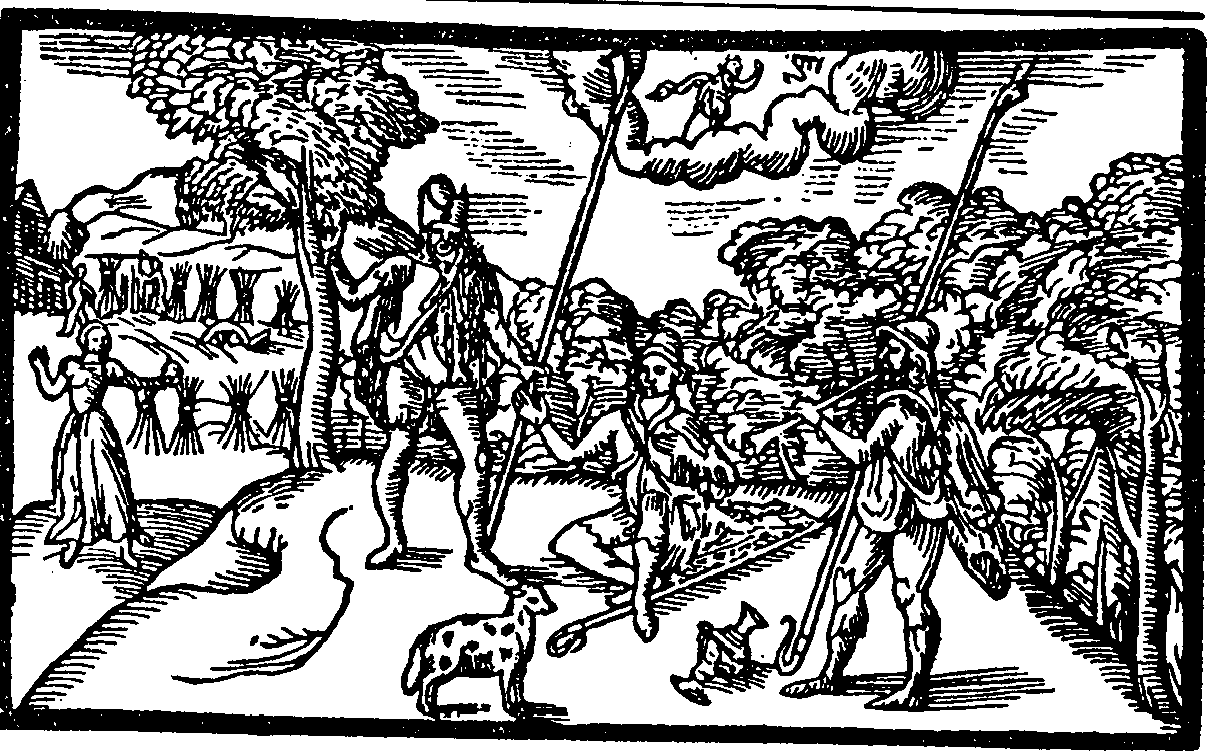
Spenser, Month of August, 1579


SHEPHERD's CALENDAR: August

Harvest approaches with its bustling day
The wheat tans brown and barley bleaches grey
In yellow garb the oat land intervenes
And tawney glooms the valley thronged with beans
Silent the village grows, wood wandering dreams
Seem not so lovely as its quiet seems
Doors are shut up as on a winters day
And not a child about them lies at play
The dust that winnows neath the breezes feet
Is all that stirs about the silent street
Fancy might think that desert spreading fear
Had whisperd terrors into quiets ear
Or plundering armys past the place had come
And drove the lost inhabitants from home
The fields now claim them where a motley crew
Of old and young their daily tasks pursue
The barleys beard is grey and wheat is brown
And wakens toil betimes to leave the town
The reapers leave their beds before the sun
And gleaners follow when home toils are done
To pick the littered ear the reaper leaves
And glean in open fields among the sheaves
The ruddy child nursed in the lap of care
In toils rude ways to do its little share
Beside its mother poddles oer the land
Sun burnt and stooping with a weary hand
Picking its tiney glean of corn or wheat
While crackling stubbles wound its legs and feet
Full glad it often is to sit awhile
Upon a smooth green baulk to ease its toil
And feign would spend an idle hour to play
With insects strangers to the moiling day
Creeping about each rush and grassy stem
And often wishes it was one of them
In weariness of heart that it might lye
Hid in the grass from the days burning eye
That raises tender blisters on his skin
Thro holes or openings that have lost a pin
Free from the crackling stubs to toil and glean
And smiles to think how happy it had been
Whilst its expecting mother stops to tye
Her handful up and waiting his supply
Misses the resting younker from her side
And shouts of rods and morts of threats beside
Pointing to the grey willows while she tells
His fears shall fetch one if he still rebells
Picturing harsh truths in its unpracticed eye
How they who idle in the harvest lye
Shall well deserving in the winter pine
Or hunt the hedges with the birds and swine
In vain he wishes that the rushes height
Were tall as trees to hide him from her sight
Leaving his pleasant seat he sighs and rubs
His legs and shows scratchd wounds from piercing stubs
To make excuse for play but she disdains
His little wounds and smiles while he complains
And as he stoops adown in troubles sore
She sees his grief and bids him sob no more
As bye and bye on the next sabbath day
She'll give him well earned pence as well as play
When he may buy almost with out a stint
Sweet candied horehound cakes and pepper mint
Or streaking sticks of lusious lolipop
What ere he chuses from the tempting shop
Wi in whose diamond winder shining lye
Things of all sorts to tempt his eager eye
Rich sugar plumbs in phials shining bright
In every hue young fancys to delight
Coaches and ladys of gilt ginger bread
And downy plumbs and apples streaked with red
Such promises all sorrows soon displace
And smiles are instant kindled in his face
Scorning all troubles which he felt before
He picks the trailing ears and mourns no more
The fields are all alive with busy noise
Of labours sounds and insects humming joys
Some oer the glittering sickle sweating stoop
Startling full oft the partridge coveys up
Some oer the rustling scythe go bending on
And shockers follow where their toils have gone
First turning swaths to wither in the sun
Where mice from terrors dangers nimbly run
Leaving their tender young in fears alarm
Lapt up in nests of chimbled grasses warm
And oft themselves for safty search in vain
From the rude boy or churlish hearted swain
Who beat their stone chinkd forks about the groun(
And spread an instant murder all around
Tho oft the anxious maidens tender prayer
Urges the clown their little lives to spare
Who sighs while trailing the long rake along
At scenes so cruel and forgets her song
And stays wi love his murder aiming hand
Some ted the puffing winnow down the land
And others following roll them up in heaps
While cleanly as a barn door beesome sweeps
The hawling drag wi gathering weeds entwind
And singing rakers end the toils behind

When the sun stoops to meet the western sky
And noons hot hours have wanderd weary bye
They seek an awthorn bush or willow tree
Or stouk or shock where coolest shadows be
Where baskets heapd and unbroachd bottles lye
Which dogs in absence watchd with wary eye
To catch their breath awhile and share the boon
Which beavering time alows their toil at noon
All gathering sit on stubbs or sheaves the hour
Where scarlet poppys linger still in flower
Stript in his shirt the hot swain drops adown
And close beside him in her unpind gown
Next to her favoured swain the maiden steals
Blushing at kindness which her love reveals
Who makes a seat for her of things around
And drops beside her on the naked ground
Wearied wi brambles catching at her gown
And pulling nutts from branches pulld adown
By friendly swain the maid Wi heaving breast
Upon her lovers shoulder leans at rest
Then from its cool retreat the beer they bring
And hand the stout hooped bottle round the ring
Each swain soaks hard-the maiden ere she sips
Shrieks at the bold whasp settling on her lips
That seems determined only hers to greet
As if it fancied they were cherrys sweet
So dog forgoes his sleep awhile or play
Springing at frogs that rustling jump away
To watch each morsel that the boon bestows
And wait the bone or crumb the shepherd throws
For shepherds are no more of ease possest
But share the harvests labours with the rest

When day declines and labour meets repose
The bawling boy his evening journey goes
At toils unwearied call the first and last
He drives his horses to their nights repast
In dewey close or meadow to sojourn
And often ventures on his still return
Oer garden pales or orchard walls to hie
When sleeps safe key hath locked up dangers eye
All but the mastiff watching in the dark
Who snufts and knows him and forbears to bark
With fearful haste he climbs each loaded tree
And picks for prizes which the ripest be
Pears plumbs or filberts covered oer in leams
While the pale moon creeps high in peaceful dreams
And oer his harvest theft in jealous light
Fills empty shadows with the power to fright
And owlet screaming as it bounces nigh
That from some barn hole pops and hurries bye
Scard at the cat upon her nightly watch
For rats that come for dew upon the thatch
He hears the noise and trembling to escape
While every object grows a dismal shape
Drops from the tree in fancys swiftest dread
By ghosts pursued and scampers home to bed
Quick tumbling oer the mossy mouldering wall
And looses half his booty in the fall
Where soon as ere the morning opes its eyes
The restless hogs will happen on the prize
And crump adown the mellow and the green
And makes all seem as nothing ne'er had been
Amid the broils of harvests weary reign
How sweet the sabbath wakes its rest again
For each weary mind what rapture dwells
To hear once more its pleasant chiming bells
That from each steeple peeping here and there
Murmur a soothing lullaby to care
The shepherd journying on his morning rounds
Pauses awhile to hear their pleasing sounds
While the glad childern free from toils employ
Mimic the ding dong sounds and laugh for joy
The fields themselves seem happy to be free
Where insects chatter with unusual glee
While solitude the stubbs and grass among
Apears to muse and listen to the song

In quiet peace awakes the welcomed morn
Men tired and childern with their gleaning worn
Weary and stiff lye round their doors the day
To rest themselves with little heart for play
No more keck horns in homestead close resounds
As in their school boy days at hare and hounds
Nor running oer the street from wall to wall
With eager shouts at 'cuck and catch the ball'
In calm delight the sabbath wears along
Yet round the cross at noon a tempted throng
Of little younkers with their pence repair
To buy the downy plumb and lucious pear
That melt i' th mouth-which gardners never fail
For gains strong impulse to expose for sale
And on the circling cross steps in the sun
Sit when the parson has his sermon done
When grandams that against his rules rebell
Come wi their baskets heapd wi fruit to sell
That thither all the season did pursue
Wi mellow goosberrys of every hue
Green ruffs and raspberry reds and drops of gold
That makes mouths water often to behold
Sold out to clowns in totts oft deemd too small
Who grudging much the price eat husks and all
Nor leaves a fragment round to cheer the eye
Of searching swine that murmurs hungry bye
And currans red and white on cabbage leaves
While childerns fingers itches to be thieves
And black red cherrys shining to the sight
As rich as brandy held before the light
Now these are past he still as sunday comes
Sits on the cross wi baskets heapd wi plumbs
And Jenitens streakd apples suggar sweet
Others spice scented ripening wi the wheat
And pears that melt ith' mouth like honey which
He oft declares to make their spirits itch
They are so juicy ripe and better still
So rich they een might suck em thro a quill
Here at their leisure gather many a clown
To talk of grain and news about the town
And here the boy wi toils earnd penny comes
In hurrying speed to purchase pears or plumbs
And oer the basket hangs wi many a smile
Wi hat in hand to hold his prize the while

Not so the boys that begs for pence in vain
Of deaf eard dames that threat while they complain
Who talk of the good dinners they have eat
And wanting more as nothing but consiet
Vowing they ne'er shall throw good pence away
So bids them off and be content wi play
Reaching her rod that hangs the chimney oer
And scaring their rude whinings to the door
Who sob aloud and hang their hats adown
To hide their tears and sawn along the town
Venturing wi sullen step his basket nigh
And often dipping a desiring eye
Stone hearted dames thrifts errors to believe
Who make their little bellys yearn to thieve
But strong temptation must to fears resign
For close beside the stocks in terror shine
So choaking substitutes for loss of pelf
He keeps his hungry fingers to himself
And mopes and sits the sabbath hours away
Wi heart too weary and too sad for play
So Sunday's scenes and leisure passes bye
In rests soft peace and home tranquillity
Till Monday morning doth its cares pursue
And wakes the harvests busy toils anew

John Clare

Thirty-one days until The Oyster Months.

21 September 2025

Minstrelsy.


The LAST of SUMMER

A beauty on the scene attends
Ere autumn comes & summer ends
When summers glory first we see
As staind with its mortality
A tree turnd yellow ere & there
& some already nearly bare
Who in the sun fade sick & fall
& leave a lesson with us all
& clouded skyes that hourly wain
& brighten into smiles again
Oer clearing fields & parched bowers
& witherd tufts that once was flowers
Nor can I wish those scenes away
So beautiful in their decay
For summers smiles to yearly be
Or give springs hopes eternity
Around me wood & valley seems
Fading in visionary dreams
A fairey scene that once begun
To fade & sicken in the sun
Decks in new beautys wood & hill
& like enchantment varies still
A rainbow glory nature weaves
Around her dwelling ere she leaves
Her autumns sickning toils to keep
Her sabbath rest of winter sleep
Oft in my earlier days of leisure
I felt a mellancholy pleasure
To track the sun burnt heaths & plains
When summers dazzling glory wains
When flowers had left the open walks
& nought appeard but rustling stalks
& those still lingering loath to fade
Were daily sickening in the shade
When orchard apple reddening mellow
& woodland branches sickening yellow
Proclaim the summers first decay
& autumn hastning on his way
& I do love this season still
To ramble round the scenes at will
To rove the smoothly shaven meadow
Were fading summer like a widow
Bewails in silence heavy hearted
The pleasant din of days departed
When sweeping mowers late & soon
From sunrise to eves dewy moon
Toild cheerful oer its level ground
& whetting sythes kept tinkling round
When swain & maid in artless glee
Sing round the haycock merrily
Mixing with grass[h]opper & bee
The summers soul of mellody
So sweet that ecchos extasys
Murmurd their mirth in mild replys
Tho these are gone & in their stead
A silent scene around is spread
A russet level bleak & bare
With yellow blossom here & there
Sickly smiling on the sun
As tho they wishd their end to shun
Till noon tide bids their hopes be oer
& evens dews can heal no more
Then dropping in their grave the grass
They claim our pity as we pass
Tho no fond bee with cheering hum
To their lorn bosoms cares to come
Tho fled the din of sythe & men
& but an odd lark now & then
Starts from its lonley naked way
To hope & sing for summers stay
Yet wandering in these fields at will
I feel a saddend pleasure still
Each morn wakes wan its sunlight wains
On yellowing leaves & fading plains
Green fields no more the summer views
All sicknd into ripend hues
Of brown & grey & darksome glooms
That mark the path were autum comes
& in each woodlands buried way
The dew drop lives for half the day
Dank mists oft creep 'tween earth & skye
& dreaming dim the mornings eye
& dullness wears along the while
As if the sun was loath to smile
Yet at mid day his feebld powers
Will brighten up in sultry hours
& sweating toil that often stops
To wipe aside the falling drops
Piercd with his downward daily ray
Wishes the lagging hours away
By swallows we may plain percieve
When summers on the point to leave
Who shun the pond & rippeling spring
Were oft they dipt their sutty wing
& green lanes were from morn till night
They joyd to weel their circling flight
Now perchd on cottage tops to rest
They twit & prune each dingy breast
Or flock together in the skye
As if to learn their young to flye
Preparing each unpractisd wing
For flight to seek another spring
Each orchard now is smiling gay
Glittering in the morning ray
Rich clustering plums of varied hue
Of freckld red & misty blue
& suntand pears with ruddy streak
Brown as was summers lusty cheek
& blushing apples round & red
Whose loaded branches pat the head
Of longing maid who hither goes
To hang on lines the bleaching cloaths
She views the fruit with tempting eye
& steals one as she saunters bye
& boys will often slive from play
& in the orchard find a way
Hurling up stones with jerking spring
Or sti[c]ks with many a sturdy swing
Till on the foot markd batterd ground
The pears & apples patter round
& truant school boys stealing play
Oft sneaks along some secret way
Tho neer a nest his eye percieves
Tho pootys hide in falling leaves
Yet are there hips & haws to seek
& suntand crabs with ruddy cheek
& with harsh grin & w[r]inkld frown
He chews the unpleasant prizes down
& arching oer the woodland way
Blackberrys tempt his thoughts astray
Sloes powderd oer with misty down
From hedges too he scrambles down
By shepherds deemd a pleasant treat
Tho not till winter makes them sweet
When frost nipt they awake desire
& anxious to his cottage fire
On the clear blaze each branch he th[r]ows
& roasts the hissing sputtering sloes
Now mushrooms with the morning light
Above the whet grass glisten white
Whose shade perhaps in nights wet hours
May serve the faireys sports for bowers
& often in the morning hours
That cheer awhile half witherd flowers
Ive markd suprisd as passing bye
Unseen save by each curious eye
From bent to bent oer closes spread
The slender cobwebs silken thread
By unseen insects finely spun
Glittering in the gleaming sun
Nor is the summers farewell hours
Always left without their flowers
The majoram oft in shady lane
Nights plentious dews revive again
Long scorchd in summers earlier hours
It now will freshen into flowers
On hills & roads & every where
The ragwort blossoms half the year
& thistles on each rushy baulk
Are constant blushing in our walk
That towers in scornful majesty
Oer oddling daiseys peeping nigh
Untouchd by sheep that hither stray
Who from its pr[i]ckles sneak away
& endive flowering closly bye
That steals its colors from the sky
The old-mans-beard too in its prime
Covers the hedges like a rime
With downy flowers that thickly twind
Oft shields the swain from rain & wind
These live till summers last decay
& lingering oft in fond delay
With autumn if she enters mild
Are sought & found by many a child
Who sort their blooms in poseys fair
& garlands glad her yellow hair
O Autumn now thy reign is nigh
I feign woud hail thy majesty
But hollow winds & tumbling floods
& singing showers & yellow woods
These are thy mighty minstrelsy
Who maddening into life with thee
Woud make amid their strains divine
Unheard the song so tame as mine.

John Clare

Thanks for the reminder, Kurt.

28 August 2025

Excellent.

An excellent book ...


There are those days which seem a taking in of breath which, held, suspends the whole earth in its waiting. Some summers refuse to end.

So along the road those flowers spread that, when touched, give down a shower of autumn rust. By every path it looks as if a ruined circus had passed and loosed a trail of ancient iron at every turning of a wheel. The rust was laid out everywhere, strewn under trees and by river-banks and near the tracks themselves where once a locomotive had gone but went no more. So flowered flakes and railroad track together turned to moulderings upon the rim of autumn.

09 July 2025

Confidence.


Grandfather smiled in his sleep. 

Feeling the smile and wondering why it was there, he awoke. He lay quietly listening, and the smile was explained. 

For he heard a sound which was far more important than birds or the rustle of new leaves. Once each year he woke this way and lay waiting for the sound which meant that summer had officially begun. And it began on a morning such as this when a boarder, a nephew, a cousin, a son or a grandson came out on the lawn below and moved in consecutively smaller quadrangles north and east and south and west with a clatter of rotating metal through the sweet summer grass. Clover blossoms, the few unharvested dandelion fires, ante, sticks, pebbles, remnants of last year’s July Fourth squibs and punks, but predominantly clear green, a fount leaped up from the chattering mower. A cool soft fount; Grandfather imagined it tickling his legs, spraying his warm face, filling his nostrils with the timeless scent of a new season begun, with the promise that, yes, we’ll all live another twelve months. 

God bless the lawn mower, he thought. Who was the fool who made January first New Year’s Day No, they should set a man to watch the grasses across a million Illinois, Ohio, and Iowa lawns, and on that morning when it was long enough for cutting, instead of rachets and horns and yelling, there should be a great swelling symphony of lawn mowers reaping fresh grass upon the prairie lands. Instead of confetti and serpentine, people should throw grass spray at each other on the one day each year that really represents Beginning! 

He snorted at his own lengthy discussion of the affair, went to the window and leaned out into the mellow sun shine, and sure enough, there was a boarder, a young newspaperman named Forrester, just finishing a row. 

“Morning, Mr. Spaulding!” 

“Give ’em hell, Bill!” cried Grandpa heartily, and soon downstairs eating Grandma’s breakfast, with the window open so the rattling buzz of the lawn mower lolled about his eating. “It gives you confidence,” Grandpa said. 

“That lawn mower. Listen to it!”

Ray Bradbury, from Dandelion Wine

08 July 2025

Tilting.

Grimshaw, The Spirit of the Night, 1879


Hold summer in your hand, pour summer in a glass, a tiny glass of course, the smallest tingling sip for children; change the season in your veins by raising glass to lip and tilting summer in.

Ray Bradbury, from Dandelion Wine

06 July 2025

Working.

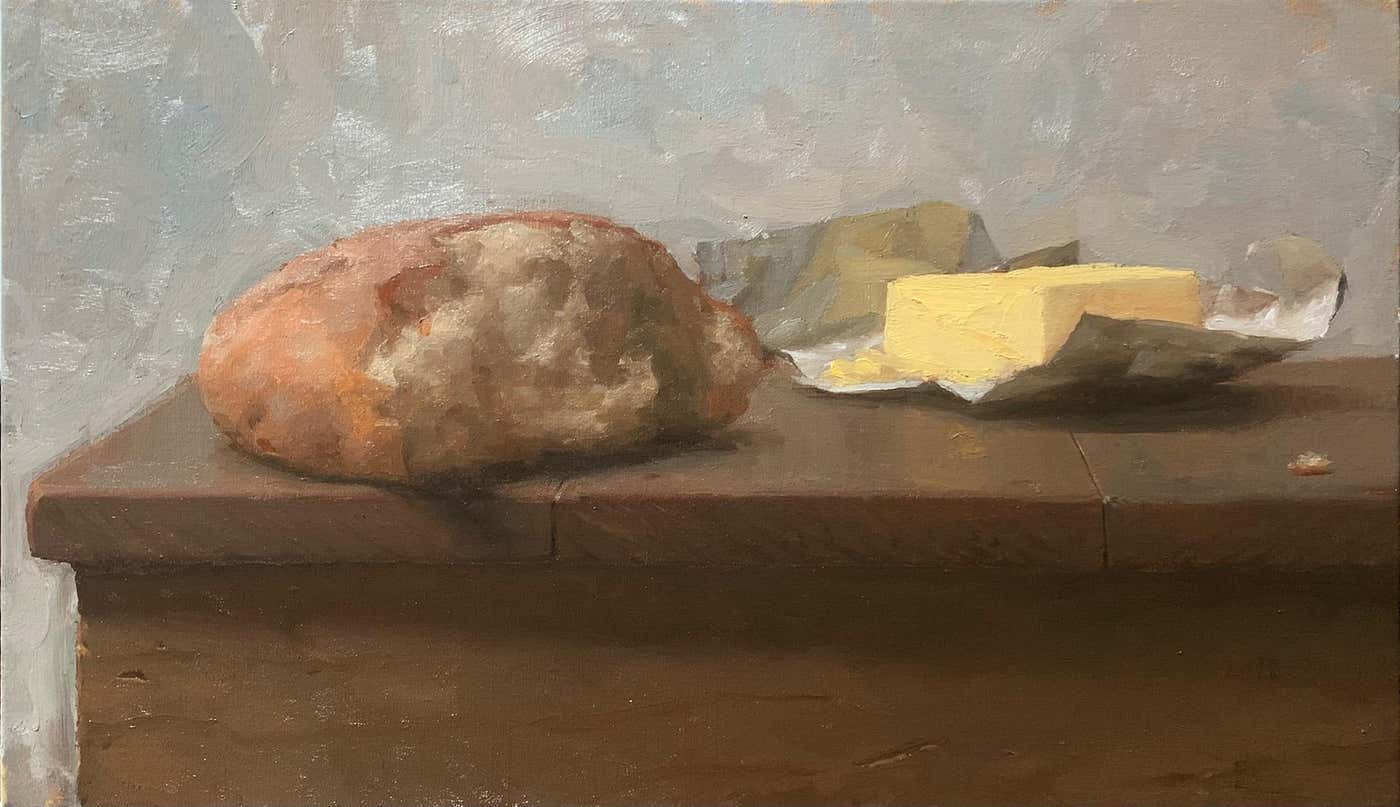
Collins, Bread and Butter, 2022


Every hand, every head, every mouth made a big or little motion. You could hear their faraway voices under glass. You could hear someone singing in a high sweet voice. You could smell bread baking, too, and you knew it was real bread that would soon be covered with real butter. Everything was there and it was working.
Ray Bradbury, from Dandelion Wine

01 July 2025

Hum.


JULY

Loud is the Summer's busy song,
The smallest breeze can find a tongue,
While insects of each tiny size
Grow teasing with their melodies,
Till noon burns with its blistering breath
Around, and day lies still as death

The busy noise of man and brute
Is on a sudden lost and mute;
Even the brook that leaps along,
Seems weary of its bubbling song,
And, so soft its waters creep,
Tired silence sinks in sounder sleep;

The cricket on its bank is dumb;
The very flies forget to hum;
And, save the wagon rocking round,
The landscape sleeps without a sound.
The breeze is stopped, the lazy bough
Hath not a leaf that danceth now;

The taller grass upon the hill,
And spider's threads, are standing still;
The feathers, dropped from moorhen's wing
Which to the water's surface cling,
Are steadfast, and as heavy seem
As stones beneath them in the stream;

Hawkweed and groundsel's fanny downs
Unruffled keep their seedy crowns;
And in the over-heated air
Not one light thing is floating there,
Save that to the earnest eye
The restless heat seems twittering by.

Noon swoons beneath the heat it made,
And flowers e'en within the shade;
Until the sun slopes in the west,
Like weary traveler, glad to rest
On pillowed clouds of many hues.
Then Nature's voice its joy renews,

And chequered field and grassy plain
Hum with their summer songs again,
A requiem to the day's decline,
Whose setting sunbeams coolly shine;
As welcome to day's feeble powers
As falling dews to thirsty flowers.

John Clare

24 June 2025

Honey-Slow.


MIDSUMMER

This starbreak is celestial air, 
Just silver; earthlight, dying amber.
Underneath an arch of pallor
Summer keeps her brightened chamber.

Bright beauty of the risen dust
And deep flood-mark of beauty pressed
Up from earth in lovely flower,
High against my lonely breast;

Thou rhythm like the changing moon’s
The catch to which the waters play,
That as they kiss moon-silver sink,—
As soon to spurn the baffled clay;

Only before the waters fall
Is Paradise shore for gaining now.
The grasses drink the berry-bright dew;
The small fruits jewel all the bough.

Heart-breaking summer beyond taste,
Ripeness and frost are soon to know;
But might such color hold the west,
And time, and time, be honey-slow! 

Léonie Adams

Shaping.

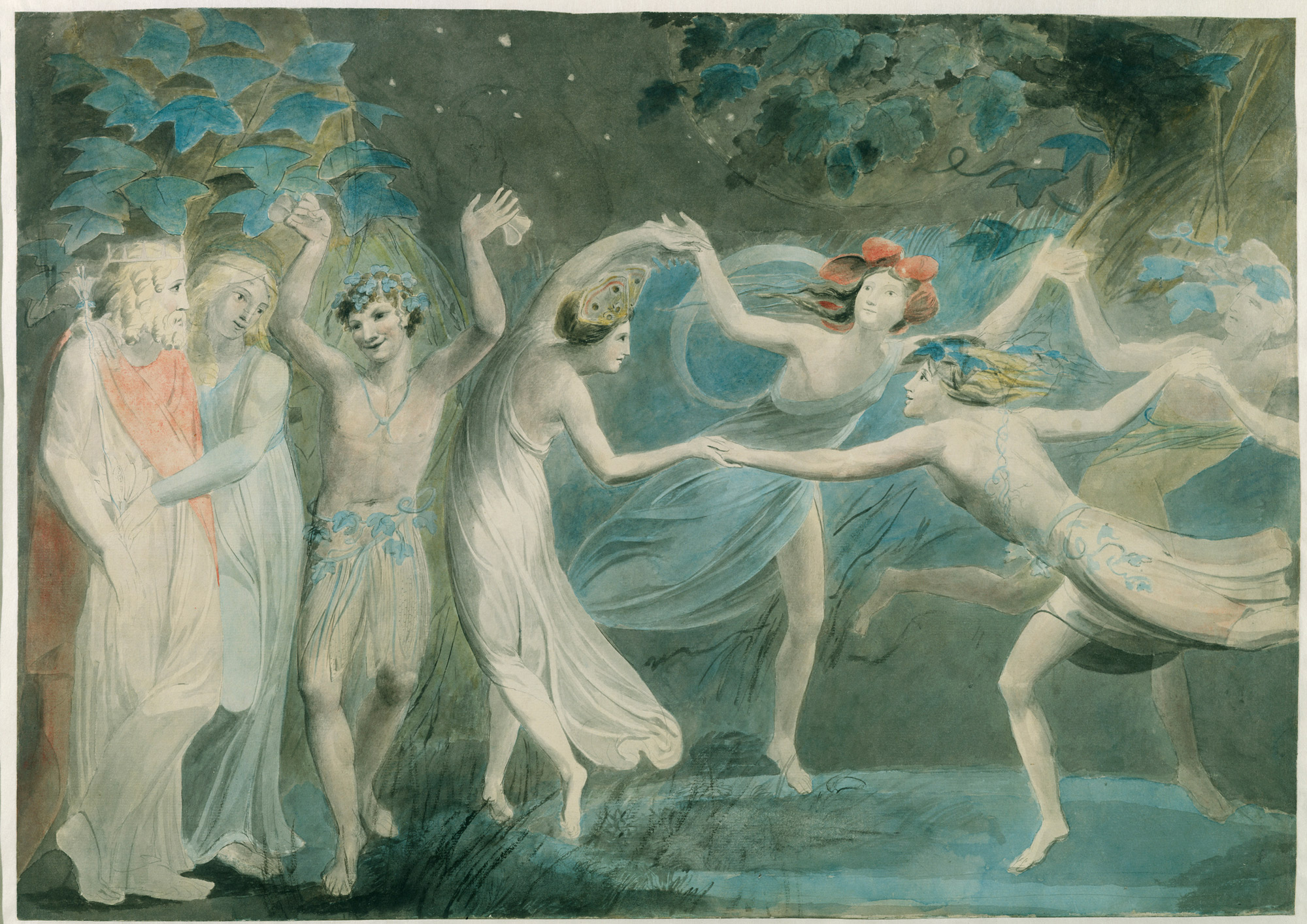
Blake, Oberon, Titania and Puck with Fairies Dancing, 1786


Lovers and madmen have such seething brains,
Such shaping fantasies, that apprehend
More than cool reason ever comprehends.
The lunatic, the lover and the poet
Are of imagination all compact:
One sees more devils than vast hell can hold,
That is, the madman: the lover, all as frantic,
Sees Helen's beauty in a brow of Egypt:
The poet's eye, in fine frenzy rolling,
Doth glance from heaven to earth, from earth to heaven;
And as imagination bodies forth
The forms of things unknown, the poet's pen
Turns them to shapes and gives to airy nothing
A local habitation and a name.

William Shakespeare, from A Midsummer Night’s Dream

23 June 2025

Statistics.


He brought out a yellow nickel tablet. He brought out a yellow Ticonderoga pencil. He opened the tablet. He licked the pencil. 

“Tom,” he said, “you and your statistics gave me an idea. I’m going to do the same, keep track of things. For instance: you realize that every summer we do things over and over we did the whole darn summer before?” 

“Like what, Doug?” 

“Like making dandelion wine, like buying these new tennis shoes, like shooting off the first firecracker of the year, like making lemonade, like getting slivers in our feet, like picking wild fox grapes. Every year the same things, same way, no change, no difference. That’s one half of summer, Tom.” 

“What’s the other half?”

“Things we do for the first time ever.” 

“Like eating olives?” 

“Bigger than that. Like finding out maybe that Grandpa or Dad don’t know everything in the world.” 

“They know every dam thing there is to know, and don’t you forget it!” 

“Tom, don’t argue, I already got it written down under Discoveries and Revelations. They don’t know everything. But it’s no crime. That I discovered, too.” 

“What other new crazy stuff you got in there?” 

“I’m alive.” 

“Heck, that’s old!” 

“Thinking about it, noticing it, is new. You do things and don’t watch. Then all of a sudden you look and see what you’re doing and it’s the first time, really. I’m going to divide the summer up in two parts. First part of this tablet is titled: RITES AND CEREMONIES. The first root beer pop of the year. The first time running barefoot in the grass of the year. First time almost drowning in the lake of the year. First watermelon. First mosquito. First harvest of dandelions. Those are the things we do over and over and over and never think. Now here in back, like I said, is DISCOVERIES AND REVELATIONS or maybe ILLUMINATIONS, that’s a swell word, or INTUITIONS, okay? In other words you do an old familiar thing, like bottling dandelion wine, and you put that under RITES AND CEREMONIES. And then you think about it, and what you think, crazy or not, you put under DISCOVERIES AND REVELATIONS. Here’s what I got on the wine: Every rime you bottle it, you got a whole chunk of 1928 put away, safe. How you like that, Tom?” 

“I got lost a mile back somewhere.” 

“Let me show you another. Up front under CEREMONIES I got: First argument and licking of Summer 1928 by Dad, morning of June 24th. In back under REVELATIONS I got: The reason why grownups and kids fight is because they belong to separate races. Look at them, different from us. Look at us, different from them. Separate races, and never the twain shall meet. Put that in your pipe and smoke it, Tom!” 

“Doug, you hit it, you hit it! That’s right! That’s exactly why we don’t get along with Mom or Dad. Trouble, trouble, from sunrise to supper! Boy, you’re a genius!” 

“Any time this next three months you see something done over and over, tell me. Think about it, and tell me that. Come Labor Day, we’ll add up the summer and see what we got!” 

“I got a statistic for you right now. Grab your pencil, Doug. There are five billion trees in the world. I looked it up. Under every tree is a shadow, right? So, then, what makes night? I’ll tell you: shadows crawling out from under five billion trees! Think of it! Shadows running around in the air, muddying the waters you might say. If only we could figure a way to keep those dam five billion shadows under those trees, we could stay up half the night, Doug, because there’d be no night! There you are; something old, something new.” 

“That’s old and new, all right.” Douglas licked the yellow Ticonderoga pencil, whose name he dearly loved. “Say it again.” 

“Shadows are under five billion trees . . .”

Ray Bradbury, from Dandelion Wine

22 June 2025

Realest.


She learned a lot about music during these free nights in the summer-time. When she walked out in the rich parts of town every house had a radio. All the windows were open and she could hear the music very marvelous. After a while she knew which houses tuned in for the programs she wanted to hear. There was one special house that got all the good orchestras. And at night she would go to this house and sneak into the dark yard to listen. There was beautiful shrubbery around this house, and she would sit under a bush near the window. And after it was all over she would stand in the dark yard with her hands in her pockets and think for a long time. That was the realest part of all the summer—her listening to this music on the radio and studying about it.

Carson McCullers, from The Heart Is a Lonely Hunter

20 June 2025

Tennis.


Tennis anyone?

Summer.


The introduction to Dandelion Wine, by Ray Bradbury ...
JUST THIS SIDE OF BYZANTIUM: an introduction

This book, like most of my books and stories, was a surprise. I began to learn the nature of such surprises, thank God, when I was fairly young as a writer. Before that, like every beginner, I thought you could beat, pummel, and thrash an idea into existence. Under such treatment, of course, any decent idea folds up its paws, turns on its back, fixes its eyes on eternity, and dies.

It was with great relief, then, that in my early twenties I floundered into a word-association process in which I simply got out of bed each morning, walked to my desk, and put down any word or series of words that happened along in my head.

I would then take arms against the word, or for it, and bring on an assortment of characters to weigh the word and show me its meaning in my own life. An hour or two hours later, to my amazement, a new story would be finished and done. The surprise was total and lovely. I soon found that I would have to work this way for the rest of my life.

First I rummaged my mind for words that could describe my personal nightmares, fears of night and time from my childhood, and shaped stories from these.

Then I took a long look at the green apple trees and the old house I was born in and the house next door where lived my grandparents, and all the lawns of the summers I grew up in, and I began to try words for all that.

What you have here in this book then is a gathering of dandelions from all those years. The wine metaphor which appears again and again in these pages is wonderfully apt. I was gathering images all of my life, storing them away, and forgetting them. Somehow I had to send myself back, with words as catalysts, to open the memories out and see what they had to offer.

So from the age of twenty-four to thirty-six hardly a day passed when I didn’t stroll myself across a recollection of my grandparents’ northern Illinois grass, hoping to come across some old half-burnt firecracker, a rusted toy, or a fragment of letter written to myself in some young year hoping to contact the older person I became to remind him of his past, his life, his people, his joys, and his drenching sorrows.

It became a game that I took to with immense gusto: to see how much I could remember about dandelions themselves, or picking wild grapes with my father and brother, rediscovering the mosquito-breeding ground rain barrel by the side bay window, or searching out the smell of the gold-fuzzed bees that hung around our back porch grape arbor. Bees do have a smell, you know, and if they don’t they should, for their feet are dusted with spices from a million flowers.

An then I wanted to call back what the ravine was like, especially on those nights when walking home late across town, after seeing Lon Chaney’s delicious fright The Phantom of the Opera, my brother Skip would run ahead and hide under the ravine-creek bridge like the Lonely One and leap out and grab me, shrieking, so I ran, fell, and ran again, gibbering all the way home. That was great stuff.

Along the way I came upon and collided, through word-association, with old and true friendships. I borrowed my friend John Huff from my childhood in Arizona and shipped him East to Green Town so that I could say good-bye to him properly.

Along the way I sat me down to breakfasts, lunches, and dinners with the long dead and much loved. For I was a boy who did indeed love his parents and grandparents and his brother, even when that brother “ditched” him.

Along the way, I found myself in the basement working the wine-press for my father, or on the front porch Independence night helping my Uncle Bion load and fire his home-made brass cannon.

Thus I fell into surprise. No one told me to surprise myself, I might add. I came on the old and best ways of writing through ignorance and experiment and was startled when truths leaped out of bushes like quail before gunshot. I blunwas somehow true.

So I turned myself into a boy running to bring a dipper of clear rainwater out of that barrel by the side of the house. And, of course, the more water you dip out the more flows in. The flow has never ceased. Once I learned to keep going back and back again to those times, I had plenty of memories and sense impressions to play with, not work with, no, play with. Dandelion Wine is nothing if it is not the boy-hid-in-the-man playing in the fields of the Lord on the green grass of other Augusts in the midst of starting to grow up, grow old, and sense darkness waiting under the trees to seed the blood.

I was amused and somewhat astonished at a critic a few years back who wrote an article analyzing Dandelion Wine plus the more realistic work of Sinclair Lewis, wondering how I could have been born and raised in Waukegan, which I renamed Green Town for my novel, and not noticed how ugly the harbor was and how depressing the coal docks and railyards down below the town.

But, of course, I had noticed them and, genetic enchanter that I was, was fascinated by their beauty. Trains and boxcars and the smell of coal and fire are not ugly to children. Ugliness is a concept that we happen on later and become self-conscious about. Counting boxcars is a prime activity of boys. Their elders fret and fume and jeer at the train that holds them up, but boys happily count and cry the names of the cars as they pass from far places.

And again, that supposedly ugly railyard was where carnivals and circuses arrived with elephants who washed the brick pavements with mighty streaming acid waters at five in the dark morning.

As for the coal from the docks, I went down in my basement every autumn to await the arrival of the truck and its metal chute, which clanged down and released a ton of beauteous meteors that fell out of far space into my cellar and threatened to bury me beneath dark treasures.

In other words, if your boy is a poet, horse manure can only mean flowers to him; which is, of course, what horse manure has always been about.

Perhaps a new poem of mine will explain more than this introduction about the germination of all the summers of my life into one book.

Here’s the start of the poem:
Byzantium, I come not from,
But from another time and place
Whose race was simple, tried and true;
As boy
I dropped me forth in Illinois.
A name with neither love nor grace
Was Waukegan, there I came from
And not, good friends, Byzantium.
The poem continues, describing my lifelong relationship to my birthplace:
And yet in looking back I see
From topmost part of farthest tree
A land as bright, beloved and blue
As any Yeats found to be true.
Waukegan, visited by me often since, is neither homelier nor more beautiful than any other small Midwestern town. Much of it is green. The trees do touch in the middle of streets. The street in front of my old home is still paved with red bricks. In what way then was the town special? Why, I was born there. It was my life. I had to write of it as I saw fit:
So we grew up with mythic dead
To spoon upon midwestern bread
And spread old gods’ bright marmalade
To slake in peanut-butter shade,
Pretending there beneath our sky
That it was Aphrodite’s thigh…
While by the porch-rail calm and bold
His words pure wisdom, stare pure gold
My grandfather, a myth indeed,
Did all of Plato supercede
While Grandmama in rockingchair
Sewed up the raveled sleeve of care
Crocheted cool snowflakes rare and bright
To winter us on summer night.
And uncles, gathered with their smokes
Emitted wisdoms masked as jokes,
And aunts as wise as Delphic maids
Dispensed prophetic lemonades
To boys knelt there as acolytes
To Grecian porch on summer nights;
Then went to bed, there to repent
The evils of the innocent;
The gnat-sins sizzling in their ears
Said, through the nights and through the years
Not Illinois nor Waukegan
But blither sky and blither sun.
Though mediocre all our Fates
And Mayor not as bright as Yeats
Yet still we knew ourselves. The sum?
Byzantium.
Byzantuim.
Waukegan/ Green Town/ Byzantium.
Green Town did exist, then?
Yes, and again, yes.

Was there a real boy named John Huff? There was. And that was truly his name. But he didn’t go away from me, I went away from him. But, happy ending, he is still alive, forty-two years later, and remembers our love.

Was there a Lonely One? There was, and that was his name. And he moved around at night in my home town when I was six years old and he frightened everyone and was never captured.

Most importantly, did the big house itself, with Grandpa and Grandma and the boarders and uncles and aunts in it exist? I have answered that.

Is the ravine real and deep and dark at night? It was, it is. I took my daughters there a few years back, fearful that the ravine might have gone shallow with time. I am relieved and happy to report that the ravine is deeper, darker, and more mysterious than ever. I would not, even now, go home through there after seeing The Phantom of the Opera.

So there you have it. Waukegan was Green Town was Byzantium, with all the happiness that that means, with all the sadness that these names imply. The people there were gods and midgets and knew themselves mortal and so the midgets walked tall so as not to embarrass the gods and the gods crouched so as to make the small ones feel at home. And, after all, isn’t that what life is all about, the ability to go around back and come up inside other people’s heads to look out at the damned fool miracle and say: oh, so that’s how you see it!? Well, now, I must remember that.

Here is my celebration, then, of death as well as life, dark as well as light, old as well as young, smart and dumb combined, sheer joy as well as complete terror written by a boy who once hung upside down in trees, dressed in his bat costume with candy fangs in his mouth, who finally fell out of the trees when he was twelve and went and found a toy-dial typewriter and wrote his first “novel.”

A final memory.

Fire balloons.

You rarely see them these days, though in some countries, I hear, they are still filled with warm breath from a small straw fire hung beneath.

But in 1925 Illinois, we still had them, and one of the last memories I have of my grandfather is the last hour of a Fourth of July night forty-eight years ago when Grandpa and I walked out on the lawn and lit a small fire and filled the pear-shaped red-white-and-blue-striped paper balloon with hot air, and held the flickering bright-angel presence in our hands a final moment in front of a porch lined with uncles and aunts and cousins and mothers and fathers, and then, very softly, let the thing that was life and light and mystery go out of our fingers up on the summer night air and away over the beginning-to-sleep houses, among the stars, as fragile, as wondrous, as vulnerable, as lovely as life itself.

I see my grandfather there looking up at that strange drifting light, thinking his own still thoughts. I see me, my eyes filled with tears, because it was all over, the night was done, I knew there would never be another night like this.

No one said anything. We all just looked up at the sky and we breathed out and in and we all thought the same things, but nobody said. Someone finally had to say, though, didn’t they? And that one is me.

The wine still waits in the cellars below.

My beloved family still sits on the porch in the dark.

The fire balloon still drifts and burns in the night sky of an as yet unburied summer.

Why and how?

Because I say it is so.


Ray Bradbury
Summer, 1974
Your hymnal is here.

Fire balloons afloft in Thailand.


Basic fire balloon how-to is here.

Pitched'st.

Thomson, Summer Day, 1915


TO SUMMER

O Thou who passest thro’ our vallies in 
Thy strength, curb thy fierce steeds, allay the heat 
That flames from their large nostrils! thou, O Summer, 
Oft pitched’st here thy golden tent, and oft 
Beneath our oaks hast slept, while we beheld 
With joy, thy ruddy limbs and flourishing hair. 

Beneath our thickest shades we oft have heard 
Thy voice, when noon upon his fervid car 
Rode o’er the deep of heaven; beside our springs 
Sit down, and in our mossy vallies, on 
Some bank beside a river clear, throw thy 
Silk draperies off, and rush into the stream: 
Our vallies love the Summer in his pride. 

Our bards are fam’d who strike the silver wire: 
Our youth are bolder than the southern swains: 
Our maidens fairer in the sprightly dance: 
We lack not songs, nor instruments of joy, 
Nor echoes sweet, nor waters clear as heaven, 
Nor laurel wreaths against the sultry heat. 

William Blake

01 August 2024

Home-Tranquillity.

Spenser, The Shepheard's Calendar: August, 1579


The SHEPHERD'S CALENDAR: AUGUST

Harvest approaches with its busy day;
The wheat tans brown, and barley bleaches grey;
In yellow garb the oatland intervenes,
And tawny glooms the valley throng'd with beans.
Silent the village grows, — wood-wandering dreams
Seem not so lonely as its quiet seems;
Doors are shut up as on a winter's day,
And not a child about them lies at play;
The dust that winnows 'neath the breeze's feet
Is all that stirs about the silent street:
Fancy might think that desert-spreading Fear
Had whisper'd terrors into Quiet's ear,
Or plundering armies past the place had come
And drove the lost inhabitants from home.
The fields now claim them, where a motley crew
Of old and young their daily tasks pursue.
The reapers leave their rest before the sun,
And gleaners follow in the toils begun
To pick the litter'd ear the reaper leaves,
And glean in open fields among the sheaves.
The ruddy child, nursed in the lap of Care,
In Toil's rude strife to do its little share,
Beside its mother poddles o'er the land,
Sunburnt, and stooping with a weary hand,
Picking its tiny glean of corn or wheat,
While crackling stubbles wound its little feet.
Full glad it often is to sit awhile
Upon a smooth green bank to ease its toil,
And fain would spend an idle hour in play
With insects, strangers to the moiling day,
Creeping about each rush and grassy stem,
And often wishes it were one of them:
Meanwhile the expecting mother stops to tie
Her handful up, and, waiting his supply,
Misses the idle younker from her side;
Then shouts of rods, and morts of threats beside
Picture harsh truths in his unpractised breast, —
How they, who idle in the harvest rest,
Shall well-deserving in the winter pine,
Or hunt the hedges with the birds and swine.
In vain he wishes that the rushes' height
Were tall as trees to hide him from her sight.
Leaving his pleasant seat, he sighs and rubs
His legs, and shows scatch'd wounds from piercing stubs,
To make excuse for play; but she disdains
His little wounds, and smiles while he complains;
And as he stoops adown in troubles sore,
She sees his grief, and bids him mourn no more,
For by and by, on the next Sabbath-day,
He shall have well-earn'd pence as well as play,
When he may buy, almost without a stint,
Sweet candied horehound, cakes, and peppermint,
At the gay shop, within whose window lie
Things of all sorts to tempt his eager eye:
Rich sugar-plums in phials shining bright,
In every hue, young fancies to delight;
Coaches and ladies of gilt gingerbread;
And downy plums, and apples streak'd with red.
Such promises all sorrow soon displace,
And smiles are instant kindled in his face;
Scorning the troubles which he felt before,
He picks the trailing ears, and mourns no more.
The fields are all alive with sultry noise
Of labour's sounds, and insects' busy joys.
The reapers o'er their glittering sickles stoop,
Startling full oft the partridge coveys up;
Some o'er the rustling scythe go bending on;
And shockers follow where their toils have gone,
Heaping the swaths that rustle in the sun,
Where mice from Terror's dangers nimbly run,
Leaving their tender young in fear's alarm,
Lapt up in nests of chimbled grasses warm,
Hoping for safety from their flight in vain;
While the rude boy, or churlish-hearted swain,
Pursues with lifted weapons o'er the ground,
And spreads an instant murder all around.
In vain the anxious maiden's tender prayer
Urges the clown their little lives to spare;
She sighs, while trailing the long rake along,
At scenes so cruel, and forgets her song.
When the Sun stoops to meet the western sky,
And Noon's hot hours have wander'd weary by,
Seeking a hawthorn bush or willow-tree
For resting-places that the coolest be,
Where baskets heaped and unbroached bottles lie,
Which dogs in absence watch'd with wary eye,
They catch their breath awhile, and share the boon
Which bevering-time allows their toil at noon.

Next to her favour'd swain the maiden steals,
Blushing at kindness which his love reveals;
Making a seat for her of sheaves around,
He drops beside her on the naked ground.
Then from its cool retreat the beer they bring,
And hand the stout-hoop'd bottle round the ring.
Each swain soaks hard; the maiden, ere she sips,
Shrieks at the bold wasp settling on her lips,
That seems determined only her's to greet,
As if it fancied they were cherries sweet!
The dog foregoes his sleep awhile, or play,
Springing at frogs that rustling jump away,
To watch each morsel carelessness bestows,
Or wait the bone or crust the shepherd throws;
For shepherds are no more of ease possest,
But share in harvest-labours with the rest.
When day declines and others meet repose,
The bawling boy his evening journey goes;
At toil's unwearied call the first and last,
He drives his horses to their night's repast,
In dewy close or meadow to sojourn;
And often ventures, on his still return,
O'er garden pales, or orchard walls, to hie,
When sleep's safe key hath lock'd up danger's eye,
All but the mastiff watching in the dark,
Who snuffs and knows him, and forbears to bark.
With fearful haste he climbs each loaded tree,
And picks for prizes, that the ripest be;

While the pale moon, creeping with jealous light,
Fills empty shadows with the power to fright;
And, from the barn-hole, pops and hurries by,
The grey owl, screaming with a fearful cry; —
He hears the noise, and, hastening to escape,
Thinks each thing grows around a dismal shape.

Quick tumbling o'er the mossy, mould'ring wall,
He loses half his booty in the fall;
Where, soon as ever Morning opes its eyes,
The restless hogs will happen on the prize,
And crump adown the mellow and the green,
Making all seem as nothing e'er had been.
Amid the broils of harvest's weary reign,
How sweet the Sabbath wakes its rest again!
And on each weary mind what rapture dwells,
To hear once more the pleasant chiming bells,
That from each steeple, peeping here and there,
Murmur a soothing lullaby to care.
The shepherd, journeying on his morning rounds,
Pauses awhile to hear the pleasing sounds,
While the glad children, free from toil's employ,
Mimic the " ding dong " hums, and laugh for joy.
The fields themselves seem happy to be free,
Where insects chatter with unusual glee;
While Solitude, the grass and stubs among,
Appears to muse and listen to the song.
In quiet peace awakes the welcome morn;
Men tired, and children with their gleaning worn,
Weary and stiff, lie round the doors all day,
To rest themselves, with little heart for play.

In calm delight, the Sabbath wears along;
Yet round the Cross, at noon, a tempted throng
Of little younkers, with their pence, repair
To buy the downy plum and luscious pear
That melts i' th' mouth, which gardeners never fail,
For gain's strong impulse, to expose for sale;
Placed on the circling Cross-steps in the sun,
What time the parson has his sermon done.

There, soon the boy his sore-earn'd penny spends;
And he the while, that pennyless attends,

In sullen, silent mood, approaching nigh,
Full often drops a keen, desiring eye,
Upon each loaded basket, to perceive,
What makes his little fingers itch to thieve; —
But, close at hand, the stocks in terror shine,
And temptings strong, to stronger fears resign.

Thus Sunday's leisure passes swiftly by
In rest, soft peace, and home-tranquillity,
Till Monday morning doth its cares pursue,
Rousing the harvest's busy toils anew.

John Clare

03 July 2024

Relax.

An excellent album ...


SUMMER'S CAULDRON

Drowning here in summer's cauldron
Under mats of flower lava
Please, don't pull me out
This is how I would want to go

Breathing in the boiling butter
Fruit of sweating golden Inca
Please, don't heed my shout
I'm relax in the undertow

When Miss Moon lays down
And Sir Sun stands up
Me, I'm found floating 'round and 'round
Like a bug in brandy in this big bronze cup
Drowning here in summer's cauldron

Trees are dancing drunk with nectar
Grass is waving underwater
Please, don't pull me out
This is how I would want to go

Insect bomber Buddhist droning
Copper chord of August's organ
Please, don't heed my shout
I'm relax in the undertow

When Miss Moon lays down (in her hilltop bed)
And Sir Sun stands up (raise his regal head)
Me, I'm found floating 'round and 'round
Like a bug in brandy in this big bronze cup

Drowning here in summer's cauldron

Andy Partridge

 
 Thanks, GRF III

26 June 2024

Imagination.


It's later on a Wednesday, the sun is going down
I'm standing naked by a swimming pool, there's no one around
My imagination wanders back, red dust is always there
We lay together in the jungle, and love was in the air

As I dive into the water, both time and motion freeze
I'm hanging there suspended like a feather in the breeze
Below is your reflection, like an image from the past
But I can't be sure if it's really you, because you're wearing a tribal mask ...

Roger Glover, from "The Mask"

24 June 2024

Smell.


Smell is important. It reminds a person of all the things he’s been through; it is a sheath of memories and security. 

Tove Jansson, from The Summer Book