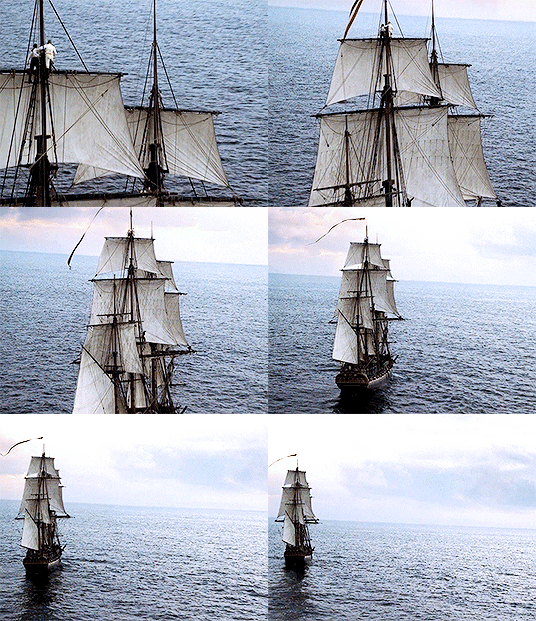
"I am not one who was born in the custody of wisdom. I am one who is fond of olden times and intense in quest of the sacred knowing of the ancients." Gustave Courbet
Showing posts with label O'Donohue. Show all posts

24 February 2025

Ancient.


In your clay body, 
things are coming to expression and to light
 that were never known before,
 presences that never came to light or shape
 in any other individual.  
To paraphrase Heidegger, who said,
 "Man is a shepherd of being," 
 we could say,  "Man is a shepherd of clay." 
 You represent an unknown world
 that begs you to bring it to voice.  

Often the joy you feel 
does not belong to your individual biography 
but to the clay out of which you are formed. 

 At other times, 
you will find sorrow moving through you, 
like a dark mist over a landscape.
  This sorrow is dark enough to paralyze you.
  It is a mistake to interfere 
with this movement of feeling.  
It is more appropriate to recognize
 that this emotion belongs more to your clay
 than to your mind.
  
It is wise to let this weather of feeling pass; 
 it is on its way elsewhere.  
We so easily forget that our clay
 has a memory that preceded our minds, 
a life of its own 
before it took its present form.   

Regardless of how modern we seem, 
we still remain ancient, 
sister and brothers of the one clay. 
 In each of us 
a different part of the mystery
 becomes luminous.  

To truly be and become yourself, 
you need the ancient radiance of others.

John O'Donohue

03 August 2024

Woven.


May you awaken to the mystery of being here
And enter the quiet immensity of your own presence.
May you have joy and peace in the temple of your senses.
May you receive great encouragement when new frontiers beckon.
May you respond to the call of your gift
And you find the courage to follow its path.
May the flame of anger free you from falsity.
May warmth of heart keep your presence aflame and anxiety never linger about you.
May your outer dignity mirror an inner dignity of soul.
May you take time to celebrate the quiet miracles that seek no attention.
May you be consoled in the secret symmetry of your soul.
May you experience each day as a sacred gift, 
Woven around the heart of wonder.

John O'Donohue

10 July 2024

Courage.


A MORNING PRAYER

I bless the night that nourished my heart
To set the ghosts of longing free
Into the flow and figure of dream
That went to harvest from the dark
Bread for the hunger no one sees.

All that is eternal in me
Welcome the wonder of this day,
The field of brightness it creates
Offering time for each thing
To arise and illuminate.

I place on the altar of dawn:
The quiet loyalty of breath,
The tent of thought where I shelter,
Wave of desire I am shore to
And all beauty drawn to the eye.

May my mind come alive today
To the invisible geography
That invites me to new frontiers,
To break the dead shell of yesterdays,
To risk being disturbed and changed.

May I have the courage today
To live the life that I would love,
To postpone my dream no longer
But do at last what I came here for
And waste my heart on fear no more.

John O'Donohue

12 June 2024

Be.


It is a strange and magical fact to be here, walking around in a body, to have a whole world within you and a world at your fingertips outside you. 

It is an immense privilege, and it is incredible that humans manage to forget the miracle of being here. 

It is uncanny how social reality can deaden and numb us so that the mystical wonder of our lives goes totally unnoticed. We are here. We are wildly and dangerously free.

John O'Donohue

29 May 2024

Receiver.


We do have a deadening desire to reduce the mystery, the uncertainty of our lives…. 
We bind our lives in solid chains of forced connections that block and fixate us. …. 
Our sense of uncertainty and our need for security nail our world down. …. 
 
Each time we go out, the world is open and free;
 it offers itself so graciously to our hearts, to create something new and wholesome
 from it each day. It is a travesty of possibility and freedom to think
 we have no choice, that things are the way they are and that the one street,
 the one right way is all that is allotted to us. 
Certainty is a subtle destroyer.

We confine our mystery within the prison of routine and repetition. 
One of the most deadening forces of all is repetition. 
Your response to the invitation and edge of your life becomes reduced 
to a series of automatic reflexes. For example, you are so used to getting up
 in the morning and observing the morning rituals of washing and dressing.
 You are still somewhat sleepy, your mind is thinking of things you have to do
 in the day that lies ahead. You go through these first gestures of the morning
 often without even noticing that you are doing them. This is a disturbing
 little image, because it suggests that you live so much of your one life
with the same automatic blindness of adaptation.

… Habit is a strong invisible prison.
 Habits are styles of feeling, perception, 
or action that have now become second nature to us.
 A habit is a sure cell of predictability; it can close you off from the unknown,
 the new, and the unexpected. You were sent to the earth to become a receiver
 of the unknown. From ancient times, these gifts were prepared for you; 
now they come towards you across eternal distances. 
Their destination is the altar of your heart. 

John O’Donohue

14 November 2023

Arrival.


When near the end of day, life has drained
Out of light, and it is too soon
For the mind of night to have darkened things,

No place looks like itself, loss of outline
Makes everything look strangely in-between,
Unsure of what has been, or what might come.

In this wan light, even trees seem groundless.
In a while it will be night, but nothing
Here seems to believe the relief of darkness.

You are in this time of the interim
Where everything seems withheld.

The path you took to get here has washed out;
The way forward is still concealed from you.

The old is not old enough to have died away;
The new is still too young to be born.”

You cannot lay claim to anything;
In this place of dusk,
Your eyes are blurred;
And there is no mirror.

Everyone else has lost sight of your heart
And you can see nowhere to put your trust;
You know you have to make your own way through.

As far as you can, hold your confidence.
Do not allow confusion to squander
This call which is loosening
Your roots in false ground,
That you might come free
From all you have outgrown.

What is being transfigured here in your mind,
And it is difficult and slow to become new.
The more faithfully you can endure here,
The more refined your heart will become
For your arrival in the new dawn.

John O’Donohue

01 May 2023

Anchorage.

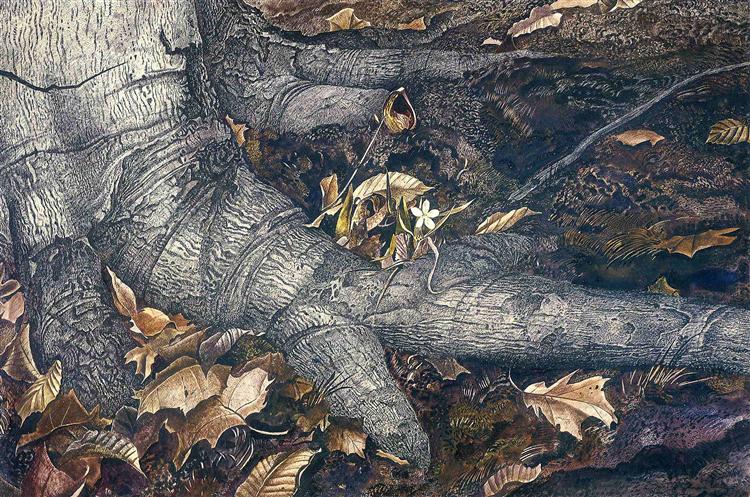
 Wyeth, Spring Beauty, 1943


In prayer, we come nearest to making a real clearance in the thicket of thought.  
Prayer takes thought to a place of stillness.
Prayer slows the flow of the mind until we can begin to see with a new tranquility. 
In this kind of thought, we become conscious of our divine belonging.
We begin to sense the serenity of this clearing.

We learn that regardless of the fragmentation and turbulence 
in so many regions of our lives, there is a place in the soul 
where the voices and prodding of the world never reach.

It is almost like the image of the tree.  The branches can sway and quiver in the wind,
the center of the tree, there pertains the stillness of its anchorage. 
In prayer, thought returns to its origin in the infinite.  
Attuned to its origin, thought reaches below its own netting. 

In this way prayer liberates thought from the small rooms where fear and need confine it. 
Despite all the negative talk about God, the Divine still remains
the one space where thought can become free. 

There we will be liberated from the repetitive echoes of our own smallness and blindness.
Prayer is the path to the secret belonging at the heart of our other lives.

John O'Donohue

09 April 2023

Light.

Veronese, The Resurrection of Christ, 1570


No one knew the name of this day;
Born quietly from deepest night,
It hid its face in light,
Demanded nothing for itself,
Opened out to offer each of us
A field of brightness that traveled ahead,
Providing in time, ground to hold our footsteps
And the light of thought to show the way.

The mind of the day draws no attention;
It dwells within the silence with elegance
To create a space for all our words,
Drawing us to listen inward and outward.

We seldom notice how each day is a holy place
Where the eucharist of the ordinary happens,
Transforming our broken fragments
Into an eternal continuity that keeps us.

Somewhere in us a dignity presides
That is more gracious than the smallness
That fuels us with fear and force,
A dignity that trusts the form a day takes.

So at the end of this day, we give thanks
For being betrothed to the unknown
And for the secret work
Through which the mind of the day
And wisdom of the soul become one.

John O'Donohue

09 June 2022

Trust.


THRESHOLDS

Within the grip of winter, it is almost impossible to imagine the spring. The gray perished landscape is shorn of color. Only bleakness meets the eye; everything seems severe and edged. Winter is the oldest season; it has some quality of the absolute. Yet beneath the surface of winter, the miracle of spring is already in preparation; the cold is relenting; seeds are wakening up. Colors are beginning to imagine how they will return. Then, imperceptibly, somewhere one bud opens and the symphony of renewal is no longer reversible. From the black heart of winter a miraculous, breathing plenitude of color emerges.

The beauty of nature insists on taking its time. Everything is prepared. Nothing is rushed. The rhythm of emergence is a gradual slow beat always inching its way forward; change remains faithful to itself until the new unfolds in the full confidence of true arrival. Because nothing is abrupt, the beginning of spring nearly always catches us unawares. It is there before we see it; and then we can look nowhere without seeing it.

Change arrives in nature when time has ripened. There are no jagged transitions or crude discontinuities. This accounts for the sureness with which one season succeeds another. It is as though they were moving forward in a rhythm set from within a continuum.

To change is one of the great dreams of every heart – to change the limitations, the sameness, the banality, or the pain. So often we look back on patterns of behavior, the kind of decisions we make repeatedly and that have failed to serve us well, and we aim for a new and more successful path or way of living. But change is difficult for us. So often we opt to continue the old pattern, rather than risking the danger of difference. We are also often surprised by change that seems to arrive out of nowhere.

We find ourselves crossing some new threshold we had never anticipated. Like spring secretly at work within the heart of winter, below the surface of our lives huge changes are in fermentation. We never suspect a thing. Then when the grip of some long-enduring winter mentality begins to loosen, we find ourselves vulnerable to a flourish of possibility and we are suddenly negotiating the challenge of a threshold.

At any time you can ask yourself: At which threshold am I now standing? At this time in my life, what am I leaving? Where am I about to enter? What is preventing me from crossing my next threshold? What gift would enable me to do it? A threshold is not a simple boundary; it is a frontier that divides two different territories, rhythms and atmospheres. Indeed, it is a lovely testimony to the fullness and integrity of an experience or a stage of life that it intensifies toward the end into a real frontier that cannot be crossed without the heart being passionately engaged and woken up. At this threshold a great complexity of emotions comes alive: confusion, fear, excitement, sadness, hope. This is one of the reasons such vital crossing were always clothed in ritual. It is wise in your own life to be able to recognize and acknowledge the key thresholds; to take your time; to feel all the varieties of presence that accrue there; to listen inward with complete attention until you hear the inner voice calling you forward. The time has come to cross.

To acknowledge and cross a new threshold is always a challenge. It demands courage and also a sense of trust in whatever is emerging. This becomes essential when a threshold opens suddenly in front of you, one for which you had no preparation. This could be illness, suffering or loss. Because we are so engaged with the world, we usually forget how fragile life can be and how vulnerable we always are. It takes only a couple of seconds for a life to change irreversibly. Suddenly you stand on completely strange ground and a new course of life has to be embraced. Especially at such times we desperately need blessing and protection. You look back at the life you have lived up to a few hours before, and it suddenly seems so far away. Think for a moment how, across the world, someone’s life has just changed – irrevocably, permanently, and not necessarily for the better – and everything that was once so steady, so reliable, must now find a new way of unfolding.

Though we know one another’s names and recognize one another’s faces, we never know what destiny shapes each life. The script of individual destiny is secret; it is hidden behind and beneath the sequence of happenings that is continually unfolding for us. Each life is a mystery that is never finally available to the mind’s light or questions. That we are here is a huge affirmation; somehow life needed us and wanted us to be. To sense and trust this primeval acceptance can open a vast spring of trust within the heart. It can free us into a natural courage that casts out fear and opens up our lives to become voyages of discovery, creativity, and compassion. No threshold need be a threat, but rather an invitation and a promise.

Whatever comes, the great sacrament of life will remain faithful to us, blessing us always with visible signs of invisible grace. We merely need to trust.

John O'Donohue

09 March 2022

Baptized.

Poortvliet, Fox, n/d


Nearer to the earth's heart,
Deeper within its silence:
Animals know this world
In a way we never will.

We who are ever
Distanced and distracted
By the parade of bright
Windows thought opens:
Their seamless presence
Is not fractured thus.

Stranded between time
Gone and time emerging,
We manage seldom
To be where we are:
Whereas they are always
Looking out from
The here and now.

May we learn to return
And rest in the beauty
Of animal being,
Learn to lean low,
Leave our locked minds,
And with freed senses
Feel the earth
Breathing with us.

May we enter
Into lightness of spirit,
And slip frequently into
The feel of the wild.

Let the clear silence
Of our animal being
Cleanse our hearts
Of corrosive words.

May we learn to walk
Upon the earth
With all their confidence
And clear-eyed stillness
So that our minds
Might be baptized
In the name of the wind
And light and the rain.

John O'Donohue

12 December 2021

Contour.


On Being
's Krista Tippett discusses "the invisible world" with John O'Donohue ...
Ms. Tippett: I know that “landscape” is a really pivotal word for you that you use, not just in describing the natural world, but an important word in talking about how human beings know themselves and move through the world. I haven’t been to precisely the place you’re from, but I think the west coast of Scotland, the west coast of Ireland, it is this completely unusual, this wild, raw, bleak beauty. But talk to me about how you have come to understand landscape as something that forms each of us. 
Mr. O’Donohue: Well, I think it makes a huge difference, when you wake in the morning and come out of your house, whether you believe you are walking into dead geographical location, which is used to get to a destination, or whether you are emerging out into a landscape that is just as much, if not more, alive as you, but in a totally different form, and if you go towards it with an open heart and a real, watchful reverence, that you will be absolutely amazed at what it will reveal to you.

And I think that that was one of the recognitions of the Celtic imagination — that landscape wasn’t just matter, but that it was actually alive. What amazes me about landscape — landscape recalls you into a mindful mode of stillness, solitude, and silence, where you can truly receive time.

Ms. Tippett: Are you just talking, though, about landscape as the natural world around us? I’ll tell you, I remember a summer I spent, a few years after I had first gone to this beautiful, raw, wild edge of Scotland, and I was working with children in a very impoverished inner-city neighborhood. And I would often wish that I could just transport them for an hour so that what they saw when they opened their eyes and looked around them was that kind of beauty that opens so much possibility. So I wonder how this Celtic sensibility would also speak to people who don’t have that kind of beauty at hand — that kind of beauty.

Mr. O’Donohue: Yeah, I do agree with you that an awful lot of urban planning, particularly in poor areas, has doubly impoverished the poor by the ugliness which surrounds them. And it’s understandable that it’s so difficult to reach and sustain gentleness there. And I do think — like a friend of mine just in the last week, who was absolutely exhausted in London, just came away down to southern England and spent the week by the slow ocean, and she’s totally recovered. She’s come back to herself.

But I do think, though, that it’s not just a matter of the outer presence of the landscape. I mean the dawn goes up, and the twilight comes, even in the most roughest inner-city place. And I think that connecting to the elemental can be a way of coming into rhythm with the universe. And I do think that there is a way in which the outer presence, even through memory or imagination, can be brought inward as a sustaining thing.

I mean I think that — and it’s the question of beauty, I mean you’re asking, essentially — as we are speaking, that there are individuals holding out on frontlines, holding the humane tissue alive in areas of ultimate barbarity, where things are visible that the human eye should never see. And they’re able to sustain it, because there is, in them, some kind of sense of beauty that knows the horizon that we are really called to in some way. I love Pascal’s phrase, that you should always keep something beautiful in your mind. And I have often — like in times when it’s been really difficult for me, if you can keep some kind of little contour that you can glimpse sideways at, now and again, you can endure great bleakness.

CONNECT 

O'Donohue's site is HERE.

11 December 2021

Mind.


On the day when
the weight deadens
on your shoulders
and you stumble,
may the clay dance
to balance you.

And when your eyes
freeze behind
the grey window
and the ghost of loss
gets into you,
may a flock of colours,
indigo, red, green
and azure blue,
come to awaken in you
a meadow of delight.

When the canvas frays
in the currach of thought
and a stain of ocean
blackens beneath you,
may there come across the waters
a path of yellow moonlight
to bring you safely home.

May the nourishment of the earth be yours,
may the clarity of light be yours,
may the fluency of the ocean be yours,
may the protection of the ancestors be yours.

And so may a slow
wind work these words
of love around you,
an invisible cloak
to mind your life.

John O'Donohue

09 December 2021

Realize.


Wonder, as the child of mystery, is a natural source of prayer.  
One of the most beautiful forms of prayer is the prayer of appreciation.
  This prayer arises out of the recognition of the gracious kindness of creation.
  We have been given so much.  We could never have merited or earned it.
  When you appreciate all you are and all you have, 
you can celebrate and enjoy it. 

 You realize how fortunate you are. 
 Providence is blessing you and inviting you to be generous with your gifts.
  You are able to bless life and give thanks to God. 
 The prayer of appreciation has no agenda but gracious thanks.
  Nothing is given to you for yourself alone.  
When you receive some blessing or gift, 
you do it in the name of others;
 through you, they, too, will come to share
 in the kindness of Providence.

John O'Donohue

17 March 2020

Contributes.


No one else has access to the world you carry around within yourself; you are its custodian and entrance. No one else can see the world the way you see it. No one else can feel your life the way you feel it. Thus it is impossible to ever compare two people because each stands on such different ground. When you compare yourself to others, you are inviting envy into your consciousness; it can be a dangerous and destructive guest. If you try to avoid or remove this awkward quality, it will pursue you. The only effective way to still its unease is to transfigure it, to let it become something creative and positive that contributes to who you are.

Nietzsche said that one of the best days in his life was the day when he rebaptized all his negative qualities as his best qualities. Rather than banishing what is at first glimpse unwelcome, you bring it home to unity with your life. One of your sacred duties is to exercise kindness toward them. In a sense, you are called to be a loving parent to your delinquent qualities.

John O'Donohue

13 March 2020

Floods.


Because the heart dwells in unattended dark, we often forget its sensitivity to everything that is happening to us. Without our ever noticing, the heart absorbs the joy of things and also their pain and care. Within us, therefore, a burdening can accrue. For this reason it is wise now and again to tune in to your heart and listen for what it carries. Sometimes the simplest things affect unexpected transformation. The old people here used to say that a burden shared is a burden halved. Similarly, when you allow your heart to speak, the burdens it carries diminish, a new lightness enters your body, and relief floods the heart.

John O’Donohue

04 November 2019

Solitude.


When you decide to practice inner hospitality, the self-torment ceases.
The abandoned, neglected, and negative selves come into a seamless unity.
The soul is wise and subtle it recognizes that unity fosters belonging.
The soul adores unity. What you separate, the soul joins.

As your experience extends and deepens,
your memory becomes richer and more complex.
Your soul is the priestess of memory, selecting, sifting,
and ultimately gathering your vanishing days toward presence.

This liturgy of remembrance, literally re-membering,
is always at work within you.
Human solitude is rich and endlessly creative.

John O'Donohue

02 November 2019

Do.

Kitajgorod, between, 2019


A MORNING POEM

I bless the night that nourished my heart
To set the ghosts of longing free
Into the flow and figure of dream
That went to harvest from the dark
Bread for the hunger no one sees.

All that is eternal in me
Welcome the wonder of this day,
The field of brightness it creates
Offering time for each thing
To arise and illuminate.

I place on the altar of dawn:
The quiet loyalty of breath,
The tent of thought where I shelter,
Wave of desire I am shore to
And all beauty drawn to the eye.

May my mind come alive today
To the invisible geography
That invites me to new frontiers,
To break the dead shell of yesterdays,
To risk being disturbed and changed.

May I have the courage today
To live the life that I would love,
To postpone my dream no longer
But do at last what I came here for
And waste my heart on fear no more.

John O'Donohue

13 September 2019

Realize.


Wonder, as the child of mystery, is a natural source of prayer.  
One of the most beautiful forms of prayer is the prayer of appreciation.
This prayer arises out of the recognition of the gracious kindness of creation.
We have been given so much.  We could never have merited or earned it.
When you appreciate all you are and all you have, 
You can celebrate and enjoy it. 

You realize how fortunate you are. 
Providence is blessing you and inviting you to be generous with your gifts.
You are able to bless life and give thanks to God. 
The prayer of appreciation has no agenda but gracious thanks.
Nothing is given to you for yourself alone.  
When you receive some blessing or gift,
You do it in the name of others;
Through you, they, too, will come to share
In the kindness of Providence.

John O'Donohue

27 September 2018

One.

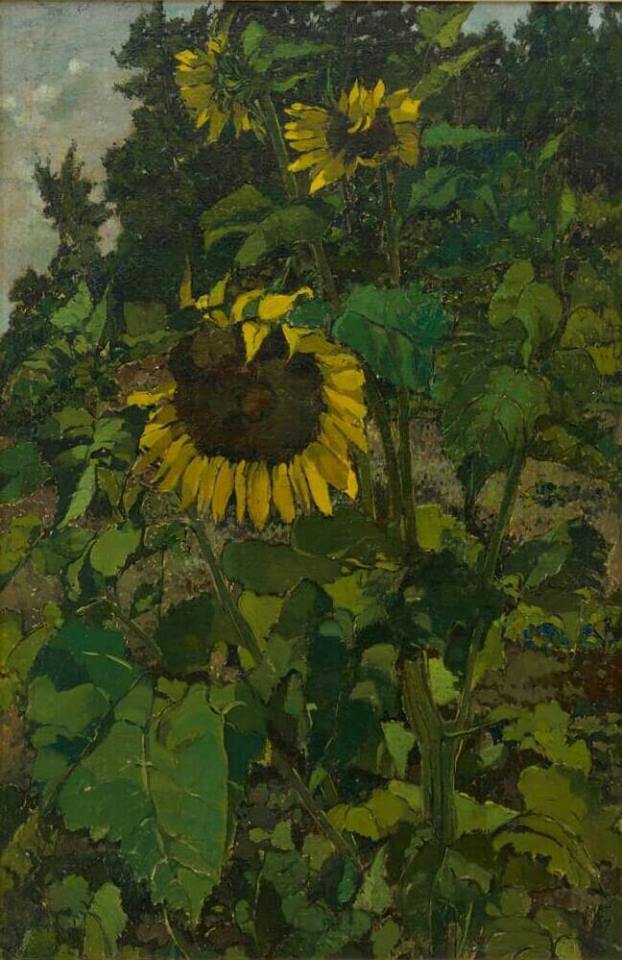
Ket, Sunflowers in the Garden, 1927


No one knew the name of this day;
Born quietly from deepest night,
It hid its face in light,
Demanded nothing for itself,
Opened out to offer each of us
A field of brightness that traveled ahead,
Providing in time, ground to hold our footsteps
And the light of thought to show the way.

The mind of the day draws no attention;
It dwells within the silence with elegance
To create a space for all our words,
Drawing us to listen inward and outward.

We seldom notice how each day is a holy place
Where the eucharist of the ordinary happens,
Transforming our broken fragments
Into an eternal continuity that keeps us.

Somewhere in us a dignity presides
That is more gracious than the smallness
That fuels us with fear and force,
A dignity that trusts the form a day takes.

So at the end of this day, we give thanks
For being betrothed to the unknown
And for the secret work
Through which the mind of the day
And wisdom of the soul become one.

John O’Donohue

30 May 2018

Presence.

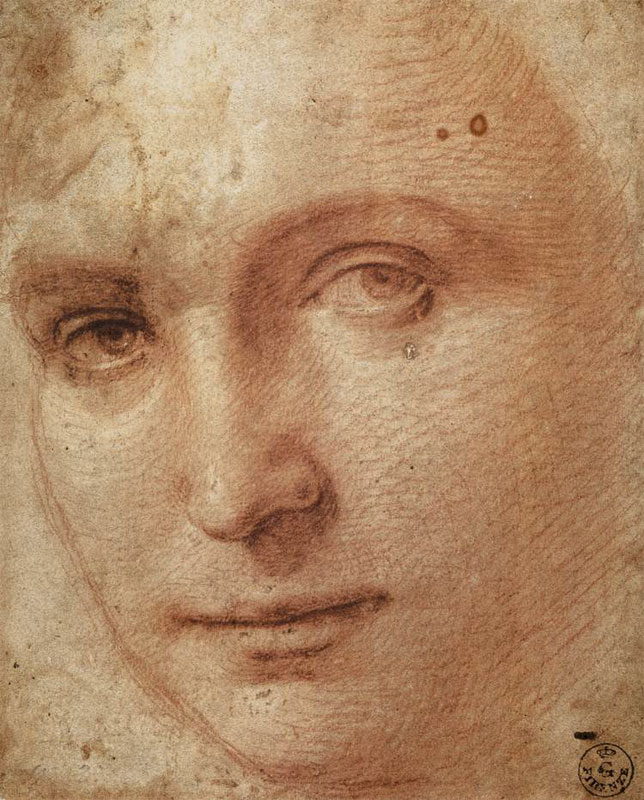
Raphael, Study of a Face, 1509


The days and nights a person has lived seep into their presence in the countenance. It is interesting that the Latin root of the word face is “facies,” meaning the shape or form of the head, which is derived from the verb “facere,” which means “to make.” This background confirms the artistic and active force of the face. Neither a surface nor a cover, the face is a doorway to the soul. When you gaze into someone’s face, a pathway opens, resonant with [a] life and memory. You glimpse what life has made or unmade, woven or unravelled in that life. Each face fronts a different world. The philosopher Maurice Merleau-Ponty, “My body is the awareness of the gaze of the other.” We are animated though the presence of the other. Every face is a window outwards and inwards on a unique life. Of course, in dance and in theatrical activity, the whole body becomes expressive. Because others can see us, our lives never remain merely ours alone. The openness of the face shows that we participate in the lives of others. Presence to each other is the door to all belonging. And nowhere in the universe is longing so powerfully present as in the human countenance.
John O'Donohue