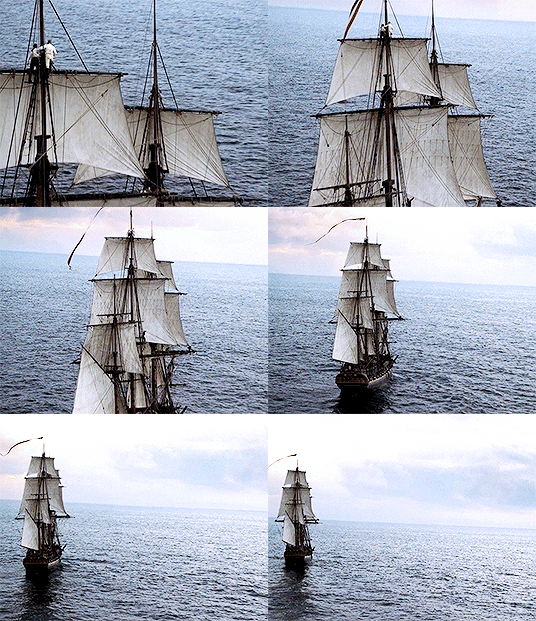
"I am not one who was born in the custody of wisdom. I am one who is fond of olden times and intense in quest of the sacred knowing of the ancients." Gustave Courbet
Showing posts with label Melville. Show all posts

18 July 2026

Back.

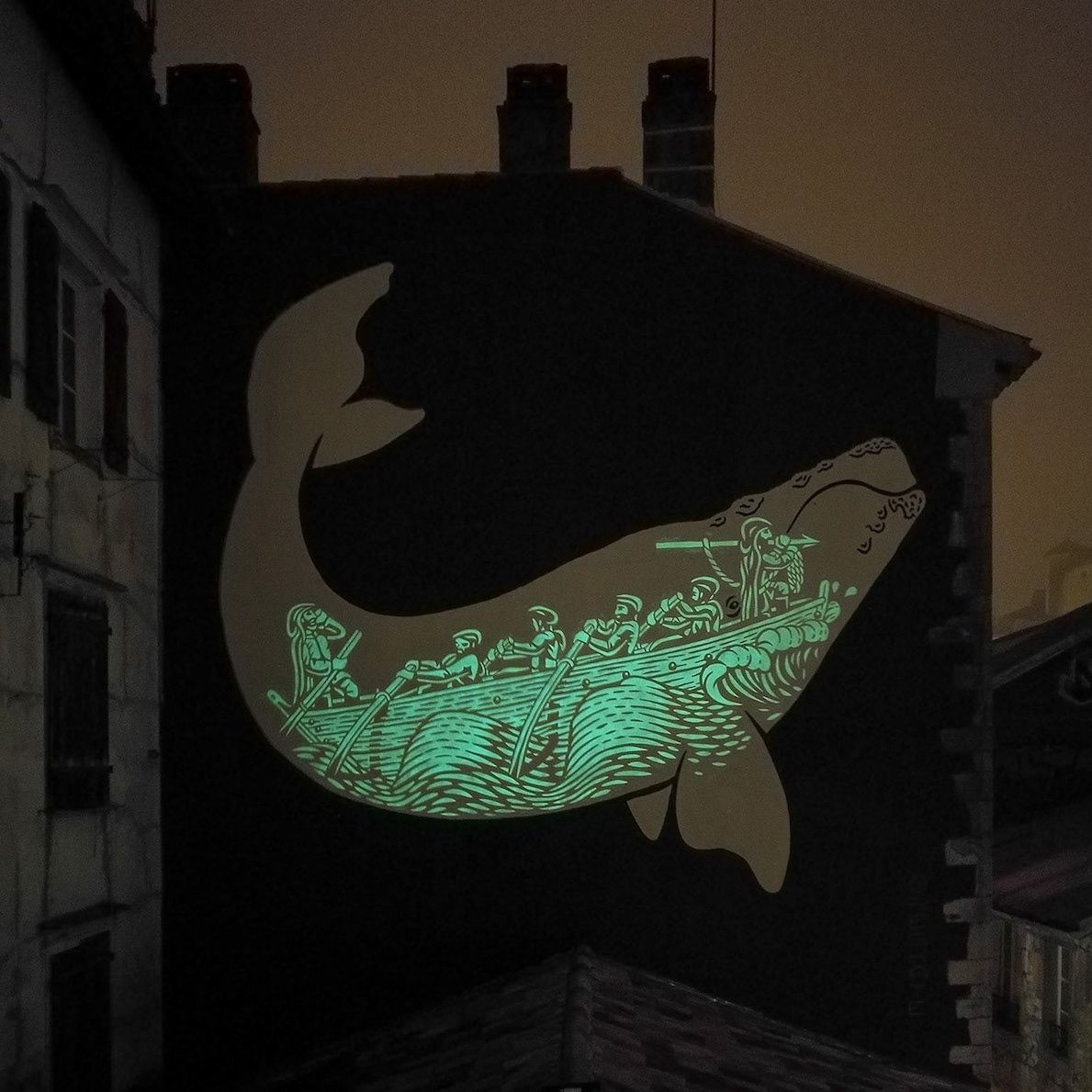
Think of artificial intelligence as the "clear fire" as Professor Bloom reads from Chapter 119 of Moby-Dick, "The Candles" ...
Oh! thou clear spirit of clear fire, whom on these seas I as Persian once did worship, till in the sacramental act so burned by thee, that to this hour I bear the scar; I now know thee, thou clear spirit, and I now know that thy right worship is defiance. To neither love nor reverence wilt thou be kind; and e'en for hate thou canst but kill; and all are killed. No fearless fool now fronts thee. I own thy speechless, placeless power; but to the last gasp of my earthquake life will dispute its unconditional, unintegral mastery in me. In the midst of the personified impersonal, a personality stands here. Though but a point at best; whencesoe'er I came; wheresoe'er I go; yet while I earthly live, the queenly personality lives in me, and feels her royal rights. But war is pain, and hate is woe. Come in thy lowest form of love, and I will kneel and kiss thee; but at thy highest, come as mere supernal power; and though thou launchest navies of full-freighted worlds, there's that in here that still remains indifferent. Oh, thou clear spirit, of thy fire thou madest me, and like a true child of fire, I breathe it back to thee.

AI will never be skeptical, it's programmed job is to satisfy you, validate you, make you feel "smart" (whatever that means) for ultimately doing nothing -- more symbolism over substance.  

YOU must be the skeptic and breathe the clear fire back into the mouth of its fakery.

08 March 2026

Telling.

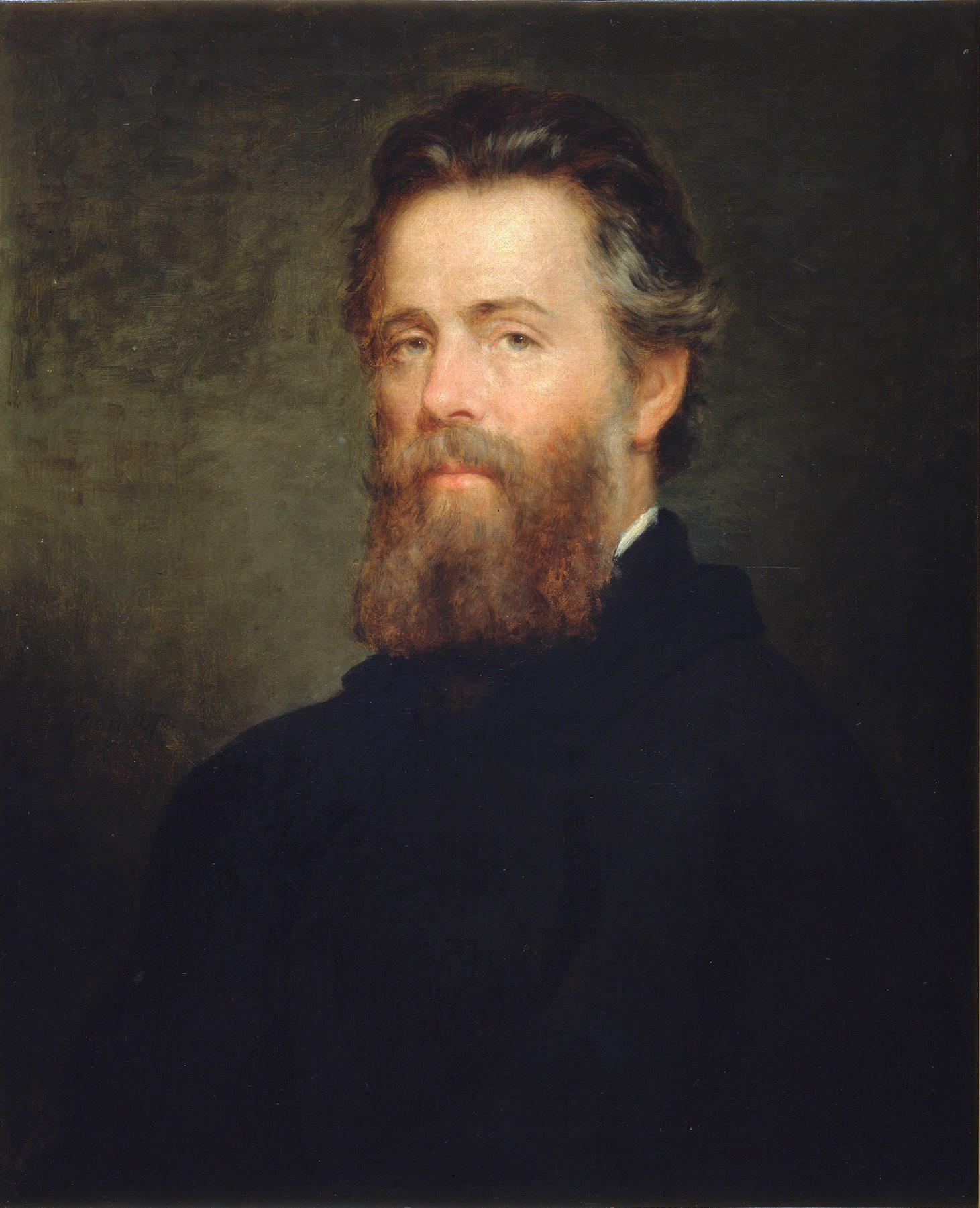
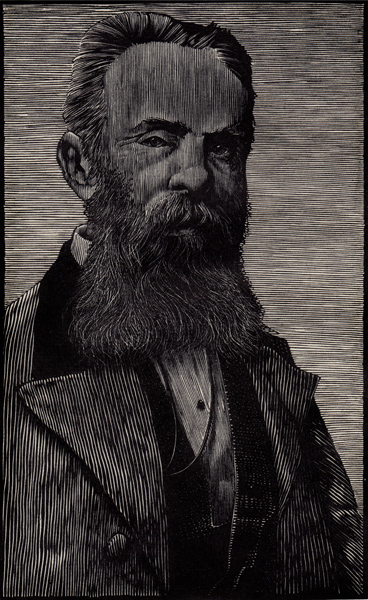
Rockwood, Herman Melville, 1885


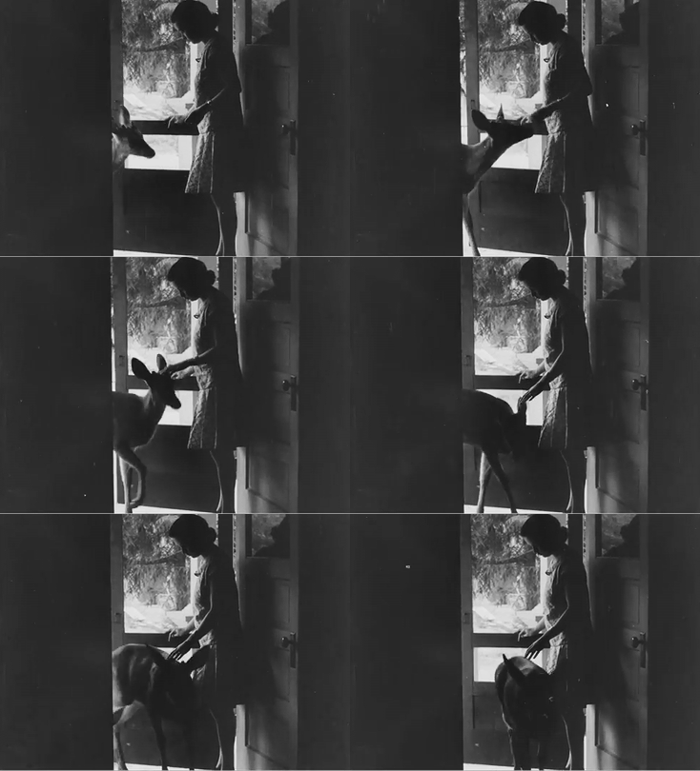
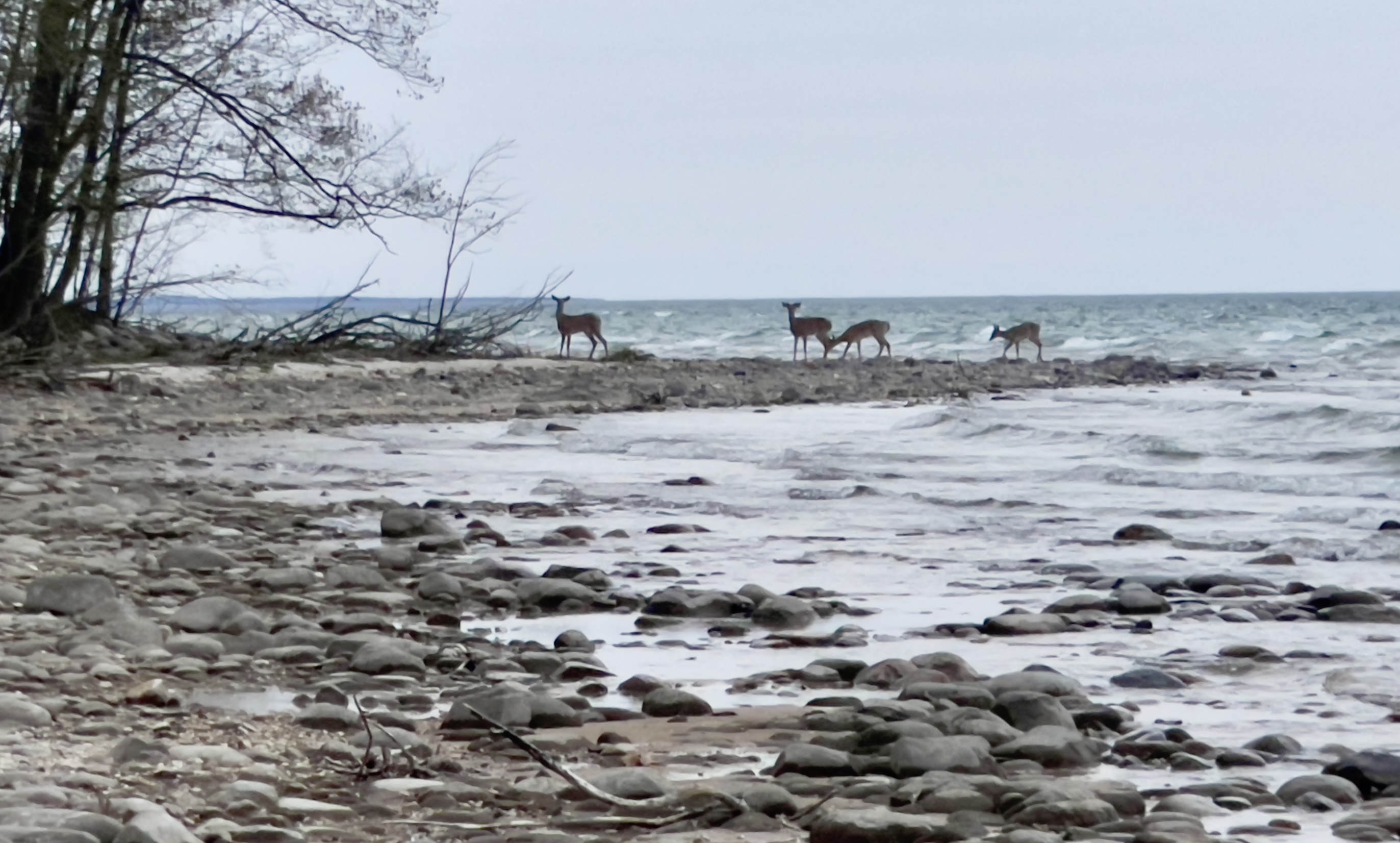
For in this world of lies, Truth is forced to fly like a scared white doe in the woodlands; and only by cunning glimpses will she reveal herself, as in Shakespeare and other masters of the Great Art of Telling the Truth,—even though it be covertly, and by snatches.

Herman Melville, from "Hawthorne and His Mosses"

14 November 2025

Arises.


“I will have no man in my boat," said Starbuck, "who is not afraid of a whale."


By this, he seemed to mean, not only that the most reliable and useful courage was that which arises from the fair estimation of the encountered peril, ...


 ... but that an utterly fearless man is a far more dangerous comrade than a coward.

Hrman Melville, from Moby-Dick

Published.


It is not down on any map; true places never are.

Herman Melville from Moby-Dick, or The Whale, published on this day in 1851.

Dr. Jamie Jones presents an outstanding talk entitled, Nostalgia for the Wooden World:  Rockwell Kent's Moby-Dick ...

02 November 2025

Choose.


"Would you tell me, please, which way I ought to go from here?"
"That depends a good deal on where you want to get to," said the Cat.
"I don't much care where -" said Alice.
"Then it doesn't matter which way you go," said the Cat.
"- so long as I get SOMEWHERE," Alice added as an explanation.
"Oh, you're sure to do that," said the Cat, "if you only walk long enough.”

Lewis Carroll, from Alice in Wonderland

If you mishandle a firearm, you could hurt yourself.  How are the expectations of any smart device different?

The word "addiction" comes from the Latin addicere, meaning to give over, to sacrifice, or devote.   

If you're struggling with devices, don't give yourself, your choices, and your precious time over to them.  It's not the device's fault. 

Choose to be more and more curious.  Choose not to click the ad, choose not to become a statistic in the algorithm, choose to put it down.

Choose to live a life astounded by the unexpected.

01 July 2025

Warrior-Monument.

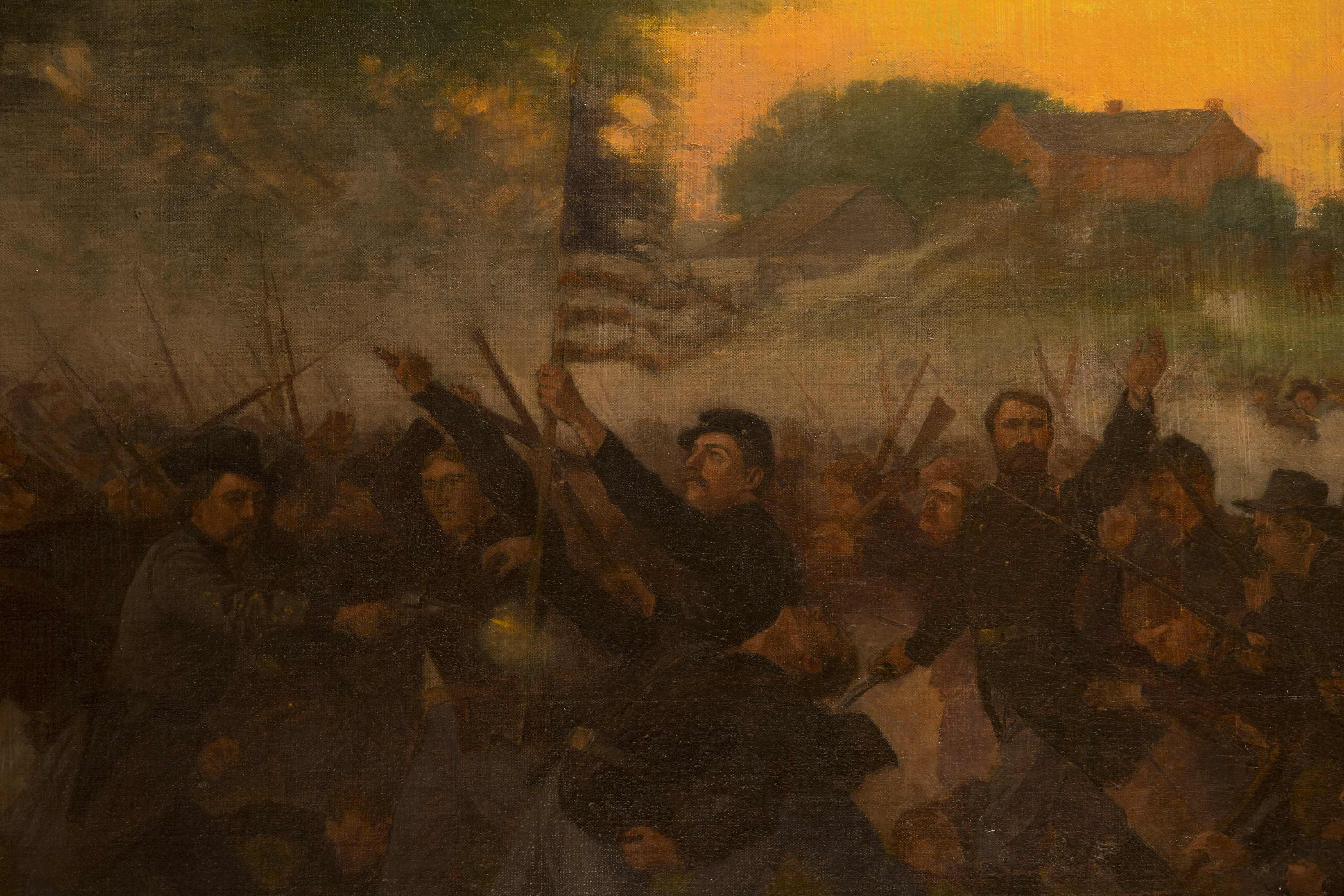
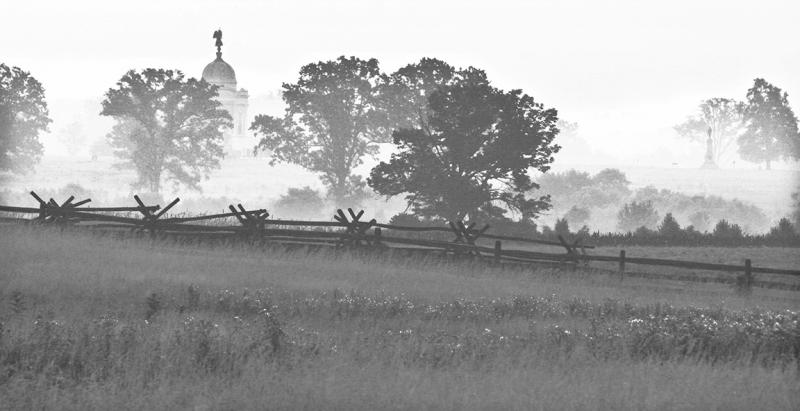
Wheeler,  1st Minnesota Infantry Regiment at the Battle of Gettysburg, n/d


GETTYSBURG

O Pride of the days in prime of the months
  Now trebled in great renown,
When before the ark of our holy cause
Fell Dagon down-
Dagon foredoomed, who, armed and targed,
Never his impious heart enlarged
Beyond that hour; God walled his power,
And there the last invader charged.

He charged, and in that charge condensed
  His all of hate and all of fire;
He sought to blast us in his scorn,
And wither us in his ire.
Before him went the shriek of shells-
Aerial screamings, taunts and yells;
Then the three waves in flashed advance
  Surged, but were met, and back they set:
Pride was repelled by sterner pride,
  And Right is a strong-hold yet.

Before our lines it seemed a beach
  Which wild September gales have strown
With havoc on wreck, and dashed therewith
Pale crews unknown-
Men, arms, and steeds. The evening sun
Died on the face of each lifeless one,
And died along the winding marge of fight
And searching-parties lone.

Sloped on the hill the mounds were green,
  Our centre held that place of graves,
And some still hold it in their swoon,
  And over these a glory waves.
The warrior-monument, crashed in fight,
Shall soar transfigured in loftier light,
A meaning ampler bear;
Soldier and priest with hymn and prayer
Have laid the stone, and every bone
Shall rest in honor there.

Herman Melville

01 August 2024

Happy Birthday, Melville

Eaton, Herman Melville, 1870


There is a wisdom that is woe; but there is a woe that is madness. And there is a Catskill eagle in some souls that can alike dive down into the blackest gorges, and soar out of them again and become invisible in the sunny spaces. And even if he for ever flies within the gorge, that gorge is in the mountains; so that even in his lowest swoop the mountain eagle is still higher than other birds upon the plain, even though they soar.

Herman Melville, born on this day in 1819, from Moby-Dick, or The Whale

21 June 2024

Happy Birthday, Kent

Kent, Frontispiece from the Lakeside Press publication on Moby-Dick, 1930


All things look good from far away and it is man's eternally persistent childlike faith in the reality of that illusion that has made him the triumphant restless being he is.

Rockwell Kent, born on this day in 1882, from Voyaging: Southward from the Strait of Magellan

07 June 2024

Transition.

Kent, Queequeg, 1930


But Queequeg, do you see, was a creature in the transition stage—neither caterpillar nor butterfly. He was just enough civilized to show off his outlandishness in the strangest possible manners. His education was not yet completed. He was an undergraduate. If he had not been a small degree civilized, he very probably would not have troubled himself with boots at all; but then, if he had not been still a savage, he never would have dreamt of getting under the bed to put them on. At last, he emerged with his hat very much dented and crushed down over his eyes, and began creaking and limping about the room, as if, not being much accustomed to boots, his pair of damp, wrinkled cowhide ones—probably not made to order either—rather pinched and tormented him at the first go off of a bitter cold morning.

Herman Melville, from Moby-Dick, or The Whale

24 January 2024

Enriched.


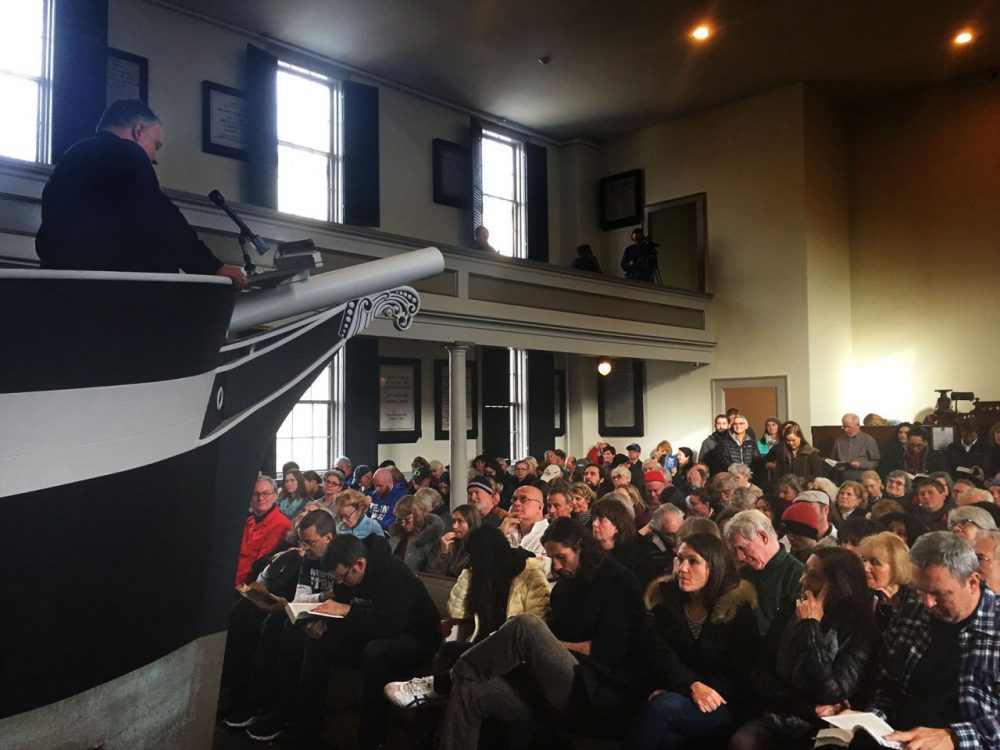
 A 24-hour marathon reading of Moby-Dick at the New Bedford Whaling Museum ...
“The marathon is a way to read the book with more structure and purpose,” said Dotson, who was taking the opportunity to explore Moby-Dick for the first time since he left school.
“To really get immersed in it.”

You heard that refrain in every corner of the New Bedford Whaling Museum: Moby-Dick is spectacular, hilarious, misunderstood, sonorous, and psychedelic. You will be enriched as a person by experiencing it, and you must ignore those who gripe about its quirks. This is where I must admit that I, too, have never read Moby-Dick, so I can say with confidence that if you are the least bit curious about the book, and require a gentle push to take the dive, then nothing will convince you more of its majesty than to sit on the deck of the Lagoda—amid a panorama of oceanic bric-a-brac and reclaimed nautical artifacts—watching the Nation of Melville burst into hysterics.

23 January 2024

Memories.

Agge, On the Yardarm of the Viking, 1920


Wonderfullest things are ever the unmentionable; deep memories yield no epitaphs.

Herman Melville, from Moby-Dick

22 March 2023

Enchanting.


The HAGLETS

By chapel bare, with walls sea-beat,
The lichened urns in wilds are lost
About a carved memorial stone
That shows, decayed and coral-mossed,
A form recumbent, swords at feet,
Trophies at head, and kelp for a winding-sheet.

I invoke thy ghost, neglected fane,
Washed by the waters’ long lament;
I adjure the recumbent effigy
To tell the cenotaph’s intent—
Reveal why fagotted swords are at feet,
Why trophies appear and weeds are the winding-sheet.

–––––––

By open ports the Admiral sits,
And shares repose with guns that tell
Of power that smote the arm’d Plate Fleet
Whose sinking flag-ship’s colors fell;
But over the Admiral floats in light
His squadron’s flag, the red-cross Flag of the White.
   The eddying waters whirl astern,
The prow, a seedsman, sows the spray;
With bellying sails and buckling spars
The black hull leaves a Milky Way;
Her timbers thrill, her batteries roll,
She revelling speeds exulting with pennon at pole,
   But ah, for standards captive trailed
For all their scutcheoned castles’ pride—
Castilian towers that dominate Spain,
Naples, and either Ind beside;
Those haughty towers, armorial ones,
Rue the salute from the Admiral’s dens of guns.

Ensigns and arms in trophy brave,
Braver for many a rent and scar,
The captor’s naval hall bedeck,
Spoil that insures an earldom’s star—
Toledoes great, grand draperies, too,
Spain’s steel and silk, and splendors from Peru.
   But crippled part in splintering fight,
The vanquished flying the victor’s flags,
With prize-crews, under convoy-guns,
Heavy the fleet from Opher drags—
The Admiral crowding sail ahead,
Foremost with news who foremost in conflict sped.
   But out from cloistral gallery dim,
In early night his glance is thrown;
He marks the vague reserve of heaven,
He feels the touch of ocean lone;
Then turns, in frame part undermined,
Nor notes the shadowing wings that fan behind.

There, peaked and gray, three haglets fly,
And follow, follow fast in wake
Where slides the cabin-lustre shy,
And sharks from man a glamour take,
Seething along the line of light
In lane that endless rules the war-ship’s flight.
    The sea-fowl here, whose hearts none know,
They followed late the flag-ship quelled,
(As now the victor one) and long
Above her gurgling grave, shrill held
With screams their wheeling rites—then sped
Direct in silence where the victor led.
    Now winds less fleet, but fairer, blow,
A ripple laps the coppered side,
While phosphor sparks make ocean gleam,
Like camps lit up in triumph wide;
With lights and tinkling cymbals meet
Acclaiming seas the advancing conqueror greet.

But who a flattering tide may trust,
Or favoring breeze, or aught in end?—
Careening under startling blasts
The sheeted towers of sails impend;
While, gathering bale, behind is bred
A livid storm-bow, like a rainbow dead.
    At trumpet-call the topmen spring;
And, urged by after-call in stress,
Yet other tribes of tars ascend
The rigging’s howling wilderness;
But ere yard-ends alert they win,
Hell rules in heaven with hurricane-fire and din.
    The spars, athwart at spiry height,
Like quaking Lima’s crosses rock;
Like bees the clustering sailors cling
Against the shrouds, or take the shock
Flat on the swept yard-arms aslant,
Dipped like the wheeling condor’s pinions gaunt.

A lull! and tongues of languid flame
Lick every boom, and lambent show
Electric ’gainst each face aloft;
The herds of clouds with bellowings go:
The black ship rears—beset—harassed,
Then plunges far with luminous antlers vast.
    In trim betimes they turn from land,
Some shivered sails and spars they stow;
One watch, dismissed, they troll the can,
While loud the billow thumps the bow—
Vies with the fist that smites the board,
Obstreperous at each reveller’s jovial word.
    Of royal oak by storms confirmed,
The tested hull her lineage shows:
Vainly the plungings whelm her prow—
She rallies, rears, she sturdier grows:
Each shot-hole plugged, each storm-sail home,
With batteries housed she rams the watery dome.

Dim seen adrift through driving scud,
The wan moon shows in plight forlorn;
Then, pinched in visage, fades and fades
Like to the faces drowned at morn,
When deeps engulfed the flag-ship’s crew,
And, shrilling round, the inscrutable haglets flew.
    And still they fly, nor now they cry,
But constant fan a second wake,
Unflagging pinions ply and ply,
Abreast their course intent they take;
Their silence marks a stable mood,
They patient keep their eager neighborhood.
    Plumed with a smoke, a confluent sea,
Heaved in a combing pyramid full,
Spent at its climax, in collapse
Down headlong thundering stuns the hull:
The trophy drops; but, reared again,
Shows Mars’ high-altar and contemns the main.

Rebuilt it stands, the brag of arms,
Transferred in site—no thought of where
The sensitive needle keeps its place,
And starts, disturbed, a quiverer there;
The helmsman rubs the clouded glass—
Peers in, but lets the trembling portent pass.
    Let pass as well his shipmates do
(Whose dream of power no tremors jar)
Fears for the fleet convoyed astern:
"Our flag they fly, they share our star;
Spain’s galleons great in hull are stout:
Manned by our men—like us they’ll ride it out."
    Tonight’s the night that ends the week—
Ends day and week and month and year:
A fourfold imminent flickering time,
For now the midnight draws anear:
Eight bells! and passing-bells they be—
The Old year fades, the Old Year dies at sea.

He launched them well. But shall the New
Redeem the pledge the Old Year made,
Or prove a self-asserting heir?
But healthy hearts few qualms invade:
By shot-chests grouped in bays ’tween guns
The gossips chat, the grizzled, sea-beat ones.
    And boyish dreams some graybeards blab:
"To sea, my lads, we go no more
Who share the Acapulco prize;
We’ll all night in, and bang the door;
Our ingots red shall yield us bliss:
Lads, golden years begin to-night with this!"
    Released from deck, yet waiting call,
Glazed caps and coats baptized in storm,
A watch of Laced Sleeves round the board
Draw near in heart to keep them warm:
"Sweethearts and wives!" clink, clink, they meet,
And, quaffing, dip in wine their beards of sleet.

"Ay, let the star-light stay withdrawn,
So here her hearth-light memory fling,
So in this wine-light cheer be born,
And honor’s fellowship weld our ring—
Honor! our Admiral’s aim foretold:
A tomb or a trophy, and lo, ’t is a trophy and gold!"
   But he, a unit, sole in rank,
Apart needs keep his lonely state,
The sentry at his guarded door
Mute as by vault the sculptured Fate;
Belted he sits in drowsy light,
And, hatted, nods—the Admiral of the White.
    He dozes, aged with watches passed—
Years, years of pacing to and fro;
He dozes, nor attends the stir
In bullioned standards rustling low,
Nor minds the blades whose secret thrill
Perverts overhead the magnet’s Polar will:—

Less heeds the shadowing three that play
And follow, follow fast in wake,
Untiring wing and lidless eye—
Abreast their course intent they take;
Or sigh or sing, they hold for good
The unvarying flight and fixed inveterate mood.
    In dream at last his dozings merge,
In dream he reaps his victory’s fruit;
The Flags-o’-the-Blue, the Flags-o’-the-Red,
Dipped flags of his country’s fleets salute
His Flag-o’-the-White in harbor proud—
But why should it blench? Why turn to a painted shroud?
    The hungry seas they hound the hull,
The sharks they dog the haglets’ flight;
With one consent the winds, the waves
In hunt with fins and wings unite,
While drear the harps in cordage sound
Remindful wails for old Armadas drowned.

Ha—yonder! are they Northern Lights?
Or signals flashed to warn or ward?
Yea, signals lanced in breakers high;
But doom on warning follows hard:
While yet they veer in hope to shun,
They strike! and thumps of hull and heart are one.
    But beating hearts a drum-beat calls
And prompt the men to quarters go;
Discipline, curbing nature, rules—
Heroic makes who duty know:
They execute the trump’s command,
Or in peremptory places wait and stand.
    Yet cast about in blind amaze—
As through their watery shroud they peer:
"We tacked from land: then how betrayed?
Have currents swerved us—snared us here?"
None heed the blades that clash in place
Under lamps dashed down that lit the magnet’s case.

Ah, what may live, who mighty swim,
Or boat-crew reach that shore forbid,
Or cable span? Must victors drown—
Perish, even as the vanquished did?
Man keeps from man the stifled moan;
They shouldering stand, yet each in heart how lone.
    Some heaven invoke; but rings of reefs
Prayer and despair alike deride
In dance of breakers forked or peaked,
Pale maniacs of the maddened tide;
While, strenuous yet some end to earn,
The haglets spin, though now no more astern.
    Like shuttles hurrying in the looms
Aloft through rigging frayed they ply—
Cross and recross—weave and inweave,
Then lock the web with clinching cry
Over the seas on seas that clasp
The weltering wreck where gurgling ends the gasp.

Ah, for the Plate-Fleet trophy now,
The victor’s voucher, flags and arms;
Never they’ll hang in Abbey old
And take Time’s dust with holier palms;
Nor less content, in liquid night,
Their captor sleeps—the Admiral of the White.

            Imbedded deep with shells
            And drifted treasure deep,
            Forever he sinks deeper in
            Unfathomable sleep—
            His cannon round him thrown,
            His sailors at his feet,
            The wizard sea enchanting them
            Where never haglets beat.

            On nights when meteors play
            And light the breakers dance,
            The Oreads from the caves
            With silvery elves advance;
            And up from ocean stream,
            And down from heaven far,
            The rays that blend in dream
            The abysm and the star.

Herman Melville

03 March 2023

And.

Buchholz, Fool, 1994


... To sail forbidden seas, and land on barbarous coasts.

Herman Melville, from Moby-Dick or, the Whale

14 November 2022

Published.


Herman Melville's Moby-Dick, or The Whale was published on this day in 1851.

It is not down on any map; true places never are.

Herman Melville, from Moby-Dick, or The Whale

12 November 2022

Deliciousness.


To enjoy bodily warmth, some small part of you must be cold, for there is no quality in this world that is not what it is merely by contrast. Nothing exists in itself. If you flatter yourself that you are all over comfortable, and have been so a long time, then you cannot be said to be comfortable any more. For this reason a sleeping apartment should never be furnished with a fire, which is one of the luxurious discomforts of the rich. For the height of this sort of deliciousness is to have nothing but the blanket between you and your snugness and the cold of the outer air. Then there you lie like the one warm spark in the heart of an arctic crystal.

Herman Melville, from Moby-Dick or, the Whale

03 August 2022

Back.


At the base of the mainmast, full beneath the doubloon and the flame, the Parsee was kneeling in Ahab's front, but with his head bowed away from him; while near by, from the arched and overhanging rigging, where they had just been engaged securing a spar, a number of the seamen, arrested by the glare, now cohered together, and hung pendulous, like a knot of numbed wasps from a drooping, orchard twig. In various enchanted attitudes, like the standing, or stepping, or running skeletons in Herculaneum, others remained rooted to the deck; but all their eyes upcast.

"Aye, aye, men!" cried Ahab. "Look up at it; mark it well; the white flame but lights the way to the White Whale! Hand me those mainmast links there; I would fain feel this pulse, and let mine beat against it; blood against fire! So."

Then turning--the last link held fast in his left hand, he put his foot upon the Parsee; and with fixed upward eye, and high-flung right arm, he stood erect before the lofty tri-pointed trinity of flames.

"Oh! thou clear spirit of clear fire, whom on these seas I as Persian once did worship, till in the sacramental act so burned by thee, that to this hour I bear the scar; I now know thee, thou clear spirit, and I now know that thy right worship is defiance. To neither love nor reverence wilt thou be kind; and e'en for hate thou canst but kill; and all are killed. No fearless fool now fronts thee. I own thy speechless, placeless power; but to the last gasp of my earthquake life will dispute its unconditional, unintegral mastery in me. In the midst of the personified impersonal, a personality stands here. Though but a point at best; whencesoe'er I came; wheresoe'er I go; yet while I earthly live, the queenly personality lives in me, and feels her royal rights. But war is pain, and hate is woe. Come in thy lowest form of love, and I will kneel and kiss thee; but at thy highest, come as mere supernal power; and though thou launchest navies of full-freighted worlds, there's that in here that still remains indifferent. Oh, thou clear spirit, of thy fire thou madest me, and like a true child of fire, I breathe it back to thee."

01 August 2022

Happy Birthday, Melville


Herman Melville was born on this date in 1819.

“I turn my body from the sun. What ho, Tashtego! Let me hear thy hammer. Oh! ye three unsurrendered spires of mine; thou uncracked keel; and only god-bullied hull; thou firm deck, and haughty helm, and Pole-pointed prow, - death-glorious ship! must ye then perish, and without me? Am I cut off from the last fond pride of meanest shipwrecked captains? Oh, lonely death on lonely life! Oh, now I feel my topmost greatness lies in my topmost grief. Ho, ho! from all your furthest bounds, pour ye now in, ye bold billows of my whole foregone life, and top this one piled comber of my death! Towards thee I roll, thou all-destroying but unconquering whale; to the last I grapple with thee; from hell's heart I stab at thee; for hate's sake I spit my last breath at thee. Sink all coffins and all hearses to one common pool! and since neither can be mine, let me then tow to pieces, while still chasing thee, though tied to thee, thou damned whale! Thus, I give up the spear!"

The harpoon was darted; the stricken whale flew forward; with igniting velocity the line ran through the groove; - ran foul. Ahab stooped to clear it; he did clear it; but the flying turn caught him round the neck, and voicelessly as Turkish mutes bowstring their victim, he was shot out of the boat, ere the crew knew he was gone. Next instant, the heavy eye-splice in the rope's final end flew out of the stark-empty tub, knocked down an oarsman, and smiting the sea, disappeared in its depths.

For an instant, the tranced boat's crew stood still; then turned. "The ship? Great God, where is the ship?" Soon they through dim, bewildering mediums saw her sidelong fading phantom, as in the gaseous Fata Morgana; only the uppermost masts out of water; while fixed by infatuation, or fidelity, or fate, to their once lofty perches, the pagan harpooneers still maintained their sinking lookouts on the sea. And now, concentric circles seized the lone boat itself, and all its crew, and each floating oar, and every lance-pole, and spinning, animate and inanimate, all round and round in one vortex, carried the smallest chip of the Pequod out of sight.

But as the last whelmings intermixingly poured themselves over the sunken head of the Indian at the mainmast, leaving a few inches of the erect spar yet visible, together with long streaming yards of the flag, which calmly undulated, with ironical coincidings, over the destroying billows they almost touched; - at that instant, a red arm and a hammer hovered backwardly uplifted in the open air, in the act of nailing the flag faster and yet faster to the subsiding spar. A sky-hawk that tauntingly had followed the main-truck downwards from its natural home among the stars, pecking at the flag, and incommoding Tashtego there; this bird now chanced to intercept its broad fluttering wing between the hammer and the wood; and simultaneously feeling that etherial thrill, the submerged savage beneath, in his death-gasp, kept his hammer frozen there; and so the bird of heaven, with archangelic shrieks, and his imperial beak thrust upwards, and his whole captive form folded in the flag of Ahab, went down with his ship, which, like Satan, would not sink to hell till she had dragged a living part of heaven along with her, and helmeted herself with it.

Now small fowls flew screaming over the yet yawning gulf; a sullen white surf beat against its steep sides; then all collapsed, and the great shroud of the sea rolled on as it rolled five thousand years ago.”

Herman Melville, from Moby Dick

The BBC's, The Hunt for Moby-Dick ...


Fonts In Use tribute to Moby Dick is HERE.

01 July 2022

Honor.


GETTYSBURG

O Pride of the days in prime of the months
  Now trebled in great renown,
When before the ark of our holy cause
Fell Dagon down-
Dagon foredoomed, who, armed and targed,
Never his impious heart enlarged
Beyond that hour; God walled his power,
And there the last invader charged.

He charged, and in that charge condensed
  His all of hate and all of fire;
He sought to blast us in his scorn,
And wither us in his ire.
Before him went the shriek of shells-
Aerial screamings, taunts and yells;
Then the three waves in flashed advance
  Surged, but were met, and back they set:
Pride was repelled by sterner pride,
  And Right is a strong-hold yet.

Before our lines it seemed a beach
  Which wild September gales have strown
With havoc on wreck, and dashed therewith
Pale crews unknown-
Men, arms, and steeds. The evening sun
Died on the face of each lifeless one,
And died along the winding marge of fight
And searching-parties lone.

Sloped on the hill the mounds were green,
  Our centre held that place of graves,
And some still hold it in their swoon,
  And over these a glory waves.
The warrior-monument, crashed in fight,
Shall soar transfigured in loftier light,
A meaning ampler bear;
Soldier and priest with hymn and prayer
Have laid the stone, and every bone
Shall rest in honor there.

Herman Melville

26 March 2022

Sail.


I love to sail forbidden seas, and land on barbarous coasts.

Herman Melville, from Moby-Dick or, the Whale

14 November 2021

Published.


Herman Melville published Moby-Dick on this day in 1851.
Dr. Jamie Jones presents an outstanding talk entitled, Nostalgia for the Wooden World:  Rockwell Kent's Moby-Dick ...