"I am not one who was born in the custody of wisdom. I am one who is fond of olden times and intense in quest of the sacred knowing of the ancients." Gustave Courbet
Showing posts with label Doisneau. Show all posts

12 July 2025

Depends.

Doisneau, L'écolier puni, 1956


“Why aren't you in school? I see you every day wandering around."

"Oh, they don't miss me," she said. "I'm antisocial, they say. I don't mix. It's so strange. I'm very social indeed. It all depends on what you mean by social, doesn't it? Social to me means talking to you about things like this." She rattled some chestnuts that had fallen off the tree in the front yard. "Or talking about how strange the world is. Being with people is nice. But I don't think it's social to get a bunch of people together and then not let them talk, do you? An hour of TV class, an hour of basketball or baseball or running, another hour of transcription history or painting pictures, and more sports, but do you know, we never ask questions, or at least most don't; they just run the answers at you, bing, bing, bing, and us sitting there for four more hours of film-teacher. That's not social to me at all. It's a lot of funnels and lot of water poured down the spout and out the bottom, and them telling us it's wine when it's not. They run us so ragged by the end of the day we can't do anything but go to bed or head for a Fun Park to bully people around, break windowpanes in the Window Smasher place or wreck cars in the Car Wrecker place with the big steel ball. Or go out in the cars and race on the streets, trying to see how close you can get to lampposts, playing 'chicken' and 'knock hubcaps.' I guess I'm everything they say I am, all right. I haven't any friends. That's supposed to prove I'm abnormal. But everyone I know is either shouting or dancing around like wild or beating up one another. Do you notice how people hurt each other nowadays?”

Ray Bradbury, from Fahrenheit 451

17 June 2025

Own.

Doisneau, The Child and Dove, 1979


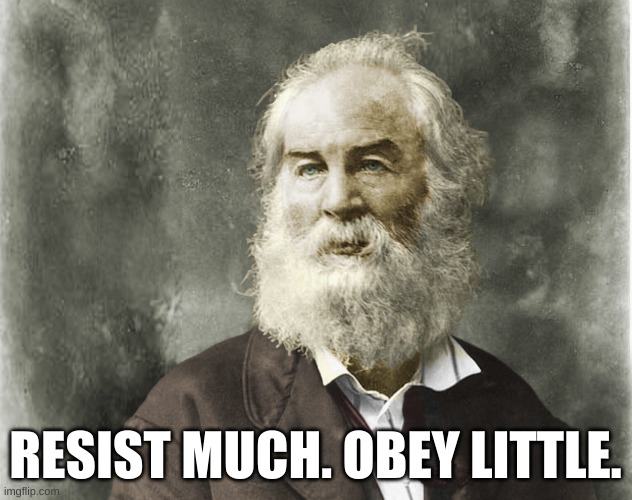
Whoever you are! Motion and reflection are especially for you,
The divine ship sails the divine sea for you.

Whoever you are! You are he or she for whom the earth is solid and liquid,
You are he or she for whom the sun and moon hang in the sky,
For none more than you are the present and the past,
For none more than you is immortality.

Each man to himself and each woman to herself, is the word of the past and present, and the true word of immortality;
No one can acquire for another—not one,
Not one can grow for another—not one.

The song is to the singer, and comes back most to him,
The teaching is to the teacher, and comes back most to him,
The murder is to the murderer, and comes back most to him,
The theft is to the thief, and comes back most to him,
The love is to the lover, and comes back most to him,
The gift is to the giver, and comes back most to him—it cannot fail,
The oration is to the orator, the acting is to the actor and actress not to the audience,
And no man understands any greatness or goodness but his own, or the indication of his own.

I swear the earth shall surely be complete to him or her who shall be complete,
The earth remains jagged and broken only to him or her who remains jagged and broken.

Walt Whitman

09 February 2025

Abnormal.

Doisneau, L'écolier puni, 1956


“Why aren't you in school? I see you every day wandering around."

"Oh, they don't miss me," she said. "I'm antisocial, they say. I don't mix. It's so strange. I'm very social indeed. It all depends on what you mean by social, doesn't it? Social to me means talking to you about things like this." She rattled some chestnuts that had fallen off the tree in the front yard. "Or talking about how strange the world is. Being with people is nice. But I don't think it's social to get a bunch of people together and then not let them talk, do you? An hour of TV class, an hour of basketball or baseball or running, another hour of transcription history or painting pictures, and more sports, but do you know, we never ask questions, or at least most don't; they just run the answers at you, bing, bing, bing, and us sitting there for four more hours of film-teacher. That's not social to me at all. It's a lot of funnels and lot of water poured down the spout and out the bottom, and them telling us it's wine when it's not. They run us so ragged by the end of the day we can't do anything but go to bed or head for a Fun Park to bully people around, break windowpanes in the Window Smasher place or wreck cars in the Car Wrecker place with the big steel ball. Or go out in the cars and race on the streets, trying to see how close you can get to lampposts, playing 'chicken' and 'knock hubcaps.' I guess I'm everything they say I am, all right. I haven't any friends. That's supposed to prove I'm abnormal. But everyone I know is either shouting or dancing around like wild or beating up one another. Do you notice how people hurt each other nowadays?”

Ray Bradbury, from Fahrenheit 451

21 September 2024

Understand.

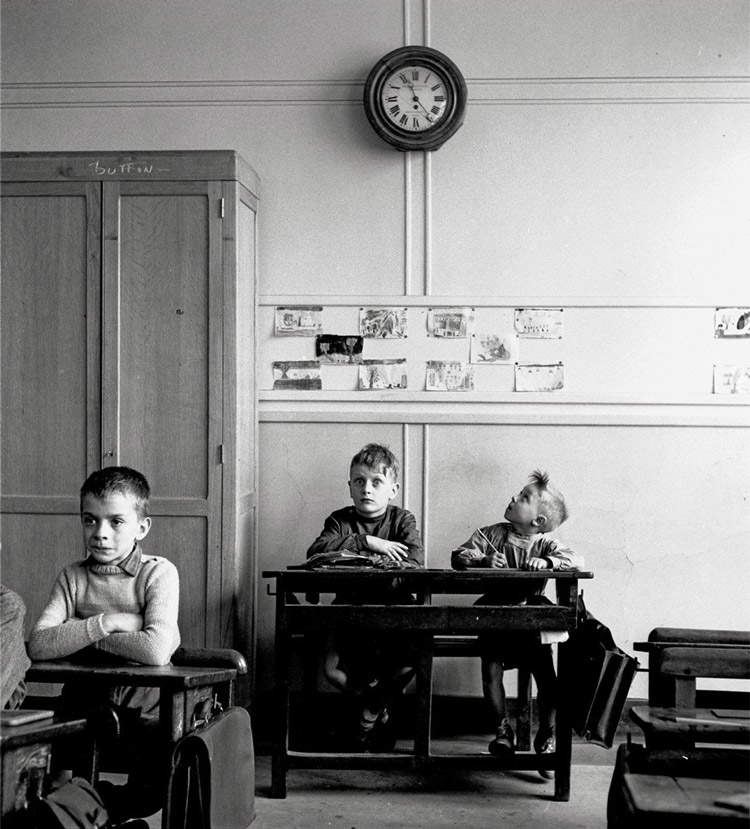
Doisneau, Le Cadran S(c)olaire, 1956


Fill in the blank ...
“By far the greatest danger of _________ is that people conclude too early that they understand it.”

03 September 2024

Merry.

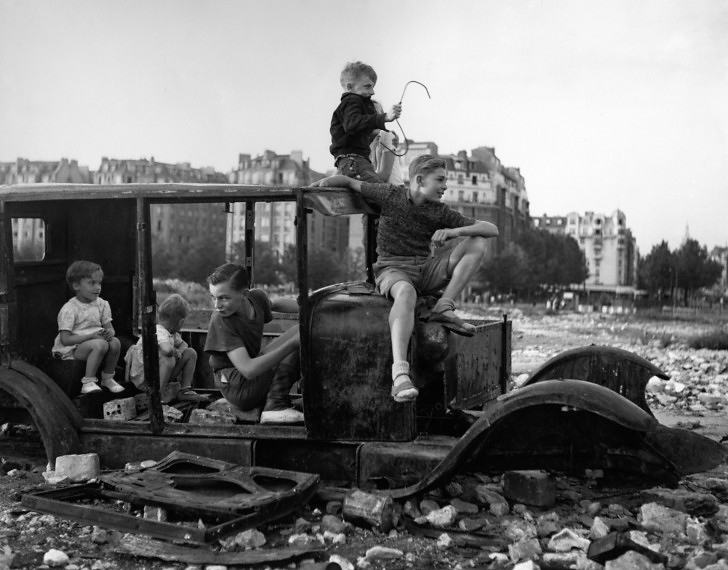
Disneau, The Melted Car, 1944


There is in the long run only one way in which we can taste this illustrious experience with safety. And Bunyan has indicated it in the same passage. It was in the House of the Interpreter, after they had been bathed, sealed and freshly clothed in "White Raiment" that the women saw one another in this light. If we remember the bathing, sealing and robing, we shall be safe. And the higher the common ground of the Friendship is, the more necessary the remembrance. In an explicitly religious Friendship, above all, to forget it would be fatal. 

For then it will seem to us that we we four or five have chosen one another, the insight of each finding the intrinsic beauty of the rest, like to like, a voluntary nobility; that we have ascended above the rest of mankind by our native powers. The other loves do not invite the same illusion. Affection obviously requires kinships or at least proximities which never depended on our own choice. And as for Eros, half the love songs and half the love poems in the world will tell you that the Beloved is your fate or destiny, no more your choice than a thunderbolt, for "it is not in our power to love or hate." Cupid's archery, genes anything but ourselves. But in Friendship, being free of all that, we think we have chosen our peers. In reality, a few years' difference in the dates of our births, a few  more miles between certain houses, the choice of one university instead of another, posting to different regiments, the accident of a topic being raised or not raised at a first meeting any of these chances might have kept us apart. But, for a Christian, there are, strictly speaking, no chances. A secret Master of the Ceremonies has been at work. Christ, who said to the disciples "Ye have not chosen me, but I have chosen you," can truly say to every group of Christian friends, "You have not chosen one another but I have chosen you for one another." The Friendship is not a reward for our discrimination and good taste in finding one another out. It is the instrument by which God reveals to each the beauties of all the others. They are no greater than the beauties of a thousand other men; by Friendship God opens our eyes to them. They are, like all beauties, derived from Him, and then, in a good Friendship, increased by Him through the Friendship itself, so that it is His instrument for creating as well as for revealing. At this feast it is He who has spread the board and it is He who has chosen the guests. It is He, we may dare to hope, who sometimes does, and always should, preside. Let us not reckon without our Host. 

Not that we must always partake of it solemnly. "God who made good laughter" forbid. It is one of the difficult and delightful subtleties of life that we must deeply acknowledge certain things to be serious and yet retain the power and win to treat them often as lightly as a game. But there will be a time for saying more about this in the next chapter. For the moment I will only quote Dunbar's beautifully balanced advice: 
Man, please thy Maker, and be merry, 
And give not for this world a cherry.
C.S. Lewis, from The Four Loves

24 August 2024

Wondrous.


Artificial intelligence is making kids doubt the authenticity of true beauty and the wondrous magic of reality.

Help kids see the difference.

01 October 2022

Touched.

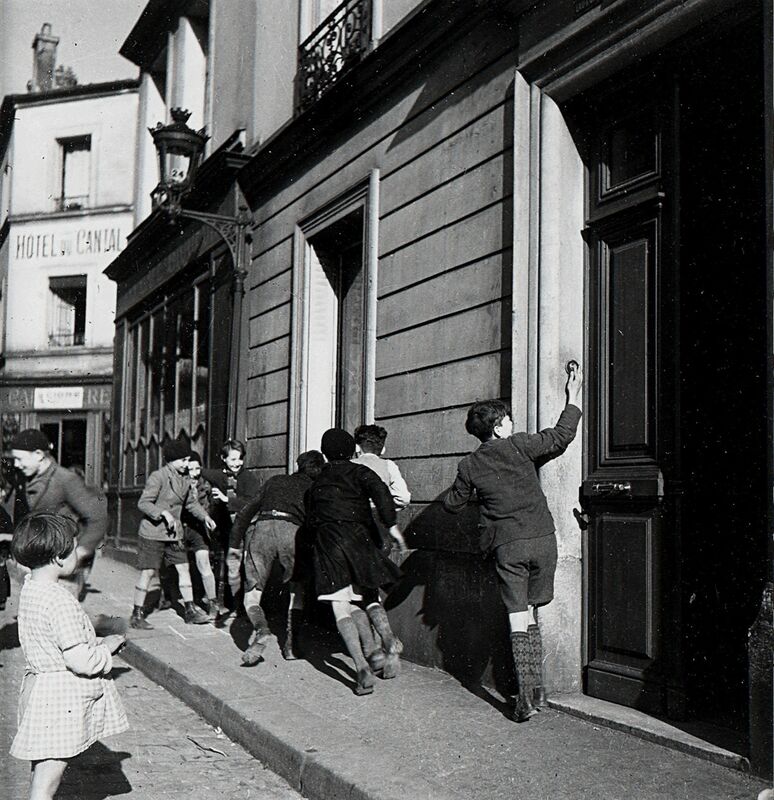
Doisneau, Le Sonnette, 1934


Learning to let go should be learned before learning to get. Life should be touched, not strangled. You’ve got to relax, let it happen at times, and at others move forward with it.

Ray Bradbury

22 August 2022

Wisdom.

Doisneau, The School Clock, Paris, 1956


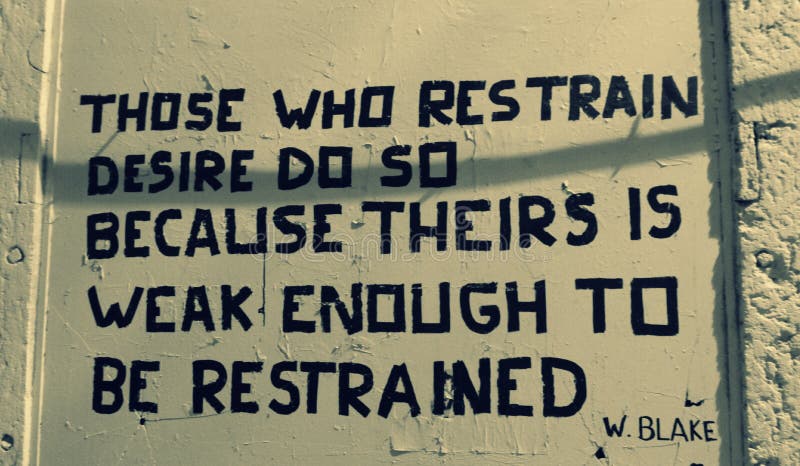
The hours of folly are measured by the clock; but of wisdom, no clock can measure. 

William Blake

School starts today.

02 August 2022

All.

Doisneau, Punished Child, 1956


Crooked trees stand alone, seeing and hearing all.

Umberto Limongiello

25 October 2021

Omnipresence.


He felt within him an endless inclination to stillness, to contemplation, to silence. He often stopped in the middle of a street, in the middle of a room to listen. Listen to what? Listen to everything. He felt like a light, stealthy, solitary hermit, who walks with invisible steps in the forest and who hangs to catch all the sounds, all the mysteries, all the accomplishments. He wanted to walk for years in cities and in forests, to be nowhere and to be everywhere. The dreamer has a divine taste for omnipresence.

Pierre Drieu La Rochelle

11 August 2021

Excellence.

Doisneau, Shy Kid with Glasses, 1956


I’ve come to believe that genius is an exceedingly common human quality, probably natural to most of us. I didn’t want to accept that notion — far from it: my own training in two elite universities taught me that intelligence and talent distributed themselves economically over a bell curve and that human destiny, because of those mathematical, seemingly irrefutable scientific facts, was as rigorously determined as John Calvin contended.

The trouble was that the unlikeliest kids kept demonstrating to me at random moments so many of the hallmarks of human excellence--insight, wisdom, justice, resourcefulness, courage, originality--that I became confused. They didn't do this often enough to make my teaching easy, but they did it often enough that I began to wonder, reluctantly, whether it was possible that being in school itself was what was dumbing them down. Was it possible I had been hired not to enlarge children's power, but to diminish it? That seemed crazy on the face of it, but slowly I began to realize that the bells and the confinement, the crazy sequences, the age-segregation, the lack of privacy, the constant surveillance, and all the rest of the national curriculum of schooling were designed exactly as if someone had set out to prevent children from learning how to think and act, to coax them into addiction and dependent behavior.

John Gatto, from Dumbing Us Down: The Hidden Curriculum of Compulsory Schooling

Crooked trees rule! -Ed.

14 July 2021

More.

Doisneau, Punished Kid, 1956


Next time what I'd do is look at
the earth before saying anything. I'd stop
just before going into a house
and be an emperor for a minute
and listen better to the wind
or to the air being still.

When anyone talked to me, whether
blame or praise or just passing time,
I'd watch the face, how the mouth
had to work, and see any strain, any
sign of what lifted the voice.

And for all, I'd know more - the earth
bracing itself and soaring, the air
finding every leaf and feather over
forest and water, and for every person
the body glowing inside the clothes
like a light.

William Stafford

30 December 2020

Through.

Doisneau, Punished Pupil, 1956


The CONUNDRUM of the WORKSHOPS

When the flush of a new-born sun fell first on Eden's green and gold,
Our father Adam sat under the Tree and scratched with a stick in the mould;
And the first rude sketch that the world had seen was joy to his mighty heart,
Till the Devil whispered behind the leaves, "It's pretty, but is it Art ?"

Wherefore he called to his wife, and fled to fashion his work anew -
The first of his race who cared a fig for the first, most dread review;
And he left his lore to the use of his sons -- and that was a glorious gain
When the Devil chuckled "Is it Art ?" in the ear of the branded Cain.

They fought and they talked in the North and the South, they talked and
they fought in the West,
Till the waters rose on the pitiful land, and the poor Red Clay had rest -
Had rest till that dank blank-canvas dawn when the dove was preened to start,
And the Devil bubbled below the keel: "It's human, but is it Art ?"

They builded a tower to shiver the sky and wrench the stars apart,
Till the Devil grunted behind the bricks: "It's striking, but is it Art ?"
The stone was dropped at the quarry-side and the idle derrick swung,
While each man talked of the aims of Art, and each in an alien tongue.

The tale is as old as the Eden Tree - and new as the new-cut tooth -
For each man knows ere his lip-thatch grows he is master of Art and Truth;
And each man hears as the twilight nears, to the beat of his dying heart,
The Devil drum on the darkened pane: "You did it, but was it Art ?"

We have learned to whittle the Eden Tree to the shape of a surplice-peg,
We have learned to bottle our parents twain in the yolk of an addled egg,
We know that the tail must wag the dog, for the horse is drawn by the cart;
But the Devil whoops, as he whooped of old: "It's clever, but is it Art ?"

When the flicker of London sun falls faint on the Club-room's green and gold,
The sons of Adam sit them down and scratch with their pens in the mould -
They scratch with their pens in the mould of their graves, and the ink and the anguish start,
For the Devil mutters behind the leaves: "It's pretty, but is it Art ?"

Now, if we could win to the Eden Tree where the Four Great Rivers flow,
And the Wreath of Eve is red on the turf as she left it long ago,
And if we could come when the sentry slept and softly scurry through,
By the favour of God we might know as much - as our father Adam knew!

Rudyard Kipling

27 April 2020

Responsible.

Doisneau, Handstands, 1939


You become responsible, forever, for what you have tamed.

Antoine de Saint-Exupéry, from The Little Prince

27 February 2020

Rather.

Doisneau, Punished Child Lying on Bench, 1956


“Ah" said Dumbledore gently, "Yes, I thought we might hit that little snag!"

"Snag?" said Fudge, his voice still vibrating with joy. "I see no snag, Dumbledore!"

"Well," said Dumbledore apologetically, "I'm afraid I do."

"Oh, really?"

"Well it's just that you seem to be labouring under the delusion that I am going to -- come quietly. I am afraid I am not going to come quietly at all, Cornelius. I have absolutely no intention of being sent to Azkaban. I could break out, of course -- but what a waste of time, and frankly, I can think of a whole host of things I would rather be doing.”

J.K. Rowling, The Order of The Phoenix

11 July 2019

Seeker.


The reactionary is not a nostalgic dreamer of a canceled past, but rather a seeker of sacred shades upon eternal hills.

Nicolás Gómez Dávila  

10 May 2018

Inspiration.

Doisneau, The Old District of Lille, 1951
“Genius,” Baudelaire observes, “is none other than childhood formulated with precision.” I believe that the great French décadent, who was writing here about the equally decadent English essayist Thomas De Quincey, author of Confessions of an English Opium-Eater, intended the word “genius” to be understood in this context as the “daimon,” which the ancient Greeks believed is in every man: his character, indeed his essence. If Baudelaire is correct, then in a sense childhood never ends, but exists in us not merely as a memory or complex of memories, but as an essential part of what we intrinsically are. Every artist knows the truth of this since, for the artist, childhood and the childhood conception of things is a deep source of what used to be called inspiration, if for no other reason than that it was as children that we first apprehended the world as mystery. The process of growing up is, sadly, a process of turning the mysterious into the mundane. We cease to be amazed by things— the sky, the turning of the seasons, love, other people — only because we have grown accustomed to them.

John Banville

21 September 2017

Different.

Doisneau, Punished Pupil Waiting, 1956


It is not that I am mad, it is only that my head is different from yours.

Diogenes

15 February 2017

Will.

Doisneau, The Clock, 1956


Of all tyrannies, a tyranny sincerely exercised for the "good" of its victims may be the most oppressive. This very kindness stings with intolerable insult. To be "cured" against one's will and cured of states which we may not regard as disease is to be put on a level of those who have not yet reached the age of reason or those who never will; to be classed with infants, imbeciles, and domestic animals.

C.S. Lewis

23 June 2016

Drunk.

Doisneau, The Genius of the Bastille, Paris, 1955


THE BEAUTIFUL NIGHT

What chant has taken off this night 
that interwaves
of crystalline echo of the heart
the stars

What spring feast
of wedding heart

I was
a watertight of darkness

Now I bite
like a baby the breast
the space

Now I am drunk
with universe.

Giuseppe Ungaretti